Science Arts & Métiers (SAM)
is an open access repository that collects the work of Arts et Métiers Institute of
Technology researchers and makes it freely available over the web where possible.
This is an author-deposited version published in: https://sam.ensam.eu Handle ID: .http://hdl.handle.net/10985/9095
To cite this version :
Zakaria ALLAM, Eric BECKER, Cyrille BAUDOUIN, Régis BIGOT, Pierre KRUMPIPE - Forging process control: Influence of key parameters variation on product specifications deviations - In: 11th International Conference on Technology of Plasticity, ICTP 2014, Japan, 2014-10 - Procedia Engineering - 2014
Any correspondence concerning this service should be sent to the repository Administrator : [email protected]
11th International Conference on Technology of Plasticity, ICTP 2014, 19-24 October 2014,
Nagoya Congress Center, Nagoya, Japan
Forging process control: Influence of key parameters variation on
product specifications deviations
Zakaria Allam
a, Eric Becker
a,*, Cyrille Baudouin
a, Regis Bigot
a, Pierre Krumpipe
baLCFC, Laboratoire de Conception Fabrication et Commande (EA 4495), Arts et Métiers Paristech, Ecole Nationale Supérieure d'Arts et
Métiers, 4, rue Augustin Fresnel ; Metz Technopole ; 57078 Metz Cedex 3
bCETIM, Centre Technique des Industries Mécanique, 7, rue de la Presse - BP 802, 42952 Saint-Étienne Cedex 9
Abstract
Process control in forging industry is essential to ensure a better quality of the product with a lower cost at the end of the manufacturing process. To control the process, a number of key parameters must be monitored to prevent product or forging plan deviations. This paper will illustrate how a variation in a process parameter can create product specifications deviations and how key parameters influence product final state.
The illustration work is done on a part obtained via hot forging. An analysis is made on product parameters such as geometry, by varying the key process parameter values previously determined from a created methodology. This later is represented as a decision support system that connects product specifications (geometry, absence of defects…) or other forging specifications (tool wear, involved energy...) to the process parameters.
1. Introduction
Nowadays, process control has become indispensable for industrial. To control process and improve product quality, several methodology can be used; Six sigma, experimental design, SPC, etc. The problem in forging processes is the difficulty to access directly to product parameter during manufacturing and the absence of linear relation between process parameters and product parameter (Kopp 1998). The understanding of physical
A =
phenomenon in forging is mandatory, our work start from a simple hypothesis: There is a relation between means of production, process parameter to control and product specifications. Many studies have been conducted in the field of forging. For example, Belur and Ramana (2004) have worked on wheel geometry deviation in forging.
Sahoo and Tiwari (2008) have determined the responsible parameter of some defects in radial forging. He and Yu (2008) determined the responsible parameters of microstructure deviation in hot forging. Another method consists
on controlling the key process parameters that are determined via a methodology described in our precedent work
(Allam 2013). A Decision Support System (DSS), which inputs are product and forging plan specifications, is used
in the upstream of the forging plan. Key parameters are monitored to avoid a product variable deviation.
Two processes with the same mean of production are compared; direct extrusion and hot forging of a wheel. Key parameters influences in each case are analysed. The most important parameters are identified and influences of lubrication and temperature variation on geometric deviation are analysed.
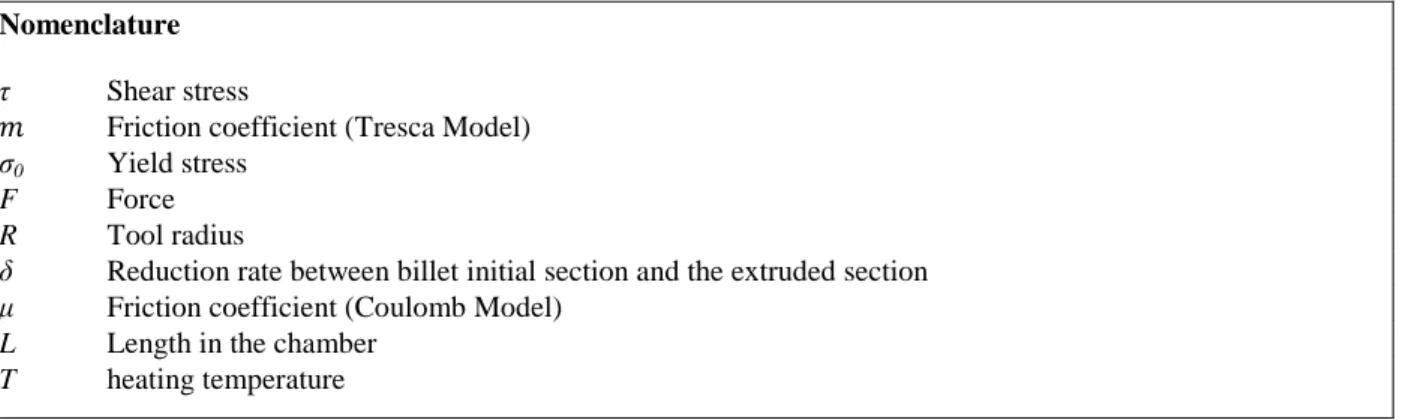
Nomenclature
τ Shear stress
Friction coefficient (Tresca Model)
σ0 Yield stress
F Force
R Tool radius
δ Reduction rate between billet initial section and the extruded section
μ Friction coefficient (Coulomb Model)
L Length in the chamber
T heating temperature
2. Product variable deviation in hot forging 2.1. Experimental procedure
The process is composed of three sub-processes; the first step consists on cutting a billet of 40mm, the second step is heating with different temperatures between 900°C and 1100°C and the final step is forging in one step with different lubrication. Experimental material is composed of a circular saw, a resistance furnace and a hydraulic press. The forged workpiece is represented in Fig.1. To respect industrial constrains, thickness A (Fig.1) have to be less than 10.5mm. The observed parameter in the experimental design is the workpiece thickness A (Fig.1). Key parameters determined by the DSS are billet temperature, billet length and lubrication (friction). The two first parameters are easy to control, but the friction coefficient linked to each of the lubrications is not simple to determine. An experimental design has been applied with these three parameters, using three levels.
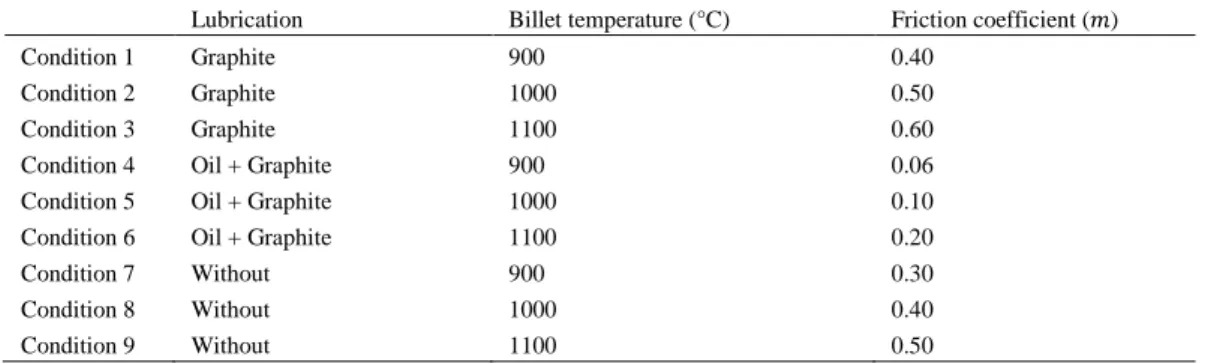
To analyze influence of friction on thickness variation, friction coefficient must be determined before experimental design application. To determine the friction coefficient linked to each lubrication level, a ring test has been used (Male and Cocroft 1964). The test is used with the same mean of production and tool material used in hot forging. Friction coefficient depends on lubrication, but also on billet temperature. Table.1 synthetize the friction coefficient linked to lubrication type and temperature.
3
0
m (1)Table 1. Friction coefficient linked to each lubrication and temperature.
Lubrication Billet temperature (°C) Friction coefficient ( )
Condition 1 Graphite 900 0.40
Condition 2 Graphite 1000 0.50
Condition 3 Graphite 1100 0.60
Condition 4 Oil + Graphite 900 0.06
Condition 5 Oil + Graphite 1000 0.10
Condition 6 Oil + Graphite 1100 0.20
Condition 7 Without 900 0.30
Condition 8 Without 1000 0.40
Condition 9 Without 1100 0.50
2.2. Results
If hydraulic press is used with holds, thickness doesn’t vary but a tool wear is observed. If work isn’t done on holds, thickness will vary and variation will depends on key parameters. To evaluate the influence of each of the key parameter, correlation coefficient has been calculated. The correlation coefficient determinates a statistical relationship according to dependence. Temperature correlation coefficient is equal to 55%. It’s higher than the one linked to friction, which is 20%. It proves that friction doesn’t have a big influence on thickness comparing to temperature, but friction variation can affect other parameter, for example the tool wear. Fig.2 represents thickness variation according to lubricant type and temperature.
Fig. 2. Parameter A variation according to temperature and friction
Table.1 shows that friction coefficient increases when temperature grows, this is due to the fact that billet surface sticks more to the chamber when temperature increases. Monte Carlo simulations have been conducted to evaluate the influence of process parameters variation in an interval. The method used by the JCGM (2008) in the uncertainties propagation is used. It consists on using a model which describes thickness variation. The model varies according to key parameters. The entries of the Monte Carlo simulations are:
Key parameter variation interval
Number of Monte Carlo trials Entries Probability density
Calculations shows that thickness have a probability of 98% to be less than 10.5mm if the temperature is not monitored and varies between 950°C and 1050°C. This proves that key parameters must be monitored, especially temperature if a thickness less than 10.5 want to be avoided.
3. Product variable deviation in extrusion 3.1. Experimental procedure
Experimental material used is like the one used in hot forging, it’s composed of a resistance furnace, a circular saw and a hydraulic press. The obtained workpiece is represented in Fig.3, it’s obtained via direct extrusion. The first step consists on cutting a billet of 86mm, the second step is heating with a temperature of 1000°C, and the final step is extrusion. The observed parameter in workpiece is the length B (Fig.3), it’s due to a gap between the chamber and the ram; it creates an indirect filling of the material. Length B describes material flow, in fact the more the length B is high (>6mm) the less the material will flow in the die.
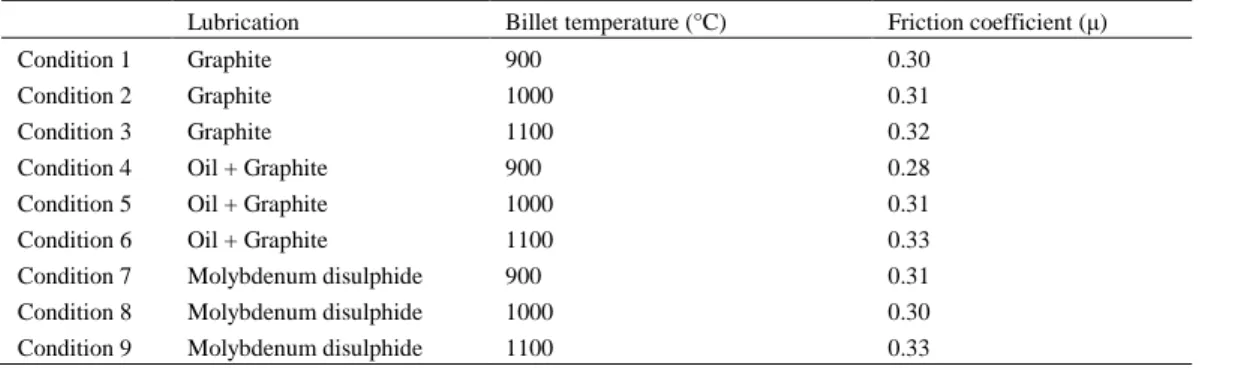
Key parameters determined by the DSS are billet temperature, billet length and lubrication (friction). Material flow in extrusion is different from the one in hot forging; hence friction is not determined via a ring test. Effort acquisition helps in friction determination using the formula (2) explained by (Sejournet 1993). Yield stress is estimated using Spittle modeling (equation (2)). Yield stress depends on temperature, strain and strain rate. The first step is to determine the friction coefficient linked to each lubrication level. To do this, effort has been measured in each experience. Friction coefficient depends on lubrication, billet temperature and billet length. Table.2 shows friction coefficient variation according to lubrication type and billet temperature for one length.
) 2 exp( ) ln( ² 0 R L R F (2) 4 3 2 1 . 0 m m m T m e Ae (3)
Table 2. Friction coefficient linked to each lubrication and temperature.
Lubrication Billet temperature (°C) Friction coefficient (μ)
Condition 1 Graphite 900 0.30
Condition 2 Graphite 1000 0.31
Condition 3 Graphite 1100 0.32
Condition 4 Oil + Graphite 900 0.28
Condition 5 Oil + Graphite 1000 0.31
Condition 6 Oil + Graphite 1100 0.33
Condition 7 Molybdenum disulphide 900 0.31
Condition 8 Molybdenum disulphide 1000 0.30 Condition 9 Molybdenum disulphide 1100 0.33
Fig. 3. Workpiece obtained via direct extrusion and the used mean 3.2. Results
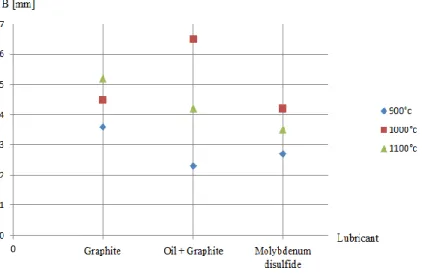
In the case of direct extrusion, the same steps followed in the first case study have been followed in direct extrusion. Correlation coefficient calculation gives a friction coefficient correlation of 64%, it proofs that friction has more influence comparing to temperature, since temperature correlation coefficient is 35%. Fig.4 represents parameter B variation according to lubricant type and temperature. Like in hot forging, friction coefficient increase when temperature grows. Temperature can affect other parameters in direct extrusion, but geometry variations depends more on friction.
Monte Carlo simulations, like in hot forging, have been conducted to evaluate the influence of process parameters variation in an interval. By using the same methodology used in hot forging, calculation have been conducted to estimate the length B. Calculations shows that the parameter B have a probability of 9% to be more than 6mm if lubrication is not monitored ; friction coefficient vary between 0.29 and 0.32. It proves that friction variation won’t create a problem; we’ll have 91% of probabilities to get a length less than 6mm. This will help in having more material filling in the die.
Fig. 4. Parameter B variation according to temperature and friction 4. Conclusion
In hot forging, the wheel was used to illustrate the influence of some process parameters on geometric variations. Experimental design shows that temperature has more influence compared to lubrication. The control of these key parameters is mandatory to avoid product deviation. In the case of a hydraulic press, temperature
B Ram
Workpiece
Chamber
variation gives a geometric deviation if holds aren’t used. If holds are used, temperature variation gives a tool wear. It comes from the fact that temperature variation leads to a variation in the required effort. Indeed, a variation of 50°C in temperature can lead to a deviation of 2mm in workpiece thickness. Ring test shows that friction depends on temperature and lubricant type. In hot forging, the higher the temperature is, the higher the friction coefficient will be. It proofs that temperature increase gives a friction increase.
In direct extrusion, experimental design shows that friction is the most influential parameter on product geometry. Temperature doesn’t have a big influence on geometry. A variation of 0.03 in friction coefficient can lead to a deviation of 5mm in the parameter B. Monte Carlo simulations can be a good indicator to parameter control pertinence, actually it show that product parameter variation probability depends on process parameter variation interval.
The first hypothesis has been confirmed, there is a relation between means of production and the process parameter to control. Key parameter can be pointed out according to the mean of production but influence and importance of each parameter will vary according to the used process. The two experimental studies show that the influence of each key parameter varies according to the used process; in wheel hot forging, temperature is a very important parameter compared to the others and in direct extrusion friction is more influent than temperature.
References
Allam Z., Becker E., Baudouin C., Bigot R., Krumpipe P., 2013. A generic methodology to improve the control of forging process parameters, Key Engineering Materials, (554-557), 2138-2144.
Belur B.K., Ramana V.G., 2004. Geometric deviations in forging and cooling operations due to process uncertainties, Journal of Materials Processing Technology., (152), 204-214.
He X., Yu Z., Lai X., 2008. Robust parameters control methodology of microstructure for heavy forgings based on taguchi method, Journal of Materials and Design, (30), 2084-2089.
Jacques Sejournet, 1993, Filage de l'acier et des métaux difficiles à déformer, Technique de l’ingénieur, M640, 9.
Joint Committee for Guides in Metrology, JCGM guidance 101:2008, Evaluation of measurement data — Supplement 1 to the “Guide to the expression of uncertainty in measurement” - Propagation of distributions using a Monte Carlo method, 2008.
Lee Y.H., Kopp R., 1998. Application of fuzzy control for a hydraulic forging machine, Fuzzy Sets and Systems, (118), 99-108.
Male A.T., Cocroft M.G., A method for the determination of the coeficient of friction of metals under condition of bulk plastic deformation, J.Inst. Metals 1964-1965, 93, pp. 38-46.
Sahoo A.K., Tiwari M.K., Mileham A.R., 2008. Six sigma based approach to optimize radial forging operation variables, Journal of Materials Processing Technology, (202), 125-136.