HAL Id: hal-00000078
https://hal.archives-ouvertes.fr/hal-00000078v3
Submitted on 11 Mar 2003
HAL is a multi-disciplinary open access
archive for the deposit and dissemination of
sci-entific research documents, whether they are
pub-lished or not. The documents may come from
teaching and research institutions in France or
abroad, or from public or private research centers.
L’archive ouverte pluridisciplinaire HAL, est
destinée au dépôt et à la diffusion de documents
scientifiques de niveau recherche, publiés ou non,
émanant des établissements d’enseignement et de
recherche français ou étrangers, des laboratoires
publics ou privés.
Diffraction phases in atom interferometers
Caroline Champenois, Matthias Büchner, Rémi Delhuille, Alain Miffre, Cécile
Robilliard, Jacques Vigué
To cite this version:
Caroline Champenois, Matthias Büchner, Rémi Delhuille, Alain Miffre, Cécile Robilliard, et al..
Diffraction phases in atom interferometers. Physical Review A, American Physical Society, 2003,
68, pp.013607. �10.1103/PhysRevA.68.013607�. �hal-00000078v3�
ccsd-00000078 (version 3) : 11 Mar 2003
M. B¨uchner, R. Delhuille, A. Miffre, C. Robilliard, J. Vigu´e (a) and C. Champenois (b)
(a) Laboratoire Collisions Agr´egats R´eactivit´e -IRSAMC Universit´e Paul Sabatier and CNRS UMR 5589, 118,
Route de Narbonne 31062 Toulouse Cedex, France (b) PIIM, Universit´e de Provence and CNRS UMR 6633,
Centre de saint J´erˆome case C21, 13397 Marseille cedex 20, France. e-mail: [email protected]
Diffraction of atoms by laser is a very important tool for matter wave optics. Although this process is well understood, the phase shifts induced by this diffraction process are not well known. In this paper, we make analytic calculations of these phase shifts in some simple cases and we use these results to model the contrast interferometer recently built by the group of D. Pritchard at MIT. We thus show that the values of the diffraction phases are large and that they probably contribute to the phase noise observed in this experiment.
PACS numbers: 03.75.Dg, 39.20.+q, 32.80.Pj, 42.50.Vk
I. INTRODUCTION
In atom interferometry, laser diffraction is a very pow-erful and versatile tool (for overviews, see references [1, 2]). The diffraction of matter waves by a standing light wave was proposed by P. Kapitza and P.A.M. Dirac [3] in the case of electrons and generalized to atoms by S. Altshuler et al. [4]. Atom diffraction by light has been studied theoretically [5, 6] and experimentally [7, 8] and these early works have been followed by many studies too numerous to be quoted here. The phases of the diffrac-tion amplitudes are rarely discussed in detail, with a few exceptions like the works of S. Chu and coworkers [9] and of K. Burnett and coworkers [10], in both cases for Raman adiabatic transfer, and the work of C. Bord´e and cowork-ers [11, 12], which analyzes the general diffraction pro-cess in the rotating wave approximation. Unfortunately, this approximation cannot be used for elastic diffraction studied here.
In an interferometer, the diffraction phases modify the interference signals but this effect is difficult to detect, as it requires accurate phase measurements and it can-cels in symmetric interferometers, like the Mach-Zehnder interferometer. The goal of this paper is to present an analytic calculation of diffraction phases in a simple case (elastic diffraction by a laser standing wave) and to show the importance of these diffraction phases in an existing experiment. We consider here diffraction in the Raman-Nath regime and second order Bragg diffraction in the weak field regime and we apply these results to the con-trast interferometer built by the group of D. Pritchard [13]. The calculated diffraction phases are large in this interferometer and as these phases depend rapidly on the laser power density used for the diffraction process, our calculation may explain the observed phase noise as re-sulting from fluctuations of this power density.
II. THE PROBLEM
We consider diffraction of slow ground state atoms by a near-resonant laser standing wave of frequency ωL. For
a sufficiently large laser detuning δ = ωL− ω0, where ω0
is the resonance transition frequency, the probability of real excitation is negligible and the diffraction process is coherent. In the dressed-atom picture [14], the laser standing wave creates a light shift potential V (x, t) :
V (x, t) = V0(t) cos2(kLx)
= V0(t)
4 [2 + exp(+2ikLx) + exp(−2ikLx)](1) where the envelope V0(t) is proportional to the laser
power density divided by the frequency detuning δ and kL is the laser wavevector. We are going to forget the
x-independent term, which simply shifts the energy zero and therefore has no effect, as long as all atoms see the same potential. The motion along the y and z directions is free and will not be discussed. The natural energy unit is the atom recoil energy ¯hωrec= ¯h2k2L/2m and we
will measure the potential with this unit, by defining q(t) [15, 16] :
q(t) = V0(t)/(4¯hωrec) (2)
Using a dimensionless time τ defined by τ = ωrect, a
dimensionless spatial coordinate, X = kLx and a
dimen-sionless wavevector κ = kx/kL, the 1D Schr¨odinger
equa-tion becomes :
i∂Ψ ∂τ = −
∂2Ψ
∂X2 + q(τ ) [exp(2iX) + exp(−2iX)] Ψ (3)
For a constant value of the potential q, the atom eigen-states are Bloch eigen-states [15, 16, 17]. Writing the Hamil-tonian matrix corresponding to equation (3) in the basis |κi of plane waves of momentum ¯hκ and using numerical
2
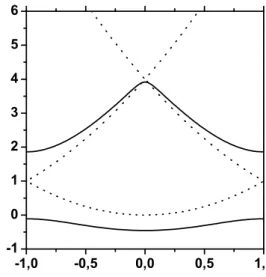
diagonalization, we get the band structure ε(κ, p), with the pseudo-momentum κ belonging to the first Brillouin zone ( −1 < κ ≤ 1) and the integer p labeling the bands [16]. Figure 1 presents the energy of the lowest Bloch states as a function of κ for two values of the potential, q = 0 and q = 1, with two important features : when q is not equal to zero, band gaps appear at each crossing of the q = 0 folded parabola and energy shifts appear at the same time. These energy shifts are explained by perturbation theory : each free plane wave |κi is coupled to two other states, |κ ± 2i and the two coupling terms are equal. As the energy denominator is larger for the coupling to the upper state, all the levels are pushed up-wards (except near the places where gaps open), but the lowest Bloch state is obviously pushed downwards.
FIG. 1: Plots of the energies ε of the lowest Bloch states versus the pseudomomentum κ : solid line q = 1; dashed line q= 0.
III. DIFFRACTION PHASES
In order to simplify the calculations, we consider that the atom is initially in a state of zero momentum, |ψ(τ = 0)i = |0i. We first consider diffraction in the Raman-Nath regime. This approximation consists in ne-glecting the dynamics of the atom during the diffraction process produced by a pulse q(τ ) of duration τRN. This
approximation is good if the potential q(τ ) is intense, q À 1, and if the pulse is brief, τRN ¿ 1. The validity
range of this approximation is given by [15, 16] :
τRN < 1/(4√q) (4)
and the diffracted wave is a classic result : |ψ(τRN)i =
X
p
(−i)|p|J|p|(γ) |2pi (5)
with γ = 2qτRN. We have verified [16] that the
Raman-Nath formula predicts accurately the diffraction proba-bility of order 0 and 1, for finite values of the parameter
q, as long as condition (4) is verified, but we have not tested the phases of these diffraction amplitudes. They could be tested by using the diffraction amplitudes cal-culated [18] as a power series of 1/q.
Second order Bragg diffraction is due to the indirect coupling of the |±2i free states, through the |0i state. As this coupling is a second order term in q, to make a con-sistent treatment, we must consider the 5 lowest energy states, with κ = 0, ±2, ±4. The Hamiltonian matrix has the following non-vanishing elements h2p|H|2pi = 4p2
and h2p|H|2(p ± 1)i = q. Up to second order in q, the energy correction of the |0 > state is E0= −q2/2 and the
effective Hamiltonian coupling the states |−2i and |+2i is: Hef f = · 4 + (q2/6) (q2/4) (q2/4) 4 + (q2/6) ¸ (6)
We have tested the quality of this expansion limited to the q2terms, by numerical diagonalization of the
Hamil-tonian matrix. The neglected terms (in q4, etc.) are of
the order of 1% (10%) of the q2 terms if q = 0.3 (q = 1
respectively), thus giving an idea of the validity range of this calculation.
The dynamics is adiabatic if the potential q(τ ) varies slowly, but diffraction remains possible when two free states are degenerate, as the |±2i states. The problem is equivalent to a Rabi oscillation exactly at resonance, for which an exact solution is available for any function q(τ ). For a pulse extending from τ1to τ2, the Rabi phase
ϕr at the end of the pulse is given by :
ϕr=
Z τ2
τ1
(q2/2)dτ (7)
and if |ψ(τ1)i = |±2i, the final state is :
|ψ(τ2)i = e[−i(4(τ2−τ1)+(ϕr/3))]
× hcos³ϕr 2
´
|±2i − i sin³ϕ2r´|∓2ii (8) where the phase shift of the | ± 2 > states due to theirmean energy shift has been expressed as a fraction of the Rabi phase. When |ψ(τ1)i = |0i, the final state
is the |0i state with an extra phase shift, also due to its energy shift:
|ψ(τ2)i = eiϕr
|0i (9)
From now on, we consider a ϕr = π pulse. If the
wave-function at time τ1 is given by :
|ψ(τ1)i =
X
p=−2,0,+2
ap(τ1) |pi (10)
the wavefunction at time τ2 is given by :
|ψ(τ2)i = eiπa0(τ1) |0i + e[−4i(τ2−τ1)−(5iπ/6)]
The phase factor exp [−4i(τ2− τ1)] is due to the free
propagation of the | ± 2 > states and is not linked to the diffraction process. The interesting results are the diffraction phases equal to (+π) for the |0i state and (−5π/6) for the |±2i states. The opposite signs of the diffraction phases are a consequence of the opposite signs of the energy shifts of these levels. In the resulting phase difference, the level shift contribution, equal to 4π/3, is proportional to the Rabi phase ϕr, taken equal to π. In
an experiment, this phase difference may differ from this calculated value, as a result of an imperfect π pulse or of other effects neglected here (e. g. : κ 6= 0).
IV. SIMPLE MODEL OF THE CONTRAST INTERFEROMETER OF S. GUPTA ET AL
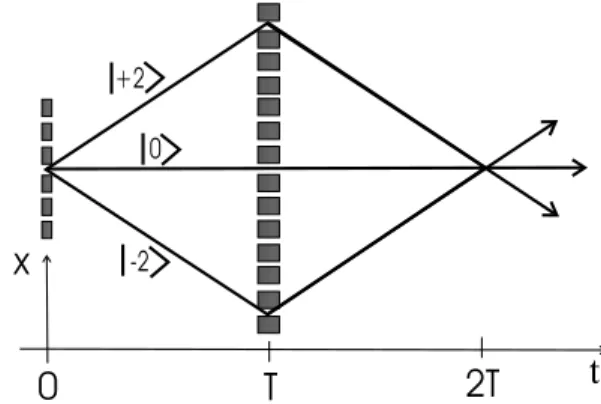
We now calculate the output signal of the contrast in-terferometer developed by S. Gupta et al. [13]. This interferometer uses second order Bragg diffraction and Raman-Nath diffraction and the atomic paths are repre-sented in figure 2. The initial state is a Bose Einstein condensate, approximated here by a |κ = 0i state. A first intense and brief pulse from τ = 0 till τRN is used
to diffract this initial state in three coherent states, |0i, |±2i. Within the Raman-Nath approximation, the wave-function for τRN is given by :
|ψ(τRN)i = J0|0i − iJ1[|+2i + |−2i] (12)
the argument γ of Bessel functions being omitted for compactness. The best contrast [13] would be obtained with diffraction probabilities equal to 50% for the |0i state and 25% for each of the |±2i states. It is im-possible to fulfill perfectly these two conditions simul-taneously as the first one implies γ = 1.13 whereas the second one implies γ = 1.21. We can nevertheless sup-pose that γ ≈ 1.17. Although J2(1.17) ≈ 0.15, we will
neglect here the second order diffraction amplitudes, as done in reference [13]. We assume that τRN is negligible
so that free propagation starts at τ = 0 and lasts till the Bragg diffraction pulse which extends from τ1 to τ2.
Using equation (11), we get the wavefunction after this pulse :
|ψ(τ2)i = J0eiπ|0i
+ J1e−4iτ2e−4iπ/3[|+2i + |−2i] (13)
Free propagation goes on till a time τ where the matter grating formed by the interference of these three states is read by the reflection of a laser beam. The atomic density as a function of X and τ is deduced from the wavefunction : | hX|ψ(τ)i |2 = J02+ 2J12(1 + cos(4X)) + 4J0J1 × cos(2X) cos µ 4τ +7π 3 ¶ (14)
The experimental signal S(τ ) is the intensity of the light reflected by this grating. This homodyne detection sig-nal is proportiosig-nal to the square of the cos(2X) mod-ulation of the atomic density, with the following time-dependence: S(τ ) ∝ cos2 µ 4τ +7π 3 ¶ (15)
while the equation used by Gupta et al. is :
S(τ ) ∝ sin2(4τ ) (16) The difference between equation (15) and (16) will be im-portant only if one wants to make an absolute prediction of the phase, but it has no consequence in the analysis carried by S. Gupta et al. [13], because their fitted value of ωrec comes from the derivative of the phase with the
time interval T [19]. However, our result remains inter-esting as it may explain a large part of the observed phase noise, 200 mrad from shot to shot. In the 7π/3 phase of equation (15), 4π/3 are proportional to the Rabi phase, which is itself proportionnal to q2 i.e. to the square of
the laser power density during the Bragg pulse. There-fore, a 1% variation of the laser power density changes the diffraction phase by 84 mrad.
FIG. 2: In the x, t plane, we have represented the atomic paths followed by the wavepackets in the interferometer of Gupta et al. [13] : Raman-Nath diffraction at time t = 0, second order Bragg diffraction at time t = T , detection near time t = 2T .
Our calculation relies on several approximations, some of them being not very accurate in the experimental con-ditions of S. Gupta et al. [13]:
i) the κ = 0 approximation is an oversimplification but the calculation with κ 6= 0 is more complex.
ii) the first diffraction pulse used in the experiment is 1 µs long, corresponding to τRN = 0.157.
Assum-ing γ ≈ 1.17, we get q ≈ 3.7 and the validity condition (4) requires τ ≤ 0.13. Therefore, the corrections to the Raman-Nath phases are not fully negligible. We have also neglected the second order diffraction beams, which contribute to the signal.
iii) as for the perturbation expansion used to describe Bragg diffraction, the π-pulse used is Gaussian with a
4
width of 7.6µs [13]. Assuming that q = qmaxexp[−(t −
T )2/(2σ2
t)], with σt = 3.8µs, i.e. στ ≈ 0.6, we get the
value qmax ≈ 2.4, well outside the validity range of our
second order perturbation expansion. Higher order terms in qn with n = 4, 6, .. contribute to the phases and the
sensitivity of the diffraction phase to the laser power den-sity may even be larger than predicted above.
Obviously, to describe very accurately this experiment, a full numerical modelization is needed and feasible, as the problem reduces to a 1D Schr¨odinger equation, if atom-atom interactions are neglected. But, as noted by Gupta et al., the mean field effect of the condensate can also modify atomic propagation and this effect has not been not considered here.
V. CONCLUSION
In this paper, we have made a simple and tutorial cal-culation of the phase shifts of atomic waves due to elastic diffraction process by a laser standing wave. We have cal-culated the associated phase shift for the contrast inter-ferometer of D. Pritchard et al. [13], thus showing that it should be possible to make an experimental test of the dependence of the diffraction phase shifts with potential strength and interaction time. The present calculations are simple because of our assumptions : Raman-Nath limit or perturbative regime, vanishing initial momentum κ = 0. An accurate modelization of a real experiment re-quires numerical integration of Schr¨odinger equation to describe the diffraction dynamics without any approxi-mation.
We have considered only first and second order diffrac-tion. Higher diffraction orders up to order 8, have been observed [20, 21, 22] with moderate laser power densities. The leading term of the coupling matrix element respon-sible for diffraction order n behaves like qn [20] whereas
the leading terms of the energy shifts, responsible for the diffraction phase shifts, are always in q2. Therefore, for
diffraction orders n > 2, the control of the phase shifts will require a full knowledge of the pulse shape. For the second order of diffraction, the diffraction phase shifts and the Rabi phase are simply related, as long as second order perturbation theory is a good approximation.
We have made a systematic use of atomic Bloch states to describe atom diffraction by laser, following our pre-vious paper [16]. The introduction of Bloch states to de-scribe atoms in a laser standing waves is due to Letokhov and Minogin [23, 24] in 1978 and also to Castin and Dal-ibard [25] in 1991. Their use is rapidly expanding, in particular to treat Bose-Einstein condensates in an op-tical lattice, as reviewed by Rolston and Phillips [26]. When coupled to reduced units as done here, the atomic Bloch states represent a very efficient tool to get a simple understanding of the diffraction process.
VI. ACKNOWLEDGEMENTS
We thank C. Cohen-Tannoudji, J. Dalibard and C. Salomon for very fruitfull discussions, D. Pritchard for a very useful private communication and R´egion Midi Pyr´en´ees for financial support.
[1] Atom interferometry edited by P. R. Berman (Academic Press 1997)
[2] Bose-Einstein condensate and atom lasers, Atom optics and interferometry, A. Aspect and J. Dalibard ed., C. R. Acad. Sc. Paris, 2, s´erie IV, 333-693 (2001)
[3] P. L. Kapitza and P. A. M. Dirac, Proc. Cambridge Phil. Soc., 29, 297-300 (1933)
[4] S. Altshuler, L. M. Frantz and R. Braunstein, Phys. Rev. Lett. 17, 231 (1966)
[5] R. J. Cook and A. F. Bernhardt, Phys. Rev. A 18, 2533 (1978)
[6] A. F. Bernhardt and B. W. Shore, Phys. Rev. A 23, 1290 (1981)
[7] E. Arimondo, H. Lew and T. Oka, Phys. Rev. Lett., 43, 753 (1979)
[8] P.E. Moskowitz et al., Phys. Rev. Lett., 51, 370 (1983) [9] M. Weitz, B. C. Young and S. Chu, Phys. Rev. A 50,
2438 (1994)
[10] P. D. Featonby et al., Phys. Rev. A 53, 373 (1996) [11] Ch. J. Bord´e, in ref. [1], p. 257
[12] Ch. J. Bord´e and C. L¨ammerzahl, Ann. Phys. (Leipzig), 8, 83 (1999)
[13] S. Gupta, K. Dieckmann, Z. Hadzibabic and D. E. Pritchard, Phys. Rev. Lett. 89, 140401 (2002)
[14] C. Cohen-Tannoudji, J. Dupont-Roc, G. Grynberg, Atom-photon interactions, Wiley Science Paperback (1998)
[15] C. Keller et al., Appl. Phys. B 69, 303 (1999) [16] C. Champenois et al., Eur. Phys. J. D 13, 271 (2001) [17] M. Horne, I. Jex and A. Zeilinger, Phys. Rev A 59, 2190
(1999)
[18] M. V. Berry, The diffraction of light by ultrasound, Aca-demic Press, London (1966)
[19] D. Pritchard, private communication (December 2002) [20] D.M. Giltner, R. W. McGowan and Siu Au Lee, Phys.
Rev., A 52, 3966 (1995)
[21] D.M. Giltner, R. W. McGowan and Siu Au Lee, Phys. Rev. Lett., 75, 2638 (1995)
[22] A. E. A. Koolen et al., Phys. Rev. A 65, 041601(R) (2002)
[23] V. S. Letokhov and V. G. Minogin, Zh. Eksp. Teor. Fiz., 74, 1318 (1978)
[24] V. S. Letokhov and V. G. Minogin, Physics Reports, 73, 1 (1981)
[25] Y. Castin and J. Dalibard, Europhys. Lett., 14, 761 (1991)