7909
Medicinal plants effectiveness against helminths of
cattle
*Daniel, Ugochi Ngozi1; Ohalete C. N2; Ibiam U. K3; Okechukwu, R. I1
1. Department of Biological Science, Federal University of Technology, Owerri.
2. Department of Microbiology and Industrial Microbiology, Imo State University, Owerri. 3. Department of Animal Science and Technology, Federal University of Technology, Owerri.
*Corresponding Author: E-mail: [email protected] , Phone: +2347066205881
Original submitted in on 7th November 2014. Published online at www.m.elewa.org on 28th February 2015
http://dx.doi.org/10.4314/jab.v86i1.6 ABSTRACT
Objective: A study was carried out to determine the antiheminthic properties of three medicinal plants namely Gongronema latifolium (Utazi), Piper guineense (Uziza) and Ocimum gratissimum (Scent leaf) on cattle faeces obtained from two (2) abattoirs in Owerri Zone of Imo State, Nigeria.
Methodology and Results: Representative faeces samples were treated with ethanolic extracts of the medicinal plants stored in concentrations of 25%, 50%, 75% and the system maintained at time schedules of 2h, 4h and 8h. Control tests were also set up consisting of no extracts. Results obtained show that all the helminthes were susceptible but differed on times taken to achieve maximum mortality (measured by distortion/paralysis of helminths). At 25% concentration, the highest and lowest mortality rates of 80% against Trophozoites of Giardlia lamblia was by P. guineese at the time of 4hr, and 50% (each of ova of Taenia saginata & trophozoites of G. lamblia) by G. latifolium after optimum time of exposure respectively. There was however no significant difference in the mortality rates observed at this concentration level of the different extracts (P < 0.05 = 10.260). At 50% concentration, O.gratissimum recorded 100% mortality after optimum time of exposure against each of ova of Taenia saginata & trophozoites of G. lamblia, while Faciola gigantic, Ascaris lumbricoides and Schistosama spp received 70% mortality by both G. latifolium and O. gratissimum. There was a significant difference in the mortality rates at this concentration level of the different extracts (P < 0.05 = 11.444). Finally, at 75% concentration, P. guineese effected 100% mortality after the shortest time of exposure (4hr) on Ascaris, Faciola and Giardia. There was no significant difference in the mortality rates at 75% concentration of the different extracts (P < 0.05 = 5.443). Similarly, results of the study carried out to determine the phytochemical properties of the medicinal plants revealed that out of the six properties tested for, only terpenoids was absent in O. gratissimum, but it contained other components. P. guineense and G. latifolium had all the six phytochemicals present.
Conclusion and application of results: This method of helminthiasis control/eradication is cheap and easy to practice and could be adopted to replace conventional use of anti-helminthic drugs because of recent development of resistance of the helminthes to these drugs. The formulation of the plant extract regimen could be carried out without much technical know-how and the use of highly sophisticated equipments. Consequently, rural dwellers could access this nascent method of eradication of helminthiasis with little training/orientation. Key Words: Antihelminthic, Phytochemical, Gongronema latifolium, Piper guineense, Ocimum gratissimum, Cattle, Owerri.
Journal of Applied Biosciences 86:7900– 7917
7910 INTRODUCTION
Man obtains his necessary protein from either animal or vegetable source. The meat from cattle, goat, sheep, pig and poultry including the offal are the main sources of daily per capita consumption of animal protein (Atlas et al, 1990). Cattle are the single most important livestock species in Nigeria in terms of animal protein supply, value and biomass. They provide meat, milk, skin, bone, blood and horn products and are used to transport people and loads, to pull ploughs, carts and ridgers and to lift water from deep wells. Heliminths are classified into nematodes or round worms, trematodes or flatworms and cestodes or tapeworms. These groups are subdivided for convenience according to the host organ in which they reside. For example: Lung flukes, extra intestinal tapeworms and intestinal roundworms (Gilbert, 1996). The use of plant and animal parts for medicines has been in existence and is widely documented in records kept in ancient China, India and Egypt. These ancient indigenous practices were discovered by a series of “trial and error” which then could not be substantiated by proven scientific theories. However, these practices have produced results of proven efficacies compared to conventional modern medicines. In recent times, herbal medicines have become indispensable and are forming an integral part of the primary health care system of many nations (Fajimi and Taiwo, 2005). The efficacies of conventional medicaments against endo- and ecto- parasites diseases have
been reported with variable success (Meloney, 1982; Basu et al., 1978). However, the toxic effects of these chemicals on humans and livestock (Kaemmerer and Butenkotter, 1973; Murray et al., 1992), the development of resistance to it by target parasites (Maingi et al; 1996) as well as high cost of drugs (Chema and Ward, 1990) pave way for herbal remedies as reasonable alternatives. Piper guineense is a gnarled vine native to West Africa, which is used as a substitute for black pepper. It is a perennial plant that is characterized by heart-shaped leaves and oval, petiolate, alternate, 12cm long. (Anon, 2013). Ocimum gratissmum (scent leaf) is an herbaceous plant, which belongs to the Labitae family. The plant is indigenous to tropical areas especially India and it is also in West Africa. Gongronema latifohium (Asciepiadaceae) (Utazi) bush buck, an edible rainforest plant, native to South Eastern part of Nigeria, has been widely used in folk medicine as spices and vegetable (Morebise et al., 2002) for maintaining blood glucose levels. (Ugochukwu et al, 2003) reported the antioxidative effect of extracts of Gongonema latifolium leaves. ). Taking advantage of the medicinal potentials of Ocimum, gratissimum, Piper guineense and Gongronema latifolium, this research study was therefore designed to investigate and evaluate their anti-parasitic effects on the gastrointestinal parasites of cattle.
G. latifolium O.gratissimum P.guineense Fig. 1: Medicinal Plants studied
7911 MATERIALS AND METHODS
Collection of materials: Fresh and healthy leaves of the medicinal plants were collected from Owerri, Imo State, Nigeria, washed and air dried in the laboratory for 7 days. The dried leaves were each macerated and ground into fine powder using clean, dry Super-Master/ Crownstar electric blender, disinfected with 95% ethanol.
Extraction of plant materials: The ground plants were separately submerged in 10ml 95% alcohol contained in round bottom flasks. The flasks were stoppered and left to stand for 24hrs. The extracts were then filtered into a beaker using Whatman No.1 filter. The filtrates were concentrated to a pastry form by mildly heating in the beaker at 80OC to evaporate the solvent. The pastry
residue was dried to a constant weight at 65oC in an oven
before being stored in the refrigerator at 5oC until needed
for the various studies (Tonk et al., 2006; Obi et al., 2012).
Phytochemical analysis of the extracts
Test for Alkaloids: This was carried out according to the method of Harborne (1975). In the test, 0.5g of each plant extract was shaken with 5ml of 1% HCl and heated gently in a steam bath for 1 minute. Then 0.5ml of Wagner’s Reagent was added to each mixture (1ml) and observation made for a brick red colouration which indicated a positive result or non which indicated negative.
Test for Saponins (frothing test): This was carried out according to the method of Harborne (1975). 0.3g of each plant extract was dissolved in 3ml of 95% ethanol and 2.0 ml of each was added into test tubes and shaken vigorously. They were then allowed to stand on the bench for 1 minute and observation made for the formation of stable froths that indicated positive results.
Test for Sugars: This was according to Cheesbrough (2000
Test for Flavonoids: An amount 0.3 g of each extract was dissolved in 3 ml of 95% ethanol and heated. A small magnesium metal was added to the mixture followed by the addition of a few drops of concentrated HCl. The occurrence of a red or orange colouration was indicative of the presence of flavonoids compounds (Trease and Evans, 1983)
Test for Tannins: Each extract (1 g) was dissolved in 20 ml of distilled water and filtered. Three drops of 10% of FeCl3 were added to 2ml of the filtrate. The appearance of blackishblue or blackish-green colouration was indicative of tannins. Some 2 ml of the filtrate was added, 1 ml of bromine water and a precipitate was taken as positive for tannins (Harborne, 1975).
Test for Terpenoids: Standard processes were followed according to Harborne, (1975).
Collection of Cattle Faeces: Faeces from two abattoirs (Egbu Owerri and Obinze) were collected in triplicates with clean 2L conical flasks and taken to the laboratory for analysis.
Pre-examination of Faeces samples: The faeces samples were pre-examined for the presence of ova/egg and adult helminthes using standard methods of examination of faeces by Cheesbrough (2000).
In vitro Treatment of Helminth Eggs with the Different Grades of Extract Concentration : Some 2.5g (25%), 5.0g (50%), and 7.5g (75%) of the respective plant leaves extracts were reconstituted in 10ml of distilled water in a Petri dish. These represented extract concentrations of 0.25g/ml, 0.5g/ml and 0.75g/ml. the cattle faeces (emulsified) was then added in equal volume into each Petri dish. This was allowed to stand on the laboratory bench undisturbed and viewed microscopically according to standard methods at 2hr interval. The control consisted of only distilled water without the extracts. Following the treatment of the faeces with the plant extracts, rate of distortion/paralysis of ova/adult helminth respectively was monitored for 8 hrs.
Estimation of helminthic effect; The anti-helminthic effects of leaves of the plants were evaluated upon examination using flotation and sedimentation methods of faeces examination as % mortality based on the following:
i. Loss of motility by motile larva/trophozoites ii. Distortion of helminthes proglottids iii. Increase of fecal matter
iv. Absence of proglottids
The percentage mean mortality of the ova/adult at any particular time was calculated as:
Number of distorted ova/adult per field x 100 Number of ova/adult from pre-examination
Statistical analysis of data: All the data collected from the enumeration of the mortality rate of the ova/adult in the different extract concentrations and at different hours of exposure were subjected to analysis of Chi- Square and values were collected. The degree of freedom was evaluated as 0.05% probability.
7912 RESULTS
The result of the phytochemical analysis of the plant extracts is shown in Table 1 below. Table 1. Phytochemical properties of the experimental Plant extracts
Plant Tannins Alkaloids Saponins Flavonoids Terpenoids Sugar
G. latifolium + + + + + + P. guineense + + + + + + O. gratissimum + + + + - + Key: + positive - negative
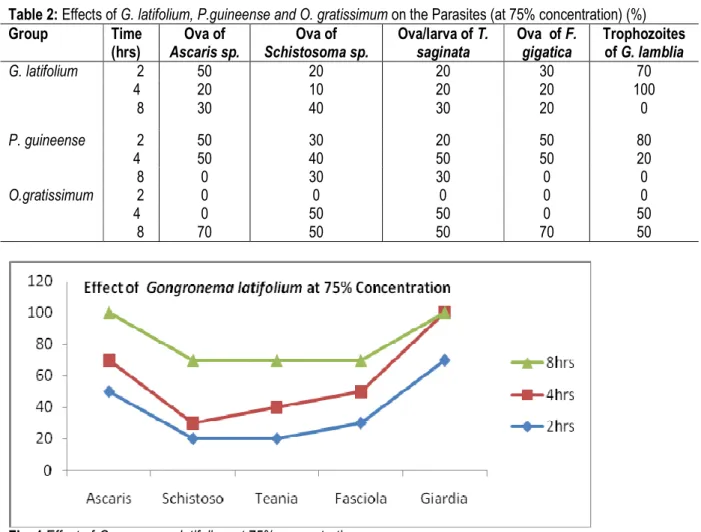
Table 2: Effects of G. latifolium, P.guineense and O. gratissimum on the Parasites (at 75% concentration) (%)
Group Time (hrs) Ova of Ascaris sp. Ova of Schistosoma sp. Ova/larva of T. saginata Ova of F. gigatica Trophozoites of G. lamblia G. latifolium 2 50 20 20 30 70 4 20 10 20 20 100 8 30 40 30 20 0 P. guineense 2 50 30 20 50 80 4 50 40 50 50 20 8 0 30 30 0 0 O.gratissimum 2 0 0 0 0 0 4 0 50 50 0 50 8 70 50 50 70 50
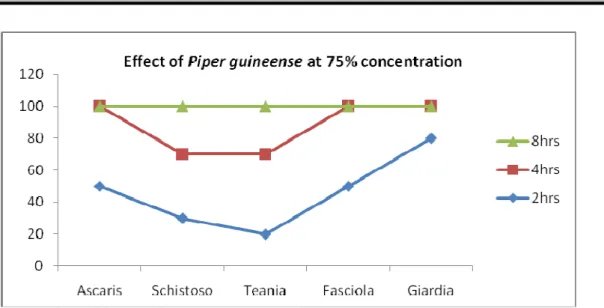
7913 Fig. 2 : Effect of Piper guineense at 75% concentration
Fig. 3. Effect of Ocimum gratissimum at 75% concentration
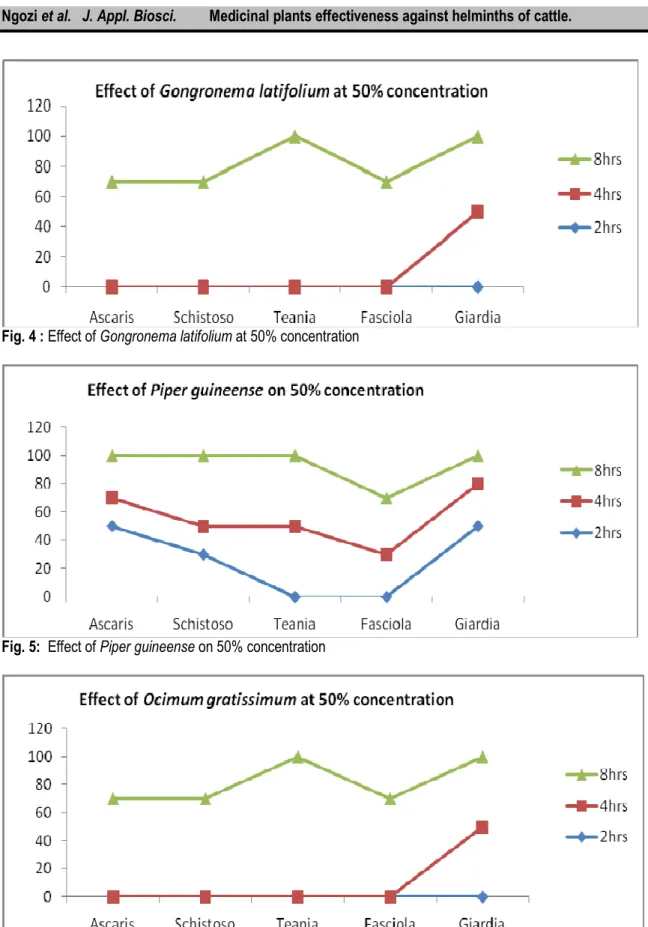
Table 3: Effects of 50% concentration of G. latifolium, P. guineense and O. gratissimum on the parasites (%)
Group Time (hrs) Ova of Ascaris sp. Ova of Schistosoma sp. Ova/larva of T.saginata Ova of F. gigatica Trophozoites of G. lamblia G.latifolium 2 0 0 0 0 0 4 0 0 0 0 50 8 70 70 100 70 100 P. guineense 2 50 30 0 0 50 4 70 50 50 30 80 8 100 100 100 70 100 O.gratissimum 2 0 0 0 0 0 4 0 0 0 0 50 8 70 70 100 70 100
7914 Fig. 4 : Effect of Gongronema latifolium at 50% concentration
Fig. 5: Effect of Piper guineense on 50% concentration
7915
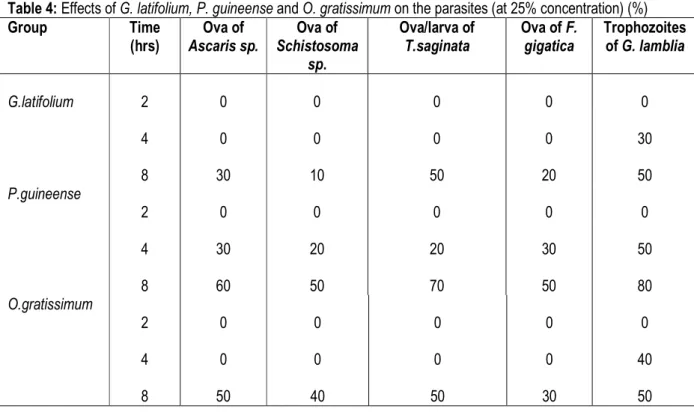
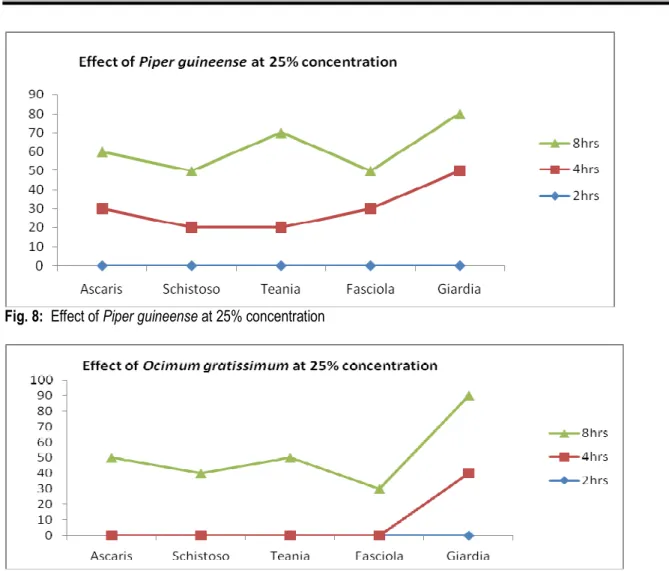
Table 4: Effects of G. latifolium, P. guineense and O. gratissimum on the parasites (at 25% concentration) (%)
Group Time (hrs) Ova of Ascaris sp. Ova of Schistosoma sp. Ova/larva of T.saginata Ova of F. gigatica Trophozoites of G. lamblia G.latifolium 2 0 0 0 0 0 4 0 0 0 0 30 8 30 10 50 20 50 P.guineense 2 0 0 0 0 0 4 30 20 20 30 50 8 60 50 70 50 80 O.gratissimum 2 0 0 0 0 0 4 0 0 0 0 40 8 50 40 50 30 50
7916 Fig. 8: Effect of Piper guineense at 25% concentration
Fig. 9: Effect of Ocimum gratissimum at 25% concentration DISCUSSION
The results as revealed in Table 1 shows that all the plants extracts contain saponins, tannins, flavonoids, sugar, alkaloids and terpenoids except for O. gratissimum, that does not have terpenoids. Tannins are bitter plant polyphenolic compounds that bind to and precipitate proteins and various other organic compounds including amino acids (Dahanukar et al., 2000). The antihelminthic properties of the different ethanolic extracts of the plants understudied revealed in this study, indicate that the plants can be used as an agent in the control of helminthes. The extracts could disrupt the parasite’s life-cycle at the trophozoite stage, thus halting further development into the adult helminth (Chema and Ward, 1990). This is in agreement with a similar study conducted by Daniel et al., (2013), who reported that since there may not be 100% eradication of the parasites of animals due to their survival strategies in the host, the inhibition of the parasite’s life-cycle could go a long way in controlling the disease. In addition, Basu and Halder
(1994) reported that control of livestock helminthes could occur by the anti-helminthic effects of some approved commercial regimen, which could hinder the trophozoites from completing its normal life-cycle. The motility of trophozoites was observed to be gradually inhibited on introduction of the extracts and that the higher the concentration of the extracts, the lesser the time in which mortality was achieved and vice versa (Table 2, 3, 4). This observation is in agreement with that of Akudo et al (2010) who reported that same effect was achieved on the introduction of G. latifolium, a drastic result was achieved which was exponential with time interval of exposure The anti-helminthic activities of the extracts could be due to the presence of tannins in the extracts. Tannins could have precipitated the protein-content of the ova thereby distorting its physiology. Similarly saponins and alkaloids could have contributed to the anti-helminthic potential of the extracts since the former could induce cell death by inhibiting proteins while digestion of
7917 the latter could hydrolyze the compound (Daniel, et al., 2013). This study actually suggests that the introduction of these plants extracts into cattle feed (especially drinking water) could help control the parasite by interfering with its development. The fact that the control in this study produced no mortality at the different time intervals is an argument in favor of the result since whatever resulted in the death of the ova in the test samples could have come from the presence of the extracts (Akudo et al., 2010). Given the wide spread availability of the medicinal plants and the reported resistance of the adult helminth to existing antihelminthic regimes, this alternative means of helminth control could
be adopted to break the life cycle of the parasite and halt its progression into the adult helminth. Since this study has established the anti-helminthic properties of these medicinal plants, while these plant parts could be introduced into the drinking water of livestock especially cattle, further work needs to be done to access the after-effect of the consumption of these plants and their extracts by these livestock. This method of parasite control is indeed cheap and easy to practice and could be adopted to complement the already in-use method of application of commercially available chemical anti-helminths.
CONCLUSION
Finally, there should be a public enlightenment program to educate the populace on this additional medicinal
quality of these plants known for its long-standing history in the treatment of gastro-enteritis and other ailments ACKNOWLEDGEMENT
The authors acknowledge the contributions of laboratory technologists in Biological and Animal Science
Departments of the Federal University of Technology Owerri. Imo State, Nigeria.
REFERENCES
Akudo, G.C, M.S. Idris-Usman, C.C. Mba, et al (2010): Studies on anti-ulcer, analgesic and antipyretic properties of the ethanolic leaf extract of Gongronema latifolium in rodents. African Journal of Biotechnology, 9:2316-2321. Anon, L (2004). Realizing the promise and potentials of
African agriculture. Inter Academy council, pp. 267.
Basu, A.K, Haldar, D.P (1994): An in-vitro study of the efficacy of sevin (inapthylmethylcarbamate) on ectoparasites of livestock. Bull-Animal Health prod. Afr. 42:303-305
Cheesbrough, M. (2000): District Laboratory Practice in Tropical Countries Parts 1 and 2. Cambridge University Press, United Kingdom. Pp 201-12. Dahanukar, S.A., Kulkarni, R.A., Regge, N.N (2000),
Pharmacology of medicinal plants and natural products. Indian J Pharmacol.; 32:S81-S118. Daniel, U. N., Onyemekara N. N., Ohalete, C. N., Nnoli
M. C (2013). Schistosomiasis Snail-control using a Natural Plant. World Journal of Pharmacy and Pharmaceutical Science. 2013. Volume 2, Issue 1, 52-63.
Duru, U.N, Orji J.C., Obi, R.K (2012). The Larvicidal Potentials of Crude Extract of Azadirachta indica. World Journal of Pharmacy and
Pharmaceutical Science, Volume 1, Issue 3, 1188-1197.
Fajimi, A.K and Taiwo, A.A (2005): Herbal remedies in animal parasitic diseases in Nigeria: a review. African Journal of Biotechnology: 4:303-307 Harborne, J.B., (1975). Phytochemical screening
methods, a guide to modern techniques of plant analysis, 2nd edition, Macmillan publisher, London; Pp 232-237.
Morebise, O. M., J. M., Makinde et al. (2002): Anti inflammatory property of the leaves of
Gongronema latifolium phytother. Res., 16:575-577.
Tonk, S., Bartarya, R., Maharaj, K.K., Bhatanagar, V.P., Srivastara, S.S (2006). Effective method for extraction of larvicidal component from leaves of Aradirachta indica and Artemisia annua. Linn. J, Environ. Biol. 27 (1): 103-105.
Ugochukwu, N.H., Babady, N.E., Cobourne M. and Gasset, S.R. (2003): The effect of Gongronema latifolium leaf extract on serum lipid profile and oxidative stress of hepatocytes to diabetic rats., J.Bio.Science, 28:1-5.