HAL Id: hal-01233429
https://hal.archives-ouvertes.fr/hal-01233429
Submitted on 25 Nov 2015
HAL is a multi-disciplinary open access
archive for the deposit and dissemination of
sci-entific research documents, whether they are
pub-lished or not. The documents may come from
teaching and research institutions in France or
abroad, or from public or private research centers.
L’archive ouverte pluridisciplinaire HAL, est
destinée au dépôt et à la diffusion de documents
scientifiques de niveau recherche, publiés ou non,
émanant des établissements d’enseignement et de
recherche français ou étrangers, des laboratoires
publics ou privés.
Dielectric study of local relaxations in dendritic
macromolecules
Eric Dantras, Anne-Marie Caminade, Jean-Pierre Majoral, Colette Lacabanne
To cite this version:
Eric Dantras, Anne-Marie Caminade, Jean-Pierre Majoral, Colette Lacabanne. Dielectric study of
local relaxations in dendritic macromolecules. Journal of Physics D: Applied Physics, IOP Publishing,
2002, vol. 35 (n° 1), pp. 5-8. �10.1088/0022-3727/35/1/302�. �hal-01233429�
To cite this version : Dantras, Eric and Caminade, Anne-Marie and
Majoral, Jean-Pierre and Lacabanne, Colette Dielectric study of local
relaxations in dendritic macromolecules. (2002) Journal of Physics D:
Applied Physics, vol. 35 (n° 1). pp. 5-8. ISSN 0022-3727
To link to this article : doi:
10.1088/0022-3727/35/1/302
URL :
http://dx.doi.org/10.1088/0022-3727/35/1/302
Open Archive TOULOUSE Archive Ouverte (OATAO)
OATAO is an open access repository that collects the work of Toulouse researchers and
makes it freely available over the web where possible.
This is an author-deposited version published in :
http://oatao.univ-toulouse.fr/
Eprints ID : 14472
Any correspondance concerning this service should be sent to the repository
administrator: [email protected]
Dielectric study of local relaxations in
dendritic macromolecules
E Dantras
1,3, A M Caminade
2, J-P Majoral
2and C Lacabanne
1,3 1Laboratoire de Physique des Polym`eres, CIRIMAT, Universit´e Paul Sabatier,31062 Toulouse Cedex 04, France
2Laboratoire de Chimie de Coordination, 31077 Toulouse Cedex 04, France
E-mail: [email protected] and [email protected]
Abstract
The aim of this work is to characterize the dielectric properties of amorphous dendritic macromolecules as a function of architectural complexity. By combining thermostimulated currents and dynamic dielectric spectroscopy, the dielectric permittivity has been obtained as a function of temperature, in a very broad frequency range (10−4–106Hz).
Generations g = 0 to g = 2 were investigated. The molecular origin of the quasi-Debye mode observed for g = 0 at low temperature is common to all generations: localized reorientations of aldehyde end groups. The
interactions with the phosphorus/sulfur (P = S) dipoles are probably responsible for the broadening pointed out in upper generations.
1. Introduction
Phosphorus-containing dendrimers have been chosen as a complex polymeric model to investigate the relationship between complex relaxation processes associated with specific architecture. Dendrimers are characterized by a self-similar architecture (tree-like architecture). The architectural effect on the dielectrical properties of non-conductive materials, such as phosphorus-containing dendrimers, has been investigated by dynamic dielectric spectroscopy (DDS) and thermostimulated currents (TSC). Dielectric losses associated with localized molecular relaxations have been analysed at low frequency and low temperature.
Secondary β relaxation modes, generally characteristic of the chemical structure in the glassy state, have been considered. The influence of generation evolution and the modification of the chemical nature of the core and end groups have been followed.
2. Materials and methods
2.1. Materials
The synthesis of phosphorus-containing dendrimers has been described previously [1, 2]. Numbering of these compounds hereafter will be as [G′
g], in which g is the number of the
3 Authors to whom correspondence should be addressed.
generation—here g = 0 and 2 − G′correspond to a dendrimer
with terminal aldehyde groups and a P = S core. Phosphorus-containing dendrimers of generation 0 with a P = O core will be designated as [G′
0(P = O)] for chemical species with an
aldehyde end group and [G0(P = O)] for chemical species
without an aldehyde end group. The molecular structure of phosphorus-containing dendrimers is illustrated in figure 1. All the samples studied are available as powder. For [G′
0], no
calorimetric manifestation of glass transition has been pointed out; for [G′
2], the glass transition temperature Tgis 122◦C.
2.2. Methods
Broadband dielectric measurements were performed using a Novocontrol BDS400 covering a frequency range of 10−2 Hz/106 Hz with 10 points per decade. Experiments
were carried out within a temperature range −150◦
C/100◦
C. Dielectric isotherms were measured every 5◦C. Before each
frequency scan, the temperature was kept constant to within ±0.2◦
C. The real ε′
T and imaginary ε ′′
T parts of the relative
complex permittivity ε∗
T, were measured as a function of the
frequency F at a given temperature T . The experimental data were fitted by the Havriliak–Negami (HN) function [4, 5] without any additional conductivity term
ε∗T(ω) = ε∞+
εst−ε∞
Figure 1.Scheme of phosphorus-containing dendrimer architectures (points (•) symbolize P = S or P = O groups) and molecular structures for g = 0 and g = 2.
Figure 2.Frequency and temperature dependence of the dielectric loss for the β-mode of [G′ 0] and [G
′ 2].
where ε∞is the relative real permittivity at infinite frequency,
εst is the relative real permittivity at null frequency, τH N is
the relaxation time, ω is the angular frequency, and αH N and
βH N are the HN parameters. TSC spectra were recorded on
a Thermold TSC/RMA spectrometer. The sample was po-larized by an electrostatic field EP = 400 kV m−1 during
tp = 2 min over a temperature range from the polarization
temperature TP = −100 ◦
C down to the freezing temperature T0= −180◦C. Then, the field was turned off and the
depolar-ization current was recorded with a constant heating rate (qh=
+7◦C min−1), so that the equivalent frequency of the TSC
spectra was feq∼10−3–10−4Hz. TSC experiments are
com-plementary to DDS spectroscopy on the low-frequency side.
3. Results and discussion
Evolution of the generation allowed us to follow the relaxational complexity and molecular structure relationships.
Figure 3.TSC spectra of P = S core dendrimers [G′ 0], [G ′ 1] and [G ′ 2].
Figure 4.TSC spectra of P = O core dendrimers [G′
0(P = O)] and [G0(P = O)].
For [G′
0], the sample exhibiting no glass transition, no α
dielectric relaxation was observed. However, the dielectric loss profile confirms previous data on different dendritic macromolecules [3]: a quasi-Debye mode β[G′
0] (figure 2), confirmed by HN parameters [4, 5], is observed at low frequency and low temperature. The numerical values of the HN parameters are reported in table 1. Since the isotherm T = −25◦
C, the contribution of electrical conductivity σ appears on the low-frequency tail of ε′′
T(ω).
Nevertheless, it does not modify HN fitting. Details of the dielectric data analysis have been published elsewhere [6]. By TSC [7], the depolarization current exhibits a narrow (quasi-non-distributed) β relaxation mode. Its maximum is located at −124◦C (figure 3). For [G′
2], two relaxation
regimes are revealed by TSC: the α relaxation mode observed at higher temperature is due to the dielectric
manifestation of the glass transition; at lower temperature, the β mode due to localized molecular mobility is characterized by relaxation times with an Arrhenius-like temperature dependence
τ (T ) = τ0exp
µ 1H RT

where R is the ideal gas constant, τ0 is the pre-exponential
factor, and 1H is the activation enthalpy. τ0is of the order of
magnitude of ∼10−13s.
According to the Eyring relationship
τ0= h kBT exp µ −1S R 
where h is the Planck constant, kBis the Boltzmann constant,
and 1S is the activation entropy. For [G′ 0] and [G
′
Figure 5.Comparison of TSC spectra of [G′
0(P = O)] and [G ′ 0].
Table 1.Evolution of HN parameters (αH Nand βH N) with
temperature for generation g = 0 and g = 2 (extracted from a series of isotherms from T = −150◦ C to T = 50◦ C). HN parameters g =0 [G′ 0] g =2 [G ′ 2] αH N 0.90–0.971 0.28–0.41 βH N 0.912–1.0 1.0
zero, and 1H takes the values 1H = 40.4 and 34.9 kJ mol−1,
respectively.
The low-temperature mode β[G′
2] occurs in the same temperature range as β[G′
0] (figure 3), but its half-width increases (HN parameters related to mode width). The hypothesis of an additional dipolar relaxation is proposed in order to explain this broadening.
Considering the mobility and the polarity of the aldehyde groups, they might be responsible for the β relaxation modes. To check this hypothesis, a TSC comparative study of dendrimers without aldehyde end groups (G0(P = O),
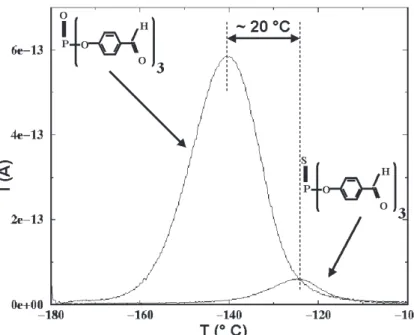
figure 1) was performed: it was found that the β mode is divided by a factor higher than 500; in practice, this β mode does not exist (figure 4). The quasi-Debye β mode was therefore assigned to local movements of the aldehyde end groups. The increase of complexity of the β relaxation mode upon generation indicates the existence of interactions with other dipolar species, most probably P = S. The substitution of a P = S core by a P = O core for g = 0 (respectively [G′
0]
and [G′
0(P = O)]) shows that there is a significant interaction
with this group. Indeed, TSC experiments indicate a low-temperature shift of ∼20◦
C of the narrow mode (figure 5).
4. Conclusion
Dendrimers are good models for analysing the molecular origin of broad relaxation modes observed in complex systems. Starting with dendrimers of generation g = 0 with a P = O core, the comparative study of molecules with and without aldehyde end groups allows us to attribute the low-temperature relaxation mode to reorientations of aldehyde end groups. This is a quasi-Debye mode, characteristic of a localized molecular mobility. The substitution in the phosphorus core of P = O by P = S is reflected in the TSC spectrum: the β peak is shifted towards higher temperatures by 20◦
C and its magnitude is divided by a factor of six. This evolution might be explained by a stronger interaction of the core with the end groups. For P = S phosphorus core dendrimers, when generation increases (g = 1 and 2), a broadening of the β relaxation mode is observed: it has been associated with the broad distribution of interactions with the dipolar species.
References
[1] Lartigue M L, Donnadieu B, Galliot G, Caminade A M, Majoral J P and Fayet J P 1997 Macromolecules 30 7335–7 [2] Majoral J P and Caminade A M 1998 Topics in Current
Chemistryvol 197 (Berlin: Springer) pp 79–124 [3] Hurve S A, Appelhans D, Prigann J, Voit B I and Kremer F
2000 Macromolecules 33 3762–6
[4] Havriliak S and Negami S J 1966 Polym. Sci. C 14 99–117 [5] Havriliak S and Negami S J 1967 Polymer 8 161–210 [6] Dantras E, Lacabanne C, Caminade A M and Majoral J P 2001
Macromolecules 343808–11
[7] Chatain D, Gautier P and Lacabanne C 1973 J. Polym. Sci. Phys. Ed. 111631–40
![Figure 2. Frequency and temperature dependence of the dielectric loss for the β-mode of [G ′ 0 ] and [G](https://thumb-eu.123doks.com/thumbv2/123doknet/2355057.37378/4.892.210.696.570.935/figure-frequency-temperature-dependence-dielectric-loss-v-mode.webp)
![Figure 3. TSC spectra of P = S core dendrimers [G ′ 0 ], [G ′ 1 ] and [G ′ 2 ].](https://thumb-eu.123doks.com/thumbv2/123doknet/2355057.37378/5.892.230.680.129.435/figure-tsc-spectra-p-s-core-dendrimers-g.webp)