HAL Id: sic_00276091
https://archivesic.ccsd.cnrs.fr/sic_00276091
Submitted on 29 Apr 2008HAL is a multi-disciplinary open access archive for the deposit and dissemination of sci-entific research documents, whether they are pub-lished or not. The documents may come from
L’archive ouverte pluridisciplinaire HAL, est destinée au dépôt et à la diffusion de documents scientifiques de niveau recherche, publiés ou non, émanant des établissements d’enseignement et de
From semantic web data to inform-action: a means to an
end
Laurence Noël
To cite this version:
From semantic web data to inform-action:
a means to an end
Laurence Noël
Paris 8 University / Mondeca
3, cite Nollez, 75018 Paris
[email protected]
Prof. Ghislaine Azémard
Paris 8 University
MSH Paris Nord, 93210 Saint Denis la Plaine
[email protected]
ABSTRACT
In this paper, we analyze how data stored in a knowledge base can be externalized on a web portal so as to support exploratory search. We describe exploratory search according to a three-axis referential and we use this referential to determine how the explicit semantics of the data can be used to provide targeted inform-action.
Author Keywords
Exploratory search, interaction design, information design, knowledge management.
ACM Classification Keywords
H5.m. Information interfaces and presentation (e.g., HCI): Miscellaneous.
INTRODUCTION
To communicate efficiently, people structure their discourse according to several factors: the targeted audience, the point in their message they want to emphasize, the context in which their message will be delivered, the medium they are going to use to communicate, etc. These different parameters help them distinguish what data can be considered as relevant information and need to be transmitted and what data are not.
In the case of human-computer communication, the message is mediated via an interface. For this communication to be successful the interface not only has to present relevant information to the end-user, it also has to offer relevant possibilities of interaction with the system. Transmitting relevant inform-action (information which may be tied up with a possibility of interaction) is what any information system is designed to do, but how effectively it can actually do it depends on several factors.
One of these factors is the type of data that is used by the system and the way those data are modelled. In this paper, we analyze how data from a knowledge base can be communicated on a web portal so as to support exploratory search, and we describe this transmission process as being an externalization process. We propose to define exploratory search according to a three-axis referential so as to better apprehend end-user needs and we analyze how the explicit semantics of the data and the way they are modelled can be used to provide targeted inform-action.
INFORM-ACTION
Uniform data display, irrelevant display of data infrastructure [11] and lack of usability are some of the criticisms that have been addressed to semantic web applications. These criticisms point to the fact that what should be displayed on the interface is not all that is known but only what can be considered relevant inform-action given a specific communication context.
Web design as a communication act
A web page can only contain a limited set of data (the limits being both defined by the potential length and width of the page and by the quantity of data that end-users can actually process and analyse) but the system within which these web pages are articulated should give access to the whole set of data that can potentially interest the end-user. It is the role of the web designer to determine the internal dynamics of the system: he specifies how data should be assembled and presented within a web page and how these web pages can be articulated within a coherent system.
As underlined by de Souza [12], when end-users consult a web-based information system, they are engaged in a communication process: end-users don't communicate with the system in itself (they just interact with it), they communicate with the designers of this system: “The
message is elaborated and composed by designers and intended for the users (...) In order to decode and interpret the designers’ message, users proceed to communicate with the message, which gradually unfolds to them all the meanings encoded in it by the designers. The message actually speaks for the designers in the sense that it contains all the meanings and supports all meaning manipulations that the designers have rationally chosen to incorporate in the application in order to have it do what it Permission to make digital or hard copies of all or part of this work for
personal or classroom use is granted without fee provided that copies are not made or distributed for profit or commercial advantage and that copies bear this notice and the full citation on the first page. To copy otherwise, or republish, to post on servers or to redistribute to lists, requires prior specific permission and/or a fee.
CHI 2008, April 5–10, 2008, Florence, Italy.
Copyright 2008 ACM 978-1-60558-011-1/08/04…$5.00
has been designed to do.”
We approach web design according to a pragmatic perspective [1, 10], considering the data contained in a web page as being part of a communication act: a web page is a specific type of utterance, and the data that have been assembled in order to form this utterance have been selected because they had a specific communication function which act upon the way the end-user will decide to pursue the communication.
Inform-action: definition and associated design methods
An utterance expressed via a web page has for characteristics to be potentially multiform (the message can be conveyed by images, videos, texts,...), and the possible utterances that can be delivered to end-users are delimited by the possibilities of interactions that have been made available on the interface by the web designer: a web interface not only has to present relevant information to the end-user (that is, a selected set of data which are related to the parameters expressed in this query and which have been given a form), it also has to offer relevant possibilities of interactions with the system (that is, interactions that the end-user may potentially want to perform given the set of data that is displayed). We have coined the term inform-action to emphasize the informative and/or performative role which data can play within a web page.
Information architecture and interaction design are two complementary design approaches which enable to determine ways of providing relevant inform-action. Interaction design is focused on the development of application flows to facilitate user tasks [3,5]. Design patterns and wireframes can be used to analyse how these interactions can be integrated in a coherent system of interfaces. Design patterns are abstract design solutions: they define the “structural and behavioural features” [13] of the component that is the most appropriate to use considering a given design situation. Wireframes are used to define the way a web page should be structured and to describe the possibilities of interaction associated with each building block. They enable to check that the different design patterns considered can be articulated together within a coherent framework.
Information architecture [8] (as an activity including information design) is a more content-oriented approach to web design. Both the semantics of the data and the semantics of the presentation structures chosen to contain these data have to be analysed : data are grouped, ordered and prioritized within an overall organisational scheme and effective presentation structures (concrete interface components or widgets, as opposed to design patterns) are then chosen according to different parameters: the type of
quantity of data to be displayed, the actual function of the component (visualize, filter, sort, ...)
Interface design and information architecture are two design approaches which give general guidelines that can help create a hypermedia artefact. But the actual creation of an artefact also depends on the tools and the type of material a person has to make it: they have an impact both on the final product and on the process that leads to its production. In the case of web application design, one of the factors that determine the set of functionalities and display modalities that can be proposed to end-users is the type of data used and the way they are modelled.
THE INPUT
Our goal here is to analyze the characteristics of the data stored in an ontology-based application (ITM1), so as to better understand how these data can be exploited at the interface level and so as to define the steps that need to be taken in order to transform these data into inform-action.
Organised data vs. structured data
From an engineering point of view, the term “structured data” is used to refer to data which can be accessed by machines according to explicit structuring elements. Data contained in an XML document, for instance, are considered structured data: they are contained within tags which are used to make the document structure explicit. The data format enables here to define the syntactic elements that can be used to structure the data contained
within the document. The notion of “structured data”
becomes more ambiguous when it comes to semantic web data. Structural properties are part of a larger set of properties that can be used to characterize web resources. Web resources can be explicitly related to an organisational scheme but the structure of this organisational scheme is not enforced, it is described.
We base here our distinction between organisation and structure on the definitions given by Marena and Varela [7]. Organisation denotes those relations that must exist among the components of a system for it to be a member of a specific class. Structure denotes the components and relations that actually constitute a particular unity and makes its organisation concrete.
When working at an organisational level, structure is brought to an abstract level, it is not assigned a concrete form. Multiple data structures can be explicitly described and integrated into one common scheme of organisation (as long as they are coherent as regards one another) and, inversely, multiple potential data structures can be
instantiated from the explicit data descriptions given in the organisational scheme (as long as they respect the organisational scheme). Working at the organisational level results in a gain in flexibility, but also in expressivity since the semantics of structural components can itself be described.
We consider that the data stored in ITM knowledge base are organised data. The knowledge experts have about a domain is formally represented via an ontology, which gives a formal explicit description of the concepts used in the domain, of the properties these concepts can have and of the relationships they share. This ontology represents the organisational scheme to which the different resources can be explicitly related.
The fact that data are organised has implications on the design process:
• When communicated via the interface, data need to be grouped, ordered and prioritized in order to form an utterance that will be meaningful for the end-user. Data thus need to be articulated within structured containers and properties defined in the organisational scheme have to be examined so as to determine if they can be used for creating these structured containers or for articulating the system.
• As resources are described via multiple properties, these properties can be used to present them according to multiple presentation structures (or multiple visualisation modes) or to access them according to multiple paths.
Comprehensive data vs. selected data
A knowledge-base is a data-intensive system. It should be able to integrate a maximum amount of information about a certain domain of expertise according to an organisational scheme that enables to define all the complex relations that the elements in this domain entertain.
This results in the fact that the data stored are comprehensive both from a qualitative point of view, and from a quantitative point of view. But integrating data within an organisational scheme in a comprehensive way is not a goal in itself: the data stored are meant to be used, either to provide relevant information or to provide efficient ways of retrieving some information. When having rich data, the temptation is to show that those data are rich by displaying them all. But efficient communication is in fact based on the transmission of a specific selected set of data. When designing an information system that makes use of comprehensive data, a web designer can consider two complementary approaches:
• He can specify the way data are going to be filtered and prioritized before they are presented to the end-user. Presentation templates have to be considered not only according to their structuring dimension but also according to their filtering dimension.
• He can let the end-user define himself the filtering or ordering criteria to be used (when an end-user searches for a hotel, for instance, different ways of filtering a result list can be presented to him so that he can specify the set of data he is really interested in).
THE EXTERNALIZATION PROCESS
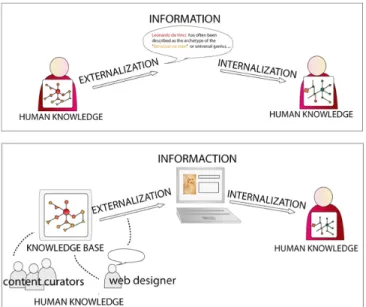
Communicating data stored in a knowledge base on a web portal corresponds to an externalization process. Nonaka and Takeuchi [9] have already used the terms “internalization process” and “externalization process” to analyze how people could acquire new knowledge or transmit what they know. For them, the externalization process corresponds to a passage from tacit to explicit knowledge. In a knowledge base, however, resources are explicitly described and knowledge is formally represented, which makes the tacit/explicit opposition non-relevant. For us, the externalization process (see Figure 1) corresponds to the formulation of an articulated set of utterances which are based on the knowledge we have in a domain, according to a specific communication. From a web design perspective, it corresponds to the articulation of a set of web pages within a coherent system which has been designed in function of the specification of different end-users' tasks and according to the informative and performative potentialities offered by a given data organisational scheme.
Figure 1. Externalization and internalization processes
During the externalization process, it is first important to determine the tasks that end-users may want to perform [2] and to analyze if the property types specified in the organisational scheme can be assigned a specific function that will help end-users perform this task. In this paper, we will examine how using data related via explicit semantic relations can help support exploratory search and we will illustrate our point by describing its implementation with data issued from a tourism knowledge base.
EXPLORATORY SEARCH
Exploratory search has been characterized by Marchionini [6] as blending querying and browsing strategies and by White et al. [14] as a way of presenting relationships and mechanisms for discovering new insights. It is based on the assumption that an end-user doesn’t always know how to specify what he really searches for and that letting him discover how the information space is organized can help him locate points of interest.
When consulting a tourism web portal, for instance, end-users can have a very precise idea of what to look for or, on the other hand, they can expect the information system to give them ideas about where to go and what to do because they themselves don't really know what to search for and what there is to see. End-users will thus need help not only to search the information space – that is, to access a precise part of the information space quickly – but also to explore it – that is, to construct their way towards different parts of the information space, have an overview of what's around and decide if they want to know more about this part or if they want to change directions.
In order to characterize this information-exploring behavior, we have defined a three-axis analysis framework which is based on the different directions an end-user can choose to follow, given a set of data to be explored. • The vertical axis of exploration is the one that enables
end-users to reduce or enlarge their focus on a specific part of the information space (which can be constituted of a set of items or of one item in particular). This axis lets end-users determine the selection of data that can potentially be transmitted to them by the system. Implementing a vertical axis of exploration not only requires to give end-users the means to retrieve a selection of data, it also requires to give them explicit indications about how they can specify their query so as to let them decide on the path they want to take to explore a part of the information space further.
• The horizontal axis of exploration is the one that lets end-users go from one displayable portion of the set of results matching their current request to another displayable
potentially be returned to them according to their query. This axis of exploration is also the one that actually enables end-users to analyse the components of the information space on which they are focused.
• The transversal axis of exploration is the one which end-users can follow when they decide to change perspective and access a new part of the information space. They don’t zoom in or out a part of this information space, they actually decide to inspect it according to a different angle. When accessing a resource via the transversal axis of exploration, an end-user takes an alternative path as regards as the one he had first decided to take. These alternative paths don't correspond to the end-user's current focus on the information space but they should still be relevant as regards his initial focus (one possible way, for instance, to let an end-user take a transversal path is to let him visualize the resources that are directly related to the ones that actually correspond to his query.) In short, we consider that there are three main tasks that an exploratory search module should enable an end-user to perform: end-users need means to adjust their focus, analyze what is within this focus or change perspective.
IMPLEMENTING EXPLORATORY SEARCH
To illustrate our point, we present here the exploratory search module we have designed for a tourism web portal.
Vertical exploration
The vertical axis of exploration of our module is designed to be implemented via the combined use of a faceted navigation system, a keyword search component and a trail menu component.
Faceted navigation enables end-users to navigate in the information space by progressively selecting desired facet values. It is a type of navigation that has already been described as facilitating exploratory search [6,14] since it enables end-users to access objects according to multiple paths. For faceted navigation to work, the items in the information space have to share some common characteristics. When exploiting data from a knowledge base, the different property types according to which the resources are characterized can be used to provide these different facet values.
The faceted navigation system relies on the definition of multiple navigation taxonomies, expressed in SKOS [16], and which concern only a selection of some property types used to characterize the resources in the knowledge base. Indeed, all the property types defined in the knowledge base for management purposes are not relevant for the web portal's end-users and if the number of facets displayed is
frequently used (in the case of hotels for instance, priority display will be given to the price and the hotel category). This faceted navigation is combined with the use of a keyword search component. End-users have then the possibility to express their query according to their own terms – even if it is only poorly defined – and to refine it via the use of the facet values. For instance, an end-user might start a search by entering “exhibition” in the keyword search component. The facets will then be actualized according to his query and he will have then the opportunity to specify a date or a location or a domain, etc. via the different facets displayed.
A trail menu is eventually used so as to help end-users locate where they are in the information space and to enable them to enlarge their focus by suppressing one of the criteria expressed.
Horizontal exploration
The horizontal axis of exploration is designed to be implemented via a visualization panel combined with a pagination component – so as to let end-users browse through the complete list of items that match their query – and with a tab menu – so as to let end-users choose between different visualization modes. As each way of representing some data has for characteristics to make some properties more directly accessible to the viewer, letting the end-user choose between different visualization modes is also a way of letting him browse a set of data more quickly.
Four different visualization modes have been considered for our module. By default, end-users can view the results in the form of an image-card. It contains data that have an identification function (the title of the tourism object and a photo of the object) and data that have a comparison function (three attributes maximum, determined and selected according to the class of the object).
The second visualization mode is similar to the first one except for the inclusion of a short text that has a descriptive function (the end-user gains in informational content as regards each result but there's a loss in the number of results that he can see within the same surface).
The third visualization mode enables end-users to view results on a map (see Figure 2). End-users' lack of knowledge about the area results in a lack of knowledge about how the tourism resources are located as regards to one another and a map can give them the means to better estimate geographical distances than if they had to browse a list of geographical property values. It will also give them the means to compare different spatial areas in function of the quantity of tourism resources they offer.
Time, like space, has the characteristics of being used as a reference framework that has commonly accepted representations (timeline, agenda, week planner, etc.). The advantage of letting end-users view result on a agenda (which is here the temporal representational mode that is the more adapted to view results spanning within a year period) is comparable to that of using a map for geographical data: it facilitates both the comparison between objects according to their temporal properties since they are grouped into time slices, but it also facilitates the comparison between the different temporal periods as end-users can see the number of events they contain and so, they can discover at which period of the year they are more things to do.
Figure 2. A set of results displayed on a map.
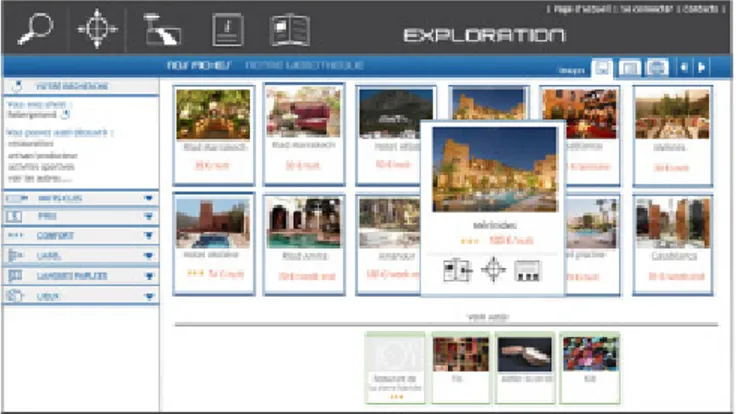
The particularity of each of the visualization mode proposed is that, by rollover on the different results displayed, the end-user has also the means to visualize this result in the context of the instances it is related to in the knowledge base (see Figure 3).
Figure 3. A set of results in image-card mode. On rollover, an image-card gains more visual importance and the resources
related to it are displayed in the bottom part.
As stated by Latour [4] in his actor-network theory, it is via the relations an actor (that is, a performing object in a network) has with other actors that this actor can be defined. From a information communication perspective,
showing a tourism resource in the environment of the tourism resources it is related to has a contextualisation function (it gives information about how an object is situated in relation to other objects, not only geographically but also thematically and temporally) which can help end-users better identify the data presented to them.
Transversal exploration
Displaying tourism objects that are related to another tourism object also has a suggestive power: it can help end-users discover new resources and give them the means to access these resources directly, without having to formulate a query.
Tourism information systems generally don't implement this transversal axis of exploration, or they only implement it partially, by relying only on the geographical properties of the tourism resources to offer suggestions, thus leaving out other possibilities of relating the data. This prevents end-users from gaining new insights into the information space but also slows down their exploration of the information space (instead of having a direct access to objects that are related to one another, they will have to formulate a new query to access them).
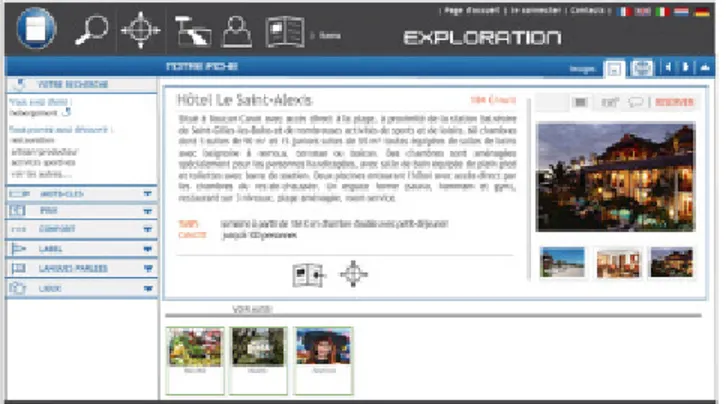
As described in the previous section, suggestions are displayed by rollover on a specific item in the case of a result set. They are also displayed when the end-user consults a local view on a resource (see Figure 4).
Figure 4. Local view on a resource with suggestions displayed on the bottom part.
Articulation of the three axes
To show the articulation between the different axes of exploration, we will give here an example of a short scenario: an end-user has to spend a night in Paris for his work. He first searches for a hotel and uses the faceted navigation system (vertical exploration) to specify his query (Paris + three star). He browses the different results
information about a hotel H. As he consults the local view corresponding to this resource, he discovers that it is close to a theatre. He clicks on this tourism resource (transversal exploration), consults the actual web site of the theatre to check the program via the link provided on the local view display, but finds nothing interesting. However, as he returns to the local view of the theatre, he notices a restaurant in the suggestions so he checks the address and as he does so, he notices – again in the suggestions – that there is an exhibition about Art and Sciences near this restaurant and he decides he will go there too.
As shown by this example, and as we've already explained in the previous paragraphs, the three axes of exploratory search entertain dependency relations:
• To access a resource via the transversal axis of exploration, those resources first have to be displayed. As they don't correspond to the end-user's current focus on the information space as determined by the vertical axis, they have to be presented to him in an alternative way (and with less visual importance than the actual results of the query) as he advances along the horizontal axis of exploration.
• When advancing along the vertical axis of exploration, an end-user gets more and more (or less and less) focused on a part of the information space. This modifies the information granularity level to be given, and influences the way data should be represented so as to facilitate horizontal exploration (different templates have to be designed according to the different situations in which some information about a resource is given: if a resource is part of a result list, the template used to present this resource will be different from the one used to present it when the end-user consults a local view and actually focuses on it).
• Facilitating vertical exploration enables to limit horizontal exploration and vice-versa (the more an end-user focuses on a precise part of the information space, the less he needs to browse the different components that are part of this information space).
• Facilitating transversal exploration enables to limit vertical exploration.
We do not intend here to describe those dependency relations in a comprehensive manner. Our goal is to underline that this inter-dependency requires that the three axes of exploratory search need to be implemented in a combined way. Using data issued from a knowledge base gives the potential means to do so and it is only when these three axis of exploration are coherently combined and articulated that the information system can eventually gain
4. Latour B. Reassembling the Social: An Introduction to Actor-Network Theory.Oxford University Press, New-York, 2005.
produce synergetic designs.”
CONCLUSION
5. Laurel B. Ed. The Art of Human-Computer Interface Addison-Wesley Publishing Co, 1990.
When exploring an information space, end-users try to locate points of interest and to gain some insights about the way data are organised within this space. As data stored in a knowledge base are related to one another within an explicit organisational scheme, it can be used at the interface level to help end-users construct their path towards a point of interest. The construction of this path is the result of a communication process between the end-user and the web designer, who has specified in advance how data can potentially be assembled within a web page and how these web pages should be articulated within a coherent system. In a knowledge base, data are organised and comprehensive but data displayed in a web page need to be structured and limited to those that can have a specific communication function so as to form a meaningful utterance for the end-user. Describing exploratory search according to a three-axis referential has helped us analyse which data from the knowledge base should be displayed and how they could be used to help end-users explore the information space. The general articulation of the exploratory search module we have designed can be transposed to different domains but the widgets chosen need to be adapted according to the type of data they contain and the type of interactions they need to afford: defining design rules enabling to choose an appropriate widget according to different communication contexts is the subject of our future research work.
6. Marchionini G. Exploratory Search: from Finding to Understanding, ACM Press (2006), 49(4):41–46. 7. Marena H.R. and Varela F.J. The Tree of Knowledge,
Shambhala, Boston, MA, 1998.
8. Morville P. & Rosenfeld L. Information Architecture. O'Reilly Media, Inc. 1998.
9. Nonaka I. and Takeuchi H. The Knowledge-Creating Company. Oxford University Press, New-York, 1995. 10. Searle J.R. Speech Acts: An Essay in the Philosophy of
Language. Cambridge University Press, 1970. 11. Schraefel m.c. and Karger D. The Pathetic Fallacy of
RDF. In Proc. of SWUI 2006.
12. Souza C.S. The Semiotic Engineering of Human-Computer Interaction. The MIT press , 2005. 13. Tidwell J. Designing Interfaces. O’Reilly Media Inc,
2006.
14. White R., Rules B., Drucker S., and Schrafael m.c. Supporting Exploratory Search. ACM Press, Special Issue, volume 49(4).
15. Wilson M. L., Schraefel m.c., and White R.W. Evaluating Advanced Search Interfaces using
Established Information-Seeking Models. In submission to the Journal of the American Society for Information Science and Technology. (2007)
16. W3C (2005) Simple Knowledge Organisation for the web (SKOS). Core Vocabulary Specification. 2nd W3C Public Working Draft available at
http://www.w3.org/2004/02/skos/specs
REFERENCES
1. Austin J.L. How to do things with words. Oxford, 1963. 2. Battle L. Preliminary Analysis of Users and Tasks for
the Semantic Web. In Proc. SWUI 2006.
3. Garrett J. The Elements of User-Centered Design for the Web. New Riders, 2002.