Université de Montréal
Nego:
A Virtual Negotiatïon Market
Par
Dongfang Li
Département d’informatique et de recherche opérationnelle Faculté des arts et des sciences
Mémoire présenté à la Faculté des études supérieures envue de l’obtention du grade de
Maître ès sciences (M.Sc.) en informatique
Avril, 2004
Direction des bibliothèques
AVIS
L’auteur a autorisé l’Université de Montréal à reproduite et diffuser, en totalité ou en partie, par quelque moyen que ce soit et sur quelque support que ce soit, et exclusivement à des fins non lucratives d’enseignement et de recherche, des copies de ce mémoire ou de cette thèse.
L’auteur et les coauteurs le cas échéant conservent la propriété du droit d’auteur et des droits moraux qui protègent ce document. Ni la thèse ou le mémoire, ni des extraits substantiels de ce document, ne doivent être imprimés ou autrement reproduits sans l’autorisation de l’auteur.
Afin de se conformer à la Loi canadienne sur la protection des
renseignements personnels, quelques formulaires secondaires, coordonnées ou signatures intégrées au texte ont pu être enlevés de ce document. Bien que cela ait pu affecter la pagination, il n’y a aucun contenu manquant.
NOTICE
The author of this thesis or dissertation has granted a nonexclusive license allowing Université de Montréal to reproduce and publish the document, in part or in whole, and in any format, solely for noncommercial educational and research purposes.
The author and co-authors if applicable retain copyright ownership and moral rights in this document. Neither the whole thesis or dissertation, nor substantial extracts from it, may be printed or otherwise reproduced without the author’s permission.
In compliance with the Canadian Privacy Act some supporting forms, contact information or signatures may have been removed from the document. While this may affect the document page count, it does not represent any loss of content from the document.
Faculté des études supérieures
Ce mémoire intitulé
Nego: A Virtual Negotiation Market
Présenté par:
Dongfang Li
A été évalué par unjury composé des personnes suivantes:
Président-rapporteur: Esma Aïmeur Directeur de recherche: Claude Frasson
Membre dujury: Yann-Ga1 Guéhéneuc
Résumé
Les négociations font partie de toute transaction commerciale. De nos jours, nous assistons à une prolifération importante du commerce électronique d’où le besoin grandissant de passer des négociations traditionnelles aux négociations électroniques. Ce passage est motivé par l’adhésion d’un nombre croissant d’entités commerciales à des réseaux informatiques qui fournissent un volume d’information important avec des moyens de communication rapides, sophistiqués et de plus en plus sécurisés. Ce progrès ne peut être atteint sans résoudre de nouveaux défis d’ordre technique et organisationnel. En réponse à ces défis, nous proposons une plateforme de négociations, appelée ‘Nego’, permettant aux adeptes du commerce électronique de négocier des prix de produits d’une manière efficace et rentable.
Le système Nego est un marché virtuel dans lequel on a adopte la technologie des agents mobiles. Les agents mobiles négocient aux noms des acteurs de la transaction commerciale. Les principaux avantages du système Nego consistent à, premièrement, libérer l’acheteur des détails de la négociation réduisant ainsi le trafic des informations de négociation dans le réseau; deuxièmement, rendre l’acheteur dépendant de ses expériences d’achat précédentes ainsi que de ses préférences par l’application de la théorie de l’utilité subjective; ceci conduit à la production de la solution la plus pratique et la plus personnalisée qui puisse exister. Finalement, Nego accélère la négociation en traitant tous les vendeurs d’une manière équitable en terme de temps. En somme, notre système peut être considéré comme un outil de traitement de la quatrième étape du comportement d’achats selon le model CBB (Consumer Buying Behaviour), à savoir, la négociation où les agents intelligents jouent un rôle primordial.
Abstract
Negotiation plays a very important role in commercial transaction. Today, e-commerce develops rapidly, and conventional negotiation is transforming to e-commerce negotiation. The change of conventional negotiation is significant because of the internet provides wide-ranging information, convenient and rapid communication, and a great quantity of commercial entities. In this thesis, we describe a negotiation system, called ‘Nego’, to provide the e-commerce consumer with an efficient way to negotiate for the price of products in e-commerce market.
Nego is a marketplace, in which mobile agent technology is adopted in the e-commerce negotiation on behalf of the buyer. It mainly solves three problems: First, it fiees the buyer from negotiation detail and reduces the amount of negotiation information in the network; Second, it leads that the buyer must base on his previous experience and preference to produce the solution more practical and personalized, it follows the theory of subjective expected utiÏity (SEU); Third, it speeds up the negotiation by handiing ail sellers in a fair time manner. The proposed system can be considered as a tool to deal with the fourth stage of the Consumer Buying Behaviour model (CBB): negotiation, in which intelligent agent ptays important role. Our purpose is to meet the challenges coming from more and more popular e-commerce activities.
Table of Contents
Chapter 1 Introduction 1 1.1 Ovewiew 1 1.2 Problem Statement 2 1.3 Scope ofThesis 6 1.4 Thesis Organization 9Chapter 2 Agent Application in E-commerce 11
2.1 Introduction 11
2.2 What is Intelligent Agent7 11
2.2.1 The AIMA Agent 12
2.2.2 The Maes Autonomous Agent 13
2.2.3 The Wooldridge-Jennings Agent 13
2.2.4 The Nwana’s agent 13
2.3 Agent Classification 14
2.3.1 AIMA agent classification 14
2.3.2 Nwana’s Agent Classification 18
2.3.3 Dick Stenmark’s Agent Classification 20
2.4 Agents and their Application 21
2.4.1 Functions of Agent 21
2.4.2 Consumer Buying Behavior(CBB) MoUd 23
2.4.3 Agent Examples in CBB 25
2.5 Discussion 29
Chapter 3 E-commerce Negotiation 31
3.1 Negotiation Classification 31
3.1.1 B2C Negotiation Classification 3 1
3.1.1.1 Auction 32
3.1.1.2 BilateralNegotiation 35
3.1.2 B2B Negotiation Classification 36
3.1.2.1 Buyer Controlled Negotiation 36
3.1.2.2 Seller Controlled Negotiation 36
3.2 The Development of Online Autonomous Negotiation 36
3.2.1 Kasbah 37
3.2.2 Michigan AuctionBot 37
3.2.3 Bazaar 38
3.2.4Others 39
3.3 Discussion 41
Chapter 4 Nego’s Theory and Methodology 43
4.1 Overview 43
4.2 The requirement for Negotiation Model 44
4.3 Component ofNegotiation Model 44
4.4 Negotiation Protocol 44
4.5 Negotiation Participant 46
4.6 Negotiation Strategy 46
4.6.2 Leaming-Preference Negotiation Strategy . 48
4.6.2.1 Probability, Preference and Utility 50
4.6.2.2 Least-Squares Parabola 55
4.6.2.3 How to Decide Proposai-Deal 57
4.6.2.4 More Proposai Deals 58
4.7 Closing condition 59
4.8 Discussion 59
Chapter 5 Nego Negotiation Implementation 61
5.1 Architecture 61
5.2Background 65
5.2.1 Introduction to Project Pacha 65
5.2.2 The Relation between Pacha and Nego 66
5.3 Function ofComponents 67
5.3.1 Client Side 67
5.3.2 Server Side 70
5.4 Client Negotiation Agent Working Procedure 72
5.SResultData 77
5.5.1 Simple Negotiation Strategy Result 77
5.5.2 Leaming-Preference Negotiation Strategy Resuit 80
5.6 Compare with other Systems 92
5.6.1 Kasbah 93
5.6.2Bazaar 95
5.6.3 Mobile Agent with Security Agent-Mediated Auction-like Negotiation
Protocol (MASAMANP) 95
5.7 Discussion 92
Chapter 6 Conclusion and Future Work 101
6.1 Nego Agent Evaluation 101
6.2 Negotiation Strategy Analyze 103
6.3 The Contribution ofNego 103
6.4 Problem and Future Work 104
References 106
List of Figures
figure 2.1: Simple reflex agent 15
figure 2.2: Reflex agent with states 16
figure 2.3: Goal base agent 16
figure 2.4: Utility based agent 1$
Figure 2.5: Nwana’s agent classification by agent’s primary attributes 19
figure 2.6: Consumer Buying Behavior Model 23
f igure 4.1: Negotiation protocol 45
Figure 4.2: Negotiation processing sequence 45 Figure 4.3: Kasbah negotiation strategies 47
figure 4.4: The Simple Negotiation Strategy for buyer 4$
Figure 5.1: Nego Architecture 63
f igure 5.2: Client negotiation agent (CNA) working sequence diagram 75
f igure 5.3: Negotiation process sequence diagram 76 f igure 5.4: Brokering result—products, merchants and their prices to be negotiated 77 Figure 5.5: Simple Negotiation Strategy’s user input interface 78
figure 5.6: Simple Negotiation Strategy’s resuit 79
Figure 5.7: Leaming-Preference Negotiation Strategy’s user interface (product not
urgent) $1
Figure 5.$: Leaming-Preference Negotiation Strategy’s resuit (product not urgent) $4 f igure 5.9: Probability(price, accept) and probability(price, reject) distribution $5
Figure 5.10: Gain and loss in client profile for negotiation 86 f igure 5.11: Expectation value for negotiation $7
figure 5.12: The expectation value in negotiation $9
figure 5.13: Leaming-Preference Negotiation Strategy’ s user interface (product is
urgent) 90
List of Tables
Table 1.1: Output sample ofNego 6
Table 2.1: Agents in CBB 25
Table 3.1: Auction properties 35
Table 4.1: Example for Kasbah strategy 47
Table 4.2: The Previous records 51
Table 4.3: The other previous records example 51
Table 4.4: Example of gain and loss 54
Table 4.5: Example ofexpectation value 55
Table 4.6: The gain and loss relative to table 4.3 58
Table 5.1: Client profile example 83
Table 5.2: Probability in client profile 85
Table 5.3: Gain and loss in the client profile 86
Table 5.4: Expectation Example 86
Table 5.5: Data which will form new bid aller previous bid 88
Table 5.6: The expectation values rclated to records in table 5.6 88
Table 5.7: The changed gain by the user’s preference 89
List of Equations
Equation(1) 50 Equation (2) 50 Equation (3) 56 Equation (4) 56 Equation (5) 56 Equation (6) 56 Equation (7) 56 Equation (8) 56 Equation (9) 56 Equation (10) 56 Equation (11) 56 Equation(12) 57 Equation(13) 57 Equation(14) 57 Equation(15) 57 Equation (16) 96Acknowledgement
Doing a thesis is a challenge work, in which there are a lot of enthusiasm and liard work. I would like to thank many people for their assistance and encouragement during I work for my thesis. First of ail, I want to thank my supewisor, Professor Claude frasson for giving me this opportunity and giving me advice in every period ofrnyresearch work. He aiways arranges time discussing with me and giving me suggestion even though he is very busy. I have leamed a lot and improved a lot in this period. I would not have finished my thesis without his advice.
I sincerely thank the other members of dissertation committee, Professor Esma Aïmeur and Professor Yann-Gaêl Guéhéneuc. I would iike to thank them for their reviewing of this thesis and provide valuable response and comments.
I want to thank Professor Jian-Yun Nie. He discusses with me and gives me bis suggestion.
I want to thank my colleagues, Mohammed, Amoldo, Maiyam, and others in the laboratory HERON for their help, encouraging, discussing, and suggestion.
I also want to thank my friends, Amine and the others, for their help and encourage.
finally and very important, I express my gratitude to my parents. They are aiways standing by me. Without their encouragement, I wili have more difficulty to finish my thesis.
Cliapter 1
Introduction
1.1 Overvïew
E-commerce is a general term of any business, or commercial transaction that involves the transfer of information across the Internet [URL_OÏ]. As Internet provides an available access to global information in a real time manner, e-commerce lias the advantage that the merchant is able to broadcast the commercial advertise in Internet easily, and the consumer is able to acquire the commercial information in Internet easily as well. When more and more traditional commercial operations are transformed into electronic commercial operations in Internet, e-commerce expanded rapidly recently and it is predicted to continue to expend in the future.
An e-commerce consumer usuatly searches in Internet and concerns how to find the best product and merchant that is the closest to his criteria, and how to fix the price which is acceptable to him. These concerned activities are defined as “product brokering”, “merchant brokering” and “negotiation” by Consumer Buying Behaviour [Guttman et al.,
1998].
Intelligent agent has been widely used in e-commerce to help the buyers in their buying behaviours. The intelligent agent is a software entity, which works on behave of its user, and it is autonomous, proactive, reactive, communicative, cooperative, learning and mobile. for the “product brokering” and the “merchant brokering”, there have been some efficient methodologies adopted. The technologies of information retrieval and information filtering succeed in collecting information and filtering for the useful information. And Artificial Intelligent agent techniques have helped to improve the product and merchant brokering result efficiently. In practical, there are some useful agent applications that are functional in the brokering stages to guide the user [Guttman et al., 1998] [Pivk and Gams, 2000] [Turban et al., 2002] [Ma, 2001]. When the buyer finishes searching, negotiation is a necessary step for the transaction.
Negotiation definition Negotiation is the process by which a group of agents communicate with one another to try to reach agreement on some matter of common items [Lomuscio et al., 2003].
The purpose of negotiation is to reach an agreement between the buyer and the seller about the transaction terms, in which the buyer or seller are called “negotiator”. Although there have been some negotiation applications, the negotiation in e-commerce is in its primitive state [Lomuscio et al., 2003]. This is because that current e-commerce negotiation implements simple negotiation functions, one ofthem is the probtems in price negotiation. In the foitowing sections, we discuss it.
1.2 Problem Statement
The basic problem in “negotiation” is decision making. Price negotiation involves how to decide the equilibrium price. An equilibrium price is the price that the seller and the buyer match [URL 02]. To decide it, the buyer needs to know how to evaluate the reai value ofthe product, and how to evaluate the seller’s minimum offer(e.g., each seller has his minimum accepting price) ofthis product.
In the B2C (business to consumer, B2C implies the commercial transactions, in which companies seil products or service such as online banking, online consultant and so on to consumers for own use) e-commerce, when the buyer finds some products, he usually wants to negotiate for the transaction price to reach an agreement witli the seller. During this procedure, the buyer decides bis proposai of price (e.g., both proposai-deal and counter proposai-deal can be called as proposai-deal) according to his situation and the situation of the seiier to match the seller’s proposai-deal. In the view point of a buyer, lie can only accept the price less than bis maximum price. In view of a seller, he can only accept the price more than his minimum price. For both buyer and seller, how to find the equilibrium price consistent with their specific expectation is the major challenge. Take the individual buyer as an example. The buyer normally wants to find out a most suitable price, which is the lowest for him to accept, and high enough for the seller to accept. If
the buyer’s proposai-deal is flot the possible lowest price, lie will lose money; if the buyer’s proposai-deal is not a high enougli price, the seller might tum to other possible buyers. Therefore, the main problem of the buyer is to decide exactly the suitable proposal-deal. Failing in proposing a suitable proposal-deal, the buyer may lose his business chance.
Compared with the “product brokering” and “merchant brokering”, the “negotiation” in e-commerce is not so popular. The current e-commerce negotiation just implements the simple price negotiation, in which a buyer just gives his minimum price, increment rate, and maximum price. During the negotiation, the buyer just increases an instant incrernent rate in an instant increment time toward his maximum price. For example, the world’s biggest online marketplace eBay’s “Reserve Price Auction” [URL_03] and Yahoo’s “Autornatic Bidding” [URL 04] provide such negotiation function for the buyers and sellers. But the negotiation functions in both sites implement simple negotiation skill, in which a buyer just specifles the starting and maximum price that he can provide and an instant increment rate. The negotiation continues in the buyer’s increasing the bid by the instant increment rate toward the maximum price. There is a problem in this way that the user aiways wants to leam during the negotiation, in which he can adjust the increment with a dynamic rate according to the situation on that time instead of an instant increment rate.
To soive this kind of problem of not being able to adjust the increment dynamicaiiy mentioned in the above, we must consider many problems that affect the decision making in the e-commerce negotiation. These problems include: the buyer’s knowledge of the market and the seller is limited, the buyer and the seller have different personal preference, and the values between the buyer and seller are inconsistent. Therefore, e-commerce negotiation must solve the problem of uncertainty and incompiete information, which belongs to the decision area.
Decision Science is about how to evaiuate and choose actions among several alternatives, and the theory
of
Subjective Expected Utility (SEU) defines the conditions of perfectutility-rnaximization rationality in a world of certainty or in a world in which the probability of ail relevant variables can be provided by the decision makers, and it is the central idea of decision theory that lies in the foundation of contemporary economics [Simon et aL, 1986]. In brief the SEU assigns each alternative a utility (a numeric value) and each outcome a probability, and maximize its expected utility. It is based on the personal judgement of the utility and personal estimate of Ïikelihood [URL 27]. It can specify the uncertainty with its utiiity according to the subject of the person and focus on certain attributes by ignoring unimportant attributes [URL 28]. In general, SEU has been used in decision methodologies such as: guided by heuristic to searcli for solution, uses means-ends analyze (e.g., a kind of reasoning that to find the difference between the current state and the goal, then to choose the best operation to reduce the difference {URLO5]). One of its examples is the expert system in making medical diagnoses [Simon et al., 1986]. Traditional commerce and e-commerce is different that e-commerce
is based on Internet; adopting SEU in e-commerce negotiation will soive the problem of
the limitation ofcomputation in Internet.
To implement decision making, we need the user profile. The user profile keeps the buyer’s personal information, his interest, and bis previous experience. Nonnally, different buyers will have different way to make decision. The buyer’s profile is helpfuï to make personai decision differently from others. Especially, the user’s previous experience can tell the history of the use’s value. A person has his behaviour-ruie and he normally behaves in a consistent way. When a buyer finds something interesting and wants to buy it, lie lias tlie following problems: lie does not know the general acceptable price of it (although he can check it in other resources, he would better have his own value), and the seller’s reserved price.
Normally speaking, a buyer’s preference, such as buyer A prefers seller X, while user B prefers seller Y, piays a very important role when a buyer make decision in negotiation. A buyer’s preference can change the decision that is based on bis experience. Different buyers have different preference, thus in the same situation the different buyer make different decision. b make a personal decision, the decision maker shouÏd consider the
personal preference. Most of the current negotiation applications ignore the user preference. Examples inciude eBay’s “Reserve Price Auction” [URL 03] and Yahoo’s “Automatic Bidding” [URLO4].
In the view point of technology, e-commerce negotiation involves infoniiation passed between the client and server forward and backward frequently, thus make the access overwork to the e-commerce. Moreover, the process of negotiation involves a complicate computation, and the negotiation requires a rapidiy response abiiity. The buyer negotiation agent normally can flot afford to so great amount of computation with quick feedback.
Making a decision invoives a compiicate computation. Furthermore, negotiation is sensitive with tirne limit. If a buyer needs to negotiate with more than one seller to find the best seller, he must find an efficient way to negotiate with ail of the seliers in the same time, otherwise some sellers must wait. It is a trouble for the buyer to let sellers wait because a seller normafly contacts more than one buyer and the seller can not only wait for a specific buyer because of other opportunities existing.
In this thesis, we present “Nego”, a price negotiation system based on intelligent agents. The basic idea is to provide the e-commerce buyer a useful way to bid, e.g., to negotiate for the product’s price with a set of seilers according to the buyer’s budget and preference, using mobile intelligent agent and sequence leaming base on previous experience. To iliustrate our proposal, Nego’s output will show the negotiation resuit, e.g., alist ofsellers’ offers and buyer’s bids in a buyer’s negotiation. Table 1.1 shows the specific output sampie of Nego. From it, we see how the buyer agent negotiates with ail the sellers and how to choose the best one. In the example in Table 1.1, the buyer agent can flot reach a deal with company A nor company C, but reach a deal with company B; therefore, the buyer agent will choose company B to buy
6
Table 1.1: Output Sampte of Nego
Merchant Name Seller Offer Buyer Bid
CompanyA 680 600 665.679 Final of A 672.3 665.679 Company B 700 600 665.679 668.948 Final of B 668.948 668.948 CompanyC 710 600 665.679 Final of C 697.081 665.679 1.3 Scope ofThesis
This thesis discusses how to use the intelligent agent technology to implernent the price negotiation function in a virtual market witb SEU theory, making use of the experience and user’s preference. It focuses on the following problems: intelligent agent research, e-commerce negotiation tactics, Nego’s Theory and Methodology, and mobile agent in Nego.
• Intelligent Agent research
Intelligent agents are a new paradigm for developing software applications [Jennings and Wooldridge]. They have certain properties. Here we answer the questions as: what properties the agent must have? What each property means? What the agent can do with certain properties such as autonomous, leaming, communicative, and mobile?
There are several agent classifications. The first of them classifies the agents by their intelligence [Russeli and Norvig, 1995], the second classifies the agents by their properties [Nwana, 1996], and the last classifies the agents by their application [URL26]. Each kind of classification is meaningful to different situation.
Intelligent agents are widely used in e-commerce. Especially, there are many agent providing efficient functions in the product brokering and merchant brokering. There are several agents functional in negotiation, but there is stili large space for the negotiation agents to improve. Through the discussion of different agent classification, a summary is given that some kinds of agent technique can be adopted to improve the e-commerce price negotiation.
• E-commerce Negotîation Tactics
There are several kinds of traditional negotiations in commerce, such as English Auction, Dutch Auction, First Price Sealed-Bid Auction, and Second Sealed-Bid Auction, which are the most popular types of auction [McAfee and McMillan, 1987]. Since e-commerce is sorted into 323 and 32C models, accordingly, we discuss how the conventional auctions can be adapted in these two models.
Severa{ important applications of e-commerce negotiation also are discussed to find the advantages and problems. By discussing how to give a suitable bid in e-commerce negotiation, we propose our solution.
• Nego’s Theory and Metliodology
The main problem of Nego is to adopt an efficient methodology for the user to give proposal-deal when his agent negotiates for the product’s price. We propose a methodology for Nego to solve the problem of giving a proposal-deal.
The useful way to value a buyer proposai-deal is to use the history-based algorithm, and the previous experience is a useful and available way to help him to make decision. The
previous experience can guide him to have an exact value, and helps him to avoid mistake.
A buyer’s preference normally inctudes two conflict aspects: favourite aspect and harmfuÏ aspect. The favourite aspect relates to the “gain” value of the buyer, and the harmful aspect relates to the “loss” value of the buyer. The “gain” and “loss” are the buyer’s personal values to specify his favourite or harmful rate to a specific price.
We use SEU theory in Nego’s decision making methodology. Based on the previous experience and user preference, a specific way produces the user expectation values, therefore deduces the proposaI-deal.
Mobile Agent in Nego
When the e-commerce continues expending, the accessing rate of the Internet increases rapidly. To reduce the access workload of Internet, it is necessary to reduce the repeated access. The negotiation between the buyer and the sellers wilI have a lot of data passed forward and backward, and make the situation worse. To so[ve this problem, we will take advantage ofNego.
There exists another problem that Nego’s rnethodology involves a complicate computation. Working independently in the virtual market, the mobile agent has a side effect that it can flot handle large amount of computation. This limitation will lead to slow down the negotiation. Nego solves this problem by an efficient way.
The buyer negotiation agent works on behalf of the buyer, and to avoid the problem of letting a part of potential sellers wait because the buyer negotiation agent is busy in negotiating with other potential sellers. A way to let all the negotiations between the buyer negotiation agent and the potential sellers process in a parallel time is implemented in Nego.
1.4 Thesis Organization
This thesis is divided into six chapters as the following indicated:
Cliapter 2 is a literature review of the intelligent agent. It focuses on the agent classification and the agent’s functions in the e-commerce application. It introduces the Consumer Buying Behaviour model as an underlying model to explain some important e-commerce agent applications and their supporting techniques to see the autonomous level of the e-commerce agent.
Chapter 3 introduces the negotiation theory. It outiines the properties of traditional negotiation and negotiation in e-commerce. It focuses on B2B and B2C negotiations and their strategies. It introduces the e-commerce negotiation development and introduces several important e-commerce negotiation applications, and discusses the current problems and the future development.
Chapter 4 explains the requirernents of Nego’s negotiation mode!. The Nego’s negotiation mode! is presented to explain negotiation components, negotiation process flow and negotiation strategy. It focuses on the negotiation strategy which lias detailed methodologies and algorithm-base on the SEU theory. Both the way to decide the utilities and experience values and the way to approximate the user’s utility are explained. It implements the least-squares parabola, a kind of approximation of the given set of data (utilityi, pricei), (utility2, price2), ..., (utility, pricen) [URL 24], to find the price with the
maximum utility. finally, it compares Nego’s negotiation strategy with the other current negotiation strategies and analyses its advantages and disadvantages.
Chapter 5 describes the Nego’s distributing server-client architecture in which agents take an important role. It describes responsibilities of each agent during the procedure of negotiation. In the client side, it mainly describes the CNA (client negotiation agent). In the server side, it mainly describes the sel!er agent, and negotiation monitor agent. We explain the way the mobile agent is sent to the other side, the way the resuit is received,
and the way the mobile agent negotiates with several sellers in parallel. The resuits of the Nego are presented as the support of our negotiation methodology’s evaluation. We also explain the user interface, the user negotiation parameters.
Chapter 6 makes conclusion of Nego as an e-commerce negotiation agent supporting system. It evaluates the contribution of our work and discusses the disadvantage and future work.
Cliapter 2
Agent Application in E-commerce
2.1 Introduction
Electronic commerce(also called “e-commerce”) is ail the commerce activities on network, which involves information processing. The basic objective of e-commerce is to improve the efficiency of business process and customer service. Absolutely, e-commerce can strearniine the procurement process, cut the cost by efficient process, enable more and distant client, and let smalï enterprise or individual to participate.
One of technologies widely applied in e-commerce is agent technology. The successful and popular e-commerce agents include many search agents such as Copemic Agent [URL_08] and WebRankingAgent [URL 06]. But there are sorne agents such as decision making agent did not have popular application in commerce. Is this because the e-commerce does flot involve decision making? To understand if decision making agents can be useflil to the e-commerce, let us take a brief view of agent theory and the agent applications in the current e-commerce in the following sections.
2.2 Wliat is intelligent Agent?
An intelligent agent is a software entity that acts on behalf of itself to achieve the particular object. An intelligent agent might possess one or more of the following properties [Pivk et Gams, 2000] [franklin and Graesser, 1996] [He et al., 2003]:
• Autonornous: can decide what action to take to achieve its goal by itseÏf instead ofreferring to the user.
• Reactive (sensing and acting): interacts with its environment, responds in a timely fashion to changes in the environment.
• Proactive (Goat-oriented): does flot simply act in responds to the environment, it acts to achieve its goal.
• Communicative: communicates with other agents and people.
• Learning (Adaptive,): can leam and change its behavior base on its previous experience.
• Mobile: can travel from machine to machine.
• Cottaborative: can work in collaboration with other agent to achieve a common goal.
• Knowtedge-levet comntunicative: the ability to communicate with human and
other agents with language more resembling human-like speech than symbol-level protocols.
• Inferentiat: can act on abstract task specification using prior knowledge of
general goals and preferred methods to achieve flexibility.
In general, an agent has essential properties: autonomous, proactive and reactive. As for the other properties: communicative, leaming, mobile, collaborative, knowledge-level communicative, inferential, and temporal continued, they are optional properties. In the following, let’s see the agent definitions in the agent literature.
2.2.1 The AIMA Agent
An agent is anything that can be viewed as perceiving its environment through sensors and acting upon that environment through effectors [Russeli and Norvig, 1995].
AIMA points out that, a system is autonomous to the extent that its behavior is determined by its own experience. AIMA emphases that an agent should be rational doing right thing. “Rational” means “possible in reality”. b measure rational at any given time there are four necessary parts:
• The performance measure that defines degree of success, • Percept sequence that everything the agent lias perceived so far, • What the agent knows about the environment,
2.2.2 The Maes Autonomous Agent
Autonomous agents are computationai system that inhabits some complex dynamic environment, sense and act autonomously in this environment, and do so to realize a set of goal or tasks for which they are designed [Maes, 1995].
The autonomous agents are built in the approaches focus on fast, reactive behavior, rather than knowledge and reasoning, as well as adaptation and learning. Its approach is largely inspired by Biology, and more specificaHy the fleld of Ethnology, which attempt to understand the mechanism which animais use to demonstrate adaptive and successful behavior[Maes, 1995].
2.2.3 The Wooldridge-Jennings Agent
A computer system that has the following properties[Wooldridge et Jennings, 1994]: • Autonomous: agents operate without the direct intervention of humans or others,
and have some kind ofcontrol over their actions and internai state;
• Social abiiity: agents interact with other agents (and possibïy hurnans) via some kind of agent-communication language;
• Reactivity: agents perceive their environment, (which may be the physical world, a user via a graphical user interface, a collection of other agents, the INTERNET, or perhaps all of these combined), and respond in a timely fashion to changed that occur in it;
• Pro-activeness: agents do flot only act in response to their environment, they are also able to exhibit goal-directed behavior by taking the initiative.
[Nwana, 1996] defines an agent as referring to a component of software and hardware which is capable of acting exactly in order to accomplish tasks on behaif of its user.
Nwana points out that it is hard to define agent exactly. Because agents corne from many different areas and agents can play many roies, such as personal assistants or know bots, which have expert knowledge in some specific domain.
To avoid having synonyms or plethora definition of agent, Nwana defines the agent by classifying the agents into different classes. He classifies the agents by three dimensions.
The first dimension is if the agent is static or mobile. The second dimension is if the agent is deliberative or reactive. Deliberative agents possess intemal symbolic, reasoning mode! and they engage in planning and negotiation in order to achieve coordination with other agents. Reactive agents, on the other hand, do flot have any internai, symbolic mode! of their environment, and they act using a stimuli-response type of behaviour by responding to the present state ofthe environment in which they are embedded.
The third dimension is if the agent is autonomous, learning or cooperative. In section 2.3.2, we will discuss Nwana’s agent classification, which will further iliustrate the opinion.
2.3 Agent Classification
The agents in Nego possess different properties, and their functions vary from simple to complex depending on their roles. b understand the functions of different agents in Nego, it is necessary to go through the most popular agent classifications because their agent skiils are used to buiid agents in Nego.
AIMA classifies the agents into four types, in the order of increasing generality; they are as following indicated [Russell and Nowig, 1995] [URL_3 1]:
Simple Reflex (Stimuli—Response) Agent:
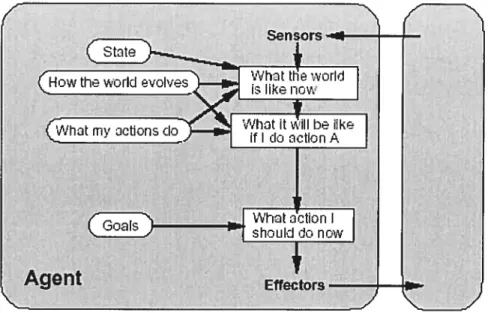
As showed in Figure 2.1, simple reflex agents response to stimuli immediately, but they can not leam. The “condition-action rules” in the diagram are production rules. These agents can help more intelligent agents in the multiple agent systems to implement some tasks.
Agent
Sensors-W1it t rIJ f; Iik ric
Ettectors
Figure 2.1: Simple reflex agent
• Reflex Agent witli States
They can leam from earlier experiences. They can adopt the current information with current state and experience. Figure 2.2 shows these agents. These agents are more intelligent than the simple reflex agents. They can be used in consultant system.
Goal Based Agent
/—\
Goal based agents can plan before they make decision. They have several search methods to search potential result for cadi proposai. Each result is evaluated to know which proposai can be the closest to their goal. figure 2.3 shows these agents. The best example of goal based agent is the agent in chess game.
Sensors
Agent
Figure2.2: Reflex agent with states
Effectors
Utility Based Agent
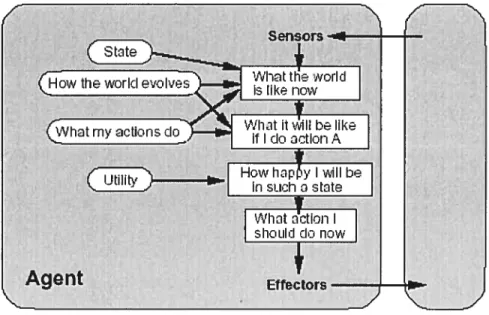
Utilityis a mathematics term ofthe personal evaluation or estimation ofa specific object. The person has his utilities for different attributes of an object. These utilities usually are used with their probabulities to have a total utility of an object, and they entirely subject to the person. Ihe utility based agent mainÏy refers to the utiiity when they take action. The difference of a Utility Based Agent from the other kind of agents is that the utility affects the agent to decide which action the agent will take. Figure 2.4 shows these agents. Utility based agents are the development trend of agent, our project will implement them
One ofthe advantage ofthe Utility Based Agent is that it can have its utilities of an object according to its (e.g., the agent’s user’s) subject of this object, and it can specify the utility for the important attributes whiÏe ignore the unimportant attributes in order to take actions which contribute the most to its profit (e.g., maximize its utility). For example, when a buyer wants to buy something, and before he decides which seller he will buy from, he can give each seller several attrïbutes that relative to his buying decision such as “delivery time (D)”, “afler sales service (A)”, “payment term (P)”, and give each attribute a utility such as Dl=lO, Al=50, Pl=O (e.g., utility=O means the user doesn’t care about it), D2=13, A2=46, P2=O,..., Pn=O, . ..Dn=1O, An=45, Pn=1; after he sums up the utilities
of ail attributes for each seller such as U1D1+D2+...,+Dn, U2A1+A2+...+An,
U3=P1+P2+...+Pn, he can compare the utilities from different sellers (e.g., compare Ui,
In summary, the AIMA agents are classified on the agent’s intelligent degree, from less intelligent to more intelligent. It is obviously that agent involves being more and more autonornous, and the utility agents are the current trend.
2.3.2 Nwana’s Agent Classification
There are several dimensions to classify existing software agents [Nwana, 1996].
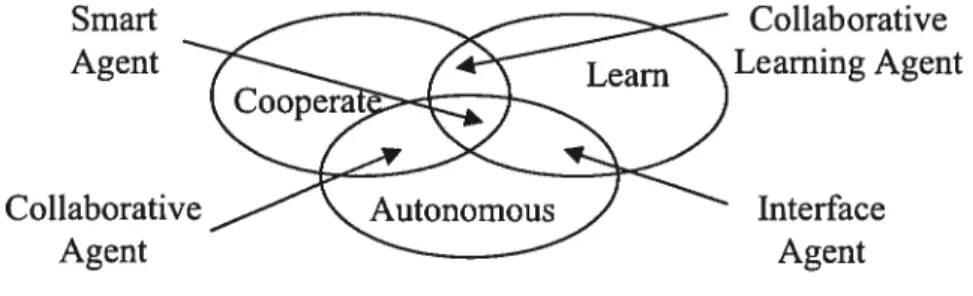
First dimension is the agent’s mobility. Two classes in this point: static or mobile. $econdly, agents may be classified as either deliberative or reactive. Thirdly, agents may be classified along several primary attributes which agents should exhibit: autonomous, leaming and cooperation.
Autonomous refers to the principle that agents can operate on their own without the need for human guidance. Leaming means the agents would have to leam as they react and interact with their extemal environment, leaming is the key attribute of any intelligent agent. Cooperation is a kind of social ability, it is necessary for multiple agents. In order to cooperate, agents need to possess social ability. Figure2.5 shows this classification.
Smart Agent
Collaborative Agent
Fourthly, agents can also be classified by the roles they play. For example, internet agents usually exploit internet search engines such as Spiders —WebCrawlers and Lycos [URL25], to help manage the vast amount of information in wide area networks like internet.
Fifthly, the agent classification includes the category ofhybrid agents which combine of two or more agent philosophies in a single agent.
In summary, Nwana identifies seven types of agents:
• Collaborative Agent • Interface Agent • Mobile Agent • Information(Internet) Agent • Reactive Agent • Hybrid Agent • Smart Agent
The Nwana’s agent is classified on agent attributes, but collaborative learning agent is ignored because there does not exist an agent which collaborative and leam but flot autonomous.
2.3.3 Dick Stenmark’s Agent Classification
Dick classifies the agent according to the agent’s function. He classifies the agent as the following [URL_26]:
• Interface Agent
Interface agent is used to guide the user using the interface. It helps the user communicate with the system and solve the user’s problem such as wrong input.
• System Agent
System agent is the manager of a application, it controls the operating system, the storage, takes care of the security, puts the cornplicated operation in an order.
• Advisory Agent
Advisory agent is to give help when it is necessary, for example the diagnostics system.
• Filtering Agent
Filtering agent is used to filter information to abstract the necessary information
• Retrieval Agent
Retrieval agent searches and retrieves information to get the necessary information.
• Navigation Agent
Navigation agent works to navigate networks.
• Monitoring Agent
Monitoring agent used to check the appearance of one specific event.
• Recommender Agent
Profile Agent
Profile Agent is used to record the user’s information such as user’s personal information, preference, purpose and experience. It is also used to reflect the relation with other users.
We can see that the AIMA’s agent classification is based on the agent intelligent, and the Nwana’s agent classification is based on the agent properties, and the Dick Stenmark’s agent classification is based on the agent’s function. I the following, we introduce the agent applications in e-commerce.
2.4 Agents and their Application
[Lomuscio etal., 2003] explains the term “electronic commerce” as: electronic commerce generally denotes an advanced step of modem commerce in which the functions of buyers and sellers are replaced by electronic entities.
[He et aÏ., 2003] estirnates that the global rnarket for software agents is 7.2$ million in 1997, is 51.5 million in 1999, will be 873.2$ million in 2004. From 1999 to 2004, the annual increase rate reaches 76.2%.
With the great amount of agents, what is their functionality? The following we discuss the e-commerce agents’ type base on its functionality.
2.4.1 Functions of Agent
The agent applications can be divided into the following categories:
Domain Expert
In the domain expert system, what an agent should do is flot an agent developer’s area of expertise; rather, it is a dornain expert’s expertise. The agent should take advantage ofthe domain expert’s knowledge [Scerri et al., 2000].
For example, the intelligent distribute environment for active leaming (IDEAL) is a multi-agent active leaming system. The system ties web clients (for students) and the underlying information servers (for courseware and student profiles) together with the multi-agent resource management. IDEAL consists of a number of specialized agents with different expertise. The personat agent acts on behave on a student who lias profite and wants to take course. The course agent manages course materials and course specific teaching techniques for a course. The teaching agent acts as tutor of a course and gets its idea to teach a specific course from the course agent. In this case, the teaching agent is an expert agent who intends to find the best way to teach a student suitable for the student’s background [Shang et al., 2001].
Decision Making
Based on domain information or retrievat information, the agent makes decision on behalfofthe user given the specific strategy.
There are lots of examples for the decision making agents. The Negoplan is a multi-agent decision support application, it represents and stimulates the comptex decision environment, enables the sequential, context dependant decision making methodology. Negoplan concems self-training of a business administration student to test lis managerial decision-making skills in an environment in which Negoplan represents two other autonomously behaving participants [Erkol, 1998].
• Search and Retrieval
The search and retrieval agent use the search engine to seardli and filter the information. For example, the Copemic is an agent which can access maximum 1000 search engine in 120 categories, it can create client profile, summarizing and analyze the search result [URL_0$] [URL_09].
• Repetitive Activities
It is a good way for the agent to handie the repetitive routine work. For example, the agent “Compagnon Office” in the Microsoft Word in Windows XP is a help agent to
guide the user using Microsoft word, its purpose is to detect mistaken operation and give assistance when the user needs help.
Personal activity
This agent helps user to achieve personal goals. For example, Amazon helps the user find the useful thing such as CDs, books in the web by user’s preference [URLYO].
2.4.2 Consumer Buying Behavior(CBB) Model
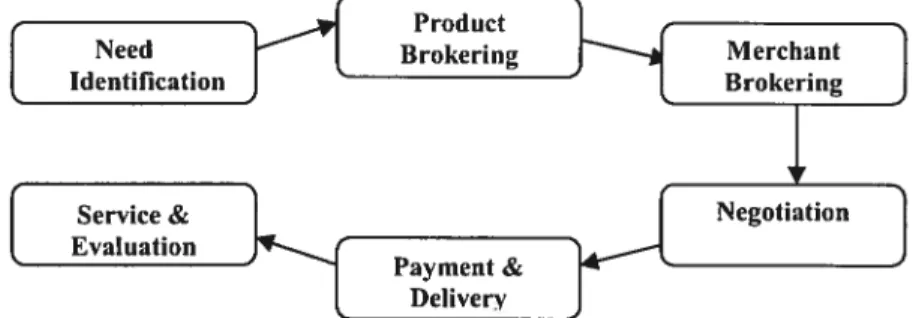
With the above mentioned agent functions, we use the CBB model to relate the agent functions with consumer buying behavior. Proposed by [Guttman et al., 1998], the Consumer Buying Behavior (CBB) model is the most popular, forrnally categorized and accepted model involving in buying and selling behavior, which stemmed from traditional marketing research. CBB has six steps as shown in figure 2.6.
• Need Identification
This stage characterizes the consumer becoming aware of some unmet need. Within this stage, the consumer can be stimulated through product information[Guttman et aÏ., 1998]. The consumer keeps on receiving the update market information such as product advertising by email or notification, and will be stimulated to identify his need.
Figure 2.6: Consumer Buying Behavior Model
After the Need Identification stage, the need has been identified, based on the retrieved product information, the consumer decide what to buy with a critical evaluation. Usually, the consumer specifies his request for the product, the agent will feedback with the expected product list accordingly afier an evaluation based on the consumer’s criteria set.
• Merchant Brokering
Combined with the Product Brokering stage deciding what to buy, this stage decides whom to buy from. The consumer made a critical evaluation based on the retrieved merchant information and consumer’s criteria, and chooses a merchant. Sometimes it is possible to change the product decided in the Product Brokering stage because of the merchant brokering [Pivk and Gams, 2000].
• Negotiation
This stage is to determine the terms of transaction. Transaction terms include price, product character, delivery, payment term, and warranty, but the most important term is the price. The price is an evaluation of ail the factors to a specific product. It can be a condition to change the other negotiation terms. The consumer and the supplier reach an agreement on a single or multiple terms of the transaction to maximum their utility function based on intended gain.
• Purchase and Delivery
This stage can either signal the termination of the negotiation or occur sornetime afierwards[Guttman et aï., 199$]. Sometimes the payment or delivery terms may influence product and merchant brokering. The delivery can be either online if the goods are in electronic format or by additional shipment if the goods are in physical format.
• Service and Evaluation
This stage includes afler sales service provided by the merchant and an evaluation of overali buying experience and decision.
2.4.3 Agent Examples in CBB
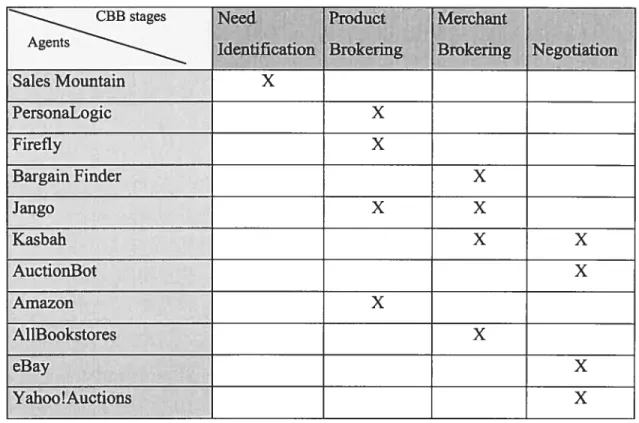
Table2. 1 shows the agents in the specific stage of existing e-commerce systems. We focus on the first four stages in CBB, which are Need Identification, Product Brokering, Merchant Brokering and Negotiation. Because these stages are more complicated, most of the existing agents are characteristic functional in these stages. The agents in the other two stages will be ignored in discussion here.
Table 2.1: Agents in CBB
CBB stages Need Product Merchant
Agents
Identification Brokering Brokering Negotiation
Sales Mountain X PersonaLogic X Firefly X Bargain f inder X Jango X X Kasbah X X AuctionBot X Amazon X AllBookstores X eBay X Yahoo!Auctions X
+ Agents in Need Identification stage in CBB
Agent in this stage is to help the user to find what lie needs.
Sales Mountain [URL1 1]
Sales Mountain is a place for comprehensive and current sales information, both nationally and locally. The agent in Sales Mountain helps user who are looking for
certain items put “on sale”, it filters the information according to the user’s constrains and sending notification to the user. The slogan of the Sales Mountain is “find what’s on SALE at your favorite local stores—The Nation’s Instant Sales’ Guide”. The agents in Need Identification stage include discogs.com, netcactus.com, and querybot.com/shopping [Turban et al., 2002].
+ Agents in Product Brokering Stage in CBB
The agents in the brokering stage have the following functions: information retrieval and processing, leaming from user, prediction of user requirements, matching merchant, and collaborating with other brokers, etc[He et aÏ., 2003]. The following are some examples.
PersonaLogic
The PersonaLogic guides the consumer through a large feature space in order to narrow down the products best meet the consumer’s needs. Based on the consumer’s constrain, it can filters unwanted products. It made product recommendations base on the prioritization of attributes such as price and delivery time by consumer [Guttman et al., 1998] [Pivk and Gams, 2000] [Turban et al., 2002].
firefly
Firefly uses a collaborative filtering process to build profiles of people who visit a web site. firefly provide users with a “passport” that identifies them when they visit sites participating in the Firefly program and recommend products/services to them. Based on people’s preference, Firefly help marketers predict what customers were likely to want next. This allows marketers to reach out to consumers with a customized pitch that was cheaper and more effective than mass advertising [Turban et al., 2002].
Amazon [URL1O]
Amazon provides very powerful product brokering function. It has different kind of search service: key word search, advance search, and power search. Furthermore, every buyer is provided with a “Shopping Card” to help the buyer to organize his potential
shopping package. Except that, it provides recommendation service, and the buyer needs only to input his request to get his recommendation.
+ Agents in Merchant Brokering Stages in CBB
Agents in this stage is to find the best merchant to match the product found in the Product Brokering stage.
Bargainfinder [URL_1 3]
BargainFinder is the pioneering agent in merchant brokering. Just input the CD name, the agent will look in several online vendors and retum the price. It had a big problem: the online vendors can “block” the agent’s visiting if they don’t want to compare the price [Turban et aÏ., 2002].
Jango [URL_14]
Jango is a newer agent who can solve this problem caused by Bargainfinder. Because the vendors can identify the agent by identifying the site where the request was originated, Jango creates request from the user’s site, therefore the vendors can’t identify if the visiting is from the agent or from the user, therefore it can’t “block” this visiting. Compared with Bargainfinder, Jango has more product categories and it provides product review. Jango also functions in product brokering stage. There are some other agents having the similar function with Jango, they are Inktomi Shopping Agent, My Simon(mysimon.com) and Junglee [Guttman et al.,1998] [Turban et al., 2002].
AllBookstores [URL32]
AllBookstores provides the merchant with the lowest price for the new and used books after compares at least 2 dozen suppliers. First, the book information must be input; then, when the button “Compare” is pressed, it search the cheapest supplier. If the “buy” button is pressed, it will link the user to the supplier’s site.
The negotiation stage is a good place to employ the agent technology. The agent functions on client profile building, decision making, and so on. The purpose of the negotiation here is to find current available information, and to bid base on its owner’s utility and counterpart’s utility to maximize its owner’s benefit.
Kasbah
Kasbah is a multi-agent system which is a web site where users go to buy and sell things. The users create buying and selling agents with appropriate protocol, send them in the marketplace. These agents negotiate in the marketplace, with one of three negotiation strategies: anxious, cool-headed, and frugal, which corresponding to a linear, quadratic, or exponential function, respectively. The most interesting in Kasbah is its multi-agent aspect [Chavez and Maes, 1996].
AuctïonBot[URLY 5]
AuctionBot is a general purpose internet auction server in the University of Michigan. The users create new auctions by selecting from a set of negotiation type, and give the pararneter such as participation number, discrete goods, bid mies, clearing schedule, closing conditions, quote schedule, allocation policy. The allocation policy dictates which agents transact, and at what price(s) [Wunnan et al., 1998].
eBay [URL_33]
The buyer clicks the “Continue Bid” button, and then inputs his user ID and password. He inputs his maximum bid, then click the “Place Bid” button. The agent in the eBay will bid on behalf of the user, and it will increase every time 0.5$ until the user’s maximum bid. If somebody outbids you, you will fail in this auction; if you outbid the others, you will win and receive an email from eBay.
Yahoo!Auctions [URL34]
There are two kinds of bidding. The first kind of bidding is the Automatic bidding [URLO4]. The buyer inputs its maximum bid, user ID, and password, and than the agent in Yahoo!Auctions will bid on behalf of the buyer. The increment of the bid depends on
the range ofthe bid. For example, if the bid is $0.01-$0.99, the increment is $0.05, and if the bid is $100.00-249.99, the increment is $2.50. At the end of the bidding, if the buyer wins, the supplier will inform him by email. The second kind of bidding is straight bidding [URL_35], where the buyer specifies the exact bid, and there is no increment in it.
2.5 Discussion
From the above description, we can see that agents have played many functions, and especially in e-commerce area, agents have already involved in the first four stages of the CBB mode!. However, with the development of the agent technology, more new agents will involve in the e-commerce. For example, the Utility Based Agent introduced in section 2.3.1 is the more recent kind of agent in classification of [Russe!! and Norvig, 1995], where it is claimed to be the most intelligent agent.
The Utility Based Agent has some advantages compared with the other types of agent. One of these advantages is that it can give its utilities to the important attributes of an object, and ignore the unimportant attributes; therefore, it can focus on the relative attributes to maximize its profit. In another word, it can focus on the already known probability, and ignore the unknown probability (e.g., utility=0), which is very useful in negotiation because a negotiator usually has uncertainty toward his counter negotiator. The other advantage ofUtility Based Agent is that it is very flexible and it can give utility to any attribute; therefore, it can be used in the simple case such as deciding the specific seller to buy from among different sellers by their attributes such as “delivery time (D)”, “after sales service (A)”, “payment term (P)”; furthermore, it can also be used in the complicate case such as in a negotiation which involves the history based data, probability, user’s gain and loss, relation with the sellers, concerns as if it is urgent or not, andSO forth.
At the earlier stage of e-commerce, the agents mainly act for the product brokering and the merchant brokering. They collect useful information, and analyze information with
the help of many intelligent search engines. These agents adopt intelligent methods such as customization when they process the information. Thus they can satisfy the user with useful information.
Although there are some negotiation agents in current e-commerce, they are flot functional enough. This is because that negotiation involves cornplicated decision making, and the agents in the product brokering and merchant brokering stages can not solve the problem in negotiation stage. If we adopt the Utility Based Agent, as well as the decision making agent and monitor agent mentioned in section 2.4.1 and 2.3.3, into e commerce negotiation, it can negotiate on behaif on the user and free the user from the complicate and time consuming negotiation. Based on this opinion, we create a utility based client negotiation agent, and we find it work well in implementing its user’s mission and freeing its user from negotiation.
Cliapter 3
E-commerce Negotiation
In this chapter, we will introduce the negotiation. We will define the negotiation, describe the negotiation types, discuss the onhine negotiation state, problem and develop trend.
Negotiation appears in every day. E-commerce is the most popular area where negotiation functions. When people make a deal, negotiation is a must. In our discussion, we mainly focus on autonomous e-commerce negotiation which means the negotiation online guided by agent.
In the view point of business, e-commerce can be classified into business-to business(B2B), and business-to-consumer(B2C). B2B means commercial transactions, in which companies buy from or seil to other companies online. It is more than purchasing that it involves supply chain management. B2C implies the commercial transactions, in which companies sel! products or service such as online banking, online consultant and so on to consurners for own use.
In the following, we introduce the negotiation types.
3.1 Negotïation Classification
[Dholakia et al., 2002] [He et al., 2003] classify e-commerce negotiation into two categories: B2C and B2B. We follow their classification to take a view at the negotiation tactics. B2C negotiation can be sub-classified into auction and bilateral negotiation. B2B negotiation can be sub-classified into buyer-controlled negotiation and seller-controlled negotiation. We will discuss these two classifications in the following sections.
3.1.1 B2C Negotiation Classification
B2C in e-commerce is the commerce model of business to consumer. The business here means the companies(e.g., seller) which seli products, the consumer means the individual
consumer(e,g, buyer). Given this B2C model, we discuss the B2C negotiations in the foïlowing.
3.1.1.1 Auction
Definition of auction An auction is a market institution with an explicit set of mies determining resource allocation and prices on the basis of bids from the market participants [McAfee and McMillan, 1987].
Auctions are the most popular negotiation in e-commerce today. Compared with the traditional auction, e-commerce auction inherits the way traditionai auction goes, but it does not have limitation of the traditional auction (the limitation of the traditionai auction is mainly caused by the problem of the location. Because the Internet makes the world like a viiiage, online auction in current e-commerce consumes less time, and the products to be auctioned are more than before).
With the e-commerce developing, online auction becornes more and more popuiar. They can be grouted into single-side auction and doubie-side auction. The single-side auction means that oniy buyer or seller submits the bid or offer at the sarne tirne. In doubie-side auction both buyer and seller can submit the bid and offer at the same time. The rnost popular single-side auctions are: Engiish auction, Dutch auction, first-price seaied-bid auction and Vickrey (also calied second-price sealed-bid) auction. The double-side auction has the Continuous Double Auction as an example. In the following we will discuss each ofthem.
• English Auction
The bidding price increases tiil there is only one bidder remaining who bids the maximum price, thus the offer will give to this bidder. In this kind of auction, because ail bids are open, the strategy for a bidder is to bid a little more than the current bid of other bidders. The bidder continues to bid tiIl reach his maximum acceptable price.
The English auction is the most common auction form. The word “auction” cornes from Latin “augere” meaning “increase” which is the English auction’s basic principle. An example ofEnglish auction is “Yahoo” auctions “automatic bidding” and “eBay” auction. In “Yahoo” Auction “autornatic bidding”, the bidder tells the auctioneer (e.g. sornebody who monitors this auction) increment value and maximum value he is willing to pay for that product, his bid will automatically increase by his increment during the auction[URLO4].
Dutch Auctïon
The price starts with high by auctioneer, and decreases tili there is a buyer signaIs that he will accept the offer. The Dutch auction is the reverse of the English auction. The difference between these two is that the English auction begins with lower price by the bidder, and the Dutch auction begins with higher price by the auctioneer.
The Dutch auction is famous from the flower market near the airport in Amsterdam, Holland, where near 60% cut flower of the world is sold to other place eveiy year [Dholakia et al., 2002]. Dutch auction is better to be used in the easy evaluated product just as in the Amsterdarn’s flower market auctions, there a big amount of flowers transact
in a quick way.
Dutch auction is also better in the rare product auction. For example the jewellery rnarket adapts Dutch auction. This is because Dutch auction gives only one opportunity to each bidder to bid, when the product is rare, the bidder, afraid of that others may get it, prefers to bid a little higher than his evaluation so that it is more possible to get the term.
• First-Price Sealed-Bid Auction
With this kind of auction, every bidder has only one chance, the bids are flot open. The highest bidder wins. The basic difference between the first-Price Sealed-Bid auction and
the Engiish/Dutch auction is that the bids in First-Price Seaied-Bid auction are flot open, and the bidder has no idea about the other bidders’ bids. Given this situation, the bidder bids base on his evaluation for the product, the estimation of the risk and opinion on other bidders.
The example of the first-price sealed-bid auction is that, it is used in the auction of minerai rights to U.S. govemment owned land, artworks, and real estate [McAfee and McMillan, 1987].
• Vickrey Auction
Aiso known under the name of Second-Price $ealed-Bid, Vickrey auction rule is similar to the first-price sealed-bid, but the winner (i.e., the bidder with the highest bid who will get the offer) should pay the second highest bid instead of his bid. Vickrey Auction exists in theory, but there is seidom example in practice.
• Continuous Double Auction (CDA)
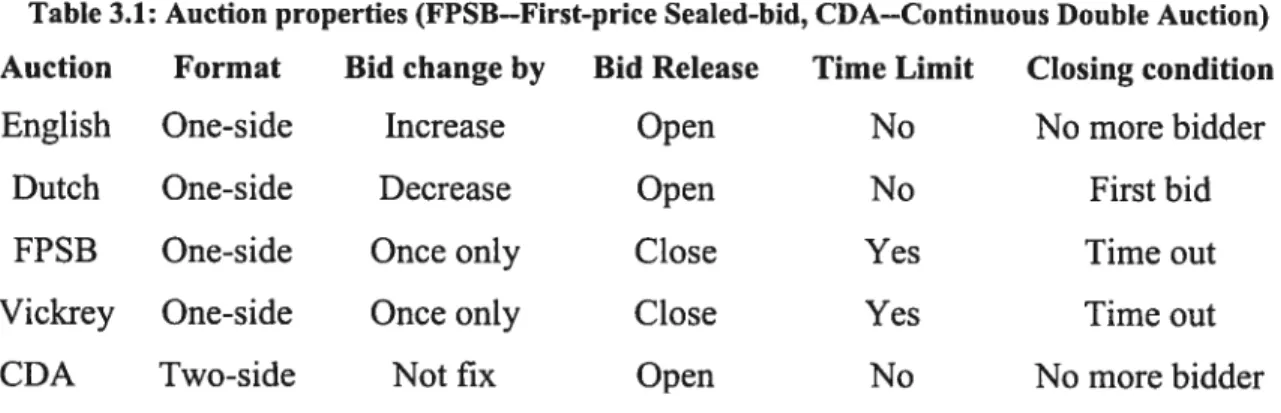
The buyer and seller can give a bid or an offer at any time during a trade period. Michigan auctionBot uses CDA combining with chronological match poiicy [Wurman et aÏ., 1998]. SouthamptonTAC also uses it in its negotiation of “entertainment” in a travel [He and Jennings, 2002]. Referring to [He et al., 2003], tabie3.1 shows the properties of each type of auctions.
Table 3.1: Auction properties (FPSB--First-price Sealed-bid, CDA—Continuous Double Auction) Auction Format Bid change by Bid Release Time Limit Closing condition
English One-side Increase Open No No more bidder
Dutch One-side Decrease Open No first bid
FPSB One-side Once oniy Close Yes Time out
Vickrey One-side Once only Close Yes lime out
CDA Two-side Not fix Open No No more bidder
3.1.1.2 Bilateral Negotiation
Bilateral negotiation involves two parties, buyer and seller, to reach a mutual agreement, it usually concems with multiple attributes contract. There is not a dominant mode for it, but it generally faits into the following three types [Heet aï., 2003]:
• Decision making by explicitly reasoning about the opponent’s behaviour • Decision making by finding the cunent best solution
• Argumentation
The first type, decision making by explicitly reasoning about the opponent’s behaviour, is to explicitly reason its opponent’s objective and behaviour, and find the best way to correspond to the opponent’s behaviour. The second type, decision making by finding the current best solution, is to correspond to maximum the user’s own profit by given its condition and preference, etc.
The argumentation is on the opinion that, in the multi-agent system, agents often have no inherent control over one another and so the only way they can influence one another’s behaviour is by persuasion. In another word, the persuadee may be unwilling to accept the proposai initially and must be persuaded to change its beliefs, goals or preferences so that the proposal, or some variant thereof is accepted. In this case, the minimum requirement for negotiation is for the agents to be able to make proposais to one another
3.1.2 B2B Negotiation Classification
The B2B e-commerce involves the business between company and company. It is different from the B2C e-commerce that the B2C most involves retail sale, the B2B most involves whoÏe sale. Given the difference between B2C and 323, we discuss the negotiation in 32B environment in the following sections.
3.1.2.1 Buyer Controlled Negotiation
The negotiation usually involves the particular product or service specified by the buyer, the buyer designs the maximum price of the item to pay and the sellers bid for the lowest price under the condition that they hope to win. Given this, the market power is shifted to buyer’s side. It is atso called reverse negotiation [Dholakia et aL. 2002].
Buyer controlled negotiation usually are for the great amount of special product that the specific buyer needs only. The buyer specifies the standard and looking for the seller. The examples are the General Electric [URL_l 9] and Boeing Inc. [URL_20].
3.1.2.2 Seller Controlled Negotiation
The seller wants to seil something and sorne buyers bid to win. The aim of this market is to create seller’s market powering the transaction.
The B2C auction strategies can be used in seller controlled negotiation [He et al., 2003]. The example is the freeMarkets run Dutch auctions several times a day in seller controlled markets with many buyers [Dholakia et aÏ., 2002].
3.2 The Development of Online Autonomous Negotiation
The features of personification and autonomy enable agents to simulate the process as it happens aÏready between humans, and hence human negotiation strategies and approaches may be easier to translate to it [Wang et al., 2002].
There are lots effort already put into the research and rnany methods were proposed in the development of the online autonomous negotiation. There are some researches which worthy of being introduced. In the following we discuss them. They are Kasbah from MIT media lab, auctionBot from Michigan University, and the Bazar.
3.2.1 Kasbah
The Kasbah virtual marketplace is an early application in the web where users create autonomous agents to buy and seil goods on the users’ behaves. This kind of earlier negotiation agent is flot smart, what makes Kasbah fundamentally interesting is its mufti-agent aspect—the interaction and competition between the mufti-agents in the marketplace [Chavez and Maes, 1996].
The user creates buying or selling agent and sends it to the market, the agent is given by the parameters about the criteria of the user such as the transaction dead une and the price limitation. The agent goes to the market and does negotiation for its user.
The advantage of the Kasbah agent is that it is proactive, interactive, and competitive. As an early and primitive negotiation model, Kasbah explores and implements a basic negotiation protocol.
One ofproblems ofthe Kasbah agent is its negotiation strategy. It adopts three bidding or offering strategies: linear, quadratic and cubic. In these three strategies, the agent doesn’t leam, it has no idea of its experiefice and its counter negotiator. Moreover, the agent’s strategy does not reflect the agent’s preference, in which the relation exists between the user and his counter negotiator.
3.2.2 Mïchigan AuctïonBot
According to [Wurman et al., 1998], AuctionBot is a price based negotiation platform, it supports a wide variety of auction types. For example, it supports the English auction,