HAL Id: hal-02541842
https://hal.inria.fr/hal-02541842
Submitted on 14 Apr 2020
HAL is a multi-disciplinary open access archive for the deposit and dissemination of sci-entific research documents, whether they are pub-lished or not. The documents may come from teaching and research institutions in France or
L’archive ouverte pluridisciplinaire HAL, est destinée au dépôt et à la diffusion de documents scientifiques de niveau recherche, publiés ou non, émanant des établissements d’enseignement et de recherche français ou étrangers, des laboratoires
A new modular implementation for Stateful Traits
Pablo Tesone, Stéphane Ducasse, Guillermo Polito, Luc Fabresse, Noury
Bouraqadi
To cite this version:
Pablo Tesone, Stéphane Ducasse, Guillermo Polito, Luc Fabresse, Noury Bouraqadi. A new mod-ular implementation for Stateful Traits. Science of Computer Programming, Elsevier, 2020, 195, �10.1016/j.scico.2020.102470�. �hal-02541842�
A new modular implementation for Stateful Traits
Pablo Tesonea,b,∗, Stéphane Ducassea, Guillermo Politoc, Luc Fabresseb, Noury
Bouraqadib aInria Lille-Nord Europe
bIMT Lille Douai, Univ. Lille, Unité de Recherche Informatique Automatique, F- 59000 Lille, France
cUniv. Lille, CNRS, Centrale Lille, Inria, UMR 9189 - CRIStAL - Centre de Recherche en Informatique Signal et Automatique de Lille, F-59000 Lille, France
Abstract
The term traits is overloaded in the literature. In this work we refer to traits as the stateless model and implementation described in Schaerli et al. articles.
Traits provide a flexible way to support multiple inheritance code reuse in the context of a single inheritance language. The Pharo programming language includes the second implementation of stateless traits based on the original version of Schaerli’s one. Even if it is the second iteration of such an implementation, it presents several limitations. First, it does not support state in traits. Second, its implementation is monolithic i.e., it is deeply coupled with the rest of the language kernel: it cannot be loaded nor unloaded. Furthermore, trait support impacts all classes, even classes not using traits. In addition, while the development tools include full support to work with classes, trait support is more limited because classes and traits do not present the same Metaobject Protocol (MOP). Finally, being monolithic and integrated in the language kernel, it is difficult to extend this current implementation.
This article describes a new modular and extensible implementation of traits: it is easily loadable and unloadable as any other package. In addition, classes not using traits are not impacted. Finally, this new implementation includes a new and carefully designed Metaobject Protocol (MOP) that is compatible with both classes and traits. This allows one to reuse existing tools as they do not require special support for traits. Then, following the semantics proposed for stateful traits in [BDNW07], we present a new implementation of stateful traits. This
∗Corresponding author
implementation is an extension of our new modular implementation.
We implemented modular traits using specialized metaclasses as our main lan-guage extension mechanism. By replacing the implementation we reduced the Pharo Language Kernel size by 15%. This model and implementation are used in production since Pharo7.0 (January 2019).
Keywords: traits, dynamic languages, meta-object protocol, language extension, modular languages, metaclass specialization
1. Introduction
The literature contains multiple concepts and implementations named traits. Several languages offer traits: Self [HCCU91], Scala [Ode07], SEDEL [BO18], Groovy [K¨07], Fortress [ACH+05] and Scheme [FFF06]. Language extensions have been also provided for Java [BD16,BDSS13], Javascript [vCM11]. However each of these implementations has its own semantics and considerations. More-over, these implementations introduce conflicting definitions.
In this paper, we use the term traits to refer to traits as in Schaerli’s et al. articles [SDNB03,DNS+06,NDS06] and implementation [Lie04].
"A trait is a set of methods, divorced from any class hierarchy. Traits can be composed in arbitrary order. The composite entity (class or trait) has complete control over the composition and can resolve conflicts explicitly, without resorting to linearization."[DNS+06]
In addition, since several variations have been made such as Stateful traits
[BDNW07] and freezable traits [DWBN07], we refer to this original model and
implementation as stateless traits. A variation of such an implementation has been introduced in Perl [RSTT04] and PHP [Loc15]. Moreover, SEDEL [BO18] presents a related toy implementation of traits into a static-typed language that adds first class traits.
Traits provide support for multiple inheritance code reuse in the context of a single inheritance language. They solve the diamond problem [Sak89, Sin94,
MA09]. Duplicated methods are extracted as traits which in turn are shared by many classes. Traits are also composable to form other traits [SDNB03,DNS+06,
Sch05,NDS06]. Reppy and Turon propose a way of reducing boilerplate code by
the use of traits [RT07] without the use of metaprogramming.
The Pharo programming language [BDN+09] includes an implementation of stateless traits [Lie04]. It is the reference implementation described in the liter-ature [SDNB03, DNS+06, NDS06]. The Pharo 6.0 implementation of stateless
traits fully reimplemented the original version [SDNB03, Lie04]; however this second version has still several limitations at the implementation and model lev-els.
Implementation level. The implementation is monolithic: it is deeply coupled with the rest of the language kernel (Section 2). This prevents Pharo de-velopers to easily load, unload or update the trait support. It restricts the flexibility of the system and makes the bootstrap process more complex [PDF+14]. In particular, classes not using traits have an useless dependency with the Trait implementation (e.g., unused instance variables, conditional code).
Model level. The implemented model presents limitations: Stateless traits do not support state definition in traits. The programmer is then forced to define accessors and initialization in all the classes using a trait that requires this instance state [BDNW07]. Stateful traits were proposed to extend traits with state support [BDNW07]. In this alternative, instance variables, accessors and initialization needed by a trait are defined in the trait itself but at the ex-pense of a change of instance layout (using dictionary-based access instead of index access). However, stateful traits were never fully implemented or adopted because of the complexity of modifying the existent monolithic implementation, and updating all the existing tools.
The impact of the introduction of a new concept in an existing model and system is often not taken into account explicitly by language designers. Based on more than 10 years of experience working with traits, this paper reflects on the introduction of traits in an existing system and its impact on existing tools. Doing so, we analyse the design space of the classes and traits API in terms of the Metaobject protocol1exposed to the developer.
This paper describes modular implementation for introducing traits in a pro-gramming language as well as a new implementation of stateful traits based on 1A Metaobject protocol is an API allowing to access and often reflectively change implementa-tion aspects otherwise hidden. Kiczales and al. [KdRB91] defines it as: “First, the basic elements of the programming language - classes, methods and generic functions - are made accessible as objects. Because these objects represent fragments of a program, they are given the special name of Metaobjects. Second, individual decisions about the behavior of the language are encoded in a protocol operating on these Metaobjects - a Metaobject protocol. Third, for each kind of Metaob-jects, a default class is created, which lays down the behavior of the default language in the form of methods in the protocol.”
the semantics defined in [BDNW07]. The contributions of this work are:
• An analysis of the limitations of the current Pharo stateless traits imple-mentation. This analysis goes beyond missing state support (Section2). It shows that traits should be polymorphic2 to classes and expose a revisited API to support tool builders.
• A new implementation of stateless traits that is compatible with classes by design, providing a smooth integration with existing programming tools (Sec-tion3). This implementation solves the key issues of the compatibility be-tween classes and traits from an API perspective. We redesigned a structural Metaobject Protocol [KdRB91] for classes and traits that takes into account the origin of the methods.
• A new Metaobject Protocol supporting a system with and without traits, both supporting stateless and stateful trais (Section4).
• A new implementation of stateful traits. We extend our new implementa-tion with stateful traits following the semantics described in the literature
[BDNW07]. This new implementation is the foundation of the trait model
of Pharo 7.0 and is used in an industrial setup (Section5).
• A modular implementation. Our new implementation is modular since it is a loadable and extensible library. This new library also ensures that classes not using traits are not impacted because it relies on specialized metaclasses3 that encapsulate the integration with traits. This modular im-plementation gives developers the freedom to load or unload this language feature bringing flexibility to the development team [CS17]. It is even pos-sible to modify the library without affecting the whole environment (Sec-tion6).
Compared with the current stateless trait model and implementation in Pharo 6.04, 2An object exposes the same API than another one with which it is polymorphic. In Java terms, two objects implement the same interface, so they are polymorphic.
3A metaclass is the class of a class, thus a metaclass defines how a class behaves. Using a spe-cialized metaclass allows one to modify the properties of classes [KdRB91,DF94,FD99]. Meta-classes provide the flexibility to assign different properties to different Meta-classes [BLR98,DSW05,
RBY+05].
4This paper always refers to version 6.0 of Pharo when talking about the current implementa-tion. And it refers to version 7.0 of Pharo when describing the new implementaimplementa-tion.
our solution improves the modularisation of the existing code base: It simplifies it – it reduces the size of the Pharo Language Kernel by 15%. It speeds up the overall bootstrapping process of 30% [PDF+14] for building reduced language kernels [Pol15] (Section 7). Section8presents the considerations in the different design decisions, and Section9compares our solution with related works. Finally, Section10concludes this paper.
2. Limitations of Stateless Traits and its Monolithic Implementation
The stateless traits implementation presents a series of limitations. The analy-sis of stateless traits limits presented by Bergel et al. in [BDNW07] still applies to the traits implementation in Pharo6.0. We do not repeat it in this article but focus on the practical problems that the Pharo development team faced over the years. 2.1. Vocabulary
In this paper, we use the following common vocabulary: A class defines or has methods and instance variables. Each class has a single superclass it inherits from. A class creates instances. Stateless traits define methods. Stateful traits in addition define instance variable. Traits cannot create instances.
Whenever a class is composed out of a trait, we say that the class uses the trait. A class using a trait has access to the methods defined in the trait.
We use the term traited class to refer to classes using traits, and normal classes to classes without traits. For reading convention, we prefix all traits’ names with a T (e.g.,TNamed). Finally, the origin of a method is the class or the trait that defines it.
2.2. Overloaded Metaobject Protocol
In normal classes, methods originate from two possible locations: Either they are defined in the class itself or they are defined in one of its superclasses i.e., they are inherited. The Metaobject Protocol (MOP) of classes was originally designed to cope with this difference: there exist two families of messages to access the methods [GR89]:
• One family of messages is used to access the methods defined in the class (i.e., se-lectors,methods).
• The other family, with messages prefixed with “all”, is used to access both defined and inherited methods (i.e.,allSelectors,allMethods).
This separation of messages provides a clear interface showing where the methods are defined.
To make traits and traited classes compatible with existing tools the previously carefully designed MOP has not been revisited and redesigned, but simply over-loaded. For example, the method methods was modified to return not only the methods defined in the class itself but also the ones contributed by the used traits. This is a problem because certain navigation operations such as editing the orig-inal method suddenly became a lot more complex to define. To identify method origin, the traited class MOP was modified to provide a new family of methods prefixed with “local” (i.e.,localSelectors,localMethods). Similarly to non-prefixed versions of the methods, methods prefixed with “local” return the elements defined in the class itself. However, while the intention was good, the resulting situation is not satisfactory since, having two different MOPs forces tools to use conditional code to detect whether it is manipulating a normal or a traited class to use the correct corresponding API.
2.3. Trait and Class Coupled Implementation
In the current version, the trait implementation is strongly coupled inside the default Pharo metaclass model [BDN+09]. There is no way to have class without trait support. This is a problem because the vast majority of classes do not use traits. In Pharo 6.1, 127 classes use traits over the 6486 classes of the system: it means that less than 1.95% of the classes are using traits5.
The original objective of having a coupled implementation was to take advan-tage of trait reuse capabilities. However, the result, while working, makes the code logic more complex. The code that actually integrates traits with classes is embed-ded inside the standard Pharo metaclasses: Behavior, ClassDescription, Classand Metaclass. Internally, these classes manage both the case where a class uses traits and where they do not, mostly using conditionals. Listing1shows an example of conditional code that is scattered all over the language kernel.
5Note that this computation does not take into account the fact that when a class root of inher-itance uses a trait, its subclasses should be counted as using traits too.
Behavior>> isComposedBy: aTrait
"Answers if this object includes trait aTrait into its composition"
aTrait isTrait ifFalse: [ ^false]. ^selfhasTraitComposition
ifTrue: [selfincludesTrait: aTrait ] ifFalse: [false]
Listing 1: Mixed up implementation in Kernel
This scattered implementation prevents Pharo developers from unloading the trait implementation, or having a smaller kernel [Pol15]. This impacts bootstrap time and future kernel evolution possibilities.
Requirements for the new implementation. Since modularity can be interpreted in different ways, we define precisely what are the requirements for a modular trait implementation. The implementation should be modular in the sense that:
• Classes not using traits should not depend on the trait implementation. • Trait support should be loadable on demand.
• To support traits, the existing hierarchy of a class should not be modified. To benefit from trait support, a class should not be forced to inherit from a special class. This is particularly important since Pharo only supports single inheritance.
From these requirements we see that the granularity of trait support is a class and its subclasses. It means that using a trait in a class only affects this class and its subclasses but not any of its superclasses.
2.4. Wrong Unified API between Traits and Classes
In the second attempt to propose a better API for traits and classes, changes were made by the community to propose a more unified API to the classes Trait andClass. The initial intent was that a class could understand the same messages than a trait, in particular to avoid tool builders to write complex conditional code. However, this attempt did not fully deliver its objectives. In Pharo6.0 implemen-tation, Trait andClass were both users of the trait TBehavior. The traitTBehavior defined common methods that allowed one to use traits and classes polymorphi-cally in some situations, for example, in the compiler.
However, traits and classes did not provide a fully compatible API. Indeed some class behavior such as instance creation did not make sense on traits. Several
methods inTraitclass were cancelled (i.e., throw an error) or had an incompatible implementation. Since traits cannot be instantiated, their methodbasicNewthrew an exception to avoid the creation of instances.
Other meaningless messages contained a valid but arguable implementation (e.g., superclass returningnil). This inconsistent and possibly accidental behaviour produced lots of conditional code in existing tools to manage such special cases and avoid misbehaviours.
Listing 2 shows an example of conditional code. This implementation is needed because by design traits returnnilto the messageinstanceSidewhere classes return the instance side class6; and traits by design did not support class variables. That’s why, first the developer had to guard against that the argument can be a trait and that the messageinstanceSidereturnednil, then that the argument can be a class trait (a trait applied on the class of a class), to finally be sure that the argu-ment is a class. Listing2shows that the situation is even more confusing since it usesclsinstead ofclassOrTraitfor the temporary variable name.
As shown, having a non carefully thought API brings more complexity in the methods having to deal with classes and traits.
AbstractTool>> browseClassVarRefsOf: aClass | cls |
cls := aClass instanceSide. cls isTrait
ifFalse: [selfsystemNavigation browseClassVarRefs: cls ] Listing 2: Conditional code in tools
3. A Modular Stateless Trait Implementation
Implementing a modular and extensible trait implementation presents a num-ber of challenges that we solved in the new implementation presented in this arti-cle.
We start with an example of stateless traits as defined by Schärli et al. [SDNB03] (Section 3.1). We remind the reader with the stateless trait composition alge-bra (Section 3.2). Then, since Pharo’s kernel is derived from Smalltalk’s one, 6In Smalltalk, when a programmer defines a class, the system internally creates a class (e.g.,
Person) instance of another class that is created automatically: its metaclass calledPerson class. The messageinstanceSidemakes sure that when sent to a class or its metaclass, the class is re-turned.
ReadLineStream hash TReadLine readLine hash read @{hashFromReadLine -> hash} TStream read write hash @{hashFromStream -> hash} readLine | line char | line := ''. [char := self read char isEndOfLine] whileFalse: [ line := line + char ]. ^ line
hash
^ self hashFromReadLine bitAnd: self hashFromStream
Uses trait Trait Name provided methods required methods
Figure 1: The classReadLineStreamimplements a stream that read lines by using two traits TRead-LineandTStream.
to ease understanding, we explain and sketch a simplified version of the original Smalltalk kernel that does not include traits [GR89] (Section3.3). Using the first example, we present our modular stateless trait implementation (Section3.4). 3.1. Studying a Trait Usage
To make the implementation description clearer, Figure 1 describes a trait-based implementation of a Stream library using the mechanisms described by Schärli et al [SDNB03]. This library gives the ability to read lines. It reads from a stream until an end of line character is encountered.
The class ReadLineStream uses two traits: TStream and TReadLine. The first trait provides the behaviour required to read from the stream and the second one the ability to handle the reading of text lines.
The traitTReadLine defines two methods readLine, and hash, and it requires the methodread. We define theTReadLinetrait as follows:
Traitnamed:#TReadLine
uses: {}
The traitTReadLinedoes not use of any other traits. Theuses:clause specifies the trait composition (empty in this case).
The interface for defining a class as composition of traits is an extension of the interface used to define classes without using traits. The extended interface includes theuses: clause to express the trait composition. Here we see how Read-LineStreamuses the traitsTReadLineandTStream:
Objectsubclass:#ReadLineStream
uses: TReadLine@ {#hashFromReadLine−>#hash} +TStream@ {#hashFromStream−>#hash} instVarNames:’’
....
In this example, both traits provide an implementation of hash, producing a conflict as the resulting class cannot have twice the same method. In our example, we decided to have an implementation of hash inReadLineStream that combine both implementations existing in the traits. This implementation replaces the ex-isting ones in the traits but requires to have access to them. So, we are applying an aliasing operation to the methods contributed by the traits. Thehashfrom TRead-Line is renamed as hashFromReadLine and the one from TStream is renamed as hashFromStream. The aliasing of the methods is done through the use of the alias operand (@) in the trait composition of theReadLineStreamclass.
3.2. Stateless Trait Composition Algebra
The implemented trait composition follows the semantics defined in the orig-inal traits implementation [SDNB03]. The trait composition algebra allows us to compose different traits to form a more complex one. Therefore, classes can use different traits along with a trait composition algebra to express the conflict resolution [DNS+06]. This section can be skipped by a reader knowing trait com-position. It is a short presentation of the three traits composition operators that are loaded when the traits library is loaded.
Sequence. The sequence operation allows us to combine two or more existing traits. The traits used in the sequence does not have any priority. The result-ing combination has all the methods defined in the original traits. Sequences are created using the+operator.
Objectsubclass:#AnExampleClass
uses:T1+T2+T3 instanceVariableNames:’’
...
Alias Method. When two or more traits implements the same method, a conflict occurs. One alternative to solve the conflict is to alias one of the conflicting meth-ods with another name using the @ operator. This operator receives an array of associations (->) of the new name and the original name. The resulting composi-tion has all the methods defined in the trait but with the aliased one renamed.
Objectsubclass:#AnExampleClass
uses:T1@ {#new−>#original} instanceVariableNames:’’
...
Remove Method. When a conflict exists between two methods, another alternative to solve it is to remove one of the conflicting methods. The - operator allows us to generate a new composition with a method removed. This composition includes all the original methods but the removed one.
Objectsubclass:#AnExampleClass
uses:T1−#aMethodToRemove
instanceVariableNames:’’
...
3.3. Starting with a Implicit Metaclass Kernel
Object Color Object class Color class Class ClassDescription Metaclass Metaclass class Class class ClassDescription class Behavior class instance of inherit from methodDictionary superclass instanceFormat Behavior
Figure 2: Initial and traditional Pharo kernel (without traits). The class kernel is decomposed in
Behavior(root of all metaclasses and classes),ClassDescription, andClassandMetaclass.Behavior
defines the essence of a class (superclass, a method dictionary and a way to describe instance state [BDN+09]).
The original Smalltalk kernel that does not include traits [GR89, BLR98,
BDN+09]. Figure2presents the original metaclass kernel of Pharo and Smalltalk, its ancestor: as in a traditional implicit metaclass kernel [BDN+09]. Each class has its own metaclass e.g., the classObjectis instance of the metaclassObject class. The metaclassObject classis instance of the metaclassMetaclass. The metaclass Metaclassis instance of the classMetaclass classand the metaclassMetaclass class is instance of the classMetaclass. Object classinherits fromClass.
Figure 3 presents a simplified view of this original kernel. We compacted theBehavior, ClassDescription, ClassandMetaclassin the classClassas in CLOS
[KdRB91]. Each class in the system is a first class citizen with a superclass, a
method dictionary, and an instance format description. The system uses meta-classes to provide a common behaviour to the meta-classes.
Object Object class Metaclass Class class instance of inherit from methodDictionary superclass instanceFormat Class
Figure 3: Simplified traditional Pharo kernel (without traits). We compacted theBehavior, Class-Description,ClassandMetaclassin the classClassas in CLOS [KdRB91].
This simplified kernel has no support for traits. Using this simplified kernel we will present the modular implementation of stateful traits that solves the problems mentioned in Section2.
3.4. Extending the Kernel with a Modular Stateless Trait Implementation
This section presents the extension of the kernel (Figure 3) to support traits as well as an instantiation of this meta-model to represent the trait-based stream library (Figure1).
To support stateless traits in a modular way, our implementation takes advan-tage of the existing metaclass support shown in Figure 2. As shown in Figure4, we define a specialized metaclass namedTraitedMetaclassto be used by the traited classes and by theTraitclass [KdRB91,BLR98]. With the new implementation:
• Classes using traits are not instances ofMetaclassbut ofTraitedMetaclass. • Normal classes are kept unmodified, as instances ofMetaclassclass.
Following the trait model [Lie04], a traited class uses a trait and its traited metaclass uses the corresponding class-side trait. Indeed when a trait defines a method sending a message to its class side, the corresponding method should be available on the composing class [BLR98]. Therefore, traits are defined and applied as a pair of traits (a trait and its class side trait) to a given class.
All the behaviour related to traits is removed from the kernel classes and it is available in the trait implementation. Neither Metaclass, Class or Behavior have
Object
Object class
Metaclass Class class
instance of inherit from
Trait Trait class
uses Traited Metaclass methodDictionary superclass instanceFormat Class Simplified Pharo kernel Trait support Stream Library TStream ReadLineStream TStream classSide TReadLine ReadLineStream class TReadLine classSide
Figure 4: The traits TStreamandTReadLineare instances ofTrait, their class-side counter parts,
TStream classSideandTReadLine classSideare instances of the classTrait class. The class Read-LineStreamis an instance of the classReadLineStream classwhich is an instance of the new meta-classTraitedMetaclassthat manages classes using traits.
any trait related behaviour. As depicted on Figure4, all the trait behaviour is de-fined inTraitedMetaclassand in the traited classes. Adding the required behaviour toTraitedMetaclassis a simple operation becauseTraitedMetaclassis a regular class in the environment, it extends the behaviour ofMetaclassthrough inheritance and overriding. However, integrating the behaviour to support traits into the system is not so simple. We need to integrate this new implementation supporting traits into classes and add new methods and instance variables to handle the trait composi-tion.
In our implementation (presented in this article), the additional behaviour needed in traited classes is factorized in trait named TTraitedClass. This trait is automatically included in all metaclasses of traited classes, as shown in Figure5. By doing so, the kernel classes of Pharo do not have any reference to the trait implementation and the parallelism of classes and metaclasses hierarchies is pre-served.
Using this model, we achieve modularity by packagingTrait, TraitedMetaclass andTTraitedClassin a separate trait library that is imported explicitly by users.
Object
Object class
Metaclass Class class
instance of inherit from
Trait Trait class
uses Traited Metaclass methodDictionary superclass instanceFormat Class Simplified Pharo kernel Trait support Application TStream ReadLineStream TStream classSide TReadLine ReadLineStream class TReadLine classSide TTraitedClass
Figure 5: The final model of our implementation, including the TTraitedClass trait. This trait provides the required behaviour to handle traits to the classes using traits.
4. Designing a Modular Metaobject Protocol
To have a good integration between the tools and the underlying model, the Metaobject Protocol has to be clear and consistent. To allow the extension of ker-nel language with a modular trait implementation, the MOP should also support new extensions in a coherent and compatible fashion.
We propose a MOP with two sets of messages, a set for handling locally de-fined elements and other set to handle contributed elements. An element is either a method or an instance variable.
• The locally defined elements are the elements directly defined in the class or trait.
• The contributed elements are the elements defined elsewhere but neverthe-less accessible to the class or trait.
Considering the language kernel without traits, the contributed elements of a class are the set of inherited elements. When the trait library is loaded, the contributed elements of a traited class are the list of both inherited elements and elements defined in the used traits. Note that such contributed element list should
take into account traits semantics: the fact that local elements (from composer class or trait) take precedence over contributed ones (inherited or used traits).
In the example ofReadLineStream(Figure1), theReadLineStreamclass has the locally defined methodhash, the contributed methods inherited from Object(for exampleequals:andprintString) and the contributed methods from using the TRead-LineandTStreamtraits.
The Pharo MOP is extended with new messages to support traits. For the sake of clarity, we only present hereafter the messages related to methods. However, the same structure is applicable to other elements of a class such as its instance variables. Note this Metaobject Protocol is shared by classes and traits:
methods. Returns all the methods defined locally in the given class.
selectors. Returns all the method selectors defined locally in the given class.
contributedMethods. Returns all the methods contributed to this class. In the
case of normal classes, it includes the methods in the class hierarchy. In the case of traited classes, it includes the methods in the class hierarchy and the methods contributed by the traits.
contributedSelectors. Returns the selectors of those methods returned by
con-tributedMethods.
allMethods. Returns all the methods, including the locally defined methods and
the contributed methods.
allSelectors. Returns the selectors of those methods returned byallMethods.
originOfMethod: aMethod. This message returns the class or the trait that defines
aMethod.
Using this Metaobject protocol, tools access elements in a class and elements contributed to a class without caring about their origin. The origin of an element is used when modifying the original element (i.e., the method defined in a trait in case of a trait). Moreover, this MOP delegates the resolution of the elements to the corresponding class by exploiting polymorphism to have a modular language extension. The contributed elements of a normal class (without using traits) are calculated by the method defined inClass(Listing3) and the contributed elements of a traited class are calculated by the method defined inTTraitedClass(Listing4). So, the implementation in the kernel classes (such asClass) does not know how to
include the contributions from traits, this is resolved in the code implemented in TTraitedClass.
Class>> contributedMethods
"Returns the methods in the superclass chain"
^selfsuperclass allMethods Listing 3: Implementation in Class
TTraitedClass>> contributedMethods
"Concatenate the methods from superclass and from the used traits"
^selfsuperclass allMethods ,self
traitComposition allMethods
Listing 4: Implementation in TTraitedClass
4.1. Traited Class Definition
To have a real modular trait implementation, the syntax to define traited classes is also loaded with the trait library. Listing5and6show the definition of a traited class (ReadLineStream) and a normal class (Color). As shown, the definition is not the same for traited classes and normal classes, the class definition should be extended to introduce trait composition.
As the definition of classes in Pharo is done through message-sends to the superclass, a new definition is added as an extension method to Class. This ex-tension method allows all the classes in the system to generate new subclasses using traits. A module in Pharo is able to contribute to existing classes through extension methods [PDFT17]. When a module containing extension methods is loaded, the extension methods are installed in the target class.
"Defining the class Account without traits"
Objectsubclass:#Color
instanceVariableNames:
’red blue green alpha’
classVariableNames:’’
package:’Colors’
Listing 5: Class definition without traits
"Defining the class Employee using a trait composition"
Objectsubclass:#ReadLineStream
uses: TReadLine@ {#hashFromReadLine−>#hash} +TStream@ {#hashFromStream−>#hash} instanceVariableNames:’’
classVariableNames:’’
package:’Streams’
Listing 6: Class definition with traits
Each class in the system is responsible to regenerate its own definition. So, each class is asked its definition through thedefinitionmessage, the new class definition syntax is specialized adequately in theTraitedMetaclassandTTraitedClass.
5. Supporting Stateful Traits
In addition to offer a modular and extensible stateless trait implementation, our discussions with the designers and engineers of the Moose analysis platform show that there was a real need for traits with state. Moose is a software and data analysis platform [NDG05]. Moose meta models represent a lot of data about the language elements and the stateless traits could not capture this important aspect of the representation.
Following the semantics proposed for stateful traits in [BDNW07], we ex-tended our new implementation presented in previous sections to support state in traits. This new implementation demonstrates the extensibility of our implemen-tation design by introducing the support of instance and class variables in traits and their initializations.
5.1. Studying a Stateful Trait Example
Before presenting this extension, we first present an example extracted from the original stateful article [BDNW07]. Figure 6 shows this example about an implementation of a SyncStream. This class extends the behaviour of a stream adding a lock to synchronize its accesses.
SyncStream isBusy hash lock TSyncReadWrite initialize syncRead syncWrite hash read write @{hashFromSync -> hash} TStream initialize read write hash @{hashFromStream -> hash} syncRead | value | lock acquire. value := self read. lock release. ^ value syncWrite | value | lock acquire. value := self write. lock release. ^ value isBusy ^ lock isAcquired hash ^ self hashFromSync
bitAnd: self hashFromStream initialize
super initialize. lock := Lock new
Uses trait Trait Name provided methods required methods
Figure 6: The classSyncStreamuses two traitsTSyncReadWriteandTStream.
The class SyncStream uses the traits TStream andTSyncReadWrite. The trait TSyncReadWrite defines the variablelock, three methodssyncRead,syncWriteand hash, and requires methodsreadandwrite.
Following the specifications of the stateful trait model, our new implementa-tion extends the mechanism for defining traits. We define theTSyncReadWritetrait as follows:
Traitnamed:#TSyncReadWrite
uses: {}
instVarNames:’lock’
The trait TSyncReadWrite does not use any other traits and it defines an in-stance variable namedlock. Theuses: clause specifies the trait composition (empty in this case), andinstVarNames:lists the variables defined in the trait (i.e., the vari-able, lock). The interface for defining a class as a composition of traits is the same as with stateless traits. Here the definition of SyncStream using the traits TSyncReadWriteandTStream:
Objectsubclass:#SyncStream
uses: TSyncReadWrite@ {#hashFromSync−>#hash} +TStream@ {#hashFromStream−>#hash}
instVarNames:’’
....
In our implementation all the instance variables are accessible to methods de-fined in the class and in all the used traits. In the example, the method isBusy implemented inSyncStreamaccesses the instance variable defined in TSyncRead-Write. The final set of variables of a traited class contains the variables defined in its hierarchy and the variables defined in the used traits.
When a traited class is defined, its class and instance variables are computed using a simple flattening process. Then methods contributed by its used traits are then re-compiled into this traited class. During this compilation process, the index of the instance variables are recalculated to integrate all the variables defined in the class and contributed by inheritance and used traits.
Note that an implementation based on method copy-down7 as used in lan-7Copy-down is a way to minimize code repetition in mixin implementation. "Methods that do not access instance variables or super are shared in the mixin. Methods that access instance variables may have to be specialized for the invocation, where the instance variable access is cus-tomized according to the structure of instance of the invocation."[BBG+02] The idea is that since
the only method impacted by changes to object internal representation (due to mixin application) are methods accessing fields, it is enough to copy down in the subclasses (classes that represent mixin application to another class) the methods accessing fields. All other methods are then appli-cable to all the mixin application classes.
guages supporting mixins could be evaluated in the future [BBG+02,BC90]. The stateful trait composition algebra extends the one of stateless traits (see Section 3.2). It includes operations required to resolve conflicts arising with in-stance variables following the semantics described in [BDNW07]. The extended operations are: renaming (@@) and removing (--) of instance variables.
5.2. Conflict Resolution
When two or more instance variables with the same name exist in the trait composition, there is a conflict. A conflict occurs in two different scenarios: (1) the instance variables have the same name but their values cannot be shared or their usage is incompatible, and (2) the instance variables should be merged as they contain the same information and it is required to be shared by both traits.
Traitnamed:#TNamed
uses: {}
instanceVariableNames:’name’. Traitnamed:#TWithRole
uses: {}
instanceVariableNames:’name’. Objectsubclass:#Person
uses:TNamed+ (TWithRole@@ {#name−>#roleName}) instanceVariableNames:’’
classVariableNames:’’
package:’APackage’
Listing 7: Example of conflict resolution by renaming thenameinstance variable of TWithRole
intoroleName
Listing7illustrates the first scenario. ThePersonclass uses two traits (TNamed and TWithRole), both traits define and use thename instance variable. However, these instance variables are used in incompatible ways. The TNamedtrait uses it to store the person name, but the TWithRole trait uses it to store the role name. In this scenario the instance variables should be renamed. During the flattening process both instance variables (name and roleName) are created and the meth-ods in TWithRole using the original conflicting variable are rewritten to use the new name (roleName). Renaming is achieved using the @@ operator on TWith-Role. This operator creates a new composition with the renamed instance variable definition.
Traitnamed:#TNamed
uses: {}
instanceVariableNames:’name’. Traitnamed:#TFormalName
uses: {}
instanceVariableNames:’name prefix’. Objectsubclass:#Person
uses: TNamed+ (TFormalName−−#name) instanceVariableNames:’’
classVariableNames:’’
package:’APackage’
Listing 8: Example of conflict resolution by merging the two nameinstances variables coming fromTNamedandTFormalName
Listing8shows a conflict solved through the merge of two instance variables. In this scenario, both traits (TNamedandTFormalName) are using anameinstance variable. Both are using their variable to store the person name, so their usage is compatible. Having a duplicated variable with the same information is not desired. To solve this problem, we use the--operator to remove the instance variable from TFormalName, leaving the one defined inTNamed. During the flattening process only one instance variable is created and all the methods are using it.
A non-conflicting scenario. This third scenario is about two traits with different instance variables but storing the same information. This is not a conflict, but merging the instance variables is desired to not duplicate the same state. To solve this scenario one of the instance variables is renamed and then the result is merged with the other trait. To merge them, we are removing the nameinstance variable from the resulting composition.
Listing9shows this scenario. The traitTDisplayNamestores the person name in thepersonNameinstance variable whileTNamedstores it in an instance variable named name. As said before, it is not a conflict, but the information should not be duplicated in two different instance variables. To merge, we first rename the instance variable inTDisplayNamefrompersonNametoname. This will replace all the users of personName withname. Then as both traits have the nameinstance variable, we remove it from one of the traits. The resulting class will have only one instance variablename.
Traitnamed:#TNamed
uses: {}
instanceVariableNames:’name’. Traitnamed:#TDisplayName
uses: {}
instanceVariableNames:’personName’. Objectsubclass:#Person
uses: TNamed+ ((TDisplayName@@ {#personName−>#name})−−#name) instanceVariableNames:’’
classVariableNames:’’
package:’APackage’
Listing 9: The instance variables inTNamedandTDisplayNameare merged to use the same instance variable.
5.3. Trait Initialization
The initialization of instances of traited classes is an important point to ad-dress [BKM12, Nad17]. The question is how to compose and invoke the initial-ization of used traits from the composite one (either a trait or a class). In particular we do not want that the class initialization has to be changed each time a used trait (of the traits the class uses) changes. We propose a simple strategy to support this. The initialization of the instance variables defined in traits is performed through the redefinition of the initializeTraitmethod. Each trait requiring the initialization of instance variables overrides this method. If a trait does not include this method, an empty method is generated during the flattening process. When an object of a traited class is instantiated, the initialization code on the class and the initialization code on the trait is executed. Listing10shows how the traitTTraitedClass, which is applied to the class side of all the traited classes, redefines thenewmethod.
A scenario that should be treated correctly is when a traited class uses a trait composition including several traits with initialization code. In this scenario, all the initialization code should be installed in the traited class. To avoid name clash, the differentinitializeTraitmethods are aliased, and a newinitializeMethodcalling the aliased methods is generated. In Listing 11 the initializeTrait method invokes the initializeTSyncReadWriteandinitializeTStreammethods that have been generated by the aliasing.
TTraitedClass>> new ^selfnew
initialize; initializeTrait; yourself.
Listing 10: Implementation ofnewmethod.
SyncStream>> initializeTrait
selfinitializeTSyncReadWrite.
selfinitializeTStream.
Listing 11: GeneratedinitializeTrait.
5.4. Metaobject protocol support
Our proposed MOP supports stateful traits following the same idea expressed for stateless traits. The same operations described for methods are applicable to instance variables. As said in Section4, the instance variables related operations have the following semantics:
slots. Returns all the instance variables8defined locally in the given class.
contributedSlots. Returns all the instance variables contributed to this class. In
the case of normal classes, it includes the instance variables in the class hierarchy. In the case of traited classes, it includes the instance variables in the class hierarchy and the instance variables contributed by the traits.
allSlots. Returns all the instance variables, including the locally defined methods
and the contributed methods.
originOfSlot: anInstanceVariable. Returns the class or trait defining the instance
variable.
Using this MOP, the tools are implemented without differentiating if they are using normal classes, traits or traited classes.
6. Implementation Details
We validated our solution by replacing the implementation of traits in Pharo 7.0. This implementation is part of the Pharo 7.0 deployed and released version. It includes the implementation described in Section3, the proposed MOP in Sec-tion4, and the proposed extension in Section5.
This implementation requires the solution of a number of technical issues. The solutions are presented in this section.
6.1. Polymorphic Classes and Traits
To simplify the integration of traits with existing tools, we represent traits as regular classes. They are subclasses of the Trait class. The only restriction we impose by design is that traits cannot be extended by means of inheritance. The commonTraitsuperclass allows one to easily specialize trait specific methods and implement a clean interface polymorphic with regular classes. For example, the Traitclass overridescompile: to compile and install a method locally in a trait and then propagate such a change to all its users.
6.2. Implementing an extensible algebra
Trait Composition <<abstract>> Empty Composition Sequence AliasMethod ...
(a) Original stateless trait operations.
Trait Composition <<abstract>> Remove Slot Rename Slot Merge Slot ... Slots Operations <<extension>>
(b) Stateful trait operation algebra extensions.
Figure 7: Extensible trait composition algebra: the original stateless trait operations are imple-mented in an extensible way (a) and are extended to support stateful trait operations
To be able to extend the set of operations supported by the system, we im-plemented the operations of the trait composition algebra as a set of first-class objects. We represent such first-class objects as classes subclasses of TraitCompo-sition. TraitCompositiondefines methods to handle the composition. We represented first the stateless operations as shown in Fig. 7a. Then such set of operations is extended to support the stateful traits operations and resolution of conflicts (Sec-tion5).
6.3. Flattening and Method Dictionaries
Our solution handles the construction of classes in the same way as the Pharo 6.0’s implementation: the methods contributed by a trait are flattened in the class
method dictionary. So, the virtual machine executes the methods defined in the class, the ones contributed by the used traits and the inherited ones using the default VM method lookup, without execution penalties. However, traited classes have two method dictionaries.
• A first method dictionary is used to store all the methods visible to the VM. This method dictionary is internal to the implementation and it is not acces-sible through the MOP.
• To be fully compatible with the existent tools, traited classes and meta-classes have an additional method dictionary with only the methods defined in the class. The second method dictionary is the one that is accessible through the MOP. This way the outside visible method dictionary has the same semantics than the method dictionary in a normal class. Any change to the available methods of the class is reflected in the hidden method dic-tionary.
Each method installed in the traited class knows the original trait where it was defined. This information is stored in the additional properties of the method. The access to this information is performed through the class metaobject protocol, and the existence of this additional property is an implementation detail that is again not part of the MOP and as such not exposed to the user.
In the Pharo implementation we see that the memory impact of having a sec-ond method dictionary is minimal. This secsec-ond method dictionary shares the sym-bols and methods with the default one. The implementation only requires extra memory for the collection itself. Measuring the Pharo 7.0 image the average num-ber of local methods in the 545 classes using traits is 2. So, the average impact per class is of 32 bytes in 32 bits images, and 64 bytes in a 64 bits image (4 in-stance variables for the dictionary itself and 2 inin-stance variables for each of the 2 associations used).
6.4. Supporting Live Programming
Pharo is a live programming environment. It allows the developer to modify its code while executing it. So, any change made to a trait should be propagated to the users of that trait. To do so, a trait knows all its users and when it is modified (i.e., method or instance variable modification) it then notifies its users. Also the users of a trait are subject to change (i.e., a class is defined to use the trait, or a class using the trait is modified not to use it any more).
This propagation mechanism is implemented using two strategies. First, the notification mechanism is implemented through an announcement event system. The announcement event system generates events whenever the system is mod-ified. All the tools requiring to react to these changes are subscribed to these events. Second, a trait intercepts its modifications by overriding the correspond-ing methods in theTraitclass.
The announcement event system is used to update the users of a trait when a traited class is created, modified or removed from the system. The modification overriding is used when a trait is modified (i.e., methods or instance variables) and the users should be updated.
6.5. Class Builder and Installer Replacement
The creation and installation of classes in Pharo are performed by a class Builder and a class Installer. These system components perform all the operations needed to create, modify and install the classes in the environment. To be able to have a modular implementation of traits, some changes to them were needed.
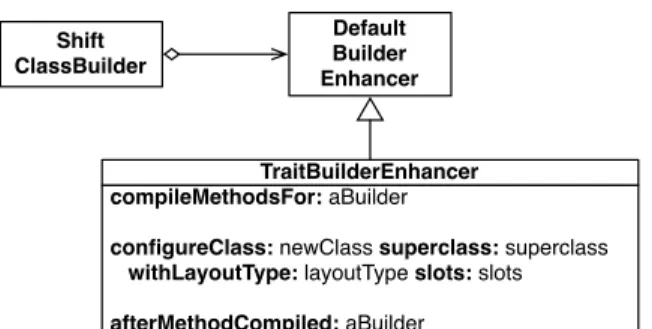
Our solution replaces the class builder and installer with variants that support extensions. It implements a new set of class builder and installer, called the Shift-ClassBuilderandShiftClassInstaller. By default, this new implementation does not have support for traits, as it is intended to be included in Pharo kernel without traits. However, this class builder allows the extension of the building process via plugin, called enhancers.
The class builder and installer are configurable using different builder en-hancers [TPF+18]. The builder enhancers contribute to the building and instal-lation process (Figure8). It also allows one to configure the class of the metaclass to use and how it is created. The implementation of traits is managed by a specific enhancer: TraitBuildEnhancer. It configures the class and metaclass to have the in-stance variables added by the traits, it also installs all the methods provided by the trait composition. This is performed through the overriding of the defaults actions of the build enhancer.
7. Validation
As said before, the solution has been applied to Pharo 7.0. This allows us to minimize the language kernel that needs to be bootstrapped in the creation of a
Shift ClassBuilder Default Builder Enhancer compileMethodsFor: aBuilder
configureClass: newClass superclass: superclass withLayoutType: layoutType slots: slots afterMethodCompiled: aBuilder
TraitBuilderEnhancer
Figure 8: The ShiftClassBuilder, used by our implementation, is extensible through pluggable build enhancers
Pharo 7.0 image9. The Pharo 7.0 image is created after each commit from scratch, generating a Pharo image from source code [PDF+14]. In the image generation process, a small image is bootstrapped. This image contains the minimal language kernel to be able to load code. After this minimal image is created all the libraries and tools are loaded, including the new trait implementation. This image is the one that is shipped.
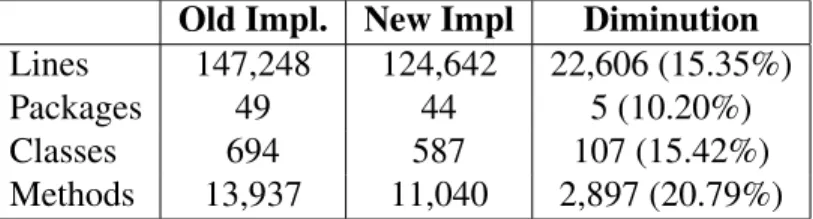
Removing Traits from Kernel. One of the objectives implementing trait support as a library was to remove the trait support from the Pharo language kernel. The language kernel includes all the elements needed to load new pieces of code and to execute Pharo code. The removal represents a diminution of 22,606 lines of code (15.36%) and 2,897 methods (20.79%)10. Table1shows a detail of removed code. Having a smaller kernel allows us to create smaller images with only the required functionality.
Removing the trait implementation from the language kernel speeds up the bootstrap process of 30%, going from an initial bootstrap process of 16 minutes to a bootstrap process of 11 minutes. On the contrary, the time to load the libraries has increased of only 1 minute. Producing an overall speed up of 20% for the whole process11.
9A Pharo image is a platform agnostic binary file containing all the objects representing the system: classes of the complete Pharo distribution. A default image consists in around 6000 classes and 120,000 methods.
10This information was extracted from the Pharo Github repository calculating the difference before and after applying the changes.
11Information recovered from the Pharo CI Server Statistics
Old Impl. New Impl Diminution Lines 147,248 124,642 22,606 (15.35%)
Packages 49 44 5 (10.20%)
Classes 694 587 107 (15.42%)
Methods 13,937 11,040 2,897 (20.79%)
Table 1: Reduction of code after removing traits from Pharo Language Kernel
About traits and classes polymorphism. The previous implementation tried to de-fine a polymorphic API for classes and traits. It leads to ad-hoc situations where while both entities offered the same API, the developers had still to be aware that he manipulated a class or a trait (for example, it does not make sense to display the superclasses of a trait). It produced unnecessary conditional code to differentiate traits and classes. This problem is not only present in the kernel, but also in all the tools and libraries manipulating traits and classes of the new implementation.
Some of the tools affected are the compiler (Opal), version managers (Epicea and Monticello), code navigation (GT-Spotter), modeling framework (Ring) and class browser and editor (Nautilus and Calypso). The new implementing repre-sents a reduction of 6,557 lines of code distributed in 89 packages. This impact is visible in the language kernel, but it is more important when analyzing the full system.
Moose. Moose is a software and data analysis platform [NDG05]. Since its ver-sion 7.0 it uses stateful traits as a key basic brick for modeling languages (Java, Pharo, PostgreSQL, PowerBuilder, Ada, VisualBasic...) and performing software evolution analyses. The core of Moose defines 123 stateful traits representing elementary program concerns. Such traits are then reused to represent different language and language constructs. This is not a real validation but Moose latest version is a heavy user of stateful traits.
8. Discussion
We discuss now the impact of the new implementation and revisit some design decisions.
8.1. Tool Support
Modern IDEs are composed of many dedicated tools. Pharo offers out of the box: message browsers, a cross referencer, navigation tools, package/class browser, change browser, advanced object inspectors, debuggers, automatic com-pletion, VCS support, and static quality rule engines to name a few.
A loadable trait implementation should include all the resources and modifi-cations needed by the tools to fully support them. Due to the fact that our traits are polymorphic to classes, we are able to remove most of the conditional code in the tools. Some tools should be adapted to use the new Metaobject Protocol for normal and traited classes. However, this topic is still an ongoing effort, as a definitive integration requires modifying existing tools and most of the tools are not prepared to be extended or to allow inclusion of pluggable components. The same consideration is applicable to the new class definition needed by traits. There exists tools that parse the class definition syntax, expecting to receive a given for-mat. These tools should be modified to allow an extensible syntax or to use the messages exposed in the MOP of the classes.
The work left for a definitive integration in Pharo is out of the scope of this work and it will take a couple of years. It is related to the overall quality im-provement of existing tools. Pharo is a complex platform composed of about 400 packages and aggregating several subprojects. As such modifying all the required elements is a continuous process requiring time, since such process should always provide useful versions to the users of the platform. This work will be handled with the Pharo community and its industrial consortium.
8.2. About design
In our solution we decided to separate the implementation of traits from the kernel classes through the use of a different metaclass for traited classes. This way all the trait related behaviour is loaded as a library. Other possible alternative is having an extensible metaclass in the kernel of the language. However, making an extensible metaclass in the kernel requires having a more complex kernel than having a simpler implementation.
As explained when presenting our solution (Section3.4), we have decided to define the behaviour requiring to implement traits in a trait, namedTTraitedClass, that is included whenever a traited class is created. TheTTraitedClasstrait includes all the methods that should be overridden in the Class class to support traited classes. By doing so, we allow one to have the ability to inherit from any class in the system and this without modifying theClassclass.
Our solution extends the existing MOP with messages to calculate the origin of class elements. This decision makes the tools independent of the reuse mechanism used. If a given tool wants to modify the definition of an element, the defining class is easily reachable and modifiable.
We decided to have the definition of traits as classes. Another alternative is the definition of traits as independent objects. As it is desirable to have polymorphism between traits and classes to share tool support, they should implement the same MOP. Taking advantage of traits being classes allows a simple implementation of the shared Metaobject Protocol.
We have decided to have two different method dictionaries. By doing so, the VM uses the method dictionary with the flattened traits, and the tools only see the methods through the MOP. This decision creates a separation between the runtime model expected by the VM and the logical model exposed by the tools. Also by restricting the tools to use the method dictionary with the local defined method only, allows us to reuse the implementation of all the methods in Classclass; as these methods expect the method dictionaries to only have local defined methods. Our solution requires a modified version of the class builder and installer. This version allows the extension of the class building process.
9. Related Work
Other languages, such as Scala [Ode07], Rust [MKI14], Groovy [K¨07] or Self [HCCU91] implement traits as a part of their language kernel. They are integrated in the language and cannot be unloaded. In addition traits in Scala, Rust and Self do not support the same composition semantics than traits defined
in [SDNB03,DNS+06]. Their implemented semantic is closer to Mixins [BC90].
There are languages, such as Javascript [Fla97,vCM11], Python [Lut01] and Racket12, that also implement traits in a loadable library. However, these imple-mentations have been developed for a language kernel without trait support. So, there is no need to modify the existing language kernel or the given tools. Finally, the tools for these languages do not support traits.
There are solutions to add traits to existing static-typed languages [BO18,
FR04] and specially to Java [BD16, BDSS13, NDRS05]. However, these solu-tions focus on the types and type checking challenges introduced by traits. They modify the compiler or generate equivalent code as the one using traits. They do not provide tools or extensible support for development using traits.
Pharo already includes a working traits implementation [DNS+06], although this implementation is heavily coupled with the kernel of the language, making impossible to make it a loadable library [Lie04].
Talents are instance specific traits. The early prototype implementation [RBN12] provides ways of expanding Pharo through a loadable library, but this solution has a bigger impact in the performance as the lookup of methods is solved in the image without taking advantage of the performance optimizations of the VM. In addi-tion, talent methods are defined as plain strings passed as arguments to methods and there is no tool support of any kind.
Razavi et al. [RBY+05] already extended an existing language through the definition of custom metaclasses. However, they applied such solution to imple-ment Adaptive Object Models. They do not apply the solution to modify the reuse mechanisms available in the language.
Cazzola et al. [CS17] also provided support to modify the semantic of the language and the reuse mechanisms through dynamic loadable modules. How-ever, their solution is centred on a modular interpreter architecture. They modify the language modifying the interpreter of it. This solution is not applicable for performance reasons.
Bouraqadi et al. [BLR98, Bou04] show how classes are extended in a reflec-tive language using metaclasses. Metaclasses are then used as an extension mech-anism to add new properties to class in a per-class basis. We leverage also meta-classes to implement traits as they did for example with Mixins. Differently from them, we also analyse the impact of changing the current trait implementation in the programming environment and its provided tools. We also introduce a modu-lar reflective MOP that prevents new language extensions to modify the existing runtime keeping compatibility.
Malayeri et al. presents CZ [MA09]. CZ is an alternative to traits to solve the diamond problem. It uses an alternative way of combining classes extending the multiple inheritance with restrictions and imports. However, this solution is centred in the development of a language and does not provide tools or a runtime library.
Tesone et al. [TPF+18] shows a general architecture to implement modular extensions to a programming language preserving the performance while running in a single inheritance VM. It shows how a modular design of the underlying mechanisms (i.e., class builder) supports the introduction of mixins, traits, and multiple inheritance. The implementation presented in the present article uses the same idea (i.e., metaclasses) and a modular class building process. However, it is less general and focused on traits. In addition, it solves the more general problem
of class and trait API mismatch and designs an adequate meta-object protocol taking traits into account.
10. Conclusion
In this paper, we addressed the problem of how to modularize a core part of Pharo environment. We took the existing implementation of traits and separated it from the language kernel. Once we had all the mechanisms identified, we pro-posed a novel implementation that uses a specialization of kernel metaclasses to support traits. This new implementation exposes a common MOP with the ex-isting classes. Since this implementation is based on the class implementation mechanisms, it offers a better support for tools support.
The use of our proposed solution and its implementation allowed us to reduce the size and complexity of Pharo Language Kernel. This reduction speeded up the bootstrapping process in 30%. A faster bootstrapping process improves the ability to modify the language, the infrastructure and the tools. This result is crucial for having a community based programming environment that is fully tested and constantly built from sources. Results of this impact are daily noticeably in the results of the Pharo Continuous-Integration process13.
Finally, having a loadable independent stateful traits library also achieves other two goals: (1) it produces an increase of the modularity of the system al-lowing users to select the features used by their applications, and (2) opens the door to the research and implementation of alternative reuse models using similar dynamic and late-bounding techniques. The first objective allows users of Pharo to easily produce tailored configurations for their development and final applica-tions.
Acknowledgements
The following works is supported by I-Site ERC-Generator Multi project 2018-2022. We gratefully acknowledge the financial support of the Métropole Eu-ropéenne de Lille.
References
[ACH+05] Eric Allen, David Chase, Joe Hallett, Victor Luchangco, Jan-Willem
Maessen, Sukyoung Ryu, Guy L Steele Jr, Sam Tobin-Hochstadt, 13https://ci.inria.fr/pharo-ci-jenkins2/andhttps://github.com/pharo-project/pharo/
Joao Dias, Carl Eastlund, et al. The fortress language specification. Sun Microsystems, 139(140):116, 2005.
[BBG+02] Lars Bak, Gilad Bracha, Steffen Grarup, Robert Griesemer, David Griswold, and Urs Hölzle. Mixins in Strongtalk. In ECOOP ’02 Workshop on Inheritance, June 2002.
[BC90] Gilad Bracha and William Cook. Mixin-based inheritance. In Proceedings OOPSLA/ECOOP ’90, ACM SIGPLAN Notices, vol-ume 25, pages 303–311, October 1990.
[BD16] Lorenzo Bettini and Ferruccio Damiani. Xtraitj: Traits for the java platform. Journal of Systems and Software, 131, 07 2016.
[BDN+09] Andrew P. Black, Stéphane Ducasse, Oscar Nierstrasz, Damien Pol-let, Damien Cassou, and Marcus Denker. Pharo by Example. Square Bracket Associates, Kehrsatz, Switzerland, 2009.
[BDNW07] Alexandre Bergel, Stéphane Ducasse, Oscar Nierstrasz, and Roel Wuyts. Stateful traits. In Advances in Smalltalk — Proceedings of 14th International Smalltalk Conference (ISC’06), volume 4406 of LNCS, pages 66–90. Springer, August 2007.
[BDSS13] Lorenzo Bettini, Ferruccio Damiani, Ina Schaefer, and Fabio Strocco. Traitrecordj: A programming language with traits and records. Sci. Comput. Program., 78(5):521–541, May 2013.
[BKM12] Viviana Bono, Jarek Ku´smierek, and Mauro Mulatero. Magda: a new language for modularity. In ECOOP 2012–Object-Oriented Programming, pages 560–588. Springer, 2012.
[BLR98] Noury Bouraqadi, Thomas Ledoux, and Fred Rivard. Safe metaclass programming. In Proceedings OOPSLA ’98, pages 84–96, 1998. [BO18] Xuan Bi and Bruno C d S Oliveira. Typed first-class traits. In 32nd
European Conference on Object-Oriented Programming (ECOOP 2018). Schloss Dagstuhl-Leibniz-Zentrum fuer Informatik, 2018. [Bou04] Noury Bouraqadi. Safe metaclass composition using mixbased
in-heritance. Journal of Computer Languages, Systems and Structures, 30(1-2):49–61, April 2004.
[CS17] Walter Cazzola and Albert Shaqiri. Open programming language interpreters. The Art, Science, and Engineering of Programming, Vol. 1, 2017.
[DF94] Scott Danforth and Ira R. Forman. Derived metaclass in SOM. In Proceedings of TOOLS EUROPE ’94, pages 63–73, 1994.
[DNS+06] Stéphane Ducasse, Oscar Nierstrasz, Nathanael Schärli, Roel Wuyts, and Andrew P. Black. Traits: A mechanism for fine-grained reuse. ACM Transactions on Programming Languages and Systems (TOPLAS), 28(2):331–388, March 2006.
[DSW05] Stéphane Ducasse, Nathanael Schärli, and Roel Wuyts. Uniform and safe metaclass composition. Journal of Computer Languages, Sys-tems and Structures, 31(3-4):143–164, December 2005.
[DWBN07] Stéphane Ducasse, Roel Wuyts, Alexandre Bergel, and Oscar Nier-strasz. User-changeable visibility: Resolving unanticipated name clashes in traits. In Proceedings of 22nd International Conference on Object-Oriented Programming, Systems, Languages, and Appli-cations (OOPSLA’07), pages 171–190, New York, NY, USA, Octo-ber 2007. ACM Press.
[FD99] Ira R. Forman and Scott Danforth. Putting Metaclasses to Work: A New Dimension in Object-Oriented Programming. Addison-Wesley, 1999.
[FFF06] Matthew Flatt, Robert Bruce Findler, and Matthias Felleisen. Scheme with classes, mixins, and traits. In Naoki Kobayashi, edi-tor, Programming Languages and Systems, pages 270–289, Berlin, Heidelberg, 2006. Springer Berlin Heidelberg.
[Fla97] David Flanagan. JavaScript: The Definitive Guide. O’Reilly & As-sociates, second edition, January 1997.
[FR04] Kathleen Fisher and John Reppy. A typed calculus of traits. In Pro-ceedings of the 11th Workshop on Foundations of Object-oriented Programming, 2004.
[GR89] Adele Goldberg and Dave Robson. Smalltalk-80: The Language. Addison Wesley, 1989.


![Figure 3 presents a simplified view of this original kernel. We compacted the Behavior , ClassDescription , Class and Metaclass in the class Class as in CLOS [KdRB91]](https://thumb-eu.123doks.com/thumbv2/123doknet/12434204.334793/13.918.272.634.323.435/figure-presents-simplified-original-compacted-behavior-classdescription-metaclass.webp)