HAL Id: hal-01185670
https://hal.archives-ouvertes.fr/hal-01185670
Submitted on 21 Aug 2015HAL is a multi-disciplinary open access
archive for the deposit and dissemination of sci-entific research documents, whether they are pub-lished or not. The documents may come from teaching and research institutions in France or abroad, or from public or private research centers.
L’archive ouverte pluridisciplinaire HAL, est destinée au dépôt et à la diffusion de documents scientifiques de niveau recherche, publiés ou non, émanant des établissements d’enseignement et de recherche français ou étrangers, des laboratoires publics ou privés.
LINA: Identifying Comparable Documents from
Wikipedia
Emmanuel Morin, Amir Hazem, Florian Boudin, Elizaveta Loginova Clouet
To cite this version:
Emmanuel Morin, Amir Hazem, Florian Boudin, Elizaveta Loginova Clouet. LINA: Identifying Com-parable Documents from Wikipedia. 8th Workshop on Building and Using ComCom-parable Corpora (BUCC), Jul 2015, Pékin, China. �hal-01185670�
LINA: Identifying Comparable Documents from Wikipedia
Emmanuel Morin2 Amir Hazem1 Elizaveta Loginova-Clouet2 Florian Boudin2 1 LIUM - EA 4023, Universit´e du Maine, France
2 LINA - UMR CNRS 6241, Universit´e de Nantes, France
{elizaveta.loginova,florian.boudin,emmanuel.morin}@univ-nantes.fr Abstract
This paper describes the LINA system for the BUCC 2015 shared track. Fol-lowing (Enright and Kondrak, 2007), our system identify comparable documents by collecting counts of hapax words. We ex-tend this method by filtering out document pairs sharing target documents using pi-geonhole reasoning and cross-lingual in-formation.
1 Introduction
Parallel corpora, that is, collections of documents that are mutual translations, are used in many nat-ural language processing applications, particularly for statistical machine translation. Building such resources is however exceedingly expensive, re-quiring highly skilled annotators or professional translators (Preiss, 2012). Comparable corpora, that are sets of texts in two or more languages without being translations of each other, are of-ten considered as a solution for the lack of paral-lel corpora, and many techniques have been pro-posed to extract parallel sentences (Munteanu et al., 2004; Abdul-Rauf and Schwenk, 2009; Smith et al., 2010), or mine word translations (Fung, 1995; Rapp, 1999; Chiao and Zweigenbaum, 2002; Morin et al., 2007; Vuli´c and Moens, 2012). Identifying comparable resources in a large amount of multilingual data remains a very chal-lenging task. The purpose of the Building and Using Comparable Corpora (BUCC) 2015 shared task1 is to provide the first evaluation of ex-isting approaches for identifying comparable re-sources. More precisely, given a large collection of Wikipedia pages in several languages, the task is to identify the most similar pages across lan-guages.
1https://comparable.limsi.fr/bucc2015/
In this paper, we describe the system that we de-veloped for the BUCC 2015 shared track and show that a language agnostic approach can achieve promising results.
2 Proposed Method
The method we propose is based on (Enright and Kondrak, 2007)’s approach to parallel document identification. Documents are treated as bags of words, in which only blank separated strings that are at least four characters long and that appear only once in the document (hapax words) are in-dexed. Given a document in language A, the doc-ument in language B that share the largest number of these words is considered as parallel.
Although very simple, this approach was shown to perform very well in detecting parallel docu-ments in Wikipedia (Patry and Langlais, 2011). The reason for this is that most hapax words are in practice proper nouns or numerical entities, which are often cognates. An example of hapax words extracted from a document is given in Table 1. We purposely keep urls and special characters, as these are useful clues for identifying translated Wikipedia pages.
website major gaston links flutist mar-cel debost states sources college crunelle conservatoire principal rampal united cur-rently recorded chastain competitions music http://www.oberlin.edu/faculty/mdebost/ under international flutists jean-pierre pro-file moyse french repertoire amazon lives external *http://www.amazon.com/michel-debost/dp/b000s9zsk0 known teaches con-servatory school professor studied kathleen orchestre replaced michel
Table 1: Example of indexed document as bag of hapax words (en-bacde.txt).
Here, we experiment with this approach for detecting near-parallel (comparable) documents. Following (Patry and Langlais, 2011), we first search for the potential source-target document pairs. To do so, we select for each document in the source language, the N = 20 documents in the target language that share the largest number of hapax words (hereafter baseline).
Scoring each pair of documents independently of other candidate pairs leads to several source documents being paired to a same target docu-ment. As indicated in Table 2, the percentage of English articles that are paired with multiple source documents is high (57.3% for French and 60.4% for German). To address this problem, we remove potential multiple source documents by keeping the document pairs with the highest num-ber of shared words (hereafter pigeonhole). This strategy greatly reduces the number of multiply assigned source documents from roughly 60% to 10%. This in turn removes needlessly paired doc-uments and greatly improves the effectiveness of the method.
Strategy FR→EN DE→EN
baseline 57.3 60.4
+ pigeonhole 10.7 10.8
+ cross-lingual 3.7 3.4
Table 2: Percentage of English articles that are paired with multiple French or German articles on the training data.
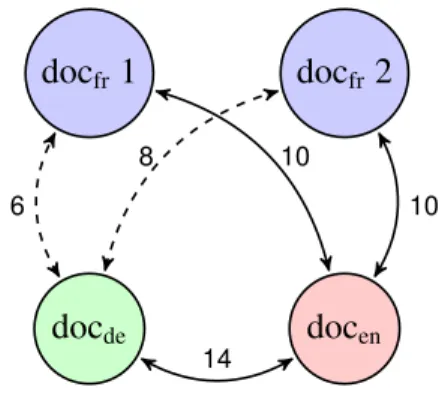
In an attempt to break the remaining score ties between document pairs, we further extend our model to exploit cross-lingual information. When multiple source documents are paired to a given English document with the same score, we use the paired documents in a third language to or-der them (hereafter cross-lingual). Here we make two assumptions that are valid for the BUCC 2015 shared Task: (1) we have access to comparable documents in a third language, and (2) source doc-uments should be paired 1-to-1 with target docu-ments.
An example of two French documents (docfr 1 and docfr2) being paired to the same English doc-ument (docen) is given in Figure 1. We use the German document (docde) paired with docen and select the French document that shares the largest number of hapax words, which for this example is
docfr2. This strategy further reduces the number of multiply assigned source documents from 10% to less than 4%. docfr1 docde docen docfr2 10 6 8 14 10
Figure 1: Example of the use of cross-lingual information to order multiple documents that re-ceived the same scores. The number of shared words are labelled on the edges.
3 Experiments
3.1 Experimental settings
The BUCC 2015 shared task consists in returning for each Wikipedia page in a source language, up to five ranked suggestions to its linked page in En-glish. Inter-language links, that is, links from a page in one language to an equivalent page in an-other language, are used to evaluate the effective-ness of the systems. Here, we only focus on the French-English and German-English pairs. Fol-lowing the task guidelines, we use the folFol-lowing evaluation measures investigate the effectiveness of our method:
• Mean Average Precision (MAP). Average of precisions computed at the point of each cor-rectly paired document in the ranked list of paired documents.
• Success (Succ.). Precision computed on the first returned paired document.
• Precision at 5 (P@5). Precision computed on the 5 topmost paired documents.
3.2 Results
Results are presented in Table 3. Overall, we ob-serve that the two strategies that filter out multi-ply assigned source documents improve the per-formance of the method. The largest part of the improvement comes from using pigeonhole rea-soning. The use of cross-lingual information to 89
FR→EN DE→EN
Train Test Train Test
Strategy MAP Succ. P@5 MAP Succ. P@5 MAP Succ. P@5 MAP Succ. P@5
baseline 31.4 28.0 7.4 32.9 30.0 7.5 28.7 24.9 6.9 29.0 24.9 7.1
+ pigeonhole 57.7 56.4 11.9 − − − 61.6 60.1 12.8 − − −
+ cross-lingual 58.9 57.7 12.1 59.0 57.7 12.1 62.3 60.9 12.8 62.2 60.7 12.8 Table 3: Performance in terms of MAP, success (Succ.) and precision at 5 (P@5) of our model. break ties between the remaining multiply
as-signed source documents only gives a small im-provement. We assume that the limited number of potential source-target document pairs we use in our experiments (N = 20) is a reason for this.
Interestingly, results are consistent across lan-guages and datasets (test and train). Our best configuration, that is, with pigeonhole and cross-lingual, achieves nearly 60% of success for the first returned pair. Here we show that a sim-ple and straightforward approach that requires no language-specific resources still yields some inter-esting results.
4 Discussion
In this paper we described the LINA system for the BUCC 2015 shared track. We proposed to extend (Enright and Kondrak, 2007)’s approach to parallel document identification by filtering out document pairs sharing target documents using pi-geonhole reasoning and cross-lingual information. Experimental results show that our system iden-tifies comparable documents with a precision of about 60%.
Scoring document pairs using the number of shared hapax words was first intended to be a baseline for comparison purposes. We tried a finer grained scoring approach relying on bilin-gual dictionaries and information retrieval weight-ing schemes. For reasonable computation time, we were unable to include low-frequency words in our system. Partial results were very low and we are still in the process of investigating the reasons for this.
Acknowledgments
This work is supported by the French National Re-search Agency under grant ANR-12-CORD-0020.
References
Sadaf Abdul-Rauf and Holger Schwenk. 2009. On the use of comparable corpora to improve SMT perfor-mance. In Proceedings of the 12th Conference of the European Chapter of the Association for Computa-tional Linguistics, pages 16–23, Athens, Greece. Yun-Chuang Chiao and Pierre Zweigenbaum. 2002.
Looking for candidate translational equivalents in specialized, comparable corpora. In Proceedings of the 19th International Conference on Computa-tional Linguistics - Volume 2, COLING ’02, pages 1–5, Stroudsburg, PA, USA. Association for Com-putational Linguistics.
Jessica Enright and Grzegorz Kondrak. 2007. A fast method for parallel document identification. In Hu-man Language Technologies 2007: The Conference of the North American Chapter of the Association for Computational Linguistics (NAACL’07), pages 29–32, Rochester, New York, USA.
Pascale Fung. 1995. Compiling bilingual lexicon en-tries from a non-parallel english-chinese corpus. In Proceedings of the 3rd Annual Workshop on Very Large Corpora (VLC’95), pages 173–183, Cam-bridge, MA, USA.
Emmanuel Morin, B´eatrice Daille, Koichi Takeuchi, and Kyo Kageura. 2007. Bilingual terminology mining - using brain, not brawn comparable corpora. In Proceedings of the 45th Annual Meeting of the As-sociation of Computational Linguistics, pages 664– 671, Prague, Czech Republic, June. Association for Computational Linguistics.
Dragos Stefan Munteanu, Alexander Fraser, and Daniel Marcu. 2004. Improved machine translation per-formance via parallel sentence extraction from
com-parable corpora. In Daniel Marcu Susan
Du-mais and Salim Roukos, editors, HLT-NAACL 2004: Main Proceedings, pages 265–272, Boston, Mas-sachusetts, USA, May 2 - May 7. Association for Computational Linguistics.
Alexandre Patry and Philippe Langlais. 2011. Identi-fying parallel documents from a large bilingual col-lection of texts: Application to parallel article ex-traction in wikipedia. In Proceedings of the 4th Workshop on Building and Using Comparable Cor-pora (BUCC’11), pages 87–95, Portland, Oregon, USA.
Judita Preiss. 2012. Identifying comparable corpora using lda. In Proceedings of the 2012 Conference of the North American Chapter of the Association for Computational Linguistics: Human Language Tech-nologies, pages 558–562, Montr´eal, Canada, June. Association for Computational Linguistics.
Reinhard Rapp. 1999. Automatic Identification of Word Translations from Unrelated English and Ger-man Corpora. In Proceedings of the 37th Annual Meeting of the Association for Computational Lin-guistics (ACL’99), pages 519–526, College Park, MD, USA.
Jason R. Smith, Chris Quirk, and Kristina Toutanova. 2010. Extracting parallel sentences from compa-rable corpora using document level alignment. In Human Language Technologies: The 2010 Annual Conference of the North American Chapter of the Association for Computational Linguistics, pages 403–411, Los Angeles, California, June. Associa-tion for ComputaAssocia-tional Linguistics.
Ivan Vuli´c and Marie-Francine Moens. 2012. Detect-ing highly confident word translations from compa-rable corpora without any prior knowledge. In Pro-ceedings of the 13th Conference of the European Chapter of the Association for Computational Lin-guistics, pages 449–459, Avignon, France, April. Association for Computational Linguistics.