THE NUMERICAL SOLUTION
OFTHE HEAT DIFFUSION
EQUATION VIA LATTICE BOLTZMANN METHOD
A.ATIA12- and
K.MOHAMMEDF
tUniversité d'El-Oued ,
B.P
789, 39000 El-Oued, Algerie 2Laborqtoire Energétique - Mécanique
&
Ingénieries(LEMI),
UniversitéM'Hamed
Bougara, 35000 Boumerdes, Algerie *E-mail : [email protected]
Abstract.
In
the
presentwork,
the solution
of
the
heatdiffusion problem
ispresented using lattice Boltzmann method
(LBM).
Thetwo
dimensional task is considered and the different boundary conditions, specifically theDirichlet
and Neumann are takeninto
account. The D2Q4 lattice modelis
applied.To
check the accuracyof
theLBM
algorithm, the same problems have been solved using theexplicit
variantof
thefinite
difference method. In thefinal
paft of the paper, the results of computations are shown and the conclusions are formulated.Keywords:
lattice Boltzmann method, numerical solution,diffusion
equationINTRODUCTION
Over
the
last decadethe
lattice Boltzmann method(LBM)
has been developed as apromising
computationaltool
to
analyzethe
large
classof
engineering problems, among others, the heat transfer problems. M.Bittagopaland
C. Mishra[1]
applied theLBM
to
solve the energy equationsof
conduction-radiation problems on non-uniformlattices.
H.
Shokouhmandet
al
[2]
studied
fully
developedlaminar
flow
and convective heat transfer between two parallel plates. R.Chaabane etal [3]
investigated the solution of conduction problemswith
heatflux
boundary condition.In
the
present study,the
simplestmodel D2Q4
BGK
was chosento
solvethe
heatdiffusion
equation in 2D square domainwith
different boundary condition.In
the
absenceol
convection andradiation,
for
a 2-D
Cartesian geometry, energy equation is given by:ar
/a2T
a2r\
o*=
a\*z+
un')*
*
Where
a =
j1is
the thermaldiffusivity.
pc(1)
q,k,
p
andc
are the rateof
heat generationper unit
volume, thermal conductivity
of
the
medium, density
and
specific
heat, respectively.T,x,t
denole
the
temperature,spatial
co-ordinates
and time,
respectively.
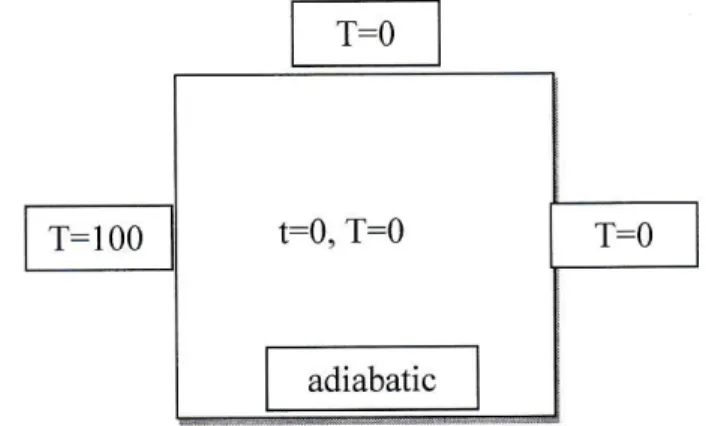
The equation (1) is supplemented by boundary conditions:IInitial
condition,t =0,
T(x.y,0)-
0"CI
uft
ttd",,
=
o, ?'(0,ÿ,t) =
100'c)aisnt
tfi",*
=t,
r(t.y,t)
=o"C
(Z)
I
eouo
side,y =ç,
ufrt*,0,11 -- o"C (adiabattc condilion)Fig. 1
A
square (2D) domainwith
coordinate systemFORMULATION AND KINETIC EQUATION
The
startingpoint
of
theLBM
is
thekinetic
equationwhich
for
a
2-D
geometry is givenby [4]:
âf,(r
t\
:1r)-z+ëi.Vfi7,t)-Ai i-1,,2,3,...m
(3)
ot
where
fi
is the
particledistribution function
denoting the numberof
particles at the lattice nodeI
=
(r(x,
y,z))
attime
t
movingin
directioni
with
velocitye â1 along thelattice
link
Lr
=
etLt
connectingthe
nearest neighborsand
m
is
the
number
of
directions
in
a
lattice throughwhich
theinformation
propagates. Theterm collision
operator
Oi
representsthe rate
of
changeof
fi
due
to
collisions. The
discrete Boltzmann equationwith
Bhatanagar-Cross-Krook(BGK)
approximation is givenby
[4,
s]:
%P+
ë1.vfi@,t)
=
-';v,rr,r1- f:"ù?,t)l
Where
r
is the relaxation timeand;(ea)
i,
11r" equilibrium distribution function. For agiven
application, relaxationtime
r
is
different
for
difierent
lattices. The relaxation timer
for the D2Q4 lattice is computedfrom
[6]:2.a.At
7, - _-r_
"-
Lxz
'2
(s)
For the D2Q4 laltice, the four velocities
ë;
andtheir coresponding
weightsw;
arecalculated
from
[6]:ë,
:
(1,0). cè,
-
(-1,0).c
â,
=
(0,1).c
ën-
(0,-1).c
and
w1=
Wz=
Wz=
w4-
0.25(4)
(6)
€3 e, e2 e4It
is to
be
notedthat
in
the
aboveequation, c
-
A,x/Lt
=
Ay/Lt
andthe
weights satisfy the relation)ll,
w;
=
1After
discretization in 2D, and considering heat generation, Eq. (3) can bewritten
as:fi@
+
A.x,y+
Ly,t
+
Lt) =
fiQ,y,t)[1
-
ar]+
afr"q(x,y,t)
+
wi.Lt.s
(7)
Where S-
,a
pc is the force or source term,wi
is the weightin
corresponding direction, andt)
=
=
a is non-dimensional relaxation time. Notice that theunit
of
S is theunit
of
temperature
('C)
per unit of time.This is
theLB
equationwith BGK
approximation that describes the evolutionof
the particledistribution
functionfi.
The solutionof
the above equationby
LBM
consists oftwo
steps, collision and streaming [6]:The
collision
step is:fi?,
y,t
+
^r)
:
fi@,
y,t)lL
-
al
+
a fr"q (x, y,t)
+
wi.
Lt. SThe streaming step is:
fi@
+
Lx,y
+
Ly,t
+
Lt)
=
fi@,y,t
+
At)
In
caseofheat
transfer problems, the temperature is obtained after summingf;
overall direction [7]:4
r(x,y,t)
-\ft{x,t,t)
(B)i=1
To
process
Eq.
(7),
an
equilibrium distribution function
is
required.
For
heat conduction problems, this is given by:lfq@,y,t)
=
wi.T(x,y,t)
(9)
From
Eqs. (8) to (9), we also have444
\
f:
of*, r,
r>=
lw
t.r
@,t, t)
:
r
@, y,t)
=
|
f,
@,t,
t)
i=1
i=1
i=1(10)
Eq.
(10),
with
definitions
of
temperaturc
T(x,y,t)
and
equilibrium
function \r"q(x,y,t)
givenin
Eqs. (8) and (9), respectively, provide solutionofa
transient heat conduction problem in theLBM.
BOUNDARY CONDITIONS
FOR
LATTICE BOLTZMANN METHOI)
In thefollowing
subsection, different boundary conditionswill
be discussed in detail.l.
The value of thefunction
(temperatue) is given at theboundary:
For
example, temperatureat the
left,
upper andright
boundaries aregiven,
T:Cl:
100'C
atx
=
0,
andT:C2:0'C
at.y
-
h
andx
= l,
(C1
andC2
are constants), sofrom Eq. (8):
(f,(0,t,t)
+
fr(o,y,t)
+
fr(o,y,t)
+
fn@,y,t)
-r
-
ct:100"c
atx:o
lh{r,n,t)+
fz?.h,t)+
ft(x,h,t)+
fq(x,h,t):T
-
c2-0 aty=h
(11)
lhQ,y,t)+
fz(t,y,t)+
fr(t,y,t)+
fn(l,y,t)
-r
-
c2=0 atx=t
Then,
the
unknowns
arefr(O,y,t)
andfr(O,y,t)
for left
boundary,right boundary, because the other distribution functions can be obtained
from
steamingstep.
fr(O,y,t)
and.ft(O,y,t)
can be calculated by usingflux
conservation equation [6]:fr"q(o,y,t)- fr(o,y,t)+
fr"q(o,y,t)-
fz@,y,t)
-o
(12)
Since w;
=
0.25for
all
steaming
direction
and,fr"q
(O,y,t)
-
fzeq(O,y,t)
:
O.2sT:0.2sC1
(fom
Eq. (9)),thenfr(O,y,t) =
0.25C1.+
0.25CL-
f2(0,y,t),
so:fr(o,y,t):
0.5c1
-
fz(o,y,t)
-
50-
fz(o,y,t)
(13)
Similarly
we can obtain:fr(x,h,t)
-
s0
-
1z(0,y,t)
(14)
Hence t\À/o unknowns are specified at the
left
boundary, similar method can be appliedfor
other
boundaries.The
conditions
for
other
boundarieswill
be
given
in
thefollowing
equations without derivations,following
the same procedure as before.F
upper boundary
(f1@,h,t)
-
0.sCz- fz@,h,t)
r---
'"".'.:,
(15)
lf+(x,
h,t)
:
o.sc2
-
fr(x,
h,t)
F
right
boundary
(fr(t,Y,t)
:0.5C2
-
fr(t,y,t)
tr,itl,r:,ri
-
o.sc2
-'iitl,y,a
(16)
2.
adiabatic
boundary condition:
ff:
0: By usingfinite
difference approach.fr
=
0..*
be approximated asT (x .y + 1,t) -T (x,y ,t)
___:_____:-
=
u
\77
)
Ly
It
cansimplified
asT(x,y +
1,t)
-
T(x,y,t),
hence for bottom boundaryy =
Q;fr(x,
t,
t)
+
fz@, 7,t)
+
ft(x,
7,t)
+ f+(x,
7,t)
=
fr(x,o,t)
+
f2Q,0,t)
+
fr(x,o,t)
+
fn@,o,t)
(18)
It
is rational to assume thatf1@,L,t)
*
h@,0,t),
f2@,1,,t)
-
fr(x,0,t)
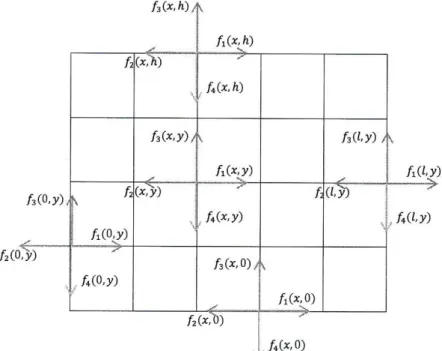
and so on.f,(x' h) fi(o'y) 1,(',à) în@,h) hQ, l.t@,y) t f,(x'v) 1,(Lv) î,
h(0!)
(/,)) f"(x' v) f,c,»
f"(L,v) ) 1^(o,v) fz@'o)t
Â(r o)f,e'
h@,0)Fig. 3 Lattices for 2-D diffusion problem
with
distribution function at the boundarvf,(x' h
RI,SULTS
OFCOMPUTATIONS
A
two
dimensional squa-reslab shown
in
fig.1
subjectedto
a different
boundary conditions. The lengthof
the domainis
100units.
the temperaturedistribution in
theslab
obtained
at time
:
400 units (s),
by
using
LB
and
FD
methods. Thermaldiffusivity is
0.25.Note that
for
stabiiity
conditionsthe
time
stepfor FDM is
0.2. There is no such a problemin
using a time stepof
1.0with
theLBM
method. Hence,LBM
is much faster and efficient than FDM.Figure
2
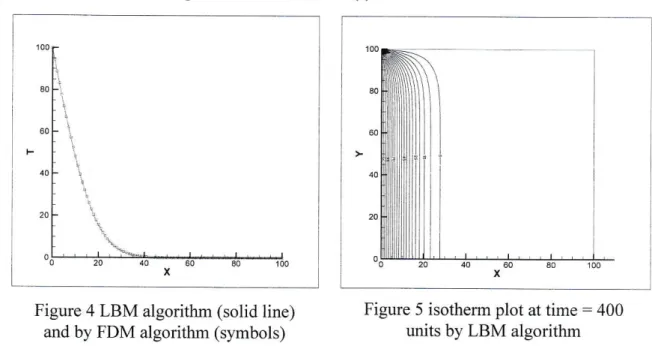
illustrate the
temperaturedistributions
obtainedby
LBM
algorithm
(solidline)
andby FDM
algorithm (symbols) along themiddle line
(y:0.5 H),
whereH
is the highofthe
square.Figure 3 shows the isotherm plot at time
:400
units (s)Figure 4
LBM
algorithm (solid line) and byFDM
algorithm (symbols)20
Figure 5 isotherm plot at time
:
400 units byLBM
algorithmCONCLUSION
The lattice Boltzmann method
for
the 2D heatdiffusion
equation supplemented by different boundary conditions andinitial
condition has been presented. The exemplary tasks have been solvedboth
by the
lattice Boltzmann
method andby the
explicit
scheme
of
thefinite
different method. The good agreementof
the solutions obtainedhas been observed.
RE,FERENCES
B. Mondal and S. C. Mishra, "Lâttice Boltzmann method applied to the solution ofthe energy equations
of the transient conduction and radiation problems on non-uniform lattices." International Journal of
Hedt and Mass Ttct sfer, voJ. 51, pp. 68-82. 2008.
H. Shokouhrnand. F. Jam, and M. Salimpour, "Simulation oflaminar flow and convective heat tratsfer in conduits filled \ÿith porous media using Lattice Boltzmann MÈthod." lnternarional Co nluûicdtions i
Heat and Mass Transfer- vol. 36. pp.378-3 84. 2009.
lll
30
2A
I t-t3l t4l t5l t61 t7l
R. Chaabane, F. Askri, and S. B. Nasrallah, "Application ofthe lattice Boltzmann method for solving conduction problems with heat flux boundary condition," presented at International Renewable Erergy
Congress, Sousse Tunisia, 2009.
S. Stcci, The laxice Boltznxann equatlon: /tr JILlid dynaulcs and belolxd: Oxford university press, 2001. P. L. Bhatnagar, E. P. Cross, and M. Krook, "A model for collisioû processes in gases. I. Small âmp;itude
processes in charged and neutral one-component systems," Pàlsica I review, vol.94, pp. 511, 1954.
A. A. Mohamad, Lattice Boltzrûann method: l:itndatnentals and engineering applications ÿith computer
codes: Springer. 201l.
W.-S. Jiaung, J.-R. Ho, and C.-P. Kuo, "Lattice Boltzmann method for the heat conduction prob)em with phase change." Nnnrerical Heat Tt'ansfer: Part B: Fundanxentals, vol. 39, pp. 167-181.2001.