affiliée à l‘Université de Montréal
Physical beneficiation of rare earth elements by Pickering emulsification
RAHI AVAZPOUR
Département de génie chimique
Thèse présentée en vue de l‘obtention du diplôme de Philosophiæ Doctor Génie chimique
Mai 2019
affiliée à l‘Université de Montréal
Cette thèse intitulée :
Physical beneficiation of rare earth elements by Pickering emulsification
présentée par : Rahi AVAZPOUR
en vue de l‘obtention du diplôme de Philosophiæ Doctor a été dûment acceptée par le jury d‘examen constitué de :
Oumarou SAVADOGO, président
Louis FRADETTE, membre et directeur de recherche Jamal CHAOUKI, membre et codirecteur de recherche Jean-Philippe HARVEY, membre
DEDICATION
To NEDA, ASA, ARSHAN and my parents
CITATION
“They who know the truth are not equal to those who love it, and they who love it are not equal to those who delight in it.” –Confucius
“The knowledge of anything, since all things have causes, is not acquired or complete unless it is known by its causes.”- Avicenna
“Be happy for this moment. This moment is your life.”- Omar Khayyam
ACKNOWLEDGEMENTS
I would like to take this opportunity to express my gratitude to my supervisor Prof. Louis Fradette who fraternal supported me throughout the research project. I am deeply thankful for his aspiring guidance, encouragement and his kindly advice during the work.
In addition, I am sincerely grateful to my supervisor Prof. Jamal Chaouki for all his valuably guidance, paternal constructive criticism and all his kindly supports which bring me into the point.
Also I would like to express my appreciations to Dr.Mohhamad Latifi for his assistance and sharing their illuminating views on a number of issues and coordination related to this research project.
I am thankful to the professors of department of chemical engineering, graduate studies and laboratories‘ staff at the University POLYTECHNIQUE for all their support. The professors: Basil D. Favis, David Vidal, Fabio Cicoira, Gregory S. Patience, Jason R. Tavares, Jocelyne Doucet, Michel Perrier, Nick Virgilio, Oumarou Savadogo and Patrice Chartrand. The laboratory NAA Cornelia Chilian, Maryam A.Neysani and Darren Hall. The laboratory mixing and emulsification Dr.Emir Tsabet. the secretaries: Monique Malouin, Hélène Chatillon, Valérie Baudart, Kalonji Mblue, Yoan Ayassamipoullé, Brigitte Gagnon, Sophie Aure and laboratory technicians: Gino Robin, Robert Delisle, Martine Lamarche, Sylvie Taillon, Carol Savoie, Manon Leduc, Jérôme Leroy, Daniel Pilon, Matthieu Gauthier and, Wendell Raphael for their availability and continuous kindly helps.
Also, I would like to acknowledge The Natural Sciences and Engineering Research Council of Canada (NSERC) and NIOBEC Company for their financial and technical support.
I would like to express my appreciations to the professors, my friends, my colleagues, students of department of chemical engineering, PEARL and URPEI members for all their help and accompaniment (in an alphabetic order): Adrián C.Garcia, Afshin Fallahi, Alexandre Al- haiek, Amin Solouki, Bahman Yari, Bing Wan, Charles Bruel, Ehsan H.Nasab, El Mahdi
Lakhdissi, Gautier Houriez, Hamed N.Lari, Iman Soleimani, Jaber Shabanian, Jean-Philippe Laviolette, Jean-Michel Tucny, Liling Jin, Luc Charbonneau, Mai Attia, Majid Rasouli, Mohammad Khalil, Mohammad H.Monzavi, Mohammad J.D.Mahboub, Mojtaba Mokhtari, Navid Elahipanah, Odile Vekemans, Philippe Leclerc, Rouzbeh Jafari, Said Samih, Sepehr Hamzehlouia, Sherif Farag, Shuli Shu, Soumaya Benzennou, Yefeng Zhou,
I would also acknowledge my wife for her unwavering support and long patience and my dear parents who without their long-distance support the realization of this thesis would never have been possible.
RÉSUMÉ
L‘émulsion stabilisée par solides (l'ÉSS ou l‘émulsion de Pickering) à de nombreuses applications dans la production des matériaux et la synthèse dans différentes industries telles que le pétrole, la pétrochimie, polymères, produits cosmétiques, la transformation des aliments, la peinture, etc., et le plus récemment proposé dans cette étude, pour la séparation physique des minéraux. L'émulsion de Pickering n'utilise que des particules en tant qu'émulsifiant autour des gouttelettes, qui forment une barrière pour limiter la coalescence malgré d'autres émulsions qui utilisent des additifs surfactants pour stabiliser les gouttelettes dans la phase continue. La nouvelle technique utilise l‘émulsion de Pickering pour séparer les particules contenant des métaux précieux et plus spécifiquement les minéraux porteurs d‘éléments de terres rares (ÉTR) de leurs gangues associées dans le minerai. L‘ÉSS peut être utilisée comme alternative à la flottation par mousse conventionnelle (FF) ou même en tant que complément à l'un des procédés en amont / aval dans l'étape d'enrichissement physique pour augmenter les performances de la séparation. Les problèmes économiques et environnementaux de la flottation sont brièvement discutées, au cours de laquelle les tensioactifs, les agents chimiques et les modificateurs de pH devraient être appliqués en plusieurs étapes et constituer de grands défis pour la durabilité du processus global. Il n'y a pas besoin d'agent tensio-actif ou de produits chimiques et donc les minéraux sont en leur surface naturelle dans le processus derrière SSE, ainsi, l'eau et l'huile peuvent être recyclée beaucoup plus facilement que FF. Par conséquent, l'ESS ouvre de nouvelles perspectives économiques et écologiques en vue d'une séparation physique durable des minéraux d‘ÉTR. Dans le même temps, l‘étude donne une idée d‘une application similaire de la SSE dans la séparation des particules précieuses d‘une poudre fine donnée dans de nombreuses industries. Compte tenu de cette application de l'ESS et en raison des grands défis environnementaux liés à l‘utilisation de la méthodeFF, le projet de recherche vise à étudier d'abord la possibilité d'utiliser l'ESS dans une séparation physique des minéraux d‘ÉTR à l'échelle industrielle. l'idée principale consiste à identifier les paramètres qui affectent la sélectivité du processus pendant la phase d‘émulsification, y compris les propriétés des phases, la formulation et les conditions de fonctionnement. L'étape suivante consiste à obtenir les conditions optimales pour l'ensemble du processus et de développer un modèle semi-empirique pour le mécanisme derrière la sélectivité pour prédire la récupération et la qualité des produits. Ainsi, quatre sous-objectifs bien définis pour le travail comme articles des chapitres:
Le premier article est une étude de faisabilité pour un procédé SSE visant à produire un concentré de minéraux porteurs d‘ÉTR provenant du mélange de minerais et de gangue. Nous avons utilisé le minerai original de la mine NIOBEC au Québec, sur lequel les minéraux les plus abondants porteurs d‘ÉTR sont les types de carbonatite de bastnäsite ((Ce, La, Nd, Y) FCO3) et de monazite ((Ce, La, Nd, Th) PO4). Les résultats ont montré que les minéraux porteurs d‘ÉTR avaient plus d'affinité à l'égard des gouttelettes d'huile que la gangue en raison de leur plus grand angle de contact. Ils ont attaché plus dans l'interface huile-eau que a gangue qui est restée plus dans la phase aqueuse. Le comportement du minerai d‘ÉTR dans le système d'émulsion, les propriétés de surface des minéraux à l'interface huile / eau et leur interaction ont été étudiés. La teneur en TREO% (oxyde total de terres rares) dans les produits est calculée sur la base du TREE% total des terres rares obtenue par analyse d‘activation neutronique. Nous avons pu démontrer la capacité de l‘émulsion de Pickering à séparer et à concentrer les minéraux d‘ÉTR, en tenant compte des effets des propriétés de minerai d'alimentation, tels que la taille des particules et la méthode de préparation. Le taux d'enrichissement (TE) après une étape d'émulsification à pH naturel a augmenté jusqu'à 290% avec une récupération supérieure à 50% sans utiliser aucun modificateur de surface, additif ou agent chimique.
Le deuxième article porte sur les effets des conditions de traitement telles que l‘intensité du mélange (c.-à-d., la modification du régime vitesse de rotation par minute RPM) et l‘uniformité du cisaillement (c.-à-d., la comparaison des turbine Maxblend et PBT) sur la récupération et la qualité du produit. La récupération et la qualité ont été améliorées en augmentant la vitesse de la turbine. En outre, la taille des gouttelettes d'émulsion a finalement été plus uniforme avec Maxblend ce qui conduit à un très meilleur de récupération et teneur de concentration. La récupération de l‘émulsification en une étape est améliorée notamment en ajustant le régime RPM de Maxblend à 65% et un TE de 385%.
Le troisième article examine l‘effet des propriétés physiques des phases pour améliorer le processus. La meilleure performance de séparation est obtenue par une amélioration de la formulation de l'émulsion et par la sélection de l'huile appropriée. Le travail se concentre sur la tension interfaciale (TIF) qui a finalement un effet significatif sur la récupération et le grade. TIF d'huiles alternatives modifiées avec des additifs (c.-à-d., la paraffine et le kérosène avec du 1-hexanol à 1%) et également une autre phase continue que l'eau (c.-à-d., l'éthylène glycol) et diverses viscosités ont été examinées. Une viscosité de 200 cSt, un rapport huile sur eau% 10 v /
v et une concentration de particules en 5% poids peuvent générer la meilleure sélectivité (c.-à-d., avec la récupération et le grade le plus élevé). Comme le PDMS est coûteux et qu‘il n‘est pas réalisable à l‘échelle industrielle, l‘huile de paraffine 100 cSt a été testée et a obtenu une meilleure sélectivité. Le récupération R et un TE sont encore améliorés jusqu‘à 60% et 270% respectivement en choisissant l‘huile de paraffine qui est une huile moins chère (comme le kérosène).
Le dernier chapitre porte un objectif très important pour une étude technico-économique sur les deux processus FF et SSE dans une échelle pilote avec une récupération de 75% et une TE de 200%. Les CAPEX, les OPEX et les impacts environnementaux ont été comparés distinctement pour les deux méthodes de séparation physique. Les résultats montrent la rentabilité économique et écologique significatives pour SSE par rapport FF conventionnel.
En conclusion, les concentrés d‘ÉTR (une teneur plus élevée en bastnaésite et en monazite) ont été produits par SSE avec une économie raisonnable de processus et de nombreux avantages environnementaux. Comme aucun agent tensioactif n'est utilisée, les propriétés de surface naturelle des minéraux en particulier les différences de mouillabilité sont les paramètres clés qui contrôlent l'attachement sélectif et compétitif des particules aux interfaces des gouttelettes d'émulsion. Le modèle semi-empirique aide à déterminer rapidement les effets des paramètres principaux pour atteindre les conditions optimales. Pour compléter l'optimisation dans les travaux futurs, des sous-processus tels que la désémulsification et la séparation des phases devraient également être pris en considération.
ABSTRACT
Solid stabilized emulsions (SSE aka Pickering emulsions) have numerous applications in materials and synthesis in different industries such as petroleum, petrochemicals, polymer, cosmetics, food processing, paint, etc. and the most recently proposed in this study, for physical beneficiation of minerals. Pickering emulsion uses only particles as emulsifier around droplets which make a barrier to limit coalescence despite other emulsions which uses additive surfactants to stabilized droplets in the continuous phase. The novel technique uses Pickering emulsion for separation of precious metal bearing particles and more specifically, carrier minerals of rare earth elements (REE) from their associated gangues in the ore. SSE can be used as an alternative to the conventional froth flotation (FF) or even as a supplement with one of the up/downstream processes in physical beneficiation stage to increase the performance of separation. The economic and environmental nightmares of flotation are briefly discussed where the surfactants, chemical agents and pH modifiers should be applied in several stages and make big challenges for the sustainability of the overall process. There is no need for surfactant or chemicals and so the minerals are going with their natural surface into the process behind SSE, hence, water and oil can be recycled much easier than FF. Consequently, SSE opens new economic and green gate toward sustainable physical beneficiation of REE minerals. Meanwhile, the study gives an idea for a similar application of SSE in the separation of valuable particles from a given fine powder in many industries.
Considering this application of SSE and remarkably because of big environmental challenges come with FF, the research project aims to study first the feasibility of using SSE in physical beneficiation of REE bearing minerals at the industrial scale. The main propose is to identify the parameters affect the selectivity of the process during the emulsification stage including the properties of phases, formulation, and operating conditions. The next step is to obtain the optimal conditions for the overall process and develop a semi-empirical model for the mechanism behind the selectivity to predict recovery and grade of the products. Thus, four sub-objectives well defined for the work as the chapter articles:
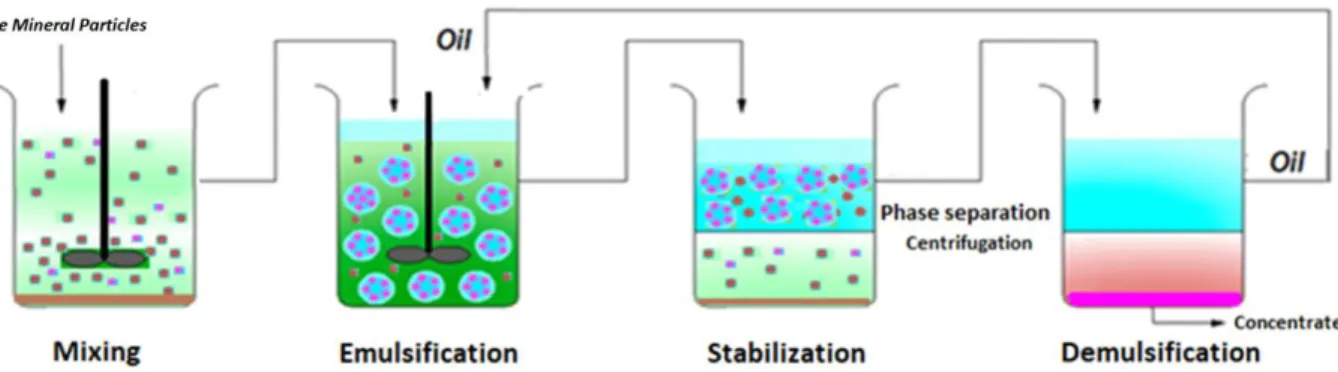
The first paper is a feasibility study for a SSE process to produce a concentrate of REE carrier minerals from the ore mixture of gangue minerals. We used original ore from NIOBEC mine in Quebec on which the most abundant REE bearing minerals are the carbonatite types of bastnäsite
((Ce, La, Nd, Y) FCO3) and monazite ((Ce,La,Nd,Th) PO4). The results showed that the REE bearing minerals had more affinity to the oil droplets than the gangues due to their larger contact angle. They attached more into the oil-water interface and the gangues stayed more in the water phase. The behavior of the REE ore in the emulsion system, the surface properties of the minerals at the oil-water interface and their interaction were investigated. The grade of total rare earth TREO% in the products is calculated based on total rare earth TREE% which is obtained through Neutron activation analysis. We could demonstrate the ability of Pickering emulsion to separate and concentrate REE minerals, considering the effects of feed properties such as particle size and preparation method. The enrichment ratio (ER) after one stage emulsification at natural pH increased up to 290% with a recovery higher than 50% without using any surface modifiers, additives or chemical agents.
The second paper focuses on the effects of process conditions such as mixing intensity (i.e., changing RPM) and shear uniformity (i.e., comparing Maxblend and PBT impellers) on recovery and grade of product. Recovery and grade improved by increasing the impeller speed. Also, the emulsion droplet size was eventually more uniform with Maxblend which leads to higher recovery and grade. The recovery of one stage emulsification is enhanced notably by adjusting the RPM of Maxblend up to 65% along with an ER of 385%.
The third paper investigates the effect of the physical properties of the phases to improve the process. The best performance of separation is achieved through an improvement of the emulsion formulation and selecting appropriate oil. The work focuses on the interfacial tension which has eventually a significant effect on recovery and grade. IFT of alternative oils modified with additives (i.e., paraffin and kerosene with 1-hexanol 1%) and also another continuous phase than water (i.e. ethylene glycol) and various viscosities were examined. A sort of viscosity 200 cSt, oil to water ratio 10% v/v and mass particle concentration of 5%, can drive the best selectivity (i.e. with highest recovery and grade). Since PDMS is expensive and not industrially feasible, paraffin oil 100 cSt was tested and achieved a better selectivity. The R and ER are improved again up to 60% and 270% respectively by choosing paraffin oil which is less expensive oil (as kerosene). The last chapter carries a very important objective for a techno-economic study on both FF and SSE processes into a pilot scale with 75% recovery and ER 200%. CAPEX, OPEX and environmental impacts were compared for two distinctive physical beneficiation methods. The
results show significant economic profitability and ecologic effectiveness for SSE vs. conventional FF.
As a conclusion, the REE concentrates (a higher grade of bastnaesite and monazite) were produced by SSE with reasonable process economy and many environmental advantages. Since no surfactants are used, the natural surface properties of minerals especially wettability differences are the key parameters which control selective and competitive particle attachment into the interface of emulsion droplets. The semi-empirical model helps quickly to find out the effects of the main parameters to reach the optimized conditions. To complete optimization in future works, sub-processes such as demulsification and phase separation should be also taken into consideration.
TABLE OF CONTENTS
DEDICATION ... III CITATION ... IV ACKNOWLEDGEMENTS ... V TABLE OF CONTENTS...XIII LIST OF TABLES ... XIX LIST OF FIGURES ... XXII LIST OF SYMBOLS AND ABBREVIATIONS ... XXVII
CHAPTER 1 INTRODUCTION ... 1
1.1 Rare earth elements ... 2
1.2 Niobec REE deposit ... 4
1.3 Problem description ... 5
CHAPTER 2 LITERATURE REVIEW ... 6
2.1 Surface characterization ... 6 2.2 Physical beneficiation ... 8 2.2.1 Electrostatic separation ... 9 2.2.2 Gravity concentration ... 9 2.2.3 Magnetic separation ... 9 2.2.4 Froth flotation ... 10 2.3 Pickering emulsion ... 14 2.3.1 Characterization of an emulsion ... 16
2.4 Stabilisation of Pickering emulsion ... 21
2.4.1 Particle/droplet interactions ... 21
2.4.3 Particle adsorption dynamic and equilibrium conditions ... 23
2.4.4 Formation of particle network ... 25
2.4.5 Properties of Pickering emulsion ... 26
2.4.6 Formulation (parameters of solid, aqueous and oil phases) ... 26
2.4.7 Effect of temperature and surface modification... 29
2.5 Minerals characterization ... 30
2.5.1 Grade of Niobec‘s ore ... 30
2.5.2 Minerals Contact angle ... 31
2.6 Pickering emulsification ... 32
2.7 Demulsification and phases separation ... 33
2.8 Rheology and mixing conditions ... 36
2.9 Selective attachment... 37
CHAPTER 3 OBJECTIVES, RESEARCH FOCUS AND COHERENCE OF THE CHAPTERS ... 39
3.1 Research questions ... 39
3.2 Original solution and the main objective of the thesis ... 39
3.3 Hypothesis, specific objectives ... 40
CHAPTER 4 ARTICLE 1: A NOVEL APPROACH FOR PHYSICAL BENEFICIATION OF RARE EARTH BEARING ORES BY PICKERING EMULSIFICATION ... 41
4.1 Abstract ... 41
4.2 Introduction ... 42
4.2.1 Pickering emulsification fundamentals ... 47
4.3 Materials and methodology ... 49
4.3.1 Liquid phases ... 49
4.3.3 Dry and Wet Sieving for feeds preparation ... 54
4.3.4 Experimental setup ... 59
4.3.5 Experimental procedure... 60
4.3.6 Analysis of overflow and underflow ... 62
4.4 Results and discussion ... 64
4.4.1 PSD of overflow vs. underflow ... 64
4.4.2 Effect of feed PSD on SSE separation performance ... 66
4.4.3 Effect of upstream sieving process on SSE separation performance ... 67
4.4.4 Emulsion (droplet) size... 68
4.4.5 REE‘s mineral attachment efficiency index ... 70
4.4.6 Pickering emulsification vs Froth flotation ... 71
4.5 Conclusion ... 72
4.6 Acknowledgment ... 72
4.7 Appendix ... 73
4.7.1 Mass balance ... 73
4.7.2 Obtaining the grade by image analysis (IMGA) ... 74
4.7.3 Particle size class attachment ... 77
CHAPTER 5 ARTICLE 2: CONCENTRATED MONAZITE AND BASTNAESITE THROUGH PICKERING EMULSIFICATION: THE EFFECT OF PROCESSING CONDITIONS ...79
5.1 Abstract ... 79
5.2 Introduction ... 80
5.3 Materials and methodology ... 82
5.3.1 Experimental setup ... 82
5.3.3 Experimental feed ... 85
5.3.4 Liquid phases ... 85
5.3.5 Experimental procedure... 86
5.3.6 Mixing parameters ... 87
5.3.7 The performance of separation ... 87
5.4 Results and discussion ... 94
5.4.1 Alignment of operating conditions... 94
5.4.2 Effect of mixing duration ... 96
5.4.3 Order of mixing ... 97
5.4.4 Effect of the mixing RPM ... 97
5.4.5 Effect of the shear uniformity ... 99
5.5 Conclusion ... 101
5.6 Acknowledgments ... 102
CHAPTER 6 ARTICLE 3: PHYSICAL BENEFICIATION OF RARE EARTH BEARING MINERALS WITH PICKERING EMULSIFICATION: EFFECT OF OIL PROPERTIES, INTERFACIAL PARAMETERS AND FORMULATION ... 103
6.1 Abstract ... 103
6.2 Introduction ... 104
6.3 Materials and Methodology ... 105
6.3.1 Rare earth elements bearing ore ... 105
6.3.2 Characterization ... 106
6.3.3 Dispersed phases ... 108
6.3.4 Continuous phases ... 108
6.3.5 Enrichment ratio and recovery of TREE ... 110
6.3.7 Experimental methods ... 113
6.4 Results and discussion ... 113
6.4.1 Surface tension and contact angle ... 113
6.4.2 The effect of oil viscosity ... 116
6.4.3 The effect of oil/water ratio ... 117
6.4.4 The effect of particles concentration ... 118
6.4.5 The effect of interfacial tension and oil polarity ... 119
6.4.6 PDMS 100cSt vs. paraffin ... 120
6.4.7 PDMS 1cSt vs. Kerosene... 121
6.4.8 Water vs. EG90 as continuous phase ... 122
6.5 Conclusion ... 124
6.6 Acknowledgments ... 125
CHAPTER 7 TECHNO-ECONOMIC EVALUATION OF THE RECOVERY OF RARE EARTH BEARING MINERALS BY PICKERING SELECTIVE EMULSIFICATION VS. FROTH FLOTATION ... 126
7.1 Material and method ... 134
7.2 CAPEX ... 136
7.3 OPEX ... 138
7.4 Economic evaluation ... 142
7.5 The sustainability of the process ... 142
CHAPTER 8 GENERAL DISCUSSION ... 145
CHAPTER 9 CONCLUSION AND RECOMMENDATIONS ... 149
9.1 Conclusion ... 149
9.2 Recommendations ... 149
APPENDIX A – MASS BALANCE ... 161
APPENDIX B – OBTAINING THE GRADE BY IMAGE ANALYSIS (IMGA) ... 163
APPENDIX C –PARTICLE SIZE CLASS ATTACHMENT ... 166
LIST OF TABLES
Table 1.1 Group of the consistent gangues in Niobec ore and weight percentage ... 4 Table 2.1 Force analysis during adsorption (Tsabet and Fradette 2016)... 22 Table 4.1 Common surfactants and pH reagents for REE minerals flotation (Anderson, Taylor et
al. 2016) ... 43 Table 4.2 ... 43 Table 4.3 Silicon oil PDMS properties ... 49 Table 4.4 Group of the consistent gangues in Niobec ore and weight percentage (Lafleur, Eng et
al. 2012) ... 50 Table 4.5 La, Ce and Nd abundant in fresh ore, pure bastnaesite and pure monazite from
NIOBEC resulted by NAA and EMPA comparing to the model pure monazite and pure bastnaesite from Mountain pass USA resulted by NAA (Lafleur, Eng et al. 2012). ... 51 Table 4.6 Particle mean sizes of three streams: feed, overflow and underflow, Feed <20 μm
,PDMS 50 cSt, PBT@1000rpm , =9%, Ms= 5% ... 66 Table 5.1 Setup specific dimensions for both PBT and Maxblend ... 83 Table 5.2 Group of the consistent gangues in Niobec ore and weight percentages (Lafleur, Eng et
al. 2012) ... 84 Table 5.3 Silicon oil properties ... 85 Table 5.4 The amount of materials in each setup ... 86 Table 5.5 The four main steps efficiencies for particle adsorption and stabilization at interface.. 91 Table 6.1 The measured contact angle of bastnaesite, monazite and majority of gangue types . 107 Table 6.2 Physical properties of liquid phases opted as dispersed or continuous phase for solid
stabilized emulsification of REE bearing ore ... 109 Table 6.3 IFT of the oils versus ethylene glycol ... 109 Table 6.4The theoretically expectation of the effect of physical properties of phases on selectivity
Table 6.5 The average of contact angles and wettability differences for the systems with different oils and continuous phases. ... 115 Table 6.6 The rare earth minerals recovery and grade of products after emulsification with polar
oil vs. non-polar oil and size of the emulsion ... 120 Table 6.7 The recovery and grade of rare earth minerals in the overflow (products) and the size of
droplets after emulsification with paraffin and PDMS oil 100cSt ... 121 Table 6.8 The recovery and grade of rare earth minerals in the overflow (products) and the size of
droplets after emulsification with kerosene and PDMS oil 1cSt ... 121 Table 6.9 The recovery and grade of rare earth minerals in the overflow (products) and the size of
droplets after emulsification with paraffin and PDMS oil 100cSt as dispersed phase versus water or ethylene glycol as continuous phase ... 123 Table 7.1 Some chemicals in FF processing with comparison prices (CAD$ 2018) (Xuefang
1985) ... 136 Table 7.2 Estimation for sizing based on 4ton/hour dry ore with head grade 3.3% TREO (the
product with 7% TREO of grade, Recovery=75%, total residence time 15 minutes overall
operation per batch of mass solid=20% wt of slurry) ... 137
Table 7.3 Total CAPEX for pilot scale processing ... 137 Table 7.4 Approximate OPEX regarding chemicals for FF at mining tonnage flow of 4 tons dry
ore per hour R=75%, (Schena, Villeneuve et al. 1996, Yang, Satur et al. 2015) ... 138 Table 7.5 Approximate OPEX regarding oil consumption for SSE at mining capacity rate of 4
tons dry ore per hour, R=75%, ... 138 Table 7.6 Approximate OPEX regarding energy consumption for FF and SSE at mining capacity
rate of 4 tons dry ore per hour R=75% (Safari, Harris et al. 2016, Tabosa, Runge et al. 2016) ... 138 Table 7.7 The abundant of selected rare earth oxides in the ore feed and their global price as of
January 2018 and average price for 1 kg REO ... 140 Table 7.8 Internal rate of return for SSE and FF ... 142
Table 7.9 Economic evaluation comparison of pilot scale physical beneficiation by FF or SSE capacity 4 ton/day feed of dry ore of 3.3%TREO ... 142 Table 7.10 Life Cycle Impacts of physical beneficiation by FF vs. SSE for producing 1 kg REO ... 143
LIST OF FIGURES
Figure 2.1 Graphical vector representation of contact angle and surface tension parameters (Kabza, Gestwicki et al. 2000) ... 7 Figure 2.2 Schematic of froth flotation (Bulatovic 2010) ... 11 Figure 2.3 Effects of surfactatnts concentration, temperature and pH on recovery of Monazite
(Bulatovic 2010)˚ ... 12 Figure 2.4 General processing routes for REE ore (Navarro and Zhao 2014) ... 13 Figure 2.5 Representation of solid particles adsorbed at the interface ... 15 Figure 2.6 Schematic representation of various breakdown processes in emulsion or mechanisms
of destabilization of an emulsion (Khatri 2010) ... 19 Figure 2.7 Potential energy curves for the interaction of two colloidal bodies. Negative values
correspond to attraction and positive values correspond to repulsion: (a) Attractive forces overcome the repulsive forces; (b) repulsion and attraction are comparable in magnitude and amplitue; (c) repulsive forces are stronger than the attractive forces (Khatri 2010) ... 35 Figure 2.8 Schematic representation of coalescence process ... 35 Figure 4.1 Schematic rout of REO‘s production from excavation to physical beneficiation
including flotation, Pickering emulsification, magnetic, gravitational ad electrostatic methods and other alternatives in upstream processes. ... 45 Figure 4.2 Schematic of particles attachment to the oil droplet to make the barrier around
interface and to prevent coalescence of droplets, Pickering emulsification with fine particles functioning as emulsifiers, θ is solid-oil-water interface contact angle ... 46 Figure 4.3 Schematic of emulsification and separation steps ... 49 Figure 4.4 Average contact angle of pure minerals were measured directly on Crystalline pure
minerals by sessile drop technique and capillary tube filled with powder ... 54 Figure 4.5 Cumulative grain size distribution of Niobec ore REE minerals from QEMSCAN
analysis ... 55 Figure 4.6 Particle size distribution of the received ore ... 55
Figure 4.7 Particle size distribution of three prepared feeds DSF,CSF and WSF ... 56 Figure 4.8 SEM image of dry (a and b) and wet (c and d) sieved fresh ore; cut size: 45-63μm ... 57 Figure 4.10 TREO grade versus sieving size cuts, Head grade of different feed sizes ... 59 Figure 4.11 Recovery and the enrichment ratio of dry and wet sieving -37μm cut size ... 59 Figure 4.12 Stirrer tank installation configuration ... 60 Figure 4.13 Ore particles in the experimental vial before and after emulsification ... 61 Figure 4.14 Schematic of the Pickering emulsification procedure ... 62 Figure 4.15 Particle size distribution of WSF <20 μm and its associated product streams,
( =9%, PDMS oil 50 cSt, Ms=5%, 15minPBT@1000 rpm) ... 65 Figure 4.16 a) TREO recovery from different feeds b) TREO enrichment ratio from different
feeds ( =9%, PDMS oil 50 cSt, Ms=5%, 15 min PBT at 1000 rpm) ... 68 Figure 4.17 Droplet mean sizes from emulsification of DSF, ( =9%, PDMS oil 50 cSt, Ms=5%,
15 min PBT at 1000 rpm)... 69 Figure 4.18 Sauter mean diameter of emulsion droplets (Emulsion size) from DSF,CSF and WSF,
( =9%, PDMS oil 50 cSt, Ms=5%, 15 min PBT at 1000 rpm) ... 70 Figure 4.19 Selective attachment index for REE bearing minerals versus particle sizes ... 71 Figure 4.20 Mineral samples with symmetric arrangement in the upside down vials to take the
photos ... 75 Figure 4.21 Obtaining the grade by IMGA when compared with NAA results ... 76 Figure 4.22 Correlation of IMGA results with NAA, the first three points from DSF, CSF and
WSF feed samples and 4th point is the concentrated ore from emulsification ... 77 Figure 4.23 Overflow particle size attachment, ( =9%, PDMS oil 50 cSt,
Ms=5%, 15minPBT@1000 rpm) ... 78 Figure 5.1 Solid stabilized droplets covered with minerals particles taken by Microscopic
NIKON ALPHAPHOT2-YS2 zoom 50x ... 81 Figure 5.2 Stirrer tank installation configuration and dimensions- a) PBT b)Maxblend ... 82
Figure 5.3 Model vs. experimental data in an acquisition flowchart diagram ... 93 Figure 5.4 Experimental points of power curve, Maxblend with baffle vs. PBT off centered- Feed
WSF<20 microns , oil PDMS 200 cSt, 9%, Ms= 5% ... 94 Figure 5.5 Average turbulent energy dissipation rate vs. We number and RPM for both impeller
types PBT and Maxblend -Feed WSF<20 microns , oil PDMS 200 cSt, 9%, Ms= 5% . 95 Figure 5.7 a) Mean droplet size for different order of mixing, b) Recovery and enrichment ratio
of monazite and bastnaesite in the overflow for different order of mixing, (Feed WSF<37, =9%, PDMS oil 50 cSt, Ms=5%, 15minPBT@1000 rpm) ... 97 Figure 5.8 Mean droplet size (emulsion size) at different impeller speed, (Feed WSF<37,
=9%, PDMS oil 50 cSt, Ms=5%, 15minPBT@1000 rpm) ... 98 Figure 5.9 a) Recovery of monazite and bastnaesite in overflow at different impeller speed,b)
Enrichment ratio of monazite and bastnaesite in overflow at different impeller speed, (Feed WSF, =9%, PDMS oil 50 cSt, Ms=5%, 15minPBT@1000 rpm) ... 99 Figure 5.10 Mean droplet size (emulsion size) vs. different Weber number for both impeller types
PBT and Maxblend, (Feed WSF<20, =9%, PDMS oil 200 cSt, Ms=5%, 15min@1000 rpm) ... 100 Figure 5.11 a) Recovery of monazite and bastnaesite in overflow at different Weber number for
both PBT and Maxblend impellers, b) Enrichment ratio of monazite and bastnaesite in overflow vs. Weber number for both PBT and Maxblend impellers, (Feed WSF<20, =9%, PDMS oil 200 cSt, Ms=5%, 15min@1000 rpm) ... 101 Figure 6.1 Fresh ore in water-oil slurry before and after emulsification (Ms=5%, PDMS oil Φd
9%, , PBT@1000rpm) ... 105 Figure 6.2 The slurry of creamed droplets after emulsification of REE ore in water (Ms=5%, Φd
9%, , PBT@1000rpm) (a) PDMS 100cSt (b) paraffin oil as dispersed phases ... 106 Figure 6.3 Attachment efficiency index as function of droplet mean size (Feed WSF<37 microns,
Ms=5%, oil Φd 9%, PDMS (γ=20mN/m), Paraffin (γ=40mN/m) and Kerosene (γ=50mN/m), PBT@1000rpm) ... 113
Figure 6.4 The oil-water contact angle as function of air-water contact angle, the wettability differences of REE minerals and the gangues is indicated for different oils versus water at natural pH of slurry around 9 (a) and ethylene glycol EG90 (b) ... 115 Figure 6.5 (a) The recovery and the grade of products (i.e. overflow) and (b) the emulsion droplet
size and span as a function of oil viscosity (Ms=5%, PDMS oil 9%, PBT@1000rpm) ... 117 Figure 6.6 (a) The effect of oil to water ratio on selectivity and (b) the emulsion droplet size or
generated interface (Ms=5%, PDMS oil 50 cSt , PBT@1000 rpm) ... 118 Figure 6.7 (a) The effect of particle concentration on selectivity and (b) the emulsion droplet size
( WSF<37, PDMS 50cSt-W, 9% , PBT@1000 rpm) ... 119 Figure 6.8 Droplets shape cluster uniformity and aggregation after emulsification with different
dispersed phases (Ms=5%, Φd 9%, , PBT@1000rpm) (a) kerosene and (b) PDMS 1cSt . 122 Figure 6.9 Variety of colors in the products (overflow) after emulsification with different liquid
phases which consists of concentrated REE bearing minerals ... 123 Figure 7.1 Process flow diagram of Pickering emulsification of fine rare earth bearing mineral
particles followed by phase separation steps from low grade ground ore to recovery of concentrates ... 132 Figure 7.2 Process flow diagram of froth flotation of fine rare earth bearing mineral particles
followed by phase separation steps from low grade ground ore to recovery of concentrates ... 132 Figure 7.3 Economic evaluation flowchart to optimize the alternative process configuration ... 134 Figure 7.4 Process flow circuit of physical beneficiation of REE-bearing minerals from low grade
ground ore (a) with two cascade stages of emulsification, and phase separation by centrifugation (b) with three stages of froth flotation (5 cells of roughing, cleaning, and scavenging)... 135 Figure 7.5 Breakdown of annual cost for overall processes a) SSE b) FF c) Annual expenses d)
Figure 7.6 Cumulative cash flow, payback period and NPV over 60 months life span of the pilot plant. BEP is less than 2 months for SSE and it is above 6 months for FF ... 141 Figure 7.7 Percentage contribution of normalized impacts for producing 1kg REO by FF vs. SSE ... 143 Figure 9.1 Mineral samples with symmetric arrangement in the upside down vials to take the
photos ... 163 Figure 9.2 Obtaining the grade by IMGA when compared with NAA results ... 164 Figure 9.3 Correlation of IMGA results with NAA, the first three points from DSF, CSF and
WSF feed samples and 4th point is the concentrated ore from emulsification ... 165 Figure 9.4 Overflow particle size attachment, ( =9%, PDMS oil 50 cSt,
LIST OF SYMBOLS AND ABBREVIATIONS
Roman Letters
Coverage potential
Effectively covered interface Generated interface
Theoretical available interface Impeller diameter
Particle diameter
Diameter below which 10% of the overall droplet size is located Diameter below which 90% of the overall droplet size is located Sauter mean diameter
The total interfacial free energy when the particle is totally in the water phase The total interfacial free energy when the particle is attached to the droplet interface The total interfacial free energy when the particle is totally engulfed by the droplet Efficiency of collision
Efficiency of three phase contact line formation Efficiency of attachment
Efficiency of droplet interface coverage Global efficiency of attachment
Gangues specific global efficiency REE‘s minerals specific global efficiency Total efficiency
Detachment force Collision force
The particle/droplet collision frequencies The droplet/droplet collision frequencies
Grade of REE in the feed stream Grade of REE in overflow Grade of REE in underflow Attachment efficiency index
Mass of particles in the feed stream
Mass of particles attached to droplets in overflow Mass of non-emulsified particles in underflow Theoretical mass of the system
Impeller power number Ni The impeller speed
Selectivity factor
Number of particles in size interval
Total number of the attached REE' s mineral particles into the interface Total number of the REE' s mineral particles in the system
Total number of the attached gangue particles into the interface Total number of the gangues particles in the system
P Inlet power on the shaft
Overall Probabilities of attachment for REE' s mineral particles Overall Probabilities of attachment for gangues particles price of rare earth element oxide
Numerical size distribution density in size interval The contact time
The drainage time TPC line expansion time Greek Letters
Water surface tension Oil surface tension
Oil/water interfacial tension water-air-solid contact angle oil-air-solid contact angle
water-oil-solid contact angle or particle contact angle
Interfacial energy preventing a particle to detach from interface
Interfacial energy needed for a particle being engulfed by the oil droplets Particle density
Average turbulent energy dissipation rate Density of suspension
Particle density Solid bulk density Liquid density
τ Torque on the impeller shaft Dispersed phase volume fraction
Acronyms
BCO LEVEL OF BRIGHTNESS EMITTED FROM CONCENTRATED ORE BEP BREAK-EVEN POINT
BFO LEVEL OF BRIGHTNESS EMITTED FROM FRESH ORE BLR BRIGHTNESS LEVEL RATIO
BS LEVEL OF BRIGHTNESS EMITTED FROM THE SAMPLE CAD$ CANADIAN DOLLAR
CAPEX CAPITAL EXPENSES CSF CRUSHED SIEVED FEED DSF DRY SIEVED FEED
ECO ELEMENTAL ASSAY OF CONCENTERED ORE EDS ENERGY DISPERSIVE SPECTROSCOPY
EFO ELEMENTAL ASSAY OF FRESH ORE EG90 ETHYLENE GLYCOL 90%
EMPA ELECTRON MICROPROBE ANALYSES
ER ENRICHMENT RATIO
ES ELEMENTAL ASSAY OF THE SAMPLE
FF FROTH FLOTATION
GB GLASS BEADS
GHG GREEN HOUSE GASES
HH HUMAN HEALTH
HREE HEAVY RARE EARTH ELEMENTS
HT HUMAN CARCINOGEN TOXICITY
IFT INTERFACIAL TENSION IMGA IMAGE ANALYSIS
IRR INTERNAL RATE OF RETURN LREE LIGHT RARE EARTH ELEMENTS MD MIXING DURATION TIME
NAA NORTON ACTIVATION ANALYSIS
NEP NON-EMULSIFIED SEDIMENT PARTICLES NPV NET PRESENT VALUE
NSD NUMERICAL SIZE DISTRIBUTION O/W OIL IN WATER EMULSION (RATIO) OPEX OPERATIONAL EXPENSES
OZP OZONE DEPLETION POTENTIAL PBT PITCHED BLADE TURBINE
PDMS POLYDIMETHYLSILOXANE (SILICONE OIL) PSD PARTICLE SIZE DISTRIBUTION
QEMSCAN QUANTITATIVE EVALUATION OF MINERALS BY SCANNING
ELECTRON MICROSCOPY
R RECOVERY
RBM RARE EARTH BEARING MINERALS REE RARE EARTH ELEMENTS
REO RARE EARTH OXIDES
RGB RED GREEN BLUE BRIGHTNESS LEVEL RPM ROTATIONAL SPEED PER MINUTE SCD STABILIZED CREAM DROPLETS
SSE SOLID STABILIZED EMULSION TPCL THREE PHASE CONTACT LINE TREE TOTAL RARE EARTH ELEMENTS TREO TOTAL RARE EARTH OXIDES WSF WET SEIVED FEED OF FRESH ORE
LIST OF APPENDICES
Appendix A – Mass balance ... 161 Appendix B – Obtaining the grade by image analysis (IMGA) ... 163 Appendix C –Particle size class attachment ... 166 Appendix D – QEMSCAN niobec ore ... 167
CHAPTER 1
INTRODUCTION
This area of research considers physical beneficiation stage in the mining industry, and more specifically the early steps of recovery of the rare earth elements (REE) bearing minerals to separate them form their associated gangues in the ore mixture. Froth flotation (FF) is one of the most common methods in physical beneficiation that uses the surface properties of REE bearing minerals (RBM) to concentrate them form their ore mixture.
It is known (Bulatovic 2007) that many surfactants which are used in conventional physical beneficiation of the ore processing like in FF and they are very detrimental to the environment. This fact is more relevant in mineral processing where the separation of minerals of interest is very difficult and complicated, due to their very similar physicochemical properties to their associated gangues such as density, magnetic susceptibility and permeability, electrostatic and wettability. There are several physical separation methods such as FF, magnetic, electrostatic techniques, etc. which are used in physical beneficiation stage. Nevertheless, such physical methods result either in low beneficiation efficiency, limited tonnage feed rate or a complex and costly configuration of several physical processing units. Also, FF uses several of harmful and detrimental chemicals to the environment and human health such as pH modifier agents, surfactants including collectors, activators and stabilizers like frothers (Bulatovic 2007, Anderson, Taylor et al. 2016). The research project will evaluate the possibility of using the surface properties of RBM to separate them in an emulsification process. More specifically, adapted oil, water and solid particles of minerals to form a solid-stabilized emulsion (SSE) or Pickering emulsion in the early stages of the physical beneficiation of the mineral processing. Therefore, in this study it is highly motivated to assess ability of Pickering emulsion to separate and concentrate REE minerals and furthermore to compare its ability with FF. Notably, one employs Pickering emulsion hopefully should have reasonable performance and it comes with less environmental impacts, more simple, cost-effective and safer along with high recovery yield and quality of product when compared with other conventional physical beneficiation methods. A semi-empirical approach in this research will use to develop a model and more specifically to predict the performance of separation of the process. Beside all, research project obtains realistic processing conditions to form Pickering emulsion, demulsification and phase separation which can lead to have economic advantages over traditional separation methods such as FF. Also it can offer the basic guidelines and orientations for further development and noteworthy, to have the
state of the art knowledge in the application of Pickering emulsion in physical beneficiation of RBM.
Beforehand, a review about rare earth minerals specifications and some notions about physical beneficiation methods, especially about FF are given. Thereafter, main parameters about properties of an emulsion is explained where the critical notions will be addressed. The key point is to address the research main question and to introduce SSE technique as a novel solution in physical beneficiation stage. Regarding to the steps of this method, Pickering emulsification, phase separation and demulsification are explained.
In term of the scope of the project, the study consists of several approaches such as emulsification, stabilization, destabilization, physicochemical aspects and surface properties of REE bearing minerals, liquid phases and mixing conditions. The study focuses the activities on the following points during emulsification, demulsificaton and phase separation: the effect of the surface properties and size distribution of the solid fine particles and the emulsion droplets, the effect of the mixing and hydrodynamics, the effect of the other physicochemical parameters such as oil viscosity, polarity and interfacial tension on the performance of separation (Bulatovic 2010).
1.1 Rare earth elements
The rare earth elements (REEs) are the fifteen lanthanide elements in the periodic table which can be regrouped in two categories of light (LREE) with atomic numbers from 57 to 62 as well as scandium21 and yttrium39 and heavy rare earth elements (HREE) with atomic numbers from 63 to 71. REEs abundance in earth‘s crust for example varies from 64, 30 and 26 ppm for Ce, La and Nd to 3.8, 3.5 and 0.88 ppm for Gd, Dy and Eu respectively (Jones, Wall et al. 1996). The electron configuration is like [Xe] 5d16s2 for La and like [Xe]4 6s2 for most of them which gives unique specification and similarity in physicochemical properties in their natural compounds (Gupta and Krishnamurthy 2004, Castor and Hedrick 2006). In addition REEs are abundant like many other elements on the earth‘s crust. The reason that REEs are called rare is not because of their abundance, but because of the difficulties with their beneficiation from the other conjunction minerals in the ore. The REEs have, in general, 3+ valences which can find in their compounds such as oxides, carbonates, phosphates and silicates (Jones, Wall et al. 1996). Their differences is in different ionic radius and the most important similarity is the nuclear
configuration of the three outer electrons. Given that, their electrons arrangement makes similar physicochemical property which in turn causes challenges in production of their oxides (REO) in pure forms. Hitherto, physicochemical properties of the rare earth elements and their applications in modern technologies are well described (Gupta and Krishnamurthy 2004). Each single element of the REEs has many applications in different sectors of industries and high technologies especially in the renewable energies and permanent magnets (Salazar and McNutt 2013). The other applications can be named here as catalysts, light devices, medical imaging, phosphors, UV resistant glasses, thermal control mirrors, ceramic, rechargeable batteries and etc., thus a fast growing global demands for applications of REEs is expected and finding substitutes for REEs producers is required in order to response to the policy driven demand-supply trends in the market. Almost 95% of the REE‘s are inherent in minerals such as Bastnaesite, Monazite, Xenotime and ion adsorption clay minerals which are the most economically feasible minerals for extraction of the REEs (Jones, Wall et al. 1996, Gupta and Krishnamurthy 2004, Zhang and Edwards 2012).
The Bastnasite (REE‘s)FCO3 containing 67-73% REO‘s and the Monazite (REE‘s)PO4 are the famous known minerals bearing REE‘s in the world which respectively contain LREEs and low amounts of HREEs. The recovery process of the REE‘s from the original deposit consist mineralogy, mining exploitation, physical beneficiation of the ore, concentration by various techniques such as thermal cracking, hydrometallurgy and separation of individual elements by refining. As previously mentioned, the physical beneficiation processes are the most difficult among mineral recovery because of the physicochemical similarities of the REE bearing minerals and their conjunction gangues in the ore. Whereby, several separation steps are required to concentrate REE bearing minerals such as magnetic, gravity, electrostatic and froth flotation in the complex network of unit operations. For example, the minerals in Bayan Obo deposit in China come with fluorite, magnetite, barite, calcite, quartz and feldspar which have very similar magnetic, specific gravity, electrical conductivity and floatability behavior to Bastnaesite and Monazite minerals. Thereupon, this challenge is more pronounced where the types and configurations of the unit operations depend on mineralogy, the grain sizes, versatility and composition of the minerals of the deposit. Furthermore, REE‘s bearing mineral composition varies from one deposit to another which makes more hurdles and their individual separation is
also very difficult regarding again to their similar physicochemical properties (Cheng, Hou et al. 2007).
1.2 Niobec REE deposit
Around 2011, IAMGOLD CORPORATION lunched the drilling reconnaissance campaign (29 drill holes) to a depth of 400 m in Niobec mine in Quebec with primary estimation of 466.8 million tons at a grade of 1.65% total rare earth oxides (TREO) which have reported in March 2012. The REE deposite consists of annular carbonatite type (Bastnaesite) and phosphate type (Monazite) corresponds to an enriched zone of LREE comprise 98.1% of the weight of the Total REEs and the rest of 1.9% HREE that have additional significant economic value. The estimation of Niobec deposit was a huge 1058.6 million tonnes at average grade of 1.64% TREO equal to 18.363 million tonnes to a depth of around 700 meters. Bastnaesite and monazite with almost a same mass ratio and gangues are including Carbonates (Dolomite, Calcite, Ankerite, Siderite) 65%, Silicates (Chlorite and Phlogopite, Feldspars, Quartz, Vermiculite)11%, Apatite 10%, Oxides (Magnetite, Hematite, Ilmenite, Rutile, Goethite, Pyrolusite ,Pyrochlore) 12%, Sulfides 1%, Fluorite, Baryte and Zircon 1 % collectively (Table 4.4) (Grenier and Tremblay 2013). Table 1.1 Group of the consistent gangues in Niobec ore and weight percentage
Name association (%wt) Average grain Size (μm) Category Pyrochlore, Columbite, Fe-Oxides, Quartz, Rutile,Other Oxides 7.48 13.42 Oxide Micas/Clays,Amphibole Chlorite, Plagioclase, K-Feldspar, Allanite 6.7 11.26 Silicate
Dolomite, Calcite, Ankerite,
Siderite 77.22 16.85 Carbonate
Pyrite, Barite 4.92 21.81 Sulfide
Bastnaesite/Synchisite 1.96 14.34 Fluorocarbonate
Monazite/Th-Monazite 1.43 12.63 Phosphate
Other REE 0.01 6.84 Phosphate
Apatite 0.28 15.77 Phosphate
1.3 Problem description
Considering the literature review, flotation has numerous environmental and viability issues. Given that, the big challenging of the conventional froth flotation raises up from chemical agents and surfactants due to recyclability of the surfactants and tailing water. The mineral particle‘s surface must be reacting with expensive organic chemicals to modify the surface into the desired wettability with higher contact angle for the minerals of interest to promote their attachment to the bubble interface. There are several types of surfactants used in the flotation which cannot also guarantee the reasonable efficiency, performances and viability of the process (Cheng, Hou et al. 2007).
Moreover, the required size treatment in case of REE bearing minerals is normally done by grinding. The ore size commonly known as P80 about 56 microns achieves liberation which is not ideal for optimal flotation performance. It more pronounced that above 50 microns the size locking between the Bastnaesite and Calcite is common. For lower than this size the treatment going to non-feasible zone in term of energy and cost. Thus, the effect of particle size on performance of flotation rate including recovery and grade is very complex (Bulatovic 2010). In the other side, the grade yield of TREO after flotation could not be more than 45% where the recovery yield hardly acheives 75% (Bulatovic 2010, Jordens, Marion et al. 2014). It is important to note that a 100% recovery of monazite and bastnaesite from Niobec ore with theoretically 100% purity has 81% TREO, especially when we need to compare SSE vs. FF. Furthermore, in term of social impacts, some of the surfactants and chemicals which are currently used in the REE beneficiation have been investigated as hazardous for human health, especially for the process workers in mineral treatment plan. Also, economically the price of the surfactants are very high and affects operational cost of FF technique. Since it more pronounced at literature review, the environmental assessment from cradle to grave of the REE processing is recently studied and all the results show the high impacts in FF method itself mostly because of chemical reagents usage. They are also at the source of many problems downstream of the concentrator (Jordens, Cheng et al. 2013),(Castor and Hedrick 2006).
CHAPTER 2
LITERATURE REVIEW
A literature review conducted here to mostly focus on surface characterization of minerals, froth flotation, Pickering emulsion and demulsification. Thereafter, a critical review will come about mineral surface characterization, interfacial properties, particle selective attachment following the works related to phase separation and particle detachment. The review summarizes the most relevant works with respect to the solid particle as emulsifier, the generation of Pickering emulsions, fundamental phenomena to understand the stabilization/destabilization mechanisms, mixing conditions, and rheology of emulsions. The effects of the properties of Pickering emulsions and relevant phases on selective attachment are well reviewed. In the last part the bases of demulsification procedure and phase separation will come in review due to aim of separation of the mineral particles. Furthermore, the critical review highlight the capacity of the main mechanisms involved during the emulsification to selectively capture specific fine particles (i.e, REE bearing minerals) on which to explain the emulsified cream droplets render a higher concentration of REE‘s.
2.1
Surface characterization
Surface charge/ Zeta potential
All solid particles in aqueous phase will have a charge on their surface which is called surface charge. The surface charge is created by attachment of the various ions in electrolyte. Surface charge can govern the attachment/detachment of solid particles or emulsifier agents into surface site and hence this parameter directly has effects on physical beneficiation of a given system. Consequently in practice it is essential to consider its effects e.g. by measuring zeta potential. Zeta potential is one of the most important notions in a colloidal system. Zeta potential is a scientific term for electrokinetic potential in colloidal dispersions which can be define as the electric potential in the interfacial double layer around the particles or droplets from the slipping plane relative to a point of the bulk of electrolyte and away from the interface. In other words, zeta potential is the potential difference between the dispersion medium and the charged layer of attached ions to the surface. Based on this, zeta potential measurement can be used to investigate colloidal particle interactions regardless of its limitations for particle density and geometry. Zeta potential migh be measured by conventional electrophoresis zeta meter or electroacoustic
techniques. Surface charge varies by change of pH depending on the species which form on particles surface at a given pH. The charge might be positive or negative and there is a pH at which zeta potential is equal to zero (IEP isoelectric point). Thus, at pH values lower than IEP, zeta potential is positive and at higher than IEP is negative. Identifying IEP of minerals and knowing the ionization behavior allow one to predict the possible interactions in the mechanisms involved physical beneficiation (Liu, Zhou et al. 2002, Ofir, Oren et al. 2007, Jordens, Cheng et al. 2013).
Wettability / Surface energy / contact angle / hydrophobicity / Interfacial tension
Wettability is the tendency to wet a solid surface by liquid molecular of attraction force between the solid surface and liquid materials at contact pattern surface and in the presence of another immiscible fluid. The strength of attraction is determined by the surface energy of the materials or interfacial boundary tension. The surface energy can be defined as the energy differential at the surface of a material compared to the bulk of the material. The higher the surface energy leads to the greater the molecular attraction forces and the lower the surface energy gives the weaker attractive forces. In the other side, greater molecular attraction increase contact between the liquid and the solid surface. Indeed, on a high surface energy material, the liquid can wet better the substrate or liquid tends to spread on the solid surface at smallest contact angle. Contact angle is the angle at the surface point where the three phases meet each other on which the liquid–vapor interface meets the solid–liquid interface. If the liquid does not tend to contract, the liquid does not readily wet the solid then the contact angle is large (θ).
Figure 2.1 Graphical vector representation of contact angle and surface tension parameters (Kabza, Gestwicki et al. 2000)
Contact angle can be a measure scale for hydrophilicity which is the behavior of solid surface to be wetted by aqueous phase. Interfacial boundary tension is also defined by the energy per unit
area or force per unit distance at the contact surface between the phases. It is commonly expressed in milli-Newtons/meter or dynes/cm. The investigations show a meaningful correlation between hydrophobicity (wettability) and solid particle attachment into the liquid phase interface. A same manner reported for the mechanism behind the selective attachment of solid particles in the both FF and SSE process. Contact angle measurements on solid fine particles in a powder needs to be met by series of complicate methods. There are a few techniques for direct measurements of contact angle such as Young-Laplace method with goniometer which cannot work properly for powders. Another way is to measure the surface energy of the solid particles (minerals) to calculate the contact angle. An important aspect of this last measurement is to compare degree of reactivity of minerals with different oil types in contact with aqueous phase especially in case of Pickering emulsion and also in case of surfactants in FF. The wettability of REE bearing minerals is based on analysis of the surface chemistry of their pure form samples with their complex composition (Kabza, Gestwicki et al. 2000, Binks and Clint 2002, Yuan and Lee 2013).
2.2
Physical beneficiation
In order to separate Bastnaesite and Monazite from the associated gangues in early stages of mineral processing, physical beneficiation take place using several techniques such as magnetic, gravimetric, electrostatic, froth flotation. In this manner, the effects of the physicochemical properties such as density, magnetic susceptibility and permeability, electrostatic and wettability of the REE bearing minerals and associated gangues are extremely important on the processing of separation. Among these, FF has applied as high tonnage capacity and effective technique for separation of bastnaesite and monazite. However a proper design that employs multiple integrated unit operations such as one employing sizing, gravity, magnetic, can outperform alternatively the separation, compare to one that use the only FF technique. Whereby, physical beneficiation can be defined as separation of minerals base on differences in physical properties. Although, bastnasite and monazite are accompanied with gangue minerals which have very slight differences in physical properties, and more specifically in wettability. Therefore, FF as a separating technique requires providing of delicate conditions (Gupta and Krishnamurthy 2004, Zhang and Edwards 2012).
2.2.1 Electrostatic separation
Indeed, electrostatic separation is a beneficiation technique which exploits the differences in electrostatic charge ability between the minerals and gangues where alternative treatment techniques are not enough. Considering that dry minerals before electrostatic separation is required and products unit operations in mineral processing plant are mostly wet, thus the energy consumption to dry minerals before electrostatic separation is significant. However, this method could be valuable enrichment technique due to usage in heavy metal bearing minerals. Electrostatic separator with high tension is used in electrostatic separation which works with an ionizing electrode and variable applied charge. The material with low ability to release charge, remain on the rotating roll while the particles which lose their charge by applied electric field are thrown from the roll (Gupta and Krishnamurthy 1992).
2.2.2 Gravity concentration
In fact, REE bearing minerals are good candidates for gravity concentration since they have relatively large specific density (mostly above 4 gr/ ). They are typically associated with gangues minerals that have significantly lower density. The approach uses gravity force in dynamic rotary mechanisms to separate particles base on their specific density, especially this technique can be used successfully for monazite enrichment. There are spiral concentrators and centrifugal concentrators which work base on density differences of the minerals in the ore. In general, size of the particles is important factor to design equipment plan where the finer mineral particles have more optimal size for gravity concentration (Gupta and Krishnamurthy 1992).
2.2.3 Magnetic separation
Magnetic separation is based on response to an applied magnetic field by minerals which might have differences in magnetic susceptibility. In general, minerals show three distinct behaviours while exposed to a magnetic field: Ferromagnetic, paramagnetic and diamagnetic particles which respectively will be attracted to the magnets and the last will be repelled. In fact, the magnetic properties of the mineral can be determined using a vibrating sample magnetometer. One of the important results for REE bearing minerals is that magnetic susceptibility of bastnaesite is lower than fergusonite and allanite which are gangue minerals. Magnetic separation can be done both in wet or dry streams. In order to have maximum performance, preparations of data sheets for the
magnetic properties of the individual minerals and a tailored magnetic separation protocol are essential(Dobbins, Dunn et al. 2009, Jordens, Sheridan et al. 2014).
2.2.4 Froth flotation
FF is the most famous conventional method among other physical beneficiation, especially in case of recovering rare earth minerals from their associated gangues. On the other hand, the composition and diversity of REE minerals are varied a lot and every deposit has its own characteristics which lead to specific processing strategies. The challenges in physical beneficiation of REE bearing minerals are mentioned before. Some of these difficulties and lack of information include: adequate characterization of physicochemical properties of individual REE mineral, suitable reagents to selectively separate minerals from ore body, how to reach highest separation performance with minimum reagent and chemical usage, sustainability aspects, water, energy and capital consumption. Indeed, the ultimate goal of FF or other physical beneficiation methods is to economically produce a concentrate with high quality and minimum ecologic impacts and in order to be well suited for leaching (i.e., to reduce acid and other chemicals consumption) in downstream processes (Zhang and Edwards 2012, Jordens, Cheng et al. 2013).
The FF process of separating targeted mineral in the ore depends on the relative wettability of the particles of interest. Indeed, the more hydrophobic particles are attached to the bubbles and in turn induced a froth carrying the particle into top of the pulp. Once a particle and bubble get in contact, the bubble must be large enough for its buoyancy to lift the particle to the surface. The froth layer must resist enough to either flow over the discharge of the cell by gravity or mechanical froth scrapers. Since, most of the minerals are hydrophilic, thus their surface must be treated by a surfactant reagent. The interactions of reagents with mineral surface in the electrolyte depend on the chemistry of the mineral surface and the solution. The interaction changes the surface either more hydrophobic or hydrophilic. As it mentioned before, hydrophobic surface has more affinity to attach into interface (i.e., bubbles) and this is the main property governing the phenomenon. The aim of additive reagents usage is to selectively float the targeted minerals while the gangue minerals are rejected (Jordens, Cheng et al. 2013).The flotation in laboratory scale tests can be carried out in a micro cell made of glass and a fritted disc installed at the bottom of the cell where the gas is pumped. A Denver cell is employed for batch flotation tests.
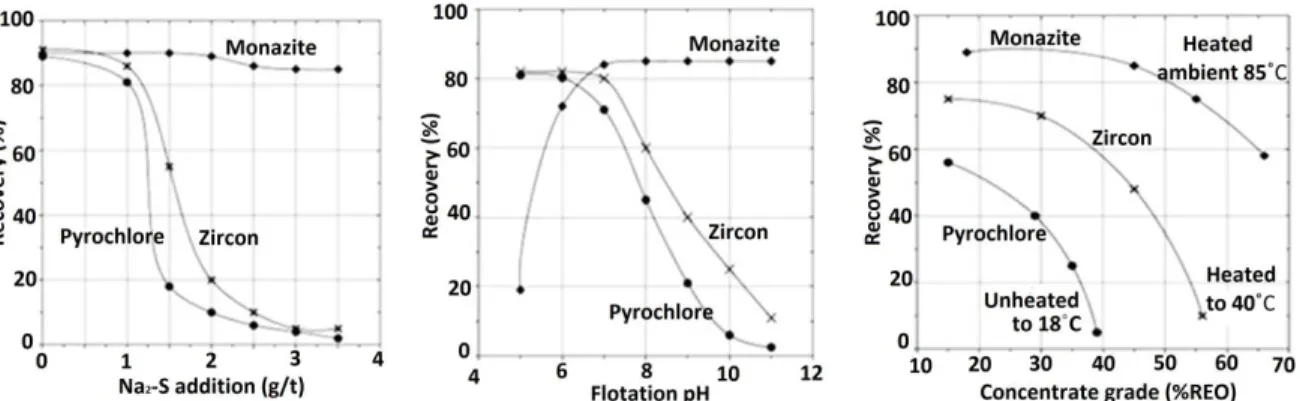
Some of the most important parameters that should be controlled during the tests are air rate, impeller speed, froth depth, froth scraping rate, surfactants, pH, temperature, concentrations and particle size distribution (Figure 2.2). In general, air rate should be high enough to maintain a fluid froth depth and to avoid collapsing froth. Also impeller speed should be sufficiently controlled to maintain solid particles in suspension whereas a constant and fairly fast scraping rate is required. Since a slow floating mineral will take longer to reach completion, the time interval between each concentrate collection should be controlled. Given that, it is required more information to simulate the results for batch flotation tests. FF will be performed on fresh ore samples provided by company at realistic conditions, e.g. particle size which plays an important role in many separation processes. In the other side, the recovery yield of monazite in total REO entire beneficiation accomplished with flotation could not be more than 80% (Figure 2.3).This last is important especially when we are looking for an alternative to flotation itself which has many environmental side effects due to usage of huge amount of surfactant and many difficulties due to recyclability of these surfactants (Bulatovic 2010), (Bulatovic 2010, Jordens, Marion et al. 2014).
Figure 2.3 Effects of surfactatnts concentration, temperature and pH on recovery of Monazite (Bulatovic 2010)˚
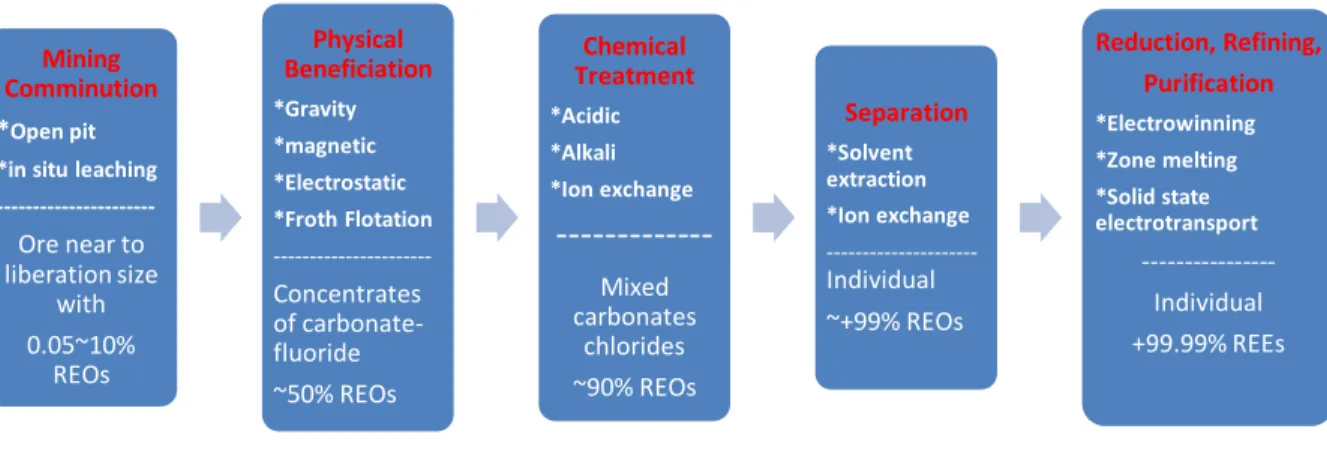
For example, in the Bayan Obo mine, there are mainly six different beneficiation processes being used. A general processing route is shown in Figure 2.4 for REE ores but as each site have different composition, the process routes deviate to different extents (except for purification step 5). Also, in term of liberation size, at least 90% of the ore being ground to less than 74mm to be prepared for the froth flotation process. C (2.5–3.3 kg/ton) is used as a pH regulator with Si (2.5–3.3 kg/ton) as the depressant agent of associated iron minerals and silicate gangues and paraffin soap as a collector. The depressed iron minerals and silicates will be remained at the bottom of the flotation cells, thus they are going for iron beneficiation and niobium recovery. After eliminating the surplus fatty acid collector by thickening and desliming treatment, selective REO flotation is completely carried out. The following accomplishment is done with C as the pH regulator, Si and Si as gangue depressants, and hydroxamic acid as the collector. The depressed calcite, fluorite and barite remain at the bottom of the cell. After the flotation, the rougher concentrate contains around 45% REO consist both monazite and bastnaesite. The recovery of REO at this stage is approximately 80%. The final treatment includes cleaning with high intensity magnetic separators. These results have two concentrate fractions with the primary bastnaesite having 68% REO concentrate and the secondary monazite containing 36%REO. The total recovery rate of REOs from the ore is around 61%. After the flotation process, it is estimated that 80.63% of Thorium as a radioactive element remains in the tailings and it might be 1.83% in the REE concentrate (Jordens, Cheng et al. 2013), (Castor and Hedrick 2006, Navarro and Zhao 2014).