O
pen
A
rchive
T
OULOUSE
A
rchive
O
uverte (
OATAO
)
OATAO is an open access repository that collects the work of Toulouse researchers and
makes it freely available over the web where possible.
This is an author-deposited version published in :
http://oatao.univ-toulouse.fr/
Eprints ID : 10002
To link to this article : doi:10.1016/j.bioelechem.2012.04.001
URL :
http://dx.doi.org/10.1016/j.bioelechem.2012.04.001
To cite this version : Reybier, Karine and Nguyen, Thi Hoang Yen
and Ibrahim, Hany and Perio, Pierre and Montrose, Armelle and Fabre,
Paul-Louis and Nepveu, Françoise Electrochemical behavior of
indolone-N-oxides: Relationship to structure and antiplasmodial
activity. (2012) Bioelectrochemistry, vol. 88 . pp. 57-64. ISSN
1567-5394
Any correspondance concerning this service should be sent to the repository
administrator:
[email protected]
Electrochemical behavior of indolone-N-oxides: Relationship to structure
and antiplasmodial activity
Karine Reybier
a,b,⁎
, Thi Hoang Yen Nguyen
a,b, Hany Ibrahim
a,b, Pierre Perio
a,b, Armelle Montrose
a,b,
Paul-Louis Fabre
c,d,1, Françoise Nepveu
a,baUniversité de Toulouse, UPS, PHARMA-DEV, UMR 152, 118 route de Narbonne, F-31062 Toulouse cedex 9, France bIRD, PHARMA-DEV, UMR 152, F-31062 Toulouse cedex 9, France
cUniversité de Toulouse, UPS, Laboratoire de Génie Chimique, F-31062 Toulouse cedex 9, France dCNRS, Laboratoire de Génie Chimique, UMR 5503, F-31062 Toulouse cedex 9, France
a b s t r a c t
Keywords: Indolone-N-oxides Antimalarials Cyclic voltammetry EPRRadical nitroxide anion
Indolone-N-oxides exert high parasiticidal activity at the nanomolar level in vitro against Plasmodium falciparum, the parasite responsible for malaria. The bioreductive character of these molecules was investigated using cyclic voltammetry and EPR spectroelectrochemistry to examine the relationship between electrochemical behavior and antimalarial activity and to understand their mechanisms of action. For all the compounds (37 compounds) studied, the voltammograms recorded in acetonitrile showed a well-defined and reversible redox couple fol-lowed by a second complicated electron transfer. The first reduction (−0.88 Vb E1/2b − 0.50 V vs. SCE) was at-tributed to the reduction of the N-oxide function to form a radical nitroxide anion. The second reduction (−1.65 Vb E1/2b −1.14 V vs. SCE) was assigned to the reduction of the ketone function. By coupling electro-chemistry with EPR spectroscopy, the EPR spectra confirmed the formation of the nitroxide anion radical. More-over, the experiments demonstrated that a slow protonation occurs at the carbon of the nitrone function and not at the NO function. A relationship between electrochemical behavior and indolone-N-oxide structure can be established for compounds with R1= ―OCH
3, R2= H, and electron-withdrawing substituents on the phenyl
group at R3. The results help in the design of new molecules with more potent in vivo antimalarial activity.
1. Introduction
The N-oxide moiety is a reducible function that leads to biologi-cally active compounds when introduced into conjugated systems such as heterocyclic and pseudo-quinoid compounds. These deriva-tives are thought to exert their biological action by the generation of reactive oxygen species through a redox cycling process that causes oxidative stress. This may explain how these compounds act as anti-infective agents towards a large number of microorganisms. This is the case of quinoxaline1,4-di-N-oxide derivatives acting as anti-infectious[1–4], or mono-N-oxides such as benzofuroxan, nitrofurane and nitroimidazole, derivatives with antiprotozoal activities[5–7], and of indolone-N-oxides with various antimicrobial activities [8–10]. The precise mechanism by which these drugs act in different biological models has not yet been fully elucidated [11]. Recently we reported the antimalarial activity of a series of indolone-N-oxides
(Scheme 1). The biological evaluation and structure–activity relationship (SAR) studies proved the efficient antimalarial activity of these deriva-tives in vitro and in vivo against Plasmodium falciparum (Pf)[12,13]. Proteomic studies that we have reported suggest that these indolone-N-oxides cause a profound destabilization of the membrane of the Pf infected red blood cells (RBC) through a mechanism apparently trig-gered by the activation of a redox signaling pathway, which could be ini-tiated by a chemical redox reaction in the RBC[14]. These results gave
⁎ Corresponding author at: PHARMA-DEV, UMR 152, Université Paul Sabatier, 118 route de Narbonne, F-31062 Toulouse cedex 9, France. Tel.: +33 562259804; fax: +33 562259802.
E-mail address:[email protected](K. Reybier).
1The author is BES member.
R
1R
2N
O
O
R
32
3
4
5
6
7
8
9
Scheme 1.Structure of the indolone-N-oxide series.
Table 1
Structure, cyclic voltammetric data, log P and antiplasmodial activity of indolone-N-oxide derivatives. Compounds R1 R2 R3 LogP
calc
a (VCCLAB) IC
50/nM FcB1 strainb E1/2/Vd,e(vs. SCE) RIpf ΔEp/mVg
1 O―CH2―O 4′-Chlorophenyl 2.07 75 ± 63 − 0.705 0.27(1) 68 − 1.312 0.35 145 2 H H 4′-Phenoxyphenyl 3.51 264 ± 60 − 0.749 0.60(0.86) 77 − 1.510 0.10 275 4 H H 4′-Methoxyphenyl 2.01 195 ± 20 − 0.744 0.89(1) 68 − 1.264 0.48 113 5 H H 4′-6′-Methoxy-naphthalen-2-yl 3.03 560 ± 15 − 0.748 0.70(0.86) 71 − 1.425 0.17 116 7 O―CH2―O 4′-Phenoxyphenyl 3.00 165 ± 40 − 0.788 0.50(0.84) 80
− 1.405 0.46 198 8 H H 3′, 4′-Dichlorophenyl 3.14 155 ± 20 − 0.635 0.92(1) 66 − 1.370 0.28 98 9 OCH3 H 4′-Chlorophenyl 2.58 210 ± 10 − 0.727 1(1) 70 − 1.518 0.40 140 11 OCH3 H 3′-Trifluoromethyl-4′-chlorophenyl 3.32 50 ± 39 − 0.611 0.37(0.72) 75 − 1.317 0.50 182 12 H OCH3 4′-Chlorophenyl 2.57 148 ± 31 − 0.729 0.85(0.95) 70 − 1.416 0.45 115 13 OCH3 H 3′, 4′-Dichlorophenyl 3.18 100 ± 7 − 0.634 0.89(1) 68 − 1.315 0.44 136 17 OCH3 H Phenyl 2.00 184 ± 53 − 0.760 0.30(0.50) 100 − 1.518 0.15 148 18 OCH3 H 4′-Tolyl 2.25 52 ± 48 − 0.794 1(1) 74 − 1.588 0.35 176 19 H CF3 4′-Chlorophenyl 3.26 186 ± 15 − 0.504 0.96(1) 76 − 1.276 0.55 149 20 OCH3 H 4′-Methoxy-naphthalen-2-yl 3.03 135 ± 45 − 0.620 0.37( ?) 80 − 1.326 0.30 195 21 OCH3 H 4′-Chlorobiphenyl-4-yl 4.06 630 ± 248 − 0.726 1(1) 74 − 1.440 Irreversible 22 OCH3 H 4′-Methoxyphenyl 2.04 40 ± 39 − 0.782 1(1) 72 − 1.650 0.44 166 24 OCH3 H 4′-Phenoxyphenyl 3.51 193 ± 55 − 0.750 0.96(1) 68 − 1.497 0.51 184 25 OCH3 H 4′-Trifluoromethoxyphenyl 2.90 20 ± 0 − 0.720 0.92(0.96) 68 − 1.590 0.85 172 26 OCH3 H 4′-Dimethylaminophenyl 2.30 b 3 − 0.882 0.60(0.80) 82 − 1.570 Irreversible 27 OCH3 H 4′-Isopropoxyphenyl 2.81 17 ± 2 − 0.816 0.89(1) 74 − 1.590 0.31 252 29 OCH3 H 4′-Methoxy-3′-tolyl 2.25 44 ± 4 − 0.836 0.75(1) 94 − 1.625 0.20 176 30 OCH3 H 4′-Aminophenyl 1.58 24 ± 19 − 0.876 0.83(1) 68 − 1.511 0.42 169 35 H OCF3 4′-Methoxyphenyl 2.88 133 ± 50 − 0.681 0.95(1) 68 − 1.487 0.37 142 37 OCH3 H 4′-Trifluoromethylphenyl 2.74 43 ± 23 − 0.643 0.92(0.96) 68 − 1.387 0.45 200 39 OCH3 H 3′-Chlorophenyl 2.60 21 ± 1 − 0.698 0.92(1) 68 − 1.470 0.47 180 40 OCH3 H 3′-Methyl-4′-tolyl 2.48 37 ± 28 − 0.802 0.92(1) 74 − 1.574 0.44 226 42 OCH3 H 4′-Tert-butylphenyl 3.63 204 ± 14 − 0.791 1(1) 68 − 1.615 0.42 202 47 OCH3 H 2′-Thiophen-3-yl 1.93 270 ± 16 − 0.785 0.91(1) 70 − 1.573 0.34 232 48 H NO2 4′-Methoxyphenyl 1.97 345 ± 81 − 0.477 0.81(1) 70 − 0.932 0.90 68 − 1.704 0.45 108 49 H H i-Butyl 1.61 > 4,500c − 0.842 0.86(1) 64 − 1.549 0.60 192 50 H H n-Propyl 1.41 12,160 ± 500 − 0.838 0.77(0.90) 80 − 1.457 0.41 194 56 H H 4′-Nitrophenyl 1.96 56 ± 4 − 0.518 0.90(1) 65 − 0.987 0.68 172 − 1.544 0.59 191 57 H OPh 4′-Phenoxyphenyl 4.79 665 ± 135 − 0.780 0.35(0.67) 74 − 1.425 0.40 138 60 H H 4′-Ethylphenyl 2.81 2,750 ± 150 − 0.726 0.67(1) 67 − 1.360 0.39 140 61 H H 4′-Trifluoromethylphenyl 2.71 1,170 ± 80 − 0.652 1(1) 72 − 1.434 0.36 132 67 H (CO)CH3 4′-Methoxyphenyl 584 ± 27 − 0.603 0.79(1) 72 − 1.264 0.90 130 − 1.932 0.80 158
rise to pharmacomodulation studies to develop new hits and leads. The conjugated system between the nitrone group and the ketonic function of the indolone moiety was found to be essential for optimal in vitro anti-plasmodial activity.
In parallel, we explored some ADMET properties (Absorption, Distri-bution, Metabolism, Excretion and Toxicity) with the binding affinity of these compounds to human serum albumin[15]and cell based metab-olism studies. In this context, we showed that indolone-N-oxides undergo a bioreductive transformation in red blood cells[16]. In previ-ous studies we evaluated the spin trapping properties of these com-pounds and demonstrated their ability to trap hetero- and carbon-centered radicals[17]. Major differences in antiplasmodial activities as well as in spin trapping properties studied by EPR spectroscopy were observed between aryl and alkyl substituted indolones at R3. It can be
noted that indolone-N-oxides are built around three reducible func-tions, the N-oxide moiety, the highly electrophilic carbon in the nitrone moiety and the ketone function. At this point we considered it necessary to study the redox properties of indolone-N-oxides to establish the rela-tionship between the electrochemical behavior and the biological activ-ity and to continue with the study of the structures required to obtain more potent in vivo antimalarial activity.
We report here the redox behavior of 37 indolone-N-oxides using cyclic and stationary voltammetry, and EPR spectroelectrochemical measurements. The relationships between the substituents, redox po-tentials, lipophilicity and antiplasmodial activities were examined.
2. Experimental 2.1. Reagents
Acetonitrile (ACN, Fisher) and tetrabutylammonium perchlorate (TBAP, Fluka) were obtained commercially at the highest purity avail-able and used without further purification. The methods for the syn-thesis of indolone-N-oxides have been previously reported[12]. The two new compounds (67, 68) were obtained from Idealp-Pharma (Villeurbanne, France).
2.2. Voltammetric measurements
Electrochemical experiments were carried out at 25 °C in acetoni-trile containing TBAP 0.1 mol L− 1using a Voltalab 80 PGZ 402
(Radiom-eter) with a conventional cell with three electrodes: reference electrode, a double junction calomel electrode (SCE); counter electrode, a platinum electrode sheet (5× 5 mm); working electrode, a platinum disk (0.5 mm diameter) for cyclic voltammetry and a rotating disk elec-trode (EDI, Tacussel) for stationary conditions. All solutions were deox-ygenated by argon bubbling through the solution for 15 min and maintaining a blanket of the inert gas over the solution during the experiment. Voltamperograms were recorded for a compound concen-tration equal to 10− 3mol L− 1(ferrocene or indolone-N-oxides) and a
potential scan rate ranging from 0.02 V/s up to 25 V/s depending on
experiments. The electrochemical data shown inTable 1were recorded at a potential scan speed of 0.1 V/s.
2.3. EPR spectroelectrochemical analysis
For spectroelectrochemical measurements, the EPR spectrometer was coupled to a potentiostat-galvanostat (EG&G Princeton Applied Research-Model 362). A PHN 81 (Tacussel) voltammeter was used to control the applied potential. A flat quartz cell adapted to electrochem-ical measurements (Bruker, Wissembourg, France) was used for analy-sis. The electrochemical reduction was performed using a three-electrode set-up: the working and counter-three-electrode were platinum and the reference electrode was a silver wire. The applied potential was chosen to be on the diffusion plateau of the first reduction wave obtained under stationary conditions: Eapplied= E1/2− 0.2 V. The electrolysis potential was applied for 5 min to the solution containing the compound in acetonitrile/TBAP and the EPR spectrum was immedi-ately recorded as a function of time. EPR spectra were obtained at X-band at room temperature on a Bruker EMX-8/2.7 (9.86 GHz) equipped with a high-sensitivity cavity (4119/HS 0205) and a gaussmeter (Bru-ker, Wissembourg, France). WINEPR and SIMFONIA software (Bru(Bru-ker, Wissembourg, France) were used for EPR data processing and spectrum computer simulation. Typical scanning parameters were scan rate, 1.2 G/s; scan number, 1; modulation amplitude, 1 G; modulation fre-quency, 100 kHz; microwave power, 20 mW; sweep width, 100 G; sweep time, 83.88 s; time constant, 40.96 ms; center field, 3 480 G; re-ceiver gain 5× 10⁴.
2.4. Biological properties
Log P and antiplasmodial in vitro activities of the compounds stud-ied have been previously reported[12]and are given inTable 1(same numbering as in Ref.[12]). The IC50value is defined as the
concentra-tion inhibiting the growth of the parasite Pf FcB1 reference strain by 50% when cultured in red blood cells.
3. Results and discussion 3.1. Electrochemical behavior
In the electroactivity domain of CH3CN/TBAP, the cyclic
voltam-mograms of the compounds showed oxidation and reduction pro-cesses at a platinum electrode. As this paper deals with the reductive properties of the indolone-N-oxides, only the cathodic be-havior is described.Table 1reports the electrochemical data obtained at a potential scan speed of 0.1 V/s: E1/2= (Epbackward+ Epforward)/2;
RIp = |Ipbackward/Ipforward| and ΔEp = |Epbackward− Epforward|.
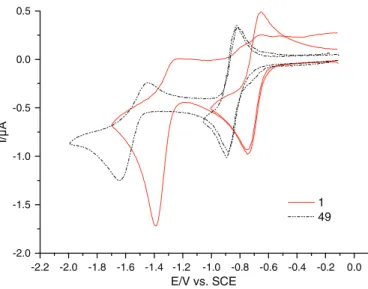
Fig. 1shows typical voltammograms obtained for the series. The
voltammogram is characterized by two electron transfers. The first electron transfer (−0.882 (26) b E1/2b − 0.477 (48) vs. SCE) is
per-fectly reversible (RIp around 1) independently of the scan rate when the potential scan is restricted to this system. As expected the
Table 1(continued)
Compounds R1 R2 R3 LogP calc
a (VCCLAB) IC
50/nM FcB1 strainb E1/2/Vd,e(vs. SCE) RIpf ΔEp/mVg
68 OCH3 H 4′-Dimethylamino-3′-tolyl 40 ± 30 − 0.815 0.66(1) 69 − 1.612 0.39 125
aLogP calculated with VCCLAB (http://www.virtuallaboratory.org/lab/alogps/start.html). bThe drug concentration giving a 50% decrease in parasite growth.
cThe highest tested concentration.
dThe electrochemical data are gathered at 0.1 V/s; for irreversible systems, E
1/2was obtained under a higher potential scan rate when the backward peak appeared. eE
1/2= (Epbackward+ Epforward)/2. fRIp = |Ip
backward/Ipforward|; in parentheses, value when the potential scan is restricted to the first system. gΔEp = |Ep
potentials E1/2depend on the nature of the substituents. The ΔEp
values are in agreement with the quasi-reversible definition of an electron transfer. The peak currents are linearly related to the square root of the potential scan rate as for a diffusion controlled process. The second electron transfer (−1.704 (48) bE1/2b − 1.264 (4, 67) vs.
SCE) is more complicated: the backward peak current is lower than the forward peak current (RIp b 1). The peak currents are of the same order of magnitude as those of the first electron transfer, which means that the same number of electrons is exchanged. When the potential scan rate was increased, the electrochemical sys-tem became reversible; a simple EC scheme (electron transfer fol-lowed by a chemical reaction) could account for these observations. As above, the peak currents are linearly related to the square root of the potential scan rate as for a diffusion controlled process and the potentials E1/2depend on the nature of the substituents.
Considering the basic structure of the indolone-N-oxides (Scheme 1), two reducible functions are present, the N-oxide and the ketone, which may correspond to the two electron transfers observed by cyclic voltammetry. By contrast, compounds 48, 56, and 67, that have a third re-ducible function in their structure such as NO2at R2(48), NO2at R3(56)
and a ketone at R2(67), gave a third redox signal (Table 1).
By comparison with the oxidation peak current of ferrocene recorded under the same conditions, monoelectronic transfers are expected for the reductions of the indolone-N-oxide compounds. More-over, as explained below, EPR spectroelectrochemical experiments demonstrated that the first reduction step gives rise to the appearance of a nitroxide radical-anion consistent with a monoelectronic transfer. These results confirm that the first reduction step can be attributed to the reduction of the N-oxide to a nitroxide radical-anion (Scheme 2). The second electron transfer is then attributed to the ketone function.
The irreversibility of this reduction is indicative of high chemical reac-tivity of the intermediate, the radical-anion C•―O−.
The ketone reduction potential depends on the delocalization[18] whereas the nature of the products formed depends on the medium: pinacol, through a monoelectron transfer, or alcohol through a bielec-tron transfer[18,19]that requires protonation. Pinacol originates from the dimerization and then protonation of the radical-anion. The revers-ibility of the second electrochemical system depends on the stability of the radical-anion C•―O−: the peak ratio RIp is lower than unity
(Table 1) but when the potential scan rate was increased (around 5 V/ s) a quasi-reversible system was observed (data not shown). In dry ace-tonitrile, the one electron reduction yields the C•―O−radical-anion,
which gives pinacol after dimerization.
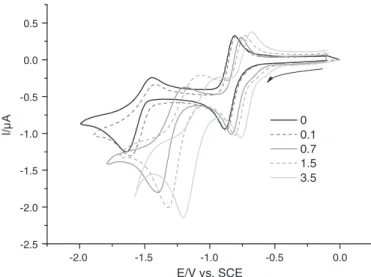
Voltammograms were recorded with increasing quantities of water (Fig. 2). Addition of small quantities of water has a slight effect on the first reduction process whereas it considerably affects the sec-ond one. The potential of the first redox process (N-oxide reduction) is slightly displaced towards less negative values when increasing the percentage of water (around 120 mV on the figure). Moreover, the system remains reversible, in particular when the potential scan is re-stricted to this system. The anodic displacement of the reduction po-tential can be explained by the protonation of the nitroxide radical-anion according to the potential-pH diagram theory, the water being the proton source. This protonation is confirmed by the EPR spectroelectrochemical analysis (cf. 3.2).
On the contrary, the potential of the second electron transfer (ke-tone reduction) is strongly displaced towards less negative values when the percentage of water is increased (around 500 mV). The for-ward peak current also increases showing that the system moves from a one electron transfer to a bielectronic transfer, leading to the production of alcohol[19,20].
For compounds 48, 56, and 67 that have a third reducible function in their structure, the signals are consistent with those reported in the literature. The acetophenone moiety in 67 is reduced around –2 V
[20–22]. In the case of the NO2derivatives, their reductions are
mono-electronic[23,24]in aprotic solvents. The potential of NO2reduction
for 48 is then attributed at −0.932 V and for 56 at −0.987 V. The C=O reduction potentials are in the same order as the reported values of other compounds (Table 1). However, as part of our study, only the data corresponding to the first reduction step were correlat-ed with anti-malarial properties.
3.2. EPR spectroelectrochemical analysis
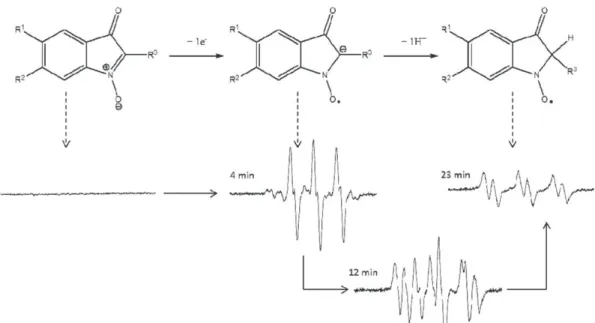
To confirm the radical nature of the species formed after the first one-electron step reduction and to study its stability, electrochemis-try was coupled with electron paramagnetic resonance (EPR) spec-troscopy. An illustration of the EPR spectrum obtained and its evolution with time is shown inFig. 3for compound 1 after 5 min of electrolysis in acetonitrile containing TBAP 0.1 mol L− 1(potential
on the plateau of the diffusion wave due to the first electrochemical system: Eapplied= E1/2− 0.2 V). The spectrum recorded 4 min after the end of electrolysis (Fig. 3a) consists in a triplet characterized, as demonstrated by simulation, by the hyperfine splitting constants
-2.0 -2.0 -1.8 -1.6 -1.4 -1.2 -1.0 -0.8 -0.6 -0.4 -0.2 0.0 -2.2 -1.5 -1.0 -0.5 0.0 0.5 1 49 E/V vs. SCE
Fig. 1.Electrochemical properties of indolone-N-oxides. Cyclic voltammograms of 1 and 49 (1 mmol L− 1) at a platinum electrode in ACN-TBAP (0.1 mol L− 1), potential
scan rate 0.1 V/s. R1 R2 N O O R3 + 1e -R1 R2 N O O R3 + 1e -R1 R2 N O O R3
aN= 6.27 G, aHγ= 1 G (protons on carbons 4 and 7 for compound 1).
This nitroxide radical-anion detected is relatively stable (about 10 min). This stability is consistent with an aprotic medium and the highly conjugated character of the indolone-N-oxide structure allow-ing the delocalization of the unpaired electron. The high stability of the spin adducts derived from indolone-N-oxides has already been demonstrated in previous studies dealing with spin trapping proper-ties of these molecules[17]. This triplet evolves with time to a signal (Fig. 3c) with hyperfine splitting constants aN= 9.5 G and aHβ= 2.3 G
indicating that the carbon of the nitroxide anionic form has been pro-tonated (Scheme 3). A protonation on the nitroxide function would give a hydroxylamine form which is EPR silent. Before the proton-ation at carbon 2, the unpaired electron is strongly delocalized on the whole structure which is nearly planar and it couples with the nu-clear spins of the nitrogen and proton at C4 and C7 (for compound 1). X-ray crystallography of a similar compound (2-phenylisatogen) shows that the isatogen ring and the phenyl ring are almost fully co-planar[25,26]. After protonation at C2, the planarity of the mole-cule is decreased thus reducing the electronic delocalization and resulting in a higher electronic density at the NO bond. The unpaired electron then couples with the nuclear spins of the nitrogen and
-2.5 -2.0 -2.0 -1.5 -1.5 -1.0 -1.0 -0.5 -0.5 0.0 0.0 0.5 E/V vs. SCE 0 0.1 0.7 1.5 3.5
Fig. 2.Electrochemical properties of indolone-N-oxides. Cyclic voltammograms of 49 (1 mmol L− 1) at a platinum electrode in ACN-TBAP (0.1 mol L− 1) with increasing
amount of water, potential scan rate 0.1 V/s.
0.0 1.0x10⁴ -1.0x10⁴ 3460 3470 3480 3490 3500 8.0x10³ -8.0x10³ 6.0x10³ -6.0x10³ 4.0x10³ -4.0x10³ 2.0x10³ 0.0 6.0x10³ 4.0x10³ 2.0x10³ -2.0x10³ -8.0x10³ 3x10³ 2x10³ 1x10³ -3x10³ -2x10³ -1x10³ -6.0x10³ -4.0x10³ -2.0x10³ In te n s it y Field/G 3460 3470 3480 3490 3500 Field/G 3460 3470 3480 3490 3500 Field/G in te n s it y 0 In te n s it y
a
b
c
Fig. 3.EPR spectra of the reduced form of indolone-N-oxide: EPR spectra and the corresponding simulated spectra recorded for compound 1 (1 mmol L− 1) a) 4 min, b) 12 min and
proton at C2. From this structural change resulting from the proton-ation at C2, the higher electronic density on the NO bond leads to a higher hyperfine splitting constant, aN, shifting from 6.27 G to 9.5 G.
These observations are in agreement withScheme 3. For compound 1a mixture of the two species (nitroxide radical-anion and its proton-ated form) is observed over about 8 min. As demonstrproton-ated by the simulation, the spectrum recorded 12 min after the end of electrolysis is the superimposition, in the same proportion, of the spectra of the two species (Fig. 3b). The coupling between the electrochemistry and EPR spectroscopy leads to a better understanding of each step of the reduction/protonation process compared with that reported for some isatogens[27].
3.3. Relationship between reduction potentials and substituents on indolone-N-oxides
All the compounds studied gave at least two electrochemical sys-tems: the first one presented a half-wave potential ranging from − 0.882 to − 0.477 V vs. SCE while for the second one the limits are in the domain [−1.650, −1.264] V vs. SCE. These values are highly dependent on the three substituents, R1, R2and R3. Studies reported
for other N-oxide derivatives, such as phosphorylated nitrones[28], phenyl-butyl nitrone derivatives [29]or quinoxaline-N, N′-dioxides [11], showed such a relationship. In our series, the presence of electron-donating groups induces an important shift of the first re-duction wave. For example compounds 49 or 50, (R3= alkyl) have
the highest reduction potential value. With the introduction of electron-withdrawing substituents (Cl, CF3, O―CF3, NO2) on the
phe-nyl ring (R3= aryl) (compounds 1, 8, 9, 11, 12, 13, 19, 25, 37, 39, 56
and 61) or on the indolone moiety at R2(compounds 19, 35, 48),
the products are more readily reduced. For example, the substitution of the alkyl chain (R3) (compound 49 or 50) by a 3,4-dichlorophenyl
(compound 8) or by a 4-trifluoromethylphenyl (compound 61) group resulted in a positive shift equal to 23 mV for the first cathodic wave. This shift was only 9 mV when R3was a 4-ethylphenyl group
(com-pound 60). By comparing the redox potentials of com(com-pounds 9, 37 and 25 or 56 and 61 the withdrawing effect of substituents appears clear: NO2> CF3> Cl. Similarly, by comparing compounds 37 and 25,
one can note that the replacement of CF3 by O-CF3 induces, as
expected, a negative shift in the reduction potential. A smaller shift is recorded with the introduction of an electron-donating group (―O―R or ―Ph―O―R) as R1or R3(compounds 2, 4, 5, 7, 18, 20,
22, 24, 27 29 and 57). By comparing compounds 9 and 12 it appears
that the position of the methoxy group (R1or R2) did not affect the
reduction potential.
These effects are consistent with the facilitation of reduction by low-ering the electron density at C2 which is confirmed by the Hammett plot (Fig. 4), considering the σp values for substituents in the
4-position of the phenyl ring[27,30]. As predicted by Hammett, the num-ber and position of electron-withdrawing groups influence the reduc-tion potential.
Note that the most cathodic potentials were obtained in the case of amine substituents (compounds 26 and 30). The addition of a
Scheme 3.Relationship between the reduced forms of indolone-N-oxides and the corresponding EPR spectra.
Fig. 4.Relationship between reduction potentials and Hammet constants of indolone-N-oxides. Plot of E1/2against Hammet substituent constants σpfor compounds having
methoxy group at R1does not modify the reduction potential as seen
by comparing compounds 2 with 24 and 37 with 61. 3.4. Relationship between the electrochemical behavior and antiplasmodial activity
The indolone-N-oxides gave rise to two reduction steps in ACN/TBAP. The first reduction of the N-oxide moiety is reversible and involves the formation of a stable nitroxide radical-anion as confirmed by EPR spec-troscopy. This relatively stable radical could be the starting point for the redox events deleterious to the parasite. In this case, the ease of the first reduction of the N-oxide moiety would play an important role in the antiplasmodial activity. Indeed, further experiments carried out on the series have demonstrated that the antiplasmodial properties of these indolone-N-oxides were controlled by a bioreductive transforma-tion in red blood cells[16].
Many parameters including solubility and log P, absorption, diffu-sion and metabolism, as well as the cellular targets affect the biolog-ical activities of compounds. It is clear that a global analysis of each parameter versus the biological activity studied may not produce a clear relationship. The effects of these parameters may be additive or subtractive, rendering any correlation difficult to observe on a large series. No simple relationship was found between the reduction potential and the antiplasmodial activity. For example, one can note that compounds with aliphatic substitutions (49, 50 and 60) are hard-ly reduced and poorhard-ly active against Plasmodium. On the contrary, compounds having amine groups (26, 30 and 68) also have very ca-thodic reduction potentials whereas they are among the most biolog-ically active compounds of the series. The amine groups at R3on these
compounds give cationic protonated forms at the pH of the cell model tested (parasitized red blood cells), which are determinant for the ab-sorption mechanism of the cell. In the case of these compounds (26, 30and 68), the absorption surpasses the electron withdrawing effects of substituents compared with other compounds. Interestingly, we
previously showed that antiplasmodial activities were more strongly affected by the substitutions at R3than by substitutions at the phenyl
group of the indolone moiety (R1and R2). Consequently, the
relation-ship between activity and the ease of reduction have been studied for molecules with R1
= ―OCH3and R2= H, compounds distinguished
by electron-withdrawing or -donating substituents on the phenyl group at R3. The corresponding graphs are shown in Fig. 5. In the
case of electron-withdrawing substituents (Fig. 5a), the antiplasmo-dial activity increases when the compounds are more readily reduced. These results are consistent with an antiplasmodial property con-trolled by a bioreductive transformation in red blood cells[16]and in agreement with mechanisms of action that we recently reported [14].
On the other hand, for electron-donating substituents (Fig. 5b), a large variation in activity is observed, whereas the potential is almost constant due to their weak influence. In this second case, variation in lipophilicity could explain such disparate IC50values. Indeed, in this
group, the less potent compounds 20, 24 and 42 are characterized by the highest partition coefficient (logP >3), reaching 3.63 for 42. 4. Conclusion
The thirty seven indolone-N-oxides studied in aprotic solvents, showed two reduction steps located around −0.68 ± 0.2 V and − 1.45 ± 0.2 V vs. SCE. The first reduction step was reversible for all the compounds studied under the conditions of the study and as-cribed to the reduction of the ―C=N―O double bond, whereas the second irreversible reduction step was ascribed to the carbonyl re-duction. EPR spectroscopy analysis confirmed that this first reduction gives rise to the formation of a relatively stable radical, which could be the starting point for the redox events deleterious to the parasite. A relationship between electrochemical behavior and indolone-N-oxide structure can be established for compounds having electron-withdrawing substituents. The insertion of an electron-electron-withdrawing group on the N-oxide ring results in a less negative reduction poten-tial making the bio-reduction easier and thus the compound more ac-tive against Plasmodium. These results will orientate the selection of substituents for the design of new molecules with better pharmaco-logical activities.
Acknowledgements
This work was supported by the European Commission (FP6-LSH-20044-2.3.0-7, STREP no. 018602, Redox antimalarial Drug Discovery, READ-UP), IDEALP'Pharma and The French National Research Agency (ANR-10-BLAN-0726, Mechanisms of action and Targets of new anti-malarial Redox molecules, MATURE). We thank J.-P. Nallet and IDEALP'Pharma for their scientific contributions.
References
[1] I. Aldana, M.A. Ortega, A. Jaso, B. Zarranz, P. Oporto, A. Gimenez, A. Monge, E. Deharo, Anti-malarial activity of some 7-chloro-2-quinoxalinecarbonitrile-1,4-di-N-oxide derivatives, Pharmazie 58 (2003) 68–69.
[2] E. Vicente, L.M. Lima, E. Bongard, S. Charnaud, R. Villar, B. Solano, A. Burguete, S. Perz-Silanes, I. Aldana, L. Vivas, A. Monge, Synthesis and structure–activity rela-tionship of 3-phenylquinoxaline 1,4-di-N-oxide derivative as antimalarial agents, Eur. J. Med. Chem. 41 (2008) 1903–1910.
[3] G. Aguirre, H. Cerecetto, R. Di Maio, M. Gonzalez, M.H. Montoya Alfaro, A. Jaso, B. Zarranz, M.A. Ortega, I. Aldana, A. Monge-Vega, Quinoxaline N, N′-dioxide derivatives and related compounds as growth inhibitors of Trypanosoma cruzi. Structure–activity relationships, Bioorg. Med. Chem. Lett. 14 (2004) 3835–3839.
[4] E. Moreno, S. Pérez-Silanes, S. Gouravaram, A. Macharam, S. Ancizu, E. Torres, I. Aldana, A. Monge, P.W. Crawford, 1,4-Di-N-oxide quinoxaline-2-xcarboxamide: cyclic voltammetry and relationship between electrochemical behavior, structure and anti-tuberculosis activity, Electrochim. Acta 56 (2011) 3270–3275. [5] W. Porcal, P. Hernandez, G. Aguirre, L. Boiani, M. Boiani, A. Merlino, A. Ferreira, R. Di
Maio, A. Castro, M. Gonzalez, H. Cerecetto, Second generation of 5-ethenylbenzofuran derivatives as inhibitors of Trypanosoma cruzi growth : synthesis, biological evaluation and structure–activity relationships, Bioorg. Med. Chem. 15 (2007) 2768–2781. Fig. 5.Relationship between antiplasmodial activity and reduction potential. Plot of E1/2
against IC50 for a) compounds having the methoxy group (R1) and
electron-withdrawing substituents on the phenyl group at R3(9, 11, 12, 13, 37); b) compounds
having the methoxy group (R1) and electron-donating substituents as R3(17, 18, 22, 24,
[6] M. Boiani, L. Piacenza, P. Hernandez, L. Boiani, H. Cerecetto, M. Gonzalez, A. Denicola, Mode of action of Nifurtimox and N-Oxide-containing heterocycles against Trypanosoma cruzi: is oxidative stress involved? Biochem. Pharmacol. 79 (2010) 1736–1745.
[7] A. Gerpe, G. Aguirre, L. Boiani, H. Cerecetto, M. González, C. Olea-Azar, C. Rigol, J.D. Maya, A. Morello, O.E. Piro, V.J. Arán, A. Azqueta, A. López de Ceráin, A. Monge, M.A. Rojas, G. Yaluff, Indazole N-oxide derivatives as antiprotozoal agents: syn-thesis, biological evaluation and mechanism of action studies, Bioorg. Med. Chem. 14 (2006) 3467–3480.
[8] M. Hooper, D.A. Patterson, D.G. Wibberley, Preparation and antibacterial activity of isatogens and related compounds, J. Pharm. Pharmacol. 17 (1965) 734–741. [9] A.B. Sahasrabudhe, H.V. Kamath, B.V. Bapat, N.K. Sheshgiri, Antitubercular agents:
part III-synthesis of substituted 2-arylisatogens, Indian J. Chem. 19 (1980) 230–232. [10] H. Hagen, R.D. Kohler, E.H. Pommer, Isatogen derivatives and their use as
fungi-cides, Eur. Pat. 54147, Chem. Abstr. 97 (1982) 216185.
[11] H. Cerecetto, M. González, N-oxides as hypoxia selective cytotoxins, Mini Rev. Med. Chem. 1 (2001) 219–231.
[12] F. Nepveu, S. Kim, J. Boyer, O. Chatriant, H. Ibrahim, K. Reybier, M.C. Monje, S. Chevalley, P. Perio, B. Lajoie, E. Deharo, M. Sauvain, R. Tahar, L. Basco, A. Pantaleo, F. Turrini, P. Arese, A. Valentin, E. Thompson, L. Vivas, S. Petit, J.-P. Nallet, Synthesis and antiplasmodial activity of new indolone N-oxide deriva-tives, J. Med. Chem. 53 (2010) 699–714.
[13] R. Tahar, L. Vivas, L. Basco, E. Thompson, H. Ibrahim, J. Boyer, F. Nepveu, Indolo-ne-N-oxide derivatives: in vitro activity against fresh clinical isolates of Plasmodium falciparum, stage specificity and in vitro interactions with established antimalarial drugs, J. Antimicrob. Chemother. 66 (2011) 2566–2572.
[14] A. Pantaleo, E. Ferru, R. Vono, G. Girbaldi, O. Lobina, F. Nepveu, H. Ibrahim, J.-P. Nallet, F. Carta, F. Mannu, P. Pippia, E. Campanella, P.S. Low, F. Turrini, New anti-antimarial indolone-N-oxides, generating stable radical species, promote de-stabilization of the host cell membrane at early stages of P. falciparum growth, Free Radic. Biol. Med. 52 (2012) 527–536.
[15] N. Ibrahim, H. Ibrahim, S. Kim, J.P. Nallet, F. Nepveu, Interactions between antima-larial indolone-N-oxide derivatives and human serum albumin, Biomacromole-cules 11 (2010) 3341–3351.
[16] H. Ibrahim, A. Pantaleo, F. Turrini, P. Arese, J.-P. Nallet, F. Nepveu, Pharmacological properties of indolone-N-oxides controlled by a bioreductive transformation in red blood cells, Med. Chem. Commun. 2 (2011) 860–869.
[17] J. Boyer, V. Bernardes-Genisson, V. Farines, J.P. Souchard, F. Nepveu, 2-Substituted-3-H-indol-3-one-1-oxides: preparation and radical trapping properties, Free. Radic. Res. 38 (2004) 459–471.
[18] N.G. Tsierkezos, Investigation of the electrochemical reduction of benzophenone in aprotic solvents using the method of cyclic voltammetry, J. Sol. Chem. 36 (2007) 1301–1310.
[19] N.A. Macias-Ruvalcaba, D.H. Evans, Electrochemical reduction of 2-fluorenecarboxaldehyde: a mechanism with a grandparent–grandchild reaction, J. Electroanal. Chem. 585 (2005) 150–155.
[20] D.C. de Azevedo, J.F.C. Boodts, J.C.M. Cavalcanti, A.E.G. Santana, A.F. dos Santos, E.S. Bento, J. Tonholo, M.O.F. Goulart, Self-protonation mechanism in the electro-chemical reduction of Jatropholone, J. Electroanal. Chem. 5466 (1999) 99–106. [21] P.-L. Fabre, L. Latapie, A. Noirot, N. Chouini-Lalanne, Correlation of cyclic
voltam-metry behaviour and photooxidative properties of indoprofen and its photoprod-ucts, Electrochim. Acta 52 (2006) 102–107.
[22] S. Michaud, V. Hajj, L. Latapie, A. Noirot, V. Sartor, P.-L. Fabre, N. Chouini-Lalanne, Cor-relations between electrochemical behaviours and DNA photooxidative properties of non stereoïdal anti-inflammatory drugs and their photoproducts, J. Photobiol. Photo-chem. B, 110 (2012) 34–42,http://dx.doi.org/10.1016/j.jphotobiol.2012.02.007. [23] J.M. Savéant, D. Tessier, Potential dependence of the electrochemical transfer
co-efficient. Reduction of some nitro compounds in aprotic media, J. Phys. Chem. 81 (1977) 2192–2197.
[24] M. Aravena, R. Figueroa, C. Olea-Azar, V.J. Aran, Esr Electrochemical and orac stud-ies of nitro compounds with potential antiprotozoal activity, J. Chil. Chem. Soc. 55 (2010) 244–249.
[25] D.B. Adams, M. Hooper, J.S. Christopher, S.E. Raper, B. Stoddart, Isatogens: crystal structure, electron density calculations, and 13C nuclear magnetic resonance spectra, J. Chem. Soc. Perkin 1 (6) (1986) 1005–1010.
[26] C.C. Bond, M. Hooper, Isatogens. Part VI. Synthesis of isatogens via tolan (diphenylacetylene) intermediates, J. Chem. Soc. C (1969) 2453–2460. [27] J.E. Bunney, M. Hooper, Isatogens Part VII. Polarographic reduction of isatogens, J.
Chem. Soc. B (1970) 1239–1241.
[28] B. Tuccio, P. Bianco, J.C. Bouteiller, P. Tordo, Electrochemical characterisation of β-phosphorylated nitrone spin traps, Electrochim. Acta 44 (1999) 4631–4634. [29] G.L. McIntire, H.N. Blount, H.J. Stronks, R.V. Shetty, E.G. Janzen, Spin trapping in
electrochemistry. 2. Aqueous and nonaqueous electrochemical characterizations of spin traps, J. Phys. Chem. 84 (1980) 916–921.
[30] P. Zuman, Substituent Effects in Organic Polarography, Plenum Press, New York, 1967.
[31] C. Hansch, A. Léo, R.W. Taft, A survey of Hammett substituent constants and res-onance and field parameters, Chem. Rev. 91 (1991) 165–195.