To link to this article :
URL :
http://www.aamas-conference.org/Proceedings/aamas2013/docs/p1361.pdf
O
pen
A
rchive
T
OULOUSE
A
rchive
O
uverte (
OATAO
)
OATAO is an open access repository that collects the work of Toulouse researchers and
makes it freely available over the web where possible.
This is an author-deposited version published in :
http://oatao.univ-toulouse.fr/
Eprints ID : 12538
To cite this version :
Drogoul, Alexis and Amouroux, Edouard and Caillou, Philippe and
Gaudou, Benoit and Grignard, Arnaud and Marilleau, Nicolas and
Taillandier, Patrick and Vavasseur, Maroussia and Vo, Duc An and
Zucker, Jean-Daniel
GAMA: multi-level and complex environment
for agent-based models and simulations (demonstration)
. (2013) In:
International Joint Conference on Autonomous Agents and
Multiagent Systems - AAMAS 2013, 6 May 2013 - 10 May 2013
(Saint-Paul, MN, United States).
Any correspondance concerning this service should be sent to the repository
administrator:
[email protected]
GAMA: Multi-level and Complex Environment for
Agent-based Models and Simulations
(demonstration)
Alexis Drogoul
a, Edouard Amouroux
b, Philippe Caillou
c, Benoit Gaudou
d,
Arnaud Grignard
a, Nicolas Marilleau
a, Patrick Taillandier
e,Maroussia Vavasseur
d,
Duc-An Vo
a, Jean-Daniel Zucker
a aUMMISCO, IRDb
LIP6, UPMCc
LRI, Univ. Paris Sud,d
IRIT, Univ. Toulouse 1,e
IDEES, Univ. Rouen
abcParis (France)dToulouse (France),eRouen (France) a
[email protected]
ABSTRACT
Agent-based models are now used in numerous application domains (ecology, social sciences, etc.) but their use is still impeded by the lack of generic yet ready-to-use tools sup-porting the design and the simulation of complex models in-tegrating multiple level of agency and realistic environments. The GAMA modeling and simulation platform is proposed to address such issues. It allows modelers to build com-plex models thanks to high-level modeling language, various agent architectures and advanced environment representa-tions and built-in multi-level support.
Categories and Subject Descriptors
I.6 [Simulation and Modelling]: Simulation Support Sys-tems
Keywords
Simulation platform, Agent-based modeling, GIS data, Multi-level model
1.
INTRODUCTION
In the last ten years there has been a striking increase in the use of agent-based models to study complex systems. This booming is partly due to the success of several software platforms that have reached a level of maturity supporting the development and simulation of agent-based models (Net-logo [4], Repast [2]., etc.). However, even with these plat-forms, the problem of the model design is still an open issue. Indeed, whereas some platforms such as Netlogo provide a dedicated modeling language to ease the model design, they are quite limited when dealing with rich models relying on GIS data. Other platforms, or toolboxes such as Repast, that allow to build more rich models are very complex to use and requires strong computer science skills. Consequently, field experts have to rely on computer scientists to develop models which slows the development and the use of realistic agent-based models.
The GAMA (GIS & Agent-based Modeling Architecture) modeling and simulation platform has been proposed to ad-dress such shortcomings. This open source platform pro-vides field experts, modelers, and computer scientists with a complete modeling and simulation environment for building rich spatially explicit agent-based simulations. In addition, it is shipped with ready-to-use abstractions for the most common needs (e.g. decision architectures, generic agent’s skill such as movements regardless of the representation of the environment), which are accessible through a dedicated high-level modeling language (GAML) and remains extensi-ble by Java programmers.
A demo video can be found at http://code.google.com/p/gama-platform/wiki/VideosPresentation to illustrate both advanced features and existing applications.
2.
GAMA APPLICATIONS
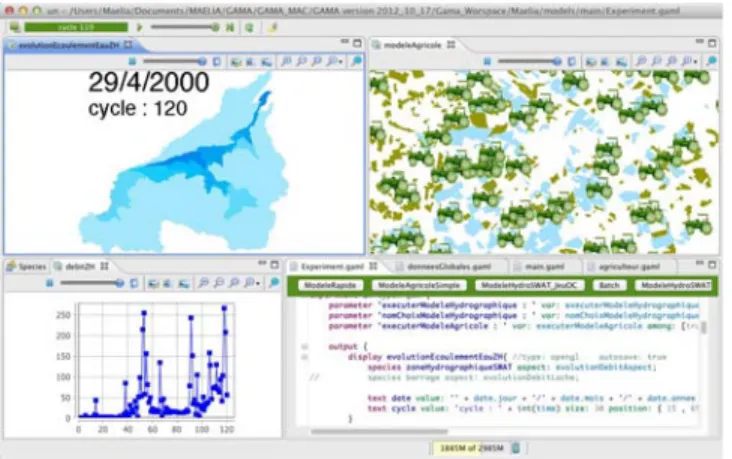
GAMA has already been used in various large scale ap-plications that share a strong focus on the interactions be-tween agents and complex environments. In natural disas-ter management, it has been applied to simulate evacuation organization in case of a tsunami in NhaTrang (Vietnam). This model combines detailed GIS data of the city and the coupling of agent and equation based modeling in order to upscale the number of inhabitants that can be simulated [5]. The MIRO model [1] allows geographers to conduct serious game sessions to identify cities management strategies for two mid-size cities in France : Dijon and Grenoble. This model makes also use of high resolution GIS data and large number of individuals (200.000+). GAMA can also be used as a support decision tool in natural resource management as in the MAELIA [3] project. This project aims at studying the social and ecological impact of water management in the Adour-Garonne Basin (France). GAMA has also been used in epidemiology. In the GAMAVI project [6], experts ques-tioned their hypotheses about avian influenza propagation through environment or animal population. A model that includes poultry production and environment dynamics has been developed. It has been used to assess the effectiveness and impact of control policies on the recurrent invasions of insects, i.e. Brown Plant Hopper, in the Mekong delta of Vietnam.
Figure 1: MAELIA simulation interface
3.
GAMA FEATURES
Modeling IDE : The GAMA modeling language (GAML) is supported by an advanced modeling IDE which eases the development of complex model (multiple environments and/or multi-level for instance). This IDE features code coloration, syntax and coherency checking.
Graphical user interface : The simulator graphical in-terface allows to keep track of the simulation dynamics from multiple point of views. Environment visualizations (2d or 3d), monitors and (agent) inspectors allow to view the in-stantaneous state of the simulation whereas various charts keep track of the simulation dynamics.
Multiple environment : GAMA is particularly power-ful concerning the management of complex environments. It allows to define several environments that can have differ-ent topologies (grid, graph or continuous). One continuous environment is used as reference to synchronize all of them. Each GAMA agent has a shape that is a 3D simple (point, polyline or polygon) or complex (composed of several sub-geometries) vector geometry.
Seamless GIS integration : A particularly interesting feature of GAMA is the possibility to create agents and to define their attributes (in particular their shape) from real data using shapefiles. Conversely, this allows the modeler to integrate geographical data into models under the form of active agents (one agents is created by geometry of a shapefile). In addition, GAMA manages the spatial projec-tion of the data (to get a spatially coherent model) and the reading of attribute values. In order to ease the manipu-lation of vector geometries, GAMA integrates different GIS features that are directly available through the GAML lan-guage (geometry buffer, convex-hull, intersection, difference, etc.). In the same way, the GAML language provides many complex primitives to manage the movement of agents in a specific environment (shortest path computation, movement constrained by a geometry, etc.).
Multi-Level based modeling : Multi-level agent-based modeling requires to manipulate agents at different levels of representation w.r.t. to time, space and behav-ior. Our approach of multi-level modeling is based on three principles. (1) An agent represents a level of organization which is associated with a spatial and temporal scale. (2) Levels are hierarchically organized to define privileged in-teractions between embedded levels. (3) Organizations can
be dynamic: some agents can move from an organization to another in order to adapt their representation level dy-namically. We have implemented these principles in GAMA which offers the modeler a straightforward way to write multi-level agent-based model in GAML [5].
Mathematical model integration : GAMA integrates a built-in numerical solver for ordinary differential equations such as prey-predator models (Lokta-Volterra) or compart-mental models in epidemiology (e.g. classic SIR models). This allows to define agent behavior according to differen-tial equations and study coupling (or simply compare) with agent-based models.
Advanced visualization : GAMA provides a high-level graphic library (based on OpenGL) that allows user to de-fine their own custom multi-layer displays. Each of these displays can show different information and represent the agents in different ways. The multi-layer rendering feature allows to superpose different layers of information on the same screen. For example, GIS data and DEM (Digital Model Elevation - grid) can be mixed to represent height information.
4.
CONCLUSION
The platform website (http://gama-platform.googlecode.com) provides modelers with numerous tutorials and GAML lan-guage reference. It provides developers with guides on how to extend the platform with their own plugins (GAMA is under GPL) while the code is accessible on the project’s SVN. The GAMA executable for the 3 major OS can also be downloaded from this website.
5.
REFERENCES
[1] Banos, A., Marilleau, N. and MIRO team: Improving individual accessibility to the city: an agent-based modelling approach. Proc. of ECCS, Bruxelles. (2012) [2] North, M., Howe, T., Collier, N., Vos, J.: A
declarative model assembly infrastructure for verification and validation. Proc. of Advancing Social Simulation: 1st World Congress. (2007)
[3] Taillandier, P., Therond, O., Gaudou B.: A new BDI agent architecture based on the belief theory. Application to the modelling of cropping plan decision-making. Proc. of IEMs pp. 107-116. (2012) [4] Wilensky, U.: Netlogo. Technical report, Center for Connected Learning and Computer-Based Modeling, Northwestern University, Evanston, IL. (1999) [5] Anh, N. T. N., Zucker, J. D., Du, N. H., Drogoul, A.,
An, V. D.: Hybrid Equation-based and Agent-based Modeling of Crowd Evacuation on Road Network. Proc. ICCS pp. 456-466 (2012).
[6] Amouroux E., Desvaux S., Drogoul A. :”Towards virtual epidemiology: an agent-based approach to the modeling of H5N1 propagation and persistence in North-Vietnam” LNCS, vol. 5357, pp. 26-33, 2008.