To cite this document
:
Shen, Weifeng and Benyounes, Hassiba and Gerbaud, Vincent From batch to
continuous extractive distillation using thermodynamic insight: class 1.0-2 case B.
(2011) In: IEEE 2nd International Conference on Computing, Control and Industrial
Engineering (CCIE 2011), 20-21 Aug 2011, Wuhan, Chine.
O
pen
A
rchive
T
oulouse
A
rchive
O
uverte (
OATAO
)
OATAO is an open access repository that collects the work of Toulouse researchers and
makes it freely available over the web where possible.
This is an author-deposited version published in:
http://oatao.univ-toulouse.fr/
Eprints ID: 6249
Any correspondence concerning this service should be sent to the repository
administrator:
[email protected]
From batch to continuous extractive distillation using thermodynamic insight:
class 1.0-2 with a heavy entrainer
Weifeng Shen
a,b, Hassiba Benyounes
c,Vincent Gerbaud
a,b,
a Université de Toulouse, INP, UPS, LGC (Laboratoire de Génie Chimique), 4 allée Emile Monso,
F-31432 Toulouse Cedex 04 – France
b CNRS, LGC (Laboratoire de Génie Chimique), F-31432 Toulouse Cedex 04 – France
cU.S.T. Oran, Faculté des sciences, Département de Chimie BP 1505, Elmnaouar, 31000 Oran, Algérie
Abstract—A systematic feasibility analysis is presented for the separation azeotropic mixtures by batch and continuous extractive distillation. Based on batch feasibility knowledge, batch and continuous separation feasibility is studied under reflux ratio and entrainer flow-rate for the ternary system chloroform-vinyl acetate-butyl acetate, which belongs to the class 1.0-2 separating maximum boiling temperature azeotropes using a heavy entrainer. How information on feasibility of batch mode could be extended to the feasibility of continuous mode is then studied, possible feasible regions are determined by finding the feasible points based on continuous methodology, they show minimum and maximum feed ratio as a function of the reflux, and a lower bound for the reflux ratio. Results are validated by simulation.
Keywords-extractive distillation; univolatility line; reflux; feed flow-rate
I. INTRODUCTION
Extractive distillation is a widely used method for separating azeotropic and low relative volatility mixtures in pharmaceutical and chemical industries. It differs from azeotropic distillation by the fact that the third-body solvent E is fed continuously in another column position other than the mixture feed. Distillation can be operated either in batch mode, suitable for small scale plants and high value added products, to recover several products in single column while the compositions change over time; or in continuous mode, suitable for large scale plant and as part of a sequence of columns. In addition, the continuous column has a stripping section more than the batch column. For both modes feasibility was investigated separately based on the reflux ratio R and the solvent to feed flow-rate ratio FE/F for
continuous method and a function of R and FE/V, where V
is the vapor flow-rate going up from the boiler, for batch process. In the literature, the continuous mode was investigated for a special case of ternary mixture ABE, class 1.0-1a, where a heavy entrainer is added to separate an azeotropic mixture with minimum azeotrope [1]. The batch method was studied for all 26 classes and found feasibility for classes 1.0-1a, 1.0-1b, 1.0-2, 2.0-1, 2.0-2a, 2.0-2b and 2.0-2c [2-4]. We intend to show how information on the feasibility of batch mode could be extended to the feasibility of continuous mode with understanding of limiting values for reflux or feed ratio.
This article will focus on a special case of ternary mixture chloroform-vinyl acetate-butyl acetate system which belongs to class 1.0-2, matching the separation of maximum boiling temperature azeotropes using a heavy entrainer. Chloroform and vinyl acetate formed a maximum azeotrope at 74.9°C, and addition of the entrainer butyl acetate in an extractive distillation column enabled to broke the original binary azeotrope. Thermodynamic properties calculations are carried out by Simulis®thermodynamics and rigorous simulation with ProSim Plus® [5].
II. BATCH PROCESS FEASIBILITY FROM THERMODYNAMICS CRITERIA
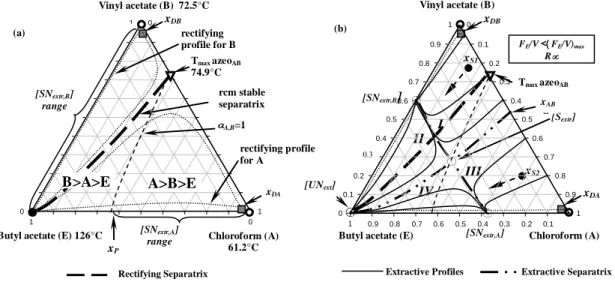
Separation of chloroform-vinyl acetate by adding butyl acetate illustrates the case when the univolatility line αAB
reaches the binary A-E side. As shows in Fig.2, both original components A and B are unstable nodes, the entrainer (E) is the stable node, while the maximum boiling azeotrope Tmax azeoAB is a saddle point. The rcm stable
separatrix, so-called distillation boundary, links the azeotrope to E. The univolatility curve αAB =1 starts at Tmax
azeoAB until it intersects the A-E side at the so-called xP
point. According to the general feasibility criteria for extractive distillation under infinite reflux [4]: both chloroform (A) and vinyl acetate (B) are the most volatile in their respectively region (see volatility order B>A>E and A>B>E in Fig.2a) where there exists a residue curve with decreasing temperature from E to their location. Therefore, either A or B are possible distillates of the extractive
(a) (b) FE, xE F, xF D xD W xW F, xF D xD FE,xE
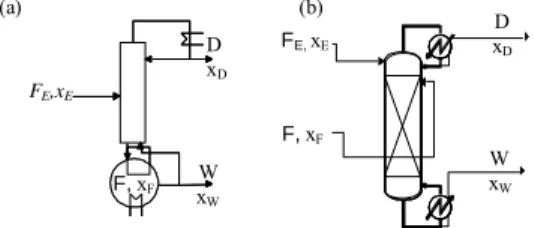
Figure 1. Extractive distillation column: (a) batch process and (b) Double-feed continuous process
W xW
distillation process. As explained in [4], there is a maximum value (FE/V)max,A,R to recover component A and no
entrainer limit restriction applies to recover component B at infinite reflux [6-7] (See [SNextr,A] and [SNextr,B] range in
Figure 2a).
As seen in Fig.2b for (FE/V)<(FE/V)max,A,R , pure A can
be obtained from the initial charge composition xS2 by
adding even a small quantity of E. Indeed, xS2 lies in the
regions III and IV where extractive composition profiles reach [SNextr,A]which isable to cross a reactifying profile
reaching the unstable rectifying node vertex A. above (FE/V)max,A,R , [SNextr,A]would disappear in the left of xP. In
contrast starting from xS1 in regions I and II, all extractive
profiles reach [SNextr,B] whatever the entrainer flowrate and
enable to recover distillate xDB.
0.9 0.8 0.7 0.6 0.5 0.4 0.3 0.2 0.1 1 0.9 0.8 0.7 0.6 0.5 0.4 0.2 0.1 0 1 0.9 0.8 0.7 0.6 0.5 0.4 0.3 0.2 0.1 0 1 0 Rectifying Separatrix rectifying profile for A
Extractive Profiles Extractive Separatrix
Chloroform (A) 61.2°C Vinyl acetate (B) 72.5°C
Butyl acetate (E) 126°C
rectifying profile for B rcm stable separatrix (a) xDB A,B=1 xDA xF Tmax azeoAB 74.9°C xP I II III IV (b) FE/V <( FE/V)max R [UNext] [SNextr,B] [Sextr] [SNextr,A] xDA xF xDB xF xS2 xF xS1 xF xAB xF Chloroform (A) Vinyl acetate (B)
Butyl acetate (E)
Tmax azeoAB B>A>E A>B>E [SNextr,B] range [SNextr,A] range 0.9 0.8 0.7 0.6 0.5 0.4 0.3 0.2 0.1 1 0.9 0.8 0.7 0.6 0.5 0.4 0.3 0.2 0.1 0 1 0.9 0.8 0.7 0.6 0.5 0.4 0.3 0.2 0.1 0 1
Figure 2. Feasibility analysis of the separation of chloroform-vinyl acetate using butyl acetate at infinite reflux ratio: (a) residue curve map (rcm) and (b) extractive composition profile map at FE/V> (FE/V)max.
III. CONTINUOUS MODE FEASIBILITY ASSESSMENT
The feasibility always rely upon intersection for composition profiles in the various column sections (rectifying, extractive, stripping), joining the top and bottom composition, whatever the operation parameter values (reflux, flow-rates...) [8]. Here we use geometrical analysis but mathematical ones could be used as well. The column section profiles are described by the general finite differential model of Lelkes et al.:
(1) * ) ( i i y x y L V dh dx
Where V and L are the vapor and liquid flow-rates, the vapor composition y* in equilibrium with x is computed by the liquid-vapor equilibrium relation and the actual vapor composition y is computed from the mass balance in each column section, depending on the chosen column configuration [9]. Table 1 displays the derived equations. There is a direct relation from mass balances between FE/V
in batch and FE/F in continuous.
TABLE 1.COLUMN PROFILE EQUATIONS FOR THREE SECTIONS
Column section Rectifying section Stripping section
Profile equations 1 * 1 1 1 i D i i y x R x R R R R dh dx * 1 1 1 1 i N i i x y S x S S S dh dx
Column section Extractive section
Profile equations ) ( * 1 1 1 1 1 1 1 1 x y Continuous D F F S R x R x D F F S R R R D F F S R R dh dx i E D i i ) ( * 1 1 1 ) 1 ( 1 x y Batch V F x R x V F R R V F R R R dh dx i E E D i E E i
IV. SIMULATION RESULTS AND DISCUSSION Reflux Ratio 0 10 20 30 40 50 0 5 10 15 20 25 30 Fe ed R a ti o Feasible Unfeasible Continuous process Fe ed R a ti o 0 10 20 30 40 0 5 20 25 Reflux Ratio Feasible Unfeasible 10 15 Batch process (a)
(b)
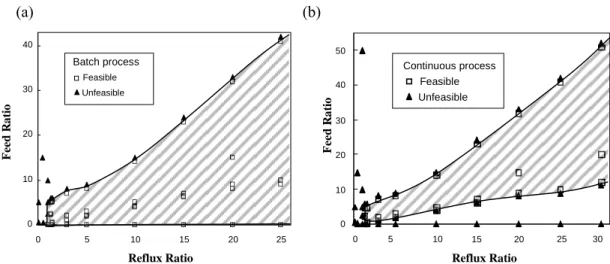
Figure 3. Feed ratio FE/F as a function of the reflux ratio to recover chloroform (A) at xF = {0.9, 0.1, 0}: (a) batch extractive distillation (b) continuous
extractive distillation 0 10 20 30 40 50 0 3 6 9 12 15 18 21 24 27 30 33 36 39 Reflux Ratio Feasible Unfeasible Continuous and batch
r er eppr eppr pr ocess
F e e d R a ti o
Figure 4. Feed ratio FE/F versus reflux ratio to recover vinyl acetate (B) for
batch and continuous extractive distillation at xF = {0.1, 0.9, 0}
The simulation results for separation of system chloroform-vinyl acetate-butyl acetate are summarized in Fig. 3 (for a chloroform distillate) and 4 (for a vinyl acetate distillate) respectively. Feasible regions (shaded) under different conditions of feed ratio and reflux are sketched by drawing the various operation points (Filled Triangle Up represents an unfeasible point; Open Square represents a feasible point). It can be seen that the feasible region is contained by the minimum and maximum feed ratio as a function of the reflux, and a lower bound for the reflux ratio, which gained based on criteria provided by the theories explained before.
Fig. 3 concerns a chloroform (A) distillate. As expected from the infinite reflux analysis there exists a maximum value for feed ratio above which the process is unfeasible.
That maximum gradually reduces as reflux gets smaller, until a minimum reflux. A detailed calculation of the profile map shows that the feasible rectifying section profiles region gets smaller until it can no longer intersect the extractive profile region. The same holds for the continuous mode as a maximum FE/V in batch translates into a
maximum FE/F in continuous.
The batch (Fig. 3a) and continuous mode (Fig. 3b) differ as an additional minimum value of the feed ratio exists for the continuous mode, because the stripping section is now involved and its conditions can limit feasibility.
When distillate is vinyl acetate (B) (Fig. 4), infinite reflux analysis shows no limit for the feed ratio. However when the reflux decreases, an unstable extractive separatrix reduces the feasible region (see [3]), thus setting a minimum value for the feed ratio. Batch and continuous modes display the same features. Similarly to Fig. 3, there is a minimum reflux value below which the separation becomes impossible no matter how big the amount entertainer feed given.
V. RIGOROUS SIMULATION
Continuous distillation rigorous simulations were carried out with ProSim Plus®, with thermodynamic model UNIFAC modified Dortmund 1993 for all conditions reported in Figure 3 and 4. They agreed with the feasibility analysis based on equations in Table 1. The separation is performed under continuous entrainer feed, 298K, atmospheric pressure and pure solvent. The column consists of three main parts: stages above the entrainer feed stage
named rectifying section, stages between entrainer feed and azeotropic mixture feed named extractive section, stages below is stripping section. The column contains 50 theoretical stages (total condenser and reboiler), the entrainer feed in the fifth stage, the mixture feed stage is 25.
butyle acetate(E) vinyl acetate(B) 1 0.9 0.8 0.7 0.6 0.5 0.4 0.3 0.2 0.1 0 1 0.9 0.8 0.7 0.6 0.5 0.4 0.3 0.2 0.1 0 1 0.9 0.8 0.7 0.6 0.5 0.4 0.3 0.2 0.1 0 Rectifying profile Extractive profile Stripping profile chloroform(A)
Figure 5. Rigorous simulation results
Figure 5 show the composition profiles computed from rigorous simulation. A feed rich in vinyl acetate(B) xF =
{0.1, 0.9, 0.0} is used. The prescribed liquid distillation flow rate is 0.9 kmol/hr to recover vinyl acetate as distillate, with a high purity, Reflux ratio (R=10) and feed ratio (FE/F=10). Results indicate that this process is feasible,
because starting from the charge of given composition (xF)
under the given operation conditions the specified distillated composition xD can be obtained, satisfying the
necessary and sufficient condition of the feasibility to have at least one possible column profile connecting still path with the point xD. Regarding purity, the composition of
distillate is {0.0637, 0.9916, 0.0001} compared to residue composition {0.9363, 0.0084, 0.9999}.
VI. CONCLUSIONS
Feasibility method based on batch process was extended to the investigation of potential feasible region under the operating parameters reflux ratio (R) and feed ratio (FE/F,
FE/V) for both continuous or batch mode, In the case of the
mixture vinyl acetate- chloroform using butyl acetate as entrainer, which belong to the ternary diagram class 1.0-2 (any binary maximum boiling azeotrope with a heavy entrainer forming no new azeotrope), the univolatility curve αAB =1 intersects the A-E edge. The batch feasibility
criterion under infinite reflux then states that A or B can be distillated out, depending on the starting composition. However, the process has its best potential for the
component that is located in the concave side of the residue curve map (rcm) where the rcm is C-shaped.
At infinite reflux ratio, an unfeasible region occurs (either for component A or component B), because of the extractive unstable separatrix always occurring for this 1.0-2 class. Furthermore, because the αAB =1 curve intersects
the A-E edge, a maximum entrainer flow rate exists for component A.
For continuous extractive distillation, these results translate well. Regarding the distillation of A, there is still a maximum entrainer flowrate at any reflux, above a minimum reflux value occurring because of the happening of a rectifying profile stable separatrix that limits the feasibility [3]. However, continuous mode differs from batch as a there exists a mimimum entrainer flow rate because then feasibility is limited by the stripping profiles region.
Regarding the distillation of B, batch analysis predicts no entrainer limitation under infinite reflux, but there exists one under finite reflux because of the reduction of the rectifying profile region as reflux decreases.
As these observations are corroborated by rigorous simulations, we demonstrate that feasibility analysis based in simple thermodynamic insight (the ternary class, the univolatility line intersect with the diagram) can be exploited to evaluate the feasibility under finite reflux and both for batch and continuous operation.
REFERENCE
[1] J. P. Knapp, M. F. Doherty,“Minimum entrainer flows for extractive distillation: A bifurcation theoretic approach,” AIChE J. 1994, 40(2) 243–268.
[2] Z. Lelkes, P. Lang, M. Otterbein, “Batch extractive distillation: The process and the oporafional policies,” Comput. Chem. Eng, 1998, 22, 653-656.
[3] I. Rodríguez-Donis, V. Gerbaud, and X. Joulia, “Thermodynamic insights on the feasibility of homogeneous Batch Extractive Distillation, 2. Low relative volatility binary mixtures with a heavy entrainer,” Ind. Eng. Chem. Res., 2009, 48(7) 3560–3572.
[4] I. Rodríguez-Donis, V. Gerbaud, and X. Joulia, “Thermodynamic insights on extractive distillation with entrainer forming new azeotropes,” Proceedings of Distillation & Absorption (Eindhoven, Pays Bas, 2010, 12-15/09/10).
[5] Documentation available at http//www.prosim.net
[6] I. Rodríguez Donis, V. Gerbaud, and X. Joulia, “Feasibility of heterogeneous batch distillation processes,” AIChE J., 2002, 48, 1168–1178.
[7] A. A. Barreto, I. Rodriguez-Donis, V. Gerbaud, and X. Joulia, “Optimization of heterogeneous batch extractive distillation,” in press online http://pubs.acs.org/doi/abs/10.1021/ie101965f. [8] E. R. Frits, Z. Lelkes, Z. Fonyó, E. Rév, M.C. Markót, and T.
Csendes,“Finding limiting flows of batch extractive distillation with interval arithmetic,”AIChE journal, 2006, 52, 3100–3108.
[9] I. Rodriguez-Donis, K. Papp, E. Rev, Z. Lelkes, V. Gerbaud, and X. Joulia, “Column configurations of continuous heterogeneous extractive distillation,”AIChE J., 2007, 53, 1982–1993.