ZOOPLANKTON USE OF TERRESTRIAL ORGANIC MATTER IN AQUATIC FOOD WEBS
THE SIS PRÉSENTED
AS PARTIAL REQUIREMENT OF THE DOCTORA TE OF BIO LOG Y
EXTENDED OF
L'UNIVERSITÉ DU QUÉBEC À MONTRÉAL
BY
GUILLAUME GROISBOIS
Avertissement
La diffusion de cette thèse se fait dans le respect des droits de son auteur, qui a signé le formulaire Autorisation de reproduire et de diffuser un travail de recherche de cycles supérieurs (SDU-522 - Rév.0?-2011 ). Cette autorisation stipule que «conformément à l'article 11 du Règlement no 8 des études de cycles supérieurs, [l'auteur] concède à l'Université du Québec à Montréal une licence non exclusive d'utilisation et de publication de la totalité ou d'une partie importante de [son] travail de recherche pour des fins pédagogiques et non commerciales. Plus précisément, [l'auteur] autorise l'Université du Québec à Montréal à reproduire, diffuser, prêter, distribuer ou vendre des copies de [son] travail de recherche à des fins non commerciales sur quelque support que ce soit, y compris l'Internet. Cette licence et cette autorisation n'entraînent pas une renonciation de [la] part [de l'auteur] à [ses] droits moraux ni à [ses] droits de propriété intellectuelle. Sauf entente contraire, [l'auteur] conserve la liberté de diffuser et de commercialiser ou non ce travail dont [il] possède un exemplaire.»
UTILISATION DE LA MATIÈRE ORGANIQUE TERRESTRE PAR LE ZOOPLANCTON DANS LES RÉSEAUX TROPHIQUES AQUATIQUES
BORÉAUX
THÈSE PRÉSENTÉE
COMME EXIGENCE PARTIELLE DU DOCTORAT EN BIOLOGIE
EXTENSIONNÉE DE
L'UNIVERSITÉ DU QUÉBEC À MONTRÉAL
PAR
GUILLAUME GROSBOIS
zooplankton in Chicoutimi and trusted me with this PhD project. I highly value the advice and help she offered me at every step of the project, her inspiring efficiency, her availability despite having a full agenda and her great open-mindedness allowing me to conduct my studies within the best environment I could hope for. I started studying aquatic ecology within river ecosystems and had much to leam to conduct studies on a boreal lake. I thank her for the trust she put in me; it was always a leitmotiv to give everything I had. Milla fulfilled her role of being a concenied and enlightening guide and she will always be an example of a team leader for me. I would also like to thank my co-superviser, Paul del Giorgio, who brought a very different and always interesting perspective to my biological background. He challenged many of my interpretations leading to very enriching exchanges, full of leaming and that allowed me to include a very unique perspective to this project, substantially improving its quality. I would like to thank him for presenting me to his CarBBASS team where I always felt welcome and which allowed me to meet many brilliant and friendly people and collaborators that I wish to keep working with in the future.
The Laboratory of Aquatic Sciences (LASA) is a very dynamic place, gathering people from very different backgrounds and, in this respect, forces its members to widen their perspectives and opinions on a range of subjects, which, I believe, is a real strength of the la b. Thank you to the prof essors who helped at different stages of the project: Mathieu Cusson for experimental design and statistics, Pascal Sirois and his fish team for advice conceming predation and Murray Hay for English revisions and help in paleo teaching.
Every student member of LASA helped me at one moment or another of the project. Thank you to Tobias Schneider, who started his PhD at the same time as I, for the countless discussions about statistics, biology, copepod reproduction, politics, feelings and more or less everything that life can be about! Thank you for being always available to listen, for sharing all your thoughts about whatever issue I had and for being interested in whatever I asked you. Thank you very much for the field and lab analyses which we carried out together, always in a good mood even when the night was falling and days were definitely too short. Several people contributed to the lab and field work and made this project feasible. Thank you very much to Sonya Lévesque who was always happy to go and help me with the Quebec material for sampling and lab work. Thanks to her, each of the problems we ran into always had a solution, even borrowing a family canoe to be able to sample whenever or whatever needed. Merci aussi pour l'intégration à la vie québécoise, tes nombreux conseils m'ont sauvé la vie!! Thank you as well to David, Steeve and Aurélie. A lab would not run as smooth as it does right now without the help of a permanent research professional, so thank you Anne-Lise for your help in the lab as well as for organization of Ex cel files, zooplankton identification and countless discussions. She is a key to the lab's success. Thanks as well to Pierre Carrier-Corbeil who helped me in the field and with fatty acid analyses. It is al ways a pleasure to work and joke with him. I really appreciated his good mood and his very special humour that often helped me to decompress. I wish him the best in his career in phytoplankton identification and hope to continue working with him for a long time. I would like to thank the biological station of Lake Simoncouche and its technician, Patrick Nadeau, for all the logistical help in sampling. Claire Fournier, the biology technician, was always happy to help and gave me whatever I needed for lab experiments and analyses.
Moving to a foreign country allows you to meet many warm and friendly people who have a significant influence on your work. Merci Stéphanie pour m'avoir fait
découvrir le milieu benthique marin, pour les sympathiques soirées et tous les bons gâteaux! Merci à Gabrielle pour les coups de main au lab et sur le terrain, pour les mille aventures et pour avoir fait de mon passage au Québec une expérience très riche et inoubliable. Merci à Patrick et Maryline, mes fous de colocataires pour m'avoir sorti la tête de la biologie et ouvert à la scène culturelle de Chicoutimi. Merci aussi à Angélique pour m'avoir partagé sa sagesse et rassuré de nombreuses fois, merci aussi à Maxime, Julie, Lucie, Laurence, Tommy, Patrick.
Merci également à mes amis « béconnais » sans qui le moral n'aurait jamais pu être aussi résistant à toutes les épreuves. Merci à Pauline, Anne, Geoffrey et Stéphane d'être venus découvrir cet endroit où je m'installais pour plusieurs années ainsi que le coup de main sur le terrain! Merci à Olivia, Nico, Lou, Manon, Adeline et Sophie pour le support moral et les discussions qui m'ont tellement donné d'énergie. Merci à chacun d'entre vous pour avoir su entretenir même à distance une amitié qui m'est essentielle et particulièrement chère. Un immense merci à ma famille, à mes cousines pour m'avoir inclus dans leur vie familiale qui s'est considérablement agrandie depuis mon départ, à mes cousins, à ma grand-mère, à mes oncles et tantes mais surtout à mes parents pour avoir toujours soutenu mes choix même les plus douloureux, pour avoir été présents et impliqués à chaque étape de ce doctorat. Merci à ma sœur Ophélie d'entretenir notre relation que j'aime chaque jour un peu plus! Mention spéciale pour elle, ma mère et mon beau-frère Milo qui sont venu de l'autre bout de l'océan pour partager cette expérience. Merci à vous tous. Pour finir, muchisimas gracias a Miguel qui a survécu à chaque étape du doctorat en étant au plus près, merci d'avoir été là dans les joies intenses comme dans les plus grandes déceptions, d'avoir partagé chaque moment en assurant que tout irait bien. Son support et sa compassion ont été essentiels et ont grandement contribué à la réussite de ce doctorat. Merci infini pour tout, pour la jungle, pour la ménagerie, pour la folie et ... pour chaque seconde!
This project has been financed through grants from Milla Rautio's Canada Research Chair in aquatic boreal ecology, the Natural Sciences and Engineering Research Council of Canada (NSERC), the Fonds de recherche du Québec - nature et technologies (FRQNT) and the Group for Interuniversity Research in Limnology and aquatic environrnent (GRIL). The Association for the Sciences of Lirnnology and Oceanography (ASLO) as well as several funding sources from the University of Québec in Chicoutimi (UQAC) helped me attend a number of international conferences.
Pour finir voici une réflexion du philosophe Edgar Morin qui a su capturer l'essence de l'autonomie et de l'inter-dépendance qui s'applique, je trouve, tellement bien à la thématique de l'allochtonie.
«Plus un système vivant est autonome, plus il est dépendant à l'égard de l'écosystème ; en effet, l'autonomie suppose la complexité, laquelle suppose une très grande richesse de relations de toutes sortes avec l'environnement, c'est-à-dire dépend d'interrelations, lesquelles constituent très exactement les dépendances qui sont les conditions de la relative indépendance.»- (Le paradigme perdu, p.32, Points n°109) Edgar Morin
crustacean zooplankton biomass from terrestrial origin (i.e. allochthony) using stable isotopes and the production of crustacean zooplankton community. This chapter is the result of a collaborative work between my supervisor Dr. Milla Rautio, my co-supervisor Dr. Paul del Giorgio, his PhD student Dr. Dominic Vachon and 1. DV provided the gross primary production and river flow data. I carried out the sampling, data and statistical analysis as weil as zooplankton identification and production calculations. I wrote the article together with MR while DV revised the final version. PdG will provide comments before submitting the paper to a journal.
The second chapter uses fatty acid analyses, a complementary method to stable isotopes to study lipid reserves of the same zooplankton community. It allows a better understanding of how life history strategies influence the building of lipid reserves and how different food sources (phytoplankton, terrestrial organic matter, bacteria) are used in zooplankton life cycle and winter survival. This study has been possible thanks to the collaborative effort of Dr. M. Rautio and her post-doc fellow Dr. Heather Mariash who carried out the survival experiment, as well as MR's PhD student Dr. Tobias Schneider who provided sorne of the seston fatty acid data. I designed the study with my supervisor's help, carried out the sampling, lab work, data and statistical analysis. I wrote the manuscript with MR. Ail authors participated to the manuscript revision that is now submitted to Scientific Reports (February 2017).
The third chapter looked at the spatial distribution of the allochthony in the most abundant copepod, Leptodiaptomus minutus in Lake Simoncouche and explained it ecologically with the carbon source distribution. This chapter has been published in
Freshwater Biology (March 2017) thanks to the collaboration of Dr. M Rautio, Dr. P. del Giorgio and I. I designed the study, carried out the sampling, data, lab work and statistical analysis. I wrote this manuscript together with MR and PdG.
LIST OF TABLES ... xxi
ABBREVIA TI ONS ... xxiii
RÉSUMÉ ET MOTS-CLÉS ... xxv
SUMMARY AND KEYWORDS ... xxvii
INTRODUCTION ... 1
Statement of the problem ... 1
State ofthe science ... 6
Allochthony in zooplankton biomass ... 6
Zooplankton reliance on terrestrial organic matter at the ecosystem scale .... 12
Objectives and hypotheses ... 18
Methodological approach and study site ... 20
Thesis structure ... 27
CHAPTERI SEASONAL V ARIABILITY OF ZOOPLANKTON PRODUCTION SUPPORTED BY TERRES TRIAL ORGANIC MATTER AND DRIVING FACTORS ... 31
Abstract ... 34
1.1 Introduction ... 3 5 1.2 Methods ... 39
1.2.1 Study site ... 39
1.2.2 Sampling and continuous measurements ... 39
1.2.3 Zooplankton production ... 40
1.2.4 Stable-isotope analyses and allochthony ... 45
1.2.5 Zooplankton production based on terrestrial source i.e. allotrophy ... 47
1.2.6 Environmental and food web variables ... 47
1.2. 7 Statistical analyses ... 48
1.3.1 Total zooplankton production ... 49
1.3 .2 Stable isotopes and allochthony ... 51
1.3.3 Allotrophy ... 54
1.3.4 Environmental and food web variables ... 55
1.3.5 Multiple linear regressions ... 57
1.4 Discussion ... 59
1.4.1 Estimation of zooplankton production and influencing factors ... 59
1.4.2 Seasonal pattern of zooplankton allochthony ... 62
1.4.3 Zooplankton allotrophy and terrestrial C inputs ... 64
1.5 Acknowledgements ... 68
1.6 References ... 68
1. 7 Supporting information ... 69
CHAPTERII SEASONAL PATTERN OF ZOOPLANKTON LIPID RESERVES AND WINTER LIFE STRATEGIES ... 73
Abstract ... 76
2.1 Introduction ... 77
2.2 Methods ... 81
2.2.1 Study site and zooplankton community ... 81
2.2.2 Survival experiment ... 81
2.2.3 Water and zooplankton sampling ... 82
2.2.4 Fatty ac id analyses ... 84
2.2.5 Statistical analyses ... 85
2.3 Results ... 86
2.3 .1 Seasonal abundances in zooplankton community ... 86
2.3.2 Starvation experiment ... 88
2.3.3 Seasonality in water chemistry and putative food sources ... 89
2.3.4 Totallipids and FA composition in zooplankton ... 92
2.5 Acknowledgements ... 101
2.6 References ... 102
2.7 Supporting information ... 102
CHAPTERIII SPATIAL DISTRIBUTION OF ZOOPLANKTON ALLOCHTHONY WITHIN A LAKE ... 109
Abstract ... 112
3.1 Introduction ... 113
3.2 Ma teri al and methods ... 118
3 .2.1 Study lake and sampling ... 118
3.2.2 Characterization ofresource heterogeneity ... 121
3.2.3 Stable-isotope analyses ... 124
3.2.4 Isotope mixing model.. ... 126
3.2.5 Statistical analysis ... 128
3.3 Results ... 129
3.3 .1 Contribution of autochthonous and allochthonous sources to lake resource pool ... 129
3.3.2 Spatial heterogeneity in the putative zooplankton resource pool.. ... 130
3.3.3 Spatial distribution of allochthony in L. minutus ... 134
3.4 Discussion ... 138
3.4.1 Spatial heterogeneity ofC resources ... 139
3.4.2 Spatial variability in putative allochthony ... 141
3.5 Acknowledgements ... 144
3.6 References ... 144
3.7 Supporting information ... 145
GENERAL DISCUSSION ... 148
Seasonal variability of allochthony ... 148
Allocation of terrestrial organic carbon in lipids ... 150
Driving factors of allochthony ... 152
Terres trial organic matter ... 152
Autochthonous primary production ... 154
Zooplankton life strategy ... 155
Upscaling allochthony at the eco system lev el ... 156
CONCLUSIONS ... 159
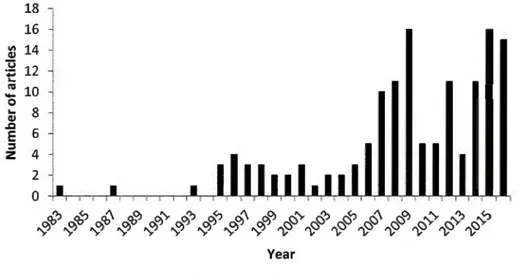
Figure Page 1 Number of published articles citing "allochthony" (all fields) in the
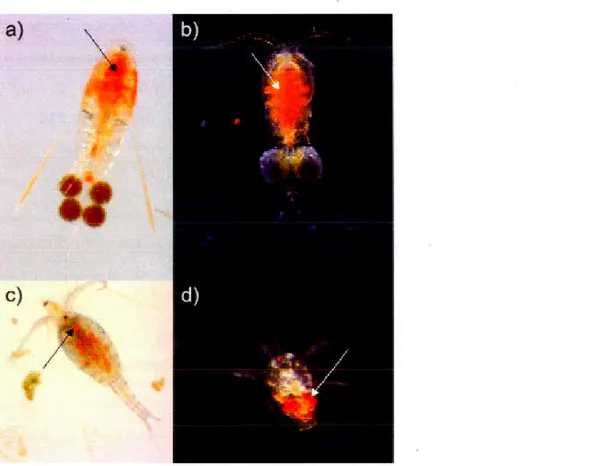
"Agricultural, and Biological Sciences" and "Environmental Sciences" databases from Scopus® ... 7 2 Lipid droplets containing fatty acid reserves of zooplankton (arrow) in
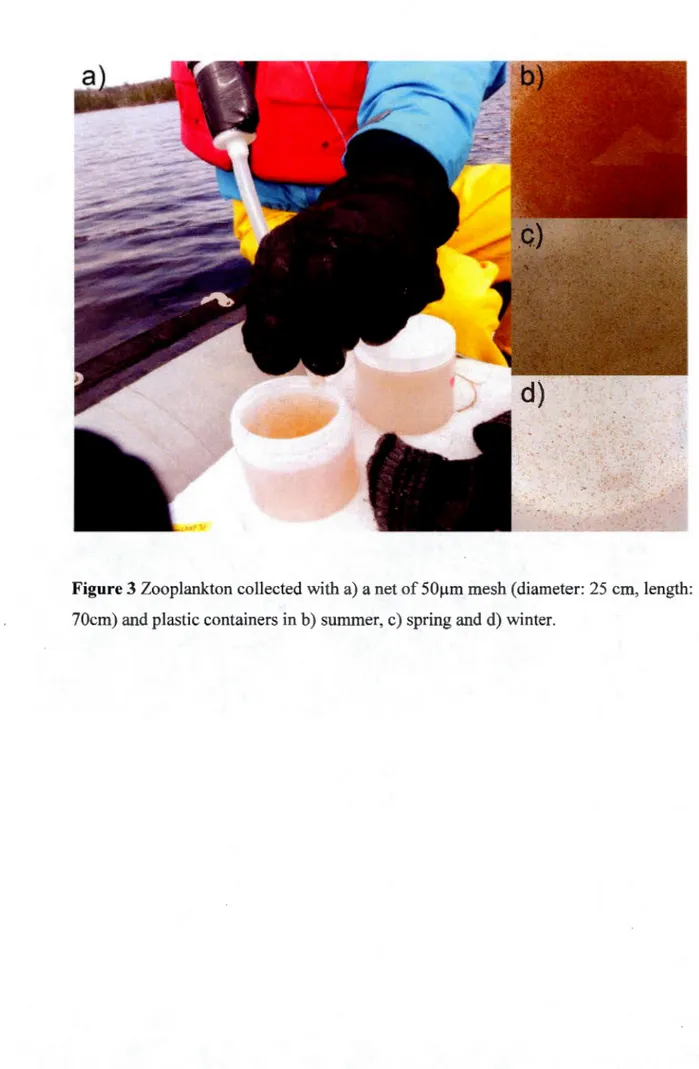
a) Leptodiaptomus minutus, b) Cyclops scutifer, c) Mesocyclops edax and d) cyclopoid larvae (nauplius) ... 16 3 Zooplankton collected with a) a net of 5û)lm mesh (diameter: 25 cm,
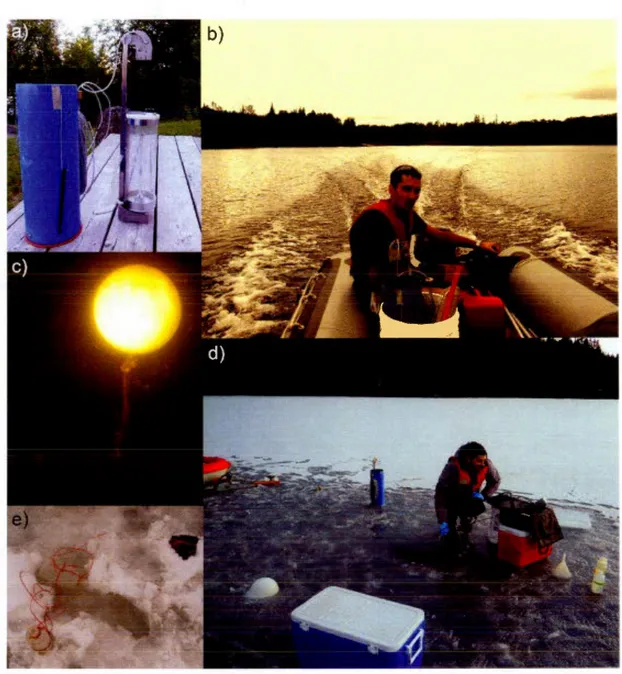
length: 7ûcm) and plastic containers in b) summer, c) spring and d) winter ... 21 4 Sampling on Lake Simoncouche with a) a Limnos sampler, b) a zodiac,
c) an installed underwater buoy having e) botties allowing for benthic algae colonization and d) a YSI for physico-chemistry ... 22 5 Sampling in winter on Lake Simoncouche: a) using an ali-terrain vehicle
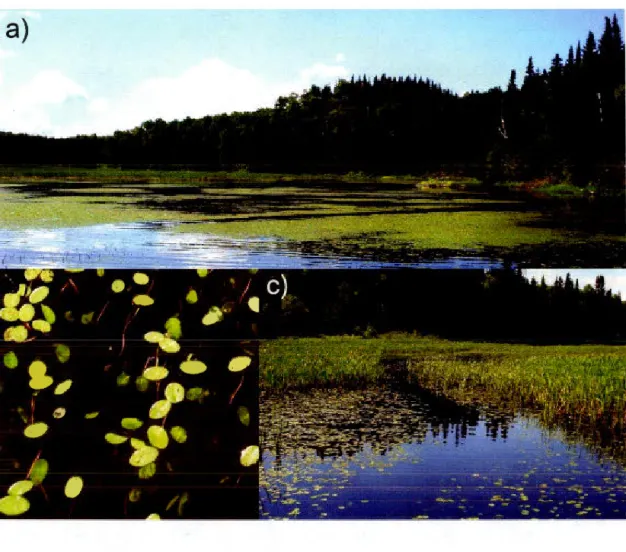
and b ), c) drilling a ho le through the ice ... 23 6 Macrophyte habitats in Lake Simoncouche: a) littoral zone in summer
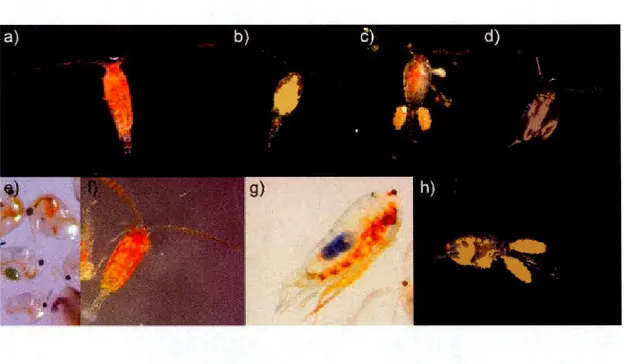
dominated by b) Brasenia schreberii and c) B. schreberii and Typha angustifolia ....... 24 7 Representative taxa from the zooplankton community of Lake
Simoncouche. Main taxa are represented by: a) Leptodiaptomus minutus, b) Cyclops scutifer, c) Mesocyclops edax (with eggs) and
Daphnia sp. Examples of secondary taxa include: e) Bosmina spp., f) Aglaodiaptomus spatulocrenatus, g) Epishura lacustris and h) Eucyclops speratus (with eggs) ....... 25 8 Illustration of a digital surface model developed from aerial
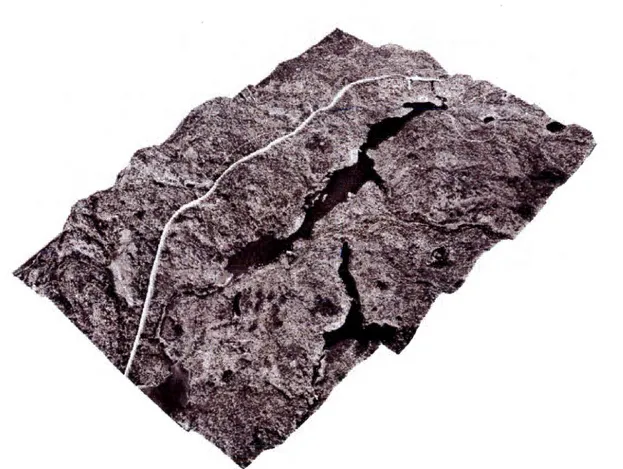
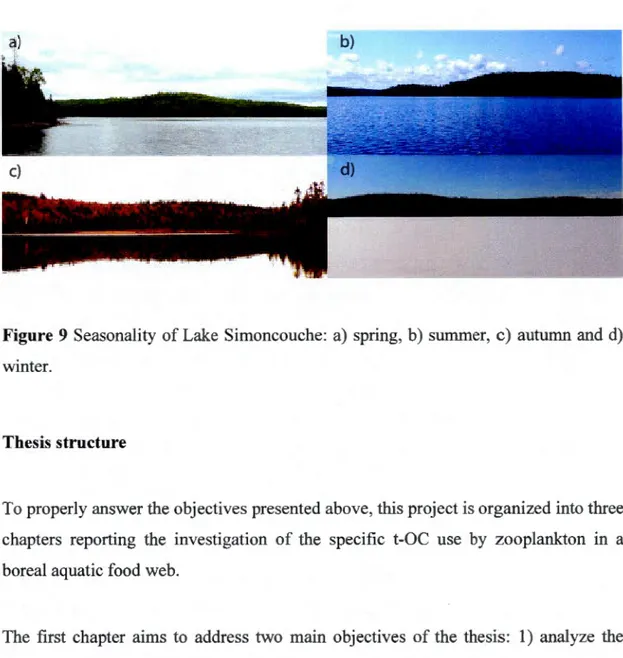
photography (1987) and the altimetric curves of Lake Simoncouche and the associated catchment basin using ArcGIS® (M. Montoro-Girona, vegetal and animallaboratory, UQAC) ... 26 9 Seasonality of Lake Simoncouche: a) spring, b) summer, c) auturnn and
d) win ter. ... 27 1.1 Seasonal pattern of zooplankton production (mgC m-2 d-1) based on
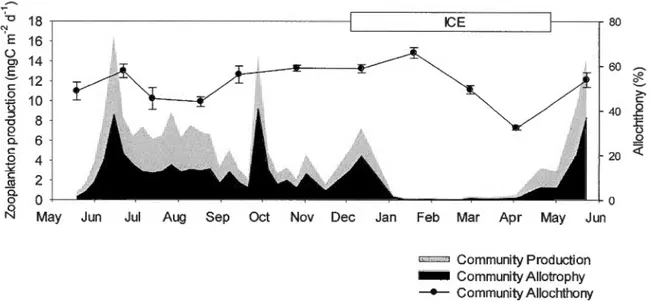
weekly values separating total production and allotrophy. Allochthony ratios are weighed means with species biomass ( C. scutifer, M edax, L. minutus, Daphnia spp.) ± weighed SD ... 51 1.2 Seasonal pattern of zooplanktonic production for the main zooplankton
taxa of Lake Simoncouche a) C. scutifer, b) M edax, c) L. minutus, d) Daphnia spp., e) Bosmina spp., f) Diaphanosoma spp. and g)
Holopedium spp. Notice the different scales. Black lines are median output from the algebraic model showing the seasonal pattern of allochthony ... 54 1.3 Seasonal variation of a) waterflow in the main inlet and epilimnion
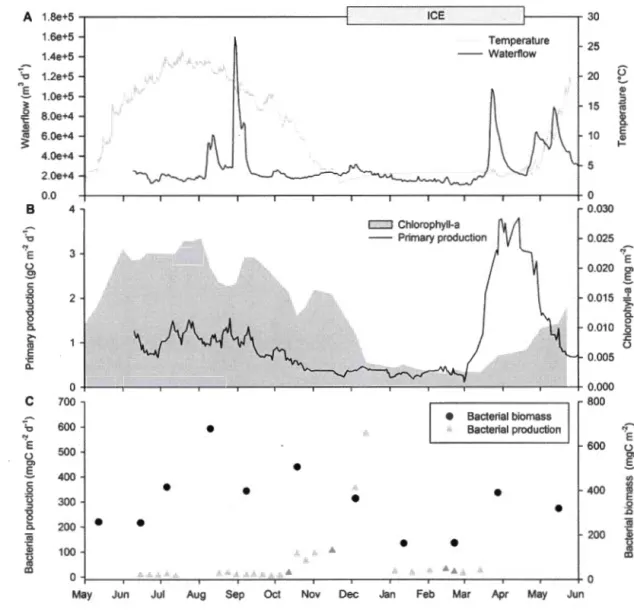
temperature (2 rn), b) chlorophyll-a and primary production, and c) bacteria biomass and production ... 56 1.4 Seasonal pattern of carbon fluxes in Lake Simoncouche food web
throughout an entire year with a) production (kg C d-1; cumulated bar) of zooplankton community shared in zooplankton production supported with allochthonous carbon sources i.e. allotrophy (closed bar) and zooplankton production supported with autochthonous carbon sources (grey bar), b) bacterial production (kg C d-1; striped bar) and c) C source inputs as terrestrial inputs calculated from t-DOC and t-POC concentrations multiplied by the waterflow of main tributaries ( closed bar; kg C d-1) and gross primary production (GPP) calculated from 02 concentrations in water (grey bar; kg C d-1) ... 67 l.S1 Zooplankton Lengths measured from May 2011 to May 2012 defining
cohorts for each species. Only Holopedium spp. mean size has been kept and production has been calculated considering the difference between egg weight and mean a duit weight. ... 71 l.S2 Mean+ SD of stable-isotope (813C) signatures of zooplankton (Cyclops
scutifer, M edax, L. minutus, Daphnia spp.) and potential food sources (terrestrial and phytoplankton) throughout the year 2011-2012 ... 72 2.1 Seasonal abundance (nb individuals L-1) of copepodites ( copepods ),
adult females and males of the four main species in the zooplankton community of Lake Simoncouche. Daphnia spp. numbers include females and males. Notice the different scales ... 87 2.2 Adult L. minutus survival in the starvation experiment for individuals
that were collected from the Lake Simoncouche when the lake was freezing in November (20-Nov-2012). Values are means of six replicates and SD. The experiment was terminated when the lake became ice-free in May (3-May-2013). The asterix mark the days when the survival was statistically different between the treatments ... 89 2.3 Seasonal pattern of seston fatty acids divided by FA biomarkers that
represent A) phytoplankton, B) terrestrial and C) bacteria sources. Notice the different scales of y axis. Grey shade represents the period wh en the lake was ice covered. Dates represents sampling dates ... 91 2.4 Cumulated concentration of fatty acid biomarkers of phytoplankton
(filled circle ), bacteria (filled triangle) and terrestrial (filled square) in zooplankton. The gap in M edax represents a period of the year when ali individuals were absent of the pelagie environment. Notice the different scales in Y axis ... 93
2.5 Principal component analysis (PCA) on FA compositiOn grouped as polyunsaturated fatty acids (PUF A), monounsaturated fatty acids (MUFA), saturated fatty acids (SAFA), biomarkers of phytoplankton (Phyt), terrestrial (Terr), bacteria (Bact), omega-3 fatty acids (n-3) and omega-6 fatty acids (n-6). The sample scores represent C. scutifer (orange), Daphnia sp. (green), L. minutus (red), M edax (blue) or seston (open). Proportion of explained variance per axes is in parentheses ... 95 2.S 1 Seasonal pattern of lipid content (%) in 4 different species of
zooplankton: A) Leptodiaptomus minutus, B) Cyclops scutifer, C) Mesocyclops edax and D) Daphnia spp. Grey shade represents the period when the lake was ice covered. Gaps in certain dates occurred wh en the species disappeared from the column water. ... 105 2.S2 Daphnia spp. with parthenogenetic eggs and young (27 January 2017) ... 106 2.S3 Mesocyclops edax eating a Daphnia sp. Arrows indicates the prey
Daphnia sp ... 107 3.1 Location of Lake Simoncouche ( 48°13'N, 71 °14'0) in the boreal
Quebec, Canada. Numbered black dots show the sampling sites in different habitats: tributary (T), macrophytes (M), tributary + macrophytes (TM), pelagie (P) and shore (S). Water flow direction is from basin 3 to basin 1. ... 121 3.2 The distribution of 813C and 82H signatures of Leptodiaptomus minutus
( corrected for dietary water and carbon fractionation) inside a polygon of the potential food sources+ SD: terrestrial, macrophyte (B. schreberi) and phytoplankton. L. minutus stable-isotope signatures are represented according to sampling sites. A) spring (May 2013) and B) summer (August 2013). The isotopie composition of benthic algae that was not included in the Bayesian model is also represented in the figure ... 133 3.3 a) Spring and summer contributions of terrestrial organic matter,
phytoplankton, macrophytes and benthic algae to L. minutus tissues calculated with Bayesian SIAR model, and b) fractional spring and summer contribution of phytoplankton, terrestrial organic matter and macrophytes to L. minutus tissues, based on Bayesian mixing model. Whisker plots show the distribution of 95% highest densities of contribution probabilities. Open circles are outliers ... 136 3.4 L. minutus allochthony in relation to the presence of macrophytes. 0 =
sites without macrophytes, 1 = low abundance of macrophytes (basins 1 and 2), 2 = high abundance of macrophytes (basin 3), and 3 = macrophyte sites. Whisker plots show the distribution of 95% highest densities of contribution probabilities. Open circles are outliers ... 137 3.5 Spatial distribution of L. minutus allochthony calculated from median
output of Bayesian mixing model and extrapolated by kriging in Lake Simoncouche for (a) spring and (b) summer. Notice the different scales ... 139 3.S1 Bathymetrie map ofLake Simoncouche ... 146
Table 1.1 1.2 2.1 2.S1 2.S2 3.1 3.2 3.S 1. Page Length-dry weight equations and main species identified with high enough abundances to calculate zooplankton production. Individuals were classified as nauplii (Na), copepodites (Co) and Adult (Ad) ... .42 Results of multiple linear regression models (based on lowest AI Cc) to estimate zooplankton a) total production and b) allotrophy. Temperature (Temp), bacteria production (BP), gross primary production (GPP), chlorophyll-a (Chl-a), and water inflow (Flow) were the variables used in the regression models. Variables are reported with the selected lag applied (il in weeks). Explanatory variables were log transformed ... 58 Environmental and biological variables from the epilimnion of Lake Simoncouche represented by temperature (Temp, °C), total dissolved nitrogen (TDN, mg N L-1), total dissolved phosphorus (TDP, )lg P L-1),dissolved organic carbon (DOC, mg C L-1), chlorophyll-a (Chi-a, )lg L-1), bacteria biomass (Bact Biom, )lg C L-1) and SUV A2s4nm··· 90 Selected fatty acid biomarkers for phytoplankton, terrestrial organic matter and bacteria. References are listed at the end of the thesis ... 102 Paired Wilcoxon tests between "Control" and "Starved" treatments per date. p = NA when each replicates had 50 individuals at the beginning of the experiment and no test could be completed ... 103 Contribution of terrestrial, phytoplankton, macrophyte and benthic carbon to Lake Simoncouche in spring and summer. Terrestrial contribution is expressed as t-DOC and t-POC input by the tributaries, phytoplankton and benthic carbon as rate of primary production, and macrophyte carbon contribution as a DOC release from macrophyte beds . NA= not available ... 130 Dissolved and particulate organic carbon characteristics of the sampled habitats in spring and summer, including dissolved organic carbon (DOC), specifie UV-absorbance (SUVA), rate of DOC degradation (biolability), particulate organic carbon (POC), chlorophyll-a (Chl-a) and 13C of POC (P013C). Sites as indicated in Fig. 2.1. Values are means ± SD. NA= not available ... 132 Raw stable-isotope signatures (813C, 815N and 82H) of Leptodiaptomus minutus and potential food sources in Simoncouche lake. NA = Not available ... 145
BP BrFA
c
chl-a DOM FA GPP LC-SAFA MOtNEP
OM PEG POM PUFA SAFA SI t-DOC t-DOM t-OC t-OM t-POM t-POC bacterial production branched fatty acid carbonchlorophyll-a
dissolved organic matter fatty acids
gross primary production long chain saturated fatty acids matière organique terrestre net ecosystem production organic matter
plankton ecological group particulate organic matter polyunsaturated fatty acids saturated fatty acids stable isotope
terrestrial dissolved organic carbon terrestrial dissolved organic matter terrestrial organic carbon
terrestrial organic matter
terrestrial particulate organic matter terrestrial particulate organic carbon
La moitié de la matière organique terrestre (MOt) transportée des bassin-versants vers les océans par les écosystèmes aquatiques est transfonnée pour être diffusée dans l'atmosphère ou stockée dans les sédiments. Ce rôle de puits ou de source de carbone (C) des écosystèmes aquatiques est grandement influencé par les réseaux trophiques de ces systèmes et notamment le zooplancton tenant une position clé dans ces réseaux. Un nombre croissant de recherches ont démontré une assimilation importante de MOt dans la biomasse zooplanctonique, assimilation que l'on nomme allochthonie. Malgré les conclusions de ces études, le rôle de la MOt dans les réseaux trophiques aquatiques est encore mal compris surtout lorsque 1' on considère que cette source allochtone de 1 'écosystème qui est largement intégrée dans les tissus zooplanctoniques en milieu naturel ne permet pas une survie ou une reproduction suffisante des organismes en laboratoire. Une augmentation des apports en MOt est prédite dans un futur proche avec les changements climatiques. Les effets sur les réseaux trophiques aquatiques et notamment le zooplancton sont très peu connus et nécessitent des recherches approfondies.
Ce projet de doctorat vise à quantifier l'importance de la MOt pour la communauté zooplanctonique afin de mieux comprendre son rôle dans les réseaux trophiques aquatiques. L'intégration de la MOt par les principaux taxons de la communauté zooplanctonique d'un lac boréal a été étudiée à différentes saisons et dans différents habitats. Premièrement, l'allochtonie basée sur des signatures d'isotopes stables (813C) a été mesurée chez les principales espèces zooplanctoniques ainsi que leur production (croissance et reproduction) respective. Pour la première fois, une nouvelle variable représentant le taux de MOt intégrée dans la biomasse pour chaque semaine a été proposée : l'allotrophie et a été calculée durant une année entière. Deuxièmement, complétant l'approche des isotopes stables, la composition en acides gras biomarqueurs terrestres, algaux et bactériens à été mesurée pour estimer l'allocation de ces différentes sources dans les réserves lipidiques du zooplancton. Le but était d'évaluer si la MOt était une source alternative à la production primaire autochtone lorsque cette dernière est faible notamment en hiver sous le couvert de glace. Troisièmement la variabilité spatiale intra-lac de l'allochtonie basée sur les isotopes stables 813C et 82H a été estimée en fonction des bancs de macrophytes aquatiques et des points d'entrée de MOt via les tributaires du lac. Les hypothèses de recherche prédisaient que l'allochtonie ainsi que les acides gras biomarqueurs terrestres et bactériens seraient plus importants en hiver sous la glace que pendant la période d'eau libre lorsque la production phytoplanctonique est minimale. Il était également supposé que l'allochtonie serait distribuée de manière hétérogène, spatialement, à l'intérieur du lac selon les bancs de macrophytes et les sources de
MOt. Finalement, il était présumé que les macrophytes diminuent l'allochtonie du zooplancton qui devait au contraire augmenter à proximité des tributaires. Afin de tester ces hypothèses, un échantillonnage de la communauté zooplanctonique et des sources de C a été effectué durant une année entière, de manière hebdomadaire en été et toutes les deux semaines en hiver portant une attention particulière aux processus se passant sous le couvert de glace. Un deuxième échantillonnage s'est intéressé à la distribution spatiale de l'allochtonie de l'espèce principale de la communauté de crustacés zooplanctoniques lors de deux saisons (printemps et été) significativement différentes dans leurs apports de source de C (phytoplancton, apports de MO~> macrophytes, algues benthiques).
L'allochtonie était importante pour chacune des espèces de zooplancton se stabilisant autour de 60% en automne et durant la majeure partie de l'hiver. Lors de la transition hiver-printemps, l'allochtonie diminua fortement chez toutes les espèces. Lorsque l'allochtonie fut couplée avec la production de zooplancton, la production primaire brute, la production bactérienne ainsi que les nouveaux apports de MOt ont été identifiés comme les principaux facteurs influençant 1 'intégration de MOt dans la biomasse zooplanctonique. Selon 1' approche des acides gras, une période critique d'accumulation des réserves lipidiques a été identifiée en automne et se poursuivant en hiver sous la glace, ce qui va à 1' encontre du paradigme en matière de disponibilité de nourriture phytoplanctonique en hiver. Cette période a été identifiée comme essentielle à la survie du zooplancton qui reste actif toute l'année y compris en hiver. La distribution spatiale de 1' allochtonie dans le zooplancton était hétérogène et influencée par la proximité des bancs de macrophytes ainsi que par les tributaires majeures contribuant à l'hydrologie générale du lac. Pris collectivement, ces résultats ont permis de montrer que 1 'intégration de la MOt dans les réseaux trophiques aquatiques est très dynamique saisonnièrement et spatialement même à l'intérieur d'un seul lac. Contrairement à nos hypothèses, le patron saisonnier de l'utilisation de la MOt par le zooplancton a décrit l'hiver en tant que période critique d'assimilation de C autochtone soulignant l'importance des différentes allocations de la MOt dans les organismes zooplanctoniques. Ces résultats suggèrent que la MOt est une source complémentaire mais pas une alternative aux sources autochtones. Pour la première fois, cette étude montre l'hétérogénéité spatiale de l'allochtonie du zooplancton à l'intérieur d'un lac et l'explique écologiquement par la présence de macrophytes et 1 'hydrologie du lac. Enfm, cette thèse rapporte une quantification unique du taux d'assimilation de la MOt dans le zooplancton durant une année entière. Appliquer et étendre de nouvelles approches telles que combiner les acides gras et les isotopes stables et mesurer l'allotrophie afin d'estimer les différentes allocations de la MOt dans d'autres organismes et d'autres écosystèmes, permettra de comprendre comment les écosystèmes aquatiques seront affectés par l'augmentation d'apports en MOt et leur rôle dans la modification du cycle du C mondial.
Mots-clés : acides gras, allochtonie, hiver, isotopes stables, macrophytes, production du zooplancton
SUMMARY AND KEYWORDS
Half of the global terrestrial organic matter (t-OM) carried from terrestrial ecosystems to the oceans is processed within aquatic ecosystems by being diffused into the atrnosphere or stored within sediments. Aquatic food webs play an important role in the processing of t-OM, in particular at the zooplanktonic trophic level. Increasing numbers of studies have demonstrated that a significant share of t-OM is assimilated into the zooplankton biomass, this assimilation being termed "allochthony". However, very little is understood about how this t-OM is used by zooplankton especially given that zooplankton neither survive nor reproduce well when solely utilizing t-OM as a food source. As terrestrial inputs oft-OM are predicted to increase in the coming decades due to climate change, our lack of understanding of the role of t-OM as an allochthonous source makes it difficult to predict possible impacts on aquatic food webs and the consequences for aquatic ecosystems.
This PhD project aims to investigate how zooplankton assemblages, within a boreal lake, use t-OM. Zooplankton use of t-OM is compared between different aquatic habitats and across seasonal and spatial differences in carbon (C) inputs. First, zooplankton allochthony was determined from stable-isotope (SI) measurements. In addition, production (growth and reproduction) of the main zooplankton taxa was measured throughout an entire year including under-ice conditions in winter. The coupling of both measurements permitted, for the first time, an ecosystem-scale quantification of the rate oft-OM assimilated in zooplankton biomass, defined here as "allotrophy". Second, fatty ac id (FA) composition was measured throughout the year for the same species of zooplankton to identify algal, terrestrial and bacterial FA biomarkers in the lipid reserves. Third, the spatial distribution of allochthony for the dominant zooplankton species (Leptodiaptomus minutus) was measured using the combined
o
13C ando
2H signatures from different habitats (habitats dominated by t-OM inputs, macrophytes, phytoplankton or benthic algae ). Terrestrial inputs were hypothesized to be an alternative source to phytoplankton for zooplankton production and energetic lipid reserves particularly in winter when primary production is low. Aquatic macrophytes were also hypothesized to influence the degree of allochthony representing an alternative autochthonous C source. Sampling occurred weekly during the open-water period and every two weeks under the ice to highlight the oft-neglected winter processes. A second sampling survey measured the within-lake spatial distribution of the allochthony for L. minutus at ten sites having variable dominant C sources (t-OM, macrophytes, phytoplankton, benthic algae).Zooplankton allochthony was high, stabilizing around 60% for all taxa in autumn and for most of the winter. A decrease in allochthony was observed for all species during the transition between win ter and spring. FA composition in zooplankton revealed a critical period of phytoplanktonic FA accumulation in autumn and under the ice in the early winter for taxa that remain active throughout the winter. The quantitative estimates of allotrophy demonstrated that t-OM assimilation was relatively efficient during the growth phases of zooplankton and was driven by bath gross primary production and fresh t-OM inputs. Finally, a spatial heterogeneity of zooplankton allochthony was detected within the lake influenced by the proximity to macrophyte beds and by lake hydrology. Collectively, these results highlight a seasonal and a spatial variability of t-OM assimilation in zooplankton within a lake. Contrary to our hypothesis, the seasonal pattern of t-OM use by zooplankton shows the winter season to be a critical period of autochthonous C assimilation in lipid reserves and emphasizes the importance of differentiai allocations of t-OM in zooplankton organisms. These results suggest that terrestrial inputs are complementary C sources, not alternative C sources for zooplankton. Also, this study shows for the frrst time, a spatial heterogeneity in zooplankton allochthony within a lake explained ecologically by macrophytes and lake hydrology. Finally, this thesis reports a unique quantification of the assimilation rate of t-OM in zooplankton throughout an entire year. Expanding and applying these new approaches of combined SI-FA methods and zooplankton allotrophy for investigating the differentiai allocation rates of t-OM in other organisms and other ecosystems will greatly contribute to a better understanding of how aquatic food webs will be affected by increasing t-OM inputs and clarify their role in the modification of the global C cycle.
Keywords: allochthony, fatty acids, macrophytes, stable isotopes, winter, zooplankton production
Statement of the problem
For a long time, ecologists have understood that ali ecosystems receive considerable amounts of material from outside their boundaries (e.g. Wetzel 1975). It is particularly pronounced in lakes as, due to their convex location in the landscape, waterbodies are linked with their drainage basin through the dissolved and particulate material transported by the downhill flow of water (Jackson and Fisher 1986, Leroux and Loreau 2008, Marcarelli et al. 2011). At global scale, inland waters receive annually three petagrams of carbon (C) namely 3 billion metric tons of C (Lennon et al. 2013). Terrestrial organic C (t-OC) carried by inland waters from terrestrial ecosystems to the oceans is significant in the global C cycle being equivalent to more than halfthe total C assimilated by the terrestrial biosphere biomass each year, i.e. the net ecosystem production (NEP) of terrestrial world ecosystems (Cole et al. 2007). Aquatic ecosystems are active catalytic environments where terrestrial inputs are diffused into the atmosphere, stored in sediments or used in food webs thereby leaving only 47% to be finally transported into the ocean (Cole et al. 2007). Less conservative studies estimated that 0.4 petagrams were arriving into the oceans from the terrestrial environment implying that freshwater ecosystems process 87% of t-OC (Hedges et al. 1997). Inputs from the terrestrial environment in adjoining freshwater ecosystems are described as "allochthonous" and, for a long time, have been believed to greatly influence the functioning of recipient ecosystems such as lakes (Wetzel 1975), rivers (Jones 1949, 1950), oceans (Polis and Hurd 1996) and estuaries (Teal 1962).
Terrestrial organic matter (t-OM) eventually enters the aquatic food web and is reflected in biomass referred to as the organism's "allochthony". The significance of allochthony in aquatic food webs has been revealed by recent literature (Cole et al. 2011, Karlsson et al. 2012, Berggren et al. 2014). Increasing numbers of studies provide evidence of substantial values of allochthony in bacteria (Berggren et al. 2010a, Guillemette et al. 2016), in zooplankton (Cole et al. 2011, Kelly et al. 2014) and in fish (Glaz et al. 2012, Tanentzap et al. 2014). While ali aquatic organisms may play a role in t-OM assimilation, zooplankton occupy a strategie position in aquatic food webs, potentially accessing autochthonous C (i.e. produced within the aquatic eco system boundaries) as well as allochthonous C. Support of zooplankton production by autochthonous sources is well established through numerous studies showing direct algal consumption (Fryer 1957, Galloway et al. 2014). Allochthonous sources as support of pelagie zooplankton production is less obvious.
While earlier studies have concluded to a significant support of zooplankton with terrestrial particulate organic matter (t-POM) (Cole et al. 2006), recent studies tend to show that this t-OM supply is rather small (Wenzel et al. 2012, Mehner et al. 2015). However, terrestrial assimilation may occur lower in the food web based on microbial degradation of terrestrial dissolved organic matter (t-DOM) and the subsequent assimilation into the food web at the level characterized by ciliates, flagellates or rotifers (Jansson et al. 2007). Zooplankton rnake these C sources available for zooplanktivores including nurnerous fish species (e.g. Perca jlavescens) or invertebrates (e.g. Chaoborus obscuripes, Leptodora kindtii) participating in the control of the higher trophic level allochthony (Tanentzap et al. 2014). Thus, zooplankton has been considered as an indicator of allochthony in aquatic food webs and has been the focus of many studies of allochthony (Perga et al. 2006, Cole et al. 2011, Lee et al. 2013). Allochthony in zooplankton has shawn a very wide range estirnated to be from less than 5% (Francis et al. 2011) to 100% (Rautio et al. 2011 ).
Whereas there remams debate about the significance of t-OM contribution for zooplankton in different lake ecosystems ( e.g. large clear water lakes or humic lakes ),
it is now increasingly accepted that allochthony can be often very significant for a large range of zooplankton species (Cole et al. 2011, Wilkinson et al. 2013a, Emery et al. 20 15).
Terrestrial OM is comprised of a mix of various molecules that are believed to be either not accessible for zooplankton or lacking essential compounds for zooplankton growth and reproduction. Recent studies tend to show that t-POM flux is relatively small for pelagie crustaceans and reflects poor nutritional conditions (Mehner et al. 2015, Taipale et al. 2015a). Additionally, t-POM has been shown to be poorly available in lipids and protein, mostly composed of lignin that is non-digestible for zooplankton (Taipale et al. 2016). Most importantly, t-POM does not contain polyunsaturated fatty acids (PUF A) essential for organism growth and reproduction (Brett et al. 2009). Terrestrial dissolved organic matter is not directly available for crustacean zooplankton, but is probably utilized by protists via osmotrophy, and preferentially retained in biomass by bacterial communities (Guillemette et al. 2016). However, survival and growth of zooplankton has been evaluated to be lower when organisms are sustained with bacteria rather than with lipid-rich autotrophic phytoplankton cells (Wenzel et al. 2012). Whether t-OM can efficiently sustain zooplankton production remains a point of debate, however as for t-POM, t-DOM is believed to represent a marginal subsidy when both adequate trophic links and upgrading are lacking to make it available for zooplankton.
Recently, it has been suggested that t-OM can have differentiai allocation by aquatic organisms, such as in bacteria where phytoplankton C is mostly respired and terrestrial C is used for biomass synthesis (Guillemette et al. 2016). Based on this new finding, Taipale et al. (2016) suggested that carbohydrates derived from
terrestrial C were used by zooplankton while phytoplanktonic C were preferentially retained in lipid reserves. As the allochthony in zooplankton is usually measured without any quantification of the respective t-OM used in respiration, energy storage, growth or reproduction, it is very difficult to evaluate the actual role of this t-OM for zooplankton individuals. Simultaneously, severa! non-exclusive visions of t-OM utilization by aquatic food web emerge. On one hand, t-OM is considered as an alternative food source when autochthonous OM is missing· thereby providing the sufficient nutritive conditions for survival while diminishing growth and reproduction (McMeans et al. 2015a, Taipale et al. 2016). On the other hand, t-OM is considered as a complementary resource and assimilated along with autochthonous OM suggesting a synergetic utilization of bath sources. The idea behind this concept is that labile autochthonous C sources can induce modifications in the mineralization rate of the more recalcitrant C of terrestrial origin initially present; this being described as the "priming effect" (Guenet et al. 2010). Also, t-OM is often considered by limnologists to be homogeneous, but is, in reality, a mix of material having very different origins and differing states of degradation (Berggren et al. 201 Ob). Terrestria1 disso1ved organic matter includes 1ow mo1ecu1ar weight compounds such as carboxylic acids, amino acids and carbohydrates that are easily utilized by bacteria and eventually transferred to higher trophic leve1s (Berggren et al. 2010a). As mixotroph and heterotroph protists can feed on bath aquatic primary producers and bacteria, zooplankton can comprise a mixed C composition ( autochthonous versus allochthonous) already present in their prey. Despite a good number of recent studies discussing allochthony, these different mechanisms of how t-OM is assimi1ated and differentially allocated within the aquatic food web have se1dom been addressed and remain uncertain.
Taxonomie differences have been detected in zooplankton allochthony usually reporting that cladocerans followed the C composition in the environment (Rautio et
al. 2011 ), while calanoid and cyclopoid copepods were less dependent of C sources due to lipid accumulation (McMeans et al. 2015b). Moreover, species have different feeding strategies that determine the degree of allochthony in their biomass with calanoid copepods depending more on phytoplankton cell abundance and becoming more allochthonous when phytoplankton are lacking. However, cyclopoid copepods, usually predators or omnivorous organisms, are more dependent on the degree of allochthony of their prey (Berggren et al. 2014). Cladoceran allochthony is more dependent on what they can filter as well as the size of particles, relying on both phytoplankton availability and the DOM-based food web (Karlsson et al. 2003). To understand the variability of allochthony estimates based on the entire zooplankton community, species composition needs to be accounted for as a major influencing factor.
The vast majority of existing knowledge collected regarding zooplankton allochthony has been acquired from the open-water season starting in the spring and ending in the autumn while the winter season, particularly in ice-covered ecosystems, is usually excluded (Hampton et al. 2015). Winter, however, represents a critical period for zooplankton as many species stay active under the ice and autochthonous production is drastically reduced in a lightless environment (Lizotte 2008). One might naturally think that winter provides the ideal conditions to study zooplankton reliance on terrestrial sources while aquatic primary production is not available. The few available studies of the seasonal patterns of allochthony in zooplankton have shown that food source assimilation was not constant. Rather, zooplankton switched easily from one source to another (Grey et al. 2001, Rautio et al. 2011, Berggren et al. 2015). As these C utilization pathways are highly taxon-dependent (Berggren et al. 2014), they are linked to species' life strategies and particularly to their capacity to store molecules in lipid reserves. Lipid accumulation in winter allows individuals to use organic matter and its associated energy at the time required and not only when
food sources are immediately available in the environment (Schneider et al. 2016). Winter under-ice measurements are thus important for understanding the links to open-water patterns as winter processes are increasingly acknowledged as influencing the full year of seasonal patterns in plankton cycles (Sommer et al. 2012). As the winter season reunites important conditions that influence the degree of allochthony in zooplankton, winter allochthony measurements should help to better understand open-water patterns.
The aim of this project was to better understand the role of the t-OM in aquatic ecosystems focusing on high frequency measurements of seasonal and spatial use of allochthonous C sources by the zoop1ankton community within a boreal lake. Several innovative aspects were addressed that had been previously ignored or unexplored, such as zooplankton production, winter feeding ecology or within-lake variability. Combining these unique aspects aim, here, to provide a better understanding of the differentiai use of t-OM in boreal aquatic food webs and identify the driving factors among possible environmental and biological factors such as terrestrial input,
macrophyte beds, phytoplankton and bacterial production, water temperature and the
lipid composition of seston. This high frequency spatial and seasonal study also aimed to quantify the t-OM role in zooplankton communities and highlight its influence on the complete boreal lake ecosystem.
State of the science
Allochthony in zooplankton biomass
The role of t-OM assimilation in aquatic food webs has been studied for a long time, particularly by stream ecologists who studied the role of allochthonous food sources for invertebrates and fish (Jones 1949, 1950, Teal 1957, Fisher and Likens 1972,
Petersen and Cummins 1974). However, the notion of "allochthony" defined as the terrestria1 contribution in aquatic biomass, bas been used in literature only very recently. Researching the keyword "allochthony" in the peer reviewed literature of the Scopus® database, within "Agricultural and Biological Sciences" and "Environmental Sciences" disciplines, 140 articles were referenced from 1983 to 2016 (Fig. 1). The number of articles using "allochthony" rose very recently in 2007 and peaked in 2009 (16 references) reflecting a recent and close interest of scientific community in the last years.
18 16 "' 14 (LJ u 12 ·;::
...
ra 10-
0...
(LJ 8 .c 6 E ::::1 z 4 2 0 YearFigure 1 Number of published articles citing "allochthony" (ail fields) in the "Agricultural, and Biological Sciences" and "Environmental Sciences" databases from Scopus®.
Allochthony in the biomass of aquatic organisms is almost exclusively calculated from stable-isotope (SI) ratios. The natural occurrence of SI is now widely used in ecology in particular for tracing the fluxes of organic matter such as allochthonous inputs in aquatic biomass within lake eco systems (del Giorgio and France 1996, Jones et al. 1998, Cole et al. 2002, Carpenter et al. 2005, Rautio and Vincent 2006,
Pace et al. 2007, Taipale et al. 2009, Berggren 2010, Berggren et al. 2015). The most widely used SI ratio in trophic studies is the relative abundance of 13C over 12C due to the C-based compounds that characterize organic matter molecules and the relatively high abundance of 13C compared to 12C in ecosystems. This 13C/12C ratio in animal biomass assimilated into their tissues closely reflects the ratio absorbed from their diet when applying a known fractionation (Post 2002, Fry 2006). As 13C occurrence over 12C is much lower (about 1000 times -less abundant), a more convenient ratio of SI is applied, symbolized by "o" through the following eq. [1]:
0 = ( RsAMPLE - 1) X 1000
RsrANDARD eq. [1]
where R is the ratio of the less abundant isotope over the more common isotope measured in the sample or in an international standard. The occurrence of the less abundant isotope is usually much lower than the more common isotope for most elements (Fry 2006). Interest in allochthonous inputs was initially raised m Scandinavian small humic lakes (Meili 1992) where bacterial metabolism can be supported by t-OM (Hessen 1992) leading to the theory that allochthony m zooplankton was linked to lake trophy (del Giorgio and France 1996, Grey et al. 2000). However, SI ratios demonstrated that zooplankton can also be significantly (~50%) subsidized byt-OM in a large clear water lake (Jones et al. 1998). The natural occurrence of SI demonstrated that reliance on t-OM can range from< 5% to > 80% (Francis et al. 2011, Wilkinson et al. 20 13b ). This high variability in t-OM re lian ce follows a seasonal pattern whether in a clear water Scottish lake (Grey et al. 2001) or in subarctic lakes (Rautio et al. 2011). In lakes from Northern Sweden, allochthony in zooplankton has been linked to pelagie energy mobilization more than t-OM prevalence in the environment, thereby underlying an active role of heterotrophic protists in the assimilation of t-OM within aquatic food webs (Karlsson et al. 2003).
Defining the end-members that play a role in the studied aquatic food web is one of the more difficult tasks. The end-member of allochthonous origin (terrestrial plants) is quite easy to obtain due to the relative stability in bulk 613C among C4 plants, while the end-member of autochthonous (phytoplankton) origin is more difficult to estimate and constitutes a strong limitation to SI studies in pelagie ecosystems. For now, no technique allows for physically separating phytoplankton from terrestrial particles in the particulate organic matter (POM) although sorne estimates can be obtained, e.g. from POM with a correction for algal biomass (Marty and Planas 2008). Pace et al. (2004) circumvented the issue by adding labeled H13C03 to a small lake enriching the autochthonous C pool of the lake in 13C. It was then possible to trace the C pathway from allochthonous and autochthonous sources to the zooplankton consumer. This method was later used to test the effect of lake trophic status on allochthony demonstrating that allochthony was more pronounced in a dystrophie lake than in a nutrient enriched lake (Carpenter et al. 2005). Both lakes confirmed sorne substantial allochthonous support of the pelagie food web including POC, zooplankton, the predatory invertebrate Chaoborus spp. and fish. Pace et al. (2007), with the same method, showed that in a clear water lake, autochthonous carbon was the dominant source (88-100%) for POC, gram-positive bacteria, copepods and Chaoborus spp. Autochthonous carbon would provide a lower fraction (< 70%) of carbon to DOC, gram-negative bacteria and cladocerans leading to the conclusion that a relatively small flux of terrestrial particulate carbon supported
~50% of zooplankton and fish production. France (1995) argued that SI analysis was an irrelevant tool to trace carbon origin because of the global variability found in a compilation of studies. Doucett et al. (1996) maintained that SI analysis was reliable as long as any spatial heterogeneity was taken into account.
Mixing models provided a new perspective on SI studies and added precision in the estimates of allochthony when calculating plausible contributions of each food source
to the consumer biomass to account for uncertainties that were previously neglected (Phillips and Gregg 2001, Phillips and Gregg 2003). Mixing models have the capacity to quantify the share (or fraction) of a food source for a given consumer biomass. As organic matter is composed of C-based compounds, 813C has been the fust isotope ratio used with mixing models (Phillips 2001). The ratio 815N has also been used with a fractionation in animais often considerable and estimated about 3.4 ± 1 %o for each consumer compared to its diet (Post 2002). This high fractionation allows for deduction of the trophic level of the studied organism. Combined 813C and 815N signatures are powerful due to the complementary food tracers and trophic level information. End-member signatures are sometimes overlapping as with terrestrial and algal 813C making it impossible to calculate source contributions. To overcome this issue, deuterium eH) has been recently used because of its presence in organic matter and a strong separation between aquatic and terrestrial primary production (Doucett et al. 2007). The 82H has been shawn as a powerful tool in food web studies wh en the non-exchangeable part of hydrogen in the tissue is considered and "dietary" water is accounted for (Wassenaar and Hobson 2003, Cole et al. 2011). When added to carbon and nitrogen SI, hydrogen can provide a tridimensional stable-isotope signature of consumer and end-member tissues that new mixing models have now the ability to exploit (Batt et al. 2012).
The variability in allochthony has been explored very recently due to these new mixing models and isotopes. For example, a strong reliance on t-OM (20-40%) for pelagie food webs has been confirmed using these isotopes and mixing models (Cole et al. 2011). A multi-lake study measured a strong variability in consumer allochthony (1-76%) that also confirmed the strong reliance of pelagie zooplankton on terrestrial inputs albeit negatively influenced by lake surface area (Wilkinson et al. 2013a). Another multi-lake study sampled a large number of boreal lakes from the Canadian Shield and demonstrated that zooplankton allochthony is highly influenced
by the feeding strategies of species (Berggren et al. 2014). Allochthony in cyclopoid copepods (16%) was 1inked to predation on 1ower trophic level organisms, e.g. rotifers, ciliates, flagellates, and to the corresponding microbial food web while calanoid copepod allochthony (18%) was more dependent of the availability of phytoplankton. Finally cladoceran allochthony, such as Daphnia (31 %), was linked to both pathways (Berggren et al. 2014). The same strong reliance on t-OM (26-94%) has been measured in reservoirs where a large amount of terrestrial C is assimilated into the aquatic environment when the valley is flooded (Emery et al. 2015). Finally, a new approach combining lake metabolism and SI demonstrated that a lake ecosystem can be significantly supported by t-OC including subsidizing 47% of zooplankton biomass (Karlsson et al. 2012).
Fatty acids (FA) are essential molecules for the survival, growth and reproduction of most animais including crustacean zooplankton (Wenzel et al. 2012). These molecules cannot be synthesized de nova by animais and need to be acquired from
their di et (Arts et al. 2009). Most of the essential FA for survival, growth and reproduction are n-3 polyunsaturated fatty acids (n-3 PUFA) necessary for zooplankton growth and reproduction (Brett et al. 2009). As phytoplankon -are recognized as synthesizing most of the n-3 PUF A and terrestrial plants synthesize more n-6 PUFA and saturated fatty acids (SAFA) that zooplankton are unable to directly use, it is usually believed that zooplankton require molecules from algae to survive, grow and reproduce (Taipale et al. 2014). Sorne lipid species (FA, fatty alcohols, hydrocarbons and sterols) are limited to certain taxa and, being metabolically stable, they are used to trace energy transfers through the food web (Napolitano 1999). For instance, algae are the only organisms that possess the enzyme for producing long chain PUF A such as 20:5n-3 and 22:6n-3 (!verson 2009). PUF A are related biochemically due to the location of the first double bond such as long chain "n-3" and "n-6" FA, essential for normal functioning of the cell. In the
animal king dom ( consumers ), the se FA must be acquired from the ir di et. Heterotroph organisms can elongate and desaturate FA, but they are unable to place a bond between the terminal methyl-end and the n-9 carbon, being incapable of inserting a double bond in the n-3 and n-6 position (Arts and Wainman 1999). FA groups, such as those previously cited, are used as tracers throughout the food web as weil as specifie FA used as trop hic mark ers of algae, cyanobacteria and bacteria (Tai pale et al. 20 15b ). Studies have shawn that lipids from aquatic and terres trial primary producers have different fatty acid signatures and can therefore be used to characterize the predominant energy source in aquatic systems. U sing FA, Brett et al. (2009) showed that Daphnia sp. preferentially use algae for their growth and reproduction over terrestrial carbon. It seems then paradoxical that in the allochthony studies, the zooplankton reliance on t-OM is very significant. Combining SI with the FA composition of consumers has provided contradictory results, but this combination is a necessary approach for understanding food source utilization (Perga et al. 2006). Employing only stable isotopes to understand food web functioning and interactions with t-OM may be misleading due to the complex paths that organic matter can follow through to the highest trophic levels (Perga et al. 2008).
Zooplankton reliance on terrestrial organic matter at the ecosystem scale
Allochthony is often presented in zooplankton because of the strategical position that these organisms occupy in the aquatic food web. The ultimate goal is to understand the interactions between terrestrial and aquatic ecosystems or to quantify the aquatic reliance on terrestrial ecosystems and, as such, ecosystem-scale conclusions are often drawn from allochthony in zooplankton. However, the measured allochthony in zooplankton is the result of multiple processes occurring at different levels of the food web that reflects on1y a part of the extent of the aquatic reliance on the surrounding terrestrial ecosystems which is practically never quantified for the whole
lake ecosystem. This reliance on terrestrial ecosystems depends on: 1) allochthonous and autochthonous fluxes coming into the lake, 2) differentiai metabolism allocation of t-OM by individuals and 3) the importance of biomass and production at the ecosystem level.
From allochthonous and autochthonous sources to zooplankton
Terrestrial organic matter can overwhelm the environment in aquatic ecosystems and represent more than 90% of the DOC as weil as more than half of the POC in boreal and temperate lakes (Meili 1992, Wilkinson et al. 2013b). DOC represents much larger inputs with a usual DOC:POC ratio between 6:1 and 10:1 (Wetzel1995). This is particularly true when an aquatic ecosystem is surrounded by a coniferous forest producing massive humic inputs from the catchment basin where terrestrial dissolved organic carbon (t-DOC) is dominated by fulvie acids of relatively low molecular weight that can heavily subsidize bacterial production (Hessen 1992, Berggren et al. 2010b). Bacterial biomass can then be composed of a large proportion of t-OC (Guillemette et al. 2016) and be consumed by heterotrophic or mixotrophic protists such as ciliates and flagellates (Martin-Creuzburg et al. 2005). Zooplankton predation of these organisms may cause them to inherit of the same degree of allochthony. This is currently believed to be the major flux of terrestrial organic matter in pelagie aquatic food web.
DOM uptake by aquatic food webs depends very much on the composition, size and age of the molecules. Molecules are referred to as labile, semi-labile or recalcitrant (Kragh and Sondergaard 2004). The terrestrial share of DOM (allochthonous) is composed of molecules that originate from the tissue of terrestrial plants and is often modified by soil microorganism communities before entering inland waters (Solomon et al. 2015). Generally, t-DOM is composed of humic and fulvie acids that contain aromatic hydrocarbons including phenols, carboxylic acids, quinones, catechol and a
non-humic fraction characterized by lipids, carbohydrates, polysaccharides, amino acids, proteins, waxes and resins (McDonald et al. 2004). Among these compounds,
low molecular weight carboxylic acids, amino acids and carbohydrates can
potentially support ali bacterial production in boreal ecosystems (Berggren et al. 2010a). The rest of incoming terrestrial organic matter is highly concentrated in tannins and represents organic compounds non-degraded by microbial fauna in the
soil (Daniel 2005). Despite this recalcitrance, the aquatic-terrestrial interface are
biogeochemical hotspots for organic matter processing (McClain et al. 2003).
Degradation processes preferentially remove oxidized, aromatic compounds, whereas
reduced, aliphatic and N-containing compounds are either resistant to degradation or
are tightly cycled and th us persist in aquatic systems (Kellerman et al. 20 15). The role of allochthonous carbon in aquatic ecosystems is closely . related to bacterial abundance, biomass and production (Azam et al. 1983, Roiha et al. 2011) as most of the DOC and POC decomposition is undertaken by planktonic bacteria (Wetzel 1975, Daniel 2005). Depending on the quality of the organic carbon, bacterial productivity might change while organic carbon quantity seems to define community composition (Roiha et al. 2011). Terrestrial OMis thus a mix of molecules in the environment that can directly influence and foster very different bacterial communities and possibly
affect higher trophic levels.
Severa! studies have demonstrated a substantial support of zooplankton via t-POM in
temperate lakes (Cole et al. 2006, Pace et al. 2007). However, direct assimilation
oft-POM by zooplankton and its uptake by higher trophic levels is now thought to be
rather minimal as t-POM is composed of recalcitrant lignin. Recent experiments have demonstrated that zooplankton survives, grows and reproduces poorly with t-POM
alone (Brett et al. 2009, Wenzel et al. 2012, Taipale et al. 2014). High degrees of
allochthony found in zooplankton are thus most likely the result of DOC assimilation