HAL Id: tel-01744203
https://pastel.archives-ouvertes.fr/tel-01744203
Submitted on 27 Mar 2018HAL is a multi-disciplinary open access archive for the deposit and dissemination of sci-entific research documents, whether they are pub-lished or not. The documents may come from teaching and research institutions in France or abroad, or from public or private research centers.
L’archive ouverte pluridisciplinaire HAL, est destinée au dépôt et à la diffusion de documents scientifiques de niveau recherche, publiés ou non, émanant des établissements d’enseignement et de recherche français ou étrangers, des laboratoires publics ou privés.
Adaptive and efficient radio resource sharing schemes
for machine type communications underlying cellular
networks
Safa Hamdoun
To cite this version:
Safa Hamdoun. Adaptive and efficient radio resource sharing schemes for machine type communica-tions underlying cellular networks. Networking and Internet Architecture [cs.NI]. Université Paris-Est, 2017. English. �NNT : 2017PESC1096�. �tel-01744203�
Université Paris-Est
École Doctorale MSTIC
Mathématiques et Sciences et Technologies de
l’Information et de la Communication
Thèse de doctorat
Discipline : INFORMATIQUE
présentée par
Safa HAMDOUN
Adaptive and Efficient Radio Resource Sharing
Schemes for Machine Type Communications
underlying Cellular Networks
le 27 Juin 2017
Prof. Marcelo DIAS DE AMORIM Université Paris 6 Président du jury Prof. Fabrice VALOIS INSA LYON Rapporteur Prof. Nadia BOUKHATEM Télécom ParisTech Rapporteur Prof. Véronique VEQUE Centrale Supélec Examinateur Dr. Jérémie LEGUAY Huawei Technologies Examinateur Prof. Tijani CHAHED Télécom SudParis Examinateur Prof. Jean-Marie BONNIN Télécom Bretagne Invité
Dr. Abderrezak RACHEDI UPEM Co-encadrant Prof. Yacine GHAMRI-DOUDANE Université de La Rochelle Directeur de thèse
To my beloved mother, Rafika Al Khémir ... To my beloved father, Ali Hamdoun ...
Acknowledgments
First, I would like to express my sincere gratitude to my main advisor, Prof. Yacine GHAMRI-DOUDANE for giving me the opportunity to take this posi-tion, encouraging me to do my best in research, and for his kind support. I would also like to thank my co-advisor Dr. Abderrezak RACHEDI for his positive atti-tude of sharing. I am grateful to Dr. Hamidou TEMBINE, who I had the chance to meet once in LIGM as an invited guest, for the thoughtful discussions we had and his enthusiasm.
I would like also to thank the members of my PhD committee who patiently devoted their effort in reading and reviewing this dissertation: Prof. Fabrice VALOIS, Prof. Nadia BOUKHATEM, Prof. Véronique VEQUE, Prof. Marcelo DIAS DE AMORIM, Prof Tijani CHAHED, Dr. Jérémie LEGUAY, and Prof. Jean-Marie BONNIN.
I cannot thank my parents, Rafika and Ali, enough for their unconditional love, support, and encouragement. They taught me never to be afraid of a chal-lenge. I am a proud daughter of such wonderful parents. It is to them that I owe all the success in life. I would also like to thank my sister, Heifa, for her support and my sweet niece Sarah who was born a few months after I started my PhD. Her smile and grace were a great source of energy for me. I thank my uncle and my aunts. Particularly, I would like to express my deepest gratitude to my dear aunt Sabiha for always finding time from her busy schedule despite her jet lag to give me invaluable advice on countless occasions on various issues of life. She is the most impressive woman I have ever known. I am so proud of her. I would thank the members of my family here in France, tata Hosnia, Sonia, David, Noa, Leila, Alia and Yanis with whom I spent many pleasurable moments. Finally, I like to thank all the new friends and colleagues I met in LIGM or in the campus for the endless philosophical debate we had during coffee breaks and with whom I enjoyed playing ping pong, as well as my many old friends in Tunisia. I prefer not to name them because I will not be able to cite all of them.
6
The light is in my heart and between my wings, so why shall I fear to walk in the darkness.
List of Acronyms
• Internet-of-Things: IoT • Machine-to-Machine: M2M • Machine-Type-Communication: MTC • Human-to-Human: H2H • Base Station: BS • Machine-Type-Device: MTD • Machine-Type-Head: MTH • Device-to-Device: D2D• Proportional Integral Derivative: PID • Medium Access Control: MAC
• Long Term Evolution and its Advancement: LTE-A • Machine-Type-Server: MTS
• Peer-to-Peer: P2P
• Third Generation Partnership Project: 3GPP • Heterogeneous Network: HetNet
• Relay Node: RN
• Remote Radio Head: RRH
• Single-Carrier-Frequency-Division-Multiple-Access: SC-FDMA • Orthogonal-Frequency-Division-Multiple-Access: OFDMA
2 • Peak-to-Average Power Ratio: PAPR
• Transmission-Time-Interval: TTI • Resource Block: RB
• Evolved Universal Terrestrial Radio Access Network: E-UTRAN • evolved Node B: eNB
• User Equipment: UE • MTC Gateway: MTG
• Radio Access Network: RAN
• Time Division Multiple Access: TDMA
• Orthogonal Frequency-Division Multiplexing: OFDM • Physical Random Access Control Channel: PRACH • 5th Generation: 5G
• Uplink Shared Channel: UL-SCH • Downlink Shared Channel: DL-SCH • Quality-of-Service: QoS
• Access Grant Time Interval: AGTI
• Long Term Evolution-Unlicensed: LTE-U
• Carrier Sense Multiple Access with Collision Avoidance: CSMA/CA • Licensed-Assisted Access: LAA
• Listen Before Talk: LBT • Path Loss: PL
• Signal-to-Interference-plus-Noise-Ratio: SINR • Non-deterministic Polynomial Time Hard: NP-hard • Bipartite Graph: BG
• Proportional Fairness: PF • Round Robin: RR
3 • Maximum/Minimum Weighted Matching: MWM
• Kuhn Munkres: KM
• Channel State Information: CSI
• Physical Uplink Shared Channel: PUSCH • Probability Density Function: PDF
• Discontinuous Reception: DRX • Membership Function: MBF • Mixed Nash Equilibrium: MNE • Evolutionary Game Theory: EGT
Abstract
The Internet-of-Things (IoT) refers to the ever-growing network of everyday objects that interconnect to each other or to other Internet-enabled systems via wireless sensors attached to them. IoT envisions a future where billions of smart devices will be connected and managed through a range of communication networks and cloud-based servers, enabling a variety of monitoring and control applications. Machine-to-Machine (M2M) communications supported by cellular networks, also known as Machine-Type-Communications (MTC) acts as a key technology for partially enabling IoT. M2M communications is a new technology paradigm that facilitates the ubiquitous connectivity between a myriad of devices without requiring human intervention. The surge in the demand for connectivity has further challenged network operators to design novel radio resource allocation algorithms at affordable costs to handle the massive scale of MTC.
Different from current radio access technologies tailored to traditional
Human-to-Human (H2H) communications, the goal of this thesis is to provide novel
effi-cient and adaptive radio resource sharing schemes for MTC under a H2H/M2M coexistence scenario. We first provide a suitable multiple access scheme to ad-dress the joint spectrum scarcity, scalability and Base Station (BS) overload issues. Toward this end, we design a group-based operation where MTC corre-sponds to local uplink communications between Machine-Type-Devices (MTDs), which represent a specific type of devices that do not rely on the presence of a human interface, and a Machine-Type-Head (MTH). This latter plays the role of a cluster head that relays the information to the BS. We thus address the need to aggregate M2M and Device-to-Device (D2D) technology, as one of the major components of the future evolving cellular networks. Having said that, we first propose in this thesis to model the radio resource sharing problem between MTDs and H2H users as a bipartite graph and develop a novel interference-aware graph-based radio resource sharing algorithm for MTC so as to mitigate the co-channel interference and thus enhance network efficiency. Moreover, low-complexity semi-distributed solution is investigated to alleviate the communication overhead of a centralized solution that we propose as well. Then, as a second contribution, we examine how M2M devices can share the available radio resources in
cellu-6 lar networks with no or limited impact on existing H2H services. Consequently, we propose a joint spectrally and power efficient radio resource sharing scheme. Convinced by the strength of the bipartite graph modeling for the resource shar-ing problem between H2H users and M2M devices, we empower the graph-based radio resource sharing algorithm with a novel adaptive power control feature us-ing one of two followus-ing mechanisms: the Proportional Integral Derivative (PID) controller and the fuzzy logic. Finally, in our third contribution of this thesis, we develop a power efficient and fully-distributed radio resource sharing frame-work for MTC underlying cellular netframe-works. We use game theory and model the resource sharing problem as an efficient hybrid-game where M2M devices compete for radio resources and switch opportunistically, as M2M devices are selfish in nature, between non-cooperative and cooperative games. The differ-ent derived solutions are extended to existing cellular networks, and extensive simulation studies in the context of LTE are conducted. The various simulation results show that the proposed solutions can significantly increase the efficiency of the spectrum usage, mitigate the negative effect on H2H services and save the battery life of M2M devices.
Keywords
Radio resource sharing, M2M communications, D2D technology, PID, Fuzzy logic, bipartite graph, game theory.
Résumé
L
’Internet des objets (IoT) fait référence à la croissance continue des réseaux d’objets du quotidien qui s’interconnectent entre eux ou avec d’autres sys-tèmes Internet via les capteurs sans fil qui y sont attachés. L’IoT promet un futur où des milliards de terminaux intelligents seront connectés et gérés via une gamme de réseaux de communication et de serveurs basés dans le cloud, per-mettant ainsi l’apparition d’un large spectre d’applications de surveillance et de contrôle. Les communications machine-à-machine (M2M) représentent le pont de l’IoT prises en charge par les réseaux cellulaires. Elles sont également connues sous le nom de “Machine-Type-Communication” (MTC) et constituent une tech-nologie clé permettant d’activer partiellement l’IoT. Les communications M2M sont un nouveau paradigme qui facilite la connectivité omniprésente entre une myriade de dispositifs sans ou avec intervention humaine limitée. La demande croissante de connectivité a mis au défi les opérateurs de réseau à concevoir de nouveaux algorithmes d’allocation de ressources radio pour gérer l’échelle mas-sive des MTC à des coûts abordables.Contrairement aux technologies d’accès radio traditionnelles, adaptées aux communications usuelles, dites de humain-à-humain (H2H), l’objectif de cette thèse est de développer de nouvelles techniques de partage de ressources radio ef-ficaces et adaptatives pour les MTC dans un scénario de coexistence H2H/M2M. Dans le cadre de cette thèse, notre première contribution consiste en la proposi-tion d’un système d’accès multiple adapté pour résoudre à la fois les problèmes liés à la rareté des ressources radio, à la scalabilité et à la surcharge de la
sta-tion de base (BS). À cette fin, nous proposons de décomposer les opérasta-tions de
communication en les groupant. Ainsi, les MTC correspondent à des commu-nications locales en liaison montante entre des dispositifs connus sous le nom de Device” (MTD), et un cluster head appelé
“Machine-Type-Head” (MTH). Les MTHs relayerons ensuite les informations vers le BS. Nous
examinons ainsi la nécessité d’agréger la technologie M2M et le
“dispositif-à-dispositif” (D2D), considéré comme composante majeure des réseaux cellulaires
évolutifs du futur. Nous modélisons le problème de partage de ressources ra-dio entre les MTDs et les utilisateurs H2H sous la forme d’un graphe biparti et
8 développons un algorithme de partage de ressources radio pour MTC basé sur les graphes afin d’atténuer les interférences co-canal et donc améliorer l’efficacité du réseau. En outre, une solution semi-distribuée de faible complexité est dévelop-pée pour atténuer la surcharge de communication d’une solution centralisée que nous proposons également. Ensuite, dans une deuxième contribution de cette thèse, nous nous intéressons à examiner comment les dispositifs M2M peuvent partager les ressources radio disponibles sans pour autant dégrader les perfor-mances des applications traditionnelles H2H. Par conséquent, nous proposons un système de partage de ressources efficace en terme de spectre et de puissance. Convaincu par la robustesse de la modélisation en graphe biparti, nous intro-duisons à l’algorithme de partage de ressources radio basé sur ces graphes une fonction adaptative de contrôle de puissance utilisant l’un des deux mécanismes suivants : un contrôleur proportionnel intégral dérivé (PID) et la logique floue. Enfin, comme troisième contribution de cette thèse, nous développons un sys-tème de partage de ressources radio efficace en terme de puissance et entièrement distribué pour les MTC. Nous utilisons la théorie des jeux et modélisons le prob-lème de partage de ressources par un jeu hybride où les dispositifs M2M rivalisent pour les ressources radio et basculent de façon opportuniste, étant des dispositifs égoïstes de nature, entre un jeu non-coopératif et un jeu coopératif. Toutes les solutions dérivées dans cette thèse sont mises en place dans le cadre des réseaux cellulaires existants, et une évaluation des performances poussée par simulation dans le contexte des réseaux LTE est menée. Les résultats des simulations mon-trent que les solutions proposées ont un impact significatif sur la maximisation de l’efficacité de l’utilisation du spectre, l’atténuation de l’effet négatif sur les services H2H et la prolongation de la durée de vie des batteries des dispositifs M2M.
Mots-clefs
Partage de ressources radio, communications M2M, technologie D2D, PID, logique floue, graphe biparti, théorie des jeux.
Contents
1 Thesis presentation 15
1.1 Introduction . . . 15
1.2 Research challenges and contributions . . . 15
1.3 Thesis organization . . . 17
2 An overview of M2M communications 20 2.1 Foreword. . . 20
2.2 M2M communications . . . 21
2.3 MTC applications . . . 22
2.3.1 Intelligent transportation systems . . . 22
2.3.1.1 Logistics . . . 22
2.3.1.2 Driving assistance . . . 23
2.3.1.3 Fleet management . . . 23
2.3.1.4 Smart parking . . . 24
2.3.2 Healthcare . . . 24
2.3.2.1 Tracking and monitoring . . . 24
2.3.2.2 Identification and authentication . . . 24
2.3.2.3 Data collection . . . 24
2.3.3 Smart environment . . . 24
2.3.3.1 Smart homes, offices and cities . . . 25
2.3.3.2 Industrial plants . . . 25
2.3.4 Public safety . . . 25
2.4 Characteristics of MTC . . . 25
2.5 SC-FDMA in LTE networks . . . 26
2.6 Architectural enhancement to enable MTC . . . 27
2.6.1 Direct access . . . 27 2.6.2 Multi-hop access . . . 28 2.6.3 Peer-to-peer access . . . 29 2.7 D2D communications . . . 29 2.7.1 D2D categories . . . 30 2.7.2 D2D use cases . . . 31
Contents 12
2.7.3 D2D and M2M aggregation . . . 33
2.8 Major challenges in enabling MTC . . . 34
2.9 Conclusions . . . 35
3 Graph-Based radio resource sharing scheme for M2M commu-nications 38 3.1 Foreword. . . 38
3.2 Context and motivation . . . 39
3.3 Related works . . . 40
3.3.1 Random access procedure . . . 40
3.3.2 Multi-radio access technologies in LTE-U . . . 42
3.3.3 OFDM-LTE systems . . . 43
3.4 System model and H2H/M2M coexistence problem formulation. . 44
3.4.1 System description . . . 44
3.4.2 Resource sharing optimization problem . . . 47
3.4.3 Complexity analysis . . . 48
3.4.4 Interference-aware bipartite graph modeling . . . 48
3.5 Fixed Radio Resource Sharing Algorithm . . . 49
3.5.1 Fixed Centralized Radio Resource Sharing Algorithm . . . 50
3.5.1.1 Edge weight assignment . . . 50
3.5.1.2 MWM Solving . . . 51
3.5.2 Fixed semi-Distributed Radio Resource Sharing Algorithm 52 3.5.2.1 Edge weight assignment . . . 52
3.5.2.2 MWM Solving . . . 52
3.5.3 Complexity analysis . . . 53
3.6 Performance evaluation . . . 53
3.6.1 Average network sum-rate . . . 54
3.6.2 Average H2H sum-rate . . . 55
3.6.3 Impact of the inter-cluster interference . . . 56
3.6.4 Potential H2H users selected for resource sharing . . . 58
3.7 Conclusions . . . 58
4 Adaptive Graph-Based radio resource sharing scheme for M2M communications 62 4.1 Foreword. . . 62
4.2 Context and motivation . . . 63
4.3 Related works . . . 64
4.3.1 Discontinuous reception . . . 64
4.3.2 Energy-efficient resource allocation for MTC . . . 64
4.3.3 Group-based MTC . . . 65
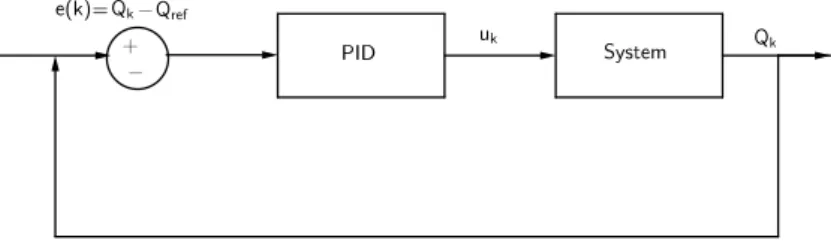
4.4 Overview of PID and Fuzzy logic controllers . . . 66
4.4.1 PID controller . . . 66
Contents 13
4.5 System description . . . 68
4.6 Fixed Radio Resource Sharing Algorithm . . . 70
4.6.1 Edge weight assignment . . . 71
4.6.2 MWM Solving . . . 71
4.7 Adaptive Radio Resource Sharing Algorithm using PID controller 72
4.8 Adaptive Radio Resource Sharing Algorithm using Fuzzy Logic . 75
4.9 Performance evaluation . . . 78
4.9.1 Network sum-throughput . . . 80
4.9.2 H2H throughput and percentage of MTDs whose QoS is not met . . . 81
4.9.3 H2H fairness. . . 83
4.9.4 PDF of MTDs whose QoS is not met . . . 84
4.10 Conclusions . . . 85
5 Efficient transmission strategy selection algorithm for M2M
com-munications 88
5.1 Foreword. . . 88
5.2 Context and motivation . . . 89
5.3 Related works . . . 90
5.3.1 Non-cooperative game . . . 90
5.3.2 Cooperative game . . . 91
5.3.3 Discussion . . . 91
5.4 System model and problem formulation . . . 92
5.4.1 System model . . . 92
5.4.2 Problem formulation . . . 93
5.5 MTC transmission strategy selection algorithm: a hybrid-game . 95
5.6 Non-cooperative power control game . . . 96
5.6.1 Payoff function . . . 96
5.6.2 Mixed Nash Equilibrium . . . 97
5.7 Cooperative power control game . . . 98
5.7.1 Cost of information exchange . . . 98
5.7.2 Payoff function . . . 98
5.7.3 Advanced power control techniques in the strategy space . 99
5.7.3.1 Strategy space set using PID controller . . . 99
5.7.3.2 Strategy space set using fuzzy logic . . . 101
5.8 Performance evaluation . . . 101
5.8.1 H2H throughput . . . 102
5.8.2 H2H fairness. . . 104
5.8.3 M2M power consumption . . . 105
5.8.4 MTDs whose QoS is not met. . . 105
Contents 14
6 Conclusions and Future works 110
6.1 Conclusions . . . 110
6.2 Future works . . . 112
List of Figures 118
List of Tables 120
-
Chapter
1
-Thesis presentation
1.1 Introduction
With the burgeoning advance of intelligent devices and infrastructure, the
Internet-of-Things (IoT) has emerged as a new paradigm that refers to the
inter-connection and interoperability of such smart devices. IoT will be widely used in an incredibly plethora of applications in almost every field from intelligent trans-portation systems to smart environment going through smart building, smart grids, smart healthcare and more. It has the aim of improving and considerably revolutionizing our everyday lives.
It is predicted that at least 50 billion devices will be deployed worldwide by 2020 [36, 35], and a major portion of them will be connected to cellular net-works [85]. Thus, Machine-to-Machine (M2M) communications, also known as
Machine-Type-Communications (MTC), supported by cellular networks will be
one of the fundamental enablers of IoT. MTC aims to provide the communica-tion infrastructure through facilitating the autonomous interconneccommunica-tion between billions of devices among each other or with the underlying data transport in-frastructure, without human intervention.
A successful deployment of MTC requires a paradigm shift from the cur-rent radio access technologies tailored to traditional Human-to-Human (H2H) communications in order to handle the massive number of M2M devices. Fur-thermore, introducing M2M communications into cellular networks should not have a detrimental effect on the performance of existing H2H communications.
1.2 Research challenges and contributions
Taking advantage of the Device-to-Device (D2D) benefits, as one of the major components of the evolving 5G networks that refers to the direct communication
1.2. Research challenges and contributions 16 between two users without traversing the infrastructure, it becomes an effective strategy to use D2D technology in cellular M2M networks. The present work is devoted to designing radio resource sharing schemes for MTC underlying cellular networks. In other words, the main goal of this dissertation is to develop novel radio resource allocation algorithms for MTC where the same spectrum is ex-pected to be shared between H2H communications and M2M communications. In essence, the three high level key questions we should ask in order to achieve this are:
• Q1 How to provide a scalable Medium Access Control (MAC) protocol able to handle the massive number of M2M devices?
• Q2 How to have no or limited impact on existing H2H services with the introduction of M2M devices?
• Q3 Considering the selfish behavior of M2M devices, how to provide fully distributed and energy efficient concurrent access for MTC under cellu-lar networks since M2M devices are battery driven and often deployed in remote areas which makes battery replacement hard?
Our first contribution then is to provide a suitable multiple access scheme to enable the large scale usage of M2M devices under a H2H/M2M coexis-tence scenario. More precisely, we advocate that M2M devices transmit traf-fic through D2D technology underlying cellular network. To cope with the huge complexity of the optimal radio resource sharing problem between H2H users and M2M devices in this case, we propose a two-stage radio resource allocation ap-proach giving higher priority to H2H users. We consider a group-based operation where MTC corresponds to local uplink communications between
Machine-Type-Devices (MTDs) and a Machine-Type-Head (MTH) with the aim of offloading
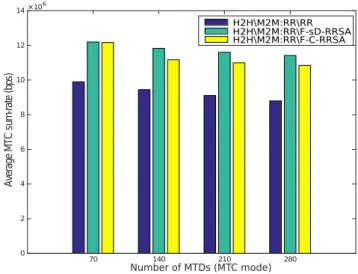
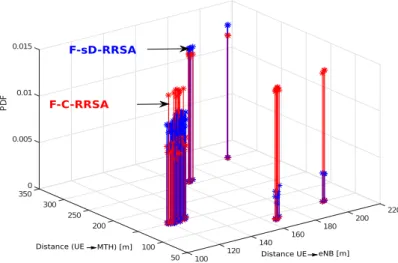
the Base Station (BS). MTH plays the role of a cluster head that has higher ca-pabilities in terms of memory and processing power. The MTH acts as the link between MTDs and the BS. The tasks of the CH includes that of aggregating the data from MTDs before sending it to the BS. This latter having "just" to establish communications with the MTHs in addition to handling H2H communications. Consequently, the scope of this contribution is suitable for the client-server model of M2M communications, where MTDs are connected to a Machine-Type-Server (MTS). Thus, we formulate the radio resource sharing problem as a bipartite graph and develop a novel interference-aware graph-based radio resource sharing algorithm for MTC so as to mitigate co-channel interference and consequently enhance network efficiency. Furthermore, we provide a semi-distributed instan-tiation to alleviate the communication overhead of the centralized instaninstan-tiation. Simulation study is conducted under a static scenario to evaluate the impact of the proposed algorithm in conjunction with the centralized and semi-distributed instantiations on H2H services in terms of throughput. The proposed Fixed Cen-tralized Radio Resource Sharing Algorithm (F-C-RRSA) achieves approximately
1.3. Thesis organization 17 a gain of 15% over the proposed Fixed semi-Distributed Radio Resource Sharing Algorithm (F-sD-RRSA) in terms of network sum-rate. However, the proposed F-sD-RRSA has lower communication overhead.
Our second contribution is devoted to examining how M2M devices can share the available radio resources in cellular networks with no or limited impact on ex-isting H2H services. Therefore, we propose a joint spectrally and power efficient radio resource sharing scheme. Convinced by the strength of the bipartite graph modeling of the resource sharing problem between H2H users and M2M devices, we empower the graph-based radio resource sharing algorithm proposed in the first contribution with a novel power control feature. The latter uses two al-ternative mechanisms: the Proportional Integral Derivative (PID) controller and the fuzzy logic that aim to guarantee H2H services and maximize the spectrum usage of M2M communications. We consider a mobile scenario and conduct an extensive simulation study to evaluate the impact, in terms of throughput and fairness, of the different proposed graph-based radio resource sharing schemes on H2H communications. The fuzzy logic-based adaptive M2M radio resource sharing algorithm yields the best compromise between guaranteeing H2H perfor-mance and satisfying M2M services.
Our third contribution concerns designing power efficient and fully distributed radio resource allocation schemes for MTC. We consider a multiple radio resource sharing scheme where multiple M2M devices transmitting traffic through D2D technology can share the spectrum with a H2H user. We use game theory and model the resource allocation problem as an efficient hybrid-game where M2M devices which are selfish in nature compete for radio resources and switch effi-ciently and opportunistically between non-cooperative and cooperative games. In addition, our proposed scheme is fully distributed to cope with the heavy information exchange, between all M2M devices and the BS, heaviness that can result from a centralized approach. The proposed framework in contrast to the two previous contributions is convenient to the peer-to-peer model of the M2M communications- i.e., a situation when the devices (sensors, actuators or controllers) communicate directly between themselves. An extensive simula-tion study is conducted in order to assess the impact of the proposed hybrid-game-based transmission strategy selection algorithm on H2H services in terms of throughput and fairness and evaluate the gain in terms of power consump-tion. The battery life of MTDs is significantly extended with a gain of up to 40% compared to a pure non-cooperative game approach.
1.3 Thesis organization
The dissertation is structured as follows:
In chapter 2, we present an overview of M2M communications summariz-ing the literature. More precisely, we present M2M communications, introduce
1.3. Thesis organization 18 their characteristics and the different types of M2M applications. We discuss the architectural enhancements in the next generation wireless networks to enable cellular M2M communications with an emphasis on D2D technology. Then, we give a brief overview of D2D use cases. Particularly, we highlight the M2M com-munications as a use case of D2D technology. Finally, we conclude this chapter by focusing on the major challenges to be addressed for efficiently enabling MTC under a H2H/M2M coexistence scenario.
In chapter 3, we present our first contribution. It provides a novel spec-trally efficient radio resource sharing scheme for MTC to address the scalability issue under a H2H/M2M coexistence scenario. We detail how we mitigate the co-channel interference due to the orthogonality loss through using a bipartite graph methodology and then present two alternatives of the proposed MTC ra-dio resource sharing scheme: centralized and semi-distributed. Finally, we focus on evaluating the impact of both alternatives on H2H services.
In chapter 4, we present our second contribution, which further tackles the negative effect of introducing M2M communications on H2H services. We study and characterize our proposed power efficient radio resource sharing scheme us-ing two mechanisms: PID controller and fuzzy logic. Then, we detail the perfor-mance evaluation of our proposal under a H2H/M2M coexistence scenario.
In chapter 5, we present our third contribution which addresses the case of multiple radio resource sharing between M2M and H2H communications. Hence, we detail and characterize our fully distributed and power efficient transmission strategy selection algorithm using game theory with the aim of saving the battery life of M2M devices characterized by a selfish behavior. The performance evalu-ation of our proposal is conducted and is also compared to existing approaches. Finally, the conclusions of this thesis appear in chapter6which also describes some future research directions.
-
Chapter
2
-An overview of M2M communications
Contents
2.1 Foreword . . . 20 2.2 M2M communications . . . 21 2.3 MTC applications . . . 22 2.4 Characteristics of MTC . . . 252.5 SC-FDMA in LTE networks . . . 26
2.6 Architectural enhancement to enable MTC . . . 27
2.7 D2D communications . . . 29
2.8 Major challenges in enabling MTC . . . 34
2.9 Conclusions . . . 35
2.1 Foreword
Apart from the growing proliferation of smartphones and other human-oriented devices in conventional Human-to-Human (H2H) communications, the mas-sive scale of Machine-to-Machine (M2M) communications or
Machine-Type-Communications (MTC) introduced into cellular networks represents a
detri-mental factor. To design new radio resource allocation schemes to accommodate MTC underlying cellular networks, we need to investigate on MTC features, MTC applications and the existing cellular network standard.
In this chapter, we aim to give an overview of M2M communications to de-limit the context of the thesis. We first define M2M communications, introduce the different types of M2M applications and M2M characteristics. We present in the next step the multiple access scheme used in Long Term Evolution and
2.2. M2M communications 22
its Advancement (LTE-A) standard and discuss the architectural enhancement
in the next generation wireless networks to enable cellular M2M communica-tions. We also give an emphasis on Device-to-Device (D2D) communications as an emerging paradigm introduced in LTE-A networks along with M2M commu-nications. Then, we give a brief overview of D2D use cases. Particularly, we highlight the M2M communications as a use case of D2D technology. Finally, we conclude this chapter with focusing on the major challenges to be addressed for efficiently enabling MTC under a H2H/M2M coexistence scenario.
2.2 M2M communications
Machine-to-Machine (M2M) communications is a new paradigm that refers to
the ubiquitous connectivity between a myriad of machines without or with lim-ited human intervention. The autonomous connection of devices facilitates the emergence of a wide range of intelligent M2M applications, enabling partially the Internet-of-Things (IoT) [23, 24]. The M2M applications can be envisioned in two major scenarios. The first scenario adopts the client/server model and considers the communication between M2M devices called Machine-Type-Devices (MTDs) and one or more Machine-Type-Servers (MTSs). This scenario is the most adopted by many M2M applications, such as health monitoring, water, gas, or power metering. The main concept consists of connecting seamlessly an autonomous and self-organizing network of MTDs to a remote client, through heterogeneous wired or wireless communication networks. At the remote client is deployed an intelligent software application that aims to process the collected data and provide the end user with a set of smart services through a user-friendly interface. The second scenario of M2M applications may require an alternative model of communication where MTDs are communicating directly through
Peer-to-Peer (P2P) communications [87, 48]. This kind of inter-MTD communications
can be either through the mobile network or in an ad hoc mode.
To enable M2M communications, different short range technologies can be proposed such as Bluetooth, Zigbee or Wi-Fi. Considering that the ultimate goal for M2M communications is to provide ubiquitous connectivity among all devices for serving human beings, scenarios for M2M communications supported by the Third Generation Partnership Project (3GPP) are considered the most promising solution. The 3GPP has standardized M2M as MTC in LTE-A. In ad-dition, a specific network architecture known as Heterogeneous Network (HetNet) is provided by 3GPP LTE [29, 61, 22]. In addition to conventional macrocells, HetNet involves Remote Radio Heads (RRHs), femtocells, picocells as well as
relay nodes (RNs) which are low-power overlaid Base Stations (BSs) underlying
the macro-cellular layout. HetNets enhance the network performance (through-put) by reducing the distance between the transmitter and the receiver, improve the network coverage area and offload the macrocells. Besides, an ubiquitous
2.3. MTC applications 23 connection among all MTC devices can be provided by attaching to these sta-tions. The 3GPP infrastructure also offers a secure connection and is considered a good support for user or device mobility. Last but not least, an effort on en-abling low cost MTDs is considered in 3GPP [90]. More precisely, release 12 of LTE has introduced low-cost MTDs also called Category 0 devices. The cost of Category 0 devices is about 50 % the cost of regular LTE Category 1 devices of release 8. The cost reduction is mainly achieved by reducing the number of radio transceivers and by limiting the maximum transport block sizes [9].
2.3 MTC applications
The autonomous connection of devices and the emergence of low-cost devices from sensors and actuators able to wirelessly communicate with each other facil-itate the emergence of a large number of intelligent M2M applications. The latter have exhibited a strong potential to improve the quality of our lives in different aspects such as: at home, at work, when sick or when traveling, and so on and so forth. M2M applications can be classified into different domains as presented in [12, 39], for instance. We present a summary of different applications for each of these domains in Fig. 2.1. An overview of these domains and applications is given in the following.
2.3.1 Intelligent transportation systems
Intelligent transportation systems represent advanced applications that aim to provide innovative services related to different modes of transport and traffic management. On one hand, the increasingly wide range of advanced vehicles equipped with M2M sensors and actuators enables various users to be better informed and makes the use of transport networks smarter and safer. On the other hand, M2M sensors and tags used in roads and in transported goods provide relevant information to transportation control sites in order to better route the traffic, provide the traveller with appropriate transportation information and monitor the status of the transported goods. The major M2M applications in intelligent transportations systems are discussed below.
2.3.1.1 Logistics
M2M communications enhances the logistic services, as a major economic activ-ity, that involve the process of planning, implementing and efficiently controlling the related information from point of origin to point of consumption. For in-stance, the surveillance of the status of goods, transportation, storage, sale and after sale services in real-time through M2M sensors can help in being conform to the customer requirements. Obtaining a current and accurate information about any product is possible so that customers become better informed about
2.3. MTC applications 25 was reported in [18] that approximately 27% of the total carbon dioxide emissions are the result of the combustion of fuels from vehicles.
2.3.1.4 Smart parking
M2M applications in smart parking help drivers to identify if the parking space is occupied or not and let them know where unoccupied car parking spaces are. Parkings are equipped with M2M sensors. Each of these M2M sensors is able to detect that a car has parked over it and then sends the information to a gateway. The latter relays the information to the core network. Finally, the information is sent to a M2M database server to inform users in real-time about the occupancy of parkings.
2.3.2 Healthcare
M2M communications will play a major role in healthcare domain including: the tracking of objects and people (staff and patients), the identification and authentication of people and the automatic medical data collection [84].
2.3.2.1 Tracking and monitoring
Tracking is the operation of identifying an object (organ) or a person in motion. M2M communications helps in preventing left-ins during a surgery through real-time stock tracking, for instance. In addition, M2M communications enables remote monitoring of a patient, triggers alarms or enables remote treatment and crisis interventions in case of emergencies.
2.3.2.2 Identification and authentication
Identification and authentication in healthcare play a major role in securing and protecting patients. On one hand, it reduces the risk of incidents (such as wrong drug, time, or operation). On the other, it is used to grant access and security for both employees and patients.
2.3.2.3 Data collection
Automatic data collection in healthcare involves administrative enrollment, billing records, and medical records. It helps with optimizing the processing time as well as enhancing medical care services and medical inventory management.
2.3.3 Smart environment
The ubiquitous communication among devices deployed at homes, in offices, in cities or industrial plants helps in building a smart environment.
2.4. Characteristics of MTC 26
2.3.3.1 Smart homes, offices and cities
M2M sensors and actuators deployed in houses and offices play a prominent role in easing and making comfortable our lives. For instance, sensors installed in various electronic appliances such as air conditioners, heaters, cookers provide a controllable and more efficient utilization of energy. Another example is adapting the lighting in offices to the time of a day and to the number of occupants inside the offices. Besides, a smart city framework provides authorities and citizens with real-time information and assistance in the decision-making to obtain a cost-efficient management of resources, and thus the life quality of citizens is promoted.
2.3.3.2 Industrial plants
By collecting and exchanging information among sensors, M2M communications can improve the degree of automation in industrial plants. For instance, M2M devices can transmit an event-related information in real-time to the M2M server in case an emergency event is triggered.
2.3.4 Public safety
M2M communications enhances the security level through making the process of security including remote surveillance reliable, simple and cost-efficient. Public safety networks provide communications for services like police, fire and ambu-lance. Security-relevant events such as fire are detected by deployed sensors and relayed in real-time and automatically via M2M communications to a control center allowing triggering a timely response.
2.4 Characteristics of MTC
H2H communications has always been the center of attention of many researchers. Consequently, current mobile networks such as LTE-A networks have been mainly designed to support human-oriented services such as voice calls or data appli-cations [6]. Unlike traditional H2H appliappli-cations, M2M services are character-ized by a massive number of deployed devices with specific features such as: short payload size, extra low power consumption and centralized data collection. Many new potential MTC use cases are more limited by power consumption than the offered data rate or latency [66]. Indeed, M2M devices in most M2M applications are battery driven and it is often very difficult to replace devices’ batteries once deployed. Thus, low power consumption is essential for battery operated terminals to prolong time between battery charges. Different from H2H communications that are downlink-oriented, M2M communications are mainly
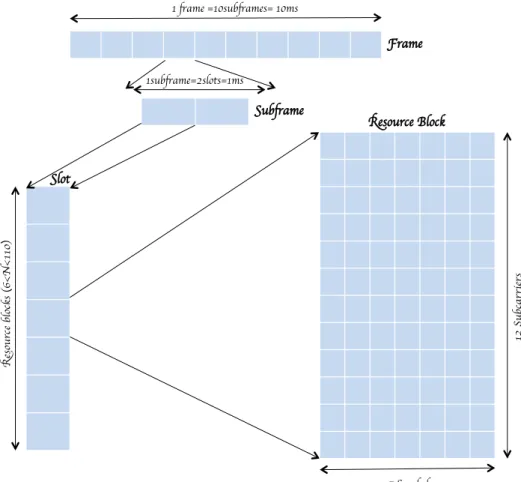
2.5. SC-FDMA in LTE networks 27 uplink-centric. Thus, H2H devices along with M2M devices bring new require-ments and challenges to LTE-A cellular networks originally optimized to carry high data rates for broadband applications. From a MAC layer perspective, the coexistence between H2H users and M2M devices raises the problem of radio resource competition among each other in the same network due to the limited licensed spectrum. 1 rame =10subrames= 10ms 1subrame=2slots=1ms R es ou rc e bl oc ks ( 6< N <1 10 ) 7 Symbols 12 S ub ca rr ie rs Frame Subrame Slot Resource Block
Figure 2.2 – Resource block structure in LTE networks
2.5 SC-FDMA in LTE networks
Since most M2M applications are uplink-centric, we give a brief overview of
Single-Carrier-Frequency-Division-Multiple-Access (SC-FDMA) as the multiple
access scheme used in the uplink transmission of the 3GPP LTE standard [49]. Different from Orthogonal-Frequency-Division-Multiple-Access (OFDMA), SC-FDMA is a modified version that offers increased uplink coverage due to its low Peak-to-Average Power Ratio (PAPR). Radio resources are distributed in the time-frequency domain. More specifically, radio resources are distributed
2.6. Architectural enhancement to enable MTC 28 every Transmission-Time-Interval (TTI) in LTE networks which consists of one subframe and has a duration of one ms. Each TTI consists of two slots, thus, 20 slots equivalent to 10 TTI constitute one LTE frame. In the frequency domain, the available bandwidth is divided into a number of sub-channels each including 12 subcarriers with a spacing of 15 Khz. Each sub-channel has a bandwidth of 180 Khz and along with 7 symbols in the time domain constitutes a Resource
Block (RB) as illustrated in Fig. 2.2. This latter is the minimum unit of the
resource allocation process. Depending on the available bandwidth, the number of RBs can vary from 6 to 110. The use of SC-FDMA in the uplink implies certain restrictions on power and RB allocation [68, 40]. Because of the adjacency restriction, multiple RBs allocated to a user must be adjacent. Besides, the transmit power on all RBs allocated to a user should be equal for retaining the low PAPR benefits [8]. Consequently, the constraints associated with SC-FDMA in LTE uplink networks in terms of RB adjacency and transmit power restriction must be respected in case multiple RBs are assigned to a MTD.
2.6 Architectural enhancement to enable MTC
The access network of LTE and its advancements, known as Evolved
Univer-sal Terrestrial Radio Access Network (E-UTRAN) consists of evolved Node Bs
(eNBs) which provide user plane and control plane protocol terminations toward the User Equipment (UE). The E-UTRAN architecture is flat since there is no centralized controller in radio access network. The eNBs may be interconnected with each other by means of the X2 interface and to the core network by means of the S1 interface as illustrated in Fig. 2.3. The current LTE cellular network is designed to support only H2H services for UEs. With the introduction of M2M communications into LTE-A cellular networks, architectural enhancement needs to be addressed to accommodate future M2M services without degrading the performance of existing traditional H2H services. Fig. 2.3 illustrates three dif-ferent methods which are feasible to enable M2M communications: direct access, multi-hop access and peer-to-peer access.
2.6.1 Direct access
A MTD can directly access an eNB without any intermediate device as illustrated in Fig. 2.4. This type of direct link is similar to the one established by a regular UE. Even though the direct link access is the simplest access method, it may cause a network congestion when a huge number of devices send communication requests to the eNB simultaneously.
2.7. D2D communications 32
Figure 2.7 – D2D communications in cellular spectrum
contrast to underlay D2D communications where D2D and cellular links share the same spectrum, D2D links in overlay D2D are assigned dedicated resources. Fig.
2.8 shows the interference scenario for D2D communications underlying cellular networks when considering an uplink transmission. A mutual interference can be created between D2D and cellular links. Particularly, the BS may be interfered by the signal transmitted from the D2D transmitter and the D2D receiver may be interfered by the signal transmitted from the cellular user. While the spectrum efficiency is the major advantage of underlay D2D communications compared to overlay D2D, the co-channel interference remains the prominent issue to solve. Consequently new radio resource allocation algorithms should be designed to mitigate such co-channel interference.
2.7.2 D2D use cases
Different use cases for D2D communications have been addressed in literature as follows:
• P2P communications: In this case, D2D devices represent the source and destination of the exchanged data [55]. The major applications of P2P communications are:
– Local voice service: when two geographically proximate users want to
talk, D2D communications can be used to offload local voice traffic.
– Local data service: when two geographically proximate users want to
exchange data, D2D communications can be used to provide local data service for enabling content sharing or context aware applications. • Video dissemination: authors in [32, 42] have proved that D2D
2.7. D2D communications 34
2.7.3 D2D and M2M aggregation
In a similar way to D2D communications, MTC focuses on exchanges between M2M devices or between M2M devices and the infrastructure. Nevertheless, M2M communications is technology-independent and application-oriented since there is no requirements in terms of distances for example between devices as in D2D communications. On the other hand, D2D communications aims to establish proximity connectivity services which is technology-dependent [10].
Many researchers in the literature have focused separately on the two emerg-ing paradigms in the next generation cellular technologies, M2M and D2D com-munications. However, only few have addressed the combination of M2M and D2D communications. Indeed, M2M communication is usually handled by a ran-dom medium access technique. However, ranran-dom access can potentially lead to increased collisions for a dense system such as massive MTC. Therefore, network-assisted D2D communication can be considered a prominent technology to ac-commodate M2M communications. Although few authors have exploited the benefits of D2D to accommodate M2M communications in cellular networks, the motivation between M2M and D2D aggregation has been different. For instance, motivated by the reduced power consumption and the hop gain enabled through D2D communications, authors in [78] have considered a multi-hop D2D commu-nication for end-to-end M2M connectivity, where cellular and D2D links have been assigned orthogonal radio resources to avoid the co-channel interference. In [75], authors have developed a relay-based technique in a M2M use case and have proved that relay-aided D2D communications could be an elegant solution to provide reliable transmission as well as improve the overall network through-put.
Group-based operation of MTDs is considered a promising solution to offload the eNB. The ultimate goal behind grouping MTC devices remains mainly in reducing the number of communications through the BS. The advantages of transmitting MTC traffic using D2D links are twofold: (i) MTC in a group can communicate to the group head called Machine-Type-Head (MTH) without traversing the BS, thus the number of connections between devices and the BS is reduced and the Radio Access Network (RAN) overhead is prevented. (ii) the energy consumption at the uplink side (M2M applications are uplink-centric) is reduced since traversing the BS is not always the optimal way particularly when the transmitter is nearby the receiver. For instance, authors in [79] have proposed a protocol access scheme with the aim to mitigate the access overload due to the massive number of deployed MTDs. Specifically, authors exploited D2D communications in a Time Division Multiple Access (TDMA) scheme to aggregate M2M traffic and forward data generated by low-power MTDs through nearby cellular users. However, the design of the system model for group based M2M communications is still considered to be subject to further study [22].
2.8. Major challenges in enabling MTC 35
2.8
Major challenges in enabling MTC
Different from H2H communications, M2M communications has different require-ments due to their specific features. Designing efficient radio resource allocation schemes convenient to the two major scenarios of M2M communications, namely the peer-to-peer model and the client-server model, is still an open problem. Re-cent research works are addressing the key question of: “how existing cellular networks should be improved to enable the massive scale of MTC?”. However, only few have considered the H2H/M2M coexistence scenario. In essence, at least the following major issues have to be addressed to provide efficient radio resource allocation algorithms under a H2H/M2M coexistence scenario.
The first issue to tackle is the scalability due to the limited licensed spec-trum. Current cellular networks have been optimally designed to support human-oriented services and consider only a small number of H2H users. Due to the high penetration of M2M devices in order of the billions, the competition on the limited radio resources will significantly increase. Hence, our first contribution in chapter3is devoted to design a spectrally efficient radio resource sharing scheme under a H2H/M2M coexistence scenario.
The second issue that must be addressed is the guarantee of the desired
Qual-ity of Service (QoS) of H2H links while maximizing the efficiency of the shared spectrum usage. Indeed, the massive scale of M2M communications introduced
in cellular networks can play a detrimental role in degrading the performance of existing H2H services. Hence, our proposed radio resource sharing algorithm in the second contribution in chapter 4 is not only spectrally efficient but also power efficient with the aim to reduce the negative impact on H2H services and maximize the M2M spectrum usage which is crucially important.
The two first contributions in chapters 3 and 4 are convenient to the client-server model of M2M communications, where MTDs are connected to a MTS. Throughout these two chapters, on can say that we design an efficient M2M group-based operation to alleviate the air interface overload due to the huge num-ber of deployed MTDs while considering a client-server communication model for MTC.
The third issue concerns designing distributed and power efficient radio re-source sharing schemes. Indeed, a centralized radio rere-source sharing scheme can be prohibitive since it requires a huge computational complexity due to heavy information exchange between all MTDs and the eNB. We propose in the third contribution, described in chapter5, a fully distributed and power efficient trans-mission strategy selection algorithm. The proposed framework is convenient to the second scenario of M2M communications, which is the peer-to-peer model.
2.9. Conclusions 36
2.9 Conclusions
MTC is a new paradigm that refers to the autonomous communication between devices without or with limited human intervention. MTC has exhibited a strong potential for enhancing human life through different intelligent M2M applications ranging from e-health, smart grids, intelligent transportation systems and much more. Existing cellular networks are not tailored to the scale of M2M com-munications, which makes conventional resource allocation algorithms for H2H communications prohibitive to cater to MTC requirements. Orthogonal resource allocation is a simple solution adopted by many researchers. However, sharing the same spectrum between H2H and M2M communications represents a promis-ing solution but results in a co-channel interference. The scope of this thesis is hence to design novel radio resource sharing schemes for MTC underlying cellular networks that tackles jointly the scalability and energy efficiency at a low com-putational cost and thus enabling the massive scale of M2M without degrading the perceived quality of service of existing H2H services.
-
Chapter
3
-Graph-Based radio resource sharing
scheme for M2M communications
Contents
3.1 Foreword . . . 38
3.2 Context and motivation . . . 39
3.3 Related works . . . 40
3.4 System model and H2H/M2M coexistence problem
formulation . . . 44
3.5 Fixed Radio Resource Sharing Algorithm . . . 49
3.6 Performance evaluation . . . 53
3.7 Conclusions . . . 58
3.1 Foreword
Considering the high proliferation of Machine-to-Machine (M2M) devices which is in the order of billions along with smartphones in Human-to-Human (H2H) communications, significant challenges are posed to the wireless cellular net-works. In this chapter, we address the coexistence issues between H2H and M2M communications, by proposing a novel radio resource sharing scheme for
Machine-Type-Communications (MTC).
We first highlight the coexistence problem between H2H and M2M commu-nications. Then, we formulate the radio resource sharing problem throughout M2M devices and H2H users such as both are allowed to access the same ra-dio resources, as a sum-rate optimization problem. In order to reduce the high computational complexity of the optimal solution, we model the radio resource
3.2. Context and motivation 40 sharing problem in a H2H/M2M coexistence scenario as a bipartite graph and consider a two-stage radio resource allocation approach, giving higher priority to H2H communications. Then, we develop a novel interference-aware graph-based resource sharing algorithm aiming to efficiently re-assign Machine-Type-Devices (MTDs) one of the available radio resources already assigned to H2H users. In addition, we propose a centralized and a semi-distributed instantiations of the proposed interference-aware graph-based radio resource sharing algorithm.
To that end, we introduce the context of this work in Section 3.2, followed by a brief overview of the related works in Section 3.3. The scenario under study is described and the resource assignment optimization problem is formulated in Section 3.4. In Section 3.5, the interference-aware graph-based radio resource sharing algorithm is proposed. The performance evaluation of our proposal is drawn is Section 3.6, followed by the conclusion in Section 3.7.
3.2 Context and motivation
The need of the various public and private organizations to automate their real-time monitoring and control processes, as well as the growing reputation of smart applications aiming to enhance the human well-being demonstrate the explosive growth predicted for M2M applications. The most prominent fields of potential M2M applications include environmental monitoring, smart grids, healthcare, intelligent transportation systems and surveillance. It is expected that over 25 billion devices will be connected to the cellular network in 2020 which far exceeds the existing number of devices in current wireless networks [85].
From a Medium Access Control (MAC) layer perspective, an increased com-petition on radio resources will be generated due to the massive scale. Unlike traditional H2H applications, M2M systems are characterized by a massive num-ber of deployed devices with specific features such as: small data transmission, extra low power consumption and centralized data collection. Hence, designing novel radio resource allocation algorithms is of paramount importance to be able to cater to specific M2M requirements, ensure network efficiency and deal with the massive scale of Internet-of-Things (IoT). In addition, low-computational complexity as well as distributed algorithms are required to tackle the exponen-tial computational complexity of an optimal resource allocation scheme and the huge signaling overhead of a centralized approach, respectively.
To address the scalability issue and motivated by the low M2M transmit power constraint, we propose to exploit Device-to-Device (D2D) communications underlying cellular networks for M2M traffic, as a convenient way to scale the network capacity and handle millions of devices. As a consequence, new radio resource allocation methods should be developed to mitigate the co-channel inter-ference due to the orthogonality loss. Within this aim, we propose a two-stage radio resource allocation approach in order to reduce the high computational
3.3. Related works 41 complexity of the optimal solution. Then, we develop a novel interference-aware graph-based resource sharing algorithm to minimize the interference and thus improve the network performance. Finally, we propose a centralized and a semi-distributed instantiations of the proposed algorithm. Simulation study is con-ducted to evaluate the impact of the proposed algorithm along with the central-ized and semi-distributed instantiations on H2H services in terms of throughput.
3.3 Related works
Literature addressing the radio resource allocation schemes for M2M communi-cations has gained much momentum. However, jointly handling the scalability issue associated with the emergence of the high number of MTDs while designing M2M radio resource allocation algorithms is of a paramount importance. There-fore, the multiple access channel is considered as a convenient way to avoid the spectrum scarcity and thus support M2M communications. We present here some existing solutions of M2M radio resource allocation schemes in a H2H/M2M co-existence scenario along with their limitations and classify them into three main categories based on the used access channel method.
3.3.1 Random access procedure
The random access procedure has been considered a promising solution to en-able the massive scale of M2M communications since it allows a multiple M2M access. There are two types of random access procedure in Long Term Evolution (LTE): contention-based and contention-free. In a contention-based approach, a device (either a MTD or a H2H device) normally initiates random access by randomly choosing a preamble. A preamble is an Orthogonal Frequency-Division
Multiplexing (OFDM)-based signal. In each LTE cell, there are 64 preambles.
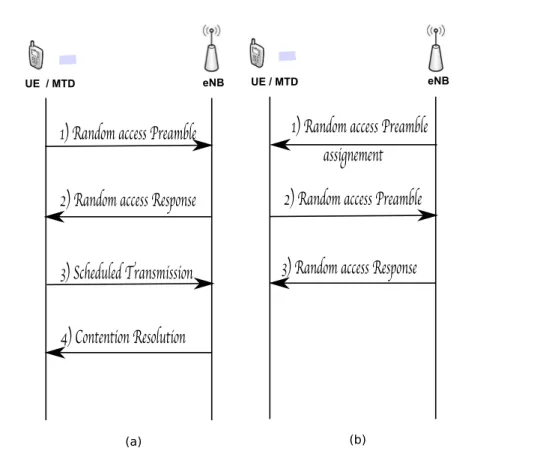
Some preambles are reserved for contention-free (or coordinated) random ac-cess, while the remaining ones are used for contention-based (or uncoordinated) random access. In a contention-based manner, more than one device can possi-bly choose the same preamble, which necessitates further contention resolution processes. In a contention-free random access, an evolved NodeB (eNB) has com-plete control over devices to initiate random access by using dedicated preambles. Hence, it guarantees a faster access than the contention-based approach which explains its use in handover purposes where the delay requirement is strict. Fig.
3.1(a) illustrates the contention-based random access procedure, which involves the following four steps [28]:
1. The first step consists of the transmission of a random access preamble. Specifically, the device (either a MTD or a H2H device) selects one of the eNBs’ preambles and transmits over the Physical Random Access Control
3.3. Related works 42
1) Random access Preamble
2) Random access Response
3) Scheduled Transmission
4) Contention Resolution
1) Random access Preamble
2) Random access Preamble
assignement
3) Random access Response
UE / MTD eNB UE / MTD eNB
(a) (b)
Figure 3.1 – Overview of the random access procedure: (a) contention-based random access procedure; (b) contention-free random access procedure
of the device. Uplink synchronization is necessary in order to allow the device to transmit uplink data to the eNB, otherwise the device cannot transmit any uplink data.
2. The second step consists of the network transmitting a timing advance command to adjust the device transmit timing, based on the timing mea-surement in the first step. In addition to establishing uplink synchroniza-tion, the second step also assigns uplink resources to the device to be used in the third step in the random access procedure.
3. The third step consists of the transmission of the mobile-device identity to the network using the Uplink Shared Channel (UL-SCH) similar to normal scheduled data. The exact content of this signaling depends on the state of the device, in particular whether it is previously known to the network or not.
4. The fourth and final step consists of the transmission of a contention-resolution message from the network to the device on Downlink Shared
Channel (DL-SCH). This step also resolves any contention due to multiple
3.3. Related works 43 A contention-free random access procedure is illustrated in3.1(b). This latter consists of the following three steps [44]:
1. The procedure starts with the random access preamble assignment by the eNB. This step consists of allocating dedicated preamble signatures to a
User Equipment (UE).
2. The transmission of an assigned random access preamble by the UE. 3. The eNB responds with the random access response. This is the last step of
the contention-free random access since there is no need to resolve further collision.
Authors in [44] have discussed the random access procedure in LTE-A net-works as a convenient way to provide the multiple access channel for MTDs. However, significant congestions may occur in a scenario with a massive number of MTDs such as in IoT. A Quality of Service (QoS) guaranteed M2M massive access management scheme has been proposed in [57, 58]. In this scheme, MTDs sharing the same QoS requirements, i.e. the jitter, have been grouped logically into clusters. Then, fixed Access Grant Time Interval (AGTI) has been allocated to each cluster. The major limitation is that contrarily to the randomness of the real M2M traffic, only constant-rate traffic patterns have been considered. Fur-thermore, the impact of this mechanism on traditional H2H users has not been discussed.
3.3.2 Multi-radio access technologies in LTE-U
The use of the unlicensed spectrum by the LTE technology is seen as a convenient way to offload the existing traffic from the licensed spectrum. In this context,
LTE-Unlicensed (LTE-U) technology is initiated as part of LTE release 13 [3],
and is considered as a groundbreaking innovation to ensure a seamless and a high quality user experience through extending LTE to the readily available unlicensed spectrum. However, the coexistence between LTE-U systems and the incumbent unlicensed systems such as WiFi systems remains a prominent challenge. Indeed, LTE and WiFi have distinct features. While LTE has been designated to use the licensed spectrum exclusively in a centralized manner endowing its devices with a continuous transmission, WiFi uses Carrier Sense Multiple Access with
Colli-sion Avoidance (CSMA/CA) which is a distributed media access control protocol
that allows transmissions only when the channel is idle. In case the LTE proto-col is not properly designed to coexist with the unlicensed spectrum, the WiFi devices suffer from the LTE interference [20, 69, 96]. To enable a friendly and a fair coexistence with the incumbent unlicensed systems, a modification to the LTE protocol is required. For instance, authors in [46, 67] have opted to use the
Licensed-Assisted Access (LAA) in 3GPP [1, 17] known also as the Listen Before Talk (LBT) feature. This latter requires to detect the channel status (occupied
3.3. Related works 44 or free) at a millisecond scale before a potential transmission of LTE-U devices, meaning that a device is allowed to transmit only if the channel is detected free for a specified period [4, 2]. However, the main drawback of this approach is the starvation problem for LTE-U devices in case of a high WiFi traffic. Several so-lutions tried to overcome this with more or less efficiency. For instance, authors in [56] have empowered the LTE protocol with a discontinuous duty-cycle trans-mission pattern. Specifically, LTE-U devices access the unlicensed spectrum for a fraction η of time (0 ≤ η ≤ 1), and are muted for the complementary 1 − η fraction of time, enabling the WiFi devices to transmit. In [25], a hybrid method to perform both traffic offloading and resource sharing in an LTE-U scenario using a coexistence mechanism based on optimizing the duty cycle of the system has been proposed. In [34], authors have investigated the joint radio resource management on licensed and unlicensed bands and have shown its capability to further improve the cellular system performance. In [43], authors have consid-ered the joint channel selection and fractional spectrum access problem through a cognitive coexistence scheme to enable spectrum sharing between LTE-U and WiFi networks. On the other hand, authors in [73] have investigated the co-existence of LTE and ZigBee networks at the unlicensed frequency band of 2.4 GHz in order to offload the existing traffic from the licensed spectrum in a smart meter communication scenario. In this regard, in an IoT scenario, devices with relaxed QoS constraints can be served by the WiFi network while devices with strict QoS constraints can be served by the LTE-U network. However, in most of these solutions, LTE-U requires MTDs to be equipped with dual radio interfaces.
3.3.3 OFDM-LTE systems
A handful of works [59, 100] have recently investigated the radio resource allo-cation issue in a H2H/M2M coexistence scenario for LTE. For instance, authors in [59] have proposed two fully dynamic (per transmission time interval) M2M scheduling algorithms for the LTE uplink based on a delay tolerance objective and channel conditions. Higher priority has been given to UEs, then the remaining resources have been assigned to MTDs. In the first scheduling algorithm, radio resources have been ranked based on the channel quality. The resource with the highest rank has been assigned to a MTD only if its maximum delay tolerance is smaller than the mean delay tolerance of all remaining MTDs. Meanwhile, in the second algorithm, MTDs have been ranked first based on their delay tolerance, then the best resources in terms of channel quality have been assigned to the least delay tolerant machine. In [100], a mixed scheduling algorithm for H2H and M2M communications has been introduced. Here, authors have classified devices into two queues: the high-priority queue that includes all classical H2H users and some delay-sensitive M2M service users, while remaining MTDs have been grouped in the low-priority queue. Then, the authors have applied different scheduling algorithms for each queue by implementing a compound two-phase