1 THE PHYSICALITY OF ARCHITECTURE IN PRACTICE
The physicality of architecture at the start of the XXIth century is an recurrent issue. It should be enough to mention the short term building trends, the omnipresence of sustainability and en-ergy savings, the influence of industrial (post)globalization, the pressure exerted by fast emer-ging countries, or the omnipresence of virtuality and of non-physical designing tools.
In today's divergent contexts, styles and approaches, it appears necessary for practicing archi-tects to establish renewed and adapted operational frameworks, which make it possible for this diversity to coexist. The reality of the act of construction remains a possible common frame-work for architecture.
In consequence, the relationship between architecture and structure appears to be very relevant. We propose to analyze a particular approach through various projects of the Brussels's based architecture office AgwA (the authors are its partners). The illustrated projects aim to identify space and structure. However, space does not follow blindly the structural design. Rather, the structure follows flexible general principles, which allow variations in shape, size, material, design, and consequently can be used coherently in very different situations.
2 PRAXEMES
Some comments should be made on the nature, the scope and the consequence of the analysis we make of our own projects.
First, it is necessary to mention that the analysis requires some distance from the design pro-cess. Often, we were not explicitly conscious of the structural analysis when we were in the design process itself. It would seem strange to us to attempt to apply predefined design strategies to a project, as this would lead us to neglect the specificity of each project. However, in the latter projects, the consciousness has grown of the global attitude, but it is always pushed to an unspoken background in the design activity itself.
AgwA architecture office : study cases on structure and
architecture
Harold Fallon
LUCA School of Arts - Sint-Lucas School of Architecture, Brussels-Ghent, Belgium AgwA architecture office, Brussels, Belgium
Benoît Vandenbulcke
Civil engineer architect, founder & partner of AgwA architecture office, Brussels Teacher and researcher at LOCI, Université Catholique de Louvain, Belgium PhD student at LOCI, Université Catholique de Louvain, Belgium
“Il faudrait non point une rhétorique par auteur mais une rhétorique par poême” What we need, is not a rethoric for each author, but rather a rethoric for each poem.
«Raisons de vivre heureux», Francis Ponge, Proêmes, t I, Paris, Gallimard, 1965, p 190 (dated 1928-1929)
ABSTRACT: Through different projects of the office, the paper explores which design strategies allow to address structure and architecture as two equally important aspects of one unique ambition in each project. The structural approaches are specific to each project. How-ever, all procede from the a same attitude : structural principles are enounced at some point, that address the structural typology rather than its formal design. By doing so, a high flexibility is induced in the design towards the constraints of the design and construction process.
Second, we need to clarify the objective of these analysis. It is not our intention to discover some inherent, hidden truth in the designs and their process. Rather, the analysis is made from the point of view of a designer, with its position and tools. We look at the designs in order to discover possible ways of approaching architecture, that may be useful to practitioners. Our in-tention is to make use of the designs to extract and define possible useful design tools. Whether they are really what is at stake in the project, or if this exhaustively explains the structural ap-proach, become secondary. It even is a fundamental condition of this kind of analysis : extract-ing a specific conceptual tool, means that it is extracted from other dimensions that disturb the perception thereof. We refer to such design tools as “praxemes”. The word “praxeme” is a con-traction of “praxis” (action) and “semeion” (sense, meaning). We use it to refer to a piece of knowledge that can not be considered independently from the practice. It is distilled from the practice and informs the practice in return.
3 VERTIGO : COEXISTENCE OF STRUCTURE AND ARCHITECTURE
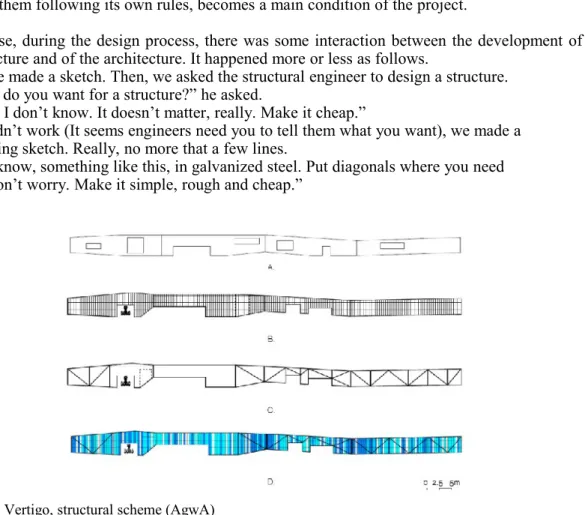
The shape of Vertigo’s polycarbonate skin has been defined according to a set of constraints, resulting in an irregular shape avoiding contact with the ground. The structure sustaining the skin is a pragmatic triangulation which is left as is. The coexistence of the structure and skin, each of them following its own rules, becomes a main condition of the project.
Of course, during the design process, there was some interaction between the development of the structure and of the architecture. It happened more or less as follows.
First, we made a sketch. Then, we asked the structural engineer to design a structure. - “What do you want for a structure?” he asked.
- “Well, I don’t know. It doesn’t matter, really. Make it cheap.”
As it didn’t work (It seems engineers need you to tell them what you want), we made a zigzagging sketch. Really, no more that a few lines.
- “You know, something like this, in galvanized steel. Put diagonals where you need them, don’t worry. Make it simple, rough and cheap.”
Figure 1. Vertigo, structural scheme (AgwA) A. Formal Sketch
The skin of the vertigo was given a quite arbitrary shape. Openings allow contact between the inside and the inside.
B. Contingencial fitting
The openings were adapted to fit needs of the project : entrances, exits, emergency and technic-al accesses, shape of the existing structure, modulation to the size of polycarbonate panels. C. Structural feedback
The structure is “added” to the project : it coexists, but its shape and design are not dictated by the project.
D. Layered reality
Last minute coloring by the theme park’s direction : “You don’t want us to develop a colorless theme park, do you?”
4 METAL : VARIATIONS ON A FLEXIBLE STRUCTURAL PRINCIPLE
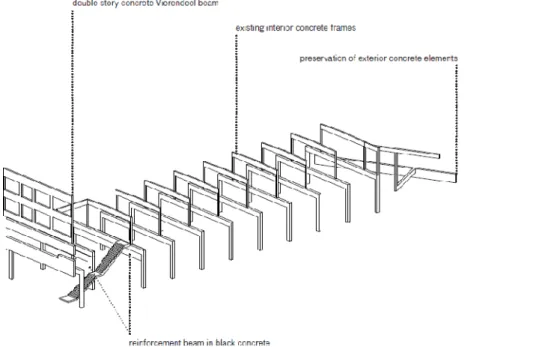
For the refurbishment of this existing tyre workshop, all disturbing vertical structural elements are suppressed by the use of large beams overarching space from neighbour to neighbour. This principle is the project red line.
The existing building consists of large concrete frames on the first floor, that liberate space from disturbing vertical structural elements between the two neighbouring walls. On the second floor, similar, smaller frames provide zenithal light to the level below, and provide lateral views to the second floor.
This principle of large beams freeing space completely, becomes the red line of the structural approach. It is a very simple, flexible principle, that doesn’t give indications on the shape, design, or materiality of the structural elements. In consequence, it gives freedom in the solving of local issues and situations. A variation of strategies was developed around this principle. First, the structure was cleaned in its original situation. The exterior elements, some of which were discovered during the works, were painted black in order to avoid expensive concrete res-toration works.
Second, two beam were modified by the integration of a new staircase. One beam was cut and the scheme of loads was modified. These beams are supported by new elements in black con-crete. Third, the structure is extended with a variety of structural solutions, like simple steel beams for the facade cladding and the realization of a two levels Vierdendeel beam on the front elevation.
The flexibility induced on the formal and material level allowed us to respond specifically to very local constraints and situations, without loosing the sense of coherence of the whole.
5 PHILIPPEVILLE : MULTIPLICATION
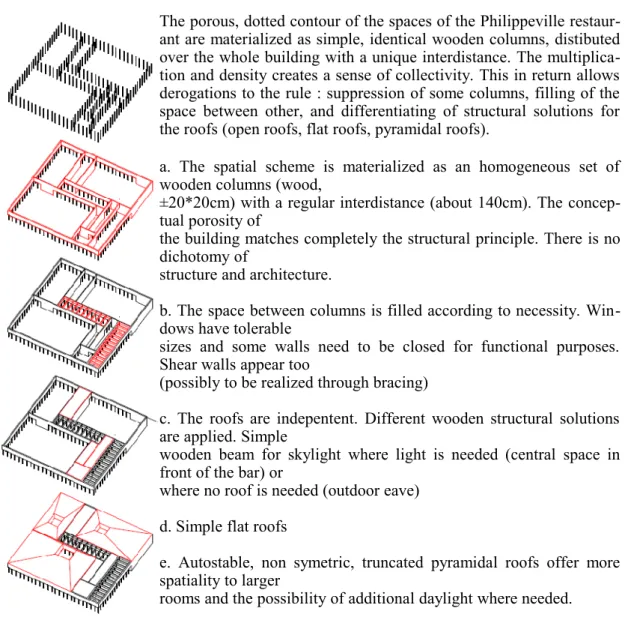
The porous, dotted contour of the spaces of the Philippeville restaur-ant are materialized as simple, identical wooden columns, distibuted over the whole building with a unique interdistance. The multiplica-tion and density creates a sense of collectivity. This in return allows derogations to the rule : suppression of some columns, filling of the space between other, and differentiating of structural solutions for the roofs (open roofs, flat roofs, pyramidal roofs).
a. The spatial scheme is materialized as an homogeneous set of wooden columns (wood,
±20*20cm) with a regular interdistance (about 140cm). The concep-tual porosity of
the building matches completely the structural principle. There is no dichotomy of
structure and architecture.
b. The space between columns is filled according to necessity. Win-dows have tolerable
sizes and some walls need to be closed for functional purposes. Shear walls appear too
(possibly to be realized through bracing)
c. The roofs are indepentent. Different wooden structural solutions are applied. Simple
wooden beam for skylight where light is needed (central space in front of the bar) or
where no roof is needed (outdoor eave) d. Simple flat roofs
e. Autostable, non symetric, truncated pyramidal roofs offer more spatiality to larger
rooms and the possibility of additional daylight where needed.
Figure 3. Philippeville (AgwA - Artgineering), structural scheme (AgwA) 6 CARRE DES ARTS : INTEGRATION
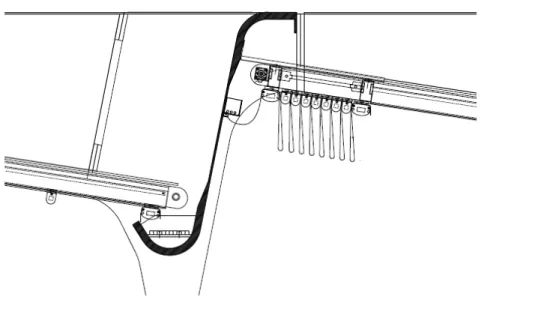
In this project, we face a hybrid system, a classical differentiation of skin and structure. How-ever, the structure is not merely a servant support of a skin: they complement and define each other. The structure is shaped in order to integrate all architectural dimensions, and minimize the necessity of non structural accessories.
This is achieved through an iterative process (which is explored in detail in another paper), in which different aspects of the structure are defined successively. First, the typology is defined, then the formal principles of the shape are decided, then the size of the structure is analyzed, and last, the details are developed. In this process, structure gradually integrates and fits all ar-chitectural (non structural) facets of the design. There is an almost total identification of struc-ture and architecstruc-ture.
Figure 4. Carré des Arts (AgwA – Ney & partners), structural scheme (AgwA) 7 PERONNES : DEFORMATION
This sports center hosts a variety of buildings, which share the feature of panoramic windows on the ground level, that are completely free of columns. A system of orthogonal concrete walls with door-like openings and cantilevers suspend the facade beams and create the spatial rela-tionships between interior spaces.
This scheme is deformed and adapted to the variable geometries and situations. This principle allows the shape of the structural walls to vary widely. The flexibility of the structural principle is ensured by its morphing from one shape into another. This is a kind of restriction of the vari-ation principles of the Metal project : varivari-ations are strictly limited to the shape of the structural walls, not the materiality or the typology.
Figure 5. Péronnes (AgwA – Artgineering), structural scheme (AgwA) 8 FORT VI : LIMITED COLLECTION
The spatial organization of the Fort VI sports school can be considered as a layered variation of the Philippeville project. Consequently, the structural issue is more complex. Instead of looking
for a structural common denominator through typology or shape, we decided to work with one identical material for all structural solutions. The structure proposes a variety of typologies and dimensions, and ensures coherence through the systematic use of concrete.
The challenge to provide a structure for a three-dimensional puzzle is that the arrangement of spaces doesn’t proceed from an inherent constructive logic. Also, spaces vary widely in length, width and height. We decided to take advantage of the diversity of situations to implement a wide range of structural solutions in concrete. It is a principle of limited collection, with no oth-er rule than its limitation. Its a kind of uniform and organized disordoth-er (or is it disordoth-ered uni-formity?).
Figure 6. Fort VI (AgwA – landinzicht), structural scheme (AgwA) 9 CONCLUSIONS
The strategies above are specific to each project. However, they share common features like the induced formal flexibility, or the identification with the architectural design. The approach of structure is at the same time carefully calibrated, and loosely processed. It is an issue of balance between control and adaptation.
Structural strategies play an important role in most projects of the office. Instead of “structural design”, we like to speak about strategies, because this allows to understand the behavior of the structure, to frame a dialogue between structure and architecture, rather than establishing a co-ercive carcan for structure or for architecture.