»»»
æ ²² ²²²÷²² ² ²÷÷÷÷÷²÷÷÷²÷÷² ²÷²²÷÷÷÷²÷÷÷ ÷÷ ²÷²÷÷÷÷÷÷ ÔÔÔÔÔÔÔÔ ÔÔÔÔÔÔ ²÷÷·÷ è ·÷²÷²÷÷÷ ëëëë ÷²÷÷÷ ÷÷÷÷÷÷÷²÷÷÷ ÷÷· ²÷÷²÷²÷÷÷÷ ²²²÷÷÷ ÷÷ ÷÷·÷÷÷÷÷ ÷÷· ÷÷÷÷÷÷ ÷²÷÷÷÷÷÷÷²÷÷÷ ·÷ ²²÷÷÷ ÷÷ ²²²÷÷÷ ²÷÷²÷²÷÷÷÷ ·÷÷÷ ÷÷÷÷·÷÷÷÷÷ ÷÷ ÷÷ ÷÷÷÷÷÷÷ ²÷÷÷÷÷ ·÷ ç÷²²÷÷²²÷ ²÷÷÷÷÷÷ ÷÷ ²÷²÷÷÷÷÷÷² ²²ç÷ ÷çç ëëçç ç÷÷÷÷ ÒÒ²ç÷²²²² Ò÷÷÷¿²÷÷÷ ¿¿çÒ÷²² ²÷²÷÷÷²÷÷÷ ÷÷ ²÷÷÷÷÷²÷÷÷²÷² ÷÷÷÷÷÷÷÷÷² ÷÷ ¿÷÷÷÷÷ ²÷÷ ²²²÷²²² ²÷÷·÷÷÷ ¿÷÷÷÷÷÷÷÷ ÷÷÷ ²÷÷÷÷² ²÷²÷÷÷÷÷÷² ÷÷· ²÷²÷÷÷÷÷² ²÷²²÷²÷÷ ÷÷÷÷÷ ²ÒÇÒ÷²÷² ²÷÷²÷÷ Ç÷÷÷÷ ¿÷÷÷÷÷÷÷÷ ÷÷÷ ÷÷²²²÷÷÷÷÷² ç÷÷÷÷÷²²² ²÷÷÷²÷÷÷÷²² ²Çขอบคุณครับเพชรน้อยของผม เธอเป็นคนที่ส ำคัญที่สุดในชีวิตของผม
ผมเป็นของเธอตลอดไป
Thank you Rufin, for competently and perseveringly answering all my questions. I have learned so much under your guidance. I could not imagine a more capable and qualified supervisor.
Thank you Peter, I could not have been happier being able to stay in your lab and learning all these things from you. I feel honored to know such a great researcher and such a great person.
Thank you Doug, Marina, Biao, Jaya and Edd, for so many shared moments, shared thoughts, and shared friendship.
Thank you Diego, for being such a pleasant, relaxed, and entertaining officemate.
Thank you Manu, for extremely component translations into French, and for joining the lab before I left it.
Thank you Marie, Damien, Sasskia, Christelle, Rasa, Séb, Grace, Samy, Anne-Claire, Céline, Laia, Mehdi,
Tracy, Jake, Lola, Adri, Felipe, Marlene and Gab, for making the CerCo such a lively, happy place.
Thank you Noelle and Annie, for sharing office at the NKI. Without you my time there would not have been the same.
Thank you Jordi, for so many discussions, for shared work, and for being a friend. Soon we’ll meet again.
Thank you Emmanuelle, Arthur, Natalia and Arnaud, for your friendship, for help with work, and for many rounds of Settlers.
Merci Claire et Zoé, pour une organisation du labo qui est extrêmement compétente et agréable en même temps.
Grazie Marcello, non dimenticherò mai le nostre conversazioni italiane.
Danke Rodi, für viel gute Laune und Unterhaltung im Büro und überhaupt, dass wir uns so gut verstehen. Bald sehen wir uns wieder: Das Leben scheint uns ja immer in dieselben Ecken zu führen... Danke liebe Eltern! Für eine wunderschöne, Wissensdurst weckende Kindheit (so etwas wie das hier wird dann eben daraus) und für groẞartige Unterstützung im darauf folgenden Leben.
Danke Mama, Papa, Molch, Rainer, Friederike, Pauline, Frederik, Hannah, Sophia und Peter, einfach nur, dass wir alle zusammen eine Familie sind.
Danke Eugen, für deine Unterstützung, ohne die ich das hier (und alles andere auch) niemals hinbekommen hätte.
ขอบคุณครอบครัวจำกประเทศไทยที่รับผมเข้ำไปอยู่ในครอบครัว
ผมภูมิใจที่ได้เป็นสมำชิกของครอบครัวนี้ครับ
ABSTRACT
Phase entrainment and perceptual cycles in audition and vision
Recent research indicates fundamental differences between the auditory and visual systems: Whereas the visual system seems to sample its environment, cycling between “snapshots” at discrete moments in time (creating perceptual cycles), most attempts at discovering discrete perception in the auditory system failed. Here, we show in two psychophysical experiments that subsampling the very input to the visual and auditory systems is indeed more disruptive for audition; however, the existence of perceptual cycles in the auditory system is possible if they operate on a relatively high level of auditory processing. Moreover, we suggest that the auditory system, due to the rapidly fluctuating nature of its input, might rely to a particularly strong degree on phase entrainment, the alignment between neural activity and the rhythmic structure of its input: By using the low and high excitability phases of neural oscillations, the auditory system might actively control the timing of its “snapshots” and thereby amplify relevant information whereas irrelevant events are suppressed. Not only do our results suggest that the oscillatory phase has important consequences on how simultaneous auditory inputs are perceived; additionally, we can show that phase entrainment to speech sound does entail an active high-level mechanism. We do so by using specifically constructed speech/noise sounds in which fluctuations in low-level features (amplitude and spectral content) of speech have been removed, but intelligibility and high-level features (including, but not restricted to phonetic information) have been conserved. We demonstrate, in several experiments, that the auditory system can entrain to these stimuli, as both perception (the detection of a click embedded in the speech/noise stimuli) and neural oscillations (measured with electroencephalography, EEG, and in intracranial recordings in primary auditory cortex of the monkey) follow the conserved “high-level” rhythm of speech. Taken together, the results presented here suggest that, not only in vision, but also in audition, neural oscillations are an important tool for the discretization and processing of the brain’s input. However, there seem to be fundamental differences between the two systems: In contrast to the visual system, it is critical for the auditory system to adapt (via phase entrainment) to its environment, and input subsampling is done most likely on a hierarchically high level of stimulus processing.
Keywords: neural oscillations – perceptual cycles – phase – entrainment – audition – vision –
electroencephalography – current-source density – subsampling – speech – noise – high-level – intelligibility
RESUME
Entraînement de phase et cycles perceptifs dans l'audition et la vision
Des travaux récents indiquent qu’il existe des différences fondamentales entre les systèmes visuel et auditif: tandis que le premier semble échantillonner le flux d‘information en provenance de l’environnement, en passant d’un “instantané” à un autre (créant ainsi des
cycles perceptifs), la plupart des expériences destinées à examiner ce phénomène de
discrétisation dans le système auditif ont mené à des résultats mitigés. Dans cette thèse, au travers de deux expériences de psychophysique, nous montrons que le sous-échantillonnage de l’information à l’entrée des systèmes perceptifs est en effet plus destructif pour l’audition que pour la vision. Cependant, nous révélons que des cycles perceptifs dans le système auditif pourraient exister à un niveau élevé du traitement de l’information. En outre, nos résultats suggèrent que du fait des fluctuations rapides du flot des sons en provenance de l’environnement, le système auditif tend à avoir son activité alignée sur la structure rythmique de ce flux. En synchronisant la phase des oscillations neuronales, elles-mêmes correspondant à différents états d'excitabilité, le système auditif pourrait optimiser activement le moment d’arrivée de ses “instantanés” et ainsi favoriser le traitement des informations pertinentes par rapport aux événements de moindre importance. Non seulement nos résultats montrent que cet entrainement de la phase des oscillations neuronales a des conséquences importantes sur la façon dont sont perçus deux flux auditifs présentés simultanément ; mais de plus, ils démontrent que l'entraînement de phase par un flux langagier inclut des mécanismes de haut niveau. Dans ce but, nous avons créé des stimuli parole/bruit dans lesquels les fluctuations de l’amplitude et du contenu spectral de la parole ont été enlevés, tout en conservant l'information phonétique et l’intelligibilité. Leur utilisation nous a permis de démontrer, au travers de plusieurs expériences, que le système auditif se synchronise à ces stimuli. Plus précisément, la perception, estimée par la détection d'un clic intégré dans les stimuli
parole/bruit, et les oscillations neuronales, mesurées par Electroencéphalographie chez
l’humain et à l’aide d‘enregistrements intracrâniens dans le cortex auditif chez le singe, suivent la rythmique “de haut niveau” liée à la parole. En résumé, les résultats présentés ici suggèrent que les oscillations neuronales sont un mécanisme important pour la discrétisation des informations en provenance de l’environnement en vue de leur traitement par le cerveau, non seulement dans la vision, mais aussi dans l'audition. Pourtant, il semble exister des différences fondamentales entre les deux systèmes: contrairement au système visuel, il est essentiel pour le système auditif de se synchroniser (par entraînement de phase) à son environnement, avec un échantillonnage du flux des informations vraisemblablement réalisé
à un niveau hiérarchique élevé.
Mots clés: oscillations neuronales – cycles perceptifs – phase – entraînement – audition –
vision – electroencéphalographie – current-source density – sous-échantillonnage – parole – bruit – haut niveau – intelligibilité
RESUME SUBSTANTIEL
Il est possible que la perception humaine ne fonctionne pas de façon continue, mais plutôt de manière discrète, à la manière d'une caméra vidéo. De nombreuses études suggèrent que le système visuel échantillonne son environnement, en extrayant des "instantanés" qui correspondent à des moments distincts dans le temps, créant ainsi des moments optimums et d’autres défavorables pour le traitement de l’input visuel (par exemple, Busch et al., 2009; VanRullen and Macdonald, 2012). Curieusement, les tentatives pour mettre en évidence une discrétisation perceptive par le système auditif se sont révélées infructueuses (İlhan and VanRullen, 2012; Zoefel and Heil, 2013). Ceci pourrait refléter une différence cruciale entre le système visuel et le système auditif : en raison des constantes fluctuations temporelles du flot auditif, un sous-échantillonnage brut pourrait se révéler déstructurant, dû à la perte d'informations essentielles. Dans une première expérience de psychophysique, nous avons sous-échantillonné temporellement des stimuli auditifs (des extraits auditifs de discours) et des stimuli visuels (des vidéos de discours en langue des signes) et nous avons testé l'impact de la fréquence de sous-échantillonnage sur les performances de reconnaissance auprès de sujets humains. Ainsi, nous avons pu montrer que la discrétisation des stimuli à l'entrée des systèmes visuel et auditif a un effet plus perturbateur pour le système auditif (VanRullen et al., 2014). En principe, ce résultat pourrait indiquer qu’un traitement discontinu mène à une perte d'informations trop importante pour le système auditif empêchant une correcte extraction des caractéristiques pertinentes pour la compréhension. Il existe cependant une alternative: le sous-échantillonnage auditif pourrait être réalisé à un niveau hiérarchiquement
supérieur du traitement de l'information, c'est à dire après que l'extraction de certaines
stimuli langagier ayant été sous-échantillonnés à des fréquences différentes, soit directement dans le domaine temporel (directement sur l’onde d'entrée) ou après extraction de caractéristiques auditives (obtenu par un vocodeur utilisant un codage prédictif linéaire). Dans une deuxième expérience psychophysique, nous avons montré que la reconnaissance auditive est plus résistante au sous-échantillonnage réalisé à un niveau élevé de traitement de l'information auditive en comparaison d'un sous-échantillonnage réalisé dans le domaine temporel (Zoefel et al., 2015). Bien que ces résultats ne prouvent pas que le système auditif procède à une discrétisation du flux auditif, ils (1) montrent qu'un sous-échantillonnage est possible dans une certaine mesure sans pertes majeures et (2) suggèrent que, s’il existe une discrétisation, elle devrait être opérée à un niveau relativement élevé du traitement auditif. Il existe aussi une seconde possibilité, qui permettrait le sous-échantillonnage temporel dans le domaine auditif, et qui n’est pas mutuellement exclusive de la première: les effets délétères du sous-échantillonnage pourraient être réduits activement si le système auditif pouvait
décider du moment où les «instantanés» de l'environnement sont extraits. Basé sur des
recherches récentes, un mécanisme physiologique important, les oscillations neuronales, pourrait s'avérer crucial pour cette alternative. Les oscillations neuronales reflètent des changements cycliques dans l'excitabilité des groupes de neurones (Buzsaki and Draguhn, 2004). Comme des études précédentes l'ont montré (Schroeder and Lakatos, 2009; Schroeder et al., 2010), en jouant sur les phases d’excitabilité de ses oscillations, le cerveau peut
contrôler activement quelle partie de l'information entrante est amplifiée (l'information
coïncidant avec une phase de plus grande excitabilité) et quelle partie est négligée (l’information coïncidant avec une phase de faible excitabilité). Ce phénomène, la synchronisation d'un système oscillant avec un système externe, a été appelé l'entraînement
primaire chez le singe, nous avons confirmé que dans une scène auditive ambiguë, la phase des oscillations neuronales influence si deux inputs auditifs simultanés sont regroupés en une seule entité ou séparés en deux séquences distinctes. Ce résultat indique que la phase des oscillations neuronales a des conséquences sur le traitement et la perception des stimuli, et, que l'alignement actif de cette phase serait un outil important pour contrôler ou filtrer l'entrée des stimuli et leur traitement ultérieur. En outre, il a été suggéré que cet alignement (c’est-à-dire l'entraînement de phase) entre la parole et les oscillations neuronales - sans doute le stimulus rythmique qui est le plus important dans l'environnement auditif humain - pourrait améliorer la compréhension de la parole (Luo and Poeppel, 2007). Toutefois, la parole est une construction complexe, et il n’est toujours pas clair à quelles caractéristiques de la parole le cerveau s'ajuste effectivement. Par exemple, dans un discours standard, l’amplitude du son et de son contenu spectral (la distribution de l’énergie dans les différentes fréquences), ci-après définis comme des caractéristiques de bas niveau, fluctuent rythmiquement, et pourraient être "suivis" par le cerveau. Ainsi, lorsque l’amplitude du signal est large ou lorsqu’il a un contenu spectral "riche", le discours sera perçu clairement et les caractéristiques de haut niveau (notamment la quantité d'informations que l'auditeur peut extraire, c’est-à-dire "l'information phonétique") seront élevées. En revanche, lors de silence entre les mots ou des syllabes, l'amplitude du son, mais aussi l’information phonétique est faible. En d'autres termes, les variations de l’amplitude du son ou de son contenu spectral sont corrélées avec les changements de l'information phonétique et le cerveau pourrait s'y adapter. Toutefois, si l'on pouvait montrer que l'entraînement de phase à la parole persiste même en l'absence de fluctuations systématiques de l’amplitude et du contenu spectral, cela indiquerait un processus plus "élaboré" du cerveau: un "suivi" de l'information phonétique elle-même. Dans ce but, nous avons développé des stimuli parole/bruit, sans fluctuations systématiques de
l’amplitude du son et du contenu spectral, et qui conservent suffisamment les caractéristiques de la parole pour permettre la compréhension. En utilisant ces stimuli, nous avons montré, dans plusieurs expériences, que le cerveau peut en effet s'adapter à ces stimuli parole/bruit. Dans une expérience psychophysique (Zoefel and VanRullen, 2015), des clics ont été intégrés dans les stimuli parole/bruit et les sujets devaient appuyer sur un bouton à chaque fois qu'ils les détectaient. Singulièrement, la détection de ces clics était modulée par le "rythme de haut niveau" (la discrétisation inhérente au langage) ayant été conservé dans les stimuli parole/bruit, ceci indique que la perception s'aligne aux aspects de haut niveau de la parole. Ce résultat était lié aux caractéristiques linguistiques de la parole, dans la mesure où il a été aboli lorsque les stimuli étaient présentés à l'envers. Dans une expérience utilisant l'électroencéphalographie (EEG) avec des sujets humains (Zoefel and VanRullen, in press), nous avons pu montrer que les oscillations neuronales (mesurées à l’aide de l'EEG) s'alignent non seulement aux stimuli classiques mais aussi à nos stimuli qui ne conservent que les caractéristiques "de haut niveau", indiquant que l'entraînement de phase neuronal est à la base des effets perceptifs mesurés précédemment. Aussi il est intéressant de noter que les oscillations neuronales se synchronisent aux caractéristiques de haut niveau de la parole même en l’absence d'informations linguistiques (lorsque les stimuli étaient présentés à l'envers), ce qui indique que la compréhension de la parole est impliquée dans un processus sophistiqué à l'interface entre l'entraînement neuronal et le comportement. Dans une troisième expérience, les stimuli parole/bruit et des stimuli parole simple étaient présentés pendant des enregistrements intracrâniens dans le cortex auditif du singe. Comme dans l’expérience EEG, les deux types de stimuli utilisés induisaient un entraînement de phase, qui était de plus ici couplé à une modulation de l’activité neuronale dans les hautes fréquences. Cependant pour les stimuli parole/bruit (pour lesquels les fluctuations de bas niveau de la
parole étaient absentes) la synchronisation de l’activité neuronale s’établissait à un autre moment de la phase des oscillations neuronales et le couplage s’établissait avec des fréquences moins élevées. Ces résultats ont des implications importantes pour la théorie d'entraînement de phase, dans la mesure où nous avons démontré, pour la première fois, que celui-ci ne reflète pas seulement la réponse neurale aux fluctuations d'amplitude: il consiste également à un alignement à l’information phonétique.
Tous les résultats décrits ici peuvent être combinés pour formuler une conclusion générale: Alors que l'idée du traitement discrétisé dans le système visuel est déjà relativement établie (VanRullen and Koch, 2003), pour le système auditif les résultats négatifs reportés dans la littérature semblaient être – à première vue – surprenants. Nos résultats démontrent que cette absence apparente de sous-échantillonnage dans le domaine auditif n‘indique pas qu'il n'y a pas de discrétisation. Mais plutôt, et contrairement au système visuel, qu’il y a pour le system auditif, une nécessité d’utiliser des mécanismes neurophysiologiques pour éviter les effets destructifs du sous-échantillonnage. Ainsi, l'entraînement des oscillations neuronales aux stimuli rythmiques présents dans l'environnement pourrait être un processus fondamental pour le système auditif, le sous-échantillonnage étant probablement réalisé à un niveau hiérarchique élevé du traitement des stimuli. En utilisant ces deux processus, le sous-échantillonnage temporel de l'entrée auditive pourrait être possible sans perte des informations essentielles.
ABSTRACT ... I RESUME ... III RESUME SUBSTANTIEL ... V
GENERAL INTRODUCTION ...1
CHAPTER 1: On the cyclic nature of perception in vision versus audition... 19
Article 1 ... 23
CHAPTER 2: The ability of the auditory system to cope with temporal subsampling depends on the hierarchical level of processing ... 39
Article 2 ... 41
CHAPTER 3: The phase of neural oscillations acts as a tool for the segregation and integration of auditory inputs ... 47
Article 3 ... 49
CHAPTER 4: Selective perceptual phase entrainment to speech rhythm in the absence of spectral energy fluctuations ... 85
Article 4 ... 89
CHAPTER 5: EEG oscillations entrain their phase to high-level features of speech sound ... 101
Article 5 ... 103
CHAPTER 6: Characterization of phase entrainment to low- and high-level features of speech sound in laminar recordings in monkey A1 ... 111
Article 6 ... 115
CHAPTER 7: The role of high-level processes for oscillatory phase entrainment to speech sound 157 Article 7 & Discussion ... 161
GENERAL DISCUSSION: Oscillatory mechanisms of stimulus processing and selection in the visual and auditory systems: A comparison ... 191
Article 8 ... 193
ANNEX: Investigating the rhythm of attention on a fine-grained scale: evidence from reaction times ... 221
The perception, if not the enjoyment, of musical cadences and of rhythm is probably common to all animals, and no doubt depends on the common physiological nature of their nervous system.
GENERAL INTRODUCTION
Every movie that is shown in cinema or television is a series of images, yet it appears smooth and continuous – a classical example for the fact that subsampling a continuous stream of information can be parsimonious without affecting its perceived integrity and continuity. Is it possible that the human brain uses a similar mechanism: Subsampling the vast incoming flow of information into “chunks” or “snapshots” of input, being at the same time parsimonious yet without losing essential information? This question can be seen as the central theme of this thesis and we will follow it throughout this work. We will encounter phenomena that potentially represent reflections of the brain’s subsampling procedure and meet difficulties that the brain has to face on its way to an efficient stimulus processing. We will realize that these difficulties might be of particular importance for the auditory system, and that it might have developed a clever “tool” to face them. It will become clear that periodicity is an important feature of this tool, a feature that might be actively used by the brain for an optimal stimulus selection. All these points will be discussed in the following, chapter by chapter, with the focus on the comparison of arguably the two most important sensory systems for humans: Vision and audition. I will start by providing a short summary of the most important “periodic tool” for the brain, neural oscillations, and show how they were discovered and can be measured and analyzed. I will also shortly summarize the structure of the visual and auditory systems, and show that we can find neural oscillations in (almost) all of their hierarchical stages. The rest (and main part) of the thesis is composed of eight chapters, each of them based on a manuscript that is either published, submitted, or ready to submit. In the first chapters, we will meet the idea that neural oscillations are ultimately related to the creation of perceptual cycles, periodic fluctuations in perception that can be seen as evidence for the
brain’s discrete way of stimulus processing. These cyclic processes can be used to structure the system’s input, and individual elements of this influx are either grouped or segregated, depending on where they fall with respect to the oscillatory cycle. Moreover, we will see that, although neural oscillations play an important role for both visual and auditory systems, and mechanisms of discretization are plausible in both of them, the two systems do differ in their ways of stimulus processing and selection. We will come to the conclusion that the adaption of neural oscillations to the stimulus influx is of particular importance for the auditory system, due to its vulnerability to a loss of information if the related subsampling is done “blindly”. To the characterization of this adaption, also called phase entrainment, are dedicated the following chapters. They will mainly concentrate on speech sound, arguably one of the most important rhythmic stimuli in the auditory environment. We will see that the adaptation of neural oscillations to speech sound includes mechanisms that take place on a relatively high level of stimulus processing. The characterization of these high-level mechanisms, based on results obtained in this thesis as well as in other studies coming to a similar conclusion, is then summarized and discussed in a separate chapter, in the form of a review article. In the final chapter, a general discussion is provided, also in form of a scientific article. In contrast to the preceding chapter, which focuses on phase entrainment to speech sound, more general insights obtained in this thesis and elsewhere are summarized, explaining how neural oscillations are used by the visual and auditory system, resulting in an efficient way of environmental subsampling, stimulus selection and processing. Both similarities and differences between the two systems are illustrated.
Neural oscillations and how they are recorded and analyzed
It is relatively unclear who described neural oscillations for the first time. It is speculated that in the 1870’s, almost 150 years ago, Caton observed, but did not record, spontaneous oscillations in the potential of cortical gray matter (Bremer, 1958). Certainly one of the most famous “discoverer” of oscillations is Hans Berger, who connected a string galvanometer to electrodes at the skull of patients and relatives and reported potential changes with surprising regularity (for a review, see Herrmann et al., 2015). Although already described in mammals in 1925 by Práwdicz-Neminski, it is Hans Berger who is generally accepted to be the inventor of the electroencephalogram (EEG; Berger, 1929). Indeed, the most prominent and “famous” neural oscillation, the alpha-rhythm, was named by him in 1930. Berger’s discovery was met with skepticism first, but soon oscillations at other frequencies were discovered (e.g., Dietsch, 1932; Rohracher, 1935; Walter, 1936; Jaspers and Andrews, 1938). Already at that time, Berger (among others) seemed to have realized that the measured signals can be decomposed into different oscillatory frequency bands by the use of certain signal processing algorithms, such as Fourier transformation (Rohracher, 1935; Herrmann et al., 2015). Although the definition of these bands have changed somewhat (Figure 1), this notion is still kept up nowadays, and researchers have tried to assign different functions to the different frequency bands (for reviews, see, e.g., Başar et al., 2001; Lopes da Silva, 2013; Herrmann et al., 2015).
Given that they are evolutionary preserved (Buzsáki et al., 2013), it seems to be surprisingly difficult to find different roles for neural oscillations at different frequency bands. Slow oscillations (~0.5 – 4 Hz), also called delta-oscillations, seemed to be increased during sleep (Steriade et al., 1993), but they also adjust to rhythmic stimulations during wake, as we will see in detail in several chapters of this thesis. Theta-oscillations (~4-8 Hz) in the hippocampal gyrus of the brain are important for memory processes (Pavlides et al., 1988; Lisman and Jensen, 2013), but cortical theta oscillations might fulfill a different role, especially for audition (Luo and Poeppel, 2007; Strauß et al., 2014a). Alpha oscillations (~8-12 Hz) were long considered as the brain’s idle rhythm (Pfurtscheller et al., 1996), but it becomes increasingly clear that their role as an inhibitory rhythm is of particular importance (Klimesch et al., 2007; see also chapter 8). Beta oscillations (~12-30 Hz) might be important for the maintenance of the current cortical state (Engel and Fries, 2010), but they also seem to be involved in motor planning (Picazio et al., 2014) and even memory (Salazar et al., 2012) or audiovisual integration (Keil et al., 2014). Gamma oscillations (~30-70 Hz) are a relatively local phenomenon in the brain, potentially involved in binding or integration of stimulus features (Fries, 2009), but also in several other tasks (Schepers et al., 2012; Lee et al., 2014). Recently, evidence accumulated that even activity at higher frequencies might play an important role in the processing of information in the cortex (Lachaux et al., 2012).
Another point should be mentioned here, as it is essential for the reasoning behind many results reported in this thesis. Already in the time of Berger, Bishop (1932) found that the excitability in the optic pathway in the rabbit changes in a cyclic manner. This result might not sound exciting at first glance, but it might have important consequences for our understanding of neural oscillations today: It is now commonly accepted that neural oscillations might underlie – or be a reflection of – these rhythmic changes in neuronal excitability. This is
important, because it creates a different role for these oscillations, besides the cognitive functions mentioned above: They can be used to control the input to the brain, with “windows of opportunity” (Buzsáki and Draguhn, 2004) for the input to be processed when arriving at a phase of high excitability, and unfavorable moments for stimulus processing at a phase of low excitability. This notion is a central idea for this work and will be taken up in many chapters of the thesis.
Apart from their role, a question of similar importance but also ambiguity is where these oscillations actually come from. Although the membrane potential of single neurons already shows regular fluctuations (Llinás, 1988), it seems to be the interplay between many different neurons that produces the oscillations that are relevant for perception and behavior (Buzsaki and Draguhn, 2004): Neural oscillations, as they are commonly measured (see below), stem from synchronized activity of neuronal populations (Uhlhaas et al., 2009). Interestingly, different neuronal populations might have different preferred frequencies in which they oscillate (Hutcheon and Yarom, 2000). Also, synchronized populations do not necessarily have to be located in the same area: The famous alpha-rhythm, for example, might be produced by complex thalamo-cortical (Lopes da Silva, 1991) or cortico-cortical loops (Bollimunta et al., 2008).
Neural oscillations can be recorded at several levels (Figure 2) and some of them will appear in this thesis. Apart from their assumed reflection in psychophysical data (Chapters 1, 2 and 4), they are visible in intracranial recordings (as local field potentials, LFP, or their second spatial derivative current source density, CSD; Chapters 3 and 6), on the cortical surface (as ECoG) or as recorded from the scalp (with EEG or magnetoencephalogram, MEG; Chapter 5).
Studies have shown that oscillations measured at different levels are related: For instance, EEG oscillations can be associated with neuronal firing (Whittingstall and Logothetis, 2009; Ng et al., 2013). Nevertheless, there are differences between the levels of recording: Of course, the spatial resolution decreases from LFP/CSD via ECoG to EEG. At the level of LFP/CSD, laminar profiles can be recorded (Figure 3), and oscillatory activity can be differentiated between layers. Moreover, the current flow can be spatially estimated, resulting in sinks and sources of neural activity (Schroeder et al., 1998). However, simultaneous recordings are usually restricted to one or two brain regions, and often change site from measurement to measurement, making both comparison across experiments and a complete overview of brain activity difficult. Also, LFP/CSD are, for obvious reasons, rare for human subjects and, consequently, insights for the human brain have to be inferred from animal experiments. At the level of the EEG, at each electrode, the measured activity is a transformed mix from many different cortical sources (Lopes da Silva, 2013), and methods of source analysis have only
Figure 2. Neural oscillations can be measured at different scales. Here, exemplary signals from LFP, ECoG, and EEG recordings are shown. The spatial resolution decreases in this order. Modified from Buzsaki et al., 2012.
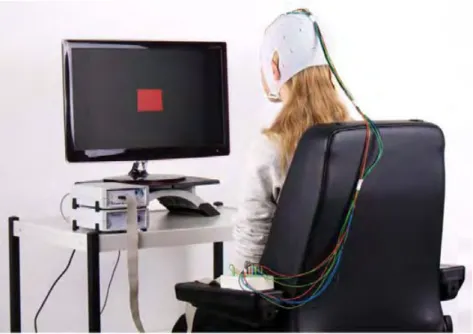
partly met with success (Michel et al., 2004). EEG can only capture the activity perpendicular to the cortical surface, mostly from pyramidal cells (Lopes da Silva, 2013). However, EEG is cheap, can be easily applied in human recordings (Figure 4) and is an appropriate tool for research projects where spatial origins are not relevant.
We now turn towards the analysis of neural oscillations. As mentioned above, the idea of spectral decomposition was introduced relatively early but is still up-to-date, as we will see throughout this thesis. Most studies concerning the functional role or clinical relevance of brain oscillations focus on the amplitude of the oscillations in particular frequency bands. However, as shown in Figure 5, an oscillation is not only defined by frequency and amplitude, but also by its phase. Indeed, the phase of neural oscillations will be the most important oscillatory parameter in this work. The phase of an oscillation can be defined as the fraction of a whole period that has elapsed with respect to an arbitrary reference (Ballou, 2005). Most commonly, a cosine wave is used as a reference. In Figure 5, two 1 Hz waves are shown, which
Figure 3. Example for a laminar profile recorded intracranially in monkey primary auditory cortex. The current flow (left) across cortical layers (right) can be estimated and results in sinks (red) and sources (blue). The recording site usually has a sound frequency it is tuned to (green curve in inset). From Lakatos et al., 2013a.
are shifted by 𝜋2. Due to the phase shift, they differ in their phase state for each arbitrary point in time. Alternatively, an oscillatory signal can be thought of as a rotating vector in the complex plane, where the radius r (or the absolute value) reflects the amplitude and the angle reflects the phase of the oscillation (Figure 5B). Thus, every rotation of a full 360° cycle (or 2π) by the vector represents a single cycle of the oscillation. As an example, the state of the two signals (blue and red) at time t = 0.5 s in Figure 5A is shown again in Figure 5B, this time in the complex plane. It can be seen that the two signals do not differ in amplitude (r = 1) or frequency (1 Hz), but only in their phase. There are several ways of estimating amplitude (or power, which is proportional to the squared amplitude) or phase of an oscillation. Most of the standard methods rely on the same idea: Waveforms with different frequency, phase and/or amplitude are compared with the signal of interest and the goodness of fit between waveform and signal is taken as an indicator of how much of this “reference” waveform is “hidden” within the signal. This waveform can be a sine or cosine wave, as in the case of the Fourier transform, or of a more complex shape, as in the case of Wavelet Transformation. Whatever the method,
the ultimate goal is a decomposition of the complex recorded signal into different frequency bands (Figure 1), each of which defined by an amplitude and phase. This can potentially be done as a function of time, as in the case of time-frequency transformations such as the Wavelet Transformation (Herrmann et al., 2014).
The visual system and its oscillations
Light at wavelengths of ~350-750 nm stimulates receptors (rods and cones) in the retina. The signal is then transmitted to retinal ganglion cells, the first cells in the visual system that fire action potentials (Bear et al., 2006). Surprisingly (or not, keeping in mind that the retina is considered part of the brain; Bear et al., 2006), these cells already exhibit oscillations whose frequency seems to differ between spontaneous (1-5 Hz and 30 Hz) and evoked activity (~70-90 Hz; Neuenschwander et al., 1999; Arai et al., 2004). These oscillations can reach and affect neural activity in cortical areas (Koepsell et al., 2009). From retinal ganglion cells, the neural
Figure 5. A. Two phase-shifted oscillations (blue and red; frequency 1 Hz, amplitude 1 AU) differ in their phase state (top, in radians) at each arbitrary moment in time. B. Oscillatory signals can be displayed as a rotating vector in the complex plane. The radius r reflects the amplitude and the angle reflects the phase of the oscillation. The signals that are shown here correspond to the blue and red waves at time t = 0.5 s in A. Note, that their phase shift is now visible as the angle between them.
signal is transmitted to the brain via the optic nerve. There is only one relay station1 between the optic nerve and primary visual cortex (V1): the lateral geniculate nucleus (LGN) of the thalamus (Figure 6). The LGN is a six-layered structure with dense connections to higher cortical regions. These connections seem to be important for neural oscillations, especially for alpha and gamma frequency bands: The latter can be observed both in LGN and in the cortex and thalamocortical connections seem to be necessary for their generation (Wall et al., 1979; Deschênes et al., 1984; Usrey and Reid, 1999; Lorincz et al., 2009; Minlebaev et al., 2011; although a matter of debate for gamma oscillations, Bastos et al., 2014). Neural oscillations are abundant in visual cortex, both in primary and higher-order regions. As already described by Hans Berger and mentioned above, the alpha rhythm is the most prominent rhythm in the visual system (this topic is also treated extensively in the General Discussion), and this is particularly true for V1. Although alpha waves can readily be measured in and above V1, it is somewhat surprising that their origins are still debated and can be assigned to thalamocortical or corticocortical connections (or both; Steriade et al., 1990; Lopes da Silva, 1991; Jones, 2002;
1For both visual and auditory systems, only the principal ascending pathway is described here. Of course, many
alternate pathways and connections exist, and there are extensive feedback connections from higher-level regions back to earlier stages of the pathways. Also, for both visual and auditory systems, the cortical areas seem to consist of “core” and “belt” regions and the ascending cortical pathway splits into a ventral “what” and a dorsal “when”-stream (Rauschecker, 2015). These are not treated further in this chapter.
Figure 6. Schematic view of the visual pathway. There is only one relay station between retina and primary visual cortex: The LGN. From Bear et al., 2006.
Bollimunta et al., 2008). The different regions of the cortical visual hierarchy seem to communicate by the use of neural oscillations in different frequency bands. Again, alpha and gamma oscillations seem to be of particular importance, with gamma band activity mainly associated with feedforward processing in supragranular layers whereas alpha band activity seems to be important for feedback processing in deeper cortical layers (Maier et al., 2010; Buffalo et al., 2011; Spaak et al., 2012; van Kerkoerle et al., 2014). There is also evidence that the alpha phase is coupled to the power of the faster gamma oscillations (Jensen et al., 2014). Finally, there are several regions associated with the processing of visual information that seem to be involved in oscillatory processes, but whose role clearly needs further investigation. One example is the lateral pulvinar, which is, again, tightly linked with alpha oscillations (Purushothaman et al., 2012), cortical processing and cognitive functions (Saalmann et al., 2012).
The auditory system and its oscillations
Only counting the number of relay stations between sensory organ and cortex, the auditory system is more complex than the visual one (Figure 7). Moreover, the characterization of neural oscillations in the auditory system is complicated by the fact that its input is already oscillatory: The ear gathers variations in air pressure (these variations can have a frequency between 15 and 20000 Hz to evoke neural activity in the auditory pathway) which is transformed into motion of fluid and finally into electrical (neural) signals, both of which in the inner ear, and most importantly, by the cochlea. It is interesting to note that the cochlea has frequency sensitivity (due to variations in mechanical properties: Different parts of the cochlea are activated, depending on the frequency of the sound input) and therefore already breaks down the input into its spectral components.
This “tonotopy2” of the cochlea is conserved up to the level of primary auditory cortex (A1; Figures 3 and 7; Saenz and Langers, 2014; Rauschecker, 2015), and beyond (although the tuning becomes broader at later stages of the auditory pathway). As explained above, the hair cells in the cochlea necessarily oscillate: They can “follow” (i.e. be in phase with) their rhythmic input (i.e. the sound) up to frequencies of 4 kHz (Palmer and Russell, 1986; Köppl, 1997; Heil
2 Note that the tonotopic organization of the auditory system is equivalent to the retinotopic organization of
the visual system (Rauschecker, 2015). Therefore, the time domain can be considered of similar importance for the auditory system as the spatial domain for the visual system (Kubovy, 1988) and sweeps of frequency-modulated tones for the auditory system might be equivalent to moving bars of light for the visual system (Mendelson and Cynader, 1985).
Figure 7. Overview of the principal auditory pathway. CN: Cochlear Nucleus. SOC: Superior Olivary Complex. IC: Inferior Colliculus. MGN: Medial Geniculate Nucleus. A1: Primary Auditory Cortex. R: Rostral field. RT: Rostrotemporal field. Note that areas R and RT are mostly described for non-human primates, but there is evidence that there are corresponding regions in the human brain with respect to their histological and electrophysiological properties. The tonotopical organization throughout the auditory system is shown as color gradients. From Saenz and Langers, 2014.
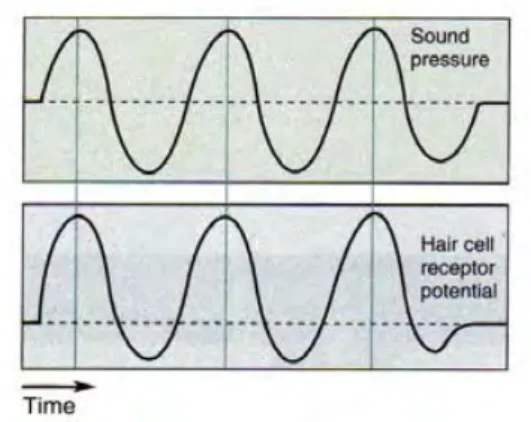
and Peterson, 2015; of course, beyond those frequencies the sound is still processed, but cells cannot stay in phase anymore). Although many neurons seem to follow the sound envelope (rather than the fine structure) at later stages of the auditory system, it is clear that these
stimulus-evoked oscillations make it difficult to decide when neurons merely follow their input
(Figure 8), and when “real” (endogenous) oscillations are “at work”. This problem is existent through the whole auditory system and several chapters are dedicated to it (Chapters 4-7). In the first relay station of the auditory system, the cochlear nucleus (CN), high-frequency oscillations (0.4 – 1 kHz) are abundant and it is likely that they play a role for pitch processing (Wiegrebe and Winter, 2001; McMahon and Patuzzi, 2002). Not much is known about slower oscillations at this level, although relatively complex processes, such as auditory stream formation, might already take place here (Pressnitzer et al., 2008). The situation is similar for the superior olive (SOC), an early auditory structure associated with sound localization (Grothe, 2000): High-frequency oscillations seem to be present (Goldwyn et al., 2014), but slower oscillations are rare. Again, essentially nothing is known about neural oscillations at the level of the inferior colliculus (IC), although one study (Langner and Schreiner, 1988) reports “intrinsic oscillations” of very high frequency (periods of “integer multiples of 0.4 ms”). This absence of slower neural oscillations changes somewhat at the level of the thalamus, in
Figure 8. Sound is an oscillatory stimulus (top). The potentials recorded in the cochlea can “follow” this rhythm up to 4 kHz (bottom). From Bear et al., 2006.
the medial geniculate body (MGN): Gamma oscillations seem to be the most prominent oscillations here (Brett et al., 1996). However, these oscillations also might be an important feature of cortical auditory processing and the MGN might merely modulate the gamma activity in auditory cortex (Barth and MacDonald, 1996; Smith et al., 2007). Oscillations at many frequencies can be found at the level of A1 and beyond: Delta (Lakatos et al., 2008; Stefanics et al., 2010), theta (Henry and Obleser, 2012; Ghitza, 2013), alpha (Frey et al., 2014; Strauß et al., 2014b), and gamma (Lakatos et al., 2005; Fontolan et al., 2014) frequencies seem to play a role for cortical auditory processing. Similar to the visual system, the phase of slower oscillations is coupled to the power of faster oscillations (Lakatos et al., 2005; Fontolan et al., 2014), and gamma activity is associated with feedforward processing between primary and higher auditory areas, whereas slower oscillations might be responsible for feedback processing (Fontolan et al., 2014). There seems to be a general phenomenon for the auditory (and potentially also for the visual) system: The higher in the pathway of stimulus processing, the slower the frequency of the oscillations (Edwards and Chang, 2013).
As it is apparent from this summary, neural oscillations are abundant in both visual and auditory systems, especially in cortical regions. Also, there are clear differences between the systems: For instance, in contrast to vision, the input to the auditory system is already oscillatory3 and can easily be followed. The spectral characteristics of neural oscillations in the auditory system seem to be more variable than in the visual one, where alpha oscillations are dominant. We will discover these differences – in particular their meaning for stimulus processing and selection – in the next seven chapters. The results described in these chapters
3 It is acknowledged here that light – as the principal visual stimulus – can also be considered a wave and thus
(and elsewhere) lead to a final summary and conclusion in the form of the eighth chapter, the General Discussion.
What this thesis is about
Having introduced neural oscillations and their abundance in the visual and auditory systems, we can now come back to the question that was presented at the beginning of this Introduction. Does the brain subsample its environment or: Is perception discrete or continuous (VanRullen and Koch, 2003)? Sudden changes are rare in nature. If perception were indeed discrete (and not continuous), instead of taking one “snapshot” at a particular moment in time followed by an absence of stimulus processing, one would rather expect a smooth, periodic, or cyclic change from one “snapshot” to the other, with most incoming information being processed at the time of the “snapshot”, and the least likelihood of input being perceived between two subsequent “snapshots” (i.e. after half the period of the perceptual cycle with respect to the moment of a “snapshot”). Following this notion, and combined with the information summarized in this chapter, it becomes clear that neural oscillations are the optimal “candidate” for a reflection of these perceptual cycles. Perceptual cycles4 create “windows of opportunity” for incoming information to be perceived or processed, with these windows gradually cycling between being open and closed. If neural oscillations reflected perceptual cycles, one would expect them to be linked to perception as well – and, importantly, one would expect the phase of neural oscillations to be related to the instantaneous state of perception. Indeed, this is what has been found in the last few years: Busch et al. (2009) showed that the pre-stimulus phase of alpha oscillations in the EEG is
4 It is important to distinguish perceptual cycles from a mere “low-pass” filtering of information, such as when
the pace of information is too fast for a system to follow (and is therefore lost), as the latter does not show cyclic properties.
predictable for the perception of a visual stimulus at threshold. Dugué et al. (2011) reported that the likelihood of perceiving a phosphene induced by transcranial magnetic stimulation (TMS) depends on the alpha phase as well. Finally, it has been shown a presented luminance sequence (with an equal amount of power at all frequencies within a given range) “reverberates” in the brain for more than one second at a frequency of 10 Hz (VanRullen and Macdonald, 2012). Another evidence for perceptual cycles stems from a phenomenon called “continuous wagon wheel illusion”: If a signal (here: the wagon wheel) is a moving periodic visual pattern, and the information processing system is taking temporally discrete samples with a sampling rate lower than a critical limit, then the system’s representation of the signal is inaccurate (this effect can be described by the term “aliasing”). This inaccuracy can be experienced as a pattern that seems to move in the wrong direction. Interestingly, the critical limit frequency has been found to be located at approximately 13 Hz and thus, again, lying in the alpha band (Purves et al., 1996; VanRullen et al., 2005). The perception of the illusion goes along with a peak in the power spectrum of the EEG at the same frequency (VanRullen et al., 2006; Piantoni et al., 2010) and is thus reflected on a neural level as well.
These findings strongly suggest that perceptual cycles do exist in the human brain and that they are intimately linked to neural oscillations (in particular in the alpha range). However, it is intriguing to see that all of the above mentioned studies report findings in the visual domain. Can we find perceptual cycles in the auditory domain as well? I tried to answer this question in this PhD thesis and – given the prominence of neural oscillations in the auditory system – it might be surprising to find a (at first glance) negative answer, as presented in Chapter 1: Perceptual cycles seemed to bring about too many drawbacks for the auditory system. However, this answer brought up more questions: What can the auditory system do, in order to avoid these drawbacks and afford perceptual cycles? Two solutions are presented in this
thesis. First, as shown in Chapter 2, perceptual cycles in the auditory system might be located on a hierarchically higher level, where auditory stimuli are temporally more stable. Second, the auditory system might adjust (entrain) to its (dominantly rhythmic) input, and thereby
decide which information is processed (at the moment of the “snapshot”) and which
information is lost (between “snapshots”). The entrainment of the phase of neural oscillations to rhythmic stimulation, in particular for auditory input, has often been demonstrated (e.g., Lakatos et al., 2008; Stefanics et al., 2010; Henry and Obleser, 2012). However, considering phase entrainment as the auditory system’s “tool” for an efficient way of stimulus selection (as it is necessary to avoid disruptive effects of perceptual cycles), it needs to be shown that this tool can be used actively. In Chapter 3, it is shown that, in an ambiguous auditory scene, it is the neural phase that “decides” whether two simultaneous auditory inputs are grouped into a single stream or segregated into two separate streams. For Chapters 4-7, speech/noise stimuli have been constructed without systematic fluctuations in amplitude and spectral content – in order to entrain to those stimuli, the auditory system would have to actively disentangle speech and noise features (because it cannot “follow” the fluctuations in amplitude anymore). Phase entrainment to the constructed speech/noise stimuli is shown in a psychophysical experiment (Chapter 4), using EEG recordings (Chapter 5) and intracranial recordings in monkey A1 (Chapter 6) and an overview of phase entrainment to high-level features of speech sound is given (Chapter 7). Having described all these results, we can come back to the apparent discrepancies in the use of neural oscillations for stimulus processing and selection (including subsampling and perceptual cycles) between the visual and auditory system. On the basis of the obtained results, a general framework to explain these differences is presented in Chapter 8, the General Discussion.
CHAPTER 1: ON THE CYCLIC NATURE OF PERCEPTION IN
VISION VERSUS AUDITION
In the previous chapter, we have seen that neural oscillations are ubiquitous in the brain and that they reflect cyclic changes between more and less favorable moments for stimuli to be processed, due to underlying rhythmic changes in neuronal excitability. We will now make a step onto a more abstract level and try to see these oscillations as a cyclic reflection of discrete processing in the brain (and ultimately, perception).
As summarized above and reviewed in the following article, there is plenty of evidence for periodic changes in perception, called perceptual cycles: For instance, the detection of a visual target at threshold depends on the EEG phase at 7 Hz (Busch et al., 2009) and a given luminance sequence reverberates in the brain for up to one second at a frequency of 10 Hz (VanRullen and Macdonald, 2012). Perceptual cycles would represent clear support for a discretization of information in the brain, both on a neuronal and perceptual level. However, evidence for perceptual cycles is abundant for vision, but remains sparse for audition. Most of the above-mentioned findings have been failed to be replicated in the auditory domain: The perception of an auditory click in silence seems to be independent of EEG phase (Zoefel and Heil, 2013); No “neural reverberation” of auditory stimulation could be found (İlhan and VanRullen, 2012); The attempt to create an illusion similar to the continuous wagon wheel illusion (as explained in the preceding chapter), by measuring the perceived motion direction of a spatially periodic sound source, failed (unpublished). This chapter is dedicated to shed some light on this controversy. The current state-of-the-art is described and several psychophysical experiments are presented, all of them speaking against perceptual cycles in audition.
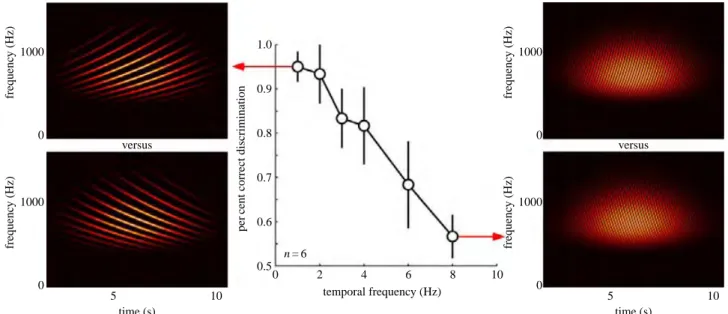
As mentioned above, measuring the perceived motion direction of a spatially periodic sound source did not succeed in revealing an auditory “wagon wheel” illusion. However, it might be possible that sound frequency or “pitch”, rather than spatial position, may be the proper equivalent to the spatial location of visual objects. Thus, periodic stimuli were designed that moved in particular directions in the frequency domain—so-called Shepard or Risset sequences (Shepard, 1964). Participants were presented with sequences of each temporal frequency in randomized order, moving up or down in frequency space, and asked to report their perceived motion direction (up/down). Note that an auditory “wagon wheel” illusion introduced by those stimuli would not merely result in performance at chance level, but, critically, in performance below chance level, as perception is “biased” towards the “wrong direction”. It was found that the direction judgments were only accurate up to 3–4 Hz, and deteriorated rapidly at higher temporal frequencies. This low-pass sensitivity function critically limits the possibility of measuring a “wagon wheel” illusion in the auditory domain: If perceptual performance is already at chance at the hypothesized frequency of the illusion, then this illusion will simply not be observed—whether the perceptual process relies on periodic sampling or not. In other words, if auditory perceptual cycles exist, then it must be at a sampling rate above 3–4 Hz (if the illusion occurred at frequencies below 3-4 Hz, then it would have been possible for our subjects to perceive it, and they would have systematically reported reversed motion).
Why is it so difficult to observe auditory perceptual cycles? In this chapter, we present the following hypothesis: In contrast to vision, the auditory system heavily relies on temporal, continuously changing, information. Whereas a visual scene might be stable for a relatively long time, acoustic stimuli are fluctuating by nature (as they can be described by their spectral content, a variable that can only be defined in time). Consequently, whereas “blind”
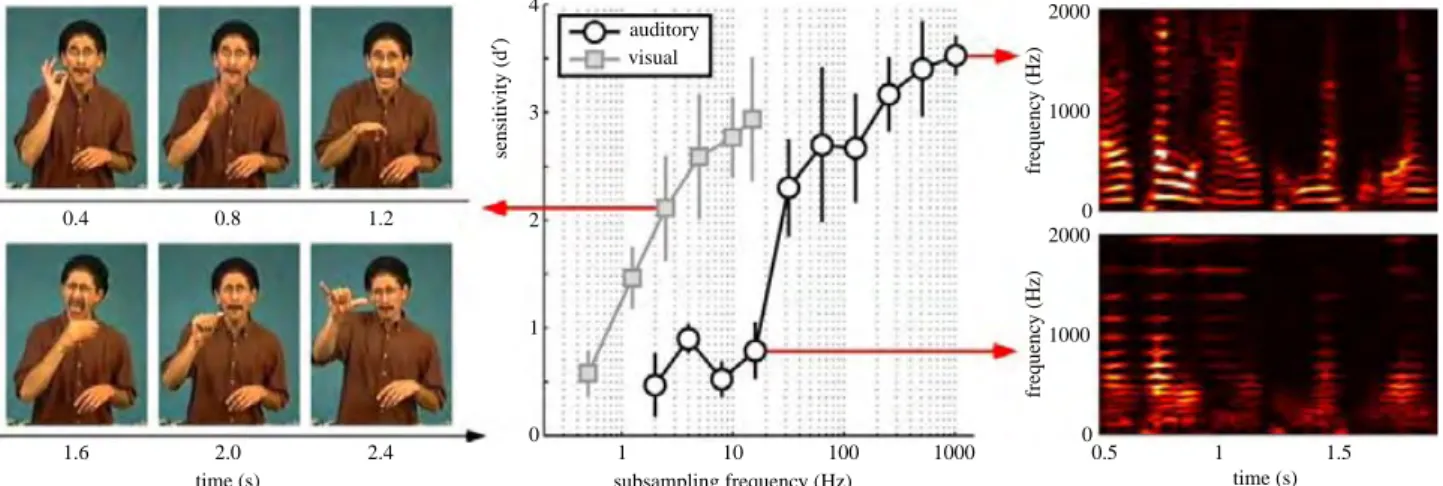
sampling of the environment (i.e., taking “snapshots” that are unrelated to the stimulus input to the system) might not disrupt the integrity and perceived continuity of visual information, the same sampling mechanism could be destructive for auditory processing. This notion was confirmed in a psychophysical experiment. Participants watched and listened to sequences of 3-s long video and audio snippets (respectively) in different blocks while performing a two-back task (responding to a repeat of the penultimate snippet). The visual and auditory inputs were subsampled in a representation space roughly equivalent to the first sensory stage of each system: the retina (with the entire image representing a subsampling “frame”) and the cochlea (with the instantaneous complex frequency spectrum resulting from a wavelet decomposition of the audio signal as a subsampling “frame”), respectively. That is, for both sensory systems, the consequences of the most severe possible temporal subsampling strategy were evaluated, by subsampling the very input to the system. It was found that visual performance only started to deteriorate below 2.5 frames per second, but auditory performance suffered for all subsampling frequencies below 32 Hz. Thus, vision is indeed an order of magnitude more robust to temporal subsampling than audition, arguing against the feasibility (or even the existence) of auditory perceptual cycles.
Nevertheless, is it possible that we cannot discover auditory perceptual cycles in the same way as we do for vision? And if so, why is this the case? In the following article, several explanations are presented and suggestions are made that can “keep alive” the notion of perceptual cycles in the auditory domain. These suggestions are then taken up again and developed further in Chapter 2.
Article:
VanRullen R, Zoefel B, Ilhan B (2014) On the cyclic nature of perception in vision versus
, 20130214, published 17 March 2014
369
2014 Phil. Trans. R. Soc. B
Rufin VanRullen, Benedikt Zoefel and Barkin Ilhan
On the cyclic nature of perception in vision versus audition
References
http://rstb.royalsocietypublishing.org/content/369/1641/20130214.full.html#ref-list-1
This article cites 106 articles, 27 of which can be accessed free
Subject collections
(332 articles)
cognition
Articles on similar topics can be found in the following collections
Email alerting service right-hand corner of the article or click Receive free email alerts when new articles cite this article - sign up in the box at the tophere
http://rstb.royalsocietypublishing.org/subscriptions go to:
Phil. Trans. R. Soc. B
rstb.royalsocietypublishing.org
Research
Cite this article: VanRullen R, Zoefel B, Ilhan B. 2014 On the cyclic nature of perception in vision versus audition. Phil. Trans. R. Soc. B 369: 20130214.
http://dx.doi.org/10.1098/rstb.2013.0214
One contribution of 13 to a Theme Issue ‘Understanding perceptual awareness and its neural basis’.
Subject Areas: cognition
Keywords:
perceptual cycles, discrete perception, brain rhythms, perceptual sampling, sampling rate, speech processing
Author for correspondence: Rufin VanRullen
e-mail: [email protected]
On the cyclic nature of perception in
vision versus audition
Rufin VanRullen1,2, Benedikt Zoefel1,2 and Barkin Ilhan3
1Universite´ de Toulouse, France
2CNRS-CerCo, UMR 5549, CHU de Purpan, Toulouse, France 3Meram Medical Faculty, Konya University, Konya, Turkey
Does our perceptual awareness consist of a continuous stream, or a discrete sequence of perceptual cycles, possibly associated with the rhythmic structure of brain activity? This has been a long-standing question in neuroscience. We review recent psychophysical and electrophysiological studies indicating that part of our visual awareness proceeds in approximately 7–13 Hz cycles rather than continuously. On the other hand, experimental attempts at applying simi-lar tools to demonstrate the discreteness of auditory awareness have been largely unsuccessful. We argue and demonstrate experimentally that visual and auditory perception are not equally affected by temporal subsampling of their respective input streams: video sequences remain intelligible at sampling rates of two to three frames per second, whereas audio inputs lose their fine temporal structure, and thus all significance, below 20–30 samples per second. This does not mean, however, that our auditory perception must proceed continuously. Instead, we propose that audition could still involve perceptual cycles, but the periodic sampling should happen only after the stage of auditory feature extraction. In addition, although visual perceptual cycles can follow one another at a spontaneous pace largely independent of the visual input, auditory cycles may need to sample the input stream more flexibly, by adapting to the temporal structure of the auditory inputs.
1. Introduction: perceptual awareness, a discrete process?
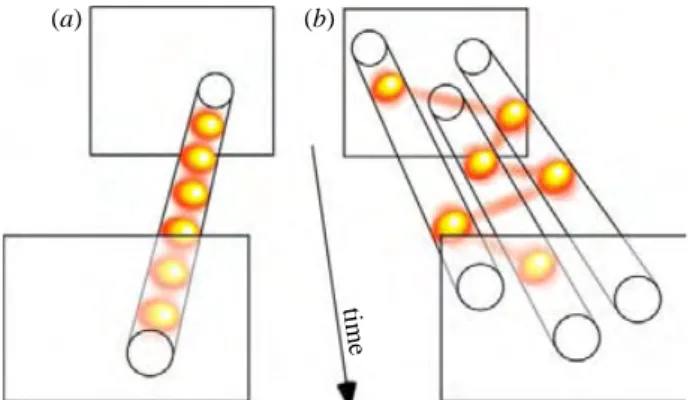
Our conscious perception of the world appears smooth and continuous. A moving object is not seen to disappear here and reappear there, but as suc-cessively occupying all positions in between. Similarly, the sound of an approaching car seems to steadily loom closer, without being interrupted by brief recurring moments of silence. And yet, it is not at all certain that the brain mechanisms supporting our sensory perception are themselves continu-ous; rather, visual and auditory perception may well be intrinsically discrete or cyclic [1–5]. We are not referring here to the discreteness of individual neur-onal events (action potentials, synaptic release) but to the potentially discrete nature of perceptual experience itself. In this case, the continuity of our inner experience would merely be an illusion, a temporal ‘filling-in’ created by our brain to hide its recurring (albeit brief ) moments of blindness and deafness, perhaps in the same way as the ‘blind spot’ of the retina is hidden from our consciousness by spatial filling-in mechanisms [6].
The notion of perceptual ‘snapshots’, ‘moments’ or ‘cycles’, once popular [1– 4] but later discarded without ever being firmly disproved [7] has regained momentum in recent years owing to a number of converging experimental studies. As we shall see in the following sections, however, most of this new experimental evidence concerns the periodicity of visual perception; it has been more challenging, it seems, to uncover similar signatures of auditory ‘snapshots’. After reviewing the corresponding findings, we consider the major differences between the visual and auditory modalities, both in terms of cerebral organization and information processing demands, that could justify a difference in temporal perceptual organization. Finally, we speculate that both systems, under the influence of neuronal oscillations, may, indeed, represent