HAL Id: hal-01141081
https://hal.archives-ouvertes.fr/hal-01141081
Submitted on 10 Apr 2015
HAL is a multi-disciplinary open access
archive for the deposit and dissemination of
sci-entific research documents, whether they are
pub-lished or not. The documents may come from
teaching and research institutions in France or
abroad, or from public or private research centers.
L’archive ouverte pluridisciplinaire HAL, est
destinée au dépôt et à la diffusion de documents
scientifiques de niveau recherche, publiés ou non,
émanant des établissements d’enseignement et de
recherche français ou étrangers, des laboratoires
publics ou privés.
IMPROVED TONE MAPPING OPERATOR FOR
HDR CODING OPTIMIZING THE
DISTORTION/SPATIAL COMPLEXITY TRADE-OFF
Paul Lauga, Giuseppe Valenzise, Giovanni Chierchia, Frédéric Dufaux
To cite this version:
Paul Lauga, Giuseppe Valenzise, Giovanni Chierchia, Frédéric Dufaux. IMPROVED TONE
MAP-PING OPERATOR FOR HDR CODING OPTIMIZING THE DISTORTION/SPATIAL
COMPLEX-ITY TRADE-OFF. EUSIPCO 2014, Sep 2014, Lisbon, Portugal. �hal-01141081�
IMPROVED TONE MAPPING OPERATOR FOR HDR CODING OPTIMIZING THE
DISTORTION/SPATIAL COMPLEXITY TRADE-OFF
Paul Lauga, Giuseppe Valenzise, Giovanni Chierchia, Fr´ed´eric Dufaux
Institut Mines-T´el´ecom; T´el´ecom ParisTech; CNRS LTCI
ABSTRACT
A common paradigm to code high dynamic range (HDR) im-age/video content is based on tone-mapping HDR pictures to low dynamic range (LDR), in order to obtain backward com-patibility and use existing coding tools, and then use inverse tone mapping at the decoder to predict the original HDR sig-nal. Clearly, the choice of a proper tone mapping is essential in order to achieve good coding performance. The state-of-the-art to design the optimal tone mapping operator (TMO) minimizes the mean-square-error distortion between the orig-inal and the predicted HDR image. In this paper, we argue that this is suboptimal in rate-distortion sense, and we pro-pose a more effective TMO design strategy that takes into ac-count also the spatial complexity (which is a proxy for the bitrate) of the coded LDR image. Our results show that the proposed optimization approach enables to obtain substantial coding gain with respect to the minimum-MSE TMO.
Index Terms— High dynamic range; coding; convex op-timization; spatial complexity.
1. INTRODUCTION
High dynamic range (HDR) imaging enables to capture and display the huge range of luminance values of a real-world scene, and is therefore extremely important in making video user experience more immersive and realistic. In order to represent scene-referred luminance values, HDR pictures use more than the 8 bits/pixel/channel employed for display-referred low dynamic range (LDR) pictures [1]. As a result, HDR content entails much more information to be stored and transmitted, which has recently motivated research towards new coding schemes for HDR pictures and video [2] [3] [4].
HDR content can be coded using a scalable approach. First, an LDR base layer is obtained by applying a tone map-ping operator (TMO) to the HDR picture. Then, an enhance-ment layer is computed as the residual between the HDR im-age and the prediction obtained by inverse tone mapping the base layer [5] [6] [3]. This approach enables to ensure back-ward compatibility with legacy LDR displays, and to provide at the same time full HDR experience for users equipped with HDR displays. Mai et al. [5] derived a closed-form expression for the TMO that minimizes the energy of the inter-layer pre-diction residuals, i.e., the mean square error (MSE) between
the original HDR image and the one obtained by inverse tone mapping the base layer. This is shown to be beneficial in terms of coding efficiency, since a lower residual energy en-ables to have a better prediction quality and to reduce the bi-trate of the enhancement layer. The results in [5] demonsbi-trate that the minimum-MSE TMO achieves higher rate-distortion performance1than other commonly used TMOs designed to
enhance LDR visual quality.
However, minimizing MSE distortion is not necessarily optimal in terms of coding performance. For instance, LDR images obtained with the method in [5] preserve more details of the original HDR, but they could be harder to code due to an increased spatial complexity [7]. A better approach would be instead to find a TMO that is optimal in rate-distortion (RD) sense. In this paper, we reformulate the problem of find-ing an optimal TMO for HDR compression by takfind-ing explic-itly into account the spatial complexity of the resulting LDR base layer. To this end, we modify the cost function of [5] by adding an extra term which describes the amount of spatial information in the LDR image, in terms of the total variation measure [8]. We show that the so-obtained problem is convex and can be solved efficiently through a proximal optimization method [9]. We plot rate-distortion curves for HDR images and demonstrate that our approach brings higher RD gains with respect to the minimum-MSE TMO of [5].
The rest of the paper is organized as follows. In Section 2 we review the optimal TMO derived in [5] for minimizing the log MSE between inverse tone-mapped image and the origi-nal HDR. In Section 3 we describe the proposed optimization scheme which takes into consideration the spatial complex-ity of the tone-mapped image in the base layer. Section 4 demonstrates experimentally the performance of the proposed method, while Section 5 draws conclusions.
2. OPTIMUM TONE MAPPING TO MINIMIZE RECONSTRUCTED HDR-MSE
Mai et al. [5] have proposed an efficient HDR compression method optimizing the MSE between the logarithm values of
1Notice that in the results in [5], the distortion is measured between the
original and the reconstructed HDR image, while the bitrate is that of trans-mitting the base-layer only. Coding of the enhancement layer is not directly taken into account.
(lk+1,vk+1) (l1,v1) 0 sk LD R v alue s segment Lmin Lmax vmax
HDR values l (log10 of relative luminance)
(lk,vk)
bin
Fig. 1: Piecewise parameterization of the optimal tone map-ping curve as in [5]
the luminance of original HDR content and the reconstructed version. The distortion in the process of tone mapping, encod-ing, decoding and inverse tone mapping have been estimated by a statistical distortion model and they use a closed-form solution to tone map the HDR image based on the luminance histogram of the HDR image.
Given the notations l and v corresponding to the logarithm of the luminance of HDR frame and the pixel values of tone mapped LDR version respectively, the tone mapping curve is first parameterized as a piece-wise linear function with the nodes(lk, vk) as shown in figure 1. Each segment k between
two nodes (lk, vk) and (lk+1, vk+1) has a constant width in
HDR values equal to δ (selected as 0.1). The tone mapping operation is then characterized by a set of slopes
sk=
vk+1− vk
δ , (1)
which forms a vector of tone-mapping parameters. Using such a parameterization, the optimized tone mapping prob-lem is given as minimize s∈]0,+∞[N N X k=1 pks−k2 s.t. N X k=1 sk= vmax δ , (2)
where pkis the summation of the normalized histogram of
lu-minance values for the k-th bin, N is the total number of bins in the histogram, and vmaxis the maximum LDR value. By
computing the first order Karush-Kahn-Tucker (KKT) opti-mality conditions of corresponding Lagrangian, their ultimate closed form solution is derived as
sk= vmaxp1/3k δPN k=1p 1/3 k . (3)
A tone mapping characterized by the slopes skreads
v= (l − l1) · s1+ v1, if l∈ [l1, l2], . . . (l − lN) · sN+ vN, if l∈ [lN, lN +1], (4)
where lkand vkare represented on figure 1. The tone
map-ping operator represented by equation (4) used with the sk
defined in equation (3) minimizes the MSE between the orig-inal and reconstructed HDR frames.
3. PROPOSED METHOD
The method presented in Section 2 allows one to minimize the distortion by means of a tone-mapping compression. How-ever, as we can see in Equation (3), this method neglects the obvious spatial dependencies than any real-world image ex-hibits. From a rate-distortion standpoint, it is certainly prefer-able to take into account both the distortion and a suitprefer-able spatial regularization. In this work, we modify problem (2) by adding a regularity term C, leading to
minimize s∈]0,+∞[N N X k=1 pks−2k + λ C(T s) s.t. N X k=1 sk= vmax δ , (5) where λ is a positive constant, T denotes the (linear) operator that performs the tone-mapping in (4),2and C denotes a
real-valued convex function that models the spatial regularization. In [10] the authors also proposed to minimize the bit rate of the LDR layer by modeling the smoothness of the tone-mapped image. However, their model approximates spatial regularity based on conditional pixel value probabil-ities, while in our case we optimize explicitly the spatial dependencies at the pixel level.
3.1. TV regularization
The quality of the results obtained through a variational ap-proach strongly depends on the ability of the function C to model the regularity present in images. Since natural images usually exhibit a smooth spatial behaviour, except around some locations (e.g. object edges) where disconti-nuities arise, popular regularization models tend to penalize the image gradient. In this context, Total Variation (TV) [8] has emerged as a simple, yet successful, convex optimization tool. This regularization term can be expressed as
C(v) = k∇vk1,2=
X
i∈Ω
k(∇v)ik2, (6)
whereΩ is the rectangular lattice over which the image v is defined, and(∇v)iis the 2-element vector denoting the
gra-dient of v at site i.
Note that an alternative regularization approach consists in replacing the gradient operator with a frame representa-tion which yields a more suitable sparse representarepresenta-tion of the image [11]. The connections between these two different ap-proaches have been studied in [12]. In this work, we focus our attention on TV regularization, although our proposed al-gorithm is quite general and it can also be adapted to frame-based approaches.
2Note that v = T s is a linear operation, as the HDR image l is regarded
3.2. Convex optimization
In this paper, we propose to find the vector s that achieves the optimal balance between the distortion and TV regularization. Hence, we need to solve the following problem
minimize s∈]0,+∞[N N X k=1 pks−2k +λk∇T sk1,2 s.t. N X k=1 sk= vmax δ . (7)
To gain some insight into the solution of Problem (7), let us define the (non-smooth) convex functions
f(s) = N X k=1 fk(sk), with fk(sk) = ( +∞ if sk≤ 0, pks−2k if sk>0, (8) g(y) = λkyk1,2, (9)
and the closed convex set
C = {s ∈ RN | N X k=1 sk = vmax δ }. (10)
Therefore, Problem (7) can be more conveniently rewritten as minimize
s∈C f(s) + g(∇T s), (11)
which consists in minimizing the sum of two convex func-tions, one of which composed by a linear operator, over a closed convex set.
The solution of Problem (11) requires an efficient algo-rithm for dealing with non-smooth functions. Among the many approaches proposed to solve convex optimization problems, we resort here to proximal algorithms [9], since they provide a unifying framework that allows one to address both non-smooth functions and hard constraints. Within the large panel of existing proximal algorithms [13–16], we con-sider the primal-dual M+LFBF algorithm recently proposed in [15], which is able to address general convex optimization problems involving non-smooth functions and linear opera-tors without requiring any matrix inversion.
4. EXPERIMENTAL RESULTS
We test our method on several images taken from the HDR Photographic Survey dataset3. The images have a maximum
resolution of 4,288×2,848 and span a wide range of lumi-nance conditions and contrast ratios. We cut a square portion of 1024×1024 pixels in each image to apply our algorithm and test coding performance. A subset of these images used in our tests is shown in Figure 2. We encode images using JPEG and JPEG2000 on image luminance tone mapped to 8 bits values using the piecewise linear tone mapping obtained by solving (11). We compare this method with the tone map-ping in [5], which corresponds to solving problem (2) or to
3Available at http://www.cis.rit.edu/fairchild/HDR.html
setting λ= 0 in our problem. In both cases, we consider lu-minance only as in the original setup [5], based on the same consideration that one could easily extend tone mapping to red, green and blue color channel independently while pre-serving color appearance [17]. The cost of transmitting sup-plemental information to reconstruct the tone mapping curve (i.e., the vector of sk), which is present both in our proposal
and in the baseline method [5], depends on the choice of the histogram step δ (fixed here to 0.1) and is in general negligible with respect to the total bitrate.
We use the standard JPEG implementation available in Matlab through the imwrite command, while for JPEG2000 we employ the Kakadu implementation available at [18]. The quality rate used for JPEG are 20 to 90 with a step of 10. As for JPEG2000, we use 5-level, 9/7 Daubechies wavelet decomposition, and we fix the rate from 0.1 to 1 bits per pixel with a step of 0.1. In order to evaluate the distortion between the original and the reconstructed HDR image after coding, we use the HDR-MSE metric as also done in [5]. The HDR-MSE is defined as the logarithm of the MSE between the logarithm of the luminance chanel of the reconstructed HDR image and the reference one. A popular perceptually-based image difference predictor is the HDR-VDP2 [19]. We compared the reconstructed HDR images using our TMO with those produced using minimum-MSE, with a publicly available implementation of HDR-VDP2 4, and found that
the results are inconsistent with the compression quality used for the LDR layer, e.g., higher LDR rates could randomly produce worse HDR-VDP2 results. Therefore, we do not in-clude performance evaluation relative to HDR-VDP2 in this paper.
Figure 3 shows rate-distortion results for minimum-MSE TMO [5] and our proposal for three HDR pictures. The op-timal λ in (11) has been found empirically. The experiments show that a λ between 0.001 and 0.004 tends to yield im-portant coding gains with respect to minimum-MSE TMO. Higher values of λ may produce washed-out LDR images, which are certainly smoother but poorer in details. On the other hand, very low values of λ do not improve significantly the performance of the minimum-MSE method. On the re-sults we present, we choose a value of 0.004 for “Amikeus-BeaverDamPM1” and “Flamingo” and a value of 0.002 for “GoldenGate(2)”.
In order to gain a better insight of how the proposed method improves RD performance, we show as an example in Figure 4 two tone mapping curves obtained from the im-age “AmikeusBeaverDamPM1”: the minimum-MSE TMO, and our proposal based on TV regularization (λ = 0.004). Minimum-MSE TMO allocates a larger interval of LDR values to mid luminance range, and compresses instead the extreme regions of the original HDR histogram. This enables to produce well contrasted LDR pictures which preserve most part of HDR high-frequency content and details. Conversely,
(a) AmikeusBeaver-DamPM1
(b) Flamingo (c) GoldenGate(2)
Fig. 2: Some HDR images from the HDR Photographic Sur-vey dataset.
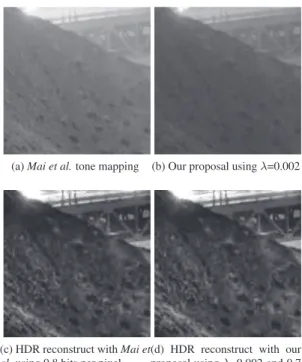
TV regularization generates curves which are closer to linear tone mapping. As a result, the LDR image has lower global contrast with respect to [5]. However, local image structures such as edges are well preserved thanks to the definition of the TV measure (5). We give an example in Figure 5, which shows the tone-mapped LDR image and the reconstructed HDR content for a detail of the image “GoldenDate(2)”. The two decoded HDR images details have similar HDR-MSE values of -3.52 and -3.64 for [5] and the proposed method, respectively. However, it is apparent that the LDR image obtained with our TMO is smoother than the minimum-MSE one, thus it has lower spatial complexity and is easier to code, which explains the RD gain in Figure 3. For our matlab op-timization implemention (wich is not optimized for speed), we put a large number of iteration to assure the convergence. however, the process stops hitself before the end of the iter-ations when the difference between two following iteration results is to small. The number of needed iteration depends on the image and on λ. In general, 5000 iterations are enough to assure the convergence and the process took on average 5 minutes to find the skfor an1024 × 1024 image.
5. CONCLUSION
In the context of backward compatible HDR image compres-sion, the HDR content is mapped to LDR to be compressed with available coding tools and be used as predictor at the decoder. In this paper we have presented a tone mapping op-erator that minimizes the prediction error and the spatial com-plexity of the LDR image, modeled through the total variation measure. The resulting problem is convex and can be solved efficiently. While we do not claim that this is optimal from the rate-distortion point of view, we show that it achieves sig-nificant RD gains with respect to the state of the art technique that minimizes mean-square-error distortion between original and reconstructed HDR [5].
We are currently working to extend this model to video, by modeling temporal complexity as well. In addition, the simple quadratic MSE term is know to be poorly related to perception [20], which motivates for using more advanced,
0 0.5 1 1.5 2 2.5 −3.2 −3 −2.8 −2.6 −2.4 −2.2 −2 −1.8 HD R M S E bits/pixel HDR MSE JPEG AmikeusBeaverDamPM1
lambda=0.004 Mai et. al.
(a) 0 0.2 0.4 0.6 0.8 1 −3 −2.8 −2.6 −2.4 −2.2 −2 −1.8 −1.6 HD R M S E bits/pixel HDR MSE JPEG2000 AmikeusBeaverDamPM1
lambda=0.004 Mai et. al.
(b) 0 0.5 1 1.5 2 −3.1 −3 −2.9 −2.8 −2.7 −2.6 −2.5 −2.4 −2.3 −2.2 −2.1 HD R M S E bits/pixel HDR MSE JPEG Flamingo
lambda=0.004 Mai et. al.
(c) 0 0.2 0.4 0.6 0.8 1 −3.2 −3 −2.8 −2.6 −2.4 −2.2 −2 −1.8 −1.6 HD R M S E bits/pixel HDR MSE JPEG2000 Flamingo
lambda=0.004 Mai et. al.
(d) 0.2 0.4 0.6 0.8 1 1.2 1.4 1.6 −4 −3.5 −3 −2.5 HD R M S E bits/pixel HDR MSE JPEG GoldenGate(2)
lambda=0.002 Mai et. al.
(e) 0 0.2 0.4 0.6 0.8 1 −4 −3.5 −3 −2.5 HD R M S E bits/pixel HDR MSE JPEG2000 GoldenGate(2)
lambda=0.002 Mai et. al.
(f)
Fig. 3: Rate-distortion performance of the proposed method compared to the minimum-MSE TMO [5] with both JPEG and JPEG2000, for the images in Figure 2.
yet feasible to optimize, fidelity measures for HDR content.
REFERENCES
[1] F. kainz and R. Bogart, “Technical introduction to OpenEXR,” Industrial Light & Magic, February 2009. [2] R. Mantiuk, G. Krawcyk, K. Myszkowski, and
H.-P. Seidel, “Perception-motivated high dynamic range video encoding,” ACM Transactions on Graphics, vol. 23, no. 3, pp. 730–738, 2004.
[3] A. Segall, “Scalable coding of high dynamic range video,” in Proc. IEEE Int. Conf. on Image Processing, vol. 1, pp. I–1–I–4. 2007.
[4] T. Richter, “On the standardization of the JPEG XT image compression,” in Proc. of the Picture Coding Symposium, San Jose, CA, Dec 2013, pp. 37–40. [5] Z. Mai, H. Mansour, R. Mantiuk, P. Nasiopoulos, and
−2 −1 0 1 2 0 50 100 150 200 250 HDR values (logarithm) LD R val u es lambda=0.004 Mai et al.
Fig. 4: Tone mapping curve for AmikeusBeaverDamPM1 using Mai et al. method (in black) and our propose with λ=0.004 (in red).
backward-compatible high dynamic range image and video compression,” IEEE Trans. on Image Processing, vol. 20, no. 6, pp. 1558–1571, June 2011.
[6] S. Liu, W.-S. Kim, and A. Vetro, “Bit-depth scal-able coding for high dynamic range video,” SPIE Vi-sual Communications and Image Processing, vol. 6822, 2008.
[7] H. Yu and S. Winkler, “Image complexity and spatial information,” in Proc. 5th Int. Workshop on Quality of Multimedia Experience, July 2013, pp. 12–17.
[8] L. Rudin, S. Osher, and E. Fatemi, “Nonlinear total variation based noise removal algorithms,” Physica D, vol. 60, no. 1-4, pp. 259–268, Nov. 1992.
[9] P. L. Combettes and J.-C. Pesquet, “Proximal splitting methods in signal processing,” in Fixed-Point Algo-rithms for Inverse Problems in Science and Engineer-ing, H. H. Bauschke, R. S. Burachik, P. L. Combettes, V. Elser, D. R. Luke, and H. Wolkowicz, Eds., pp. 185– 212. Springer-Verlag, New York, 2011.
[10] Z. Mai, H. Mansour, P. Nasiopoulos, and R. Ward, “Visually-favorable tone-mapping with high compres-sion performance,” 17th IEEE International Confer-ence on Image Processing (ICIP), pp. 1285–1288, Sept. 2010.
[11] S. Mallat, A wavelet tour of signal processing, Aca-demic Press, San Diego, USA, 1997.
[12] J.-F. Cai, B. Dong, S. Osher, and Z. Shen, “Image restoration: Total variation, wavelet frames and be-yond,” Journal of the American Mathematical Society, vol. 25, no. 4, pp. 1033–1089, 2012.
[13] J.-C. Pesquet and N. Pustelnik, “A parallel inertial prox-imal optimization method,” Pacific Journal of Opti-mization, vol. 8, no. 2, pp. 273–305, Apr. 2012. [14] A. Chambolle and T. Pock, “A first-order
primal-dual algorithm for convex problems with applications to imaging,” Journal of Mathematical Imaging and Vi-sion, vol. 40, no. 1, pp. 120–145, 2011.
[15] P. L. Combettes and J.-C. Pesquet, “Primal-dual
split-(a) Mai et al. tone mapping (b) Our proposal using λ=0.002
(c) HDR reconstruct with Mai et al.using 0.8 bits per pixel
(d) HDR reconstruct with our proposal using λ=0.002 and 0.7 bits per pixel
Fig. 5: the first row shows detail on GoldenGate(2) after tone map with Mai et al. and our propose with λ=0.002. The second row presents tone mapping of the detail on Golden Gate(2) after reconstruction of the HDR image.
ting algorithm for solving inclusions with mixtures of composite, lipschitzian, and parallel-sum type mono-tone operators,” Set-Valued and Variational Analysis, vol. 20, no. 2, pp. 307–330, Jun. 2012.
[16] G. Chierchia, N. Pustelnik, J.-C. Pesquet, and B. Pesquet-Popescu, “Epigraphical splitting for solving constrained convex formulations of inverse problems with proximal tools,” 2012, Preprint: http://arxiv.org/pdf/1210.5844.
[17] R. Mantiuk, A. Tomaszewska, and W. Heidrich, “Color correction for tone mapping,” in Computer Graphics Forum. Wiley Online Library, 2009, vol. 28, pp. 193– 202.
[18] “Kakadu software,” available at: http://www. kakadusoftware.com/.
[19] R. Mantiuk, K. Kim, A.G. Rempel, and W. Heidrich, “HDR-VDP-2: a calibrated visual metric for visibility and quality predictions in all luminance conditions,” in ACM Trans. on Graphics. ACM, 2011, vol. 30, p. 40. [20] Z. Wang and A.C. Bovik, “Mean squared error: love
it or leave it? a new look at signal fidelity measures,” IEEE Signal Processing Magazine, vol. 26, no. 1, pp. 98–117, 2009.
![Fig. 1 : Piecewise parameterization of the optimal tone map- map-ping curve as in [5]](https://thumb-eu.123doks.com/thumbv2/123doknet/11389658.287135/3.892.151.365.158.307/fig-piecewise-parameterization-optimal-tone-map-ping-curve.webp)