UMR DIAL 225
Place du Maréchal de Lattre de Tassigny 75775 • Paris Cedex 16 •Tél. (33) 01 44 05 45 42 • Fax (33) 01 44 05 45 45 • 4, rue d’Enghien • 75010 Paris • Tél. (33) 01 53 24 14 50 • Fax (33) 01 53 24 14 51
E-mail : [email protected] • Site : www.dial.prd.fr
DOCUMENT DE TRAVAIL DT/2011-13
Report on Impact Evaluation in
Sub-Saharan Africa
Vibhuti Mendiratta
UMR DIAL- IRD
Document de travail UMR DIAL
Décembre 2011
Abstract
Impact evaluation has recently gained significant momentum with good reason, as they help to
quantify the social impacts of interventions. With increased importance being attached to evaluation,
one spillover effect could be capacity development in African countries with increased participation of
African universities and local teams. It is in this respect that this report sheds some light on the recent
trends in the impact evaluations. Collating information on evaluations from key sources, we produced
a database to highlight key trends in the evolution of impact evaluations. We find a surge in the
number of evaluations since 2004, 77% starting in 2004 and later. In terms of the thematic
composition, 27% of the evaluations are health oriented followed by education, agriculture and
microfinance as the key sectors. Another interesting trend observed is that the evaluations are largely
restricted to Anglophone countries, primarily Kenya followed by Uganda. While African partners (like
local NGOs, Ministries etc.) have been involved in different stages of program implementation in the
country under consideration, only 11% of the studies on which we have information have an African
author involved in writing the research paper. We thus conclude that we are a long way away from
heavy involvement of African nationals in impact evaluations. Continued commitment from
various stakeholders would be imperative for such an initiative to work and gather momentum. The
database is available on African Impact Evaluation Network (
http://www.africaien.org/impact-evaluation-projects-dataset/
).
Keywords: Africa, Impact evaluation
Résumé
Depuis une dizaine d’années, la réflexion sur les politiques de développement et leur efficacité a
sensiblement évolué en adoptant une approche pragmatique consistant à évaluer de manière la plus
rigoureuse possible l’impact de mesures et politiques de développement avant de les appliquer à
d’autres contexte et de les généraliser. En rassemblant le plus grand nombre d’informations
disponibles, ce rapport dresse un bilan des études d’impact (EI) menées en Afrique et s’interroge sur
l’implication des chercheurs africains dans leur conception et analyse. Il apparaît que les EI se sont
sensiblement développées en Afrique qu’à partir de 2004, 77% d’entre elles ayant été initiées depuis
cette date prioritairement en santé, éducation, agriculture et micro-finance. Ces évaluations sont en
grande partie menées dans les pays anglophones, plus particulièrement au Kenya et en Ouganda.
Même si des partenaires africains ont pu participer aux études, dans seulement 11% des cas des
chercheurs africains ont participé à la publication du rapport d’analyse. Nous concluons donc que les
EI sont loin de constituer un levier pour la recherche en Afrique et que les différentes parties prenantes
devraient prendre des mesures pour qu’une telle impulsion ait lieu. La base est disponible sur le site du
réseau africain des évaluations d’impact (African Impact Evaluation Network à l’adresse suivante,
http://www.africaien.org/impact-evaluation-projects-dataset/
).
Mots Clés : Afrique, Evaluation d’impact.
JEL Codes :
O55; O10
1 This report has been written for the Evaluation and Knowledge Development Unit (RCH/EVA) of the AFD. I thank Tanguy Bernard
(RCH/EVA, AFD), Jocelyne Delarue (RCH/EVA, AFD), Sandrine Mesplé-Somps (UMR 225 DIAL, IRD) and Xavier Oudin (UMR 225 DIAL, IRD) for their relevant comments on a previous version of this report.
2
Table of contents
1.
Description of the dataset and Limitations... 3
2.
Analysis of impact evaluations ... 6
2.1
Geographical Spread ... 6
2.2
Thematic Spread ... 12
2.3
Composition of research teams ... 14
2.4
Financial and Operational Partners ... 17
3
Limitations and Conclusion ... 19
Table 1: Overall Statistics... 5
Table 2: Classification of countries included in the database into Anglophone and Francophone ... 5
Table 3: Start date of evaluations ... 6
Table 4: Cross tabulation of starting year and Anglophone- Francophone countries ... 8
Table 5: Cross tab of implementing agencies and official language ... 9
Table 6: Evaluations by country ... 10
Table 7: Implementing agencies in different countries ... 11
Table 8: Number of evaluations by theme ... 12
Table 9: Cross tab of starting date and sector ... 13
Table 10: Number of evaluations by region and theme ... 14
Table 11: Cross tab of African author with implementing agency ... 15
Table 12: Details of African authors ... 16
Table 13: Number of evaluations/projects financed by different agencies ... 17
Table 14: Cross tab of evaluations financed by the World Bank and the implementing agencies ... 17
Figure 1: Evaluation Status ... 7
Figure 2: Number of evaluations in Anglophone vs. Francophone countries ... 7
Figure 3: Whether an African author has been involved in writing the research paper (number of
evaluations) ... 15
3
Impact evaluation studies have recently gained significant momentum in the recent past and with good reason, as they help to quantify the social impacts of interventions in varied fields like health, education, agriculture, infrastructure, microfinance to name a few. These scientific impact evaluations have been particularly important in ensuring the effectiveness of aid for donors. Giving the increasing importance of impact evaluation, it thus becomes imperative to understand the evolution of evaluation studies in developing countries to help guide the future impact evaluation exercises. To this end, this report provides a meaningful descriptive analysis of impact evaluations that have been or are being undertaken in Sub- Saharan Africa.
One must keep in mind however, that this report only accounts for those programs which fall under the purview of “impact evaluation”. There have been a plethora of evaluations not included in this analysis but which share the border with the impact evaluation. For example, the research of Consultative Group on International Agricultural Research (CGIAR) focuses on crop productivity, forestry and agroforestry, water management, aquaculture, and livestock. This is turn has had consequences for Africa’s development, providing new crop and farming technologies that target the crucial agricultural sector, benefiting poor farmers, creating wealth, and protecting the environment. CGIAR has conducted several ex- post impact assessment studies to quantify the impact of their interventions. However, such evaluations conducted by different organizations have not been considered in this report.
The report is organized as follows: Section 1 describes the dataset. Since the dataset is largely a compilation of information from various sources, it is necessary to outline the limitations, to increase the understanding of the report. Section 2 is dedicated to the analysis of the database in terms of the geographic spread of the evaluations in Sub-Saharan Africa, the themes/ sectors within which these evaluations fall, the composition of the research teams and detailed information on the financiers of these projects/ evaluations. Finally, Section 3 re-outlines the limitations and concludes.
1.
Description of the dataset and Limitations
The information on evaluations has been extracted from the websites of several sources, namely World Bank Poverty Reduction and Economic Management (PREM) Unit, World Bank Development Impact Evaluation Initiative (DIME), Jameel Poverty Action Lab (JPAL), International Initiative for Impact Evaluation (3ie), Innovations for Poverty Action (IPA), Agence Française de Développement (AFD), the Network of Networks on Impact Evaluation (NONIE) and some of its members. It must be specified that NONIE members are all UN organisations, all multilateral banks, all bilateral donors from OECD, and members of the IOCE (International Organisation for Cooperation in Evaluation). Many evaluations overlap on the websites of these organizations, as far as possible we have tried to avoid the evaluations from repeating in the dataset.
Following is a detailed description of each of the variables included in the dataset. An excel sheet with the database has been provided with this report. In this database, a lot of the information on all variables was not readily available from the websites of organizations mentioned above. For all other information, we searched on the internet. All such information extracted from the internet has been colored yellow in the dataset. However, we still have quite some missing information.
Information on whether a country be classified as Anglophone, Francophone or none has been drawn from the Organisation internationale de la Francophonie, Commonwealth of Nations, internet sources and in consultation with AFD. This classification can be seen in Table 2 below. The start date and closing date correspond to beginning and the end of the evaluation in question.
Next is the information on the evaluator and author. While the World Bank database does provide information on the evaluator (related to implementation of the evaluation) on a lot of its evaluations,
4
JPAL and IPA provide information on researchers/ authors (related to the research paper). We have created separate variables for these two as it might be that evaluator(s) are not the author(s) of the paper. However, it must be noted that in most JPAL and IPA evaluations, the lead author is mostly involved in the implementation of the evaluation as well. The universities, institutes and organizations that the evaluators and authors are affiliated to are also provided. However, this information is incomplete in case of evaluations where we have more than two authors (for the sake of brevity, we included affiliations of up to two authors only). A lot of the times, the evaluators and authors are affiliated to more than one university/organization. In such a case, we have tried to use JPAL and World Bank as principal affiliations. Obviously, the information on whether there is an African author involved is restricted to only those evaluations for which we know the authors. Further, I have divided the involvement of African authors into two- African authors working in African universities and institutes and African authors working overseas.
The organizations involved in evaluations have been divided into three types based on the nature of their involvement- implementing agencies, operational partners and financiers. We would discuss each of these one by one. To be precise, one must note that the implementing agency is responsible for the implementation of the evaluation. On the other hand, the partners are operators which help in implementing the evaluation on the field.
The implementing agency is the organization involved in implementation of the evaluation in the host country- the major ones being World Bank, JPAL and IPA. It must be noted that the implementing agency for evaluations from the World Bank website is assumed to be World Bank, if either of the following is true: 1) the evaluation is not listed on JPAL’s or IPA’s website. For example, a lot of the evaluations for which the implementing agency is the JPAL are listed on the World Bank website, in which case the implementing agency would be JPAL. 2) At least one of the authors or the evaluators is working for or affiliated with the World Bank. All the remaining evaluations listed on the World Bank website have missing information under the variable ‘Implementing agency’.
The second segment that is the partners involved in any evaluation are the research and operational partners who helped in the conduct of the fieldwork and in the implementation of the evaluation in the country under consideration. This information was readily available for some evaluations of JPAL and IPA but for others, it was drawn from the ‘Acknowledgements’ section of the research papers. The variable ‘Partners- research’ consists of the universities and research centers and on the other hand, the variable ‘Partners-Ministry’ observes if any of the ministries of the host country are involved. Finally, the variable ‘Partner- operations’ consists of NGOs, UN bodies etc.
Third, the financing of evaluations is undertaken by several agencies at the same time. For most evaluations listed on the World Bank website, we had information on their database. Further, all evaluations listed on the 3IE website have 3IE mentioned as one of their financiers. However for all the remaining evaluations (and those listed on 3IE), we had to draw from the research papers under the ‘Acknowledgements’ section. It could be that the financiers of the project and the evaluation are different. While it is difficult to isolate the two, we have used the information available on the websites and the databases to answer this question in the best manner possible. For evaluations on WB website, the financier is that of the project per se and not of the evaluation, however we have assumed that they finance the evaluation as well.
For evaluations in Kenya, South Africa and Senegal, we distinguished between evaluations on the basis of their focus (which is given under “Research Orientation” in the database), that is whether they were experiments, policy oriented or public policy. Experimental evaluations are interventions that experiment on a limited area of the country and without any demand from national institution of an evaluation of a public policy/reform. Policy oriented evaluation is the impact evaluation of a policy implemented by national or local stakeholders at a local level (for testing). Public policy evaluation is the impact evaluation of a policy already implemented by national or local stakeholders.
5
Other variables included in the dataset are website from which the evaluation study is drawn, whether the evaluation is ongoing or completed and the main theme/ sector under which the evaluation falls. All evaluations have been assigned sectors using the classification in The World Bank Impact Evaluation Database. The World Bank provides information on cost of the project/ evaluation and a specific report outlining key results. This information is included under the variables “Project Cost” and “URL-Report” respectively. Information on research papers (for those available) is included under the variable “URL-Paper”. Information on other articles/ news related to the evaluation is included under “URL-Project”. From henceforth, we would use the word “evaluation” to refer to any program which has been evaluated or a project with a component of impact evaluation in it.
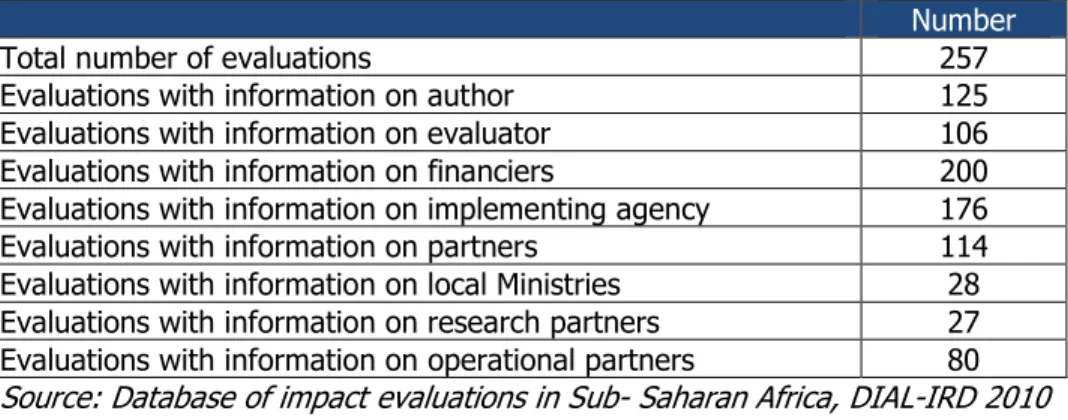
The following table presents overall statistics of the database. It comprises of 257 evaluations. Table 2 provides a classification of countries into Anglophone, Francophone or none.
Table 1: Overall Statistics
Number
Total number of evaluations 257
Evaluations with information on author 125
Evaluations with information on evaluator 106
Evaluations with information on financiers 200
Evaluations with information on implementing agency 176
Evaluations with information on partners 114
Evaluations with information on local Ministries 28
Evaluations with information on research partners 27
Evaluations with information on operational partners 80
Source: Database of impact evaluations in Sub- Saharan Africa, DIAL-IRD 2010
Table 2: Classification of countries included in the database into Anglophone and Francophone
None Angola, Cape Verde, Eritrea, Mauritius, Mozambique, Rwanda
Anglophone Ethiopia, The Gambia, Ghana, Kenya, Lesotho, Liberia, Malawi, Namibia, Nigeria, Sierra
Leone, South Africa, Sudan, Tanzania, Uganda, Zambia
Francophone Benin, Burkina Faso, Burundi, Cameroon, Cote d’Ivoire, Djibouti, Guinea, Madagascar, Mali,
6
2.
Analysis of impact evaluations
Recent trends have observed a thrust on impact evaluation with a surge in the number of studies conducted in the recent past. This section sheds light on four aspects of impact evaluation studies- first, the geographical spread of the evaluations along with their evolution over time in different countries; second, the classification of evaluations into broad sectors and their evolution over time; third, the involvement of African authors in evaluations and fourth, information on financial partners.
2.1
Geographical Spread
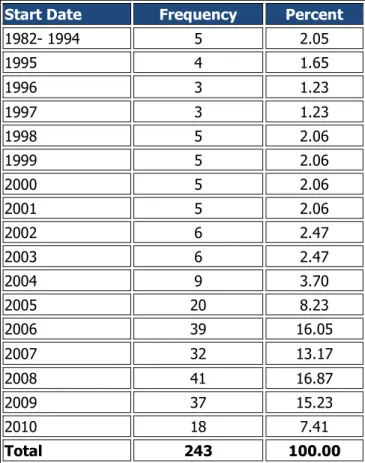
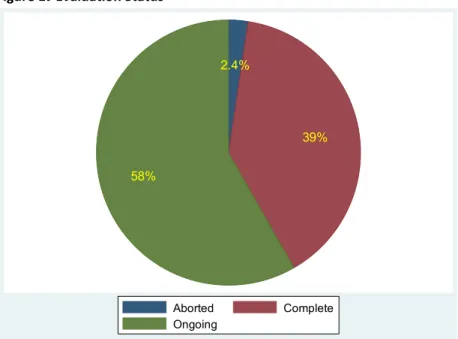
In the recent past, rigorous impact evaluation has been set to be the new “mantra” pioneered by The World Bank Poverty Reduction and Economic Management (PREM) Network, World Bank’s Development Impact Evaluation Initiative (DIME) and Jameel Poverty Action Lab (JPAL). To provide credence to the claim above, as can be seen in the table 3 below, since 2004, an increasing number of evaluations have been launched- in fact, about 77% of the evaluations have been undertaken starting from 2004. Out of these impact evaluations that have been started in the last 5-6 years, about 58% are still ongoing, as is highlighted in the Figure 1 below.
Table 3: Start date of evaluations
Start Date Frequency Percent
1982- 1994 5 2.05 1995 4 1.65 1996 3 1.23 1997 3 1.23 1998 5 2.06 1999 5 2.06 2000 5 2.06 2001 5 2.06 2002 6 2.47 2003 6 2.47 2004 9 3.70 2005 20 8.23 2006 39 16.05 2007 32 13.17 2008 41 16.87 2009 37 15.23 2010 18 7.41 Total 243 100.00 * Missing values: 14
7
Figure 1: Evaluation Status
2.4% 39% 58% Aborted Complete Ongoing * Missing values: 3
Source: Database of impact evaluations in Sub- Saharan Africa, DIAL-IRD 2010
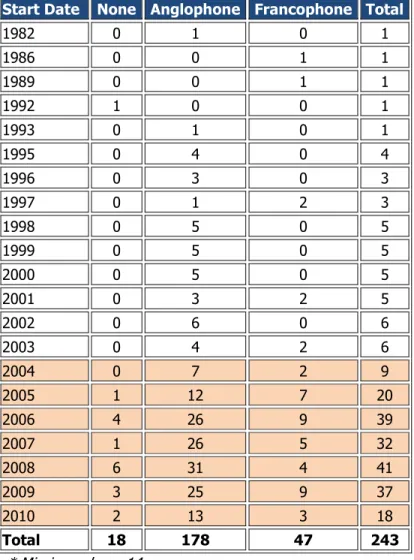
We will now explore the geographical spread of these evaluations across countries in Sub- Saharan Africa. It might be interesting to see the dispersion of evaluations across Anglophone and Francophone countries. Figure 2 and tables 4 and 5 provide some statistics on this. What we observe in the Figure 2 is that about 70% of the evaluations are concentrated in Anglophone countries with only 18% in Francophone countries.
Figure 2: Number of evaluations in Anglophone vs. Francophone countries
7.4%
74% 19%
None Anglophone Francophone
8
Next, let’s shed some light on the evolution of impact evaluation studies over time in Anglophone and Francophone countries (Table 4). We find that the increased bulge of these evaluations in the last 5-6 years is largely concentrated in Anglophone countries.
Table 4: Cross tabulation of starting year and Anglophone- Francophone countries
Start Date None Anglophone Francophone Total
1982 0 1 0 1 1986 0 0 1 1 1989 0 0 1 1 1992 1 0 0 1 1993 0 1 0 1 1995 0 4 0 4 1996 0 3 0 3 1997 0 1 2 3 1998 0 5 0 5 1999 0 5 0 5 2000 0 5 0 5 2001 0 3 2 5 2002 0 6 0 6 2003 0 4 2 6 2004 0 7 2 9 2005 1 12 7 20 2006 4 26 9 39 2007 1 26 5 32 2008 6 31 4 41 2009 3 25 9 37 2010 2 13 3 18 Total 18 178 47 243 * Missing values: 14
Source: Database of impact evaluations in Sub- Saharan Africa, DIAL-IRD 2010
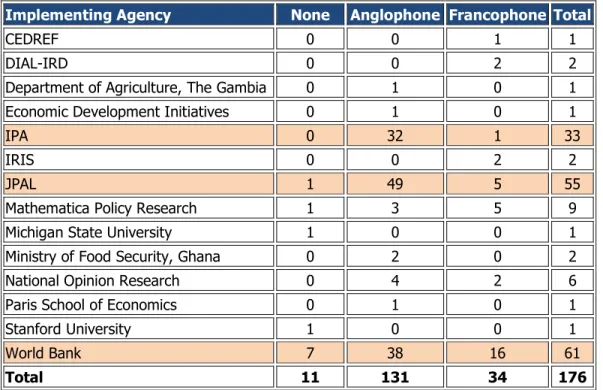
What could explain the concentration of evaluations in Anglophone countries- It might be possible that certain institutions/ agencies are inclined to work more in some countries over others. Table 5 checks for any such correlation. We find that all institutions are partly more inclined to conduct programs in Anglophone countries over Francophone countries with a lot of evaluations of JPAL/ IPA being conducted in largely Anglophone countries.
9
Table 5: Cross tab of implementing agencies and official language
Implementing Agency None Anglophone Francophone Total
CEDREF 0 0 1 1
DIAL-IRD 0 0 2 2
Department of Agriculture, The Gambia 0 1 0 1
Economic Development Initiatives 0 1 0 1
IPA 0 32 1 33
IRIS 0 0 2 2
JPAL 1 49 5 55
Mathematica Policy Research 1 3 5 9
Michigan State University 1 0 0 1
Ministry of Food Security, Ghana 0 2 0 2
National Opinion Research 0 4 2 6
Paris School of Economics 0 1 0 1
Stanford University 1 0 0 1
World Bank 7 38 16 61
Total 11 131 34 176
* Missing values: 81
Source: Database of impact evaluations in Sub- Saharan Africa, DIAL-IRD 2010
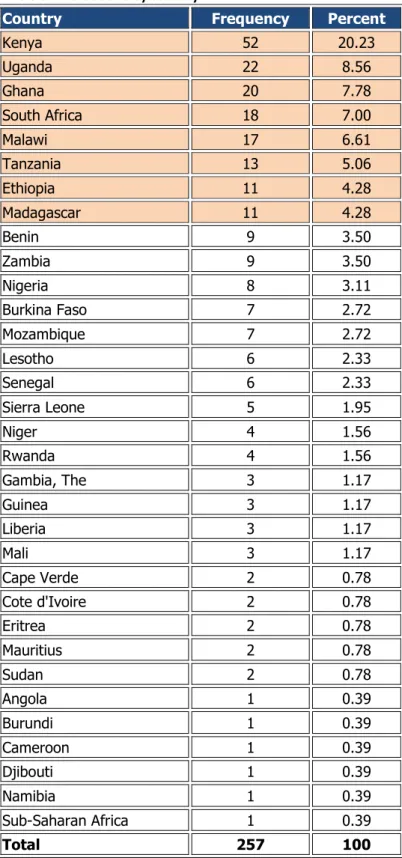
In the next set of descriptive statistics, we try to run a country level analysis to see the number of evaluations by country. Table 6 shows that Kenya is the leader with the highest number of impact evaluations being conducted in this country, followed by Uganda, Ghana, South Africa and Malawi. Amongst the 17 English-Speaking Countries of Sub-Saharan Africa where there are impact evaluations, 6 totalize 71% of the studies, Kenya being the leading country with 20%.
As of late 2010, about 52 rigorous impact evaluations have been or are being conducted in Kenya. What could be the possible reasons for such a large concentration of evaluations in Anglophone countries in general and Kenya in particular? One reason could be the commitment of the Kenyan government to evidence-based policy making, contended by The World Bank. Thus a part of the reason for concentration of evaluations can be explained by the government’s openness and acceptability to rigorous impact evaluation exercise. Another possible explanation could be the supply push- for example, the country team of World Bank for Kenya has been a major driving force for integrating rigorous impact evaluations into projects. The existence of ties between the implementing agencies like JPAL/IPA and the local NGOs which help in the conduct of fieldwork further pushes supply. For example, a large number of evaluations are concentrated in the Busia region of Kenya. For these reasons and the large scope of impact evaluation activities, Kenya is a focus country for the Africa Impact Evaluation Initiative (AIM) of The World Bank.
10
Table 6: Evaluations by country
Country Frequency Percent
Kenya 52 20.23 Uganda 22 8.56 Ghana 20 7.78 South Africa 18 7.00 Malawi 17 6.61 Tanzania 13 5.06 Ethiopia 11 4.28 Madagascar 11 4.28 Benin 9 3.50 Zambia 9 3.50 Nigeria 8 3.11 Burkina Faso 7 2.72 Mozambique 7 2.72 Lesotho 6 2.33 Senegal 6 2.33 Sierra Leone 5 1.95 Niger 4 1.56 Rwanda 4 1.56 Gambia, The 3 1.17 Guinea 3 1.17 Liberia 3 1.17 Mali 3 1.17 Cape Verde 2 0.78 Cote d'Ivoire 2 0.78 Eritrea 2 0.78 Mauritius 2 0.78 Sudan 2 0.78 Angola 1 0.39 Burundi 1 0.39 Cameroon 1 0.39 Djibouti 1 0.39 Namibia 1 0.39 Sub-Saharan Africa 1 0.39 Total 257 100
11
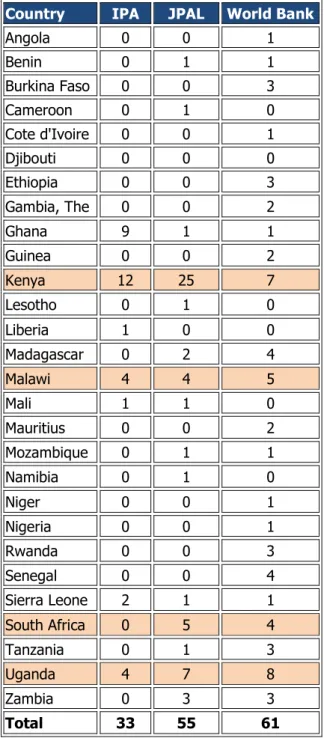
Table 7 shows the institutions which have been involved in conducting impact evaluations in different countries. We observe that JPAL is very active in Kenya. A lot of these JPAL evaluations are conducted with the help of The World Bank. World Bank is also found to be very active in Uganda ad Kenya.
Table 7: Implementing agencies in different countries
Country IPA JPAL World Bank
Angola 0 0 1 Benin 0 1 1 Burkina Faso 0 0 3 Cameroon 0 1 0 Cote d'Ivoire 0 0 1 Djibouti 0 0 0 Ethiopia 0 0 3 Gambia, The 0 0 2 Ghana 9 1 1 Guinea 0 0 2 Kenya 12 25 7 Lesotho 0 1 0 Liberia 1 0 0 Madagascar 0 2 4 Malawi 4 4 5 Mali 1 1 0 Mauritius 0 0 2 Mozambique 0 1 1 Namibia 0 1 0 Niger 0 0 1 Nigeria 0 0 1 Rwanda 0 0 3 Senegal 0 0 4 Sierra Leone 2 1 1 South Africa 0 5 4 Tanzania 0 1 3 Uganda 4 7 8 Zambia 0 3 3 Total 33 55 61
*This table has been shown only for evaluations by major implementing agencies Source: Database of impact evaluations in Sub- Saharan Africa, DIAL-IRD 2010
12
2.2
Thematic Spread
The list of themes/ sectors under which each program falls reflects a range of priority development issues and consolidates activities currently dispersed. The idea is to generate knowledge about each theme on development questions of the greatest concern and interest.
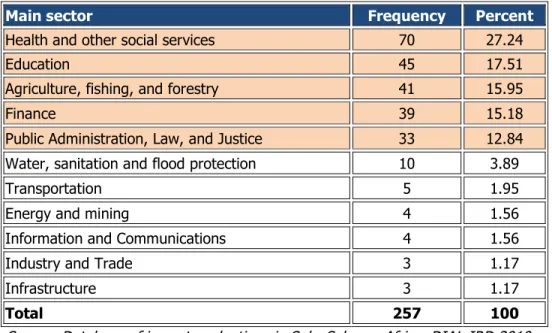
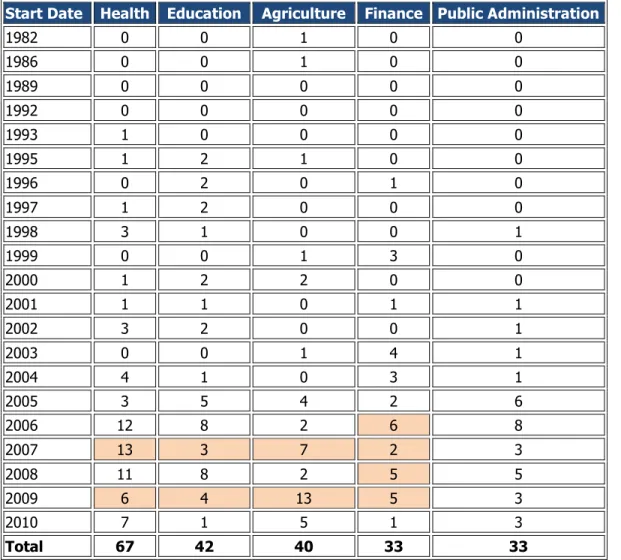
Tables 8 and 9 explore some of the questions on thematic segregation. As can be seen in the table below, the maximum number of evaluations is conducted under the theme of health (about 27%), with evaluations under the umbrella of education being a distant second at 17%. Evaluations under the purview of agriculture, microfinance and public administration follow as the third largest group with a share of 15-16% for each.
Table 8: Number of evaluations by theme
Main sector Frequency Percent
Health and other social services 70 27.24
Education 45 17.51
Agriculture, fishing, and forestry 41 15.95
Finance 39 15.18
Public Administration, Law, and Justice 33 12.84
Water, sanitation and flood protection 10 3.89
Transportation 5 1.95
Energy and mining 4 1.56
Information and Communications 4 1.56
Industry and Trade 3 1.17
Infrastructure 3 1.17
Total 257 100
Source: Database of impact evaluations in Sub- Saharan Africa, DIAL-IRD 2010
It is observed that health oriented evaluations have been the most popular for which the impact evaluation exercise has been carried (or is being carried out). If one observes the trend for the six largest themes (see table 9 below), it is clear that health oriented evaluations have gained momentum with a significant number of evaluations commencing between 2006- 2008. In the last 3-4 years, quite a few microfinance evaluations have been started, mostly undertaken by JPAL or IPA. The number of agriculture oriented evaluations has also increased in the recent past with 13 evaluations starting in 2009 alone.
13
Table 9: Cross tab of starting date and sector
Start Date Health Education Agriculture Finance Public Administration
1982 0 0 1 0 0 1986 0 0 1 0 0 1989 0 0 0 0 0 1992 0 0 0 0 0 1993 1 0 0 0 0 1995 1 2 1 0 0 1996 0 2 0 1 0 1997 1 2 0 0 0 1998 3 1 0 0 1 1999 0 0 1 3 0 2000 1 2 2 0 0 2001 1 1 0 1 1 2002 3 2 0 0 1 2003 0 0 1 4 1 2004 4 1 0 3 1 2005 3 5 4 2 6 2006 12 8 2 6 8 2007 13 3 7 2 3 2008 11 8 2 5 5 2009 6 4 13 5 3 2010 7 1 5 1 3 Total 67 42 40 33 33
Note: This table only presents evaluations for five major sectors
Source: Database of impact evaluations in Sub- Saharan Africa, DIAL-IRD 2010
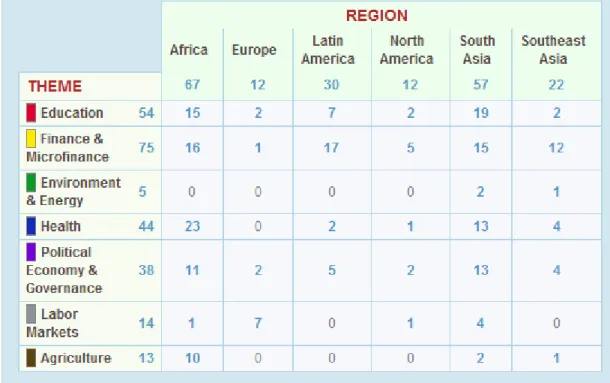
What could explain the concentration of evaluations in particular theme? If one is to compare the distribution of programs across different thematic clusters among the regions of the developing world, interesting revelations are unfolded. The table 10 below has been extracted from the JPAL website. Although the classification of sectors used here is different from the one we adopted, this table sheds some light on inter-region comparisons. One possible explanation of a large number of health related interventions could be the existence of HIV/AIDS related and malaria oriented programs in Africa over other regions. Malaria causes about 2414 deaths a day, over 90% of which are in Sub-Sahara Africa. It is both a disease of poverty and a cause of slowing economic growth by 1.3% per year in endemic areas2. A lot of health related interventions are also found to be commonplace in the South Asia region, due to the existence of malaria in this region along with Africa. An estimated 1,216 million people or 70% of the total population of SEA Region are at risk of malaria. Out of which around 29% population at moderate to high risk of malaria, 71% are at low risk of malaria where as remaining 30% of population free from malaria.3 Overall, one can observe that the concentration of evaluations across themes is similar for
2
Source: The global burden of disease: 2004 update 3
14
South Asia and Africa largely because of the existence of similar priority development issues in these two regions.
Table 10: Number of evaluations by region and theme
Source: JPAL Website
2.3
Composition of research teams
As per the Development Impact Evaluation Initiative (DIME), “Each program would develop a coordinated approach for servicing similar operations in a multi-country context, and be responsible for a series of agreed programmatic and country-specific activities”. Since its inception in 2009, DIME has geared towards the greater involvement of policy makers and country project teams and to build internal capacity for conducting impact evaluations and the establishment of a technical advisory group. Greater synergy among researchers and policy- makers has been a hallmark in the recent impact evaluations.
As per table 1, we have information that local African partners (research centers, Ministries and universities) were involved in the implementation of 117 evaluations. The involvement of local agencies in implementation has thus been rather optimistic. However, while African partners have been involved in different stages of program implementation in the country under consideration, there have not been many research papers for which African authors can be credited. The following figure 3 shows some statistics on this aspect. Of all evaluations for which we have information on the authors, we find that in only 11% of them, African authors have been involved in writing the research paper. African authors working in international universities and organizations outside of Africa have been involved in 8 evaluations. Table 11 shows that most of these African authors have been involved in evaluations implemented by The World Bank. Finally, table 12 gives the names of the African authors, their affiliations and the evaluations they have been involved in. This statistic calls for the promotion of the idea of involving African authors and making them an integral part of the process.
15
Figure 3: Whether an African author has been involved in writing the research paper (number of evaluations)
97 13 8 0 2 0 4 0 6 0 8 0 F re q u e n c y
None Yes, from African inst Yes, from overseas inst.
Source: Database of impact evaluations in Sub- Saharan Africa, DIAL-IRD 2010
Table 11: Cross tab of African author with implementing agency
Implementing Agency None Yes, from African institution Yes, from overseas Total
DIAL-IRD 2 0 0 2
IPA 27 1 2 30
JPAL 44 1 0 45
Mathematica Policy Research 0 0 1 1
Paris School of Economics 1 0 0 1
World Bank 12 5 2 19
Total 86 7 5 98*
*We have information about the authors of 117 evaluations
16
Table 12: Details of African authors
Evaluation name Author University/ Organization affiliation
African authors
Information for Accountability, Decentralizing Public Education: A Randomized Evaluation in Benin
Jean Adanguidi Leonard Wantchekon
University of Abomey-calavi, Benin NYU
Productive Safety-Nets Program in Ethiopia Alemayehu Seyoum
Taffesse
IFPRI- Addis Ababa From the Ground Up - Impacts of a Pro-Poor
Community-Driven Development Project in Nigeria
Dayo P., Muhammed K. Yahaya, Gbenga Adebowale, Tunji Arokoyo, Ephraim Nkonya
Nasarawa State University, Keffi University of Ibadan, Nigeria Enplan Group, Nigeria
Federal Ministry of Agriculture, Abuja, Nigeria IFRPI, Washington DC
Performance Based Contracting for HIV/AIDS Services in Rwanda
Paulin Basinga National University of Rwanda
Performance Based Contracting for HIV/AIDS Services in Rwanda
Paulin Basinga, Agnes Binagwaho
National University of Rwanda
Rwanda’s National Commission to Fight AIDS
Nutrition Enhancement Project in Senegal Biram Ndiaye,
Abdoulaye Ka, Khadidiatou Dieng
Cellule de Lutte contre Malnutrition, Dakar, Senegal
A Youth Wage Subsidy Experiment for South Africa Dr. Neil Rankin, David Faulkner
Macroeconomic Policy from National Treasury, Republic of South Africa University of the Witwatersrand The Impact of Unconditional Cash Transfers on
Nutrition: The South African Child Support Grant
Ingrid Woolard University of Cape Town
Increased Weight Gain with Mass Deworming Given During Child Health Days In Uganda
Joseph Konde-Lule, Isaac Sebuliba
Institute of Public Health, Makerere University, Kampala, Uganda The short-term impacts of a schooling conditional
cash transfer program on the sexual behavior of young women in Malawi
Ephraim Chirwa University of Malawi
Household Consumption and Natural Resource Management around National Parks in Zambia
Gelson Tembo University of Zambia
HIV/AIDS Prevention Education in Primary Schools in Kenya
Samuel Sinei Jomo Kenyatta University of Agriculture and
Technology, Kenya Decentralization: A Cautionary Tale - Public Finance
in Kenya
Robert Namunyu Action for child development trust, Kenya
African authors working for international organizations outside Africa
Educational and Health Impacts of Two School Feeding Schemes : Evidence from a Randomized Trial in Rural Burkina Faso
Harounan Kazianga Oklahoma State University
Evaluation of T&V-Based Extension in Burkina Faso Mathurin Gbetibouo World Bank, Burundi Savings Account Labeling and Financial Literacy
Training for Susu Customers in Ghana
Edward Kutsoati Tufts University
Clientelism and Voting Behavior: Evidence from a Field Experiment in Benin
Leonard Wantchekon New York University Examining Effects of Crop Price Insurance for
Farmers in Ghana
Edward Kutsoati Impact of farm-system management extension in
Benin
Leonard Wantchekon New York University
BRIGHT Education Project in Burkina Faso Harounan Kazianga Oklahoma State University
Control of Corruption in Tanzania Leonard Wantchekon New York University
17
2.4
Financial and Operational Partners
Table 13 sheds some light on the key financial players for impact evaluations. World Bank is the pioneer in financing these evaluations/projects, with 3IE, MCC, DFID, USAID and AFD as distant followers. Out of the 112 evaluations/projects financed by The World Bank, we have information that at least 45 are also implemented by them and 19 by JPAL (look at table 14 for details).
Table 13: Number of evaluations/projects financed by different agencies
Financier I Frequency
IDA (World Bank) 112
3IE 27
Millennium Challenge Corporation 26
DFID 12
USAID 9
AFD 8
MacArthur Foundation 7
Bill and Melinda Gates Foundation 6
IFAD 6
National Science Foundation 6
World Food Program 5
Acumen Fund 4
MCA 4
Partnership for Child Development 4
Japanese Policy and Human Resources Dev /JFSD/Other 4
African Development Bank 4
Hewlett Foundation 3
European Commission 3
Swedish International Development Agency 3
IDRB 2
Adessium Foundation 2
Global Development Network 2
IDRC 2
Government of Norway 2
Harvard Business School/ Harvard Center for International Devp. 2
Exxon Mobil Foundation 2
Canadian International Development Agency 2
Italian Trust Fund for Children and You/ Italy, Govt. Of 2
Population Service International (PSI) 2
Note: There is more than 1 funder for each evaluation; hence there is multiple counting of evaluations Source: Database of impact evaluations in Sub- Saharan Africa, DIAL-IRD 2010
18
Implementing Agency Evaluations financed by the World Bank
IPA 6
JPAL 19
WB 45
Total 70
*Missing values: 42
Source: Database of impact evaluations in Sub- Saharan Africa, DIAL-IRD 2010
Finally, as best possible, for evaluations in Kenya, South Africa and Senegal, we distinguished between evaluations on the basis of their focus (which is given under “Research Orientation” in the database)- that is whether they were experiments, policy oriented or public policy. Out of 39 evaluations, 34 are experiments. However, one must exercise caution on this interpretation. It is difficult to know if, finally the reform or policy-test have or have not been applied by the local or national governments.
19
3
Limitations and Conclusion
Impact evaluation has recently gained significant momentum with good reason, that is they help to quantify the social impacts of interventions in the varied fields like health, education, agriculture, infrastructure, microfinance to name a few. With increased importance being attached to evaluation, one spillover effect could be capacity development in African countries with increased participation of African universities and local teams. It is in this respect that this report sheds some light on the recent trends in the impact evaluations.
Before outlining the key results of this report, a few caveats deserve mention pointing that these results should be read with caution. The databases on which these results rely have been based on the evaluations conducted by a few organizations. Since this is a very dynamic area currently and because the number of evaluations is rapidly increasing, adding more evaluations might change these results. Continuous update of this database would thus be rewarding. Another cautioning factor is the missing information, especially on the implementing agency for the evaluations listed on The World Bank website. This addition would definitely make the database richer. Lastly, for most evaluations, there is more than one financier. Some of this information is drawn from the ‘Acknowledgements’ section of the research paper, this information might be erroneous.
One of the key trends observed is the increase in the number of evaluations with an impact evaluation component in the last 5-6 years. This increase is largely restricted to Anglophone countries, the largest number of evaluations being in Kenya followed by Uganda. For example, out of the 86 JPAL and IPA evaluations, 79 are operational in Anglophone countries, with 36 evaluations being in Kenya alone. The World Bank is also heavily involved in Kenya along with Uganda. In terms of the thematic composition, 27% of the evaluations are health- oriented followed by education, agriculture and microfinance as the key sectors. In the recent past, an increase has been observed in the number of microfinance, agriculture and health oriented evaluations with most microfinance evaluations being under the JPAL/ IPA umbrella. While African partners (like local NGOs, Ministries etc.) have been involved in different stages of program implementation in the country under consideration, there have not been many research papers for which African authors can be credited. Only 11% of the studies on which we have information have an African author involved in writing the research paper. The key financier of these evaluations/projects is International Development Association (IDA or The World Bank). Other bilateral development agencies have also financially contributed to these projects.
Given the findings above, it is clear that indeed we are a long way away from heavy involvement of African nationals in impact evaluations. Continued commitment from various stakeholders would be imperative for such an initiative to work and gather momentum.