Fabricating Management Practices:
“Responsible Care” and Corporate Social
Responsibility
Nicolas Berland Professor DRM - CREFIGE Paris Dauphine University
Marie-Claire Loison Post-Graduate student
DRM - CREFIGE Paris Dauphine University
Research Paper
Purpose
This study focuses on the policy of Corporate Social Responsibility (CSR) launched in the chemical industry in the 1980s and known as “Responsible Care”. The debate surrounding this issue prompts us to question the ever-changing nature of this policy and the way to measure the performance achieved.
Methodology
Our findings are drawn from analysis of a double set of data including a longitudinal survey and a current case study. Blending these two data sets allows a better understanding of the ongoing building process of “Responsible Care” and, more broadly, of corporate social responsibility.
Findings
This paper asserts that, contrary to the common wisdom developed in research, companies do not simply react to stakeholder pressure. Companies autonomously develop ways to protect their environment and so contribute to changing Society’s expectations. Thus, performance cannot be read without a dynamic perspective in mind.
Research limitations/implications
Our findings lead us to reconsider the assessment of companies’ sustainable performances by taking into account the fabricating process of sustainable activities.
The main limitation of this research stems from the single unit of analysis considered. Broader studies will be necessary to enrich our understanding of corporate policies.
Originality/value of the paper
Our paper stands apart from the traditional view of organizations as cynical actors and attempts to provide a more complex picture of the behaviours observed.
Keywords: “Responsible Care”, Corporate Social Responsibility, performance measurement, performance
Corporate Social Responsibility (CSR) has become a concern that is increasingly displayed by organisations. However, this concern is not new and has already been the subject of numerous research papers (Loison and Pezet, 2006). Today, organisations should take into account – over and above their economic performances – their social and environmental performances. The modes of measuring and monitoring this broader performance have become more complicated and confusing as a result. Indeed, it is possible to doubt the sincerity of companies that voluntarily develop a CSR policy. The aim of this research paper is therefore to understand how such systems of monitoring and measuring performance emerge and function to respond to Society’s expectations.
CSR brings us back to the classic question of the relationships between managerial practices and Society’s expectations. Stakeholder Theory (Freeman, 1984) and Neo-institutional Theory (Meyer and Rowan, 1977; DiMaggio and Powell, 1983; Fligstein, 1990; Scott, 1995, 2001) constitute the most commonly mobilised theoretical references for studying the influence of societal expectations on accounting and managerial practices. The rise of sociology in the field of accountancy (Hopwood, 1987; Miller, 1991) has also enabled us to better understand how Society and institutions influence accounting practices. Yet, this rise also requires us to study the way in which accounting practices in turn influence Society’s expectations. Consequently, our research sets out to understand how a practice of measuring and monitoring a CSR policy is institutionalised.
To conduct this study, we focus on a policy of CSR launched by the chemical industry in the 1980s known as “Responsible Care” (RC). This policy is noteworthy because it covers the chemical industry, one of the industries that concentrate heavily on CSR issues. It constitutes a policy of industry self-regulation, which has made it appear suspect in the eyes of many. This issue boils down to discussing performance, a social construct to be determined as a prerequisite to measurement. The debate surrounding CSR also prompts us to question the
nature – voluntary or constrained (i.e. under stakeholder pressure) – of policies that drive corporate managers to conserve natural and human resources. Our findings, drawn from analysis of a double set of both longitudinal and instantaneous data, show that reality draws from both voluntary and constrained policies. It appears that stakeholder pressures shape corporate practices but that, equally, corporate practices in turn alter Society’s expectations. In the first section of this paper, we lay out the issues that underpin our research question. We then outline the genealogy of RC and describe one of its contemporary practices through a case study.
Literature Review on “Responsible Care”
RC is an emblematic policy of CSR. However, it raises questions as to how sustainable management works and how effective it is.
What is “Responsible Care”?
RC is an initiative developed by the chemical industry itself with the aim of regulating negative externalities caused by the profession. Companies from the sector are invited to comply with the policy in order to become members of the professional association. The policy hinges on ten guiding principles and six codes of management practices that break down into 106 management practices (Cherry and Weiler, 1998; King and Lenox, 2000). Melnyk et al. (2002) identify three features that characterise environmental management policies: the aim of the system set up (to handle problems or achieve results); the degree of focus on the environment; and the nature of verifying the results attained (internal or external assessment). It is possible to position RC with respect to these three dimensions. RC stems from a greater focus on processes and actions and characteristically involves focusing directly on the environment. Assessing results is internal to companies, a feature that correlates to the idea of self-regulation of the chemical industry. RC enacts an imperative for companies to focus on implementing means rather than achieving results. It does not specify a performance
level to be reached so as to accommodate the different situations of companies in the sector. Members move forward at the pace that suits them best and all that is required of them is to display continuous progress. RC is a flagship example of a self-regulation policy without sanctions (King and Lenox, 2000). However, according to Reish (1998), some leading companies in the sector deem that it has not been very successful and that sanctions may be needed to prevent free riding.
“Responsible Care” in the New Institutional Sociology (NIS) Perspective
RC has been mostly studied from the standpoint of neo-institutional theories. Two major theoretical issues have been discussed. The first covers the reasons that drive companies to develop such policies on a voluntary basis. On this point, the school of neo-institutional sociology provides analysis and deployable notions relating to the theme of CSR. For example, Hoffman (1999), adopting the framework outlined by Scott (2001), analysed the institutional factors that led the chemical industry, over a long period, to further integrate environmental concerns.
The second research question deals with the effectiveness of CSR policies that are voluntarily implemented by chemical companies. Few research papers have taken self-regulatory policies and their effectiveness as their theme. The main study covers the nuclear industry (Rees, 1994). Contrary to what occurs in the nuclear industry, RC does not require a third party to monitor the performance of its members: that would limit its effectiveness. Sanctions associated with RC are fairly weak and consist essentially, and infrequently, in revoking the membership of the offending party. For supporters of this policy, it is deemed to enable the institutionalisation of best environmental practices. According to Gunningham (1995) and Rees (1997), self-regulation can shape behaviours. Coercion mechanisms are public exposure and shame, altering the preferences of actors (new norms), and even raising performance through learning and improving collective performance. These normative forces also change
preferences. As regards mimetic forces, they enable the diffusion of best practices and foster information sharing. The very fact of taking RC into consideration may already be changing practices. Thus, RC puts into play a set of isomorphic pressures (DiMaggio and Powell, 1983) that gradually lead to a homogenisation and an institutionalisation of practices within the chemical industry. Companies that adopt RC consequently constitute an organisational field in the sense employed by Fligstein (1990), meaning a set of organisations seeking stability. Critics of RC think, on the contrary, that it fosters free-riding phenomena because no formal sanctions are associated with it. For tenants of opportunism, RC serves as a smokescreen and fosters free-riding-type behaviours. RC practices may be adopted symbolically (Abrahamson and Rosenkopf, 1993; Meyer and Rowan, 1977; Oliver, 1991; Power, 1997). This being the case, some companies may still have an interest in adopting such policies even if free riding occurs.
“Responsible Care”: Beyond the NIS Perspective
NIS perspectives with regard to RC leave several questions unanswered. Firstly, does RC only constitute a symbolic discourse enabling the chemical industry to legitimise its activities or has it been truly integrated into the management systems of companies in the sector? Secondly, do companies need external pressure and a verification organisation to implement RC or could stakeholder pressure, or quite simply voluntary behaviour, suffice for such a system to work? Thirdly, is RC effective in reducing the environmental impact of externalities emanating from chemical companies?
It is our opinion that these issues cannot be fully studied without taking account of the process of institutionalisation – still in progress – of RC. It is then a matter of understanding how RC will become what it has yet to become (Burchell et al., 1980, 1985; Hopwood, 1987; Hopwood and Miller, 1994; Miller and O’Leary, 1987), namely analysing how we move from a set of hardly formalised, barely accepted, in short scarcely institutionalised practices,
towards practices with a significantly greater degree of acceptance. Previous studies have taken an interest in phenomena of institutionalisation of practices (Barley and Tolbert, 1997; Hasselblath and Kallinikos, 2000). Society does exert expectations on managerial practices, but little has been written about the origins of the solutions implemented by companies and the way in which these solutions continue to evolve. On the interactions between companies and stakeholders, which nonetheless constitute the very process of institutionalisation, current research remains equally silent. It is the whole of this phenomenon that underlies our research question: how are practices that are implemented in the framework of RC institutionalised within the chemical industry?
Data Gathering and Methodology
To answer our research question, we gathered two types of empirical data. Firstly, we summarised the history of RC. This historical analysis, insufficient in itself, was then supplemented by a case study of contemporary practices in a chemical group.
According to Scandura and Williams (2000), field studies are increasingly used in management research, especially field studies using secondary sources. Yet field study may also compromise triangulation, internal validity, external validity, and construct validity. Our double research strategy implements two levels of triangulation and thus raises the external validity of our research .
The First Data Stream
We first summarised the history of RC as it is presented on the Internet site of the Canadian Chemical Producers’ Association (CCPA1). This story was drawn from the writing of J.
Arthur O’Connor (a former board member of this association) about his personal experience, the archives of the CCPA and twenty hours of interviews with the main actors involved in this story. We selected excerpts that enable us to describe the genealogy of RC. These extracts are
1 The CCPA (or ACFPC for Association Canadienne des Fabricants de Produits Chimiques) represents 70
companies that are members and partners of Responsible Care, operating over 200 plants in Canada and responsible for over 90% of the national production of chemical products.
clearly marked by a smaller font size in our text. We then triangulated this corpus of data using various documents covering RC (LaPlante, 1998; Prakash, 2000; Bélanger, 2005). Firstly, we looked for Society’s influences on the diffusion of RC. In order to embody the various actors, we then drew up a list of the stakeholders (Freeman, 1984) present in our two case data sets. Post, Preston and Sachs (2002) identify ten categories of stakeholders. From the data gathered, we finally retained the following categories: the chemical industry, governments and regulatory authorities, professional associations, the press and media, associations and NGOs, local communities and citizens, public opinion, investors (shareowners and lenders), employees, trade unions, customers and users, and suppliers. Subsequently, we identified the way industrial groups have acted autonomously to enable the idea of environmental management to move forward on its own accord. The final phase of creating an explanation is enactment: creating a story. With this goal in mind, we made a presentation of our story using verbatim quotations and critical examples.
The Second Data Stream
Our choice of case study is both theoretical and opportunistic (Yin, 1994). Choosing Rhodia is firstly justified by its numerous citations in the press for good results with respect to the environment2. However, this company was also chosen because we had been conducting a
previous study there for four years. This study led us to gather, indirectly, much information on RC. During informal discussions, the actors we encountered talked about RC both frequently and spontaneously.
By analysing these initial data, we were able to contact the company’s actors knowing exactly what we wanted to validate. The researcher then returned to the field equipped with a grid for semi-directive theoretical interviews. Three managers (head office, functional and operational) were questioned about their experiences and practices with regard to RC. One of
2 For example, the press release from Vigeo, a CSR rating agency in France on 6th June 2006, and the Global
the persons interviewed was a former trade union representative who had developed his vision of RC as a union representative and subsequently as a manager. These interviews were supplemented with document analysis (internal reports and the Internet site).
Finally, three series of information were available for our study. Firstly, there was information gathered during the previous study. The interest of this information essentially relates to its reliability because it was gathered from actors observed with respect to another, more financial, problematic. Secondly, there was information of a factual nature regarding the company’s practices (for instance, spreadsheet models or reporting procedures). Thirdly, there were the actors’ stories, anecdotes and critical incidents with respect to RC practices. Our study shows that the latter data are by far the most interesting for our problematic since they generate new ideas (Eisenhardt, 1989).
Using these elements, a descriptive case study was written by the researcher once the data had been gathered and submitted to each of the persons encountered at Rhodia for validation.
The Genealogy and Current Practices of “Responsible Care”
The Genealogy of “Responsible Care”
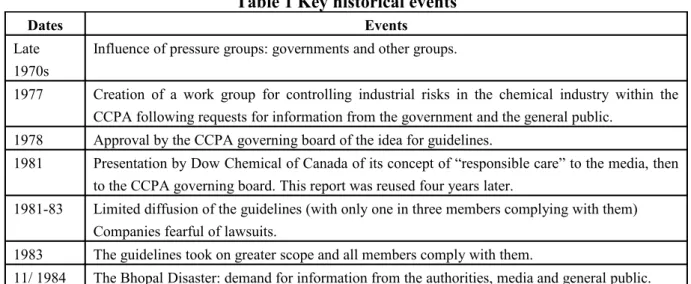
RC is a CCPA-instigated initiative. This policy was first developed in Canada before spreading in the second half of the 1980s, firstly across the United States, then into Europe and finally worldwide.
Table 1 Key historical events
Dates Events
Late 1970s
Influence of pressure groups: governments and other groups.
1977 Creation of a work group for controlling industrial risks in the chemical industry within the CCPA following requests for information from the government and the general public.
1978 Approval by the CCPA governing board of the idea for guidelines.
1981 Presentation by Dow Chemical of Canada of its concept of “responsible care” to the media, then to the CCPA governing board. This report was reused four years later.
1981-83 Limited diffusion of the guidelines (with only one in three members complying with them) Companies fearful of lawsuits.
1983 The guidelines took on greater scope and all members comply with them.
1984 Implementation of a safety policy following Bhopal.
The guidelines became mandatory for all members of the association.
The CCPA to be informed of any incidents occurring in plants (with a mechanism for respecting confidentiality).
Summer 1985
The Sarnia Incident: the creature from the black lagoon (the blob). Intervention by Greenpeace and the media.
Relaunch of the cross-referenced audit processes and reminder of the conditions for membership to the association.
Late 1985 Political agitation, risk of legislative attack, “crisis of confidence in the population”. Early
1986
Start of a policy of “quick victories” to bring about the adhesion of members and of the general public.
Creation of a code of awareness based on the model of the Chemical Manufacturers’ Association (CMA) in the USA.
Late 1986 Approval of the first code of practice.
Policy of openness and dialogue: positive reaction from the media and the general public.
1986 Development of a link between the Brundtland Report and Responsible Care following an individual initiative by a Dow manager, development of the social and societal aspects.
1986 Creation of an external assessment panel composed of stakeholders. 1988 Implementation of RC in the USA.
11/1988 Approval and appropriation of the codes of practice. 1986-90 Harmonisation of the guidelines and the codes of practice. 1990-92 Application of the codes of practice (deadline: 1992).
Perceived risk “that postponing the deadline [would] entail a loss of credibility and a tightening of regulation”.
1993 The process of public verification was initiated.
1994 CCPA published A Primer on Responsible Care and Sustainable Development in which it tried to describe both the cohesion of SD and RC topics and, equally, the grey areas where the scope of sustainable development clearly extended beyond RC.
The genealogy of RC shows that the development of this policy was an initiative proposed by several companies, then expanded to cover the whole industry in the guise of responding to stakeholder pressure. An interaction mechanism was gradually put in place to change the practices and expectations of the different actors.
The process has taken almost two decades. There was no strategic plan. There was no grand design any more than there can be a grand design for the ever-changing expectations of society […] Each new phase was triggered by an event or conditions stemming from the external environment and at each new step there was a belief that what was being done was the right thing. (O’Connor)
A Private Initiative
RC first appeared as an internal concern in several companies that subsequently attempted to recommend it to the industry as best practice. Although pressure – notably from the
government – was exerted, it was not considerable, at least at the beginning of the process, and it cannot explain the genesis of practices that seemed to be primarily private initiatives. The roots stretch back to Canada in the late 1970s. In 1977, the CCPA set up a working group for managing industrial risks in the chemical industry to contain the environmental impact caused by its production operations. There was also a need to respond to requests from the Canadian government and the general public, which were scrutinising the safety of transporting chemical products.
The driving forces at the time were that governments and others were beginning to raise questions about the health effects and safety of chemicals. The sensitivity was focused mainly around transportation. (O’Connor)
In that period, pressures to regulate the chemical industry were building up and were particularly exacerbated by the major derailment of a hazardous-material train in late 1979 that resulted in the evacuation of Canada’s fifth largest city. (Bélanger, 2005)
The group drew up recommendations that went beyond the simple framework of transportation and which the group suggested formalising in the form of recommended guidelines. It also suggested that membership of the CCPA be conditioned by compliance with these guidelines. The organisation therefore moved towards modes of self-control by the profession itself. In May 1978, the recommendations were approved by the CCPA but only one third of member companies signed the protocol. Yet, on the sidelines, the guiding principles enabling reasonable management were being improved upon in certain companies. It was these private Canadian initiatives that would finally take centre stage at the beginning of 1980s.
In October of 1981, Boldt, vice-president of Dow Chemical of Canada, presented the concept of Responsible Care to the board as part of the TMC's work plan for the coming year. He was chairman of the committee at the time. As Boldt puts it, "Either they didn't understand it or I didn't describe it well, but the program was not approved. Probably because it meant a change in the way management had historically managed."
However, the association did make use of the guiding principles as appendices to various submissions to government but there was no formal document per se which could be used to give public exposure to them. It's fair to say that the principles did not receive much, if any, public exposure at the membership level. It was known at the time that the legal advice provided to some of the members raised the spectre of potential liability associated with these statements. (O’Connor)
It therefore appears clear that there was resistance from the companies to its widespread adoption based on the fear of litigation or of wrongful use of any information provided.
Perhaps some actors – notably the weakest companies – also feared losing their rank in the face of this strengthening of competition, although no current data allows us to assert any such ulterior motive. The guiding principles of RC, which aim to steer the means to implement – in line with a logic of continuous progress – rather than the results to achieve, would actually plead in favour of the absence of any ulterior motive to regulate competition. The issue was then sidelined until 1983, if we are to believe the minutes taken at CCPA board meetings. For the first time, the guiding principles took on an official dimension and all members were to comply. The general framework of RC was thus in place, but at that time nothing obliged the companies to go beyond their simple commitment to the guiding principles and to implement genuine practices of responsible care.
The fact that the members accepted what was considered premature three or four years earlier is a clear indication of an overall shift in attitude. This was all before the industry's feet were put to the fire by Bhopal. The mind-set was beginning to form and there was a commitment to the guiding principles and a Responsible Care framework already existed. However, it still took the right ingredients to apply the resources and will to build on that framework. (O’Connor)
A Widespread Adoption under Pressure from Public Opinion
Developing the implementation of guiding principles for RC accelerated from 1984 onwards. Indeed, it was at this time that the “unthinkable” happened: the Bhopal disaster. The explosion of a Methyl Isocyanate storage tank on the site of the American multinational Union Carbide located in Bhopal (India) released a toxic cloud resulting in the poisoning of thousands of victims. The widespread adoption of RC was consequently the fruit of pressure from government, media, public opinion, local communities and citizens.
The first response of the CCPA was to set up systematic self-assessment practices for the risks involved. A task force was in charge of developing a method of verifying safety, applicable to both chemical plants and their relations with local communities.
This task force under Finn Hoveland of DuPont subsequently produced a document titled Safety Assessment Process which had two components: internal programs dealing with the plant and external programs for outside the plant fence. […] The external programs component gave rise to the development of the community awareness and emergency response program which was formally activated on June 4, 1986. (O’Connor)
These verification procedures encountered implementation problems in certain companies notably due to issues relating to the confidentiality of production techniques and liability. Thus, although certain companies were truly committed to the process in that period of time, others still attempted to delay or limit its adoption, despite growing pressure from stakeholders following Bhopal.
One board member stated emphatically that he did not want anyone from outside his company going through his plants […] The tough part for the members was that, for the first time, they were going to have to report to the association on matters related to their internal practices. This marked a quantum change in the role of the association and one which gave a great deal of heartburn to the members. Much of the concern stemmed from the potential liability attached to the information. (O’Connor)
But a series of accidents drove companies to move towards greater transparency and not simply make do with the technical management of safety issues. It was a question of opening up to the outside world. Canadian business leaders then shifted from a “private” safety policy to a public policy that clearly disclosed the issues at stake.
In the summer of 1985 Sarnia experienced its own version of the "creature from the black lagoon" in the form of "the blob". An accidental release of perchlorethylene into the St. Clair River caught the attention of Greenpeace during its annual visit to the Great Lakes. "The public was saying to us, 'not only do we not know what's going on, but we're scared to death about the involuntary risk you create for us in your plants and in the chemicals you sell and handle. And, by the way, it really is an invisible industry because we don't know how we benefit from these damn things and yet there are risks for us... and you're not telling us what you already know’." […] "The industry was becoming visible, but for all the wrong reasons." (O’Connor)
These accidents did not leave the government ambivalent, and ecologist groups and the media began to react. The chemical industry went through a real crisis of confidence in a context in which, more broadly, the environment constituted one of the main public concerns.
As a result, the approaches initiated several years earlier were given a concrete and official point of application. Yet, contrary to the stance adopted by the Americans after Bhopal, the Canadian response to this disaster was more oriented towards managing industrial risks than managing public opinion. From 1986 onwards, to the technical dimensions of RC were added the guiding principles and an ethic underpinning the whole device.
After approving the codes of practices, the association implicated its members in a policy of openness and dialogue with the general public and local communities, entailing a positive
reaction from the media and public opinion. In addition, a panel of independent members was set up to provide an outside point of view. This panel exerted its influence at the level of the professional organisation rather than at the individual company level.
The panel was seen originally as a source of informed opinion on potential or emerging public concerns over health and environment. As part of that process it was expected that it would advise the association members on their practices and the appropriate changes that might be made to them. It was never used as a means to influence the attitudes of panel members or the environmental community. […] Its members were selected based on their areas of interest and not because they belonged to any particular interest group. (O’Connor)
Convinced that the local community was entitled to know the risks to which it was exposed, the panel proposed a policy on the community’s right to know. Finally, under its influence, the association developed a set of protocols to follow whenever the commitment of a member was called into question.
An International Extension of the Industry’s Initiative
Over time, the initiative – still exclusively Canadian in 1985 – was diffused on an international level. From the local, the solution became global. Yet again, the initiative came from the American industry, undoubtedly driven by strong mimetism.
Responsible Care was never envisioned as an international movement. It just happened. There is no doubt in anyone's mind that if it had not been for the U.S. involvement it would never have expanded at the rate it did, if at all. (O’Connor)
The empirical elements presented here illustrate the interactions that exist between the company and Society within the framework of developing a device for sustainable management. The data gathered suggest that these interactions are not one-way – from stakeholders to companies – but that companies also contribute to moving Society’s expectations forward as a whole. Beyond companies, stakeholders are consequently relays for these concerns and contribute to modifying corporate practices. The Canadian panel set up to monitor RC, for instance, played a proactive role in developing practices. These practices therefore appear to be rather more a co-construction between company and Society than a response from companies to stimuli. Do we uncover these same reciprocal Society-corporate practice influences when we examine the contemporary case of a company applying RC?
CSR and “Responsible Care” at Rhodia
Following this longitudinal analysis of the origins of RC, we propose in this section to study how a company applies RC. We should assess the way in which actors use this management policy if we are to uncover the behaviours of actors as described in the historical section. The monitoring of RC policy at Rhodia is performed using three main instruments that are totally integrated into the group’s own management system: audits, performance indicators, and a policy of transparency and dialogue.
Audits enable the company to establish a diagnostic of the situation and notably to identify points for improvement for each of the entities audited. The company ensures the exhaustiveness of this analysis by conducting three types of complementary on-site audits. “System” audits are performed by the group every three years. Through this audit, the variance that exists between the reality and the benchmark is measured. Action plans and correction actions are then launched and are subject to monitoring quarterly by the members of the site’s management. Field-based audits aim to verify in the field the right appropriation of the CSR philosophy by operational managers. Members of management verify best practices and deploy the right words rather than sanctions. Finally, there exist equipment audits. The choice of points to audit is made by operational managers and validated by the safety department. These audits are supervised by senior managers. This is an opportunity to initiate the sharing of best practices, to help those who encounter difficulties and to invest in improving key factors.
These audits do not enable the company to reach preset goals but, instead, to progress continuously in improving its environmental and social performance. Indeed, the results achieved sometimes go beyond the expectations of stakeholders who are not always aware of the technical possibilities provided by this approach to continuous progress.
Different performance indicators enable the company to measure the effort made with regard to RC. Defining these indicators is largely based on the 1998 reporting guidelines recommended by the European Chemical Industry Council (CEFIC) and the Global Reporting Initiative (GRI) for chemical companies. To monitor indicators, reporting tools have been created. Consequently, a “RC Statement” is available on the group’s Intranet and accessible to all personnel. Certain RC indicators are also subject to monthly release in the form of a letter for the three levels group/companies/entities. A worldwide version of the set of indicators is also drawn up annually in both computer-generated format and in the form of a sustainable development report. In light of pressure from the authorities, the media, public opinion and the growing expectations of the set of stakeholders, these documents constitute tools for Rhodia to communicate with its stakeholders. These indicators have been integrated for several years, enabling notable trends to be measured. It is quite common for the indicators to record values that are well below legal requirements. In this case, the legal norm and the demands of stakeholders tend to fall in line with the company’s performance over time.
The case of Legionnaires’ disease
To control Legionnaires’ disease, the Rhodia group set a frequency of counts in its cooling towers: twelve counts must be performed every year. It was a question of moving away from an obligation to achieve results (an indicator displaying an absence of Legionnaires’ bacteria) towards an obligation to establish and maintain control where fluctuations are allowed within authorised limits. This is why the number of measurements has been increased in order to measure the phenomenon more frequently, to avoid being taken by surprise, and to be able to plan corrective action. Every year, an inquiry is conducted into this aspect. The figures are communicated to the Ministry of Ecology and Sustainable Development regardless of whether they are good or bad. The goal is to create trust with the governing body by being transparent. This then enables us to manage crises better.
Rhodia’s practices may then be taken on board by the Regional bodies governing Industry, Research and the Environment (DRIRE - Directions Régionales de l'Industrie, de la Recherche et de l'Environnement), which adapts its by-laws as a result. This is also explained by the presence of Rhodia employees in the various national bodies. Whenever demanding, high-performance tools are developed internally, it is gratifying to see them receive recognition afterwards. This is why the Ministry of Ecology will soon require twelve annual counts of legionnaires’ bacteria with regard to water-cooling towers.
Reporting the indicators retained poses a number of difficulties. The first difficulty arises from the heterogeneity and the subjectivity that characterise the defining and measuring of indicators: they damage the comparability of the results and the value of the information gathered. The second problem stems from the difficulty in valorising certain phenomena due
to their environmental and social nature. These difficulties in measuring results explain why industrial actors focus their attention rather more on the positive dynamic of actions undertaken than on hypothetical results.
The case of controlling work-place accidents
Work-place accidents are typical of the constraints that a manager encounters. Generally, a manager seeks to avoid any deaths or serious accidents. The law encourages him to act as such because his legal liability is most often implicated. To avoid an accident occurring, he must monitor both work-place accidents and also incidents that, alone, are events the frequency of which may serve as an alarm bell. The Bird Pyramid, a concept developed in 1969 in the United States, shows that there is a statistical relationship between incidents, accidents according to their degree of gravity, and work-place deaths. Yet, defining a work-place accident, and a fortiori an incident, is a sensitive task. It depends on the gravity but also on simply recognising it, which depends on a statement “negotiated” by the accident victim, his boss, the work-place medic, and other members of the personnel… Some accident victims are sometimes temporarily moved to specially adapted positions, enabling the company to avoid declaring accidents. This pressure may emanate from management but also from colleagues who subsequently punish “back stabbers”, even from the individual himself who may be worried about avoiding problems or keeping his “virility”. Shifts in the number of incidents or minor accidents must therefore be treated with care. If a manager reacts too suddenly to a rise in incidents (a precursor to further slippage), for example by putting pressure on his subordinates, he runs the risk of reaching his goals: the incidents will drop, but only because they will simply be covered up. Behind the figures, therefore, there are behaviours to manage. On the issue of measuring performances and monitoring, of reporting information by workshop, the pressure on operational managers must be adapted to facilitate their work so that they do not cover up the reality and, in particular, to help them to implement solutions.
Finally, certain results may sometimes appear disconcerting and incite individuals not to communicate them. Indeed, for certain types of indicators, the more it measures, the more the indicator worsens, when progress may actually have been made. It is not uncommon to see indicators rise simply because the fact of measuring them has enabled new sources of emissions to be identified.
The case of VOC emissions
Counting emissions of certain pollutants must sometimes be handled with care. For instance, with regard to VOC (volatile organic compounds), measuring these products when they are channelled is relatively easy. In contrast, it is more complicated for the same products when they are released in diffused or fleeting emissions. Indeed, the more we seek to measure, the more we find emissions and the more the indicator worsens, whereas progress may actually have been made.
This ambiguity in measuring results may explain conflicts and debates between stakeholders and companies. Integrating stakeholders into the process of continuous progress serves precisely the purpose of eliminating this difficulty in measuring results. As well as audits and indicators, Rhodia relies on a policy of transparency and dialogue to limit the risk of conflict within the framework of RC. The industrial site studied has been conducting consultations
with the local community panel for a long time, which constitute opportunities to discuss air and water emissions, noise pollution, etc. In some cases, several months are required to solve problems, something that local residents sometimes find hard to accept. To improve understanding, dialogue and explanation are needed.
The case of the plant’s ventilators
One of the issues dealt with was the silencing of noise caused by one of the plant’s ventilators. Managers went into local residences to identify the source of the problem. They invested a lot of their time identifying the problem. The noise was actually audible from the housing estate, but not from inside the plant, which initially defied understanding. Identifying the problem therefore had to involve visiting local residents to make them aware of the plant’s good will towards them. Once the cause was pinpointed, an investment of €57,000 was made over several months.
However, this dialogue also contributes to modifying stakeholders’ perceptions. Certain elements become acceptable in the view of certain stakeholders who may integrate the company’s constraints. Occasionally, diverging viewpoints between stakeholders appear and lead to radical change in the perceptions of all the actors. Moreover, corporate practices may, to a certain degree, be said to make the very demands of Society possible. Studying the complex nature of these reciprocal relationships between the company and Society is the subject of our third section.
The Reciprocal Influence Company Practices-Society
In this section, we show that the development of RC cannot be analysed solely as an influence exerted by Society upon corporate practices, but that management practices are equally constitutive of the expectations of Society and thus create feedback loops of recursive influence. Rather than only considering the institutional influence exerted on a management practice, we contribute here to illustrating the process of institutionalisation of a practice as a blend of practices and pressures.
RC practices have significantly progressed and continue to develop further. The system is therefore not institutionalised but still going through a phase of institutionalisation, meaning of construction. Despite numerous discourses surrounding chemical managerial practices, we
can observe the existence of real CSR practices in the chemical industry. However, the question of the effectiveness of these practices still remains.
The genealogy of RC policy clearly shows that the origins of the process stem from a blend of political pressure, professional initiatives and companies that go beyond a simple response to political pressure from the Canadian government. There are manifestly some stakeholders who develop initiatives for improving plant safety and do not systematically require external pressures. We should also note the absence of certain stakeholders that either do not intervene in our case studies or do not have the means to express their views. The influence of one stakeholder may equally vary over time and space. Thus, in the genealogy of RC, companies have sometimes accelerated the process due to their initiatives and to the development of RC principles and practices internally, but have also sometimes slowed down, even stonewalled, the process when they felt threatened by the programme (notably with regard to disclosing information and risking liability). Likewise, depending on the period of time and geographical zone, local residents of chemical plants may adopt a very critical, even protesting, stance towards the industry or, on the contrary, accept to collaborate with plants in order to find shared solutions to the problems raised by the chemical activity. Finally, stakeholders may equally be influenced by corporate practices.
RC is therefore not simply a response to pressures from stakeholders who mostly express their opinions well after the first initiatives undertaken by the profession itself. Even though the chemical industry has taken on board pressure from stakeholders, it has often been one step ahead and in fact continues to be so today. For example, regulations (e.g. REACH) may constitute a major factor of innovation with respect to the monitoring and steering instruments of RC policies for companies. The search for new tools to comply with legislation sometimes leads companies to develop new cutting-edge practices internally that will, in turn, be assimilated by regulatory bodies and reintegrated into legislation as the case of Rhodia’s
Legionnaires’ disease procedure shows. The institutionalisation of RC therefore arises through the active contribution of companies and may even be reinvigorated by the activities of some.
Similarly, in the framework of Rhodia’s policy of transparency and dialogue, the local community panel enables the local population to express their expectations, share in discussing issues relating to the plant and participate in resolving them in partnership with the plant’s management. Beyond problem solving, such structures for sharing also constitute, in return, a means for the company to share its own constraints with local residents. In this way, certain elements become acceptable to stakeholders. Exchanges between the company and its stakeholders, whether they are belligerent or not, may thus lead to a shift in the perceptions of all actors in relation to the problem or conflict initially addressed.
In this type of practice we can detect phenomena of reciprocal interaction between the company and Society. On the one side, the demands of Society with regard to protecting the environment and occupational health and safety are imposed as constraints on the company. Reciprocally, the company, in its drive to adapt (reactive behaviour) and in its drive to innovate (proactive behaviour), contributes to changing Society’s expectations on these issues by proposing new practices and enriching thinking on CSR with its successes and its internal performances. The genealogy of RC portrayed here shows that, on several occasions, the industry positioned itself in anticipation of stakeholder expectations and that it has widely fostered and participated in gradually increasing collective awareness of the need for this policy. The example of RC shows, in both its historical dimension and its contemporary application, that the industry isn’t limited to satisfying stakeholder demands but provides itself with the means of going beyond them and, in certain cases, even moving them forward. The process of institutionalisation therefore cannot be boiled down to a simple unilateral influence of Society on managerial practices. It is sometimes the corporate practices
themselves that make the demands of Society possible. The Society-management practice relationship may therefore be defined as a feedback loop.
Conclusion
Studying RC shows the validity of referring to neo-institutional theory within the framework of the problematic of CSR in the management sciences. Nonetheless, failing to take into account the influence of management practices on changes in Society only leads to a partial analysis of company-Society relationships. Neo-institutional theory does not allow us to study these relationships in their entirety, hence the need to supplement it with other theoretical elements dealing with factors governing the emergence and development of CSR policies. A longitudinal approach based on the idea that management practices are born out of institutional pressures but sometimes pre-date these pressures and may even participate in certain changes in Society, proves to be richer. Building a renewed theoretical framework that provides a new approach to CSR is needed.
References
Abrahamson E. and Rosenkopf L. (1993), "Institutional and competitive bandwagons: using mathematical modeling as a tool to explore innovation diffusion", Academy of Management Review, Vol. 18, N° 3, 487-517.
Barley S.R., Tolbert, P. S. (1997), Institutionalization and Structuration: Studying the Links between Actions and Institutions, Organization Studies, Vol. 18, N°1, 93-117.
Bélanger J.M. (2005). “Responsible Care in Canada: The evolution of an Ethic and a Commitment.” Chemistry International, Vol. 27, N° 2, 1-8.
Burchell S., Clubb C. and Hopwood A.G. (1985), “Accounting in its Social Context: Towards a History of Value Added in the United Kingdom”, Accounting, Organizations and Society, Vol. 10, N° 4, 381-413.
Burchell S., Clubb C., Hopwood A.G., Hugues J. and Nahapiet J. (1980), “The Roles of Accounting in Organizations and Society, Accounting, Organizations and Society, Vol. 5, No 1, 5-27.
Cherry J. and Weiler E.D. (1998), “Using critical success factors in a Responsible Care Management systems verification process”, Corporate Environmental Strategy, Vol 5, N° 3, Spring, 21-25.
DiMaggio P. and Powell W. (1983), “The Iron Cage Revisited: Institutional Isomorphism and Collective Rationality in Organizational Fields”, American Sociological Review, Vol. 48, April, 147-160.
Eisenhardt K. M. (1989). “Building Theories from Case Study Research.” Academy of Management Review, Vol. 14, N° 4, 532-550.
Fligstein N. (1990), The Transformation of Corporate Control, Harvard University Press. Freeman E.R. (1984), Strategic management. A Stakeholder Approach, Pitman, Boston. Gunningham N. (1995), “Environment, self-regulation and the chemical industry; assessing Responsible Care”, Law & policy, Vol. 17, N° 1, January, 57-108.
Hasselbladh H. et Kalinikos J. (2000), “The Project of Rationalization: A Critique and Reappraisal of Neo-Institutionalism in Organization Studies”, Organization Studies, Vol. 21, N° 4, 697-720.
Hoffman A. J. (1999), “Institutional Evolution and Change: Environmentalism and the U.S. Chemical Industry”, Academy of Management Journal, Vol. 42, N° 4, 351-371.
Hopwood A.G. (1987), “The Archaeology of Accounting Systems”, Accounting, Organizations and Society, Vol. 12, N° 3, 207-234.
Hopwood A.G. and Miller P., (1994), Accounting as Social and Institutional Practice, Cambridge University Press.
King A.A. and Lenox M.J. (2000), “Industry self-regulation without sanctions: the chemical industry’s Responsible Care program”, Academy of Management Journal, Vol. 43, N° 4, 698-716.
LaPlante A. (1998), Trust Us, Don't Track Us, Washington, US Public Interest Research Group.
Loison M.-C. et Pezet A. (2006), “L’entreprise verte et les boues rouges, les pratiques controversées de la responsabilité sociétale à l’usine d’alumine de Gardanne (1960-1966)”, Entreprises et Histoire, n°45, décembre, 97-115.
McKinnon J. (1988). “Reliability and validity in field research: Some strategies and tactics.” Accounting, Auditing & Accountability, Vol. 1, N° 1, 34-54.
Melnyk S.A., Sroufe R.P., Calantone R.L. and Montabon F.L. (2002), “Assessing the effectiveness of US voluntary environmental programmes: an empirical study”, International Journal of Production Research, Vol. 40, N° 8, 1853-1878.
Meyer J.W. and Rowan B. (1977), “Institutionalized Organizations: Formal Structure as Myth and Ceremony”, American Journal of Sociology, Vol. 83, N° 2, September, 340-363.
Miller P. (1991), “Accounting innovation beyond the enterprise: problematizing investment decisions and programming economic growth in the UK in the 1960’s”, Accounting, Organizations and Society, Vol. 16, N° 8,733-792.
Miller P. and O’Leary T. (1987), “Accounting and the Construction of the Governable Person”, Accounting, Organizations and Society, Vol. 12, N° 3, 235-265.
Oliver C. (1991), “Strategic Responses to Institutional Processes”, Academy of Management Review, Vol. 16, N° 1, 145-179.
Prakash A. (2000). “Responsible Care: An Assessment.” Business & Society, Vol. 39, N° 2, 183-209.
Post J.E., Preston L.E. & Sachs S. (2002), Redefining the Corporation: Stakeholder Management and Organizational Wealth, Stanford University Press.
Power M. (1997), The Audit Society: Rituals of Verification, Oxford University Press.
Rees J. (1994), Hostages of each other: the transformation of nuclear safety since Three Mile Island. Chicago, University of Chicago Press.
Rees J. (1997), “The development of communitarian regulation in the chemical industry”, Law and Policy, N° 19, 477.
Reish M. (1998), “Industry ponders future of Responsible Care”, Chemical & Engineering News, N° 5, May, 13.
Scandura T. A. and Williams E. A. (2000). “Research Methodology in Management: Current practices, Trends, and Implications for Future Research”, Academy of Management Journal, Vol. 43, N° 6, 1248-1264.
Scott W.R. (1995), The Institutional Construction of Organizations, Sage. Scott W.R. (2001), Institutions and Organizations, 2d edition, Sage.