Exploring the Demand-Side Strategy: a Value Creation
Perspective
ST-AIMS 14 : valeur(s) des ressources, des compétences et des capacités organisationnelles
Candidate au Prix Roland Calori
Abstract
Customers’ empowerment through digital means of communication and the connectedness entailed, allow for the emergence of new modes of value creation, looking at the demand-side. Creating more value in use for customers enables managers to construct strategies in light of the demand’s needs, and ensuring the firm’s economic performance. To better understand this phenomenon, this paper intends to understand managers’ actions to conceive and implement demand-side strategies. In this regard, we conducted a qualitative (secondary data and interviews) multiple cases study based on 6 firms implementing such strategy. Based on data analysis, we bring three main theoretical contributions: first demand-side strategies enhance firms’ performance by empowering managers to design better value propositions. Second, considering the constant interaction with customers, is at the core of demand-side strategy, value should no longer be apprehended as a chain but as a dynamic system, connecting different stakeholders. This would foster firms to rethink customers as a partner, redefining the organization’s boundaries within this value system. Lastly, our study sheds light upon the clarification of the concepts of value creation and value capture in strategic management. To top it all, our paper brings to managers a toolkit for demand-side strategy definition and implementation.
Exploring the Demand-Side Strategy: a Value Creation Perspective
1. INTRODUCTION
“Strategies aimed at increasing value creation by taking into account demand-side factors, as well as aimed at shaping such factors, are central to strategic management (and not only to marketing) but are very much an understudied topic.” (Schmidt & Keil, 2013, p. 220)
Based on digital means of communication, new modes of value creation and capture emerged (Amit & Zott, 2001), directly integrating customers as resources. For TripAdvisor, or Blablacar, the core of their resources bundle is brought by and in the hand of their customers. TripAdvisor relies on comments and advice from travelers in order to leverage on its audience; Blablacar relies its customers -drivers and passengers-, to deliver its value proposition as a platform. By focusing on a thorough understanding of customers’ needs (advice from other travelers in a world with access to large amount of information, or platform for car-sharing rides), they were able to build a bundle of assets, including customers, to construct their value proposition and provide a valuable service. It is these new modes of value creation on existing markets (tourism or transportation) that enabled them to find ways to capture value and perform on those markets (advertising and partnerships, or commission on rides). These new forms of organizations, resting on innovative modes of value creation and capture, show how the issue of turning firms’ attention to customers is at present crucial. These examples show that customers can be a genuine asset for the firms’, as new opportunities for value creation, value capture and in fine competitive advantage.
Finding new ways of generating value has always been a tremendous challenge for strategic management. The concept of value is key to understand firms’ performance and competitive advantage. Pursuant to Oxford’s dictionary1, we apprehend value as an offer’s (product or service) potential to improve the performance or satisfaction of one or several stakeholders. Though broad, this definition encapsulated the diverse realities of the term value. We can distinguish between value in exchange and value in use (Bowman & Ambrosini, 2000). The former refers to economic value, captured by the firm when customers pay for a firm’s value proposition. The latter concerns customers’ apprehension of the ability of the product to meet their specific needs, determining the realization of exchange of value (Bowman & Ambrosini, 2000). If the dominant vision of the resource-based view (RBV) has focused on value capture and internal determinants of that value, based on strategic resources
1
“The regard that something is held to deserve; the importance, worth, or usefulness of something”
(valuable, rare, inimitable and non-substitutable) (Barney, 1991), it sometimes fails to explain the achievement of firms’ performance. For instance, some firms over perform their competition by organizing an effective business model around customers’ evolving needs, even though they do not possess the best resources on the market (Zhu, Zhang, & Lin, 2017). To tackle this issue, an alternative view proposes to create value in use for customers (value creation), through value propositions, that would in fine transform this value in use in economic value capture through customers’ willingness to pay (Priem, 2007), leading to competitive advantage, as a superior economic value creation than competitors (Costa, Cool, & Dierickx, 2008). Considering that implementing demand-side strategy (i.e. starting the definition of strategy by looking at the demand and use value) can create new opportunities for firms’ performance, this paper seeks to investigate managers’ decisions for designing and implementing demand-side strategies, in continuity with Hienerth, Keinz & Lettl’s (2011) work, extending their apprehension of successful implementations of user-centric business models. To that end we focus on the following research questions: first how do firms redefine their strategic vision of customers on a managerial and organizational level? Second what are the main actions taken by managers to implement this vision i.e. a demand-side strategy?
We conducted multiple cases study (Miles, Huberman, & Saldana, 2014), among 6 firms with business-to-consumer relationships, implementing demand-side strategies. We rely on qualitative data collection (interviews and secondary data). This research design, focusing on interactions between firms and their customers, enables us to identify managers’ underlying cognitive apprehensions in implementing demand-side strategies.
This paper makes theoretical contributions to the demand-side literature in strategic management by showing the actions for implementation of such strategies (Hienerth et al., 2011; Penrose, 1959; Priem, Wenzel, & Koch, 2017), based on the definition of the strategic vision of customers, and the restructuration of the organization to infuse a new customer culture within the whole firm. A second contribution is brought by putting together the RBV literature and research on strategy implementation, re-emphasizing the importance of Penrose’s (1959) work on managerial decisions to deploy value, and thus shedding some light on the importance of managers’ cognition to define value in strategy implementation processes (Holcomb, Holmes, & Connelly, 2009; Warnier, Weppe, & Lecocq, 2013). Beyond theoretical contributions, this research also provides a toolkit for managers as a guideline for demand-side strategy definition and implementation.
2. LITERATURE REVIEW
2.1. VALUE CREATION TURNING TO CUSTOMERS TO ENHANCE FIRMS’ PERFORMANCE
2.1.1. A shifting logic towards demand side in strategic management
New means of communication have fostered the emergence of new modes of value creation, determined by customers’ needs rather than firms’ resources bundle. Because of changing customers’ habits firms had to adapt even though they had a dominant position on a given market (Slywotzky, 1996). This migration of value (Slywotzky, 1996) has entailed organizations to give more attention to customers in order to anticipate market evolutions and change in competition. This explains for instance why the software industry has switched from a licensing business model to software as a service (SAAS) (Suarez, Cusumano, & Kahl, 2013). Turning the strategic focus towards the demand side opens new ways of designing strategy and achieve firm’s performance. “By demand-side research we mean work that looks downstream from the focal firm, toward product markets and consumers, rather than upstream, toward factor markets and producers, to explain and predict those managerial decisions that increase value creation within a value system” (Priem, Li, & Carr, 2012, p. 347).
As opposed to the dominant vision concerning value (costs reduction or quality improvement with strategic resources in a strategy focused on the production process), the demand-side perspective proposes to think about performance and competitive advantage from a demand perspective (Table 1). Beyond looking to the nature of their resource bundle, firms should seek to understand what their customers want and how to create more use value for them in order to increase their willingness to pay and thus capture more value (Priem, 2007).
Table 1
Differences between internal and demand-side perspectives Production Process strategy Demand-side strategy Standing point of
analysis Product-centered Customer-centered (Galbraith, 2005) Core aim Improve production process to achieve better economic
performance
Meeting customers’ demands through bundles of services
Value creation
Costs reduction (Lieberman, Garcia-Castro, & Balasubramanian, 2017)
Lower price (Lengnick-Hall, 1996) Better quality (Lieberman et
al., 2017) Better utility (Bowman & Ambrosini, 2000). Value capture Economic value (Gans & Ryall, 2017) Economic value (Gans & Ryall, 2017) Value
This shift in strategic focus had led new structures of organization being formed putting customers at the core (Galbraith, 2005; Lengnick-Hall, 1996), to create better value propositions. Firms turning to user-centric business-models (Hienerth et al., 2011) directly integrate customers as resources in “the ideation, design and sometimes even in the selection and marketing processes” (Hienerth, Lettl, & Keinz, 2014, p. 345). These “customer integrated business models” (Plé, Lecocq, & Angot, 2010) directly rest on customers to construct their value proposition and thus capture more value. Even though the capabilities and resources that customers can bring to firm value creation system are growingly acknowledged, there is still a lack of understanding of underlying mechanisms of the integration of customers as resources. A thorough apprehension of the implementation process of demand-side strategy could be the path to reveal how turning to customers can be a tool for more value capture and performance for firms.
2.1.2. Value capture, value creation and value proposition
An ongoing debate revolves around the notion of value. The resource-based view of the firm has focused on the capture of value in factors of production markets. Firms are a bundle of rare, inimitable, non-substitutable and valuable resources (Barney, 1991), explaining their competitive advantage. However, shifting logics towards the demand-side offers a complementary explanation of firms’ performance and value capture, focusing on how to create value for customers (Priem, 2007; Priem et al., 2017). The economic literature brings fruitful insights on this issue torn apart between an objective (price) and a subjective (utility) approach of value. When many research have opposed the two, the seminal work of Marshall (1920) defines them as two sides of the same coin. Following Zander & Zander’s (2005) work on Penrose’s (1959) “inside track”, our research argues that demand-side and resource-based analysis of competitive advantage are complementary and do not exclude each other (Penrose, 1959; Zander & Zander, 2005). Nonetheless, considering the predominant role of value in strategic management, and its various uses we propose the following definitions of the core concepts underlying the dynamics of value in demand-side research in management2: (1) The value captured by the firm is the economic value (price) paid by consumers for an offer (product or service) (Priem, 2007), this is also sometimes referred to as “exchange value” (Bowman & Ambrosini, 2000). This price is captured by the firm and integrated to revenue.
2
The concepts of value creation, capture and proposition need to be clarified considering the various and different ways they have been used in management literature, this especially considering that these notions have often been used interchangeably (Priem, 2007)
(2) The value created for customers (customer value) can take two forms: economic value (lower price) (Lengnick-Hall, 1996) or use value (more utility) (Bowman & Ambrosini, 2000). Considering the central role of value in use for customers, in demand-side strategy value is always co-created, as the result of the interpretation of customers (Prahalad & Ramaswamy, 2004) (3) Value created is captured through the value propositions the firm delivers to its customers creating a fit between value created and value exchanged (Osterwalder, Pigneur, & Smith, 2014). We can analyze value capture as the result of a process: first, the firm constructs a value proposition delivered to customers, then those customers evaluate if this value proposition creates value (meaning that they consider the trade-off between this offer and their interests is positive), finally if value is created their willingness to pay increases and this price is captured by the firm (we propose a synthesis of the literature in Figure 1).
Figure 1
Demand-side value cycle
2.1.3. Reintegrating customers within a value creation system
Until recently, one of the dominant model on value creation has been Porter’s Value Chain (Porter & Millar, 1985). This linear model proposes to apprehend the production process as different steps succeeding each other, with consumers at the end of the spectrum (Ye, Priem, & Alshwer, 2012). Taking into account use value and the demand-side directly implies that customers are co-creators of value. The linear model of the value chain is thus outdated to take into account the constant interactions between firms and their customers, who are creators as well as consumers of value. To overcome this limitation, the service management literature proposes the concept of “value creation system” (Vargo et al., 2016; Vargo, Maglio, & Akaka, 2008; Vargo & Akaka, 2012) (see Figure 2)
Figure 2
Value co-creation system (Vargo et al., 2008, p. 149)
on the second conceptualization (though generally avoids using the term). Like S-D logic, the latter definition consid-ers the role of the service beneficiary as a value creator rather than as a value destroyer. Of course, value creation usually requires resources beyond a two-party system, often involving a firm, its customers, suppliers, employees, stock-holders, and other network partners (Lusch and Vargo, 2006; Normann and Ramirez, 1993).
With in-use at center stage of a complex value-creation process, the service-centered view of exchange suggests that knowledge (and skills) is ubiquitous in the market and is generated by all participants. When value cre-ation is seen from a service systems perspective, the pro-ducer–consumer distinction disappears and all participants contribute to the creation of value for themselves and for others. S-D logic captures this equivalence of participants and their roles in FP9: all economic and social actors are re-source integrators (Vargo and Lusch, 2008a). Likewise, the concept of value-in-use is potentially extended to a more descriptive ‘‘value-in-context’’ (Vargo et al., in press) by the combination of FP9 and FP10: value is uniquely and phe-nomenolgically determined by the beneficiary.
Value and value creation in service systems
Moving the locus of value creation from exchange to use, or context, means transforming our understanding of value from one based on units of firm output to one based on pro-cesses that integrate resources. We think this move is fun-damental for the development of service science, which aims to focus scientific attention on problems associated with innovating service and enhancing service provision (Chesbrough and Spohrer, 2006; Spohrer et al., 2006). And we think the service system is a useful abstraction for understanding value and value co-creation in this way (see alsoMaglio and Spohrer, 2008andSpohrer et al., 2008). Specifically, for service systems, we define value simply in terms of an improvement in system well-being and we can measure value in terms of a system’s adaptiveness or ability to fit in its environment.
In the following section, we consider how these notions of improvement and environmental fit can help us under-stand and measure value-in-use, and what this means for service science.
Deriving and determining value
A service system is an arrangement of resources (including people, technology, information, etc.) connected to other systems by value propositions (Spohrer et al., 2007; Spohrer et al., 2008). A service system’s function is to make use of its own resources and the resources of others to improve its circumstance and that of others. One way to acquire re-sources is through the exchange of a system’s applied oper-ant resources (service) with those of other service systems. We can consider individuals, groups, organizations, firms, and governments to be service systems if they can take ac-tion, apply resources, and work with others in mutually ben-eficial ways.
A barber is an individual who applies skill and experience using scissors, shampoo, and other resources to style a cus-tomer’s hair. A firm may provide IT outsourcing service(s) by applying knowledge and skills of its employees along with processes and technologies it has in-house to set up and run the IT of another firm. In both cases, systems (the bar-ber and tools, or the outsourcing firm and technologies) de-ploy their capabilities in conjunction with other systems (an individual with hair and preferences, or client firm with existing IT systems and applications to be supported). And in both cases, systems work together in mutually beneficial ways.
Service systems co-create value, effectively depending on the resources of others to survive. This interdependence drives service-for-service exchange and resource integra-tion. We see service-for-service as the basis of economic ex-change, and we think this view can reframe the relationship among value-in-exchange, value-in-use and value co-crea-tion (seeFigure 1).
Service systems are connected through the proposition, acceptance, and evaluation of value (Spohrer et al., 2008). Service providers propose value in the market based on their competences and capabilities (skills and knowl-edge). The value proposition is accepted, rejected, or unno-ticed by other service systems in need of resources. The service proposed can be provided directly (e.g., tax prepa-ration service) or indirectly through a good (e.g., tax soft-ware). Once the value is proposed and the service made available in the market, it is up to other service systems – potential customers – in need of such resources to decide
Service System (Public)
Value-in-Exchange
Value Proposition/ Money
Value-in-Context for Service System 1
Access, Adapt and Integrate Resources
Service System 1 (Firm) Value-in-Use Derived Value Service System 2 (Customer) Value-in-Use Derived Value
Value-in-Context for Service System 2
Access, Adapt and Integrate Resources
Service System (Private) Service System (Market-facing) Service System (Public) Service System (Private) Service System (Market-facing)
Figure 1 Value co-creation among service systems.
On value and value co-creation: A service systems and service logic perspective 149
This new approach, blurs the distinction between consumers and producers, through the concept of value creation system, in a service-dominant logic (SDL) (Vargo & Lusch, 2004), “tied to the value-in-use meaning of value. In SDL, the roles of producers and consumers are not distinct, meaning that value is always co-created, jointly and reciprocally, in interactions among providers and beneficiaries through the integration of resources and application of competences.” (Vargo et al., 2008, p. 146). In this value creation system, customers are reconsidered as partners for value creation, as they are key actors of the value created during the experience regarding the service or product bought (Lengnick-Hall, 1996; Priem, 2007). That is why we can talk about value co-creation when consumers and firms are hand in hand participating in creating use value through an offer (Chatterji & Fabrizio, 2014; Prahalad & Ramaswamy, 2004; Vargo et al., 2008).
2.1.4. Taking customers participation into account
The acknowledgment of customers’ capability to create value strongly influenced research on value and specifically the importance of customers’ perception of the valorization of resources (Clulow, Barry, & Gerstman, 2007). This highlights the importance of customers’ determination of value for a firm to perform and gain a competitive advantage; underpinning the search for organizations to get closer to their customers and understand the whole process of value creation, from resource bundle to the consumption and use of a product or service.
Customers participation is not something new however the scope of study might have been too narrow. For a long time the apprehension of customers’ participation has been an important focus for innovation literature. Lead users have early been integrated to product innovation in order to improve offers and capture knowledge from experts outside of the organization (Jeppesen & Molin, 2003; Von Hippel, 1986). Firms should be open to ideas
coming from their environment for innovation, especially when it comes from their customers (Chesbrough, 2011). The innovation literature particularly has taken into account the importance of digitization and platforms as a new mean of interaction with users, for product innovation. This is especially the case for users within communities, representing a strong asset for product innovation considering their engagement towards the firm and their propensity to directly help each other (Füller, Matzler, & Hoppe, 2008). This leads to investigate underlying motivation mechanisms, generating users’ participation, as a consequence of value creation entailed by open innovation processes (Jeppesen & Frederiksen, 2006). From a traditional perspective, innovation literature has focused on the moment of participation, acknowledging customers’ inputs at different stages of new product development: “ideation, concept development, product design, product testing and product introduction” (Sawhney, Verona, & Prandelli, 2005, p. 5). This paper thus argues that innovation approach to customers’ participation can be broaden and extended to the global value creation system of firms. This is especially underpinned by the digitization of societies, that fosters the role of customers and the emergence of new forms of value creation (Amit & Zott, 2001), like crowdsourcing (Saebi & Foss, 2015).
2.2. FROM VALUE CREATION TO VALUE CAPTURE
2.2.1. Value creation: going beyond economic value
Because of an overlapping use of value capture and creation, customer value has been apprehended in monetary terms, thus associated to economic value for a long time. It derives from the financial value predominance in a vision of strategy within a governance of shareholders (Lieberman et al., 2017). Customer value is often defined as the perceived trade-off between a price and an trade-offer (Woodruff, 1997), determining customers’ willingness to pay (Priem et al., 2017). Taking into account the capabilities of customers and their potential role, entails managers to broaden how customers are perceived and fosters the recognition of less tangible forms of value beyond the price variable. Differentiating value creation from value capture entails to look beyond the sole shareholder value, and apprehend situations where firms can create various forms of value at the same time, for various stakeholders (customers and shareholders for instance). To construct performing value propositions strategic management should integrate the complex nature of customer value. This rests on two fundamental considerations: customers take into account more than price to choose a product or a service, and they also can bring to the organization more than an amount of money in exchange of a product (Homburg, Koschate, & Hoyer, 2005; Yi & Gong, 2013). To define
what customer value is, we broadened Zeithaml’s (1988, p. 14) proposition, and thus choose to apprehend customer value as “the consumer’s overall assessment of the utility of a [value proposition] based on perceptions of what is received and what is given,”3. Though it is the most accepted definition (Leroi-Werelds, Streukens, Brady, & Swinnen, 2014), we believe that customer value should not be reduced to the purchase of an offer but could imply a much more complex and long term interaction and participation with the firm. On the one hand, customers want more than a lower price for an offer (Lieberman et al., 2017), strategy has thus to take that into account to ensure that value propositions are well executed and enable the firm to construct competitive advantage (Kim & Mauborgne, 1999). On the other hand, customers can bring other things than economic value to the firm. As potential value creators themselves, customers can bring firms advice, qualitative returns, ideas or even spread good reputation (Yi & Gong, 2013).
2.2.2. Firms’ value propositions: transforming value creation in value capture This paper argues that strategic logics can be driven by the demand side. Giving attention to what customer value is, is a mean to capture more economic value, and increase firm profits (Leroi-Werelds et al., 2014). Value is found in demand preferences, as the better these expectations are met, the more are customers willing to pay for the offer. Thus, firms capture value through value propositions meeting a need for value creation from customers. Value creation and capture are distinct phenomena, which mutually reinforce each other; the more value is created the more value is likely to be captured (Lieberman et al., 2017; Priem, 2007; Vargo et al., 2016). This approach casts light upon the relevance of a demand-side strategy for apprehending opportunities to capture additional value, based on customer value (Priem et al., 2017). Firms propose a potential value through a product or service and resources, but this value does not materialize until an act of consumption / usage and value is granted by customers (Grönroos & Voima, 2013; Leroi-Werelds et al., 2014). Value in use is created during the whole life cycle of a good or the creation of a service. The complex relationship beyond the sole act of buying is inviting managers to widen their scope of analysis for value creation, and look beyond the premise that value created is the relation between willingness to pay and opportunity cost (Garcia-castro & Aguilera, 2015).
3
original definition: “the consumer’s overall assessment of the utility of a product based on
perceptions of what is received and what is given” but we decided to change the word product to value proposition to extent this approach to services.
2.2.3. Understanding managers perception for demand side strategy implementation
Most research about customer value has focused mainly on the interactions between customers and goods (usage), but scarcely on an interpersonal level, between customers and actors within the firm (Leroi-Werelds et al., 2014, p. 431). It is of great importance to understand how managers apprehend the definition of customer value. This conceptualization of customer value determines the implementation of demand-side strategies, as the cornerstone of a firm’s value propositions. This paper intends to investigate the importance to encapsulate all customer value and value creation complexity and the transformation of this vision into strategic actions (Leroi-Werelds et al., 2014, p. 435). Managers’ perception of value –whether it is about resources or customer value, is essential to apprehend how value is deployed to achieve performance (Holcomb et al., 2009; Warnier et al., 2013). Managerial decisions are crucial to understand how value is perceived and deployed within an organization (Penrose, 1959; Warnier et al., 2013). Depending on managers’ perception of customer value, they will combine and create a bundle of resources, enabling them to conceive the proper value propositions. This research is in line with Hansen et al.’s (2004) work, calling for a shift away from the measure of value, to focus on managerial decisions to achieve firm’s performance. This would be helpful to understand how actors’ perceptions shape markets under different circumstances and shed new light on value creation systems (Vargo et al., 2016). Understanding customer value is also a powerful tool for managers to influence value creation. Working side by side with customers, as value co-creators, can help firms to frame the demand of customers through their interactions (Leroi-Werelds et al., 2014). Firms have a potential power of influence over customers and should be taken into account in strategy making (Adner & Zemsky, 2006). These decisions directly influence organizational structures and practices mediating the demand side and firms’ performance (Foss, Laursen, & Pedersen, 2011)
3. METHODOLOGY 3.1. RESEARCH DESIGN
Our research intends to understand how implementation of a demand-side strategy, looking at customers as resources, is a means of creating and capturing more value. We conducted a qualitative multiple case study design (Miles et al., 2014) to investigate the phenomenon of demand-side strategy implementation (Hienerth et al., 2011). It has been driven by the lack of empirical studies on such topic and especially on the operationalization of demand side
strategies (Yin, 2009). This research design enables us to investigate thoroughly, in different contexts, ongoing mechanisms at stake in firms implementing a demand-side strategy for value creation. The qualitative methodology enables to investigate managers’ representations and complex mechanisms at stake. We rest our analysis on the theoretical framework defined above to identify categories to analyze our data. As of this framework of analysis, we rely on an abductive approach to confront the literature to our field study. Considering that cases chosen are in the ongoing process of demand-side strategy implementation, we chose to systematically go back and forth between different kind of data material and literature (Dubois & Gadde, 2002). This has enabled to identify the main determinants of customer value and its implementation by firms.
3.2. CASES SELECTION AND DATA COLLECTION
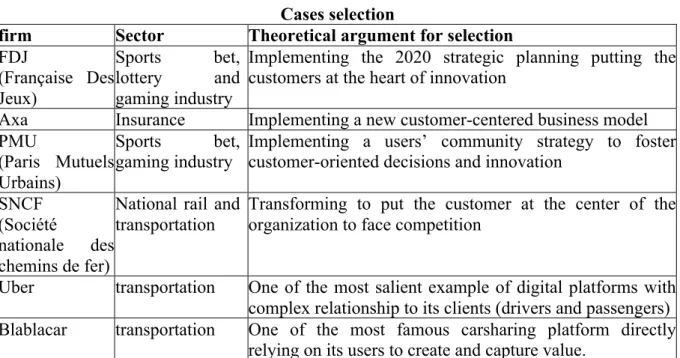
We first selected a sample of four firms implementing a demand side strategy in their 2020 strategic planning (FDJ, PMU, SNCF and Axa), then we also selected two firms born digital and customer-centric (Uber, Blablacar) to be able to draw some comparison between the shift from a product-centric strategy and firms originally oriented to the demand side. Besides the central role of customers in these firms’ strategic planning, we chose leading firms in their industries. We chose at least two firms for each activity (gaming industry and transportation) except for insurance, considering the complexity to have access to disclosed information but we believe that the ongoing transformation was so salient that studying one dominant firm on the market gives some relevant and clarifying insights to this exploratory study (see Table 2).
Table 2 Cases selection
firm Sector Theoretical argument for selection FDJ (Française Des Jeux) Sports bet, lottery and gaming industry
Implementing the 2020 strategic planning putting the customers at the heart of innovation
Axa Insurance Implementing a new customer-centered business model PMU
(Paris Mutuels Urbains)
Sports bet,
gaming industry Implementing a users’ community strategy to foster customer-oriented decisions and innovation SNCF
(Société
nationale des chemins de fer)
National rail and transportation
Transforming to put the customer at the center of the organization to face competition
Uber transportation One of the most salient example of digital platforms with complex relationship to its clients (drivers and passengers) Blablacar transportation One of the most famous carsharing platform directly
In this study, we focus our attention to relationships from firms to final customers (B-to-C) and leave aside client/supplier (B-to-B) interactions. The choice is based on the peculiar nature of B-to-C relations not framed by a legal contract or mostly defined by commercial relationship (which differs from B-to-B relationships).
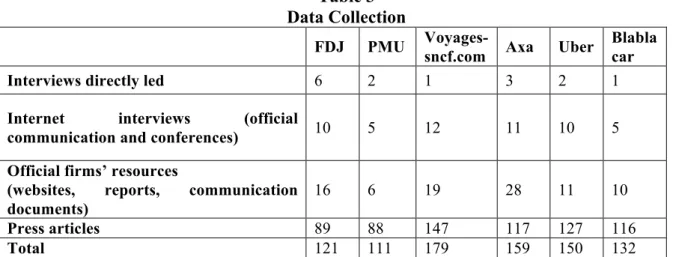
Data have been collected since 2010 (Table 3). We first led an extensive secondary data research (mainly press articles) from 2010 to 2016, completed with few exploratory interviews in order to circumscribe our topic. We collected the results in the economic press within Europresse.com database for two different research: “the name of the company” + “customer” + (1) “strategy” (2) “value” (1224 results collected at first). Putting aside irrelevant articles (dealing with B2B strategies or with key words wrongly associated with our research) we finally selected 684 articles for our research. These articles were analyzed based on units of meaning centered on our two key words: strategy and value. Since March 2017, we have identified and contacted actors within the six identified firms. We then led 15 interviews with managers inside the organizations, all interviewees took part in the implementation of customers’ strategy defined by top management. These interviews were combined with a new collection of secondary qualitative data (mainly video interviews of top managers, official documents provided by the organization and official websites). The combination of primary and secondary data has enabled to reconstruct the demand-side strategy of each firm retracing the importance of customers in the value system from a firm, but also a managerial, levels. For more details of data collection, see Appendix A.
Table 3 Data Collection
FDJ PMU
Voyages-sncf.com Axa Uber
Blabla car
Interviews directly led 6 2 1 3 2 1
Internet interviews (official
communication and conferences) 10 5 12 11 10 5
Official firms’ resources
(websites, reports, communication documents)
16 6 19 28 11 10
Press articles 89 88 147 117 127 116
3.3. DATA ANALYSIS
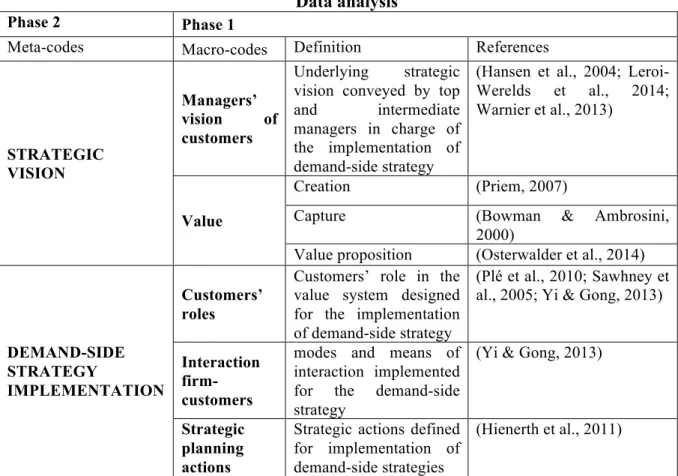
We led our data analysis in three stages. First, we coded articles and exploratory interviews with QSR Nvivo, based on macro-codes derived from the literature (Table 4). Based on these macro-codes, we led a floating open coding in order for categories to emerge from the data, this especially concerns the sub categories of macro codes (Appendix B).
Second, we transcribed the fifteen interviews conducted in the 6 firms, then we coded them as well as official documents with the final coding sheet (Appendix B).
Eventually we investigated the existence of meta-codes by looking at the link between macro-codes, through analytical coding (Richards, 2014; Strauss & Corbin, 1998). It enabled us to identify two meta-codes: strategic vison and strategy implementation, shedding light upon the core issues of our study (for more details See Appendix B).
Table 4 Data analysis
Phase 2 Phase 1
Meta-codes Macro-codes Definition References
STRATEGIC VISION Managers’ vision of customers Underlying strategic vision conveyed by top and intermediate managers in charge of the implementation of demand-side strategy
(Hansen et al., 2004; Leroi-Werelds et al., 2014; Warnier et al., 2013)
Value
Creation (Priem, 2007)
Capture (Bowman & Ambrosini, 2000)
Value proposition (Osterwalder et al., 2014)
DEMAND-SIDE STRATEGY
IMPLEMENTATION
Customers’ roles
Customers’ role in the value system designed for the implementation of demand-side strategy
(Plé et al., 2010; Sawhney et al., 2005; Yi & Gong, 2013)
Interaction firm-customers
modes and means of interaction implemented for the demand-side strategy
(Yi & Gong, 2013)
Strategic planning actions
Strategic actions defined for implementation of demand-side strategies
4. RESULTS
4.1. STRATEGIC VISION OF CUSTOMERS
We identified four steps in the definition of a demand-side strategic vision of customers: (1) customers need to be put at the center of the organization’s strategic planning, (2) managers need to define these customers, (3) this definition has to be completed by the definition of customer value to be able to construct efficient value propositions to create value, (4) firms have to consider the role they allocate to these customers in the value creation system. For a synthesis of similarities and differences among cases see Appendix
4.1.1. Making the firm customer centric Digital: chicken or the egg?
In every case the use of digital means of communication is intrinsically related to the implementation of a demand-side strategy. Each firm has conjointly implemented a digital strategy and usually assimilated the integration of customers in their value production processes. In every case digital means of communications have been the trigger to take customers into account, whether it is a consequence of a new digital transformation strategy in established firms (PMU, FDJ, SNCF, Axa) or at the heart of the value proposition enabled at first by digitization (Blablacar, Uber). Nonetheless, it is important to shed light upon the differences of these two types of firms, leading to a different impact on the apprehension of customers’ roles in the firm.
First, in the cases of PMU, FDJ, SNCF or Axa, implementing a digital strategy has been the trigger to actively integrate customers to their value creation process. For PMU, the community has been created in the realm of a larger digital transformation process, trying to reach online bettors, by “recreating this [physical] conviviality in the digital space” (P1). For these firms, turning to customers is in fact something new. The switch from a product orientation to a user-centric value creation requires from firm to adapt and make deep changes in the way they operate.
“there is no basic customer culture, it is not our … that didn’t just happen like that” (S1) “this market, until recently, or at least until a very recent time, did not consider its customers” (F1)
Turning the firm to customer centricity implies that the strategy needs to be rethought from product to usage. Indeed, many organizations, especially with a dominant, even monopolistic, position on a market, tend to focus on what they produce but not how this is part of a more
global fulfilment of customers’ needs. The Sncf for example has not been, thinking itself as a railway company since the 2010s, but rather \as a provider of transportation from point A to point B. It is the same for the insurance company Axa, considering that their implementation of a demand-side strategy completely reframed their value propositions, as they try to construct pay-as-you-go insurances to go beyond traditional actuarial products.
“Now we talk about what solution to what customer, at the right place, at the right time, with the right offer, when before we were wondering how to make the good customers come to us” (A1)
“since 2010s we have been focusing on insights on people’s experience beyond buying their ticket: what they feel before and what they feel after” (S1)
For the Sncf, this underpins a search for diversification with the launch of numerous different activities in the transportation field over the years (taxi booking, car-sharing, buses, public transportation for instance). And it could imply proposing complementary offers that have nothing to do with the firm’s original core competencies.
“the creation of services, new services, that are not at all related to our railway activity, like a valet service for example” (S1)
Second, in the cases of Blablacar and Uber, if digital is a condition for the execution of their whole business model, they do not undergo a process of transformation considering its role and the place of customers in their value creation process. Indeed, because these value propositions originally rest on resources brought by customers these firms were created as customer-centric. For both firms, their creation rests on the identification of customers’ need not met, enabling them to originally be turned towards the demand-side. Both of these platforms are thus initially strategically oriented towards the demand and put customers at the center of their value creation and capture processes.
“Blablacar is first a community within which users are at the heart of our achievements” (B-OD1); “We are proud to link drivers who want to earn money with passengers searching to go from point A to B” (U-OD1)
4.1.2. Defining who the customers are
Nonetheless, whether firms are pure players or not, giving a new status to customers, and turning to the demand-side for strategy implies to redefine what is a customer thoroughly in order to construct the best value proposition.
A first debate lies in the consideration of potential customers and not only the existing ones. The empowerment of customers through digital means of communication led every firm to start taking into account prospects. This applies whether firms are pure players or not. This is a direct consequence of the growing potential of impact of customers’ especially on the firm image and reputation, in a positive or negative way. Uber, for example, because of the importance of internet, considers society as a whole as one of its clients, thus, treating its reputation as a key resource. However, there is one exception: PMU, facing a decline in its historic pool of horseracing bettors (majority and historical customers) decided to focus on its existing community of users to better understand their needs to maintain their revenue.
“Most potential customers have no reason to enter the community, they have no interest for the product so they do not have any reason to interact or they have an aversion for the product” (P1)
The issue of defining the demand-side is a great challenge for platforms such as Blablacar or Uber. Considering that there are several faces to the platform and each side can be either regarded as partners, users or client. There is thus a blur in what is a customer and its identity. Even though both models are intermediation between drivers and passengers, managers have different views of how to apprehend their customers, even within a single firm. Blablacar for instance insists of shared value within the firm, centered around the motto “member is the boss” (B-OD1). They make no differences between the drivers and passengers, there is no customers but just members of their community.
“We are really careful about the terms we use because we don’t talk about customers or users. It is crucial because we want to show that drivers and passengers are members of the same project” (B1).
On the contrary, Uber makes a clear distinction between drivers and users. This is directly a consequence of the status of drivers on the French market: they are autonomous workers deriving most of their revenues from this activity, in opposition to Blablacar’s occasional ride-providers. This implies a complex definition of the status of these different sides of the platform: are drivers customers? Or are they suppliers? Considering the blur around customers’ identity, the firm has two different management teams for each category. This reflects the complexity of the use of the term customer. In this case managers tend to only refers to drivers and users but not to customers as they cannot be apprehended as a unique category considering the profound differences between their customer values.
“the true customer is the driver” (U1); “because Uber is a platform the notion of customer, drivers are not customers, at least they do not work for Uber, I’d rather talk about stakeholders” (U2)
4.1.3. Redefining value
Once firms define who their customers at the center of their organization are, managers have to operationalize this strategic planning by defining what customer value is, in order to construct efficient value propositions. Defining customer value implies redefining the firm value and how it constructs its offer, considering that not taking customers opinion into account can lead to failure. In the gaming industry, FDJ and PMU managers tell stories about game failures considering that they usually develop new games in chamber and only test them on actual customers as the end of the production process. FDJ developed the new game Illiko Live, mixing scratching ticket and mobile game. Separately the logic worked but after launching the test in some sales points, customers could not understand how it worked (confusion between the price scratched and the actual win after playing the mobile game). So, it has been then a great failure for a game developed for 18 months. A similar phenomenon happened to PMU and the redesign of their website: “we didn’t talk to customers at all, and it changed, the revenue went down” (P1). Turning to customers then implies to be close to them and “finally ask the right questions” (S1) to be able to construct the right value propositions.
It is to better understand and define customer value (i.e. use value encapsulated in value propositions) that firms value the collection and accumulation of customer knowledge. It sets the foundations of the definition of what customers seek and what actually is customer value for the firm. Seeking to aggregate the most extensive customer knowledge possible, firms integrate customers to their production, beyond classical means of customer knowledge collection (polls, marketing studies for instance). Taking into account other variables than price fostered firms to consider how they could bring other forms of value in use to their customers. Hitting two birds with one stone, i.e. opening the firm’s boundaries and letting customers in can be of a great help to improve the innovation process and be as close as possible to customers.
“Your feedback is precious for our teams because the most appropriate person to know your needs is you” (S-OD1)
4.1.4. How to integrate customers in the value creation system?
The issue of defining who the firm’s customers are in a digital economy within a network of actors is fostering a need for clarification of customers’roles in a value system. Considering the shift of customers’ identity defined by the firm for the implementation of demand-side strategy, firms seek to directly include them in the value system to be able to construct the best value propositions.
To that aim firms include customers as resources in their value creation process. Firms go beyond the passive behavior and make them actively participate in the production process, by transferring to them some actions previously devoted to the firm.
“customers actually do lots of tasks which were devoted to the firm, we do things ourselves, we create value ourselves as consumers” (S1)
However, the acknowledgment of customers’ participation is not an easy process. Indeed, these new roles of customers as resources question the idea of the association of the term resource and customers’ actions. Indeed, some managers have a negative perception of the association of the terms customers and resources, considering that for them a resource is exploited and we should not say that about customers. In the case of PMU, they have been lashed out in a documentary on this particular topic, they thus make it very clear that they do not talk about resources but partners. There is thus this shared idea among some managers (F2; P2; A3; U2) that there is a negative connotation to the idea of resources to name customers, even though they are integrated as such in the value system.
“Me: do you think we can talk about customers as resources? F2: ho that’s a bad your you know” (F2)
Facing this challenge of defining customers’ identity, most managers talk about them as partners, within a defined ecosystem. The empowerment of customers led managers to apprehend firm-customers relationship as equal-to-equal partnership. Some managers are even treating them as members of the organization.
“at the end, we will become more and more colleagues with customers, that’s true we realize it” (S1)
This shift in strategic vision implies in every case to integrate customers in the future development of the firm, seeing them as a potential for resources and capacities. Over the last years, customers capabilities have been growingly recognized: “this is the transformation of customers’ perception, each time we add a layer of humanity. In the 1980s we added a smile to them, and now we understand that they have emotions”(E1). Axa for example, in its prospection for the future of insurance, sees customers as potential marketers for the brand.
However, this switch unveiled new issues concerning customers. Indeed, they have been for a long time associated with passive consumers, and their new status brings new challenges. This for instance implies the qualification of customers’ participation: is this work? Should it be rewarded? Especially because of legal constraints on personal data, this issue is particularly a vivid debate within organizations implementing demand-side strategies. “Objectively we use them that way [customers as resources] but we don’t tell them because legally it’s borderline” (F2)
Turning to customers to redefine value implies to evaluate and maybe rethink the tradeoff firms offer to customers to foster their participation. All firms seek to find forms of rewards for users that are willing to participate to the value system in order to help the firm improve its value propositions, this excluding giving a wage to these customers, as they should not be regarded as employees of the firm. Most of the firms use three types of rewards as counterparts for customers’ participations: exclusive information, special gifts and special events (like anniversaries).
“a part with Top Members who beneficiate from exclusive information, we give them gifts of course, some meetings” (P1)
4.2. FEATURES FOR DEMAND-SIDE STRATEGY IMPLEMENTATION
Simultaneously with the definition of who the customers are and what they value, firms implementing demand-side strategies implies to redefine the structure of the organization base on three pillars: (1) defining who is in charge of the customer within the organization (2) defining the support and modes of interaction with customers and (3) define the boundaries of the firm in regard to customers’ roles.
4.2.1. (Re)defining who’s in charge of customers
Turning to customers’ participation to create value, and the issue of its work, questions the role of actors within the firm and its boundaries. Letting the customer inside the organization, when switching from a product-centric to a demand-side strategy, implies profound change in the organizational culture.
“change firm’s culture, the way we talk to customers, how we interact with them” (S1)
There is an important challenge to promote the importance of customers outside marketing directions, and infuse this in the whole organization. Indeed, spreading customers’ value across the organization is of great importance considering that the question of customers and their management has mostly been an issue for marketing directions within organizations. Making firms customer-centric entails a redefinition of who is in charge of the customer.
Indeed, the issue now is not to have one direction handling the interactions with customers, but this should be infused within the whole organization.
“the customer is everyone’s business” (F1); “at the end we’re all actors of customers’ relationship” (S1)
This shift in organizational culture is particularly important considering that integrating customers in a value system mainly relies on human actions, from the front end to top management defining strategic actions.
“it also relies on the firm’s values, you need a good soil because it’s a lot of human actions, there are few methods but it’s really human actions, open mind, listen and co-construct” (A3) In contrast, more recent firms, which were born customer-centric already rely on a strong concern for customers and their needs. For instance, Uber or Blablacar rely on their customers to function, they based their creation and functioning on the participation of customers, whether they propose transportation or use it.
4.2.2. Modes of interaction with customers
To that aim respondents differentiate two main ways: on the one hand organizations use “old” means to collect customer knowledge. That rests on polls, focus groups or qualitative and quantitative studies led by market research institutes. On the other hand, firms seek new ways to get in touch with customers and learn about their preferences.
“integrating customers and not only with a focus group and marketing research approach but with real actions, either for innovation or co-creation with customers in an iterative approach” (A1)
This subsection focuses more on the support of interaction firms use and especially new modes of interaction implemented in order to construct a bridge between the organization and customers beyond the context of buying. For instance, there is some variation in the use of social networks (Facebook, Twitter, Linkedin, Instagram) to gather knowledge to construct the strategic positioning of the firm. Sncf for example fully uses this communication channel to manage customer relationship, when it’s not the case for FDJ. The use of new means of communication is a powerful tool for organizations to interact with a larger number of actual or potential customers. This can be achieved by the creation of a community of customers. Managers rely on the community to ask them questions and mobilize them to iterate to innovate and improve offers.
“we implement, something which is new, if a community of customers, with which we construct, we can interact, ask questions, for example we can do ideation or design thinking workshops” (S1)
Firms construct - or interact with preexisting, communities based on shared passion and interests. This gives the firm access to a coordinated collective potential and capabilities. It enables organization to integrate the aggregated participations of customers as a whole, and not as a sum of individuals. This can rest on an important peer-to-peer interaction within those communities, and the scope of the debate outside the organization first aim. The direct peer to peer interaction is an important difference among communities. For example, Blablacar community only exists because of the firm, this is not a place dedicated to direct discussions and interactions between peers outside of the shared ride booking. The PMU case is profoundly different, it was at first created by the firm to broadcast information to betters. Quite quickly this community became a forum for peers to interact with each other and give them out tips or have vivid discussions on topic more or less related to sports bet. Acknowledging these emergent practices the firm decided to widen the offering of the community providing a broader space for peer to peer as well as peers to firm interactions.
Redefining the modes of interaction with customers fosters the importance of tuning the timelines of action between firms and their customers. New means of communication brought and issue of instantaneity, entailing firms to think differently. Two different timescales one centered around interaction with customers seeking to reduce the time and make the relationship continuous and instantaneous. Nonetheless traditional firms have to balance with long term timeline considering what they produce but also to take the time to spread this new culture across the organization, which takes quite a long time especially in firms transitioning from a product-centric to a user centric-model.
“we are going more and more, I think, to avoid anything that is satisfaction questionnaire in the long term with returns 6 months later, which is not done any more, when there is Uber and user says it was bad, the driver was bad, I don’t want him anymore it's a little instantaneous today” (S1)
4.2.3. Redefining firms’ boundaries: limitations to openness?
For some managers, customers’ integration in the value system can be perceived as a threat. There has been some reluctance to be confronted to customers’ opinion in traditional firms (FDJ, PMU), considering that it could question the expertise of actors inside the
organization, considering that their work could be questioned by customers. This shed light upon the definition and role of managers expertise within the firm. Does turning to a demand-side strategy always mean that customers know better than the firm what is value? This raises an issue for innovation, considering whether the firm has an actual capability to innovate or if it should rely on its customers to have new ideas. There is a debate at stake among the interviewees on the apprehension of customers as the solution for innovation and the limits of co-creation with them. Some managers argue that customers do not always know what they want and the firm can capture information about their preferences and behavior but customers are not suitable to find the solution meeting their demands. To underpin their argument, interviewees rely on Ford’s quote “if I had asked people what they wanted, they would have said faster horses”.
The need for a clear definition of what are the firm competencies in relation to how customers define value and might drive the firm’s innovation is a milestone of a demand-side strategy implementation. Nonetheless, this raises the issue of firms’ boundaries: if firms let customers inside the firm, what is the line between this firm and its environment? This reflection is at an early stage in firms considering that customers’ involvement raises many challenges in terms of rewards, employment or personal data use. This especially is directly derived from the definition of who are the customers and under which banner the firm is identifying them.
5. DISCUSSION
5.1. THEORETICAL CONTRIBUTIONS
5.1.1. Turning to the demand-side to define strategy
This paper investigates the implementation of demand-side strategies. Hence, it sheds light on the importance of focusing to the demand-side to achieve performance. With digital means of communication and new technologies firms are interconnected with their customers, and this constantly. Customers’ needs and opinion can influence strategic decision making, whether it is intended by the firm or not (Plé & Lecocq, 2015). It is this process of taking customers into account at the very first stages of the production process that represents a great opportunity for value propositions improvement and in fine more value capture. Understanding customer value can be a powerful tool to improve strategic decision and resources allocation, considering that resource value is defined exogenously by customers (Ye et al., 2012, p. 368), as they evaluate the value in use of a value proposition.
The continuous interaction with customers represents an opportunity for firms to improve their production process by constantly ensure that their value propositions correspond to customers’ use value and then can be turned into exchange value. To that aim value creation and value capture should be apprehended as system based on interactions between firm and customers (Vargo & Akaka, 2012) and not a sequential succession of actions (Porter & Millar, 1985). We thus contribute to strategic management literature on value creation processes (Porter & Millar, 1985; Rayport & Sviokla, 1995) in shedding light on value system using the service-dominant logic (Vargo & Lusch, 2004). This completes the RBV approach insisting on the importance on the interactionist perspective to understand value creation. Firms should not apprehend value only in an internal perspective and the acquisition of strategic resources but should foresee value as a dynamic system, where the interaction with other stakeholders and especially customers is crucial to maintain performance. This perspective proposes then to leave the traditional approach of value chain, still widely used (Chesbrough, 2011) and turn to the value system (Debruyne, 2014). This implies to rethink the way we can lead new research in strategic management and go beyond the difference between endogenous and exogenous value creation and capture. Apprehending value as a system can be used as a level of study, like ecosystems (Adner & Kapoor, 2016; Moore, 1996).
5.1.2. Customers as new partners in the value creation system
Replacing customers in a value system highlights the interactions between firms and their customers in strategic management. This research shows the importance for strategic management literature to pursue the research reintegrating end customers as a topic for research and investigation to understand firms’ performance and strategic positioning (Priem et al., 2017), calling for more empirical studies considering that nowadays most of the demand-side research focus on theoretical investigations (Priem, 2007; Priem et al., 2012, 2017). This is underpinned by the consideration of customers as firms’ partners, with a particular status considering interacting with them could bring the firm greater economic value without bargaining over it like with other stakeholders (Higgins & Adegbesan, 2010).
Integrating customers in the production process provide thus many new opportunities for firms to create and capture more value. By understanding value as a system, we extend innovation literature in strategic management, showing that customers’ participation can concern other activities than product innovation (Fosfuri, Giarratana, & Roca, 2011; Plé et al.,
2010). Customers can thus bring resources to the firm, which can be transformed and use for a better production process and better value propositions.
Concerning those resources our research show that personal data and new means of communication transform the way firms create value and enhance their construction of customer knowledge, and could even constitute the heart of a business model (Hofman, Strategy, & Osterwalder, 2013; Vitari & Raguseo, 2016). This systemic approach, apprehending customers as resource integrators, shows that control over resources have to be rethought : that it is the access to resources, which are not all strategic, that can lead to competitive advantage and not always their ownership (Schilling & Steensma, 2002). It is the capacity of a firm to combine and deploy resources - common, negative or strategic (Fréry, Lecocq, & Warnier, 2015; Warnier et al., 2013), to meet the demand-side needs that enable the achievement of performance.
Going beyond resources ownership has important implications on firms’ boundaries and their definition. This paper thus shows that openness to stakeholders outside the organization, here customers, can represent a threat to actors expertise within firms, generating reluctance from inside the organization (Hienerth et al., 2014) and thus contradicting arguments in favor of open-strategy (Chesbrough, Enkel, & Gassmann, 2009). Our work shows that there are some limits to take into account when a firm opens to other stakeholders, especially in innovation strategies. If risks encountered by an open-innovation strategy are taken into account by Chesbrough et al. (2009), our research shows the importance of understanding organizational culture to find solutions to internal resistance (Desouza et al., 2008; Hienerth et al., 2011). Moreover, this study shows the tensions between the expertise of actors within the firm, this would call for further research on the question whether customers are the solution or not for innovation, in resonance with Ford’s sentence: “if I had asked customers what they wanted, they would have told me faster horses”. This work paves the way for further research investigating the limits of the consumer-producer dyad, regarding customers as collaborators of firms within a value system. This implies to depart from binary considerations opposing the producers (firms).
5.1.3. Defining value creation beyond economic value
Another contribution is a clarification of terms considering value, value creation, value capture and value proposition. In fact, if they have been used in many different ways, this paper argues that it is important to make a clear distinction between value creation and capture (Bowman & Ambrosini, 2000), using the former in relation to value in use, and the
latter to exchange value. The comprehension of value creation and value capture helps to better understand how firms should focus on the demand-side (value creation) and how this could be a source of performance (value capture). Especially in an interconnected world, with new means of communication, it strategy should be apprehended through interaction between firms and their environment and not only in an internal perspective (Gans & Ryall, 2017).
It is this particular process of defining value creation that is at stake in case of implementation of demand-side strategies, switching from a product-centric to a customer-centric organization (Galbraith, 2005). This research thus demonstrates the importance of integrating the definition of value in use in strategy design and implementation.
This paper, in complementarity with existing research (Priem, 2007; Ye et al., 2012), investigates managers’ actions to implement demand-side strategies. This process is mainly determined by the organizational culture (Hienerth et al., 2011) and especially managers’ cognition for the integration of customers in the production process. For now on strategic marketing research has defined customer value only from customers point of view (Leroi-Werelds et al., 2014; Woodruff, 1997), but there is a need for a better comprehension from managers in order to understand what customer value is defined and apprehended within organizations. Beyond managers’ cognition our research shows the importance of the restructuration of customers’ management (customer knowledge and participation) in order to center the whole organization on this stakeholder, this particularly that in research and in practice the customers is no longer a question only for marketing, but is of great importance for firms’ strategy (Schmidt & Keil, 2013).
This demonstrates that strategic management research should go beyond price and economic measure of value creation for customers (Lieberman et al., 2017) considering that customers can actively participate to improve the production process without any financial rewards (Hienerth et al., 2011). This directly raises issues to measure and evaluate the impact of demand-side strategies in the long-term, as value creation cannot be only reduced to a price fluctuation but value can be created as value in use (Merle, Chandon, Roux, & Alizon, 2010; Sweeney & Soutar, 2001; Woodruff, 1997).
5.2. MANAGERIAL CONTRIBUTIONS
Besides theoretical contributions, this research aims at providing a better understanding of underlying mechanisms for managers willing to implement a demand-side strategy and put the customer at the heart of the value system.
Apprehending value as a system also involves some consequences as regards the way firms consider their customers and how they interact with them. Indeed, customers should be integrated in this system as an actor in interaction with the firm and not just a passive stakeholder to whom the value proposition is delivered. This study shows that turning to customers to construct better value proposition could be a useful way to enhance a production process and find new opportunities for value capture.
Resting on our data analysis, this study could be apprehended by managers as a toolkit for demand-side strategy definition (Figure 3). This toolkit provides a route for managers who supports the implementation of a demand-side strategy, mapping the different steps from demand-side strategy definition to its implementation.
Figure 3