Programme de Recherche en Economie du Climat
Chaire Finance et Développement Durable de l’Université Paris-Dauphine et de l’Ecole PolytechniqueLes Cahiers du PREC
Carbon Market and Climate Negotiations
Christian de Perthuis
1and Suzanne Shaw
2The paper gives an overview of the various types of economic instruments used to tackle environmental problems: regulation, taxes and tradable permits; tra-cing their origin in economic theory and giving concrete examples of their application in the context of national and international efforts in environmental protection, and more particularly, in climate change mitigation. Specific attention is given to the eco-nomic instruments incorporated in the implementation of the Kyoto Protocol to the United Nations Framework Convention on Climate Change: emissions trading, and emissions reduction project financing.
While Copenhagen did not deliver the international climate agreement hoped for, in the run up to the next round of negotiations in Mexico 2010, decision makers continue to discuss the fate of the international climate change effort post-2012. Car-bon markets, while instruments for inciting efficient emissions reductions, also facili-tate the emergence of compromise and will thus play a key role in these international negotiations.
PREC
n° 3 • mars 2010
Série Information et débats
1. Professeur à l’Université Paris Dauphine et directeur du PREC [email protected]
2. Doctorante et chef de projet au PREC [email protected]
Carbon Market and Climate Negotiations
Christian de Perthuis and Suzanne Shaw
Abstract: In the wake of the Copenhagen Conference and the outstanding issue of shaping climate change mitigation for the period beyond that covered by the Kyoto protocol, this paper puts into context the the various economic instruments available for tackling climate change, and highlights the emergence, as a result of the framework of instruments provided by the Kyoto Protocol, of carbon markets, an important basis in post-2012 negotiations.
The paper gives an overview of the various types of economic instruments used to tackle environmental problems: regulation, taxes and tradable permits; tracing their origin in economic theory and giving concrete examples of their application in the context of national and international efforts in environmental protection, and more particularly, in climate change mitigation. Specific attention is given to the economic instruments incorporated in the implementation of the Kyoto Protocol to the United Nations Framework Convention on Climate Change: emissions trading, and emissions reduction project financing. This gave impetus to the creation, respectively, of the European Emissions Trading Scheme and the international Kyoto projects market, currently the two principal carbon pricing mechanisms worldwide.
The European Emissions Trading Scheme is the first large-scale carbon trading system worldwide, and an international benchmark for the price of carbon. Experiences from the implementation and operation of the European carbon market provide valuable insight for European and non-European actors and a concrete tool which the European Union can use in its continued efforts in climate change mitigation, which extend well beyond the 2012 period envisaged by the Kyoto Protocol. In the case of the international projects market, the Clean Development Mechanism (CDM) is currently the dominant component. The CDM provides the only link between industrialised countries of the north and the developing countries of the south in international climate negotiations.
While Copenhagen did not deliver the international climate agreement hoped for, in the run up to the next round of negotiations in Mexico 2010,decision makers continue to discuss the fate of the international climate change effort post-2012. Carbon markets, while instruments for inciting efficient emissions reductions, also facilitate the emergence of compromise and will thus play a key role in these international negotiations.
The Kyoto Protocol adopted in 1997 established commitments aimed at implementing the objectives of the United Nations Framework Convention on Climate Change (UNFCCC).1 The Protocol defines fixed objectives for the 38 most industrialized countries (listed in Annex B of the Protocol) to collectively reduce by at least 5% their overall emissions of 6 greenhouse gases in relation to 1990 levels. Non-Annex B countries do not have set objectives. These reductions must occur over the period 2008-2012. The United States is the only developed country which has not ratified the Protocol. The commitment period covered by the Kyoto protocol expires in December 2012. The rules that will then apply were the subject of discussion at the Conference of the Parties (COP)2 in Copenhagen in December 2009, and will continue to be at the core of international climate change negitations up to and during the next COP in Mexico end-2010. The challenge is to extend the greenhouse gas emissions commitment in order to lower the current trajectory of world emissions. Despite the current divergence of positions in the post-2012 negotiations, it is important to recognise the role of the Kyoto Protocol in enabling the setting up of economic instruments, leading to the emergence of a price on a greenhouse gas emissions. Two main systems have been set up in line with the Kyoto Protocol instruments: the European system of emission trading and the international system of emissions reduction projects. Experience with these systems provide a solid basis for pursuing negotations towards a more ambitious climate agreement.
1. Free use of the atmosphere: a tragedy of the commons
In his celebrated essay The Tragedy of the Commons, Garret Hardin describes the predation mechanisms on natural resources resulting from the fact they are free (Hardin, 1968). He draws on the example of the shared pastures surrounding English villages up until the end of the 18th century. Under this system, each herdsman had access to the “common'' for grazing his stock. In a situation of demographic stagnation and with few animals per hectare, this social system provided villagers with a degree of security. Everyone had free access to a shared resource.
In a growth situation, this system tended to self-destruct: because access to the common was free, no herdsman took account, in his economic calculations, of the cost his individual use of the resource imposed on the community. It was in each herdsman's economic interest to graze his livestock as long as a positive marginal revenue remained, i.e. a few blades of grass remained in the pasture. The inevitable outcome is overgrazing, which reduces the fertility of the pasturage to zero and leads to the destruction of the collective resource.
To understand the economic problem presented by climate change, one simply has to replace the words “village'' and “common'' in Hardin's example with “planet'' and “atmosphere''. The growth in the number of inhabitants of the planet and their enrichment threatens a very special collective good: the stability of the climate. The atmosphere is not infinite, any more than was the common pasturage. Its capacity to regulate temperatures is therefore altered by the accumulation of our waste greenhouse gases. Yet, like the members of the village community, so long as the free and mode of usage of our atmosphere remains for the most part free and unlimited, we have no economic incentive to reduce emissions. But
1
The United Nations Framework Convention on Climate Change (UNFCCC) is the primary international treaty on global climate change. Signed in Rio de Janeiro in 1992, the Convention’s objective is the “stabilization of greenhouse gas concentrations in the atmosphere at a level that would prevent dangerous anthropogenic interference with the climate system.” See the UNFCCC’s website: www.unfccc.int
2
The Conference of the Parties (COP) is the supreme body of the UNFCCC. It currently meets once a year to review the Convention's progress. Source www.unfccc.int
because of the inertia of the climate system, it is not our generation that will suffer the consequences of the emissions it produces, but future generation ones.
In order to escape the “tragedy'' described by Hardin, the villagers can first of all organize themselves to limit the use of the pasture, for example by setting of a rotation system for grazing. To make the system effective, common rules must be established and necessarily adhered to. Its implementation will limit the freedom of action of each villager. It will probably include a sanctions mechanism for anyone breaking the rules. This first type of arrangement constitutes a regulations-based approach.
At the international level, a regulations-based approach was adopted to combat the destruction of the ozone layer. The 1987 Montreal Protocol gradually banned the use of CFC gases in their main industrial applications. It was considered an effective response by the international community: according to the fourth report of the Intergovernmental Panel on Climate Change (IPCC), CFC emissions were reduced from 7.5 billion tonnes CO eq2 3 to 1.5 billion tonnes in 2004. If the Kyoto protocol, which regulates emissions of carbon dioxide (CO ) and five other greenhouse gases over the period 2008-2012, were to have a similar 2
impact, the trajectory of global emissions would be considerably changed. But this will not happen. Due to the withdrawal of the United States in 2001 and the very generous concessions made to Russia and Ukraine, the implementation of the protocol will have only a minor effect, if any, on the trajectory of global CO emissions. Its contribution is of a 2
different nature. It is through its role in the emergence of a price for carbon emissions that its implementation has made itself felt.
2. Taxes or permits?
A second possible mechanism for protecting the communal pasturage would be to introduce a levy that would apply to any villager wishing to use the collective asset. The rate of the levy would need to be set in such a way that its cost causes the number of livestock to automatically adjust to the amount of forage that the communal pasture can produce on a sustainable basis. Introducing this levy will have redistributive effects: its payment will exclude the poorest villagers' animals from the pasturage. On the other hand, the revenues obtained can be allocated to programs of value to the community. In this case, the levy will bring a second benefit, a “double dividend'' in economists' terminology, to the community. This aspect of the levy corresponds to the logic of introducing a tax.
The use of a tax for protecting environmental resources was advocated as early as the 1920s by the English economist Pigou. His idea was to protect environmental assets by incorporating them into the production cost of goods, by including, in addition to the standard elements of production cost, an estimation of the social cost incurred by the use of or damage to environmental assets as a result of the production process. This pricing of environmental externalities by means of the tax allows a price to be given for the protection of the environment. This particular route, as a way of confronting climate change, has not been taken at an international level, despite being recommended by a number of economists. However, some European countries, namely Sweden, Norway, Denmark and more recentlyIreland have introduced such carbon taxes into their domestic legislation, soon to be joined by France.
3
CFC emissions were regulated by the Montreal Protocol to stop the destruction of the ozone layer. CFCs are also greenhouse gases. The application of the Montreal Protocol thus contributes to action against greenhouse gas emissions when CFCs are not replaced by substitutes that also contribute to the greenhouse effect. It is customary to convert non-CO2 greenhouse gas emissions into carbon equivalent tonnes, known as CO2eq, on the basis of their warming power over 100 years.
The third possible arrangement is to create a market which will yield a price for the common good one wishes to protect. This is the route that has historically been taken, not only in England, but in the majority of European countries in the early days of the industrial revolution. The traditional organization of the village with its common pastures was gradually replaced by a system of private land ownership. This transformation was produced by the “enclosures'' movement, which appeared in England from the 15th century onwards. The term is a reminder that one of the first consequences of the privatization of common land was the construction of enclosures designed to protect the enclosed land from incursion and grazing by the livestock of the village. The increase in agricultural productivity resulting from the implementation of this systemenabled the transfer of manpower from agriculture to industry.
This third, market route is the one that has been taken by the international community to fight against climate change. It has, of course, not taken the form of a privatization of the atmosphere, which cannot be divided up into lots or protected against greenhouse gas emissions by means of enclosures. Rather it has taken the form of emission permits markets, a route explored in the 1960s by the economists Ronald Coase and John Dales (Dales, 1968), and successfully put into practice in the United States since 1995 to combat acid rain produced largely as a result of SO emissions from power plants. 2
From a theoretical standpoint, it is simple to show that, in a situation of perfect competition, using a tax or using a system of permits are strictly equivalent. But in a context of uncertainty, from the moment when information is no longer perfect, the situation changes completely. In a well-known article, Weitzmann showed that the choice between taxes and permits depends on the shape of marginal cost curves and of marginal damage curves (Weitzmann, 1974). In the case of climate change, the marginal cost of reductions increase rapidly as effort increases while the future damage from climate change is only indirectly correlated with current emissions: it is the accumulation of greenhouse gases in the atmosphere that counts, more than the annual volume of emissions. This is the reason why both Weitzmann and Nordhaus recommend using a tax rather than a system of permits to combat emissions. But as we shall see, the options adopted in reality are largely independent of debates among economists. Market systems are seen as being able to offer the political compromises essential to launching collective action. It is for this reason that they were rapidly imposed.
Box 1. Taxation vs. a permits market: basic economic analysis
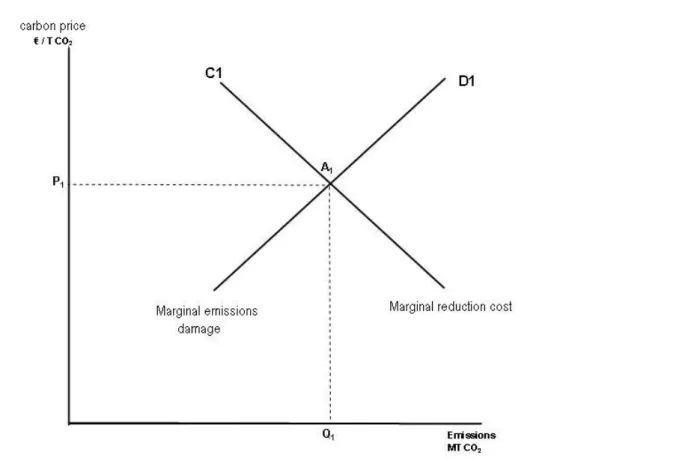
This analysis is carried out with the help of Graphs 1 and 2. The cost curve C1 links the cost of emissions reduction to the total volume of emissions. Its slope is negative: the right-hand part of the curve shows emissions that can begin to be reduced at a lower cost, for example by improving the efficiency of energy use. Once these initial reductions have been implemented, more costly operations will have to be undertaken, involving for example changes in equipment or organization. And so on, as one moves from right to left along the curve.
Figure 1: Emissions price and volume at equibrilium
The curve D1 shows the damage generated by emissions. It has a positive slope. Since climate warming is produced by the accumulation of emissions, it is therefore not the first emissions but the most recent that have the greatest effect on the climate. Eliminating these gives rise to a higher overall social benefit. n the graphs, the slopes of curves C1 and D1 are equal.
The desirable emissions quantity Q1, the “optimal quantity” in economists' terminology, is the
crossover point of the two curves at A1. If one reduces emissions more, to the left of Q1, one goes too far: the cost of emissions reduction is higher than the benefit that society will obtain from the elimination of marginal damage. Conversely, if one moves further to the right of Q1 one loses the social benefit that the community would obtain from emissions reductions situated to the right of Q1. The aim therefore is to reach point A1. To get there, two routes are open to the public authorities.
• Introduce a tax P1. Economic agents who have a marginal cost of reduction lower than P1
have a financial interest in eliminating their emissions in order to avoid paying the tax. Agents who have a marginal cost higher than P1 will continue to emit. Indeed it is in their interest to pay the carbon tax, which is lower than their cost of reduction. Agents adjust their emissions according to the price signal of the tax and bring their emissions to Q1.
• The public authorities can also set the quantities while leaving the market to take care of the price. In this case they set the overall emission ceiling Q1, which is imposed on all actors in the economy. This ceiling represents the total right of use of the atmosphere for storing greenhouse gas discharges. It will then be apportioned in the form of permits among emitters, who can either use these permits to legally cover their emissions, keep them or sell them on the market. Each actor will decide to buy or sell his permits by comparing the market price to his own marginal cost. Those who have a marginal cost lower than P1 will be sellers, and those who have a marginal cost higher than P1 will be buyers. The market price will therefore rapidly converge toward P1.
If markets are efficient and if the public authorities are perfectly informed, setting up a market system of tradable permits or introducing a tax are strictly equivalent.
In reality, the markets are not totally efficient. Setting up a tradable permits market entails transaction costs that can, in practice, turn out to be higher than the cost of collecting a tax. Moreover, if the permit market is too limited or lacks liquidity, it will not give rise to a sufficiently stable price signal that the actors would internalize as they would a tax. Hence there are practical conditions to be met in order for the system of tradable market permits to work. But it is by taking account of uncertainty that it becomes possible to decide in favor of one instrument rather than another.
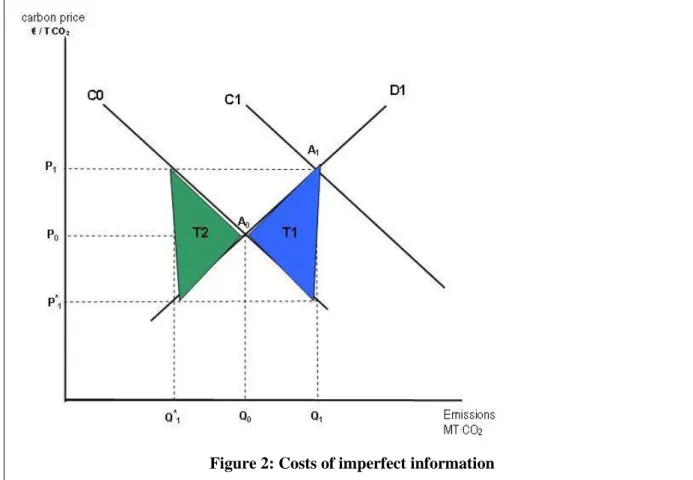
In actual fact, the public authority does not know with any certainty either the distribution of emissions reduction costs or the distribution of the damage that emissions give rise to. This uncertainty can be analyzed by means of Graph 2. A second cost curve C0, situated below C1, has been added. C1 was the curve anticipated by the public authority. C0 is the real curve which turns out to be lower than the anticipated curve (this is generally so in practice). We thus have the elements, following the economist Weizman who in 1974 constructed this analytic framework, to evaluate the comparative advantages of the two systems.
Figure 2: Costs of imperfect information
The optimal point which balances costs and marginal damage reduction is now A0. Due to the lack of information available, the action taken by the public authority has not led to the optimum.
• If the public authority sets up a quota system, real emissions remain fixed at Q1 and the market equilibrium price falls to P1*. This price is lower than P0 , which is the optimal price. The emissions Q1 are higher than the desired emissions Q0. The result of this is a loss for the community, measured by the area of the triangle T1 (blue hatching).
• If the public authority introduces a tax P1, this is higher than the desired price P0. The reduction effort from then on becomes higher than what is economically desirable. The emissions Q1*
are lower than Q0 and society suffers a loss measured by the area of the triangle T2 (green hatching). On our graph, the two areas are the same, since the slope of the cost curve is identical to that of the damage curve. This is the only case, in a situation of uncertainty, where the tax and the permit system are economically equivalent. If the slope of the cost curve is higher than that of the damage curve, the area of T1 is greater than the area of T2, and it is preferable to use a tax. Conversely, if the slope of the damage curve is higher than that of the cost curve, in other words, if the damage suddenly rises above an emission threshold, T2 is greater than T1, and it is preferable to use permits.
In the short and medium term, the marginal cost curve is likely to be more steeply sloped than that the marginal damage curve. Given existing technologies, there are few or no easy substitutes that may be adopted in order to significantly reduce emissions produced from the use of fossil fuels. In addition, the amount of damage grows slowly when emissions increase because of the inertia of the climate system. Hence, to minimize the costs of uncertainty, some economists such as William Nordhaus recommend introducing a tax rather than a permit market in order to set a price for carbon.
The preceding reasoning is valid only in the short and medium term. In the long term, if a public authority is able to set a credible emissions reduction target, the marginal cost curve flattens out and the damage curve becomes steeper. The economic appeal of the permits system increases, as Nicholas Stern reminds us. One can also add that the introduction of a market instrument is the surest way of disseminating information to all actors and public authorities on the real distribution of emissions reduction costs. There are also strong economic arguments in favor of a tradable permits market system.
3. The Kyoto protocol's flexibility mechanisms
The first international attempt to price carbon dates from 1992. It was a European initiative and took the form of a proposal to the European Commission to gradually institute a harmonized tax on industrial CO emissions in the European Union. It came up against head-2
on opposition from industry. It also engendered the hostility of the majority of member states, which were disinclined to give up part of their sovereignty regarding taxation, even in the name of environmental protection. As a result, in 1997 the Commission formally abandoned this project of a harmonized European CO tax. 2
Logically, the European Union defended the principle of a harmonized global tax on carbon in the multilateral negotiations that led in December 1997 to the signing of the Kyoto protocol. There it came up against the twofold opposition of developing countries hostile to any sharing of a constraint and of the US delegation which was in favor of setting a ceiling on greenhouse gas emissions and of using a system of internationally-traded emission permits to limit the costs. After much discussion, it was this type of architecture that was adopted at the signing of the Kyoto protocol in 1997. At the time it was viewed as a victory for the principal American negotiator, who was none other than vice-president Al Gore. The European Union was then fairly rapidly converted: as of June 1998, the Commission was completing an enquiry process aimed at setting up a European system of permit trading. Following the withdrawal of the United States from the Kyoto protocol in 2001, Europe paradoxically became the world's main propagator of negotiable permit markets.
The Kyoto protocol commits the group of industrialized countries and countries in transition (the so-called “Annex B'' countries) to a market economy to collectively reduce their average emissions over 2008 to 2012 by 5% compared to the reference year 1990. It thereby restrains the free and unlimited use of the atmosphere which previously prevailed. To
limit the cost of the obligation, the protocol makes provisions for “flexibility mechanisms'', defined in articles 6, 12 and 17. These are the basis for the carbon markets in existence today.
Article 17 authorizes, within certain limits, trading of emission rights among Annex B countries; the emissions rights are in accordance with the cap obligations set for the 2008-2012 period. By doing so, it transposes at an international scale the cap and trade system; a system which, until then, had only been applied to the power sector in the United States, to control emissions from power generation plants. A country which bears high reduction costs will be able to meet part of its obligations by buying Kyoto emission rights from a country that is better positioned to reduce its emissions. Article 17 lays the foundations of an international carbon market among countries having emissions reduction obligations.
Articles 6 and 12 complement this first mechanism by creating a projects system. The idea is to allow countries or voluntary actors capable of reducing greenhouse gas emissions to obtain credits which can be priced on the international market. These credits should financially encourage countries such as China, India, Brazil, Russia and Ukraine to launch emission-reducing projects without waiting to be actually constrained by an international treaty. The purchase of credits by the industrialized countries of Annex B should at the same time enable them to reduce the cost of attaining their emission reduction targets. For example, it is economically rational to begin by capturing methane from Chinese mines for a dollar for every tonne of avoided rather than look for emission reductions at 80 euro per tonne of avoided in western Europe.
The mechanisms of the new carbon economy have certain similarities to those of currency creation. By ratifying the Kyoto protocol, each country acknowledges an environmental debt constituted by emissions of the six greenhouse gases covered by the protocol. Through the flexibility mechanisms, the moral debt in relation to future generations acquires financial substance. It must be settled in carbon currency (emission permits) which must be refunded in amounts equal to the emissions.
4. The launch of the European
CO2trading system
The European Union chose to prepare for the 2008 launch of the first Kyoto trading period by establishing its own emission permits market in January 2005, the European Union Emissions Trading Scheme (EU ETS). This program applies to 11,500 industrial installations, representing 42% of the European Union's greenhouse gas emissions. It applies only to CO 2
(and to a small extent N2O from 2008 onward). The sectors covered are electric power-generating companies (representing over 60% of 2007-allocated quotas) and energy-intensive industry, including steel, cement and glass manufacturers. Each installation has been given an emissions ceiling instantiated by the annual allocation of a certain number of quotas –each quota giving the right to emit a tonne of CO –which it must not exceed each year. To be in 2
compliance, an installation can either reduce its emissions to the level of its ceiling or buy another installation's quotas to reduce its own below the ceiling.
Paper 2% Ceramics 1% Glass 1% Cement 9% Combustion 69% Oil refining 8% Iron and steel
10%
Figure 1 : European industries subject to quotas in 2007
Source: Mission Climat de la Caisse des Dépôts from the CITL.
The European carbon market covers two periods. 2005-2007 was a time of start-up and learning. The second, 2008-2012, is the period of obligations under the Kyoto protocol. From 2008, the European quota market will therefore integrate itself with the flexibility mechanisms proposed by the protocol. Within each of these two periods, industries may take up unused quotas from one year to cover their emissions for the following year. On the other hand, they are not permitted to carry over unused quotas from the first period to the second. This so-called “non-bankability” rule between the two periods is crucial for understanding the market during its first three years4.
With 262 million tonnes of CO2 traded, 12% of the quotas allocated to industry were traded in 2005. In 2006, the volume of transactions soared, rising to 818 million tonnes of
2
CO , nearly 40% of the quotas allocated to industry. It reached 1.4 billion tonnes of CO in 2
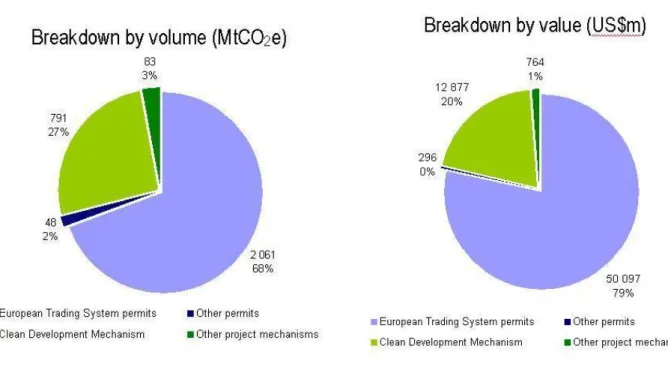
2007. These figures mean that the European trading system is by far the largest emission permits market in the world. The World Bank estimates that this market captured more than 80% of the value of the global trade in carbon from 2005 to 2007. As a result, the European market has become the international benchmark for the price of carbon.
4
For a more complete analysis, see De Perthuis C., Convery F., Ellerman D., The European Carbon Market in Action:
Lessons from the First Trading Period, Mission Climat of Caisse des Dépôts, University College of Dublin, Center for
Figure 2: The world carbon market in 2007
Source: World Bank.
When the market was launched, the price of a tonne of CO was 7 euros. The price 2
initially rose rapidly, under the impact of demand from electric power generating companies, and remained above 20 euros a tonne. In spring 2006, the market acquired the first full information on real emissions in 2005: during the first year of operation, quotas allocated were 4% higher than real emissions. The spot price immediately fell by more than half. This first alert was followed by other corrections. The mild wet weather and the fall in the price of gas significantly reduced the demand for quotas on the part of power-generating companies during the winter of 2006. In 2007, the quota price of the first period was on average below one euro a tonne.
Figure 3: The price of carbon on the European market.
Source: Tendances Carbone monthly bulletin.
The first period allocations were the result of bargaining between industry, the member states and the Commission. These involved a moderate constraint for industry except for the electric power sector where significant demand for quotas emerged during the first two years. In other respects, some countries were manifestly more flexible, indeed more lax, than others in the first period allocations. In view of this experience, the Commission adopted a more standards-based procedure for the second period allocations. Overall, quota allocations were reduced by 9% in the second period (-15% in France). For this reason, the second period quota price of
2
CO was close to 25 euros a tonne in the first half of 2008. The entry of European industry
into the world recession then triggered a sharp fall of carbon prices at the end of 2008. But the banking provisions between the second and the third periods helped the market find a new equilibrium at prices over 13 euros a tonne as from the end of April 2009. All major industry and finance players now no longer consider carbon to be free in Europe, and expect that it will continue to be costly in the future. This is a major achievement.
At more than 20 euros a tonne, most large companies subject to quotas take the emissions price into account in their day-to-day management decisions. Studies reveal that this has already triggered significant emissions reductions: in each of the years 2005 and 2006, some 75 million tonnes of CO2 are likely to have been abated by industry (Ellerman and Buchner, 2008). Although significant, this is not sufficient to radically alter their energy choices and orient investment toward less carbon-intensive technologies.
All in all, Europe has, in three years, managed to create a credible system that functions in a community of 27 countries. These nations have arrived at the necessary compromises to overcome their sometimes conflicting interests. Admittedly, this system is regularly criticized, particularly among the 12 new member states of the European Union, which have been obliged to accept the rules of the carbon market in the name of the acquis communautaire. But its legitimacy is strong. The CO quota trading system benefits from the 2
administration that is open externally. Lastly, it is supported by the commitments of heads of state who, at the European Council meeting of March 2007, adopted the target of a unilateral 20% reduction in greenhouse gas emissions by 2020, compared to 1990 levels. For these reasons, no one expects a step backwards after 2012: throughout the European continent, the era of free carbon emissions has very much come to an end.
5. The international projects market
The other main pillar of carbon finance is the international projects market which has developed since 2003 within the framework of the Kyoto protocol's flexibility mechanisms. The Clean Development Mechanism (CDM) is the principal component of this. The CDM allows for the crediting of emissions reductions obtained through voluntary projects implemented in developing countries, which are not subject to obligations, to reduce their own emissions. Industrialized nations may use credits generated through the CDM to meet a portion of their emission commitments. The CDM provides the only link between the industrialized countries of the north and the developing countries of the south in international climate agreements.
By the end of 2009, some 4600 CDM projects were registered, of which a little over 1800 have been approved by the United Nations body responsible for the mechanism. As a whole, these projects represent an emissions reduction potential of more than 2.5 billion tonnes of CO equivalent between now and 2012, thanks to the CDM. In order of size, this is 2
slightly more than 1% of world greenhouse gas emissions. Needless to say, this is not hugely significant in terms of the overall stakes, but it is unquestionably a first step.
Looking at the type of projects developed so far provides some surprises. China is established as the leading world supplier of CDM credits, with nearly half the market in 2006 and 2007. It is followed by India, South Korea and Brazil. This concentration of supply results from the disproportionate weight of some fifteen very large-scale projects enabling industrial gas emissions (HFC and N2O) from large factories to be reduced at low cost. This windfall effect has undoubtedly occurred to the detriment of projects that are more formative for the future of energy systems in developing countries. It has, moreover, largely left the least developed countries on the sidelines in terms of participation in the CDM.
Despite its rapid acceleration, the CDM has not had a structuring effect on the development of energy infrastructure in developing countries, which are investing massively in new installations that will continue to burn fossil fuels over the coming decades. There remains therefore much room for progress. Three ways forward are currently being studied: providing more flexibility and incentives for the development of small-scale projects; facilitating the grouping together of basic operations into genuine sectoral programs that could obtain credits; and finding a way of providing credits for avoided deforestation, an area in which some progress was made at the December 2007 climate change conference in Bali, Indonesia.
Once issued, carbon credits linked to Kyoto projects should be given value through actors who are willing to buy them to meet their compliance targets. Voluntary initiatives aside, two main types of actors may resort to procuring emissions reduction credits validated by the Kyoto system: countries obliged by the Kyoto protocol to reduce their emissions and industrial companies subject to emissions constraints. These two types of buyers are found in the 60 or so “carbon funds'' which have been developed around the world following the launch of the Prototype Carbon Fund by the World Bank in 1999. The great majority of investors are European, followed some way behind by Japanese investors.
The preponderance of European buyers of Kyoto credits is clearly seen in the setting of prices. The value of Kyoto credits is established according to the price of contracts for
emission allowances on the European market, reduced by a premium that takes into account the specific risks of the emission reduction project. The growth of the European CO trading 2
system has thus greatly contributed to the launch of the Kyoto projects market by providing a reliable carbon price for project actors.
6. Carbon markets in post-2012 negotiations
Since January 2005, carbon markets have been rapidly deployed on the ground, whereas international negotiations have not made significant progress. The December 2007 Bali conference in particular gave an impression of irreconcilable differences between countries. However, even in the event of a setback in international climate negotiations, no one expects a return to the situation prevailing before 1997, when there was free and unlimited use of the atmosphere for storing greenhouse gas emissions. Carbon markets will continue to function, but in different ways depending on whether or not an international treaty on the climate is agreed upon.
In January 2008, the European Commission put forward its “energy and climate'' package. Measures concerning the European carbon market are incorporated into a much wider policy targeting three objectives: reducing EU-27 greenhouse gas emissions by 20% compared to 1990 levels; raising the proportion of renewable energy used in Europe to 20% by 2020; and increasing energy efficiency by 20% within the same time frame. The initiative is known as the “three twenties''.
Regarding greenhouse gas emissions, the energy and climate package firstly reinforces the environmental constraint on industry. It aims at moving from a system in which free allocation is the rule and auctions the exception to the reverse situation: according to the proposal, all allocations for the electric power sector must be auctioned from January 2013 onward, with a more gradual introduction of auctions for other industries. To help attain the 20% reduction in total emissions, the European ceiling would have to decrease by slightly less than 2% per annum between 2013 and 2020.
The detailed architecture of the European quota trading system will become clear only once the outcome of international post-2012 negotiations is known. In the event of a “satisfactory'' post-Kyoto international agreement, European heads of state have committed themselves to a 30% reduction in greenhouse gas emissions in Europe compared to 1990. In such a scenario, the constraints weighing on European industry would be proportionately increased, but so too would the flexibility mechanisms. In the event of an international agreement, the Commission would accept half the additional effort by industry to be covered by the purchase of credits from project mechanisms. This has a twofold function: on the one hand to serve as a carrot to compensate emerging countries like India and China which are benefiting from these project mechanisms; and on the other to limit the rise in emission costs and the increase in the price of carbon in Europe.
The question is of course what counts as a “satisfactory international agreement''. The first condition for this is that all industrialized countries participate. A so-called “Copenhagen Agreement”, negotiated by 28 heads of State, was tabled at the December 2009 climate negotiations in Copenhagen; while receiving wide support, the agreement, negotiated outside the UNFCCC framework, does not constitute the official international declaration hoped for. In the United States, a voluntary carbon market has been in operation in Chicago since 2001. The Chicago Climate Exchange has limited reach and the carbon price there is low. In January 2009, 10 northeastern American states launched a mandatory carbon market covering electric power plants – the Regional Greenhouse Gas Initiative (RGGI) – and the State of California plans to launch its trading scheme for greenhouse gases by 2012. RGGI has
received less media coverage than the Californian project, but is more advanced in concrete terms.
Under the presidency of Barack Obama, these regional experiments have every chance of merging into a federal system. The US House of Representatives has already passed the draft of the "American Clean Energy and Security Act of 2009", also called the Waxman-Markey project, which has to be discussed and approved by the US Senate before entering into operation. The draft aims at establishing a broader carbon trading scheme than the one operating in Europe, covering 85% of the country's greenhouse gas emissions; and requiring its domestic sources to reduce their emissions of greenhouse gases by 17% by 2020 relative to 2005 levels. This reduction commitment is of similar magnitude to the one adopted by Europe (-19% relative to 2005 levels). However, the US effort is much lower in relation to 1990 levels because the emissions of the European Union declined slightly between 1990 and 2005, whereas US emissions increased by 16%.
Conclusion: A fragmented market or one unified by a post-Kyoto
agreement?
Carbon markets are sometimes presented as alternatives to public action in the face of climate change. Such a view is misleading. Carbon markets are instruments through which a carbon price emerges, providing strong incentives to economic actors to reduce emissions where it is least costly to do so. But by setting emissions ceilings, it is governments which determine the amount of emissions reductions and, indirectly, the carbon price needed to achieve them. Were European governments suddenly to renounce their commitments, the price of carbon would collapse and the market would disappear. If governments act in concertation, the carbon market will gain in depth and effectiveness. If they do not, carbon markets will become fragmented and therefore less effective both economically and ecologically.
Carbon markets also play a key role in international climate negotiations, since they facilitate the emergence of compromise. The economic value given to greenhouse gas emissions allows bargaining that can bring together initially very divergent positions. It was this type of compromise that enabled countries like Russia and Ukraine to be brought into the Kyoto protocol. For the next stages of international negotiations, three parameters must be taken into consideration: the advances made in the frame of the European carbon trading system; the benefits that major emerging countries such as China, India and Brazil achieve by being able to use the international carbon market to reinforce their emissions reduction efforts; and the likely introduction during the coming years of a federal cap on greenhouse gas emissions in the United States. Without a carbon market, the chances of a post-Kyoto international agreement would be poor. Thanks to the existence of these markets, the chances are possibly higher than the gulf between the positions of different governments would lead us to suppose. Moving on from Copenhagen, with next stop Mexico 2010.
References
[1] ALDY, J. & STAVINS, R. (eds), 2007, Architectures for Agreement, Adressin Global
Climate Change in the Post-Kyoto World, Cambridge: Cambridge University Press.
[2] BELLASSEN, B. & LEGUET B., 2009, Comprendre la compensation carbone, Paris: Pearson.
[3] COCHRAN, I.T., & LEGUET, B. 2007, “Carbon Investment Funds: The Influx of Private
Capital”, Mission Climat Research Report, no
12, November 2007.
[4] CONVERY, F.J., & REDMOND, L., 2007. “Market and Price Developments in the European Union Emissions Trading Scheme”, Review of Environmental Economics and Policy, 1(1), Oxford: Oxford University Press.
[5] DALES, J.H., 1968, Pollution, Property and Prices, Toronto: University of Toronto Press. [6] DE PERTHUIS, C., CONVERY, F., & ELLERMAN, A.D., 2008, “The European Carbon Market in Action: Lessons from the first Trading Period'”, Interim Report, Mission Climat CDC,
UCD, MIT-CEEPR, March 2008.
[7] DE PERTHUIS, C., 2008, “Le puzzle des marchés du carbone”, Pour la Science, 365: 44-50, March 2008.
[8] DE PERTHUIS, C., 2009, “Et pour quelques degrés de plus... Nos choix économiques face
au risque climatique”, Paris: Pearson, (forthcoming English Edition : “Economic Choices in a Warming World”, Cambridge: Cambridge University Press).
[9] ELLERMAN, A.D., & BUCHNER, B., 2008, “Over-allocation or Abatement? A Preliminary
Analysis of the EU ETS based on the 2005-06 Emissions Data”, Environmental and Resource
Economics, 41(2), octobre 2008.
[10] ELLERMAN, A.D., CONVERY, F., DE PERTHUIS, C. et al., 2009, Pricing Carbon, The
European Union Emission Trading Scheme, Cambridge: Cambridge University Press.
[11] EUROPEAN COMMISSION, 2000, “Green Paper on greenhouse gas emissions trading within the European Union”, COM(2000)87, 3 March.
[12] EUROPEAN COMMISSION, 2004a, “Commission decision for the monitoring and reporting
of greenhouse gas emissions pursuant to Directive 2003/87/EC of the European Parliament and of the Council”, 2004/156/EC dated 29 January 2004.
[13] HARDIN, G., 1968, “The Tragedy of the Commons”, Science, 162(13), December 1968.
[14] KRUGER, J., OATES, W.E., & PIZER, W.A., 2007, “Decentralization in the EU Emissions Trading Scheme and Lessons for Global Policy”, Review of Environmental Economics and
Policy, 1: 112-133, Spring.
[16] STERN, N., 2006, The Stern Review on the Economics of Climate Change, Cambridge:
Cambridge University Press.
[17] TROTIGNON, R., & DELBOSC, A., 2008, “European CO2 Market and the CITL: The Trial Period Under Scrutiny”, Mission Climat Research Report, 13 (April 2008). Forthcoming, [Online], Available: http://www.caissedesdepots.fr/missionclimat
[18] TROTIGNON, R., 2009, “Comprendre le changement climaique”, Pearson. “
[19] WEITZMAN, M.L., 1974, “Prices vs quantities”, Review of Economic Studies, 41,
Trouver plus d’information et télécharger nos publications sur
www.prec-climat.org
Programme de Recherche en Economie du Climat
Chaire Finance et Développement Durable de l’Université Paris-Dauphine et de l’Ecole PolytechniqueLes Cahiers du PREC
n° 2 • février 2010
Série Information et débats
PREC - Institut Louis Bachelier, Palais Brongniart (4e étage) 28 Place de la Bourse, 75 002 Paris
Tel : +33 (0)1 49 27 56 34 Fax : +33 (0)1 49 27 56 28
Email : [email protected]
PREC
Prix du quota de CO2 et taxe carbone : les choix économiques après la censure
du Conseil Constitutionnel par Chrisitian de Perthuis
n° 1 • janvier 2010 Prix du quota de CO2 et taxe carbone : quelques éléments de cadrage
par Chrisitian de Perthuis et Anaïs Delbosc
n° 3 • mars 2010 Carbon Market and Climate Negotiations par Chrisitian de Perthuis et Suzanne Shaw