CAHIER DE RECHERCHE
2010-03
IMPACT OF ALLIANCES ON TECHNOLOGICAL PERFORMANCE
OF LOCAL COMPANIES IN EMERGING MARKETS:
Case of Tunisian firms
Sonia BENSLIMANE
IMRI, Université Paris Dauphine, 75775 PARIS CEDEX 16 / Tel : 33.(0)1.44.05.42.92 - Fax : 33(0)1.44.05.48.49 site internet : http://www.imri.dauphine.fr
Impact of alliances on Technological performance of local Companies in Emerging Markets: Case of Tunisian firms
Sonia BEN SLIMANE Researcher, IMRI
Abstract
The evolution of co-operations between firms has permitted a plentiful literature around the conception of the firm and its frontiers and has placed the specificity of competencies and innovation in the heart of the firm analysis. The evolution of the firm is observed according to the technological opportunities and the quality of its own competencies. In this context, the international joint ventures (IJV), between firms belonging to different levels of development, can be considered as a dynamic channel for acquisition new knowledge and improvement of existent competencies. The contractual relation is a challenge for the developing partner to reach a platform of knowledge and improve its competencies. However, the transfer inherent from IJV is not systematic. It is conditioned by the existence of prior core knowledge that could influence the success and the quality of the transfer. Considering this, we propose to measure the performance of the transfer inherent from international joint ventures on the recipient partners in the case of Tunisian firms. For that purpose we based the analysis on responses to a questionnaire sent to the managers in the different sectors in year 2005 and including two types of firms, those being engaged in an IJV and those not. We describe in the first section, the sample selection and the methodology of the analysis. Then we measure the effects of the IJV that are appreciated at two levels: the level of the perception of the managers and the level of the type of supports made by the foreign parent. Empirically we obtain five main effects declined in the evolution of knowledge and
1
learning, the evolution of the tangible asset, the improvement of organizational capacities, the development of the technical learning and finally the tangible capacities. In the section 2, we test the potential absorptive capacity (PACAP), which could have an influence in terms of improving the performance effects of the IJV. The results show a correlation between the considered dimensions of the potential ACAP- the evolution of the R&D expenditure, the R&D unit and the qualifications- and the evolution of knowledge and learning. In section 3, we measure, the influence of the profiles characteristics of the firms, on moderating the IJV’ effects. The results are significant only on “the evolution of the knowledge and learning”. We extend the analysis by testing the influence of each control parameter on improving the previous results. We operate the same analysis by measuring the influence of each profile characteristic separately. We note the significant results for the parameter: Service sector. The other profile characteristics have not an exclusive and direct influence on the improvement of the alliance performance. Finally, we conclude and we underline the limits of this study.
1. Literature context and methodology
The evolution of co-operations between firms has permitted a plentiful literature around the conception of the firm and its frontiers and has placed the specificity of competencies and innovation in the heart of the firm analysis (Schumpeter J, 1934, Coase R, 1937, Williamson O, 1991). The evolution of the firm is observed according to the technological opportunities and the quality of its own competencies (Nelson R et Winter S, 1982, 1987, Teece D, 1987, Foray Det Lundvall B, 1995). Furthermore, the IJV are considered as one of main sources of technology transfer and as a dynamic channel for providing a high potential of innovation performance capabilities (Inkpen A, 1998, Lin W, 2003) and improving technological capabilities (Kumar V, Kumar U and Persaud A, 1999). In the case of IJV between firms belonging to countries with different levels of development,
2
the contractual relation is considered for the recipient partner as catalyst of development (Bellon B et al, 2000) and offers him the possibility of acquisition of new technical knowledge (Hendrickx C, Catin M and Bernard J, 1998). More specifically, the challenge for the recipient partner is not only to prove its ability in operating, maintaining the machineries at the production level but also the ability to learn and absorb the external technologies integrated in tangible assets, production and management capabilities (Davenport T and Prusak L, 2000). However, the transfer is not systematic if the local partner doesn’t already develop prior core knowledge, allowing him the ability to learn and to absorb the external knowledge. Considering this, we propose to measure the performance induced by the IJV on the recipient partners for the Tunisian case. In the following subsection we describe first the sample selection and the methodology of the analysis. Then we test whether the IJV allows an evolution of the technological capacities within the local firms.
1.1 Sample selection and methodology
We based the analysis on responses to a questionnaire sent to the managers in the different sectors in year 2005. The sample was classified into two categories of firms: those that have already participated in an IJV with a firm from a developed country and those that did not. The questionnaire was composed by three parts related to the situations of the company before, after the IJV and the strategy planned for the future. Many considerations are retained when we selected the sample. First we didn’t consider the firms that have participated in the out sourcing activities. We defend this choice by the biases that could be induced in the answers. In fact, when we tend to involve them in the sample, the most of the asked persons didn’t evoke an evolution in their activities when they contracted an outsourcing relationship with a foreign partner. They just mentioned the renewal of machines in order to satisfy the foreign partner. This criterion had a consequence among others on reducing the size of the sample. The Initial sample included 135 firms. But, due to the problem of confidentiality of some information in
3
most of the firms, and to the returned blank or incomplete questionnaires, 87 responses were finally considered useful. We note that the final sample is composed by 51 firms that are engaged in an IJV and 36 firms that are not engaged in any type of alliance. The size of the final subsample concerned the firms that are engaged in an IJV is unfortunately small and has made the exploration of the analysis difficult. But this problem doesn’t affect the final results since the statistical criterion of meaning of the size is respected. Furthermore, a test of homogeneity is operated to verify the distribution of the sample according to the structural parameters. The test is significant, which confirms the homogeneity in the distribution of the sample among these variables. We measure in the following subsection the performance effects of the IJV on the local firms.
1.2 The measurement of the alliances effects on developing the capacities
The purpose of this subsection consists on testing whether the IJV allow the development of technological capacities within the local firms. The effects of the alliances are appreciated at two levels: First, at the level of the perceptions. It is tested through a question with a 10 items scale of Likert items and concerns the following areas: the evolution of the qualifications, the Activity of conception, the Acquisition of new formal technological knowledge, the Training of the workforce, the Acquisition of new machinery and product material, the Accessing to new technology, the Profitability, the Optimization of the delivery deadlines, the quality of the final products and finally the decrease of the cost. The results of the factorial analysis show three main effects. The first type of IJV effects concerns the evolution of explicit knowledge and learning through the evolution of the tangible asset and the evolution of the qualifications skills. The second axis is formed by the correlation between the variables: Acquisition of new machines and product materials and Accessing to new technology. The new constructed variable is called: the increase of the
4
costs, the improvement of the quality and the respect for delivery deadlines. These variables compose the new constructed variable called: the
improvement of the organizational capacities. We note that such capacities
indicates the existence of a learning process within the firms, despite the fact that they are not specifically technological but a part of the core capabilities (Dosi Y, 1988, Nelson R, 1991), they are exclusive to each firm, not easily transferable and they cannot be patented (Chandler A, 1992). The second level of the IJV effects is tested through the results to the question concerning the type of support made by the foreign parent. The question is a six item scale and concerns the following areas: support in terms of engineers training, technology access (material and equipment), financial support, management support, training and qualification of the workers and the support in R&D activity. We specify that the support in terms of R&D activity doesn’t mean the joint R&D activity, because the foreign partners would not transfer or share their technological knowledge for comprehensive reasons (competition, confidence,...) but mainly the support in challenging the recipient partners to enhance their efforts in the R&D activity. Two main results are retained: The first is related to the correlation between the support in the training of the executives (the workers) and the support in the R&D activity and with lesser importance in the training of the engineers. We call the new constructed variable: the development of the
technical learning. The second constructed variable results mainly from the
correlation between the support at the level of the machines and equipments and the renewal of the machines that it’s named: the evolution of the
tangible capacities. Thus, we obtain five new constructed variables that are
used in the following section in purpose to measure the potential absorptive capacity of the recipient partner, which could allow a better success of the transfer.
2 The extent of the performance on appreciating the potential
absorptive capacity
Most of the research dealing with international co operations has assumed that the IJV enhance the firms’ absorptive capacity. We note that the
5
concept of ACAP has been extensively developed in theoretical and empirical studies. Cohen W and Levinthal D (1990) define it as “the firm’s ability to recognize the value of new external information, assimilate it and apply it to commercial ends”. Zahra S and George G, (2002) introduce the potential capacity as one of two parts composing the ACAP. The potential ACAP includes the dimensions of knowledge acquisition and knowledge assimilation. The second part of the ACAP concerns the realized capacity and it is formed by the dimensions knowledge transformation and knowledge exploitation capabilities. For the study case, we measure the potential ACAP as the success of the inter-firm technological transfer, is determined by the substantial amount of technology transferred and the level of technological capacity of the local firms to absorb, assimilate, improve and further develop the newly acquired technology (Kumar V, Kumar U, Madanmohan T, 2004).This means that understanding and assimilating complex organizational knowledge requires the active engagement of both parties as well as certain structural and cognitive preconditions (Lane P and al, 2001). We note that there’s no widely accepted a definite measure of absorptive capacity. Many empirical studies propose complementary factors for testing the PACAP. The firm’s ability to exploit external knowledge is considered as a subproduct of its R&D activities (Cohen, Levinthal, 1990). The ability of the firms to assimilate and to acquire knowledge are also measured by the R&D activities, that are evaluated through the firm’s efforts in innovation activities, such as R&D intensity (Stock et al, 2001) and the existence of a formally established R&D department in the firm (Veugelers R, 1997). The number of patents hold by the firm are also considered as part of the ACAP measurement (Nicholls-Nixon C, 1993) as the highly educated and technically qualified staff those are more receptive to assimilating and transforming available external knowledge (Leiponen A, 1999, Vinding A, 2000). Considering this, we propose to test the potential absorptive capacity within the firms of the sample and specifically to see if the IJV contributes to the development of the potential ACAP. We examine first, the evolution the R&D activity by considering the R&D expenditure and the existence of an R&D unit then, the evolution of the qualifications. We note that the indicator of the patents
6
is not taken into account, because of its limitation to a few companies, which cannot be generalized to the entire sample.
2.1 The R&D unit
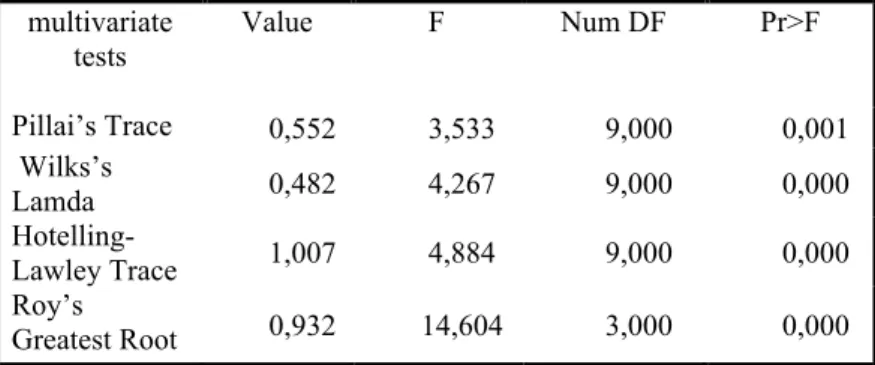
The purpose of this subsection is to measure the alliance performance on one of the dimensions of potential absorptive capacity, measured through the existence actually of a unit for the R&D activity, which can be considered as a structure for codification and learning of knowledge. Empirically, a multivariate analysis is first operated in order to verify the existence or not of a difference within the sample (Bray HJ, Maxwell E S, 1985) according to the giving variable. The results in the following table show a difference across the dependant items within the sample:
Table 1: MANOVA test criteria and F approximations for the hypothesis’s of no overall effect:
multivariate tests Value F Num DF Pr>F Pillai’s Trace 0,552 3,533 9,000 0,001 Wilks’s Lamda 0,482 4,267 9,000 0,000 Hotelling-Lawley Trace 1,007 4,884 9,000 0,000 Roy’s Greatest Root 0,932 14,604 3,000 0,000
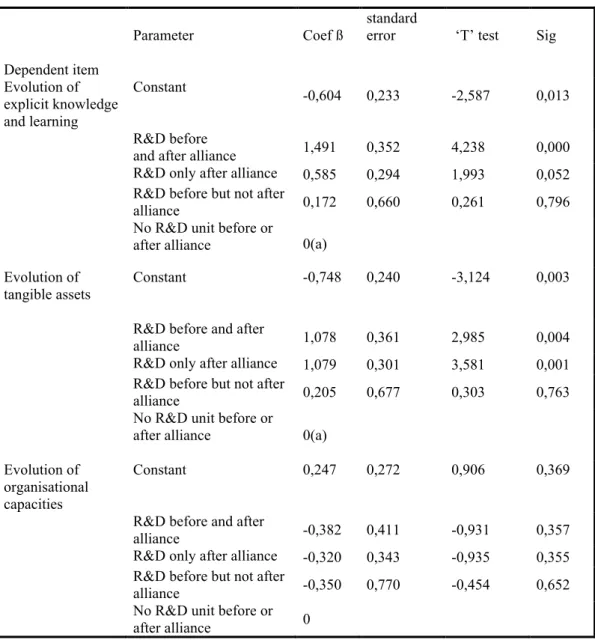
The second step, consists on testing whether, the dependent variables are significant with the parameter ” R&D unit”. For that purpose, we made four situations related to the R&D unit. More specifically, we make the following situations: the existence of an R&D unit before and after the IJV, an R&D unit before but not after the IJV, an R&D unit only after the IJV and finally an R&D unit neither before nor after the IJV. The aim is to see if the IJV has an effect on enhancing the R&D activity or not. If the results are significant in the case of having an R&D unit before and after the IJV, this could show that the company has created a learning structure (Lyle and Salk, 1996), which could be more pertinent if it exists before the IJV. In fact, the existence of an R&D unit before and after the IJV can express the engagement of the local firm in a learning process allowing it, more ability
7
to absorb new knowledge and improve its potential absorptive capacity (Zahra and Georges, 2002). If we find that the local firms haven’t an R&D activity any more, after the IJV, we can deduce the position and the strategy of the local firm toward the learning process. Giving this, we estimate the coefficients (the coefficient β and its sign) for each variable: when the coefficient β is positive, it means that there’s a correlation in the same way between the dependant variables and the existence of an R&D unit, which is confirmed by the T test and its signification. The following table (2) shows the results:
Table 2: Parameters Estimates
Dependent item
Parameter Coef ß
standard
error ‘T’ test Sig Evolution of
explicit knowledge and learning
Constant -0,604 0,233 -2,587 0,013
R&D before
and after alliance 1,491 0,352 4,238 0,000 R&D only after alliance 0,585 0,294 1,993 0,052 R&D before but not after
alliance 0,172 0,660 0,261 0,796
No R&D unit before or
after alliance 0(a) Evolution of
tangible assets Constant -0,748 0,240 -3,124 0,003 R&D before and after
alliance 1,078 0,361 2,985 0,004
R&D only after alliance 1,079 0,301 3,581 0,001 R&D before but not after
alliance 0,205 0,677 0,303 0,763
No R&D unit before or
after alliance 0(a) Evolution of
organisational capacities
Constant 0,247 0,272 0,906 0,369
R&D before and after
alliance -0,382 0,411 -0,931 0,357
R&D only after alliance -0,320 0,343 -0,935 0,355 R&D before but not after
alliance -0,350 0,770 -0,454 0,652
No R&D unit before or after alliance 0
8
The results show the importance of the existence of an R&D unit before alliance within the company on the evolution of the cognitive and technical assets. This result confirms the fact that the IJV seem to be a good channel for stimulating the development and the improvement of learning capacities. Furthermore, the increase of the tangible assets is more appreciated when there is already a learning structure such as the R&D unit, which could facilitate the assimilation of new technology. Knowing that, the acquisition of new technology require among others, the training of the staff. In order to confirm this hypothesis, we will test later the correlation between the evolution of the qualification proportion categories within the firms and the IJV effects. We propose in the following subsection to test the second dimension of the R&D activity through the analysis of the evolution of the R&D expenditure.
2.2 Investment in R&D activity
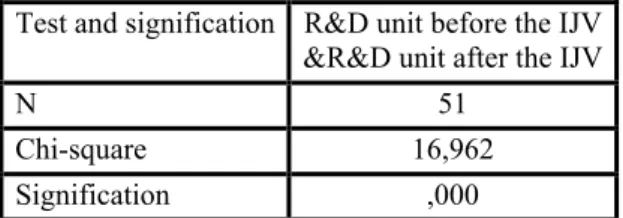
The existence of a real structure within the firm for assimilating new knowledge, contribute to the evolution of the learning process. We suppose that the IJV enhance the R&D activity for the local partner. In this subsection we test the correlation between the R&D activity and the IJV. The first step consists on testing the differentiation within the firms of the whole sample towards this variable. The hypothesis tests show a correlation between the IJV and the evolution of the R&D activity. Then, a non-parametric test is applied for the dependent items in comparing the situations before and after alliance according to the variable “R&D unit”. The results of the McNemar test show an evolution in terms of the R&D activity matched with the IJV (table 3):
Table 3-Mc Nemar test: Evolution of the R&D activity and IJV: Test and signification R&D unit before the IJV
&R&D unit after the IJV
N 51
Chi-square 16,962
9
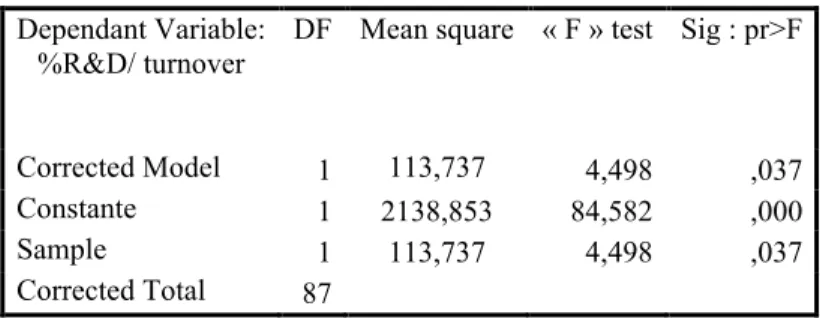
The results are significant. But, we note that these results do not confirm the existence of a real research activity. Due to the luck of information related to the patent for the whole sample, we try to value the percentage of the R&D expenditures in order to see if there’s a difference within the sample toward the IJV. The asked managers have mentioned the existence of a little activity of R&D that consists on adapting some products or services to the local context or in other cases propose some new technical part of the product that could be used by the developed firm. A one-way analysis of variance (ANOVA) is used for a distributed interval dependent variable in order to test the differences in terms of the means of the dependent variable broken down by the levels of the independent variable (table 4):
Table 4: Difference of meaning in the sample regarding the dependent variable
Dependant Variable:
%R&D/ turnover DF Mean square « F » test Sig : pr>F Corrected Model 1 113,737 4,498 ,037 Constante 1 2138,853 84,582 ,000
Sample 1 113,737 4,498 ,037
Corrected Total 87
Adjusted Model to sig 0,04.
Then we test the parameters in order to see whether this difference is correlated with the IJV. The signification of the estimated parameters is appreciated by the β coefficient (and its sign) and the T test (table 5):
Table 5: Parameters estimates
Dependant parameter β standard
error ‘t’ test Signification
Intercept 3,889 0,838 4,640 0,000
firms engaged in IJV 2,331 1,099 2,121 0,037 firms non engaged in
10
The estimation of the marginal means of the R&D percentage to the turnover shows that firms engaged in IJV spend on average 6, 25 % of their turnover in the R&D activity, against less than 4 % for the other firms. We note however, that we were confronted to a problem of confidentiality of the information concerning the amount of the turnover, which have had a consequence on the estimation of the real spend of the firms to the R&D activity. We can only deduce that companies engaged in IJV show more interest to R&D activity than the other companies of the sample. This result doesn’t mean that they are engaged in an innovation process. They didn’t yet get the second dimension of the ACAP, “the realized ACAP” (Zahra, SA, George G, 2002), whose allows the real innovation activity but they are in step of a potential ACAP, which is a part of the ACAP process.
2.3 Evolution of qualifications
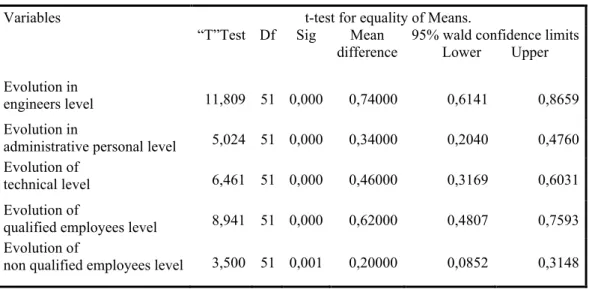
In the questionnaire there was a question related to the evolution the distribution in percentage of the socio-professional categories within the firms before and after an IJV. Giving the responses, five items are formed. A test of comparison of the averages is operated, as shown in the table 6:
Table 6: Test of the evolution of the qualifications
Variables t-test for equality of Means.
“T”Test Df Sig Mean
difference 95% wald confidence limits Lower Upper Evolution in
engineers level 11,809 51 0,000 0,74000 0,6141 0,8659 Evolution in
administrative personal level 5,024 51 0,000 0,34000 0,2040 0,4760 Evolution of
technical level 6,461 51 0,000 0,46000 0,3169 0,6031 Evolution of
qualified employees level 8,941 51 0,000 0,62000 0,4807 0,7593 Evolution of
11
We note an evolution in the human structure at all the levels of qualifications. This evolution is mainly observed in the level of the engineers. These results are not opposite with the precedent results. Despite the fact that the sample firms are not yet engaged in the realized ACAP process, they are active in terms of learning and improvement of the technological knowledge. We also note an evolution at the level of workers, those directly in interaction with the equipments and machines. These results can be related to the complexity of equipments and machines used and consequently the training that have permitted a more efficiency of the used equipments.
3 The role of control variables on moderating the IJV performance
The sample is then divided into three profiles groups (the two steps clusters method). This method allows the classification of the firms according to the combination of the initial characteristics (Kachigan SK, 1982, Everitt B et al, 2001). A test of the homogeneity of the variables distribution is operated on the qualitative variables (sector, main activity and type of export) and verified by the Chi-square test. In parallel, a test of comparison of the averages and the variances is applied to nominal variables formed by the parameters: Turnover, Size and Age. The analysis of distribution of both samples as well as the study of the variance shows similar averages. The only exception concerns the Size, for which the average and the standard deviation are not similar in both sub samples. To avoid the way that could influence the results afterward, a test of Student is operated. The results show that both sub samples present the same characteristics towards the considered quantitative variables. The structure of the whole sample is thus homogeneous. The second step consists on testing the role of some control variables on appreciating the IJV effects. Many studies have acknowledged the effect of the control variables on moderating the results (Nielson, 2002, Tsang 2002, Lyles, 2003). For that purpose, we first classified the sample in profile groups according to the following parameters: sector, turnover, size, age, main activity and percentage of export. Then we measure the influence of these variables on moderating the results. We note that giving
12
the little size of the sample, we considered first the subsample according to the combination of control parameters and see the influence of the combination of the control variables on the IJV effects. Then we considerate the control variable and test their effects separately. The following subsection describes the control groups, then measure the correlation between the effects of the IJV and the control profile groups.
3.1 Description of the profile groups
This step consists on constituting homogenous control groups by using the
Two Step Cluster Analysis method (Kachigan SK, 1982, Everitt B et al,
2001). It’s a generalization of the classic classification methods applied to the simultaneous treatment of a group of variables. We considered two categories of variables for the subsample of the firms engaged in IJV: the structural variables, formed by the age, the turnover and size (the number of employees); Then the activity variables, composed by the sector, the proportion of export (totally or partly) and the activity (conception, or commercialization). We obtain three control groups. The first profile group represents (31, 4 %) of the whole sample, formed by firms belonging to the service sector (100%), the mechanical sector (42,9%) and chemical sector (14,3%). They are medium sized firms (less than 200 employees) and with an age average of 8 years. The turnover is not relatively high. These firms are not entirely exporting and their main activity is the conception. The second group (49% of the whole sample) is composed by old companies (average of 24 years) belonging to various sectors: the Food sector (100%), the chemical sector (85,7%), the mechanic sector (57%) and finally the electric and electronic sector (44,4%). Their activity concerns production of a giving product or service and its commercialization. They are large-sized (more than 250 persons) and the turnovers are relatively high. Finally the third profile group represents 19,6% of the whole sample with an average age of 12 years and formed by the medium-sized companies, belonging to the sector of the textile and electric those have a total export activity. After forming the profile groups, we estimate whether the control variables have an influence on the alliances effects: We test first if there’s a difference
13
within the profile group according to the IJV effects. If the tests are significant, we estimate this difference according to the dependant variables. The results of the multivariate test are shown in the table 7:
Table 7: MANOVA test criteria and F approximations for the hypothesis’s of no overall effect:
Effect Mutivariate tests value F Test Df Pr>F Profile
groups
Pillai’s Trace ,299 2,754 6,000 ,016 Wilks’s Lamda ,707 2,900(a) 6,000 ,012 Hotelling-Lawley
Trace ,405 3,039 6,000 ,009 Roy’s Greatest
Root ,382 5,985 3,000 ,002 a Statistic exact
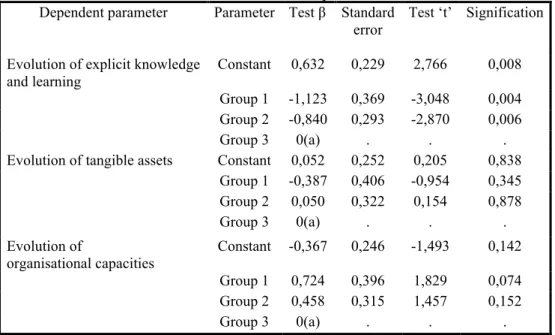
The tests are significant, the null hypothesis is rejected, which means that’s there’s a difference of the alliances’ effects among the profile’s groups. We then operate an estimation of the dependant variables that are the effects of the IJV (table 8):
Table 8: Estimation of the parameters Dependent parameter Parameter Test β Standard
error Test ‘t’ Signification Evolution of explicit knowledge
and learning Constant 0,632 0,229 2,766 0,008 Group 1 -1,123 0,369 -3,048 0,004 Group 2 -0,840 0,293 -2,870 0,006
Group 3 0(a) . . .
Evolution of tangible assets Constant 0,052 0,252 0,205 0,838 Group 1 -0,387 0,406 -0,954 0,345 Group 2 0,050 0,322 0,154 0,878
Group 3 0(a) . . .
Evolution of
organisational capacities Constant -0,367 0,246 -1,493 0,142 Group 1 0,724 0,396 1,829 0,074 Group 2 0,458 0,315 1,457 0,152
Group 3 0(a) . . .
The results are just significant for the variable “Evolution of explicit knowledge and learning”. We note the correlation between the IJV effects and two of the three profile groups. Concerning the first group, the results can be explained by the specificity of the sectors characteristics (services,
14
chemical and mechanics) those use more technological knowledge and by the complexity of the equipments concerning the second group that qualified persons at all the levels. Another result may be interesting to note concerns the correlation between the dependent item Evolution of explicit knowledge and learning” and the second profile group. But giving the little size of the sample and consequently the risk of results bias by combining the profile characteristics, we consider each control variables and measure the effect of them separately.
3.2 The results
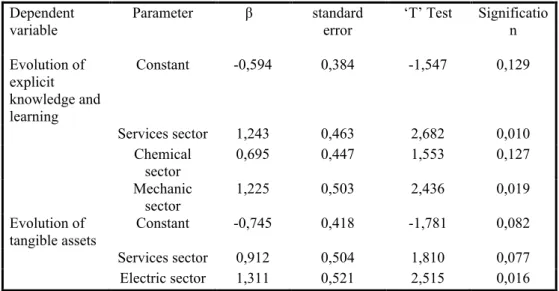
The following table (table 9), summarize only the significant results for the correlation between the IJV effects and each of the control variables:
Table 9: Estimation of the parameters Dependent variable Parameter β standard error ‘T’ Test Significatio n Evolution of explicit knowledge and learning Constant -0,594 0,384 -1,547 0,129 Services sector 1,243 0,463 2,682 0,010 Chemical sector 0,695 0,447 1,553 0,127 Mechanic sector 1,225 0,503 2,436 0,019 Evolution of
tangible assets Constant -0,745 0,418 -1,781 0,082
Services sector 0,912 0,504 1,810 0,077
Electric sector 1,311 0,521 2,515 0,016
We note that this control variable is just exclusively significant for one of the effects of the IJV. They are significant only for the variable “sector” as found in other studies (Lyles M, 2003). The other control variables are not active to moderate or approve the IJV effects as noted in other empirical studies (Nielson B, 2002). These results cannot be definitely considered due to the little size of the sample.
15
Conclusion
This analysis contributes in a better understanding of the effects of the IJV in terms of performances on local firms and to enrich the results of studies dealing with the case of firms belonging to emerging countries. In this context, we note the evolution of tangible and non-tangible assets with the condition of the existence of prior core competencies that could enhance the appreciation of the IJV effects and the enhancement of the efforts of establishing and developing the PACAP. The results related to the effects of the control variable on appreciating the IJV effects cannot be confirmed due to the little size of the sample. We also note the limit of the study according to the lack of in formations concerning the type of IJV and also the characteristics of the parents’ partners. The question could be also treated with a more large data base. This study can be also completed by making an extended analysis on the specificity of the service sector, or by making a comparison between firms from two recipients’ countries.
BIBLIOGRAPHY
• Bellon B, Voisin C and Plunket A, 2000, La cooperation industrielle, Economica.
• Bray JH and Maxwell S E, 1985, Multivariate analysis of variance, ed SAGE university paper.
• Chandler A, 1992, Organisation et performance des entreprises, Paris, L’organisation.
• Coase R, 1937, The nature of the firm. Traduction française: la nature de la firme, Revue Française d’économie, Vol 2, Winter 1987.
• Cohen WM, Levinthal DA, 1990, Absorptive capability: a new perspective on learning and innovation, Administrative science quarterly, N35.
• Davenport, TH. And Prusak L, 2000, Working Knowledge: How Organizations Manage What They Know, Harvard Business School Press, Boston.
• Dosi Y, 1988, Technology Partnership between larger and smaller firms, International Studies of management and organization, Vol 17, N4, p31-57.
• Everitt BS, Landau S and Leese M, 2001, Cluster analysis, 4th edition, London, ed Edward Arnold Publishers.
16
• Hendrickx C, Catin M and Bernard J, 1998, Secteur, taille et formes de coopérations technologiques, in Bernard J et Catin M, Les conditions économiques du changement technologique, L’Harmattan, Paris.
• Inkpen A C, 1998, Learning and knowledge acquisition through international strategic alliances, academic management executive, 12, pp69-80.
• Inkpen AC, 2000, Learning through joint ventures: A framework of knowledge acquisition, Journal of management studies, 37: 1019-1043.
• Kachigan SK, 1982, Mutlivarate statistical analysis, NY, ed Radius Press. • Kumar V, Kumar U and Madanmohan TR, 2004, Imported technological
capability: A comparative analysis of Indian and Indonesian manufacturing firms, Technovation, 24: pp979-993.
• Kumar V , Kumar U, Persaud A, 1999, Building technological capability through importing technology: the case of Indonesian manufacturing industry, Journal of Technological transfer, 24, 81- 96.
• Lane PJ , Salk J E and Lyles M, 2001, Absorptive capacity, learning and
performance in international joint ventures, Strategic Management Journal N° 22: pp1139-1161.
• Leiponen A, 1999, Competencies, R&D collaboration and innovation under different technological regimes, TSER workshop in Kleinknecht A et Mohnen P: Innovation and economic change.
• Lin W B, 2003, technology transfer as technological learnings: a source of
competitive advantage for firms with limited R&D resources, R D management, 33, pp327-341.
• Lundvall B, Foray D, 1995, The knowledge-based economy. From the economics of knowledge to learning economy, Employment and growth in the knowledge-based economy, OCDE documents, Paris.
• Lyles, M and Salk JE, 1996, Knowledge acquisition from foreign parents in international joint ventures: An empirical examination in the Hungarian. J. International Business Studies, 29: pp154-174.
• Marjorie A, Lyles M, 2003, International joint ventures in transitional economies, Leadership in international Business Education and research, Vol 8, 2003.
• Nelson R, Winter S and Dosi G, 1987, The nature and economics of organizational capabilities, Oxford University Press.
• Nelson R and Winter S, 1982, An evolutionary theory of economic change, University Press, Cambridge.
• Nicholls-Nixon C, 1993, Absorptive capacity and technological sourcing: Implications for the responsiveness of established firms. Unpublished Ph.D. dissertation, Purdue University.
• Nielsen B, 2002, Determining International Strategic Alliance Performance, Working Papers.
• Schumpeter J, 1934, The theory of economic development, Harvard University Press.
• Stock G, Greis N and Fischer W, 2001, Absorptive capacity and new product development, Journal of High Technology Management Research, vol 12, p 77-91. • Teece DJ, 1987, The competitive challenge: strategies for industrial innovation
and renewal, Cambridge Mass: Bellinger Pub.
• Tsang EW, 2002, Acquiring Knowledge by foreign partners from international joint ventures in a transition economy: Learning by doing and learning myopia, Strategic Management Journal, 23, N°9, pp 835-854.
17
• Veugelers R, 1997, Internal R&D expenditures and external technology sourcing, Research policy, Vol 26, N°3.
• Vinding AL, 2000, Absorptive capacity and innovative performance: A human capital approach. Department of Business Studies, DRUID/IKE Group, Aalborg, University, Denmark
• Williamson O E, 1991, Comparative economic organization: the analysis of secrete structural alternatives, Administrative Science Quarterly, Vol 36, N°2. • Zahra, SA and George G, 2002, Absorptive capacity: A review