Any correspondence concerning this service should be sent
to the repository administrator:
[email protected]
This is an author’s version published in:
http://oatao.univ-toulouse.fr/27286
To cite this version: Trellu, Clément and Rivallin, Matthieu and
Cerneaux, Sophie and Coetsier, Clémence and Causserand,
Christel and Oturan, Mehmet A. and Cretin, Marc Integration of
sub-stoichiometric titanium oxide reactive electrochemical
membrane as anode in the electro-Fenton process. (2020)
Chemical Engineering Journal, 400. 125936. ISSN 1385-8947
Official URL
DOI :
https://doi.org/10.1016/j.cej.2020.125936
Open Archive Toulouse Archive Ouverte
OATAO is an open access repository that collects the work of Toulouse
researchers and makes it freely available over the web where possible
Integration of sub-stoichiometric titanium oxide reactive electrochemical
membrane as anode in the electro-Fenton process
Clément Trellu
a,
h,
Matthieu Rivallin
a,*, Sophie Cerneaux
a, Clémence Coetsier
C,
Christel Causserand
C,
Mehmet A. Oturan
h,
Marc Cretin
a,*
• Institut Européen des Membranes, IEM UMR 5635, Univ Montpellier, ENSCM, CNRS, Montpellier, Franceb Laboratoire Géomatériaux et Environnemen� LGE -Université Paris-Es� EA 4508, UPEM, 77454 Marne-la-Vallée, France c Laboratoire de Génie Chimique, Université de Toulouse, CNRS, INPT, UPS, Toulouse, France
• TiOx REM was used for the first time as anode in EF process.
• •OH were generated in retentate and at REM with optimal mass transport conditions.
• The efficiency of REM/EF integrated process far exceeded that of standa lone processes.
• High mineralization current efficiency (77%) was obtained with REM/EF process.
• Synergy was observed from degrada tion in the bulk and mineralization at the TiOx REM.
Keywords:
Electro-Fenton Anodic oxidation Integrated process
Reactive electrochemical membrane Sub-stoicbiometric titanium oxide Water treatment
• Corresponding authors.
GRAPHICAL ABSTRA CT
100% n:drcublion of thi:! rcknfo1k
Cubcinlt'I! Ciitli,ode ABSTRA CT Deg.rad,1tion by•proccodu(IS 1, Orgil.nic H,O polhtl;lntS) !Dtt1nid.1ti011 "OH e,y-p��:('li l � 110� re.ictJv� 1:-klroch�c;il mirmbr11n,: Anode
Sub-stoichiometric titanium oxide (TiOx) reactive electrochemical membrane (REM) were integrated for the first time as anode in the electro-Fenton (EF) process. Hydroxyl radicals (•OH) were produced both in the retentate from Fenton's reaction and at the REM from anodic oxidation (AO). Optimal mass transport conditions were implemented because of convection-enhanced mass transport of (i) organic pollutants towards the REM surface during filtration and (ii) dissolved 02 towards cathode active sites owing to the use of a 3D carbon felt cathode in flow-through configuration for H202 generation. The efficiency of the REM/EF process was much higher than EF or REM used as standalone processes. For instance, taking paracetamol as target pollutant, (67 ± 2)% removal of 55 mg L -i of initial TOC was achieved with a high mineralization current efficiency (MCE) of ( 43 ± 1)%. By comparison, standalone REM and EF processes achieved only 47% (MCE = 30%) and 31 % (MCE = 20%) of TOC removal, respectively. By monitoring TOC removal both in retentate and permeate, the effect of homogeneous oxidation in the bulk retentate and heterogeneous oxidation at the REM could be observed separately. It was thus
highlighted that the efficiency of AO might be affected by the presence of • OH and Fe2 + in the bulk. It was also emphasized a synergistic effect related to the formation of carboxylic acids in the bulk retentate that are more easily mineralized at the REM where both • OH-mediated oxidation and direct electron transfer occur.
E-mail addresses: [email protected] (M. Rivallin), [email protected] (M. Cretin). https:/ /doi.org/10.1016/j.cej.2020.125936
C. Trellu, et aL
1. Introduction
Water treatment is currently a key focus for environmental en gineering. In most of countries, water supply and recycling (e.g. in in dustrial processes) as well as protection of natural water resources are currently crucial issues. Particularly, the removal of biorefractory or ganic pollutants is one of the main challenges [1]. In this context, the development of electrochemical advanced oxidation processes (EAOPs) is currently a major topic of interest [2-5]. They have several technical advantages, including low (or zero) consumption of chemical reagents,
process automation and compact reactor design [6,7].
EAOPs are based on the generation of hydroxyl radicals (•OH) which are able to degrade and/or completely mineralize of a wide range of biorefractory organic compounds with fast kinetics [8-17]. Firstly, ·OH can be produced homogeneously in the solution by the electro-Fenton process based on Fenton's reaction (Eq. (1)) [18-20]. Hydrogen peroxide (H202) is generated by the two-electron reduction of dissolved 02 at carbon-based cathodes (Eq. (2)), while a catalytic amount of ferrous iron is sufficient to start the Fenton's reaction (Eq.
(3)). Then, Fe2+ ion (catalyst) is generated/regenerated at the cathode
from reduction of Fe3+ formed in Eq. to ensure continuous generation
of ·OH (Eq. (3)) [21]. Secondly, ·OH can be also generated hetero geneously (AO) through water oxidation at the surface of anodes with high overpotential for oxygen evolution reaction (Eq. (4)) [7,22-25]. Fez+ + H20 2 ➔ Fe3+ + 'OH + OH-Fe3+ + e- ➔ Fez+ M+ H2 O➔ M('OH) + H+ + e-(1) (2) (3) (4)
The electron is the main reagent during EAOPs, thus the Faraday efficiency is a crucial parameter for assessing process efficiency [7]. Parasitic and wasting reactions must be minimized so that the electrons supplied to the system are used effectively for the degradation and mineralization of pollutants. Because of the short lifetime of · OH, low Faraday efficiency usually results from mass transport limitations
[2,26,27]. For example, anodic oxidation (AO) is a heterogeneous electro-catalytic process during which physisorbed • OH are generated at the anode surface, thus resulting in a thin reactive layer close to the anode surface (Jess thanl µm). Therefore, process efficiency is often limited by the diffusion boundary layer at the solution/electrode in terface ("" 100 µm) [27]. Recently, the use of sub-stoichiometric tita
nium oxide (TiOx) reactive electrochemical membrane (REM) as anode
has been developed [27-33]. Such anode material is able to strongly enhance current efficiency because of the higher electro-active surface area and convection-enhanced mass transport of pollutants from the bulk to the anode in flow-through operation [27,29,33,34]. Such ma terial also represents a promising alternative to boron-doped diamond electrodes for reducing capital expenditures of electrochemical systems
[35]. Besides, H202 production for the EF process can be also limited by mass transport issues because of the low solubility of 02 in water. Thus, recent studies have developed 3D flow-through carbon-based cathode for production of large amounts of H202 [36-39]. The objective is to improve mass transport of dissolved 02 to cathode active sites.
In the present study, it is proposed for the first time, the integration of TiOx REM as anode in the EF process. 3D flow-through carbon felt (CF) was used as cathode. The objective is to achieve mineralization of organic compounds with high current efficiency owing to optimal mass transport conditions. Optimal conditions for H202 production were identified and the efficiency of various configurations (REM alone, EF alone, REM/H202 and REM/EF) for the removal of a model pharma ceutical residue (paracetamol) were compared in order to emphasize the suitability of the new REM/EF process. Moreover, by using TiOx REM as anode and without recirculation of the permeate, it was pos sible to well differentiate the oxidation of organic compounds by either
homogeneous reactions in the bulk (TOC removal in the retentate) or heterogeneous reactions at the TiOx REM (TOC removal between re tentate and permeate). Thus, this study allowed the identification for the first time of antagonist and synergistic phenomena occurring when EF and AO processes are integrated into a single reactor.
2. Materials and methods 2.1. Chemicals
All chemicals were of reagent grade and purchased from Sigma Aldrich. Aqueous solutions were prepared with deionized water (R > 18 MQ cm).
2.2. Electrode materials
Anode materials were TiOx REM supplied by Saint-Gobain Research
Provence (CREE Cavaillon, France). This porous material was synthe sized from carbothermal reduction of Ti02 by using an extrusion die, based on the method developed by Saint-Gobain Research Provence. The synthesis method starts from a mixture of anatase Ti02, carbon black, organic binders and water. Then a debinding step followed by a sintering and carbothermal reduction step performed during 2 h at 1300 °C under argon atmosphere allows for the formation of this porous material. Additional details on the synthesis method are provided in Trellu et al. (2018) [28]. These anodes are a mixture of Ti407 and Ti509 Magnéli phases. They have a monodispersed pore size distribution, with a median pore size of 1.4 µm, a porosity (pore volume) of 41 % and a specific surface area of 0.40 m2 g-1. The water permeability of these
TiOx membranes is 3300 L m-2 h-1 bar-1• The characteristics of ma
terials obtained were detailed Trellu et al. (2018) [28] (scanning electron microscopy images, HF intrusion porosimetry and X-ray dif fraction data are provided as Supplementary Material). Electrodes were stable in the range of current density and exploitation duration required for this study. Long-term stability tests are the focus of on-going studies. Cathode materials were 6.35 mm thick CF supplied by Alfa Aesar.
2.3. Experimental mstaUation
The schematic diagram of the experimental installation is shown in
Fig. 1.
TiOx REM (inside/outside diameter = 6/10 mm, active outer sur
face 27.6 cm2) was used as anode with the solution flowing from the outside (retentate) to the inside (permeate) of the tube. CF cathode (15 x 8 cm2, 6.3 mm thick) was placed concentrically around the REM with an inter-electrode distance of 3.5 cm. 02 was injected in the tank
Tank(Z.2 L) Continuous recirculation of retentate Permeate Retentate Carbon felt cathode TiOXREM anode
Fig. 1. Scheme of the experimental installation (without recirculation of the permeate) equipped with a tubular anodic Tiüx REM and a cathodic carbon felt placed concentrically around the REM in the retentate compartment.
by bubbling fine bubbles of 02 in the solution. Experiments were car ried out with paracetamol (PCT) as a mode! organic pollutant with initial total organic carbon content (TOC0) of 55 or llO mg L -1. Sodium sulfate at low concentration (5 mM) was used as supporting electrolyte. The total volume of the treated solution was 2.2 L for ail experiments (meaning that the ratio between the geometric surface area of the anode and the volume of solution was 0.0125 cm -l ). For the EF process, 0.2 mM of Fe2+ was initially added to the solution to be treated. The pH was initially adjusted to 3.0 with H2SO4, in accordance with the optimal pH for the EF process [6]. An injection system of H2SO4 in the retentate, controlled by a pH regulation, maintained the pH value between 2.9 and 3.1 in the retentate during operation of EF without recirculation of the permeate.
The process was operated without continuous feed of the reactor and the retentate was continuously recirculated at 100% for ail ex periments. When entering the electrochemical cell, the solution is first forced to flow through the CF cathode. Then, a portion of the solution flows through the REM according to the transmembrane pressure (TMP) and is collected as permeate. The rest of the solution is forced to flow again through the CF before to corne back to the feed tank. A re circulation pump was used to adjust the retentate recirculation flow rate in the range of Q = 1-3 L min-1). TMP was in the range 0-170 mbar. The experiments were carried out either by continuously collecting the permeate or by recirculating the permeate at 100% in the feed tank (retentate). Ali experiments were carried out in galvanostatic mode, using an ELC power supply (AL924A). The current density (j)
was adjusted between 6 and 30 mA cm -2 (always calculated from the
geometric surface of the anode). The experiments were conducted systematically for 5 h.
Different processes have been tested depending on operating con ditions, which are given in Table 1:
2. 4. Analytical procedures
PCT concentration was measured by HPLC (Agilent 1200 system)
with C18 column and UV detector (À. = 254 nm). The mobile phase was
a mixture of water and acetonitrile containing 0.1 % v /v formic acid. HPLC was operated at a constant flow rate of 1.0 mL min -l using a gradient elution as described previously [ 40].
TOC was measured with a Shimadzu TOC-L analyzer using the catalytic oxidation combustion method at 680 °C. The relative standard deviation on TOC measurements was 2%. Percentage of TOC removal in the retentate at time t was calculated using Eq. (5). Percentage of TOC removal in the permeate at time t was calculated using Eq. (6). Global percentage of TOC removal (taking into consideration TOC removal in both retentate and permeate) at the end of the experiment was calcu lated using Eq. (7).
TOC removal in the retentate (t) (%) = ( 1 - ---' X 100 TOC,e,,TOCo )
(5)
Table 1
TOC removal in the permeate (t) (%)= (1 - TOCper,t) x 100
TOC,et,t (6)
Global TOC removal (%)
( (TOCo - TOCpe,) X v'i,er + (TOCo - TOC,e,) X Vre,)
= 1 - ---'---'--- X 100
TOCo X Vo
(7)
where TOCret,t and TOCper,t are TOC concentrations in the retentate and permeate at time t, and O (initial concentration); TOC,e, and TOCper are TOC concentrations in the retentate and permeate at the end of the experiment; TOC0 is the initial concentration of TOC; V,e, and Vper are the volumes of retentate and permeate at the end of the experiment; V 0 is the initial volume of the feed solution.
Mineralization current efficiency (MCE) was calculated using the following equation (Eq. (8)) for assessing the Faraday efficiency of the process for mineralization of PCT.
LiTOC
MCE(%)= exp X 100
LiTOCth (8)
where �TOCexp is the amount of TOC removed during experiments and
�TOC,h is the theoretical TOC removal calculated by assuming that the electrical charge was only consumed for mineralization of PCT.
H202 electrochemically generated in the retentate was analyzed by a spectrophotometric method, based on the measurement of the ab sorbance at 410 nm of a colored complex (titanium peroxysulfate) formed in the presence of Ti4+ in sulfuric acid medium [41]. Current efficiency for H2O2 production was calculated similarly to MCE, based
on the amount of H202 measured during experiments and the theore
tical amount of H2O2 that could be produced by assuming that the electrical charge was only consumed for the two electron reduction of 02 (Eq. (2)). Accumulation rate of H2O2 was calculated using Eq. (9). H2O2 accumulation rate (t;) (mg min-1)
[H2O2]1;• Vret,t; - [H2O2]t;-1· Vret,t;-1
t2 - t1 (9)
where [H2O2]ti and [H202lti-l are concentrations in mg L -l at time ti and ti-l (min), respectively. Similarly, V,et,ti and V,et,ti-1 are the volumes of retentate (L) at time ti and ti-l, respectively.
Oxamic acid was identified and quantified by ion-exclusion HPLC equipped with a BENSON column (300 mm, 7.8 mm (i.d.)) and using a refractive index detector (Waters 2414). Column temperature was set at 30 °C. A solution of 1.5 mM H2SO4 was used as mobile phase with isocratic elution at 0.4 mL min -1.
Sorne experiments were carried out in triplicate in order to assess the reproducibility of experimental data.
3. Results and discussion
The first set of experiments aimed at evaluating the capacity of the Operating conditions used for the different processes. The feed/retentate recirculation flow rate was controlled at Q
transmembrane pressure; EF: electro-Fenton; REM: reative electrochemical membrane. 1 L min_, for all configurations. TMP:
Process
EF
Electro-Fenton in the bulk retentate with low anodic oxidation at the REM REM
Anodic oxidation at the REM REM/H202
AO at the REM and generation of H202 in the bulk retenate
REM/EF
Electro-Fenton in the bulk retentate and AO at the REM
TMP (mbar)
0
(no perrneate flux)
30 30 30 02 supply [Fe2+] (mM) yes 0.2 no 0 yes 0 yes 0.2
C. Trellu, et aL
ff 6 mA cm·2 -1 L min-1 -02 + 15 mA cm·2 -3 L min-1 -02
6 mA cm·2 -1 L min-1 --fr 30 mA cm·2 - 1 L min•1 -02
-e-
15 mA cm·2 -1 L min•1 -02 30 mA cm·2 - 1 L min·180
-
60 40 ON 20 0 4'ë
QI) 3E
2 ·,i::; 1�
60 'ü 40 20 00
20
40
60
80
Time (min)
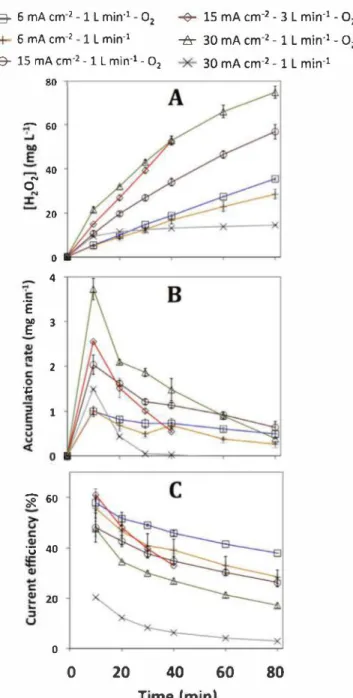
Fig. 2. Evolution over time of: (A) concentration of H2O2 in the retentate, (B)
accumulation rate (mg min-1) of H202 in the retentate and (C) current effi
ciency for accumulation of H202 in the retentate, as a function of current
density G = 6, 15 or 30 mA cm-2, corresponding to 1.4, 3.5 or 6.9 mA cm-2 for the carbon felt cathode), recirculation flow rate of the retentate (Q = 1 or
3 L min-1) and 02 supply (with or without). Ali experiments have been per
formed in deionized water with 5 mM of Na2S04• Data above 40 min have not been measured for the experiment at 3 L min -i because of the higher TMP that
decreased rapidly the volume of the retentate. Error bars have been calculated from replicate experiments (n = 3).
system to produce H202 for the EF process, according to current den sity, recirculation flow rate and 02 supply. Results are presented in Fig. 2. Generation of H202 is based on dissolved 02 reduction at the cathode. At low current density (6 mA cm-2), the consumption of dissolved 02 was low (Fig. 2A). Therefore, 02 supply only slightly in creased H202 production rate because 02 transfer from the gas phase to the liquid phase into the tank was almost sufficient to counterbalance 02 reduction at the cathode. However, at high current density (30 mA cm -2), 0
2 reduction rate at the cathode was strongly increased. Without 02 supply, H2O2 accumulation rate rapidly decreased to O. In
fact, the concentration remained constant after 30 min of operation while the volume of retentate was continuously decreasing; therefore the amount of H202 in the reactor was actually lower at 80 min than at 30 min. These results highlight that 02 supply is mandatory for main taining the H202 production rate.
For ail experiments with 02 supply, the accumulation rate of H202 decreased with time. experiment. (Fig. 2B). Generation of H202 was assumed to be constant during experiments since 02 was supplied in excess. However, the accumulation of H202 cornes from the difference between generation and destruction of H202• In this configuration, destruction of H202 can be ascribed to both cathodic reduction (Eq. (10)) and anodic oxidation (Eq. (11)). These reactions are promoted at high H202 concentration, explaining thus the decrease of H202 accu mulation rate during ail experiments as well as the stronger relative decrease of H202 accumulation rate with time when operating the process at high current density (for which higher concentration of H202 was reached).
(10) (11)
After operating the process during 30 min at 30 mA cm -2 ( corre
sponding to 6. 9 mA cm -2 for the CF cathode), (79 ± 2) mg of H 202 was accumulated in the retentate (2.2 L). In a recent study of Pérez et al. (2016) reported the accumulation of around 260 mg of H202 (in 1
L) after 30 min using polytetrafluoroethylene-modified carbon felt at 50 mA cm-2 [36]. The Venturi-based jet cell used in this study was reported to be as efficient as conventional gas diffusion electrode. By comparing these results, one can conclude that the system developed in the present study seems to be highly competitive, since the amount of H202 accumulated was only 3.3 times lower by using a current density 7.2 times lower with a non-modified carbon felt cathode.
High current efficiency for H202 production (between 30 and 50%
after 30 min) was observed whatever the current density applied for experiments performed with 02 supply (Fig. 2C). The high efficiency of the reactor was ascribed to operation of the process under flow-through mode with continuous recirculation of the retentate through the CF cathode, thus allowing a convection-enhanced mass transport of dis solved 02 to cathode active sites [36].
The influence of this convection-enhanced mass transport was fur ther investigated by increasing the recirculation flow rate from 1 to 3 L min-1 for experiments performed at 15 mA cm-2 and with 0
2 supply (Fig. 2). Higher recirculation flow rate increased the TMP (30 mbar at 1 L min-1 and 170 mbar at 3 L min-1), and subsequently, the permeate flux through the REM (95 L h -l m -2 at 1 L min -l and 510 L h-1 m-2 at 3 L min-1). Within the first minutes, higher current efficiency was observed ((61 ± 1)%) at 3 L min -l compared to 1 L min -l (( 48 ± 4)%) owing to the promotion of the convection enhanced mass transport of dissolved 02 towards cathode active sites. However, no significant difference of current efficiency was then ob served after 40 min. In fact, higher recirculation flow rate and higher
permeate flux through the TiOx REM used as anode also favored H202
destruction following Eqs. (10) and (11), respectively. Moreover, the higher concentration reached at the beginning of the experiment also promoted H202 destruction following Eq. (10) and Eq. (11).
As regards to the influence of current density, higher accumulation rate of H202 was obtained at the beginning of experiments performed at high current density. However, the accumulation rate then strongly decreased with time and the current efficiency was also lower com pared to experiments performed at lower current density because of the promotion of parasitic reactions involving either H202 destruction (Eqs.
(10) and (11)) or hydrogen evolution reaction (Eq. (12)).
(12) Overall, sustainable operating conditions for H202 production in the retentate during the REM/EF process were identified as
j
=
15 mA cm-2 (intennediate current density), continuous 0 2 supply and Q = 1 L min -1. The choice of the recirculation flow rate was also selected as regards to its influence on the TMP. In fact, successful op eration of the REM/EF process is based on the selection of the best compromise in tenns of optimizing operating conditions for both electrochemical formation of the Fenton's reagent in the retentate and AO at the TiOx REM. As regards to the efficiency of AO, it tightly depends on permeate and TOC flux through the TiOx REM. Previous study
on TiOx REM revealed that optimal MCE for mineralization of PCT at
15 mA cm-2 was obtained for TOC flux through the REM in the range
5-15 g m·2h-1 [28]. By using a recirculation flow rate of 1 L min-1 involving a TMP of 40 mbar, TOC flux through the REM could be ad justed to 5.2 and 10.4 g m·2h-1 when perfonning experiments with
TOCo
=
55 and llO mg L -1.3.2. Process efficieney
The objective of the following experiments was to evaluate the re levance and effectiveness of the innovative integrated process, by comparing the TOC removal (mineralization) achieved with the dif ferent configurations, i.e., EF standalone process, REM standalone process, REM/H202 process and REM/EF integrated process (Fig. 3). Experiments were carried out considering the optimal conditions jus tified in section 3.1. Experiments were perfonned either without re circulation of the penneate or with 100% recirculation of the permeate (meaning in this case that the volume of the retentate was constant throughout the experiment, similarly to a batch experiment) and at two
different TOC concentrations (TOC0
=
55 or llO mg L -1).All values of percentage of TOC removal have been calculated by taking into consideration TOC removal in both retentate and permeate
(Eq. (7)). For example, for the REM configuration with
TOC0
=
55 mg L -1, the percentage of TOC removal calculated from the difference between TOC in retentate and penneate was (90 ± 2)% (Eq.(6)). However, after 5 h of treatrnent, the total volume of permeate (filtrated water that passed through the REM) was 1 L. Thus, miner alization in the permeate resulted in a global percentage of TOC re moval of only 41 % by taking into consideration the total volume of the effluent (V0
=
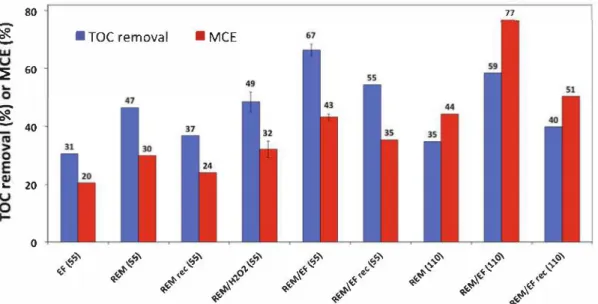
2.2 L).Overall, the global percentage of TOC removal (ascribed to miner alization in both retentate and penneate, as described in Eq. (7)) with the REM configuration was only slightly higher (47%) because low
80
�
■
TOC removal
■
MCE
-:i:
60i
40 20...
0 !-,� !-,., .... !-,., .... !-,., ....�
"'
�
"'
,_><:;�
"'
�
•
"' �o ";;.�#
�,�
f<,� <!' <!'�
mineralization was simultaneously achieved in the retentate (non-fil trated water). In fact, very low amount of oxidizing species was gen erated in the bulk because of the absence of 02 supply for H202 pro duction and absence of Fe2+ for production of •OH according to Eq.
(3). By comparison, slightly higher global percentage of TOC removal
was obtained with the REM-H202 configuration because 02 supply enhanced H202 production in the retentate, which participated to oxi dation of organics (TOC removal in the retentate was increased from 3 to 10% after 5 h). The best way to further promote the oxidation of organic pollutants in the retentate was to implement EF by supplying both 02 and 0.2 mM ofFe2+ in order to generate large amounts of •OH in the retentate. Thus, EF alone achieved 31 % removal of TOC after 5 h of treatrnent. Interestingly, the highest effectiveness was achieved with the integrated process REM/EF: the global percentage of TOC removal reached (67 ± 2)%. This value was 1.4 and 2.2 times higher than that obtained with REM alone and EF alone, respectively.
The efficiency of the integrated process was further highlighted by the high MCE obtained. The MCE achieved during the treatment of the
solution at TOC0
=
55 mg L -l was (43 ± 1)%. MCE was even furtherincreased to 77% for the treatrnent of the solution at TOC0 = 110 mg L -1• In fact, wasting reactions at high current intensity (reaction of ·OH with non-organic compounds, its dimerization to H202 (Eq. (13)) or reaction with Fe2+ (Eq. (14)) are further hindered at high concentration of organic matter. These values of MCE are higher than in previously published studies on EF process in batch reactor using plate
boron-doped diamond or TiOx anode [25,42-45]. For example, Ganiyu
et al. (2019) reported a lower efficiency during electro-oxidation of PCT by EF using Ti407 anode. The MCE was 6% for 70% removal of 30.2 mg L -l of PCT by using plate electrode in batch reactor with a
current density of 5 mA cm -2 and a ratio between the geometric sur
face area of the anode and the volume of solution of0.10 cm-1 [45]. In fact, electrochemical advanced oxidation processes using plate elec trodes (EAOPs) are usually operated under mass transport limitation
[7,26]. By comparison, the great advantage of this REM/EF process is the enhancement of the mass transport of (i) organic pollutants from the bulk to the anode surface by convection during filtration through the REM with low pore size [27,28,30] and (ii) dissolved 02 from the bulk to CF cathode active sites (for H202 generation) owing to flow through operation with continuous recirculation of the retentate through the CF cathode [36].
77
��
!-,�$-
..,_<S> ..,_<::,"\ ,_"<;;❖
❖
❖
'
"' f<,� ";;.� <°'" ";;.� <!'��
";;.� 4"-� <!' f<,�Fig. 3. Global percentage of TOC removal and MCE (%) as a function of experimental configuration (EF standalone process, REM standalone process, REM/H2O2
process, or integrated REM/EF process) and initial TOC concentration of the paracetamol solution (TOC0 = 55 or 110 mg L - 1). REM/EF rec are the experiments
performed with 100% recirculation of the permeate. Error bars for REM/H2O2 and REM/EF have been calculated from replicate experiments (n = 3). Calculations
C. Trellu, et aL
Fe2+ + üH ➔ Fe3+ +
oH-(13) (14) Experiments were also carried out by continuously recirculating the permeate into the retentate during REM/EF experiments. Therefore, similarly to a batch experiment, the total volume in the retentate re mained constant throughout the experiment. TOC removal was 1.2 and 1.5 times lower compared experiments performed without recirculation at TOC0 = 55 and 110 mg L -1, respectively. This lower effectiveness was due to a faster decrease of the TOC in the retentate (because of the recirculation of the permeate with low TOC content), which further promoted wasting reactions (Eqs. (10) and (11)). However, the ad vantage of this configuration was related to pH control. Water reduc tion at the cathode generates HO- and caused a significant pH increase in the retentate (pH = 11.8 after 5 h) when the process was performed without recirculation of the permeate. In this configuration, a pH reg ulation using H2SO4 was therefore required for implementing the EF process in the retentate at pH between 2.9 and 3.1. Besides, water oxidation at the anode generates H + that resulted in a strong decrease of the pH in the permeate (pH
=
2.1). Overall, it was observed that operating the process with continuous recirculation of the permeate keeps the pH in the retentate between 2.9 and 3.1 throughout the ex periment, without adding H2SO4• Indeed, H+
generated at the anode neutralized the effect of Ho- generated at the cathode. Besides, as re gards to the continuous operation of such reactor, pH regulation would depend on the way to implement the process (continuous feed of pol luted water, partial recirculation of the permeate, etc.)
3.3. Electro-oxidation mechanisms
During the EF process, oxidant species can be generated either homogenously in the retentate (Eqs. (1)-(3)) or heterogeneously at the anode if a sui table electrode material is used (Eq. ( 4)). Different oxi dation mechanisms are therefore involved, resulting in different beha viors in terms of degradation and mineralization kinetics. While de gradation only refers to the initial oxidation of PCT, mineralization involves a complete destruction of organic compounds into inorganic species. While results presented in section 3.1 and 3.2 gave information on the global mineralization effectiveness achieved, the objective of the following experiments was to emphasize the differences in electro oxidation mechanisms ascribed to homogeneous oxidation in the bulk
and heterogeneous oxidation at the TiOx REM.
First, the evolution of both PCT ([PCT]0
=
87 mg L -l) and TOC concentrations (TOC0 = 55 mg L -l) was monitored over time when using REM and REM/EF configuration with continuous permeate re circulation (Fig. 4). With the REM configuration, it is interesting to observe that degradation and mineralization kinetics were very similar. This can be explained by the complete and fast mineralization of or ganic pollutants near the anode surface due to the production of large amounts of M( •OH) at the anode surface. Compared to plate anodes in batch experiments, the use of REM further favors the complete miner alization of organics since the oxidation process is focused on the small volume of solution passing through the REM, without back diffusion of molecules from the anode surface to the bulk. In fact, a single passage through the REM achieved 90% removal of TOC between permeate and retentate (Fig. 5). Besides, with the REM configuration, almost none oxidant species was generated in the retentate, thus avoiding PCT de gradation in the retentate. Overall, the benefit of this configuration thus lies in the very low production and accumulation of degradation by products that can be sometimes more toxic than initial molecules. Such phenomenon usually requires high current density for conventional plate anodes and results in low current efficiency because of mass transport limitations [7,26]. However, with this configuration, high MCE (24%) was maintained for 37% TOC removal thanks to the con vection enhanced mass transport of pollutants towards the REM used as anode. 100 80�
60�
-'5
40.!=.
200
�
)
•··
·
·
·
•
···
·
····
·
···
0i
..
\
.._
·i... ... . ·•· PCT - REM ret ··+ ........ -. TOC - REM-EF rec TOC-REM rec
··
..
...
.
..
.
... .
1 2 3Treatment Tîme (h)
100
80ê
60 -40 20 0 4 5Fig. 4. PCT ([PCT]0 = 87 mg L -1) and TOC evolutions (TOC0 = 55 mg L -1)
evolution over time, as a fonction of the experimental configuration (REM standalone process or integrated REM/EF process). Ali experiments have been performed with continuous recirculation of the permeate. Error bars for REM/
EF have been calculated from replicate experiments (n = 3). Calculations have
been made using Eq. (5).
During the REM/EF process, faster degradation kinetic of PCT was observed compared to mineralization (Fig. 4). Data obtained for PCT degradation during the REM/EF process fit well with the pseudo-first order mode! (R2
= O. 997) with an apparent rate constant of 0.84 h -l. In the previous study of Brillas et al. (2005), similar rate constant was obtained (0.78 h-1) during AO using BDD anode. However, the current density was much higher (100 mA cm-2 compared to 15 mA cm-2 in this study) and the ratio between the geometric surface area of the anode and the volume of solution was also higher 0.030 cm-1 (com pared to 0.0125 cm-1 in this study). Homogeneous production of ·OH from electrochemically generated Fenton's reagent strongly improved the degradation of PCT in the retentate. In fact, > 99% of PCT was degraded after 3 h of treatment, while only 38% of PCT was degraded after 5 h of treatment by the REM process alone. Combination of REM with the EF process also increased the removal of TOC from 37 to 55% and the MCE from 24 to 35% after 5 h of treatment. The benefit of this configuration lies in the higher effectiveness for degradation and mi neralization of PCT because of production of oxidant species both homogeneously in the bulk retentate and heterogeneously at the surface of the REM. Besides, the much faster degradation of PCT compared to the mineralization kinetic means that degradation by-products are ac cumulated in the solution. Recent studies have highlighted the possi bility to combine the EF process with a biological post-treatment for cost-effective biodegradation of degradation by-products [46-49]. In this context, the REM/EF configuration would be much more suitable than the REM configuration.
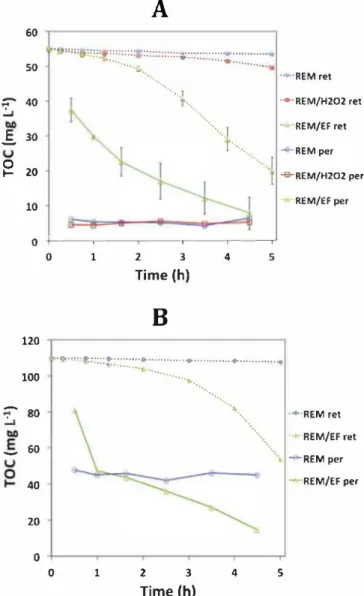
Fig. SA shows the evolution over time of TOC concentration in
permeate and retentate during experiments with TOCo
=
55 mg L -lFrom TOC measurement in the retentate it is possible to observe electro-oxidation ascribed to homogeneous oxidation in the bulk, while heterogeneous oxidation at the REM can be observed from TOC re moval between retentate and permeate. A similar trend was obtained for both REM and REM/H2O2 configurations. TOC concentration de creased very slowly in the retentate because of the absence of homo geneous • OH generation. Besides, the analysis of TOC in the permeate revealed that the effectiveness of the REM for PCT mineralization re mained constant throughout the 5 h of treatment. In the case of the REM/EF integrated process, TOC concentration in the retentate de creased quickly due to the production of · OH formed via Fenton's re action (Eq. (2)). However, at the beginning of the experiment, the ef fectiveness of heterogeneous oxidation at the REM was lower in the
A
60so
•• 11:;j ·:::;: �::��-;·;·;·:·;·�::::::::::::.:::::::::::: ... :::::::::::� ::;- 40 �._S
30 � 20 10 .,.,,_ '•·-...
···•,.I t· ...... .. . .. .,.REM rel ·•·REM/H202 rel ··· .. ! .. -·REM/EF rel f·•..... ..,...REM per····•·
..
r
)
-6-REM/H202 per �REM/Ef per 0 +---�--�--.----.---,' 0 120 100-
80:.,
60 -40 20 0 0 1 2 3 4 5Time (hl
B
•4"it!!l::f:::;::e::::::::::••••••oo,,,u+••••••••••••••••••••••ooo ..
1
···
···
··
...
.
2
3
Time (h)
· •...
··• ...
···
•
·
· ..
.
.•...•...
..
4 5 ·•·REM rel ·· .. REM/EF rel �REM per -REM/EF perFig. 5. TOC evolution over time, as a function of the experimental configura
tion (REM standalone process, REM/H2O2 process, or integrated REM/EF pro
cess). (A) TOC0 = 55 mg L -l and (B) TOC0 = 110 mg L -1• Ali experiments
have been performed without recirculation of the permeate. "ret" refers to concentrations analyzed in the retentate, while "per" refers to concentrations analyzed in the permeate. Error bars for REM/EF have been calculated from
replicate experiments (n = 3). Calculations have been made using Eqs. (5) and
(6).
configuration REM/EF compared to the configuration REM alone (without generation of •OH in the retentate). TOC removal at the REM
by the REM/EF was only 32% at t = 0.5 h of treatment with the REM/
EF configuration, compared to 90% with the configuration REM. This phenomenon could be attributed to the promotion of wasting reactions at the REM surface during filtration of the retentate containing · OH and Fe2+ in the case of the REM/EF configuration. These wasting reactions are more specifically (i) the dimerization reaction between · OH homogeneously produced in the retentate and ·OH heterogeneously produced from AO at the REM (Eq. (13)) and (ii) the reaction of ·OH heterogeneously produced at the REM with Fe2 + ions present in the retentate (Eq. (14)).
Similarly, a lower effectiveness of the REM at the beginning of the treatment with the REM/EF process compared to the configuration with the REM alone was observed during experiments performed at initial TOC of 110 mg L -1 (Fig. SB). However, with this higher TOC con centration, the presence of •OH and Fe2+ in the retentate had a lower impact on TOC removal by heterogeneously produced ·OH at the REM.
First, this phenomenon might be ascribed to a lower steady-state con centration of • OH in the retentate because of further reaction of homogeneously generated • OH with a greater amount of TOC. Fur thermore, there is actually a competition between the different species in the retentate (organic compounds, homogeneously generated ·OH
and Fe2+) for reaction with heterogeneous •OH generated at the REM.
By increasing the TOC concentration in the retentate, the reaction be tween heterogeneous • OH and organic compounds might be promoted, thus decreasing wasting reaction of heterogeneous · OH with Fe2 + and homogeneously generated •OH.
Interestingly, with the REM/EF configuration, it was observed that the reaction in the retentate strongly improved the effectiveness of the heterogeneous reaction at the REM. For example, during the experi
ment with TOC0 = 55 mg L -1, TOC removal by the REM increased
from 32% at t = 0.5 h to 57% at 1.6 h of treatment (values calculated from TOC data given in Fig. 5; details of these results are provided as
Supplementary Material), while TOC removal in the retentate was Jess than 10% in the same time. Even more significant, during the experi
ment at TOC0 = 110 mg L -1, TOC removal by the REM increased from
26% at t = 0.5 h to 59% at t = 1.6 h, while TOC removal in the retentate was Jess than 6% in the same time. These results indicate a strong synergistic effect between the EF process and the use of TiOx REM as anode. The EF process is well known for producing rapidly short-chain carboxylic acids as degradation by-products of aromatic organic pollutants, particularly oxalic and oxamic acids in the case of PCT [50]. In this study, oxamic acid was used as a mode! molecule for carboxylic acid compound in order to assess the fate of such compo nents. A high concentration of 23 mg L -l was detected in the retentate after 5 h of treatment with the REM/EF configuration
(TOC0 = 55 mg L -1). By comparison, only 2.5 mg L -l of oxamic acid
was detected in the permeate with the REM configuration (same TOC0).
Compared to aromatic compounds, carboxylic acids have lower rate constants for reaction with •OH homogeneously produced in the bulk.
However, TiOx REM is able to quickly oxidize such compound by direct
electron transfer [29,30]. Therefore, when using TiOx REM as anode, both •OH-mediated oxidation and direct electron transfer can occur simultaneously [27,29,30]. Thus, such anode material is particularly suitable for improving the removal of carboxylic acids and the miner alization efficiency of the EF process.
The antagonist and synergistic phenomena occurring during the combination of homogeneous electro-oxidation (in the bulk retentate by electrochemically produced Fenton's reagent) and heterogeneous electro-oxidation (at the TiOx REM by AO) is highlighted for the first time in this configuration allowing the separation of oxidation me chanisms in the bulk retentate and at the anode/REM.
4. Conclusions
Optimal conditions for removal of PCT (TOC0 = 55 or 110 mg L -l)
by the REM/EF integrated process were selected as (i) j = 15 mA cm -2 (ii) recirculation flow rate of 1 L min -l involving TMP = 30 mbar and
J = 95 L h-1 m-2 and (iii) continuous 0
2 supply. Very high efficiency of this process was obtained for mineralization of PCT solution (e.g., 59% removal of 110 mg L -l of TOC with MCE = 77%) because of favorable mass transport conditions for (i) H202 production owing to the flow-through operation mode with continuous recirculation of the retentate through the CF cathode and (ii) electro-oxidation of organic compounds at the TiOx REM owing to the convection-enhanced mass transport of pollutants during filtration through the REM. Such condi tions allow taking advantage of the high electro-active surface area of these three dimensional porous electrodes.
The configuration REM/EF allowed for the first time the separation of oxidation mechanisms in the bulk retentate and at the anode/REM. An antagonist effect was observed during filtration of the bulk retentate through the REM because of wasting reactions of · OH heterogeneously produced at the REM with •OH homogeneously produced in the
C. Trellu, et aL
retentate as well as with Fe2+ ions. However, a strong synergistic effect was also emphasized between the degradation of PCT in the retentate by homogeneous · OH and the complete mineralization of degradation by-products at the REM. In fact, direct electron transfer can also occur
at the TiOx REM and degradation by-products such as carboxylic acids
are more easily mineralized by direct electron transfer than by oxida tion with homogeneous · OH. This phenomenon also explains why the overall efficiency of the REM/EF integrated process far exceeded the efficiency of EF and REM used as standalone processes.
Declaration of Competing Interest
The authors declare that they have no known competing financial interests or personal relationships that could have appeared to influ ence the work reported in this paper.
Acknowledgements
We gratefully acknowledge the National French Agency of Research 'ANR' for funding the project ECO-TS/CElectrON (ANR-13-ECOT-0003). Clément Trellu particularly thanks the agency for post-doctoral fellowship. Authors are also grateful to Saint-Gobain Research Provence (CREE Cavaillon France) for supplying reactive electrochemical mem branes in the framework of the ANR program.
Appendix A. Supplementary data
Supplementary data to this article can be found online at https:/ / doi.org/10.1016/j.cej.2020.125936.
References
[1] A. Joss, H. Siegrist, T.A. Ternes, Are we about to upgrade wastewater treatment for removing organic micropollutants? Water Sei. Technol. 57 (2008) 251-255, https:/ /doi.org/10.2166/wst.2008.825.
[2] B.P. Chaplin, Critical review of electrochemical advanced oxidation processes for water treatment applications, Environ. Sei. Process. Impacts. (2014), https:/ /doi. org/10.1039/C3EM00679D.
[3] C.A. Martinez-Huitle, M.A. Rodrigo, I. Sirés, O. Scialdone, Single and coupled electrochemical processes and reactors for the abatement of organic water pollu tants: a critical review, Chem. Rev. 115 (2015) 13362-13407, https://doi.org/10. 1021/acs.chemrev.5b00361.
[ 4] I. Sirés, E. Brillas, M.A. Oturan, M.A. Rodrigo, M. Panizza, Electrochemical ad vanced oxidation processes: today and tomorrow. A review, Environ. Sei. Pollut. Res. 21 (2014) 8336-S367, https://doi.org/10.1007 /sll356-014-2783-l.
[5] F.C. Moreira, R.A.R. Boaventura, E. Brillas, V.J.P. Vilar, Electrochemical advanced oxidation processes: a review on their application to synthetic and real wastewaters, Appl. Catal. B: Environ. 202 (2017) 217-261, https://doi.org/10.1016/j.apcatb. 2016.08.037.
[6] E. Brillas, I. Sirés, M.A. Oturan, Electro-Fenton process and related electrochemical rechnologies based on Fenton's reaction chemistry, Chem. Rev. 109 (2009) 6570-6631, https://doi.org/10.1021/cr900136g.
[7] M. Panizza, G. Cerisola, Direct and mediated anodic oxidation of organic pollutants, Chem. Rev. 109 (2009) 6541-6569, https://doi.org/10.1021/cr9001319. [8] Enric Brillas, Carlos A. Martinez-Huitle, Decontamination of wastewaters con
taining synthetic organic dyes by electrochemical methods. An updated review, Appl. Catal. B 166-167 (2015) 603-643, https://doi.org/10.1016/j.apcatb.2014. 11.016.
[9] C. Saez, R. Lopez-Vizcaino, P. Canizares, M.A. Rodrigo, Conductive-diamond elec trochemical oxidation of surfactant-aided soil-washing effluents, Ind. Eng. Chem. Res. 49 (2010) 9631-9635, https:/ /doi.org/10.1021/iel01224t.
[10] M.A. Oturan, M.C. Edelahi, N. Oturan, K. El Kacemi, J.-J. Aaron, Kinetics of oxi dative degradation/mineralization pathways of the phenylurea herbicides diuron, monuron and fenuron in water during application of the electro-Fenton process, Appl. Catal. B: Environ. 97 (2010) 82-89, https:/ /doi.org/10.1016/j.apcatb.2010. 03.026.
[11] S. Garcia-Segura, E. Brillas, Mineralization of the recalcitrant oxalic and oxamic acids by electrochemical advanced oxidation processes using a boron-doped dia mond anode, Water Res. 45 (2011) 2975-2984, https://doi.org/10.1016/j.watres. 2011.03.017.
[12] R. Salazar, E. Brillas, I. Sirés, Finding the best Fe2+ /Cu2+ combination for the solar
photoelectro-Fenton treatment of simulated wastewater containing the industrial textile dye Disperse Blue 3, Appl. Catal. B: Environ. 115-116 (2012) 107-116, https://doi.org/10.1016/j.apcatb.2011.12.026.
[13] E. Mousset, L. Frunzo, G. Esposito, E.D. van Hullebusch, N. Oturan, M.A. Oturan, A
complete phenol oxidation pathway obtained during electro-Fenton treatment and validated by a kinetic mode! study, Appl. Catal. B: Environ. 180 (2016) 189-198, https:/ / doi.org/10.1 0l 6/j.apcatb.2015.06.014.
[14] C. Salazar, C. Ridruejo, E. Brillas, J. Yâfiez, H.D. Mansilla, I. Sirés, Abatement of the fluorinated antidepressant fluoxetine (Prozac) and its reaction by-products by electrochemical advanced methods, Appl. Catal. B: Environ. 203 (2017) 189-198, https:/ / doi.org/10.1 0l 6/j.apcatb.2016.10.026.
[15] R.C. Burgos-Castillo, I. Sirés, M. Sillanpiiii, E. Brillas, Application of electrochemical advanced oxidation to bisphenol A degradation in water. Effect of sulfate and chloride ions, Chemosphere 194 (2018) 812-S20, https://doi.org/10.1016/j. chemosphere.2017.12.014.
[16] E. Mousset, N. Oturan, M.A. Oturan, An unprecedented route of OH radical re activity evidenced by an electrocatalytical process: Ipso-substitution with perhalo genocarbon compounds, Appl. Catal. B: Environ. 226 (2018) 135-146, https://doi. org/10.1016/j.apcatb.2017.12.028.
[17] M. El Kateb, C. Trellu, A. Darwich, M. Rivallin, M. Bechelany, S. Nagarajan, S. Lacour, N. Bellakhal, G. Lesage, M. Héran, M. Cretin, Electrochemical advanced oxidation processes using novel electrode materials for mineralization and biode gradability enhancement of nanofiltration concentrate of landfill leachates, Water Res. 162 (2019) 446-455, https://doi.org/10.1016/j.watres.2019.07.005. [18] A.K. Abdessalem, N. Oturan, N. Bellakhal, M. Dachraoui, M.A. Oturan,
Experimental design methodology applied to electro-Fenton treatment for de gradation of herbicide chlortoluron, Appl. Catal. B: Environ. 78 (2008) 334-341, https:/ / doi.org/10.1 0l 6/j.apcatb.2007 .09.032.
[19] A. Ôzcan, Y. Sahin, A.S. Koparal, M.A. Oturan, A comparative study on the effi ciency of electro-Fenton process in the removal of propham from water, Appl. Catal. B: Environ. 89 (2009) 620-626, https://doi.org/10.1016/j.apcatb.2009.01.022. [20] H. Zhang, D. Zhang, J. Zhou, Removal of COD from landfill leachate by electro Fenton method, J. Hazard. Mater. 135 (2006) 106-111, https:/ /doi.org/10.1016/j. jhazmat.2005.11.025.
[21] M. Pimente!, N. Oturan, M. Dezotti, M.A. Oturan, Phenol degradation by advanced electrochemical oxidation process electro-Fenton using a carbon felt cathode, Appl. Catal. B: Environ. 83 (1-2) (2008) 140-149, https://doi.org/10.1016/j.apcatb. 2008.02.011.
[22] O. Scialdone, S. Randazzo, A. Galia, G. Silvestri, Electrochemical oxidation of or ganics in water: role of operative parameters in the absence and in the presence of NaCI, Water Res. 43 (2009) 2260-2272, https:/ /doi.org/10.1016/j.watres.2009.02. 014.
[23] A. Ôzcan, Y. Sahin, A.S. Koparal, M.A. Oturan, Propham mineralization in aqueous medium by anodic oxidation using boron-doped diamond anode: influence of ex perimental parameters on degradation kinetics and mineralization efficiency, Water Res. 42 (2008) 2889-2898, https://doi.org/10.1016/j.watres.2008.02.027. [24] C. Trellu, Y. Péchaud, N. Oturan, E. Mousset, D. Huguenot, E.D. van Hullebusch,
G. Esposito, M.A. Oturan, Comparative study on the removal of humic acids from drinking water by anodic oxidation and electro-Fenton processes: mineralization efficiency and modelling, Appl. Catal. B: Environ. 194 (2016) 32-41, https://doi. org/10.1016/j.apcatb.2016.04.039.
[25] N. Oturan, S.O. Ganiyu, S. Raffy, M.A. Oturan, Sub-stoichiometric titanium oxide as a new anode material for electro-Fenton process: application to electrocatalytic destruction of antibiotic amoxicillin, Appl. Catal. B: Environ. 217 (2017) 214-223, https:/ /doi.org/10.1 0l 6/j.apcatb.2017 .05.062.
[26] E. Mousset, Y. Pechaud, N. Oturan, M.A. Oturan, Charge transfer/mass transport competition in advanced hybrid electrocatalytic wastewater treatment: develop ment of a new current efficiency relation, Appl. Catal. B: Environ. 240 (2019) 102-111, https:/ /doi.org/10.1016/j.apcatb.2018.08.055.
[27] C. Trellu, B.P. Chaplin, C. Coetsier, R. Esmilaire, S. Cerneaux, C. Causserand, M. Cretin, Electro-oxidation of organic pollutants by reactive electrochemical membranes, Chemosphere 208 (2018) 159-175, https://doi.org/10.1016/j. chemosphere.2018.05.026.
[28] C. Trellu, C. Coetsier, J.-C. Rouch, R. Esmilaire, M. Rivallin, M. Cretin, C. Causserand, Mineralization of organic pollutants by anodic oxidation using re active electrochemical membrane synthesized from carbotherrnal reduction of TiO2, Water Res. 131 (2018) 310-319, https://doi.org/10.1016/j.watres.2017.12. 070.
[29] A.M. Zaky, B.P. Chaplin, Porous substoichiometric TiO2 anodes as reactive elec trochemical membranes for water treatment, Environ. Sei. Technol. 47 (2013) 6554-6563, https://doi.org/10.1021/es401287e.
[30] L. Guo, Y. Jing, B.P. Chaplin, Development and characterization of ultrafiltration TiO2 Magnéli phase reactive electrochemical membranes, Environ. Sei. Technol. 50 (2016) 1428-1436.
[31] D. Zhi, J. Wang, Y. Zhou, Z. Luo, Y. Sun, Z. Wan, L. Luo, D.C.W. Tsang, D.D. Dionysiou, Development of ozonation and reactive electrochemical membrane coupled process: enhanced tetracycline mineralization and toxicity reduction, Chem. Eng. J. 383 (2020) 123149,, https://doi.org/10.1016/j.cej.2019.123149. [32] H. Shi, Y. Wang, C. Li, R. Pierce, S. Gao, Q. Huang, Degradation of per
fluorooctanesulfonate by reactive electrochemical membrane composed of Magnéli phase titanium suboxide, Environ. Sei. Technol. 53 (2019) 14528-14537, https:// doi.org/10.1021/acs.est. 9b04 l 48.
[33] S.N. Misai, M.-H. Lin, S. Mehraeen, B.P. Chaplin, Modeling electrochemical oxi dation and reduction of sulfamethoxazole using electrocatalytic reactive electro chemical membranes, J. Hazard. Mater. 384 (2020) 121420, , https://doi.org/10. 1016/j.jhazmat.2019.121420.
[34] G. Gao, C.D. Vecitis, Reactive depth and performance of an electrochemical carbon nanotube network as a function of mass transport, ACS Appl. Mater. Interfaces 4 (2012) 6096-6103, https://doi.org/10.1021/am301724n.
to identify key innovations required for electrochemical oxidation as point-of-use treatrnent systems, Electrochim. Acta 338 (2020) 135874, , https:/ /doi.org/10. 1016/j.electacta.2020.135874.
[36] J.F. Pérez, J. Llanos, C. Saez, C. L6pez, P. Cafiizares, M.A. Rodrigo, Electrochemical jet-cell for the in-situ generation of hydrogen peroxide, Electrochem. Commun. 71 (2016) 65-68, https://doi.org/10.1016/j.elecom.2016.08.007.
[37] G. Ren, M. Zhou, M. Liu, L. Ma, H. Yang, A nove! vertical-flow electro-Fenton re actor for organic wastewater treatrnent, Chem. Eng. J. 298 (2016) 55-67, https:/ / doi.org/10.1016/j.cej .2016.04.011.
[38] L. Ma, M. Zhou, G. Ren, W. Yang, L. Liang, A highly energy-efficient flow-through electro-Fenton process for organic pollutants degradation, Electrochim. Acta 200 (2016) 222-230, https://doi.org/10.1016/j.electacta.2016.03.181.
[39] C. Zhang, Y. Jiang, Y. Li, Z. Hu, L. Zhou, M. Zhou, Three-dimensional electro chemical process for wastewater treatment: a general review, Chem. Eng. J. 228 (2013) 455-467, https:/ /doi.org/10.1016/j.cej.2013.05.033.
[40] T.X.H. Le, T.V. Nguyen, Z. Amadou Yacouba, L. Zoungrana, F. Avril, D.L. Nguyen, E. Petit, J. Mendret, V. Bonniol, M. Bechelany, S. Lacour, G. Lesage, M. Cretin, Correlation between degradation pathway and toxicity of acetaminophen and its by-products by using the electro-Fenton process in aqueous media, Chemosphere 172 (2017) 1-9, https://doi.org/10.1016/j.chemosphere.2016.12.060.
[41] E. Brillas, E. Mur, J. Casado, lron(II) catalysis of the mineralization of aniline using a carbon-PTFE O-2-fed cathode, J. Electrochem. Soc. 143 (1996) L49-L53, https:// doi.org/10.1149/1.1836528.
[42] C. Flox, S. Ammar, C. Arias, E. Brillas, A.V. Vargas-Zavala, R. Abdelhedi, Electro Fenton and photoelectro-Fenton degradation of indigo carmine in acidic aqueous medium, Appl. Catal. B: Environ. 67 (2006) 93-104, https://doi.org/10.1016/j. apcatb.2006.04.020.
[43] H. Zazou, N. Oturan, M. Siinmez-Çelebi, M. Hamdani, M.A. Oturan, Mineralization of chlorobenzene in aqueous medium by anodic oxidation and electro-Fenton processes using Pt or BDD anode and carbon felt cathode, J. Electroanal. Chem. 774
(2016) 22-30, https:/ /doi.org/10.1016/j.jelechem.2016.04.051.
[ 44] E. Brillas, B. Boye, I. Sirés, J.A. Garrido, R.M. Rodriguez, C. Arias, P.-L. Cabot, C. Comninellis, Electrochemical destruction of chlorophenoxy herbicides by anodic oxidation and electro-Fenton using a boron-doped diamond electrode, Electrochim. Acta 49 (2004) 4487-4496, https://doi.org/10.1016/j.electacta.2004.05.006. [ 45] S.O. Ganiyu, N. Oturan, S. Raffy, M. Cretin, C. Causserand, M.A. Oturan, Efficiency
of plasma elaborated sub-stoichiometric titanium oxide (Ti4O7) ceramic electrode for advanced electrochemical degradation of paracetamol in different electrolyte media, Sep. Purif. Technol. 208 (2019) 142-152, https://doi.org/10.1016/j.seppur. 2018.03.076.
[ 46] H. Olvera-Vargas, C. Trellu, N. Oturan, M.A. Oturan, Bio-electro-Fenton: a new combined process - Principles and applications, Electro-Fenton Process, Springer, Singapore, 2017, pp. 29-56,, https://doi.org/10.1007/698_2017_53.
[ 47] H. Monteil, Y. Péchaud, N. Oturan, M.A. Oturan, A review on efficiency and cost effectiveness of electro- and bio-electro-Fenton processes: application to the treat ment of pharmaceutical pollutants in water, Chem. Eng. J. 376 (2019) 119577, , https:/ /doi.org/10.1016/j.cej.2018.07.179.
[ 48] O. Ganzenko, D. Huguenot, E.D. van Hullebusch, G. Esposito, M.A. Oturan, Electrochemical advanced oxidation and biological processes for wastewater treatrnent: a review of the combined approaches, Environ. Sei. Pollut. Res. (2014) 1-32, https:/ /doi.org/10.1007 /sl 1356-014-2770-6.
[ 49] C. Trellu, O. Ganzenko, S. Papirio, Y. Pechaud, N. Oturan, D. Huguenot, E.D. van Hullebusch, G. Esposito, M.A. Oturan, Combination of anodic oxidation and bio logical treatrnent for the removal of phenanthrene and Tween 80 from soi! washing solution, Chem. Eng. J. 306 (2016) 588-596, https://doi.org/10.1016/j.cej.2016. 07.108.
[50] E. Brillas, I. Sirés, C. Arias, P.L. Cabot, F. Centellas, R.M. Rodriguez, J.A. Garrido, Mineralization of paracetamol in aqueous medium by anodic oxidation with a boron-doped diamond electrode, Chemosphere 58 (2005) 399-406, https:/ /doi. org/10.1016/j.chemosphere.2004.09.028.
![Fig. 4. PCT ([PCT] 0 = 87 mg L - 1) and TOC evolutions (TOC 0 = 55 mg L - 1)](https://thumb-eu.123doks.com/thumbv2/123doknet/2945056.79581/7.892.464.829.78.352/fig-pct-pct-mg-l-toc-evolutions-toc.webp)