Process analysis and improvments for production of
engineered wood structures in an engineer-to-order
system
Thèse
Marzieh Ghiyasinasab
Doctorat en génie mécanique
Philosophiæ doctor (Ph. D.)
Résumé
Augmenter la part de marché du bois dans la construction non résidentielle est un objectif important dans les pays où les produits forestiers et de bois d'ingénierie jouent un rôle fondamental. Afin de faciliter la production de structures en bois innovantes, il est nécessaire de mettre sur pied des procédures de réingénierie en termes d’analyse de marché et d’amélioration de la productivité. L'objectif principal de cette thèse est de faciliter la production de bois d'ingénierie (produits en lamellé-collé) destiné à être utilisé dans des structures en bois innovantes telles que les résilles en bois. Pour atteindre ce but, trois objectifs spécifiques sont définis.
Le premier objectif est de déterminer les phases de production et les opportunités de marché pour la production de résilles en bois. À cet égard, une revue de la littérature académique et de la littérature grise a été réalisée, et vingt échantillons ont été identifiés et analysés à l'aide de diagrammes de processus et de catégorisations. Les résultats ont montré qu’une structure en résille de bois est utilisée dans l'industrie de la construction en Europe et qu'elle est moins connue en Amérique du Nord, ce qui offre une opportunité de marché pour sa production et sa construction. La catégorisation des échantillons étudiés dans les petites, moyennes et grandes structures et l'identification des acteurs pour chaque catégorie fournissent une vue d'ensemble pour les entreprises qui envisagent la production de cette structure.
Le deuxième objectif de cette thèse est de fournir un modèle de simulation pour la production de bois lamellé-collé dans de petites usines et le processus d'application de techniques Lean pour apporter des améliorations. À cet égard, le système de production d’une entreprise québécoise a été analysé et un modèle de simulation créé. Afin d'éliminer chaque source de gaspillage, un outil Lean a été suggéré en fonction de la réalité du système à l’étude. Les résultats ont montré une amélioration notable du temps d’attente et de cycle suite à l’utilisation de techniques issues du Lean. Ils ont également contribué à souligner qu’une élimination du gaspillage limitée à 50% pouvait améliorer la considérablement la productivité pour les petites entreprises et s’avérer un premier pas important dans l’implantation du Lean.
Le troisième objectif est de fournir un outil de planification et d'ordonnancement de la production dans un contexte de production multi-projets d’ingénierie sur commande (Engineer-to-Order) de bois lamellé-collé. À cet égard, des modèles d'optimisation ont été créés. Le premier modèle (modèle 1) concerne la minimisation du coût de production total, tandis que le modèle 2 vise la minimisation de la durée totale des projets. Le modèle 3 cherche plutôt à réduire le temps de mise en route sur la presse, le poste goulot du système de production considéré. Le modèle 4 intègre les trois objectifs de réduction des coûts, de durée et de temps de mise en route. Deux scénarios d’ajout de projets de grande et de moyenne envergure ont été conçus et testés. Le test des scénarios démontre qu'il y a une capacité suffisante pour l’ajout d’un projet de grande envergure ou de neuf projets de taille moyenne sans recourir à la sous-traitance. L'ajout d'un projet de grande envergure est plus sensible à la période d'insertion, pouvant exiger du temps supplémentaire selon la date de début du projet.
Les travaux de cette thèse permettent donc de fournir des outils d'aide à la décision pour les entreprises œuvrant dans un milieu d'ingénierie sur commande afin d'améliorer leur productivité et la standardisation de leurs processus.
Mots-clés: Bois d'ingénierie, Petites et moyennes entreprises, Simulation, Optimisation multi-objectifs, Résille, ingénierie sur commande, Planification de la production, Planification de projet
Abstract
Increasing the share of wood in non-residential construction is an important goal in countries with major forest and engineered wood products. In order to facilitate the production of innovative timber structures, procedures should be re-engineered in terms of market analysis and productivity improvement. The main objective of this thesis is to facilitate the production of engineered wood to be used in innovative wood structures such as timber gridshell. To achieve this goal, three specific objectives are defined.
The first objective is to determine production phases and market opportunities for the production of timber gridshell. In this regard, a review of the academic and grey literature was conducted, and twenty samples were identified and analysed by making process charts and categorisations. The results showed that gridshell is used in the construction industry in Europe and is less recognised in North America, which provides a market opportunity for its production and construction. The categorisation of studied samples in small, medium and large structures provides an overview for the companies who consider the production of this structure.
The second objective of this thesis is to provide a simulation model for the production of glued laminated timber in small factories and the process of applying lean techniques to make improvements. In this regard, the production system of a Small and medium-sized enterprise (SME) was analysed, and a simulation model was created. In order to eliminate each source of waste, a lean tool was suggested according to the reality of the system under investigation. The lean methods were applied in the simulation model to analyse the potential improvements. Results showed a noticeable improvement in waiting and cycle time. It also showed that applying even 50% elimination of the wastes is also a considerable solution to improve productivity as a beginning step for SMEs.
The third objective is to provide a production planning and scheduling tool in the context of multi-project engineer-to-order production of glued laminated timber. In this regard, optimisation models were created. The first model (model 1) concerns the minimisation of total production cost while model 2 aims to minimise projects’ makespan. Model 3
introduces the set-up time reduction and model 4 integrates the three objectives of minimising cost, makespan and set-up time. Two scenarios of adding complex and medium projects were designed and tested. Testing the scenarios showed that there is enough capacity for adding one complex project or nine medium projects without the need to outsource. Adding a complex project is more sensitive to the insertion period and beginning the project in different weeks leads to different results in terms of the overtime requirement.
As a result, the work of this thesis provides decision support tools for engineer-to-order environments which could help SMEs to improve their productivity and standardisation.
Keywords: Engineered wood, Small and medium enterprise, Simulation, Multi-objective optimisation, Gridshell, engineer-to-order, Production planning, Project scheduling.
Table of contents
Résumé ... iii
Abstract ... v
Table of contents ... vii
List of tables ... x
List of figures ... xi
List of abbreviations ... xii
Acknowledgements ... xiv
Foreword ... xvi
Introduction ... 1
Chapter 1 Literature review ... 8
1.1 Lean approach ... 8
1.2 Simulation ... 11
1.3 Simulation versus optimisation ... 14
1.4 Production systems ... 15
1.5 Conclusion ... 16
Chapter 2 Objectives, Case Study and Methodology ... 17
2.1 Case study ... 17 2.2 Research methodology ... 19 2.3 Thesis organisation ... 21 2.3.1 Organisation of chapter 3 ... 21 2.3.2 Organisation of chapter 4 ... 22 2.3.3 Organisation of chapter 5 ... 23 2.4 Conclusion ... 24
Chapter 3. Production Phases and Market for Timber Gridshell Structures: A State-of-the-Art Review ... 25
Résumé ... 25
Abstract ... 26
3.1 Introduction ... 27
3.2 Preliminary concepts and definitions ... 28
3.3 Methodology ... 30
3.4 Findings ... 31
3.5 Discussion ... 38
3.5.1 Main Partners Involved and Production Phases ... 38
3.5.2 Current and Future Markets ... 42
3.6 Summary and Conclusion... 47
Chapter 4. Using Lean Techniques and Simulation to Improve the Efficiency of Engineered Wood Production: a Case Study in a small factory ... 49
Résumé ... 49
Abstract ... 50
4.1 Introduction ... 51
4.2 Literature review ... 53
4.3 Methodology and simulation model ... 56
4.3.1 Creation of the simulation model for glulam production ... 58
4.3.2 Verification of the model ... 60
4.4. Case study ... 61
4.4.1 Adapting the simulation model to reflect the case study ... 61
4.4.2 Validation of the model ... 62
4.5. Results ... 64
4.5.1 Overproduction ... 64
4.5.2 Inventory ... 64
4.5.3 Motion ... 64
4.5.4 Waiting ... 65
4.5.5 Over-processing (NVA activities) ... 65
4.5.6 Transportation... 67
4.5.7 Defects (failure and rework) ... 69
4.5.8 Summary ... 71
4.6. Discussion ... 71
4.6.1 Applying all changes simultaneously ... 71
4.6.2 Managerial insights ... 73
4.7. Conclusion ... 73
Chapter 5. Production Planning and Project Scheduling for Engineer-to-Order Systems- Case Study for Engineered Wood Production ... 75
Résumé ... 75
Abstract ... 76
5.1 Introduction ... 77
5.2 Literature review ... 79
5.3 Methodology and modelling ... 81
5.3.1 Methodology... 81
5.3.2 Presentation of the SME under study ... 83
5.4.1 Input data ... 92
5.4.2 Defining weights for the multi-objective functions ... 94
5.4.3 Tactical Planning Results ... 96
5.4.4 Scenarios for adding new projects ... 99
5.4.5 Trade-off between models ... 101
5.5 Discussion and managerial insights ... 103
5.5.1 Discussion ... 103
5.5.2 Managerial insights ... 104
5.6 Conclusions ... 105
General conclusion and perspectives ... 107
General conclusion ... 107
Recommendations for future work ... 109
List of tables
Table 1. Wood grades and their position in glulam ... 18
Table 2. Number of employees in each work group in the factory ... 18
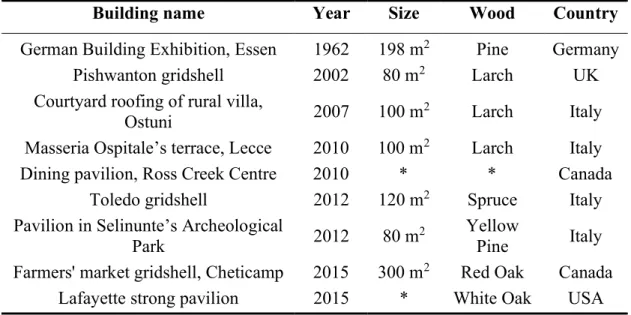
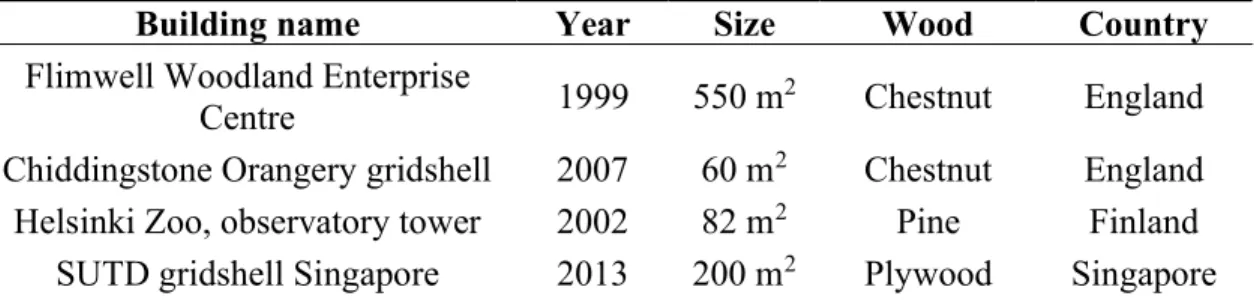
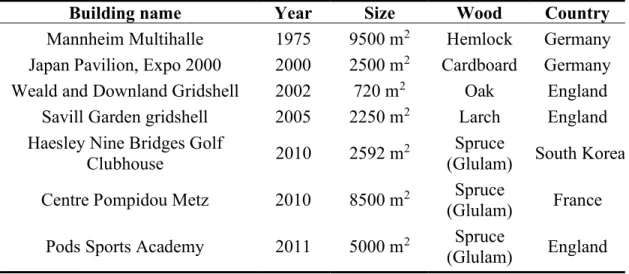
Table 3. Characteristics of the Categories ... 33
Table 4. Small Gridshells ... 35
Table 5. Medium-Sized Gridshells ... 36
Table 6. Large and Complex Gridshells ... 38
Table 7. Market Segments Observed for Example Gridshells ... 46
Table 8. Market Segments Suggested for Gridshells ... 47
Table 9. Process distribution parameters of glulam production ... 61
Table 10. Comparing simulation time with real cycle time ... 63
Table 11. Proposed preventive maintenance schedule ... 69
Table 12. Seven sources of waste and their cause ... 71
Table 13. Summary of the scenarios and results ... 72
Table 14.Input data for each phase ... 93
Table 15.Input data for fifteen projects ... 93
Table 16. Production time for a full load of the press per width and percentage of each width per project ... 93
Table 17.The best and worse solutions of each objective function ... 94
Table 18. Pareto frontier for model 2 ... 95
Table 19. Pareto frontier for model 4 ... 95
Table 20. Main results of the four models for fifteen projects ... 96
List of figures
Figure 1. Research questions ... 5
Figure 2. Waste categorisation, Nikhakhtar et al. (2015) based on Senaratne and Wijesiri, (2008) ... 10
Figure 3. Ways to study a system from Law and Kelton (2000) ... 12
Figure 4. Seven steps to prepare a valid simulation model based on Law (2008)... 14
Figure 5. Decoupling point for each production environment ( Olhager 2012 ) ... 16
Figure 6. Straight beams, special shapes, round beams, and arcs. ... 17
Figure 7. Methodology of the research ... 21
Figure 8. Research organisation in the first contribution ... 22
Figure 9. Research organisation in the second contribution ... 23
Figure 10. Research organisation in the third contribution ... 24
Figure 11. Left picture is the Toledo gridshell (Gridshell.it 2012), middle picture is the Helsinki Zoo’s observatory tower (Paoli 2007), and right picture is the Centre Pompidou Metz (Lewis 2011). ... 29
Figure 12. Steps of literature review methodology ... 31
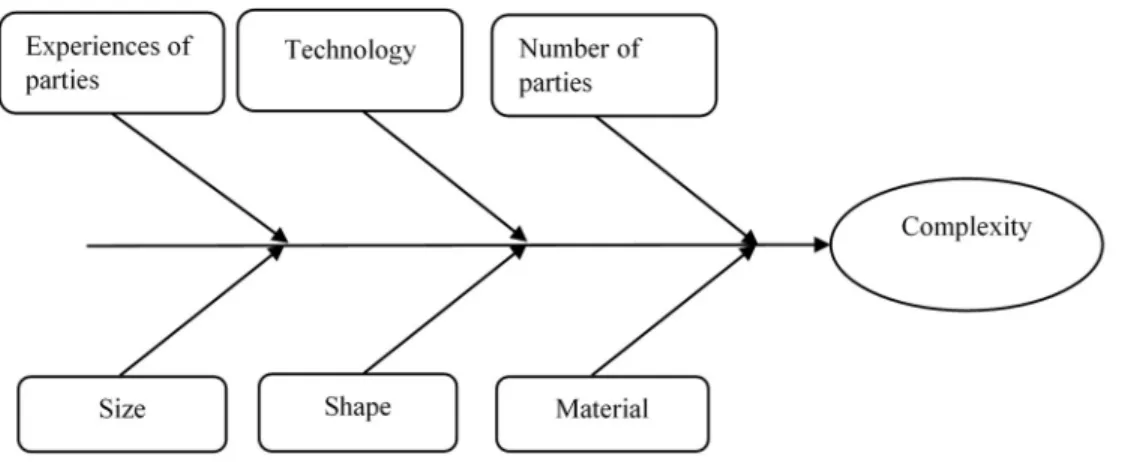
Figure 13. Cause and effect diagram for level of complexity in production of a gridshell structure ... 32
Figure 14. Diagram of the phases and partners involved for building a small and medium-sized gridshell ... 39
Figure 15. Production phases and partners involved for building a large and complex gridshell . 42 Figure 16. SWOT analysis of gridshell as an innovative structure ... 45
Figure 17. Research methodology ... 57
Figure 18. Sketch of the manufacturing process (Malo and Angst 2008, reproduced in www.glulambeams.co.uk) ... 58
Figure 19. The main processes and modules in the simulation model for glulam production ... 60
Figure 20. Simulation model of curved glulam production for a gridshell project in an SME ... 62
Figure 21. Comparing the effect of eliminating NVA processes on cycle time (left) and wait time (right) ... 67
Figure 22. Current factory layout with unnecessary transportation ... 68
Figure 23. Suggested U-shaped layout ... 68
Figure 24. Comparing the effect of implementing all improvements on cycle time (left) and wait time (right) ... 72
Figure 25. Steps to eliminate waste in small engineering wood production companies ... 73
Figure 26. Methodology of the research ... 83
Figure 27. Phases for the completion of each project ... 84
Figure 28. Pareto frontier for model 3 ... 95
Figure 29. Cumulative view of the production plans proposed by model 3 and model 4 ... 97
Figure 30. Used and available capacity for the production phase obtained with the four models 98 Figure 31. Comparison of total costs for scenario 2 ... 101
List of abbreviations
DES Discrete-Event Simulation
DFMA Design For Manufacturing and Assembly DOE Design Of Experiments
ETO Engineer-To-Order Glulam Glued-Laminated-Timber
IMVP International Motor Vehicle Program MIP Mixed-Integer Programming
MIT Massachusetts Institute of Technology
MTO Make-To-Order
NSERC Natural Sciences and Engineering Research Council of Canada NVA Non-Value-Adding
RCPSP Resource-Constrained Project Scheduling Problem SMED Single Minute Exchange of Dies
SMEs Small and Medium-Sized Enterprises
SWOT Strengths, Weaknesses, Opportunities, and Threats
TPM Total Productive Maintenance VA Value-Adding
VSM Value Stream Mapping WIP Work In Process
You never change things by fighting the existing reality. To change something,
build a new model that makes the existing model obsolete.
Acknowledgements
I am honoured and grateful to have had the opportunity to work and learn under the supervision of Nadia Lehoux. She has supported me throughout my Ph. D. with her patient guidance and enthusiastic encouragement whilst allowing me to work in my own way. I admire her discipline, knowledge, wisdom and great personality. Her level of care about research, the quality and clarity of her work are something I will always remember and aspire towards for my entire life.
I would like to express my deep gratitude to my co-director, Sylvain Ménard, for his valuable knowledge and guidance. His level of care always helped me to improve my research work and professional skills. He has always been supportive and gave me the confidence to continue.
This thesis would not be possible without the help and support of Caroline Cloutier research professional. She generously shared her time and knowledge with me and gave me valuable feedbacks all the time.
I am grateful to Mustapha Ouhimmou, Louis Antonio De Santa-Eulalia, Torsten Lihra, and Pascal.Forget for being on my thesis committee and for the time and the effort allocated to examining this dissertation. And
I am thankful to the Natural Sciences and Engineering Research Council of Canada through the ICP and CRD programs for its financial support. I am also grateful to the industrial chair on eco-responsible wood construction (CIRCERB) as well as CRMR and CIRRELT research consortiums for providing useful opportunities like conferences, workshops and social activities.
Special thanks to Pierre Blanchet and Pierre Gagné who contributed a great deal of effort into helping CIRCERB students besides the administrative support from Jenny McKenzie
providing relevant information and technical advice for the development of the case study presented in this thesis.
I am thankful to all my colleagues and friends Vanessa, Natasha, Sattar, Mehrad, François, and Azadeh. My heartfelt thanks to my parents for always being there for me even though living miles away from Quebec. I am also deeply thankful to my sister Maryam, who has always provided great support to me.
Foreword
This Ph. D. thesis was conducted under the direction of Professor Nadia Lehoux in Laval University and co-supervised by Professor Sylvain Ménard in the University of Québecin Chicoutimi. The research was funded by the Natural Sciences and Engineering Research Council of Canada (NSERC) through the ICP and CRD programs and the industrial partners of the NSERC industrial chair on eco-responsible wood construction (CIRCERB). The thesis includes three papers that have been published or submitted to scientific journals as listed here:
Ghiyasinasab, M., Lehoux, N., and Ménard, S. (2017). "Production phases and market for timber gridshell structures: A state-of-the-art review", BioRes. 12(4), 9538-9555.
Ghiyasinasab, M., Lehoux, N., Ménard, S. and Cloutier, C. (2018). "Using Lean Techniques and Simulation to Improve the Efficiency of Engineered Wood Production: a Case Study in a small factory", International Journal of Industrial Engineering and Management. 7(4) DOI: 10.4172/2169-0316.1000269
Ghiyasinasab, M., Lehoux, N., Ménard, S. and Cloutier, C. (2019). "Production planning and project scheduling for engineer-to-order systems- a Case Study of engineered wood production", submitted in: International Journal of Production Research.
Introduction
Environmental awareness increases the motivation to use wood as a renewable material which reduces CO2 emissions (Kuzman and Sandberg, 2016). In order to increase the share
of timber as a raw material especially in non-residential construction, it is necessary to pay attention to innovative structures that capture the eyes of the market. Wood construction systems typically encompass light frames, post and beams, massive wood structures, mixed and hybrid systems, and space frames (Tobergte and Curtis, 2013). Space frames provide free-formed structures which are promising solutions for contemporary and innovative needs in construction. An example of a space frame structure is Gridshell, which was developed by Professor Frei Otto in 1962. Gridshell is a structure with a shell shape made of grid timber laths (Douthe et al., 2006).
Different wood species have been used in gridshell systems such as larch, spruce, pine, oak, chestnut, and hemlock. In several important and recent constructions, glued laminated timber (glulam), which is a type of engineered wood, has been used for this structure. Engineered wood products are created using small pieces of wood adhered together with a bonding agent (Guss, 1995; Opacic et al., 2018). They are used in residential and non-residential structures (Lam and Prion, 2003). Engineered wood products make better use of wood by combining small pieces of wood and putting aside the parts that have natural defects. They can be produced to have specific characteristics in terms of fire resistance and sound absorption (Opacic et al., 2018). Glulam is one of the oldest engineered wood products and is a popular material in wood construction.
Building gridshell with glulam includes the production of glulam and then the construction of the structure that contains a combination of production and construction processes. The production of glulam, in this case, does not have the characteristic of mass production because the special design and dimensions should be produced for each construction project. These characteristics make a challenge for the optimisation and standardisation of the processes. Improvement approaches such as lean are well developed in mass-production and are even followed by the construction industry. However, mass-production of customized prefabricated parts for construction projects, especially in Small and
Medium-sized Enterprises (SMEs), have rarely been considered as the subject of systematic analysis and productivity improvement methods. Making improvements in the production of prefabricated parts such as glulam helps to increase efficiency while having greater control over the quality produced in the construction industry.
In the production planning context, the mentioned customized production for construction projects can be defined as engineer-to-order (ETO) system. ETO firms produce complex products which need specific design that does not exist before the customer order (Bertrand and Mutslag, 1993; Vaagen, 2017). Production planning in ETO systems is complex because of the higher level of production variability as it requires to manage due dates, capacity, order acceptance, and resource levelling efficiently (Ebadian et al., 2009). ETO firms that produce designed products for construction projects are project-oriented as each construction project has its start time, design specifications and due date. Therefore, a project-oriented or project scheduling approach seems to be a suitable method for production planning (Márkus et al., 2003; Alfieri et al., 2011; Carvalho et al., 2015).
Canadian forest industry has encountered serious crises since 2005. In Quebec, Canada, the Government has therefore decided to update its management towards the policies that support improvements in the use of forest products. One of the specific goals in the updated strategic plan is to increase the use of wood products in the non-residential sector and in the construction of multifamily homes as well as to intensify the use of appearance wood products. In order to reach this goal, it is required to consider innovative buildings and find the best ways possible to combine wood with other materials in hybrid systems (Ministry of Natural Resources and Wildlife of Canada, 2008). Free-formed and modern structures such as timber gridshell which is suitable to be made of hybrid materials are therefore structures that worth to pay attention to. Although timber gridshell has the characteristics of an innovative and sustainable structure, most of its examples are built in Europe and is not well recognized in North America.
increase the share of wood in construction. Productivity in the construction industry has improved more slowly than in the manufacturing sector which is related to the lack of standardisation since every project is different. According to the McKinsey Global Institute report (2017), a drastic increase in productivity would be possible if construction would tend towards a manufacturing-like system with a much higher degree of standardisation and modularisation. Conclusively, firms that produce structures or products specifically designed for construction projects have not got much attention in terms of productivity improvement methods as well as production planning and scheduling.
Industrial partner of this research is a SME that produces glulam for construction projects. This SME is interested to add gridshell into its production projects. It needs to understand the general processes of gridshell manufacturing and then make analysis if there is enough capacity in the factory to produce this new structure. The main questions that the SME encounters in the phase of considering gridshell production include: What are the motivations for construction of gridshell? What would be the potential market for this structure? In terms of productivity, there are serious issues that need improvement. The whole production system has not been analysed to reduce the non-value-adding activities and remove the other sources of waste as well. According to the observations and discussions with the production manager, the main problems in the production system are extracted. The production is not levelled and therefore there are periods where some stations are idle and other periods where overtime and outsourcing are required to meet the due date. Additionally, the production is not smooth, and the main bottleneck is the press machine. The process time is long, and a time-consuming set-up is needed.
This thesis aims to analyze how it is possible to improve the production of engineered wood in a SME as well as to facilitate its use in innovative structures such as gridshells. The first objective is to identify the production processes and involved parties as well as the motivations and barriers for the construction of gridshells. The second objective is to provide a system analysis tool for glulam production allowing to measure the impact of implementing lean manufacturing. The third objective is to provide a project scheduling tool which might help managers to analyse their capacity and decide on adding gridshell
or other projects in their production system. Research questions linked to the contributions of the research are summarised in Figure 1.
Investigating the gridshell structure in the first phase of this study showed that there is a market opportunity for this structure in North America and it could be considered as a solution for increasing the share of wood in modern non-residential construction. It also showed that glulam has been used in a certain number of gridshell examples and is an appropriate material to be used in production of this structure. Therefore, production of glulam in the SME case was analysed. The analysis showed that it is required to increase productivity in the production system to make it ready for adding new products such as gridshell. The lean approach was applied to make the first steps of improvements. In the third phase, production and capacity planning was considered to complete the standardization steps and finally make it possible to consider adding production of the gridshell to the system.
Besides to provide methods to improve productivity in the SME under study, the contribution of this study relies on providing a comprehensive point of view for gridshell production phases and market opportunities; providing a simulation model for glulam production that could be used for testing various scenarios, suggesting step by step guide to apply lean approach in SME’s; and providing a production planning model to be used for planning and capacity analysis in a SME that produces engineering wood. Moreover, the system under study is an ETO production system that produces engineered wood for construction projects. The characteristics of this system have not been considered in previous research and state an original contribution of this research.
Figure 1. Research questions
The first phase of the research followed a comprehensive investigation of the literature related to gridshell structures, including a general review of the technical production processes needed, the market expected, and the players involved. Studying most of the gridshell examples, with the purpose of understanding the production phases, led to categorising the examples as small, medium, and large-sized gridshells and defining players and production phases for the different categories of gridshell. The next step was to investigate the motivations of timber construction and combining it with the characteristics of gridshells, which then led to analysis of the strengths and weaknesses of
General Research Question
How is it possible to facilitate production of engineered wood to be used in innovative wood structures such as timber gridshell?
Research Sub Questions
Contribution 1: Determine production phases and market opportunities Are timber gridshell structures used in construction industry?
How were the examples built?
What would the potential market for this structure be?
Contribution 2: Provide a simulation model and apply lean technics What is the production system needed to produce glulam in a SME? How can we improve the productivity, production and waiting time? How can we apply lean techniques in this system?
Contribution 3: Provide a production planning and scheduling tool How is it possible to schedule the production in each phase and
each period for the combination of projects?
How should production be planned to minimize the set-up time? Which types of projects should be accepted and in which periods?
the product besides the opportunities and threats in the market. The contribution of the first phase is to provide an overview that covers existing examples of gridshell and their production phases. This study could provide guidance to companies interested in developing gridshells to make decisions in terms of their resources and facilities. Moreover, it could be viewed as a first step towards standardising the construction of timber gridshells.
The second phase of the research encompassed an analysis of the production in a SME for a prototype of gridshell using glulam as building material and the identification of a series of improvement steps based on the lean approach. The production system was analyzed, and the sources of waste identified. Then a simulation model was developed to measure the effects of the improvements proposed. The primary contribution of this research is to provide a simulation model for glulam production in SMEs which can be adapted to different cases. Developing a step by step approach that starts from feasible and less expensive improvements could motivate the managers to implement a lean approach. Another contribution is to use simulation and to apply the lean approach for glulam production designed for a specific gridshell system in order to analyze the processes, make suggestions for improvements and identify as well as prioritize the different sources of waste. Moreover, this research defines processes for the construction of gridshell with less waste which could motivate the construction of gridshell as a sustainable structure.
By taking steps in reducing waste and cycle time of the production, it becomes feasible to increase the number of gridshell systems produced in the factory. In this regard, managing and scheduling multi-projects become a key element to explore. The third stage of the research, therefore, led to the development of project-oriented optimisation models with the objective of cost minimisation (model 1), project makespan minimisation (model 2), press set-up time reduction (model 3) and a combination of all the three objectives (model 4). The models were tested for fifteen projects in a 40-week period. Also, scenarios of adding new projects were examined. The contribution of this study is to provide a planning and scheduling tool which reflect the characteristics of an ETO system for construction
research also provides a tool to facilitate strategic and tactical planning for the production of different engineered wood components.
Contribution of this study relies on prov In summary, the thesis provides a comprehensive analysis of the glulam production system and propose steps to increase its productivity while facilitating the adoption of innovative timber structures such as gridshell. The thesis is divided as follows: A review of the literature is provided in chapter 1. Chapter 2 describes the methodology and contributions. Chapter 3, 4, and 5 present the three original contributions of the thesis. The concluding section outlines the achievements and contributions of this work that are obtained through the linkage between all three contributions.
Chapter 1 Literature review
This chapter provides a literature review of the main methods and topics of the thesis which are the lean approach, simulation and optimisation. The lean approach is explained in section 1.1. Section 1.2 introduces the simulation method while in section 1.3, a comparison between simulation and optimisation models is provided. This review remains succinct as a comprehensive literature review covering the diverse research topics is included in each article inserted in the thesis.
1.1 Lean approach
Lean production techniques gained great attention when the International Motor Vehicle Program (IMVP) at the Massachusetts Institute of Technology (MIT) published its findings in 1988 (Womack and Jones, 1996). The findings showed that by following a lean approach, Japanese assemblers, especially Toyota, were the leaders in terms of productivity, quality, and inventory minimisation. Many books are published based on the Toyota Production System such as: the machine that changed the world: the story of lean production (Womack, Jones, Roos, 1991), lean thinking (Womack, Jones, 1996) and the Toyota way: 14 management principles from the world's greatest manufacturer (Liker 2004). Liker (2004) explained the 14 principles that could be used by managers in any manufacturing or service industry to improve their production system’s efficiency.
Principle 1. Base your management decisions on a long-term philosophy, even at the expense of short-term financial goals;
Principle 2. Create continuous process flow to bring problems to the surface; Principle 3. Use pull systems to avoid overproduction;
Principle 4. Level out the workload;
Principle 5. Build a culture of stopping to fix problems, to get quality right the first time;
Principle 6. Standardized tasks are the foundation for continuous improvement and employee empowerment;
Principle 8. Use only reliable, thoroughly tested technology that serves your people and processes;
Principle 9. Grow leaders who thoroughly understand the work, live the philosophy, and teach it to others;
Principle 10. Develop exceptional people and teams who follow your company’s philosophy;
Principle 11. Respect your extended network of partners and suppliers by challenging them and helping them improve;
Principle 12. Go and see for yourself to thoroughly understand the situation; Principle 13. Make decisions slowly by consensus, thoroughly considering all
options; implement decisions rapidly;
Principle 14. Become a learning organization through relentless reflection and continuous improvement.
Implementation of lean techniques in the construction industry, which is named lean construction, did not grow as fast as lean production. The reason is related to the nature of construction, which is on-site while each project is constructed in a different location (Solomon 2004). According to Howell (1999), lean construction results from the application of a new form of production management to construction.
One of the top priorities in the lean approach is the elimination of waste (Nikakhtar et al., 2015). Seven types of waste are defined by lean thinking: overproduction, defect, unnecessarily inventory, inappropriate processing, excessive transportation, waiting, and unnecessary motion (Liker 2004). These seven categories are the sources of waste in construction as well as in production (Shingo 1984). In a study concerning lean construction, Koskela (1992) enumerated defect, rework, design error, omission, change order, safety cost, and excess consumption of materials as waste groups that occurred in construction processes. An overview of waste classification from the literature can be seen in Figure 2.
Figure 2. Waste categorisation, Nikhakhtar et al. (2015) based on Senaratne and Wijesiri, (2008)
The main argument of the lean construction concept is that processes need to be analyzed not only as transformations but also as flows and value generation. According to Tommelein (1997), there are two different types of activity, namely conversion and flow. Conversion refers to the activities that are required for the transformation of raw material or information into the final product. Flow refers to activities such as transportation, inspection, storage, and delay. The view of the process flow enables managers to improve their activities by recognising and reducing these kinds of waste. In fact, the process flow is not only composed of transformation processes but also of inspection and waiting activities as well as information, materials and equipment movement. Therefore, it provides an environment in which the possibilities of improvement are visible. Concentrating on the value transferred to the final product is another basic aspect of lean construction. From a lean perspective, activities can be classified as Value-Adding (VA) and Non-Value-Adding (NVA). In contrast to the NVA, VA activities are those that directly affect the production of the final product, increase the economic worth of a process, and are valued by the customer.
After determining the NVA and VA and the seven sources of waste, various tools and techniques of lean could be applied to improve the system. The key principles of lean production theory introduced by Koskela (1992) are samples of the general goals that might
• Reduce the share of non-value adding activities;
• Increase output value through systematic consideration of customer requirements; • Reduce variability;
• Reduce the cycle time;
• Simplify by minimising the number of steps, parts or linkages; • Increase output flexibility;
• Increase process transparency;
• Focus on controlling the complete process; • Build continuous improvement into the process; • Balance flow improvement;
• Benchmark.
The next sections introduce simulation as a tool which has been used for system analysis and scenario testing purposes and its application in studying the results of applying the lean approach.
1.2 Simulation
Law and Kelton (2000) classified the ways of analysing a system in two main categories: analysing the real system and analysing a model of the system. Analysing the real system and making the changes to see what happens, is most of the time costly or not possible. Models for their part can be physical or mathematical. Physical models are useful in some fields such as architectural models and form-finding for the structure. A vast majority of models for system analysis are mathematical models which represent a system by logical relationships and can be manipulated to predict the system’s behaviour. Mathematical models can lead to analytical and simulation models. Figure 3 illustrates the ways to study a system as described by Law and Kelton (2000).
Figure 3.Ways to study a system from Law and Kelton (2000)
Simulation can be defined as an imitation of the performance of the real process or system over time (Abedi Saidabad and Taghizadeh 2015). The model, which is prepared based on the assumptions that reflect the real system, is expressed in the framework of mathematical, logical and symbolic relations among the components of the system. Simulation provides a model based on the history of the system which can be applied to understand how the system works and what will be its reaction in the future. One of the most useful applications of simulation is the possibility to analyse various what-if scenarios and predict the effects of possible changes on the key performance factors. Simulation is considered as one of the most common and widely accepted research tools in systems’ operations and analysis (Banks et al. 2005; Abedi Saidabad and Taghizadeh 2015).
Law and Kelton (2000) categorized systems as discrete and continuous. In a discrete system, the state of a variable changes in distinct points of time while in a continuous system, the state of a variable changes continuously with respect to the time. As most of manufacturing and business systems are discrete, the most commonly used algorithm for simulation applications is a discrete-event simulation (DES). This type of algorithm
based on that. The main goal of DES is to identify problem areas and quantify or optimise production system performance. DES is able to model and handle complex systems with highly dynamic decision rules and relationships between different entities and resources (Law 2008). DES has also been recognised as a powerful technique for the quantitative analysis of complex construction operations (Martinez 2010).
Computer simulation of production and logistics systems has been and is still widely in the literature. In particular, simulation helps to investigate potential failure causes of a production system or to choose between design alternatives (Gallo et al. 2007). Research that use simulation commonly follow the seven steps approach that is described by Law (2008) to build valid and credible simulation models. The first step concerns the problem formulation where the objectives of making the model and questions that need to be answered should be identified. This formulation contains the system configurations and general scopes of the model. The second step necessitates to collect information and data about the system under study and to determine the assumptions by providing a conceptual model. In the third step, the conceptual model should be examined carefully to recognise the errors in understanding the system components and flows. If the conceptual model is valid, then the next step (step 4) is to create the simulation model using a simulation programming software. The programmed model must be debugged and verified. Then, in step 5, the validation of the programmed model needs to be confirmed. The model could be validated by comparing the results of the model with the results of the real system (results validation). In addition, experts from the system simulated (factory) should confirm the model and its result (face validity). This step must be repeated until the validity is achieved. Then, step six concerns the design of different scenarios and their experimentation using the model as well as results analysis. The last step (step 7) involves to document and presents the results and assumptions of the model. These steps are illustrated in Figure 4.
Figure 4. Seven steps to prepare a valid simulation model based on Law (2008)
In this section, an introduction to simulation was provided. Another category of mathematical modelling is optimisation modelling which is used in the third phase of this thesis. In the next section, an introduction about optimisation models and the advantages and disadvantages of simulation and optimisation models is provided.
1.3 Simulation versus optimisation
Optimisation is a method to find an optimal or the most efficient results for the objectives in a decision-making process which satisfies the existing constraints associated with the problem. The objectives aim to minimise or maximise an analytical mathematical expression. The most common objectives are to minimise the cost or maximise the profit. Constraints are mathematical expressions that demonstrate restrictions in resources and the conditions of the system. Optimisation methods can be applied in planning, network/transportation flow, inventory management, resource management, scheduling/workforce assignment, or financial investment – and thus provide the most proficient results available given the objective and constraints. Optimisation models may
be implemented in various ways using, for example, linear programming, mixed integer linear programming and non-linear programming (Lund et al. 2017).
Both optimisation and simulation models have been applied vastly in terms of system analysis, problem-solving and decision making in various systems. However, there are advantages and disadvantages for each method that requires to be considered so as to apply the more appropriated model to each problem. Many researchers such as Abedi Saidabad and Taghizadeh (2015) and Lund et al. (2017) discussed the characteristics of these models. Some of the main differences between simulation and optimisation models are listed as follows:
Optimisation provides one solution to be applied to solve tactical/operational issues and is a suitable method when optimised results are required for variables such as cost, while many constraints must be considered. On the other hand, simulation does not necessarily provide the optimal solution and absolute number, but it allows the decision makers to analyse what-if questions and make changes without changing the real system.
Adding complexity and uncertainties in optimisation models is very complicated comparing to simulation models.
False input becomes obvious during simulations whereas, in optimisation, it remains hidden in the optimisation algorithms.
From the side of presenting data to the decision-makers like the managers of the companies, it is easier to understand simulation models and their visualisation helps the analyzer to explain the model logic and results.
1.4 Production systems
Ari Samadhi and Hoang (1995) categorized production systems based on the concept of customer order. Customer order decoupling point is the point where customer order arrives to the production system. In this regard, the production environment can be classified into make-to-stock (MTS), assembled-to-order (ATO), make-to-order (MTO), and engineered-to-order (ETO). Figure 5 illustrates the decoupling point for each production environment.
Figure 5. Decoupling point for each production environment ( Olhager 2012 )
In MTS, the products are standard and the production is not based on the customer’s order. Products will be kept in inventory and then sold to the customer. In ATO production environment, product modules are produced to be used to assemble the final product when the order arrives. Different products could be produced by assembling the modules. In MTO, production starts after receiving the customer’s order which defines the kind of product to be made. The difference between MTO and ETO is that in ETO, even engineering design of products is based on customer’s order (Ari Samadhi and Hoang 1995).
1.5 Conclusion
This chapter presented a summarised review of the literature focusing on the methods and methodology of this research. A simulation model is developed in the second phase of this research to analyze how the glulam production system works and how the implantation of lean approach could make improvements. Optimisation models are also developed in the third phase of the research so as to minimise the cost and the setup time when planning the production of engineered structures for construction projects.
Chapter 2 Objectives, Case Study and Methodology
This research aims to analyse the production of engineered wood and to develop tools to facilitate its use in innovative wood structures. The project was conducted in collaboration with a SME located in the Quebec province. In this chapter, the SME under study is introduced and then the methodology and the thesis organisation are explained. Finally, a conclusion is presented.
2.1 Case study
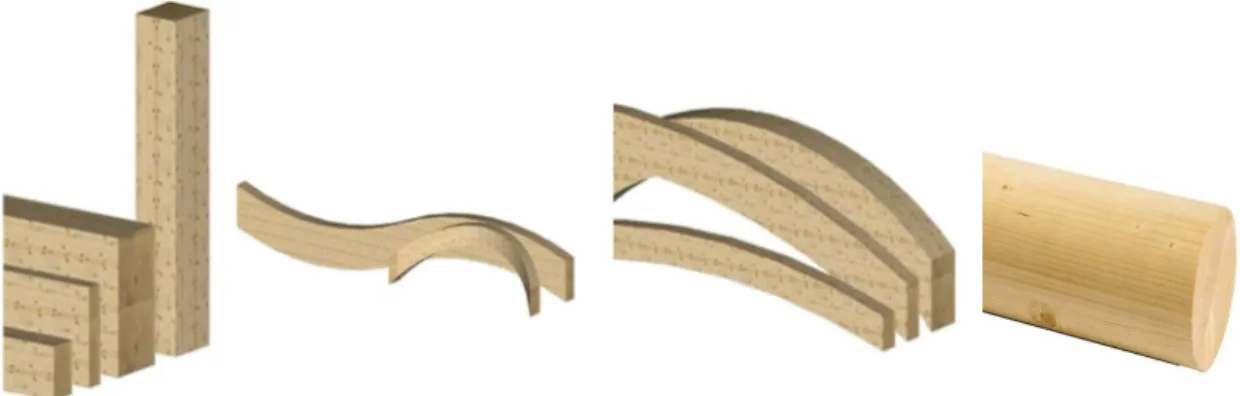
This research was conducted in collaboration with a small company active in the architectural design of buildings and the production of glulam for the construction of projects. This SME has been involved in many commercial and residential projects such as houses, restaurants, sports halls, and libraries. Some of the projects were completely designed and constructed by the company, while there were some others for which the main contractor asked this company for the part of glulam production and construction. Three main shapes of glulam are manufactured in this factory, which are straight beams, round beams, arcs. If the design of project needs a customised form, special shapes might be produced (Figure 6).
Figure 6. Straight beams, special shapes, round beams, and arcs.
The main raw material that the SME buys includes MSR (Machine Stress-Rated) 2100 and regular S-P-F (Spruce- Pine- Fir) lumber. The company categorises the wood from BF to D, where BF refers to the highest quality and D refers to the lowest quality. Wood with lower quality can be used in the middle layers of glulam while the wood used for the
surfaces needs to be of high quality. Table 1. lists the wood grades and their position in glulam.
Table 1. Wood grades and their position in glulam
Zone Visual Grade
Top face lamination B-F Within outer 1/8 section (top) B Remainder of outer ¼ (top) C Inner ½ or less D Remainder of outer ¼ (bottom) C Within outer 1/8 (bottom) B Bottom face lamination B-F
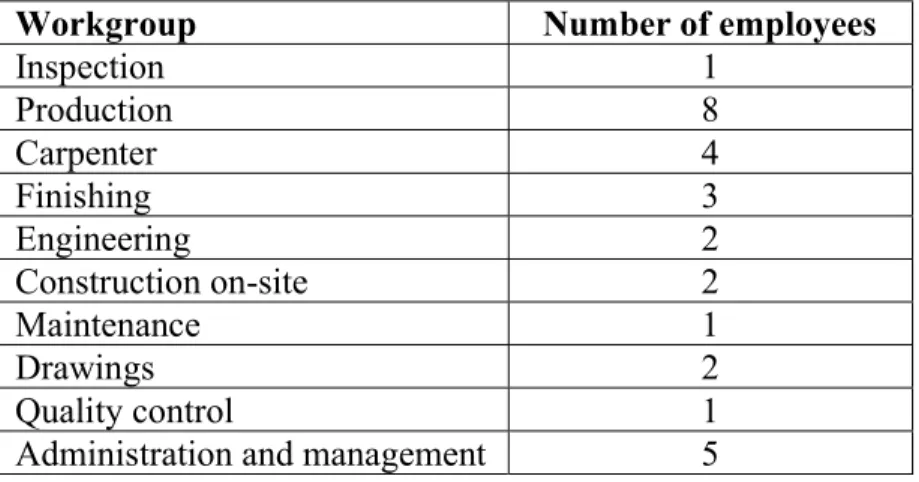
Although the company has been involved in important construction projects, it remains a small factory with limited staff and equipment. The number of employees in each workgroup is listed in Table 2.
Table 2. Number of employees in each work group in the factory
Workgroup Number of employees
Inspection 1 Production 8 Carpenter 4 Finishing 3 Engineering 2 Construction on-site 2 Maintenance 1 Drawings 2 Quality control 1
Administration and management 5
In order to analyse the production system, the first visit was conducted in February 2017 when a prototype gridshell project was under production. During the visits, time and work-study were conducted by observation and making movies and pictures. Moreover, interviews with the employees and production manager were executed to get knowledge about the production system, the problems and the challenges. The permission for taking pictures, recording movies and getting access to the documents was obtained by signing a document to keep the information confidential.
Following the visits and observations, related documents and detailed drawing for the project were asked from the production manager. During the modelling and problem-solving stage, meetings and discussions with the production manager were executed to assure the validity of ideas and hypothesis. Additionally, data for 15 projects for the year 2017 were demanded and received to be used for the optimization model.
2.2 Research methodology
The research project starts with a literature review to gather information about the global production process and market opportunities for gridshells. Grey literature resources are also investigated, including the websites of stakeholders involved in gridshell construction projects, and a list of 20 contemporary examples of gridshell structures was extracted. The investigated examples are categorised as small, medium, and large-sized gridshell. The groups involved and the production phases for the different categories of gridshell structures are identified. The next step is to investigate the motivations for timber construction, along with the characteristics of gridshell designs and analysis of the motivations and challenges of the structure and its potential market.
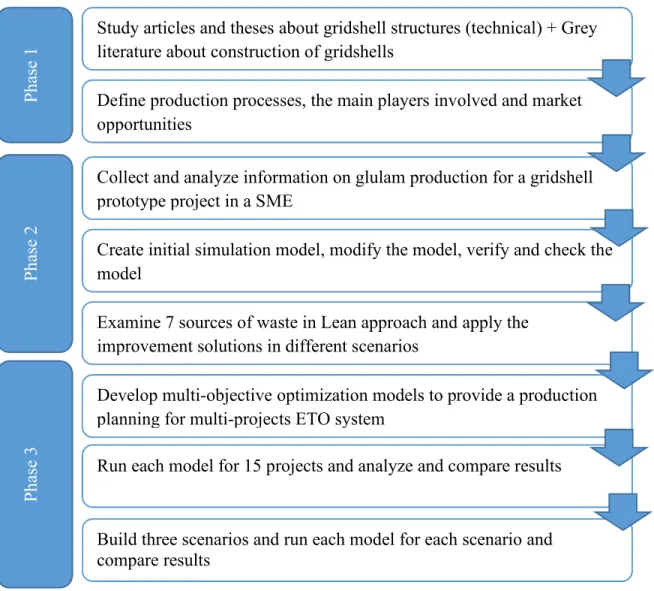
The next phase involved investigating the production of a small gridshell in the SME under study. It encompassed a combination of simulation and lean techniques to present improvement scenarios for the production system. In SMEs, it is challenging to convince the managers to apply improvement techniques as there have limited financial and human resources. Therefore, making a simulation model helps to test the scenarios which are expensive to be applied in the real system. The main steps included the data gathering, analysing and modelling the as-is situation with simulation, introducing improvements, applying improvements in the simulation model, and checking the results. The type of simulation used is discrete-event simulation and the simulation software exploited is Arena 15. The model is validated by statistical test as well as via face-to-face meetings with the president, the production manager, and the main engineer. The simulation model can, therefore, be viewed as a decision support tool to measure the impact strategic changes in the factory may have while considering a single project.
System analysis, simulation of production processes and improvement suggestions introduced a primary improvement level in the glulam production system. The next phase was to consider the production of multi-projects and to provide a production plan that makes appropriate changes in the system towards adding gridshell projects. Mixed integer linear optimisation models were therefore developed to provide a decision tool for weekly tactical scheduling as well as strategic decisions such as new project acceptance. These models aimed to minimise the cost (model 1), minimise projects’ makespan (model 2), minimise set-up times (model 3) and minimise the four combined objectives (model 4). The weighted sum method was applied to solve the multi-objective models. Three scenarios were tested to analyse the impact of adding small (easy) and medium (difficult) projects. By using this tool, the SME will be able to analyse the capacity of adding one or more gridshell projects based on the complexity of the structure. The three phases of this research are summarised in Figure 7.
Figure 7. Methodology of the research
2.3 Thesis organisation
This thesis includes three original contributions (presented as three papers), which have been provided throughout chapters 3 to 5 as follows.
2.3.1 Organisation of chapter 3
Chapter 3 introduces the first article of the research entitled “Production Phases and Market for Timber Gridshell Structures: A State-of-the-Art Review”. Figure 8 summarises the contents of chapter 3.
P ha se 1 P ha se 2 P ha se 3
Study articles and theses about gridshell structures (technical) + Grey literature about construction of gridshells
Define production processes, the main players involved and market opportunities
Collect and analyze information on glulam production for a gridshell prototype project in a SME
Create initial simulation model, modify the model, verify and check the model
Examine 7 sources of waste in Lean approach and apply the improvement solutions in different scenarios
Develop multi-objective optimization models to provide a production planning for multi-projects ETO system
Run each model for 15 projects and analyze and compare results
Build three scenarios and run each model for each scenario and compare results
Figure 8. Research organisation in the first contribution 2.3.2 Organisation of chapter 4
The second paper, entitled “Using Lean Techniques and Simulation to Improve the Efficiency of Engineered Wood Production: a Case Study in a small factory” is presented in chapter 4. The contribution organisation of the paper is shown in Figure 9.
Application in industry
Overview of the global production process and the involved partners as well as strengths, weaknesses, market opportunities and segments for future investment
Results and contribution
Demystify the gridshell structure and its production processes, motivations, and market opportunities
Methodology
Study articles and theses about structure, design and construction of samples, combine analysis of the academic and grey sources, make categories, and define main players
Problem
Figure 9. Research organisation in the second contribution 2.3.3 Organisation of chapter 5
The third paper, entitled “Production planning and project scheduling for engineer-to-order systems” is presented in chapter 5. The contribution organisation of the paper is shown in Figure 10.
Application in industry
A simulation model of glulam production as a decision-support tool to analyze and test scenarios as well as a step by step approach for implementing lean techniques in a SME
Results and Contribution
Improvements in cycle time and waiting time when applying lean tools while demonstrating how to progressively implement lean statgies in a SME
Methodology
Collect and analyze information from the SME's factory and identify activities and process mapping, build the initial simulation model, identify changes to the as-is model, measure performance and get results
Problem
Low productivity in construction production and need of improvement in production engineered wood
Figure 10. Research organisation in the third contribution
2.4 Conclusion
This thesis consists of three phases which encompass introducing a complex engineered wood structure, making the necessary changes to improve its production efficiency and developing the planning tool to allow its production on a larger scale. The research was conducted based on a thorough literature review, the creation of a simulation model and the development of optimisation models. Real data from a SME producing glulam for construction projects were exploited. Chapter 3, 4 and 5 present the papers 1, 2 and 3 explaining the contributions of the research in detail.
Application in industry
A tool for strategic and tactical planning and an emphasis on the parameters that could be considered to increase the capacity
Results and Contribution
A production schedule with the aim of minimizing costs and set-up times while respecting the due dates of projects and production capacity as well as a decision-support tool to analyse the cost and capacity for accepting a new project
Methodology
Develop multi-objective optimization models for production scheduling and analyse the capacity by testing different scenarios of adding new projects
Problem
Lack of production planning and scheduling tool to make a smooth production flow and analyze the capacity of the system
Chapter 3. Production Phases and Market for Timber
Gridshell Structures: A State-of-the-Art Review
This chapter is earmarked to the article entitled " Production Phases and Market for Timber Gridshell Structures: A State-of-the-Art Review ". It was published in BioResources Journal, 2017.
Résumé
La résille en bois est une structure à la forme incurvée constituée de lattes de bois en grillage. La structure en treillis peut constituer une solution intéressante pour les structures modernes de forme libre qui sont durables sur le plan environnemental. Cependant, les recherches universitaires axées sur les marchés potentiels et les étapes de production basées sur cette technologie de construction sont limitées. L'objectif de cette revue de littérature est d'étudier la structure de la résille afin d'identifier son processus de production global, ainsi que les partenaires impliqués dans les exemples architecturaux étudiés. Un examen des articles scientifiques examinés par des pairs et des ressources en littérature grise (par exemple, des magazines, des pages Web, etc.) a été réalisé pour rassembler des informations sur les résilles en bois. Les exemples de conception trouvés ont été classés en petites, moyennes et grandes résilles. La catégorisation est basée sur la taille et le niveau de complexité des exemples de conception. Les phases de production et les partenaires impliqués dans la conception et la construction de ces structures ont été identifiés pour chaque catégorie. En outre, les motivations et les obstacles à l’utilisation des résilles dans la construction, ainsi que les segments de marché potentiels ont été déterminés.
Mots-clés: Résille, Construction en bois, Phases de production, Processus, Durabilité, Bâtiments verts, Marché, Innovation.
Abstract
Timber gridshell is a structure with a curved shape that is made of grid timber laths. Gridshell structure can be a solution of interest in modern free-form structures that are environmentally sustainable. However, there is a lack of academic research focusing on the potential markets and the production stages based on this construction technology. The aim of this literature review is to investigate the gridshell structure to identify its global production process, as well as the partners involved in the architectural examples studied. A review of both peer-reviewed scientific articles and grey literature resources (e.g., magazines, web pages, etc.) was conducted to gather information about timber gridshells. The design examples found were categorised as small, medium, and large gridshells. The categorisation is based on the size and level of complexity of the design examples. Production phases and partners involved in the design and construction of these structures were identified for each category. Furthermore, the motivations and barriers to using gridshell designs in construction, and the potential market segments were determined. Keywords: Gridshell, Timber construction, Production phases, Process, Sustainability, Green buildings, Market, Innovation.
3.1 Introduction
Wood has been used extensively as a key construction material because of its availability in nature. Moreover, growing environmental awareness increases the motivation to use wood as a renewable material that reduces CO2 emissions (Kuzman and Sandberg 2016).
Wood construction systems typically encompass light frames, posts and beams, cross-laminated timber or massive wood structures, mixed and hybrid systems, and space frames. A space frame is a three-dimensional structure and refers to a family of systems that includes grids, barrel vaults, domes, towers, cable nets, membrane systems, and foldable assembly forms (Mupona 2004). Space frames provide free-formed structures, which are promising solutions for contemporary and innovative needs in building construction.
An example of a space frame structure is a gridshell, which was developed by Professor Frei Otto in 1962. Gridshells are structures “with the shape and strength of a shell but made of a grid instead of a solid surface” (Douthe et al. 2006). The first large gridshell was built in 1975, in Mannheim, Germany (Naicu et al. 2014). Although timber gridshell has the characteristics of an innovative and sustainable structure, it is not yet recognised worldwide as a timber solution. The gridshell structure is typically associated with one single project and there are limited numbers of examples around the world. When looking at current academic literature, there are examples concerning gridshell definitions, as well as its architectural and structural issues. Nevertheless, there is a lack of information available concerning the market, the production phases, and the standardisation of this type of building structure. There is a need for a holistic point-of-view, along with technical research, for companies that are interested in exploiting timber gridshell technology.
This paper analyses the use of timber gridshells in the construction industry and the motivations for choosing this specific system. This review also investigates construction methods to build current gridshell examples and the potential markets for this innovative structure. In this way, it becomes possible to describe the timber gridshell structure from a global production process point-of-view, while highlighting opportunities to increase the use of wood in non-residential constructions. In order to achieve these goals, a literature review was conducted and a list of 20 contemporary examples of gridshell structures was
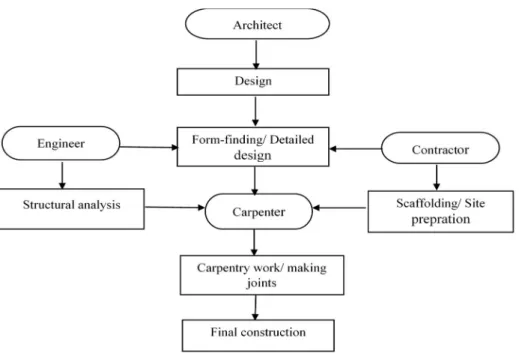
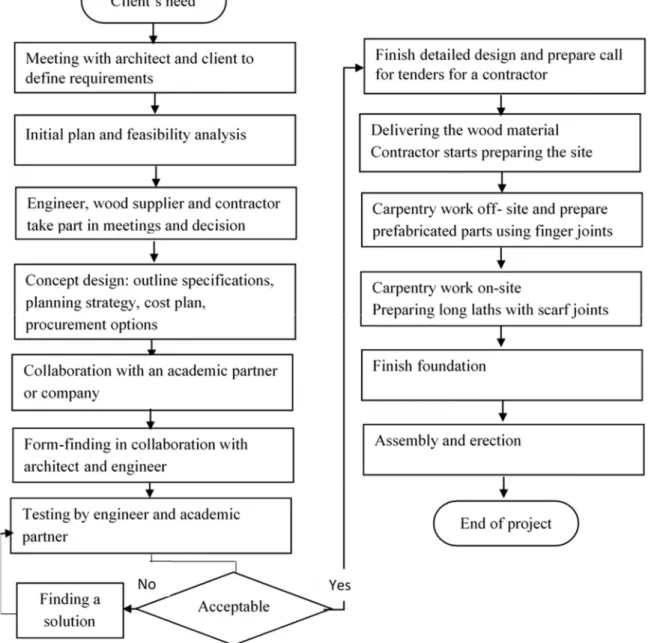
extracted. Grey literature resources were also investigated, including the websites of stakeholders involved in gridshell construction projects. The analyses showed that the main stakeholders for medium-sized gridshells are architects, engineers, carpenters, and contractors, side-by-side with academic partners and clients. For small gridshells, some roles may be omitted, while for complicated ones, many roles and stakeholders are involved. The review also provides production phases for these categories.
This literature review could provide guidance to companies interested in developing gridshells to make decisions in terms of their resources and facilities. Moreover, this review can be viewed as a first step towards standardising the construction of timber gridshells. In this paper, a definition of gridshell and its form-finding and erection phases are provided. Then, the methodology of the review is described. The next parts present the results and discussion, which is followed by a summarization.
3.2 Preliminary concepts and definitions
According to Dickson and Harris (2008), “A shell is a three-dimensional structure that resists applied loads through its inherent shape. If regular holes are made in the shell, with the removed material concentrated into the remaining strips, the resulting structure is a gridshell.” Another definition that is given by Douthe et al. (2006) defines gridshells as structures “with the shape and strength of a double curvature shell but made of a grid instead of a solid surface.”
The two main phases for constructing a gridshell include form-finding and erection. Form-finding refers to the process of determining the shape of the structure. It is important for the structures to feature a complex geometry (Naicu et al. 2014). In other words, this step consists of “finding the most efficient geometry that can both resist the external load and meet the architects’ requirements” (Paoli 2007). There are two main methods that have been used for designing gridshells and other related structures. These methods are physical modeling and computational form-finding (D’Amico 2015).
approach or inversion method. Paoli (2007) defines this method as the use of chain models to describe structures and surfaces. Paoli (2007) states that “In order to determine the most effective shape for an arch, the load which the arch will have to resist should be known. It becomes possible to achieve this by applying a scale version of this load to a chain and then flipping the chain upside down. By adopting this shape, the arch will resist loads only through geometric stiffness”. Computational form-finding is a numerical optimisation process. Numerical optimisation uses an iterative calculation sequence and solves nonlinear problems to define the optimum shape (Toussaint 2007). One of the techniques of computational form-finding, mainly used for gridshell structures, is dynamic relaxation. Harris et al. (2003) note that this method is based on “An interactive process of computer analysis that solves a set of non-linear equations. The technique modifies an initial approximation to the desired shape by minimising the kinetic energy of the lattice as it is made to oscillate.”
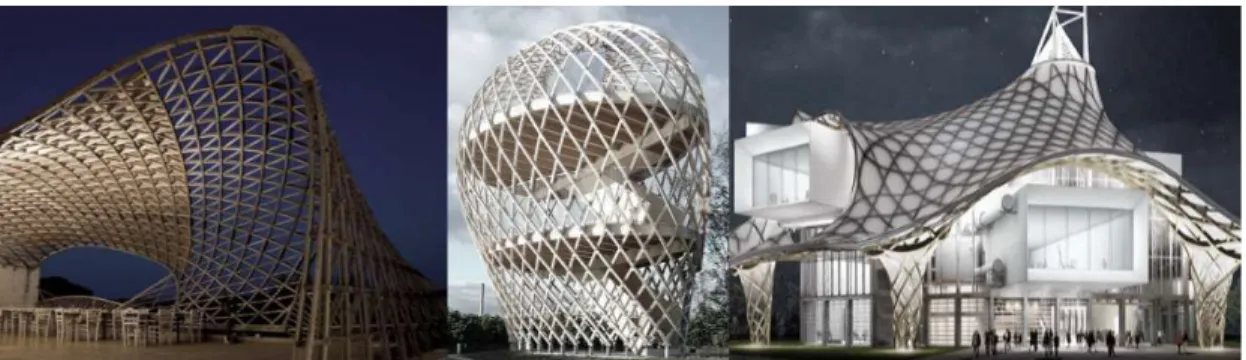
The main techniques for the erection of a gridshell structure are pull-up (crane and cables), push-up, and ease-down. The pull-up, or crane and cables, method uses cranes to pull the lattice from above the structure. The push-up method uses jacks and scaffolding to push the lattice up from underneath the structure. The ease-down method is based on using scaffolding and assembling from the top (Paoli 2007; Quinn and Gengnagel 2014). Figure 11 shows three examples of gridshell structures.
Figure 11. Left picture is the Toledo gridshell (Gridshell.it 2012), middle picture is the Helsinki Zoo’s observatory tower (Paoli 2007), and right picture is the Centre Pompidou Metz (Lewis 2011).