HAL Id: tel-01848731
https://pastel.archives-ouvertes.fr/tel-01848731
Submitted on 25 Jul 2018
HAL is a multi-disciplinary open access archive for the deposit and dissemination of sci-entific research documents, whether they are pub-lished or not. The documents may come from teaching and research institutions in France or
L’archive ouverte pluridisciplinaire HAL, est destinée au dépôt et à la diffusion de documents scientifiques de niveau recherche, publiés ou non, émanant des établissements d’enseignement et de recherche français ou étrangers, des laboratoires
Dandan Niu
To cite this version:
Dandan Niu. Music consumption in a changing ecosystem. Economics and Finance. Université Paris sciences et lettres, 2018. English. �NNT : 2018PSLEM008�. �tel-01848731�
de l’Université de recherche Paris Sciences et Lettres
PSL Research University
Préparée à MINES ParisTech
La consummation de musique dans un écosystème
Music consumption in a changing ecosystem
École doctorale n
o396
ÉCONOMIE, ORGANISATION, SOCIÉTÉ
Spécialité
ÉCONOMIE ET FINANCESoutenue par
Dandan Niu
le 27 Juin 2018
Dirigée par
Olivier B
OMSELCOMPOSITION DU JURY : M. Marc BOURREAU Telecom ParisTech Rapporteur M. Thomas PARIS HEC Paris Rapporteur
Mme. Margaret KYLE Mines ParisTech Présidente
M. Olivier BOMSEL Mines ParisTech Directeur de thèse
Acknowledgment
This thesis was conducted under the direction of Professor Olivier Bomsel at Mines ParisTech, I want to thank him for giving me the opportunity to carry out this thesis in such an insightful environment, and for introducing me to the fascinating topic of the economics of the music industry. I also want to thank him for instilling in me the encouragement and of research and the skills to do it well.
I would also like to thank Professor Margaret Kyle, for joining this PhD journey. I’m grateful for her patience and her guidance. Her expertise has been extremely valuable for this thesis.
I wish to thank the seniors of the Center for Industrial Economics, Cerna at Mines ParisTech, in particular, Professor Pierre Fleckinger and Petyo Bonev for their valuable suggestions and comments during the past years.
I thank Professor Shenle Pan from CGS, Mines ParisTech for his helpful advice, and his words of encouragement during the last few months of this thesis. I am also grateful to Professor Xitong Li from HEC for his constructive advice.
At Cerna, I have benefited from a pleasant and stimulating work environment. I thank my fellow PhD colleagues: Charlène Cosandier, Btissam EL Bahraoui, Philippe Frocrain, Paul-Hervé Tamokoué Kamga, Romain Bizet, Sabrine Bair, Guillaume Dupéret, Victor Lavialle, and Ekaterina Dukhanina for their useful comments and the entertaining times we had together
during my stay. A special thanks goes to Damien Dussaux, Connie Lee, and Laurie Ciaramella for their thoughtful suggestions during the last months of this thesis. Also, I thank Maddalena Agnoli for the “bittersweet” time spent together looking for a solution to econometric models. I thank Sésaria Ferreira for her administrative help, and for her persistence in encouraging me to speak French.
I have been working in Paris since September 2014, I have thoroughly enjoyed three won-derful years in this beautiful city. I am deeply touched by the people who supported me while completing this thesis, and I would like to thank them sincerely.
I am thankful to all my friends in France and China who helped and supported me, especially those to whom I’ve grown closer over these years: Jiayuan Zhao, Yake Wang, Shaoyi Zhang, Dongyang Huang, Hao Jiang, Fei Ye, Yubing Li, Yanhui He, Shihao Yuan, Xin Gao, Yanyan Yang, Bin Qiao, Bin Fang and Jingwen Zhao. I wish to thank Li You for her encouragement and support, and for having been pleasant hosts every time I needed them. Particularly, I want to thank my Yi Yu and Wei You for accompanying me during this journey. Last, my thanks to my beloved family, for their thorough concern and great confidence in me all through these years.
The Chaire ParisTech d’Economie des Médias et des Marques financed this research. I thank Yacast for providing the radio data used in the analysis. I also thank Universal Music for providing the datasets of streaming services and physical album sales.
Finally, I would like to give a special acknowledgment to the China Scholarship Council for giving me a three-year fellowship in Paris. Financial funding from the Fondation Mines ParisTech through the Chaire ParisTech d’Economie des Médias et des Marques is also gratefully acknowledged.
Preface
This PhD thesis was funded by the China Scholarship Council and Fondation Mines ParisTech, and was carried out in the Centre for Industrial Economics, CERNA in Ecole des Mines. It consists of three articles which have been presented by myself at several conferences and seminars. Some of them are currently under revision.
The first chapter of this thesis empirically examines the strategic responses of French radio stations to quota regulations. The second chapter of the thesis tackles the challenges involved in the construction of an integrated database between multiple music channels. The third chapter analyzes how consumption of music on streaming services compares to that of radio, as well as how new talent fares on streaming platforms. In the above three chapters, I use empirical methods taken from the economic literature to develop new tools for the analysis of the media industry, to derive new results regarding the regulation, and to propose policy guidance for further improvements of regulation in the music ecosystem.
I presented the first paper, Strategic responses to cultural quotas: evidence from French radio at EARIE (European Association for Research in Industrial Economics), in Maas-tricht Holland in August 2017; at IAAE (International Association for Applied Econometrics) in Sapporo Japan in June 2017; at AFSE (The French Economic Association) in Nice France in June 2017; at Lancaster Conference on Auctions, Regulation and Public Policy in UK in May
2017; at Doctoral workshop of CERNA in Paris France in March 2016; at SERCI (The Society for Economic Research on Copyright Issues) in Chicago USA in June 2016.
The second paper is Music consumption in France: A database linking streaming services and radio stations.
The third paper is Music Streaming: Effects on Variety and Types of Music Con-sumption.
Acknowledgment i
Preface iii
List of Figures vii
List of Tables ix
Introduction 1
1 Strategic responses to cultural quotas: evidence from French radio 17
1.1 Introduction 21
1.2 Literature review 22
1.3 Institutional environment of cultural quotas in France 24
1.3.1 Quota regulation in France 24
1.3.2 Quotas and competition between broadcasters 25
1.4 Data and summary statistics 26
1.4.1 Compliance with quotas 27
1.5 Estimation and results 29
1.5.1 Do stations select shorter Francophone songs? 30
1.5.2 Do stations shift Francophone play? 32
1.6 The importance of each strategic response 35
1.7 Conclusion and future extensions 36
1.8 Main part of paper 38
Appendix A 61
Appendix B 65
2 Music consumption in France: A database linking streaming services and
radio stations 73
2.2 Literature 77
2.3 Data 78
2.3.1 Data sources 79
2.3.2 Novelty of the data 79
2.3.3 Radio 79
2.3.4 Streaming 80
2.3.4.1 Spotify, Deezer, Napster, Google 80
2.3.4.2 Meta data 81
2.3.5 Other data: physical album sales 82
2.3.6 Challenges 82
2.3.6.1 Geographic representativeness of consumers 83
2.4 Matching 84
2.4.1 Match messy data within streaming dataset 84
2.4.2 Unify song and artist name between streaming services and radio 85
2.5 Aggregate data 87
2.5.1 Aggregate data to weekly level 87
2.5.2 Aggregate data between streaming and radio 87
2.5.3 Sample restrictions 88
2.6 Conclusion 89
Appendix 90
3 Music Streaming: Effects on Variety and Types of Music Consumption 95
3.1 Introduction 97
3.2 Literature 98
3.3 The French music market 100
3.3.1 Major music services in France 100
3.3.2 Regulatory barriers 102
3.4 Descriptive statistics 102
3.4.1 Overview of streaming services and radio 104
3.4.2 Streaming services play more gold songs, radio stations play more new music104
3.4.3 Song concentration is higher in radio than streaming 105
3.4.4 Artist concentration is higher in streaming than radio 105
3.4.5 Consumers from streaming services listen to more music produced from
France 106
3.4.6 Radio and streaming services share similarity in playing hit songs 108 3.4.7 Summary: How artists distribute music content to different music channels 110
3.5 Conclusion 111
3.6 Main part of paper 113
Appendix 127
Conclusion 129
1.1 Compliance with 35% quota for Francophone music 41
1.2 Compliance with 40% quota for Francophone music 41
1.3 Compliance with 50-60% quota for Francophone music 42
1.4 Compliance of public stations with 50% quota for Francophone music 42
1.5 Compliance with 20% quota level for new music 43
1.6 Compliance with 25% quota for new music 43
1.7 Private stations: Exposure of Francophone music 44
1.8 Public stations: Exposure of Francophone music 44
1.9 Private stations: Exposure of New Francophone music 45
1.10 Public stations: Exposure of New Francophone music 45
1.11 Length of song in seconds, by year of release between Anglophone and
Franco-phone songs 46
1.12 Average length of Francophone song and Anglophone song: one observation per
song 47
1.13 Average length of Francophone song and Anglophone song: one observation per
diffusion 47
1.14 Average audience by hour of the day 52
1.15 Average audience by month of the year 52
1.16 Percent difference in audience for each station between 2013 Q1 and 2016 Q1 56
1.17 Simulation comparison between AB, stations with 35% quota 57
1.18 Simulation comparison between AC, stations with 35% quota 57
1.19 Simulation comparison between AD, stations with 35% quota 57
1.20 Simulation comparison between AB, stations with 40% quota 57
1.21 Simulation comparison between AC, stations with 40% quota 57
1.22 Simulation comparison between AD, stations with 40% quota 57
1.23 Simulation comparison between AB, stations with 50% quota 58
1.24 Simulation comparison between AC, stations with 50% quota 58
1.25 Simulation comparison between AD, stations with 50% quota 58
1.27 Simulation comparison between AC, public stations with 50% quota 58 1.28 Simulation comparison between AD, public stations with 50% quota 58
1.29 Simulation comparison between AB, stations with 60% quota 59
1.30 Simulation comparison between AC, stations with 60% quota 59
1.31 Simulation comparison between AD, stations with 60% quota 59
1.32 Francophone play by hour, Fun Radio 61
1.33 New music play by hour, Fun Radio 61
1.34 Exposure of Francophone, stations with 35% quota 67
1.35 Exposure of Francophone, stations with 40% quota 67
1.36 Exposure of Francophone, stations with 50% quota 68
1.37 Exposure of Francophone, public stations with 50% quota 68
1.38 Exposure of Francophone, stations with 60% quota 69
3.1 Evolution of streaming and radio, by week by year 2016 114
3.2 Diffusion of music age of streaming by types of consumptions in 2016 115 3.3 Diffusion of music age of radio by types of consumptions in 2016 116
3.4 Number of distinct diffusion of streaming services in 2016 117
3.5 Distribution patterns for top songs of streaming in 2016 118
3.6 Distribution patterns for top songs of radio in 2016 119
3.7 Distribution patterns for top artists of streaming services in 2016 120
3.8 Distribution patterns for top artists of radio in 2016 121
3.9 Diffusion of Francophone music of streaming and radio in 2016 122
3.10 Diffusion of Francophone music of streaming and radio by music age in 2016 123 3.11 Top 30 songs played from matched data between Spotify and radio in 2016 124 3.12 Top 30 songs played from matched data between Spotify(lean forward) and radio
1.1 Quota category from 2014 to 2016 38
1.2 Skyrock on March 30, 2015 from 10-11 AM (source: Yacast) 39
1.3 Summary statistics 40
1.4 Summary statistics 47
1.5 Negative binomial estimates, full sample 48
1.6 Negative binomial estimates by quota level 49
1.7 Negative binomial estimates, by Anglophone and Francophone 50
1.8 Negative binomial estimates, by station demographics 51
1.9 OLS and IV estimates for Francophone 53
1.10 IV estimates for Francophone, Anglophone and Non-music minutes 53
1.11 IV estimates with language interactions 54
1.12 IV estimates with language and age interactions 55
1.13 IV estimates by Gain/Loss group 56
1.14 Summary statistics of simulation for all stations 59
1.15 Sanctions 62
1.16 Sanctions (continue) 63
1.17 Changes in quotas from 2001 to 2014 64
1.18 IV estimates of music genre by Weekday 65
1.19 IV estimates of music genre by Weekend 65
1.20 IV estimates with age interactions 66
1.21 Summary statistics of simulation for each station 70
1.22 Summary statistics of simulation for each station 71
2.1 Fun Radio on March 31, 2016 from 12-13 AM (source: Yacast) 91
2.2 Spotify on March 31, 2016 (source: Universal Music) 92
2.3 Variable Definition of Spotify dataset, for year 2016 93
2.4 Summary statistics of Spotify by song-day level, on January 2016 93
3.1 Summary statistics of No. distinct artists, and No. distinct titles between radio
and streaming services in 2016 117
Introduction
Le terme écosystème est principalement utilisé en biologie pour désigner une communauté d’organismes vivants (plantes, animaux et microbes) et leur interaction avec les éléments non vivants de leur environnement (des choses comme l’air, l’eau et le sol minéral). Willis (1997) définit les écosystèmes comme le réseau d’interactions entre organismes et entre organismes et leur environnement. Par analogie, un écosystème d’entreprise s’applique à une communauté d’agents économiques interagissant pour l’équilibre de tous, dans un cadre favorable aux exter-nalités (Teece(2007) ).
Les technologies numériques apportent de nouveaux médias à tous les écosystèmes. En ef-fet, un écosystème médiatique reflète l’état de la technologie (Bomsel (2016)). Au cours de la période phonographique, la musique a été enregistrée sur des disques et médiatisée à travers des pochettes de disques, des stations de radio, des concerts, des magazines, des clips vidéo et des magasins de disques. Les stations de radio ont dû reconnaître et annoncer la publication des enregistrements afin de commencer à créer un buzz. Les nouvelles technologies ont perturbé l’écosystème phonographique des médias et de la distribution. Du côté des médias, les plate-formes de diffusion peuvent créer et amplifier un buzz produit auparavant par la radio. Du côté de la distribution, les téléchargements de musique et, de plus en plus, les services de streaming
remplacent les ventes de CD.
La nouveauté des écosystèmes numériques est que la médiatisation devient floue avec la dis-tribution. La consommation de musique dans un écosystème numérique (voir Sonnac (2013)), ajoute de nouveaux éléments, et appelle donc de nouvelles méthodes numériques. La numéri-sation fait de la distribution de contenus musicaux un cas particulier de médiatinuméri-sation. La médiatisation, selon Bomsel and Nègre (2012), consiste à «faire connaître l’artiste et son œu-vre au public». La médiatisation inclut également la publicité. 1 Le contenu musical peut être annoncé en donnant des versions gratuites, et un écosystème peut consister en un média fournissant une version gratuite ou un teaser, alors que d’autres médias vendent des versions payantes. Avec la numérisation, les médias payants continuent à bénéficier des externalités des médias libres. Une plate-forme audio taquine gratuitement jusqu’à ce que le spectateur décide de payer pour un service. La multiplicité des canaux médiatiques et les différences dans leurs schémas de tarification soulignent l’importance des effets externes.
Cette pratique existait déjà lorsque, par exemple, les stations de radio devaient payer des droits de licence pour médiatiser la musique. Mais avec les écosystèmes numériques, une telle pratique est répandue et en expansion continue. Par exemple, les plateformes de streaming comme Spotify ou YouTube permettent aux consommateurs de créer leur propre playlist gra-tuitement ou de payer un petit abonnement. Avec l’augmentation continue et le déploiement de nouveaux médias, l’écosystème de la musique devient de plus en plus dense, ce qui rend les stratégies d’internalisation plus ouvertes et plus souples que par le passé.
La consommation de contenu culturel a des externalités de réseau (Rauch and Trindade
(2009)). Les œuvres culturelles protégées par le droit d’auteur génèrent des types spécifiques d’externalité, à la fois positifs et négatifs Bomsel(2013). La consommation de contenu musical affecte non seulement les futures distributions culturelles, mais favorise également l’innovation et la créativité qui améliorent les performances économiques futures (Bernier (2003)). Cepen-dant, l’existence de l’externalité est insaisissable, difficile à vérifier et difficile à mesurer (Bomsel
(2016)). Les difficultés résident dans l’identification et la mise en œuvre d’une réglementation efficace de la protection culturelle (Lee and Bae(2004)). Dans l’industrie des médias, les
protec-1
Voir les détails deBomsel and Nègre(2012), page 115. La médiatisation, c’est faire connaître l’artiste et sa production. Le faire connaitre, c’est lancer le buzz de l’artiste sur Internet, créer une communauté, faire, peu à peu, les gens qui incitent à découvrir son clip sur YouTube ou Dailymotion, obtenir une programmation à la radio, des passage à la télévision, susciter des articles de presse. C’est aussi la publicité.
tions sont souvent critiquées pour mener à la production sans valeur externe (Gasher(2000)). La protection du contenu culturel peut prendre plusieurs formes: tarifs, subventions ou réglementation des quotas. Les quotas réglementaires ont été utilisés principalement dans le commerce international (Ray (1981), Aw and Roberts (1986), et Anderson and Neary(1992)). Dans le secteur des médias, la réglementation des quotas exige qu’un certain pourcentage de contenu soit d’origine nationale (Helpman and Krugman(1985)), un nombre minimum de jours ou de temps consacrés aux programmes domestiques ou une proportion maximale de temps consacrée aux programmes importés (Bernier (2004)). La France a imposé des quotas pour la musique francophone depuis 1996.2
Malgré leur utilisation répandue, la littérature sur les quotas culturels est relativement éparse et se concentre principalement sur la diversité des contenus et le bien-être des consommateurs (Epstein(1998),Sweeting (2007) et Ryan (2012)). cite ren2011protective présente des preuves que les restrictions de quotas et d’investissement augmentent la diversité du contenu local et conclut que les quotas sont un moyen efficace de contrer la domination du contenu culturel étranger. Cependant, Spence (1976) pense que les réglementations culturelles sont conçues pour protéger les consommateurs ayant des goûts spécifiques. Si les entreprises ne sont pas des discriminateurs de prix parfaits, le marché peut ne pas offrir des produits pour les petits groupes avec des préférences intenses. (Richardson (2006)) soutient que les quotas laissent les consommateurs avec des produits moins variés ou plus coûteux. Certains auteurs affirment que les quotas conduisent souvent à une production de faible qualité avec de faibles valeurs culturelles et externes (Hoskins and McFadyen (1991), Marvasti (1994)). Ulff-Møller (2001) étudie les quotas d’écran français et constate que les quotas n’augmentent pas le contenu national.
La question reste ouverte quant aux mécanismes qu’un régulateur devrait utiliser pour mettre en place une réglementation des quotas afin de favoriser la diversité musicale et l’exposition des chansons françaises lorsque seules les stations de radio sont réglementées. L’intégration technologique croissante rend la réglementation des quotas de plus en plus difficile (Hoskins et al.
(1989), Hoskins et al. (2004)). Par exemple, Raboy et al. (1994) pense que la mondialisation économique a remis en question la base traditionnelle de l’intervention dans la sphère culturelle. La réglementation des quotas peut ne pas fonctionner lorsque les consommateurs peuvent accéder
2
aux médias en utilisant plusieurs canaux et technologies (Middleton(2002),Bruner(2007)). Avec un contenu musical de plus en plus disponible à travers les services de streaming, les difficultés de suivi des transactions augmentent.
Cette thèse contribue à la littérature empirique sur les marchés numériques et tente d’étudier certains aspects de la réglementation pour les marchés numériques qui ont été négligés. Il met en évidence les différentes réponses stratégiques entre les stations de radio et fournit des preuves originales sur leur portée et leur dynamique. Parce que la compréhension de l’écosystème changeant de la musique est essentielle, j’explore également les différences de consommation et de variété musicales entre les services de radio et de streaming. Les résultats de cette thèse con-cernant la réglementation des quotas, la diversité musicale et la consommation de musique pour cet écosystème musical pourraient fournir de nouvelles idées aux participants et aux décideurs politiques.
Un petit nombre d’études ont examiné la consommation de musique à l’aide de données à grande échelle et récentes. Datta et al. (2017) fournit la première preuve empirique à grande échelle sur les effets de l’adoption de Spotify sur la consommation et la découverte de la musique. Ils trouvent que Spotify peut augmenter la consommation globale de musique. D’autres études reposent sur des données d’enquête (Nguyen et al. (2014),Aguiar and Martens (2016),Wlömert and Papies (2016)). Les travaux académiques utilisant des données françaises à grande échelle sont rares et se concentrent sur des pays spécifiques. (Voir par exemple Zentner (2009) et
Liebowitz (2006), Aguiar and Waldfogel(2016))
Dans cette thèse, je m’appuie sur plusieurs sources de données à grande échelle sur la con-sommation de musique en France. J’utilise des données détaillées sur les listes de lecture des principales stations de radio en France de 2013 à 2016, fournies par Yacast, une société spécial-isée dans la surveillance des médias. Yacast rapporte la programmation minute par minute des principales radios françaises à couverture nationale (représentant plus de 34 grandes stations de radio en France). J’utilise les données de consommation musicale des principaux services de streaming opérant en France à partir de 2016, fournies par Universal Music. Je conçois une méthodologie pour nettoyer les datasets et combiner des données radio avec des données en streaming en France. J’utilise également les méta-données fournies par Universal Music en tant que jeu de données supplémentaire. Il donne accès à une vaste base de données d’informations
sur l’enregistrement sonore, y compris le code IRSC de chaque artiste et nom de la chanson, le genre musical et le pays de production de musique, etc.
La fiabilité de ces ensembles de données est essentielle à l’analyse empirique de la consom-mation de musique dans cet écosystème en évolution. La mesure de l’effet de divers types de services de musique est un exercice intrinsèquement difficile, principalement pour les raisons suivantes. L’utilisation de divers services de diffusion en continu et stations de radio ne fournit pas un enregistrement complet du comportement de l’utilisateur, ce qui rend sa mesure difficile. Il n’est donc pas facile d’obtenir des données sur chaque service ni de lier des données sur tous les services. De plus, en supposant que de telles données soient disponibles, l’identification de l’effet de la consommation de musique est rendue difficile par la complexité des données. Enfin, les données sur les caractéristiques musicales provenant de différentes plates-formes musicales manquent souvent d’harmonisation, ce qui nécessite un important travail de données supplé-mentaires.
L’analyse de la consommation de musique entre les stations de radio et les plateformes de diffusion est importante pour comprendre l’industrie de la musique. En revanche, pour les enregistrements et les téléchargements où le nombre de lectures ne peut être déterminé, le modèle de radio et de streaming permet une mesure par le morceau. Cela nécessite une adaptation des données disponibles. Des recherches récentes menées sur cette question ont été faussées en raison de la mauvaise méthodologie et l’omission d’inclure des données importantes. Le chapitre 2 est conçu pour répondre à ces défis méthodologiques en utilisant des mesures appropriées de la consommation de musique et en corrigeant les déficiences des données. L’exactitude de l’appariement de l’artiste et du nom du titre entre les différentes plates-formes prouve la validité de la consommation de musique en France (voir le chapitre 2 pour plus de détails).
Chacun des chapitres de cette thèse traite de questions de recherche indépendantes et peut être lu séparément. Je vais brièvement présenter chaque chapitre et expliquer pourquoi j’utilise l’approche empirique spécifique dans la section suivante.
Pourquoi est-il important d’étudier la consommation de musique dans l’écosystème musical en évolution? Nelson(1970) postule que la musique est intrinsèquement une bonne expérience; sa vraie valeur est inconnue apriori et n’est révélée qu’après consommation. Étant donné que l’industrie de la musique a radicalement changé au cours des dernières décennies, il est important
de comprendre les mécanismes qui déterminent le comportement des consommateurs. Dans cette thèse, je vais essayer de répondre à trois questions principales liées au sujet de l’industrie de la musique:
• La réglementation des quotas dans l’industrie de la radio est-elle nécessaire?
– Les stations de radio se conforment-elles à la réglementation des quotas?
– Comment les stations de radio peuvent-elles se comporter stratégiquement selon ces réglementations? Les stations choisissent-elles des chansons francophones plus cour-tes? Les stations changent-elles stratégiquement le jeu francophone en réponse? aux quotas?
– Quel est l’effet contrefactuel de chaque réponse stratégique faite par les stations de radio?
• Comment combiner des données entre plusieurs plateformes musicales?
– Comment un nom d’artiste et de chanson est-il unifié entre différentes plateformes musicales?
– Comment ajuster et faire correspondre les données de consommation entre la radio et les services de streaming?
Qu’est-ce qui détermine la diversité musicale parmi les différents types de stations de radio?
• Comment la diversité musicale et le modèle de consommation musicale varient-ils entre les stations de radio et les plateformes de streaming?
– L’efficacité de la réglementation des quotas dans la protection de la musique franco-phone diminue-t-elle avec le développement des services de streaming?
– Existe-t-il des relations symbiotiques dans la programmation entre la radio et les services de streaming?
Dans chapter 1 de cette thèse, j’essaierai d’aborder le premier numéro. Le premier chapitre est composé de l’article suivant:
• Réponses stratégiques aux quotas culturels: témoignages de la radio française (co-écrit avec Margaret Kyle)
Le chapitre 1 ajoute à la littérature sur la régulation du contenu culturel une caractéristique inhabituelle: les quotas réglementaires pour le contenu culturel en France sont compliqués et varient selon les stations. Cette étude contribue également en mesurant les incitations des stations de radio à répondre à la réglementation des quotas, et en simulant l’importance de chacune de ces réponses stratégiques. De nombreux articles ont tendance à considérer un régime de réglementation dans son ensemble ou à se concentrer sur une réglementation particulière et ses effets. Cependant, l’effet de la régulation culturelle n’est pas explicitement expliqué. Comme il existe diverses réponses stratégiques aux quotas réglementaires, j’ai l’occasion de commenter les effets potentiels de chaque réponse individuelle.
Je me concentre sur la nécessité de réglementer le contenu culturel dans l’industrie de la radio. Le chapitre 1 est une tentative de fournir les premières preuves empiriques sur les réponses stratégiques des stations de radio contraintes par les quotas culturels. J’analyse en particulier s’ils sélectionnent des chansons francophones relativement plus courtes et comment les stations françaises ajustent le contenu en fonction de la taille de leur public. Ce sujet est important parce que les régulateurs sont confrontés à un défi lorsqu’ils imposent des quotas culturels qui ne sont pas conformes aux goûts du public. Les réponses stratégiques compensent partiellement les effets escomptés de ces quotas, et les stations qui respectent davantage l’esprit de la loi risquent de perdre de l’audience, ce qui réduira davantage l’exposition du contenu que le quota est censé protéger.
Dans chapitre 2 de cette thèse, je vais essayer de répondre à la deuxième question. Ce chapitre est composé de l’article suivant:
• Consommation musicale en France: une base de données reliant les services de streaming et les stations de radio
Dans le chapitre 2, je construis un nouvel ensemble de données pour fournir des preuves descriptives sur les services de radio et de streaming. Afin de comparer la taille du nombre de spectateurs pour un titre de chanson en particulier sur les stations de radio avec le nombre de flux sur les services de streaming, je développe une méthodologie pour combiner les données
de consommation de la musique entre les stations de radio et les services de streaming en France en 2016 et de compléter l’ensemble de données avec des informations détaillées sur les caractéristiques de la musique. Cette méthodologie est importante parce que les stations de radio et les services de diffusion en continu sont des modèles économiques entièrement différents et ne sont pas comparables sans ajuster l’ensemble de données pour refléter les différences. Le streaming et la radio pourraient être comparés efficacement là où je peux suivre le comportement d’écoute des consommateurs à travers le nombre de jeux. Le chapitre 2 tente de fournir un nouvel ensemble de données pour les études statistiques du chapitre 3.
Dans chapitre 3 de cette thèse, je vais essayer d’aborder le troisième problème. Ce chapitre est composé de l’article suivant:
• Musique en streaming: Effets sur la variété et les types de consommation de musique.
Dans le chapitre 3, je propose une analyse descriptive sur la mesure de la diversité musicale entre services de streaming et radio en France et analyse comment les deux principales plate-formes diffusent du contenu musical en début de transition de la musique numérique en 2016. Le chapitre 3 fournit également des preuves empiriques les externalités des deux marchés. Je trouve que, contrairement à l’argument des stations selon lequel le quota francophone entraîne une baisse du nombre d’auditoires, les services de diffusion jouent plus de musique francophone que les stations de radio. Ces modèles nécessitent d’explorer comment les quotas réglementaires peuvent augmenter la diversité musicale, car c’est le but ultime des régulateurs. Ce sujet est intéressant parce que la compréhension de la diversité musicale et du modèle de consommation de musique entre le streaming et les ventes sera cruciale pour les participants de l’industrie de la musique, ainsi que pour les décideurs politiques.
Introduction
The term ecosystem is primarily used in biology do designate a community of living organisms (plants, animals and microbes) and their interaction with the non-living components of their environment (things like air, water, and mineral soil). Willis (1997) defines ecosystems as the network of interactions among organisms, and among organisms and their environment. By analogy, a business ecosystem applies to a community of economic agents interacting for the balance of all, in a framework favorable to externalities (Teece(2007)).
Digital technologies are bringing new media to all ecosystems. In effect, a media ecosystem reflects the state of the technology (Bomsel(2016)). Under the phonographic period, music was taped on records and mediatised through record sleeves, radio stations, concerts, magazines, video clips, and record shops. The radio stations had to recognize and announce the release of the records in order to start creating a buzz. New technologies have disrupted the phonographic ecosystem from both the media and the distribution side. On the media side, streaming platforms can create and amplify a buzz that was formerly produced by radio. On the distribution side, music downloads and, increasingly, streaming services substitute CD sales.
The novelty of the digital ecosystems is that mediatisation gets blurred with distribution. The music consumption in a digital ecosystem (see Sonnac (2013)), adds new elements, and therefore calls for new digital methods. Digitization makes music contents distribution a partic-ular case of mediatization. Mediatization, according to Bomsel and Nègre (2012), is “to make the artist and his work known by the public.” The mediatization also includes advertising. 3 Musical content can be advertised by giving free versions, and an ecosystem can consist of a media providing a free version or a teaser, while other media sell paid versions. With digitaliza-tion, the paid media continues to benefit externalities from the free media. An audio platform teases for free until the viewer decides to pay for a service. The multiplicity of media channels and the differences in their pricing schemes underline the importance of external effects.
This practice already existed when, for instance, radio stations had to pay license fees to mediatize music. But with digital ecosystems, such practice is widespread and continuously
3
See details fromBomsel and Nègre (2012), page 115. La médiatisation, c’est faire connaître l’artiste et sa production. Les faire connaitre, c’est lancer le buzz de l’artiste sur Internet, lui créer une communauté, faire que, peu à peu, les gens soient incités à découvrir son clip sur YouTube ou Dailymotion, obtenir une programmation à la radio, des passage à la television, susciter des articles de presse. C’est aussi la publicité.
expanding. For instance, streaming platforms like Spotify or YouTube allow consumers to create their own playlist for free or to pay a small subscription fee. With the continuous surge and rollout of new media, the music ecosystem gets increasingly dense, making the internalization strategies more open and flexible than in the past.
Consumption of cultural content has network externalities (Rauch and Trindade (2009)). Cultural works that are protected copyright generate specific types of externality, both positive and negativeBomsel(2013). Consumption of music content not only affects future cultural dis-tributions, but also fosters innovation and creativity that enhances future economic performance (Bernier (2003)). However, the existence of externality is elusive, hard to verify and hard to measure (Bomsel(2016)). Difficulties lie in identifying and implementing effective cultural pro-tection regulation (Lee and Bae(2004)). In the media industry, protections are often criticized for leading to production with no external value (Gasher(2000)).
Protection of cultural content can come in several forms: tariffs, subsidies or quota regu-lation. Regulatory quotas have been used mostly in international trade (Ray (1981), Aw and Roberts (1986), and Anderson and Neary (1992)). In the media sector, quota regulation re-quires a certain percentage of content to be of domestic origin (Helpman and Krugman(1985)), a minimum number of days or proportion of time devoted to domestic programs, or a maximum proportion of time devoted to imported programs (Bernier(2004)). France has imposed quotas for Francophone music since 1996.4
Despite their widespread use, the literature on cultural quotas is relatively sparse and focuses mainly on the diversity of content and consumer welfare (Epstein (1998), Sweeting (2007) and
Ryan(2012)). Ren(2011) presents evidence that both quota and investment restrictions increase the diversity of local content, and concludes that quotas are an effective way to counter the domination of foreign cultural content. However, Spence (1976) thinks cultural regulations are framed as protection of consumers with niche tastes. If firms are not perfect price discriminators, the market can fail to provide products for small groups with intense preferences. (Richardson
(2006)) argues that quotas leave consumers with products of less variety or higher costs. Some literature argues that quotas often lead to production of low-quality with low cultural and external values (Hoskins and McFadyen(1991),Marvasti(1994)). Ulff-Møller(2001) studies the
4
French screen quotas and finds that quotas do not increase domestic content.
It is still an open question as to which mechanisms a regulator should use to implement quota regulation in order to foster music diversity and exposure of French songs when only radio stations are regulated. Increasing technological integration makes quota regulation increasingly impractical (Hoskins et al. (1989), Hoskins et al. (2004)). For instance, Raboy et al. (1994) think economic globalization has called into question the traditional basis for intervention in the cultural sphere. Quota regulation may not work when consumers can access media using multiple channels and technologies (Middleton (2002), Bruner (2007)). With musical content increasingly available through streaming services, the difficulties of monitoring transactions rise. This thesis contributes to the empirical literature on the digital markets and tries to investi-gate some aspects of the regulation for digital markets that have been overlooked. It highlights the different strategic responses between radio stations and provides original evidence on their scope and dynamics. Because and understanding of the changing music ecosystem is critical, I also explore the differences in music consumption and variety between radio and streaming services. The findings of this thesis regarding quota regulation, music diversity and music con-sumption for this music ecosystem could provide novel insights for the participants as well as policy makers.
A small number of studies have examined music consumption using large scale and recent data. Datta et al.(2017) provides the first large scale empirical evidence on the effects of Spotify adoption on individual music consumption and discovery. They find that Spotify can increase overall music consumption. Other studies rely on survey data (Nguyen et al.(2014),Aguiar and Martens (2016), Wlömert and Papies (2016)). Academic works using large scale French data are rare, and focus on specific countries. (See for instance Zentner(2009) andLiebowitz (2006),
Aguiar and Waldfogel (2016))
In this thesis, I rely on multiple large-scale sources of data on music consumption in France. I use detailed data on playlists of major radio stations in France from 2013-2016, as provided by Yacast, a company specializing in monitoring the media. Yacast reports the minute-by-minute programming of major French radio stations that have national coverage (representing over 34 major radio stations in France). I use music consumption data for major streaming services operating in France from 2016, provided by Universal Music. I design a methodology to clean
the datasets and to combine radio data with streaming data in France. I also exploit the meta data provided by Universal Music as a supplementary dataset. It provides access to an extensive database of sound recording information, including the IRSC code of each artist and song name, music genre, and music production country, etc.
The reliability of these datasets is critical to the empirical analysis of the music consump-tion in this changing ecosystem. Measuring the effect of various types of music services is an inherently difficult exercise, mainly for the following reasons. The use of various streaming ser-vices and radio stations do not provide a complete record of user behavior, which renders its measurement difficult. It is therefore not easy to obtain data on each service nor to link data on all the services. In addition, assuming that such data is available, identifying the effect of music consumption is made difficult by the complexity of the data. Finally, data on music char-acteristics from different music platforms often lack harmonization, thus requiring substantial additional data work.
Analyzing music consumption between radio stations and streaming platforms is important to understanding the music industry. In contrast, for records and downloads where the number of plays cannot be determined, the model of radio and streaming allows a measurement by the song. This requires an adaptation of the available data. Recent research conducted on this issue has been flawed because of poor methodology and failure to include important data. Chapter 2 is designed to address these methodological challenges by using appropriate measures of music consumption and correcting data deficiencies. The accuracy of matching artist and title name between different platforms, provides evidence of the validity of music consumption in France (See chapter 2 for more details).
Each of the chapters in this thesis deals with independent research questions and can be read separately. I will briefly introduce each chapter and explain why I use the specific empirical approach in the following section.
Why is it important to study music consumption in the changing music ecosystem? Nelson
(1970) posits that music is inherently an experience good; its true value is unknown apriori and is only revealed after consumption. Since the music industry has changed dramatically in the past decades, it is important to understand the mechanisms that drive consumer behavior. In this thesis, I will try to answer to three main issues related to the topic of the music industry:
• Is quota regulation in the radio industry necessary?
– Do radio stations comply with quota regulations?
– How can radio stations behave strategically to those regulations? Do stations se-lect shorter Francophone songs? Do stations strategically shift Francophone play in response to quotas?
– What is the counterfactual effect of each strategic response made by radio stations? • How to combine data between multiple music platforms?
– How does one unify artist and song name between different music platforms?
– How does one adjust and match consumption data between radio and streaming services?
• How do music diversity and music consumption pattern vary between radio stations and streaming platforms?
– Does the effectiveness of quota regulations in protecting Francophone music decrease with the development of streaming services?
– Are there any symbiotic relationships in programming between radio and the stream-ing services?
In chapter 1 of this thesis I will try to address the first issue. The first chapter is composed by the following article:
• Strategic responses to cultural quotas: evidence from French radio (co-authored with Margaret Kyle)
Chapter 1 adds to the literature on the regulation on cultural content with an unusual feature: regulatory quotas for cultural content in France are complicated and vary for different stations. This study also contributes by measuring the radio stations’ incentives to respond to the quota regulations, and by simulating the importance of each of these strategic responses. Many papers tend to look at a regulatory regime as a whole or focus on a particular regulation and its effects. However, the effect of cultural regulation is not explicitly explained. Since there
are various strategic responses to regulatory quotas, I have an opportunity to comment on the potential effects of each individual response.
I focus on whether regulating cultural content in the radio industry is necessary. Chapter 1 is an attempt to provide the first empirical evidence on the strategic responses of radio stations constrained by cultural quotas. In particular, I analyze whether they select relatively shorter Francophone songs and how French stations adjust content in response to the size of their audience. This topic is important because regulators face a challenge when imposing cultural quotas that do not conform to audience tastes. Strategic responses partly offset the intended effects of these quotas, and stations showing greater compliance with the spirit of the law may lose audience, further reducing the exposure of content the quota is meant to protect.
In chapter 2 of this thesis, I will try to address to the second issue. This chapter is composed by the following article:
• Music consumption in France: A database linking streaming services and radio stations
In chapter 2, I build a novel dataset to provide some descriptive evidence on radio and streaming services. In order to compare the size of the audience number for a particular song title on radio stations with the number of streams on streaming services, I develop a methodology to combine music consumption data between radio stations and streaming services in France in 2016 and complement the dataset with detailed information on music characteristics. This methodology is important because radio stations and streaming services are entirely different economic models and are not comparable without adjusting the dataset to reflect the differences. Streaming and radio could be effectively compared where I can track the consumers’ listening behavior through number of plays. Chapter 2 is an attempt to provide a novel dataset for the statistical studies in Chapter 3.
In chapter 3 of this thesis, I will try to address the third issue. This chapter is composed of the following article:
• Music Streaming: Effects on Variety and Types of Music Consumption.
In chapter 3, I provide a descriptive analysis on measuring the music diversity between streaming services and radio in France and analyze how the main two platforms play music content in the early transition of digital music during 2016. Chapter 3 also provides empirical
evidence on the consumption externalities of both markets. I find that contrary to the stations’ argument that the Francophone quota leads to a low audience numbers, streaming services play more Francophone music than radio stations. These patterns necessitate the exploration of how regulatory quotas can increase music diversity as this is the ultimate goal for regulators. This subject is of interest because understanding the music diversity and music consumption pattern between streaming and sales will be crucial to participants of the music industry, as well as to the policy makers.
Strategic responses to cultural quotas: evidence from French radio
Résumé
La réglementation des médias dans de nombreux pays inclut des quotas culturels. Bien que destinés à protéger les artistes locaux, ils sont également critiqués comme une forme de protec-tionnisme. Cet article examine empiriquement les réponses stratégiques des stations de radio françaises aux quotas pour la musique francophone. En utilisant des données détaillées sur les playlists des principales stations de radio en France entre 2013 et 2016, nous montrons que les stations ont une certaine latitude pour ajuster leurs playlists soumises à des contraintes de quotas. Plus précisément, ils peuvent choisir le moment et la durée des chansons pertinentes pour le quota. Pour de nombreuses stations, le public réalisé pour la musique francophone est inférieur à ce qu’il serait en l’absence de ces ajustements. Nous estimons ensuite un modèle de régression pour montrer comment les stations françaises ajustent le contenu en fonction de la taille de leur public, en utilisant des variables instrumentales pour répondre à l’endogénéité de la demande. Les résultats montrent que les quotas augmentent la diffusion de la musique francophone, les stations réduisent le jeu francophone durant les périodes de pointe, ce qui a un effet compensateur sur l’exposition de la musique française. Nous montrons en outre que ces réponses stratégiques sont plus prononcées pour les stations qui ont gagné de l’audience au
cours de notre période d’échantillonnage que pour celles qui ont perdu de l’audience. Nos résul-tats suggèrent que les réponses stratégiques aux quotas culturels ont un effet statistiquement et économiquement significatif sur l’exposition de la musique francophone.
Abstract
Media regulation in many countries includes “cultural quotas.” While intended to protect local artists, they are also criticized as a form of protectionism. This paper empirically examines the strategic responses of French radio stations to quotas for Francophone music. Using detailed data on playlists of major radio stations in France from 2013-2016, we show that stations have some scope for adjusting their playlists subject to quota constraints. Specifically, they can choose the timing and the duration of quota-relevant songs. For many stations, the realized audience for Francophone music is lower than would be the case in the absence of these adjustments. We then estimate a regression model to show how French stations adjust content in response to the size of their audience, using instrumental variables to address the endogeneity of demand. The results show that although quotas increase the diffusion of Francophone music, stations reduce Francophone play during times of peak demand, which has a countervailing effect on the exposure of French music. We further show that these strategic responses are more pronounced for stations that gained audience during our sample period than for stations that lost audience. Our results suggest that strategic responses to cultural quotas have a statistically and economically significant effect on the exposure of Francophone music.
1.1
Introduction
Many countries regulate the media, particularly television and radio. For example, the United States restricts foreign ownership of broadcast media,1 and in China, most media outlets are state-run. A specific form of media regulation observed in some countries concerns cultural quotas. That is, broadcast media may be required to include a minimum of nationally-produced content (e.g., Australia) or a minimum of content in the local language (e.g., Quebec). Gov-ernments justify this intervention in markets as necessary to support local culture or protect it from an international cultural hegemon. As media markets have evolved, however, the effect of these regulations may also be changing. International trading partners sometimes push for the removal of quotas, arguing that they constitute non-tariff barriers to trade.2 Traditional media now face greater competition from online content providers that are not always subject to the same regulations. The strategic responses of regulated media to this increased competition may result in market outcomes unanticipated by lawmakers.
This paper focuses on the impact of cultural quotas in the French radio industry. Regula-tions require that French radio staRegula-tions devote a minimum percentage of airplay to Francophone artists, as well as to new talent and new productions.3 If binding, these quotas change the composition of radio programming and the diversity of music to which French consumers are exposed. Since radio play is historically a driver of music sales, these quotas are meant to sup-port Francophone and new talent. However, by restricting how radio stations can respond to consumer demand, quotas may also affect the ability of radio stations to adapt to competition from streaming services or other means of accessing content. If quotas lower demand for radio and therefore their advertising revenues, they may threaten the sustainability of the radio in-dustry. In addition, there are implications for the owners of intellectual property rights tied to music. A shift of the audience from radio to other media, with different terms for compensating artists, may affect other parts of the music ecosystem.
1Section 310(b)(4) of the Communications Act of 1934. 2
For example, in 2006 South Korea halved the number of days per year that cinemas were required to show locally-produced films under pressure from the United States, with which it was negotiating a free trade agreement.
3
The law defines Francophone as a work that is recited mostly in French or in a regional French language; new talent as an artist with fewer than two gold albums4; and new production as a title released during the pre-vious one year. See http://www.csa.fr/Radio/Le-suivi-des-programmes/La-diffusion-de-chansons-d-expression-francaise/Les-criteres-pris-en-compte-pour-mesurer-les-quotasfor details.
Using a novel dataset of radio programming from 34 radio stations in France from January 2013-April 2016, we show that radio stations respond strategically to cultural quotas in three ways. First, we show that stations vary in their compliance with the law, which we describe in more detail in the following section. Second, since quotas specify the fraction of songs played rather than the minutes played, stations choose short Francophone songs relative to Anglophone content, which reduces the time devoted to Francophone airplay. Third, using instrumental variables to address the endogeneity of demand, we show that radio stations shift when they play Francophone music from hours of peak demand to those with smaller audience. In contrast, the quota for new music does not appear to induce strategic responses. The audience lost due to noncompliance of the regulatory quota is the most significant factor, followed by strategic shifting. These strategic choices made by the radio stations highlight the difficulties in using regulations to protect cultural content.
This study contributes to the growing debate on regulatory quotas. The results have rel-evance outside France. As the European Commission develops a plan for the “digital single market,” one contentious issue is the requirement that streaming services such as Netflix and iTunes offer at least 30% European-produced content, while France (along with Germany, Spain, and Italy) continue to argue for the right to establish national content quotas. Disagreement between Europe and the US on this issue led to the exclusion of audiovisual content from nego-tiations over the Transatlantic Trade and Investment Partnership (TTIP) trade agreement.
The paper is structured as follows. After a review of the literature in section 1.2, we describe the institutional environment of quota regulations in section 1.3. In section 1.4, we describe our data sources and the construction of our dataset. We explain our identification strategy and provide empirical results in section 1.5. Section 1.6 presents our simulation results. Finally, we conclude in section 1.7.
1.2
Literature review
While much literature exists on strategic responses to regulation, here we specifically focus our attention on cultural quotas. This type of regulation has received a lot of attention in trade models that provide a rationale for the protection of cultural goods based on the existence of
consumption externalities. Bala and Van Long (2005) provide a dynamic analysis of trade on culture diversity and show that a large country’s preferences can dominate those of its smaller trading partner. Nonetheless, Francois and Van Ypersele(2002) demonstrate that trade restric-tions of cultural goods (through tariffs or quotas) can improve welfare. Rauch and Trindade
(2009) argue that cultural policy with the purpose of protecting cultural goods production can generate welfare gains in the short run, but reduce quality and welfare in the long run.
Theoretical models that examine the behavior of content providers and broadcasters highlight several subtle effects of quotas. Richardson and Wilkie(2015) suggests a mild quota will increase the diversity of local content by inducing domestic record companies to sign up more new bands and will improve the welfare of consumers who value diversity. However, quotas can also have adverse effects on diversity. When a quota requires that a certain percentage of new content be aired, the introduction of local content may be altered. A greater share of local content will be produced by bands in genres where international music is most prevalent.
Perona (2015) suggests that broadcasters facing a quota will compensate for the reduction of foreign programming by increasing the number of diffusions of substitutable domestic programs. Because total broadcasting time is limited, the broadcaster will be forced to abandon less popular types of programming, thus reducing overall program diversity. In Richardson (2006), quotas can increase diffusion of local content, but the number of audience overall increase by less.
Crampes and Hollander (2008) also looks at the impact of quotas in the bundle composition of television broadcasting, and finds that a quota may increase the number of channels but reduce the audience of these programs.
Most empirical work on cultural trade focuses on motion pictures. Lee and Bae (2004) find that quotas do not limit the number of foreign film screenings in domestic theaters, while in a study of the cinema sector in Brazil, Masood (2015) concludes that quotas reduce the diversity of foreign imports. Disdier et al. (2010) find that quotas have a positive effect on the trade of domestic products by promoting cultural links to other countries. Ren (2011) presents evidence that both quotas and investment restrictions increase the diversity of local content, and concludes that quotas are an effective way to counter the domination of foreign cultural content. Ferreira et al.(2012) studies the counterfactual impact on consumers and producers of the elimination of subsidies in Europe, concluding that the benefits accrue mainly to producers.
In a study covering an extensive panel of 22 countries, Ferreira and Waldfogel (2013) find that broadcasters provide predominantly local content rather than imported music. Messerlin and Parc(2014) find cultural regulation has not improved interest in of French movies in France. Parc
(2017) suggests quota regulations have not been effective for increasing the number of domestic Korean movies and does not ensure that the domestic audience will watch these movies.
As far as we can tell, no existing empirical study has investigated cultural regulation with regards to radio stations’ strategic reactions to quotas. Other studies have examined the strategic behavior of radio stations, although not with respect to cultural quotas. In his study of the US market, Sweeting (2009) estimates stations’ strategic incentives to coordinate the timing of commercial breaks. Our focus here is on the interaction of quotas with playlist choices, which is new to the empirical literature.
1.3
Institutional environment of cultural quotas in France
Regulators around the world, particularly in Europe, pay close attention to trade in cultural products. Governments can protect local content through subsidies for the production of content, or impose import quotas or cultural quotas. The latter emerged during the 20th century with the expansion of broadcasting. In addition, in some countries, quota regulations were introduced in response to the increased reach of “Anglo-saxon” content. Their use is widespread: fewer than 30 countries impose no content quotas. The United States and New Zealand are two exceptions that have opted for a laissez-faire approach to content (Puppis,2008).
1.3.1 Quota regulation in France
For decades, France has imposed quotas for Francophone music, as well as new “production” and new “talent.” 5 A similar regulation exists in Canada, where the Francophone minority is always keen to preserve its cultural identity Machill (1996). Since 1996, radio stations have been required to have a minimum percentage of total song plays be French-language songs, and have a separate minimum for new talent or new productions; a summary of the current
5
France also regulates the quantity of advertising for both public stations and those that are privately owned. For public stations, advertising is limited to an average of 30 minutes per day over the year. From 7:00 to 9:00 in the morning, a maximum of 3 minutes of advertising is permitted. For private stations, advertising can be no more than 12 to 14 minutes per hour. The total ad time is about 25% programming per day.
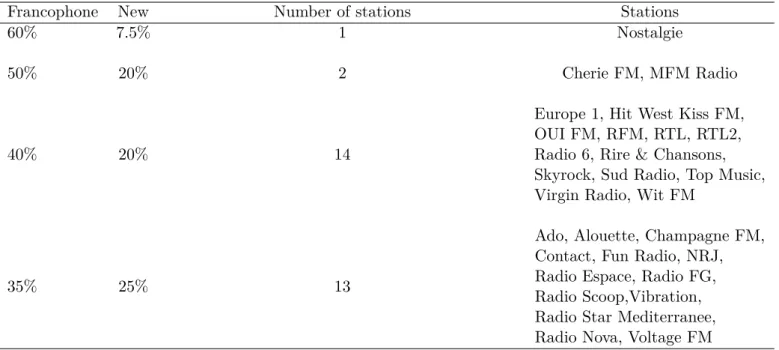
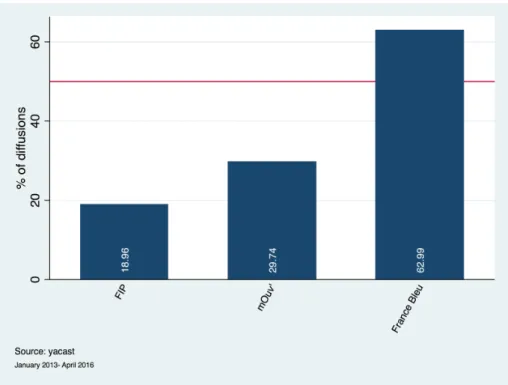
quotas is provided in Table 1.1.6 Songs mostly in French are considered Francophone, while songs performed by a French artist in another language are not. “New” music is that which has premiered within the previous year. “Recurrent” music is defined as having premiered 1-2 years ago, and “gold” is older than 3 years. The stated goal of this regulation is to protect French culture and increase the diversity of music offered. Quotas vary by station format: stations with younger audiences generally have lower Francophone quotas than “heritage” stations, and public stations face different quotas than privately-held stations. Public stations and national stations have higher quotas in general (as well as higher audiences). The public stations need to play 50% or more French music. In response to complaints from some private radio stations about the difficulty in meeting the 40% quota (as well as concerns that to do so, they played a small number of French songs many times), the quota for some stations was lowered to 35% in March 2016.7
Quotas apply from 6:30-22:30 on weekdays and 8:00-22:30 on weekends (i.e., hours when audience numbers are likely to be high). Advertising revenues are the main financial income for French radio stations, and they pay licensing fees as a share of their advertising revenues (between 3% and 4%) regardless of the titles they broadcast. The producers and SACEM (the Society of Authors, Composers and Publishers of Music) then distribute these fees to the artists in proportion to the rotations of each song. The Conseil supérieur de l’audiovisuel (CSA)8 monitors compliance with these quotas on a monthly basis.9 We describe enforcement of these regulations in more detail below.
1.3.2 Quotas and competition between broadcasters
Traditional radio stations compete in a two-sided market using an advertising-based business model. Listeners do not pay directly for content, but they must tolerate advertising. Standard models of competition, in which price is the tactical variable and product characteristics are often considered as exogenous, do not apply in this context. Rather, radio stations compete for audience by choosing differentiated playlists.
6
See la loi du 1 février 1994, which replaced an earlier statute on quotas, for details. 7
See Les quotas francophones à la radio ont été assouplis...mais la bataille continue. 8
The CSA was created on 17 January 1989 to monitor broadcasting in France. 9
Listeners choose radio stations based on their expectation that the content will match their tastes for variety and musical genre. Likewise, each radio station’s choice of playlist character-istics is based on its expectations of audience preferences and the playlists of its competitors, subject to regulatory quotas and the attractiveness of the outside option. Regulatory quotas constrain playlist choice, which affects competition, the size of the audience attracted, and advertising revenues.
The effect of cultural quotas depends on the preferences of listeners for local10 content. If demand for local content is high, quotas are unlikely to be binding. Alternately, if listeners have a strong taste for non-local content, quotas affect the revenue of both radio stations and local artists or producers. In the absence of quotas, local content receives less exposure, which has two effects on the revenues of local artists and producers. First, it reduces their share of royalties paid by stations from advertising revenues. Second, because they benefit less from the publicity provided by radio play, their sales of physical or digital content are likely to be lower. From the perspective of radio stations, quotas restrict their ability to meet the demands of listeners. If this reduces demand for radio, advertising revenues fall; this could be particularly salient in the presence of competition from streaming platforms or other options for listeners. Stations may therefore have incentive to strategically shift quota-required content, for which there is low demand, to times when their audience is low. Put another way, the opportunity cost of playing an additional minute of local content is higher when the audience is large, because the foregone advertising revenue is higher at these times. In addition, listeners may switch stations if their taste for local content is low.
1.4
Data and summary statistics
We use data on the minute-by-minute programming of major French radio stations that have national coverage from Yacast. This dataset, used by the CSA to monitor quotas, covers January 2013 to April 2016. In total, this yields 11,534,843 songs played by 34 major French radio stations11, which have more than 90% of the total market. Thus, we have fairly complete
10
We refer to Francophone music as “local,” although regulations do not require that it be locally produced. 11
About 1200 private operators are authorized in France. For reasons both technical and economic, it is impossible to observe all of them.
information on the supply side of the French radio market. We exclude talk stations from our analysis, as music quotas are less relevant for them. The Yacast dataset includes details of the broadcast content, such as the language, genre, and release date of each song. Table 2.1 shows an extract from the play log of Skyrock, a station dedicated to rap and R&B.
On the demand side, we have data on the average audience during 15-minute intervals for weekdays and weekends for each week and each station, based on measurements made by Médi-amétrie, a private company measuring the audience of radio and television. Its shareholders are both major television channels (France Télévision, TF1) as well as radio stations (Radio France, Europe 1) and advertisers. The database compiles data on programming and corresponding au-diences on major radio stations in France. This aggregate measure is based on a representative panel of listeners from the French population aged 13 and over who listen to radio at least once per day.
We convert play logs into observations of 15-minute intervals (for a total of 96 observations per day) for each station and calculate the total number of minutes of music played. We then break down the total minutes into minutes by language and status as “new.” Table 2.4 presents the descriptive statistics. About one-third of each 15-minute interval is devoted to non-music minutes, i.e. advertising or talk (we cannot distinguish between the two). An average quarter hour has about a mean of 3.1 minutes of French music, and more than double that of Anglophone music. “New” music accounts for an average of 5.31 minutes, while “gold” (music more than 3 years old) has 3.53. Note that new music here refers to new music production.
1.4.1 Compliance with quotas
Figures 1.1 to 1.4 show the average compliance of radio stations during our sample period. We calculate the fraction of Francophone plays to total music played during the hours for which the quota applies and compare this to the minimum percentage specified by the regulations. Note that we exclude Francophone plays which are longer than 1 hour and shorter than 2 minutes. We also exclude instrumental songs. It is clear that most stations fall short of perfect compliance with their Francophone quotas. In contrast, the quota for new music does not appear to be followed (see Figures 1.5-1.6).
we include a table of all CSA actions from 1991-2016. From table 1.15 and table 1.16, we compile a list of all CSA actions in the appendix and show which stations (and at what level of noncompliance) are affected. Over time, either the CSA increased its enforcement or stations were more flagrant in their violations, as we see an increase in the number of warnings, demands, and penalties. Stations which do not fully comply with the quotas face the risk of fines or sanctions. During the years for which we can directly observe compliance, the stations that were well below their quotas (meeting less than 50% or less of the required Francophone play, such as Radio Nova and Oui) were more likely to be cited. Stations that are below the quota, but not “too” far are betting that the regulator won’t enforce too rigorously.
In response to complaints from broadcasters, the CSA has adopted some modifications to the quotas. Recall that the baseline regulations stipulate that Francophone songs should comprise at least 40% of total plays, and that at least half of the Francophone play should be new talent or production.12 However, the CSA now allows stations to choose between three implementations of quotas. Option A is the default, i.e. 40% French songs, half of which (20% of all music pro-gramming) comes from new talent or new production. Option B specifies 50% French-language songs and 15% new talent or new production, while Option C decreases the Francophone quota to 30% but increases that for new talent or production to 25%.
Despite imperfect compliance, stations do not ignore Francophone quotas completely. For example, in Figure 1.32 from appendix A, we show the average percentage of Francophone plays by hour of day for Fun Radio. During non-quota hours, the percentage of Francophone play is very small. In other words, when stations are constrained by the Francophone quota, we see a persistently higher percentage of French music play. Figure 1.33 from appendix A shows a similar breakdown for new music, where quota-relevant hours appear very similar to those that are unconstrained. The Francophone quota is associated with more strategic shifting than the new music quota.
12
The only change during our dataset period is Cherie FM; its Francophone quota changed from 50% to 40% in June 2014. See this http://www.csa.fr/Espace-juridique/Decisions-du-CSA/Cherie-FM-nouveaux-quotas-de-chansons-d-expression-francaisefor more details.