HAL Id: pastel-00733052
https://pastel.archives-ouvertes.fr/pastel-00733052
Submitted on 17 Sep 2012HAL is a multi-disciplinary open access
archive for the deposit and dissemination of sci-entific research documents, whether they are pub-lished or not. The documents may come from
L’archive ouverte pluridisciplinaire HAL, est destinée au dépôt et à la diffusion de documents scientifiques de niveau recherche, publiés ou non, émanant des établissements d’enseignement et de
Quantum cosmology at finite temperature in superstring
theory
Lihui Liu
To cite this version:
Lihui Liu. Quantum cosmology at finite temperature in superstring theory. High Energy Physics -Theory [hep-th]. Ecole Polytechnique X, 2012. English. �pastel-00733052�
Thèse pour obtenir le grade de
DOCTEUR DE l’ÉCOLE POLYTECHNIQUE préparée au laboratoire CPHT
présentée par Lihui LIU
COSMOLOGIE QUANTIQUE À TEMPÉRATURE FINIE
EN THÉORIE DES SUPERCORDES
(Quantum cosmology at finite temperature in superstring theory)
Directeur de thèse : Hervé PARTOUCHE
Soutenue le 10 septembre 2012 devant la commission d’examen : Carlo ANGELANTONJ Rapporteur
Massimo BIANCHI Examinateur
Pierre BINÉTRUY Président du jury
Emilian DUDAS Examinateur
Costas KOUNNAS Rapporteur
Summary
This thesis is dedicated to the study of cosmology induced by superstring theory at finite temper-ature. The thermal string scenario has the aim of establishing a unified framework for describing cosmological evolution, with gravity quantized, and matter contents derived from first principles. The cosmological solutions of string theory are determined by the low energy effective action. The latter only accommodates static solutions at tree level, while nontrivial cosmological evo-lution is obtained when corrections from thermal and quantum effects are taken into account. We restrict our attention to the weak coupling regime. In such cases the thermal and quantum effects back-react on the initially flat static spacetime background through an effective potential computed up to one loop level, which is a Colemann-Weinberg effective potential. It turns out that this setup describes a universe filled with an ideal string gas in quasi-static evolution, and the Colemann-Weinberg effective potential is just the Helmholtz free energy density of the string gas.
The resulting cosmological evolution can be divided into three stages characterized by the scale of temperature. They are namely: 1) the Hagedorn era where the temperature is of order string scale, and the free energy density diverges due to the exponential growth of degeneracies with mass level; 2) the standard cosmology era where the temperature goes below the electroweak phase transition scale, and the nucleosynthesis takes place giving birth to the matter contents of the current universe; 3) the intermediate era which is between the above two, where the spacetime metric evolves in the pattern of a radiation-dominated universe (radiation-like), moduli can be stabilized, and the hierarchy for supersymmetry breaking scale is generated.
The issue of moduli stabilization in the intermediate era is intensively studied. At certain points in the moduli space, extra massless states emerge, and the Helmholtz free energy density, or the effective potential, develops local minima. The latter provide moduli attractors. The depth of the local minima is time dependent, which induces scalar masses reducing with cosmological evolution. This makes the coherent scalar oscillations dilute before nucleosynthesis, and the cos-mological moduli problem is avoided. Specific models are studied, where attention is given to moduli stabilization by non-perturbative effects.
We first studied cosmology induced by a maximally supersymmetric heterotic string gas. The free energy density reaches local minima where perturbative string states of nonzero winding and momentum numbers become massless, giving rise to non-Abelian gauge symmetry enhancement. This can stabilize all heterotic moduli but the dilaton, i.e. the internal metric, the internal B-field and Wilson lines, among which the internal metric components are attracted to the string scale. Through the type I/heterotic string S-duality this mechanism can be mapped to the type I side. In particular it is found that the dual type I moduli are stabilized by either non perturbative BPS D-string states or by perturbative open string states, where the internal geometric moduli are stabilized at the scale √λI, with λI the type I string coupling in ten dimensions. Enhanced
gauge symmetries at moduli attractors on the heterotic side are also sent to the type I dual side. Although these enhancements of type I gauge symmetry are non-perturbative effects, they should be treated on equal footing with the gauge group induced by perturbative states.
The second case is the cosmology induced by a gas of type II string compactified on Calabi-Yau three-folds. Moduli attractors are found to be at the loci where some 2-spheres or 3-spheres in the Calabi-Yau space shrink to zero size leading the Calabi-Yau space to a singular configuration. These can be either conifold loci or some non Abelian gauge symmetry loci. In type IIA description, in the case of shrinking 2-spheres, the extra massless states arise from BPS D2-branes wrapping these 2-cycles. In case of shrinking 3-spheres, the extra massless states are not yet identified, but their existence can be inferred from the change in moduli space dimension, and further confirmed by analyzing the low energy effective action. This mechanism can lift the whole Kähler moduli space, while in the complex structure moduli space, the flat directions lifted are those associated to the shrinking 3-spheres that can be blown up into 2-spheres. The universal hypermultiplet moduli, which contains the dilaton, cannot be lifted by this mechanism. An explicit example is analyzed where all Kähler moduli are stabilized at the intersection of a conifold locus and a non-Abelian locus. By virtue of the type II/heterotic string duality, the moduli in the dual heterotic string are stabilized, where remarkably, the axio-dilaton modulus is stabilized at order 1 in the unit of string length.
Acknowledgement
The completion of this thesis would not have been possible without the aid and support from many other people, to whom I would like to convey my sincere gratitude.
In the first place I would like to thank Hervé Partouche, my thesis supervisor, for accepting me in his research project. The work on string theory cosmology has been a challenging and stimulating adventure. My progress on the professional grounds owes directly to his constant guidance, support and encouragement. Also his enthusiasm, devotion and diligence influenced me deeply and formed my sense of responsibility for scientific research.
My thankfulness also goes to Emilian Dudas my co-supervisor, who generously offered me help in the starting stage of the thesis. He patiently stood hours after hours of my ‘harassment’, and always came up with clear and pedagogical explanations to my questions.
In addition, I cannot ignore the benefit that I have drawn from the discussions with colleagues and other young physicists: students, postdocs, etc. In particular I am thankful to Guillaume Bossard, François Bourliot, Luca Carlevaro, Cezar Condeescu, John Estes (with whom the col-laboration was really a pleasant experience), Ioannis Florakis, Stefanos Katmadas, Eran Palti, Valentina Pozzoli, Kostandinos Siampos...
Furthermore I thank all the senior physicists and professors, who have spent their time dis-cussing with me and answering my questions: Costas Bachas, Frederik Denef, Pierre Fayet, Al-brecht Klemm, Costas Kounnas (to whom I am particularly grateful for the support for my postdoc application), Viatcheslav Mukhanov, Marios Petropoulos, Nicolas Toumbas...
All these experiences of discussions have been important in broadening my mind and deepening my understanding in string theory as well as in related fields of high energy physics.
I then take advantage to record my thanks to my parents Min Xiao and Minghua Liu for their financial support for my first year’s stay in France (2008–2009). For them it was a tough year.
My most profound gratitude is reserved for my wife Diane, who initiated my idea of pursuing studies in France, and who then helped turn it into reality. Her unconditional faith in me have always been the deep reason for me to sustain effort during hard time, while that faith is far beyond the reach of my comprehension.
Certainly my gratitude extends to Diane’s family, whose understanding is an indispensable part in the whole story. Moreover, the many weekends and holidays spent with them, where I enjoyed abundantly their hospitality, are invaluable experiences, which helped me understand western values and be integrated quickly in the social environment.
Lastly, I thank all jury members, Carlo Angelantonj, Massimo Bianchi, Pierre Binétruy, Emil-ian Dudas, Costas Kounnas and Hervé Partouche for their voluntary service, and I thank Carlo Angelantonj and Costas Kounnas for preparing the referee’s reports, as well as Carlo Angelantonj and Massimo Bianchi for valuable suggestions for improving the manuscript.
Contents
1 Introduction 1
1.1 Unification and superstring theory . . . 1
1.2 Cosmology induced by string theory . . . 2
1.3 Moduli stabilization . . . 5
1.4 Organization of the thesis . . . 7
2 Perturbative string spectrum 9 2.1 Quantization of free string theories in general . . . 9
2.2 Bosonic string . . . 15
2.3 Closed N = (1, 1)2 superstring and type II strings . . . 19
2.4 OpenN = (1, 1)2 superstring and type I string . . . 24
2.5 Heterotic superstring . . . 27
3 More about compactification 29 3.1 Lattice sum and worldsheet instanton . . . 29
3.2 Enhanced gauge symmetry in toroidal compactification . . . 30
3.3 Supersymmetry breaking by orbifold compactification . . . 32
3.4 Type II string on Calabi-Yau three-folds . . . 34
4 A glimpse to non-perturbative spectra 39 4.1 D1-brane states in type I string . . . 40
4.2 Extremal transition I: singular nodes . . . 42
5 Ideal string gas at finite temperature 50
5.1 Lesson from point particle . . . 51
5.2 Ideal gas of closed superstrings . . . 54
5.3 Ideal gas of type I string . . . 58
5.4 Hagedorn singularity . . . 60
5.5 Application to ideal string gas with unbroken spacetime supersymmetry . . . 63
6 Thermal superstring cosmology 68 6.1 Setting up the scenario . . . 68
6.2 Thermal-quantum induced cosmological evolution in supersymmetric models . . . . 73
6.3 Non-supersymmetric vacuum . . . 80
6.4 Panorama of thermal string cosmology . . . 81
7 Moduli stabilization in type I string by D-string states 83 7.1 Naive perturbative type I cosmology . . . 84
7.2 D-string soliton corrected type I cosmology . . . 85
7.3 E1-instanton interpretation . . . 90
7.4 Type I moduli stabilization and examples . . . 92
8 Moduli stabilization in type II Calabi-Yau compactifications 98 8.1 Stabilization at a conifold locus . . . 99
8.2 Stabilization at a non-Abelian gauge symmetry locus . . . 105
8.3 Intersections of extremal transition loci . . . 112
9 Conclusion 117 A Computation of canonical partition function of ideal gas 122 A.1 Second quantization computation . . . 122
A.2 First quantization computation . . . 125
B Equations of motion in cosmology 132
References 134
Publication 1: J. Estes, L. Liu and H. Partouche, JHEP 1106 (2011) 060 141
Publication 2: Publication 2: L. Liu, J. Phys. Conf. Ser. 343 (2012) 012068 143
Chapter 1
Introduction
1.1
Unification and superstring theory
A prevailing conviction about the high energy physics is the unification of the four fundamental interactions. This is not only for aesthetic reason but also for addressing fundamental problems of theoretical physics such as the determination of standard model parameters, the generation of baryon-antibaryon asymmetry. Supersymmetry provides a theoretical framework which favors the unification. Even though supersymmetry is not yet directly confirmed by experiments, it is possible however, by tuning the supersymmetry breaking scale, to give rise to the grand unification theory (GUT) [1]. That is, the renormalization group flows are such that the coupling constants of the electroweak interaction and the strong interaction converge to the same value at high energy scale.
If we admit that the GUT scenario is an intermediate step towards the “theory of everything”, a theory unifying all the four interactions, then a natural way to bring gravity into play is to make the global supersymmetries local. This is because invariance under local supersymmetry transformation implies invariance under diffeomorphism transformation, and the latter is essential symmetry of general relativity. In the gauging of the global supersymmetry, spin-3�2 fields appear as the “gauge fermion” coupled to the supercurrent, making it necessary to further introduce spin-2 graviton to close the supersymmetry algebra. This leads to the supergravity theory. However the theory is plagued by non-renormalizability, when we quantize the graviton as metric fluctuations around a fixed background.
It is then realized that string theory can provide way out to the difficulty of supergravity. On one hand, superstring theories accommodate supergravity as the low energy effective theory. The quantization of superstring yields supersymmetric spectrum of spacetime states. The ground
level, which is of mass zero, contains a spin-2 mode, recognized as the graviton. Therefore the supergravity action becomes the Wilsonian effective action of superstring where all massive modes are integrated out. On the other hand, the spatial dimension of strings, which delocalizes the range of their interaction, introduces a natural UV cut-off. Therefore supergravity appears non-renormalizabile just because it is the low energy effective theory of some underlying UV finite theory.
However this picture of unification is not without price to pay. Most obviously, superstring spectrum generously offers much too more spacetime fields than what the standard model needs, so that the connection to the real world is not clear. Also the spacetime has to contain extra dimensions in order for the quantized string theory to respect the symmetries that exist on the classical level. Then upon compactification down to 4D spacetime, we face with highly degenerate vacua, parameterized by a considerable amount of moduli, which are massless scalar fields. These are the main problems that have to be coped with in the phenomenological application of string theory. To make string theory phenomenologically viable is the deep-seated motivation in many of the research works on string theory, for instance compactification, model building, moduli stabilization, etc. Despite these difficulties among others, string theory is the most promising candidate quantum theory of unification leading to a sensible account of phenomenology.
1.2
Cosmology induced by string theory
As is the case for any high energy theory in physics, in order to make contact with the observable universe, it is important that string theory pass the trial of cosmological application. The widely adopted cosmological scenario is that of the standard Big-Bang cosmology or the ΛCDM model. It supposes that the universe starts off from a singular and extremely high energy event, namely the Big-Bang. Very soon after, it experiences a short inflationary period, which accounts for the flatness, isotropy and homogeneity that we observe today. After the reheating pending the infla-tion, the universe goes through a series of symmetry breakings as it cools, including the separation of strong interaction, supersymmetry breaking and the electroweak symmetry breaking, where the last event happens when temperature drops to about O(100)GeV scale. At this moment Higgs potential is destabilized, triggering the electroweak phase transition, giving mass to fundamental particles and the four fundamental interactions appear as what we observe today. As the universe continue cooling, it becomes radiation-dominated, and meanwhile matter starts to form through the process of nucleosynthesis, and gradually matter dominates the universe. The theoretical mat-ter content in today’s universe is obtained by fitting the model with empirically supposed matmat-ter contents, each characterized by the state equation P = w ⇢, into observation results of supernovae
or galaxies. This yields the proportions that each type of matter takes up: baryonic matter ∼ 3%, dark matter ∼ 27%, and dark energy ∼ 70%.
Although the standard cosmological model has largely promoted our understanding of current observation results of the universe, it has the drawback of being a too phenominological approach. Its matter contents are put by hand, where indeed some underlying theory is desired so that these cosmic fluids can be derived from first principle. Also the application of standard model has the difficulty from the hierarchy problem at high energy scale, where the Higgs mass is attracted to an extremely large value. Then if we resolve the hierarchy problem using supersymmetric standard model scenario, the problem is transplanted into the hierarchy of supersymmetry breaking scale. Furthermore since gravity is not quantized, the model does not propose solution to the Big-Bang singularity. Last but not least, phase transitions between different cosmological eras are imposed rather than natural.
Therefore in view of the fact that string theory unifies all interactions and matter contents in a quantum theory framework, we are tempted to formulate cosmology using string theory. It should be stressed that by doing so, we are not just putting strings into the ΛCDM universe to see how they evolve, as what we do with standard model. Rather, we are requesting the string theory to generate the whole cosmology as solution to its equations of motion derived from the effective supergravity theory. However we already meet with the difficulty that for most of the cases only static AdS or flat backgrounds can be obtained at tree level as the vacuum configuration, which is already known in supergravity.
Thus effects beyond tree level must be considered. Actually in the works prior to those to be discussed in this thesis [2–7], the thermal and quantum effects are inspected for weakly coupled strings at one loop level. It is found that in certain cases the resulting corrections are under control at full string scale. These corrections induce non trivial cosmological evolution through its back reaction on the tree level solution. We will refer to this approach the “thermal string scenario” in this thesis. The logic of setting up this scenario is as follows. The universe is described at tree level by no-scale type supergravity [8], which is characterized by vanishing scalar potential minima, as well as the spontaneous breaking of supersymmetry at the scale given by the no-scale modulus. This is to account for the observation result that the universe is almost flat and has a tiny cosmological constant. As the supersymmetry is spontaneously broken by thermal effect among other possible mechanisms, a non trivial vacuum-vacuum amplitude is generated at one-loop level. The latter corrects the tree level no-scale supergravity action as the one-loop Colemann-Weinberg effective potential, and since the string coupling is set to be weak, higher order corrections can be neglected. Provided that the one-loop amplitude at finite temperature is just the logarithmic of the canonical partition function of ideal gas, the corrected action describes in effect a universe
filled with a string gas at finite temperature. From the one-loop part of the action one can derive the energy density ⇢ and the pressure P of the string gas which sources cosmological evolution, and these string theory quantities do not have UV ambiguity as in field theories. The solution describes a universe evolving in the pattern of a radiation-dominated universe: a(t) ∝ T(t)−1
and H(t)2 ∝ a(t)−D, where T is the temperature, a the scale factor in the flat Robertson-Walker
metric (flat because of no-scale), H the Hubble parameter and t the cosmological time. What is remarkable is that the solution of nontrivial cosmological evolution is induced by the thermal string gas and is purely a quantum effect.
For constructing realistic models supersymmetry should be spontaneously broken at zero tem-perature. Interesting phenomenology has been unraveled for the cases where supersymmetry breaking implemented by Scherk-Schwarz reduction in an internal circle [3–6]. The associated supersymmetry breaking scale, which are of order the inverse radius, is found to be evolving pro-portionally with temperature MSUSY(t) ∝ T(t), and ratio between the two is attracted to a fixed value of order 1. The hierarchy MSUSY � MPlanck is thus dynamically generated. It should be
stated that the backward extrapolation of these solutions is limited by the appearance of Hagedorn instability at ultra high temperature which is about of the string scale1 M
s =
�
1�↵′. There, the
one-loop correction diverges at a critical temperature called the Hagedorn temperature, where the thermal string scenario breaks down. One difficulty appears in that we cannot know what the initial conditions are at the beginning of the phase where temperature falls below the Hagedorn temperature and one-loop correction become calculable. However remarkably the radiation-like solutions described above are insensitive to the initial conditions. That is, the evolution will be dynamically attracted to the radiation-like solution whatever the initial conditions.
Another appealing thing that we expect from the string cosmology is establishing a unified description of all the cosmological eras from the very beginning to the standard matter dominated era. We have just mentioned briefly the backward extrapolation of cosmological solutions, which stops at the moment where temperature is of about the string scale. Likely, the forward extrapo-lation should also be limited, since with the dropping of the temperature and the supersymmetry breaking scale, we will end up with a supersymmetric vacuum. Indeed at the moment when tem-perature lowers to about the electroweak scale Λew, it is expected that certain infrared effects,
which was screened at hight energy scale, become relevant, and the resulting radiative corrections lead to the stabilization of MSUSY at about TeV scale. The analysis of this effect in supergravity context has been carried out in Refs [9, 10].
Therefore we can divide the thermal-quantum induced cosmological evolution in three eras: the Hagedorn erafor T ∼ Ms, the standard cosmology era for T > Λew, and finally the cosmological era
1
α′= l2
which accommodates the radiation-like solutions we have just described, satisfying Ms� T � Λew,
referred to as the intermediate era. While the intermediate era has been intensively studied, the other two eras are less well understood. For the Hagedorn era, some works have been done where the Hagedorn singularity is resolved in type II string by implementing “gravito-magnetic fluxes” [11–14]. It has been shown that such resolution of Hagedorn singularity can lead to the resolution of the Big-Bang singularity, where we obtain a bouncing universe [12,13] or an emerging universe [14].
1.3
Moduli stabilization
As the end of Sec.1.1 complains, compactification of string theory leads to highly degenerate vacua, characterized by parameters spanning the moduli space. These parameters, or moduli, are given by the vacuum expectation values (VEV’s) of massless scalar fields in the tree level effective field theory, which we refer to as moduli fields. These massless scalar fields are undesirable for phenomenological application because if they existed in nature, they would mediate new types of interaction so that we would have more than four fundamental interactions. Moreover since moduli are free parameters that the couplings and the mass spectrum depend on, the model loses predicability. Therefore if we believe in string theory as the fundamental theory of nature, then any sensible phenomenological application must manage to let moduli be settled to some fixed value and become massive scalar fields. In other words, the model must be able to generate some nontrivial scalar potential beyond tree level that lifts the flat directions.
Actually the thermal string scenario provides such mechanism. It was shown in [15] that a gas of string modes, which carry both winding and momenta, generate a free energy that enables stabilization of radii moduli. The thermal string scenario provides a quantum version of this effect, which is effectuated through the quantum one-loop correction [16]. More accurately, the Helmholtz free energy density derived from the one-loop amplitude interferes in the effective action as a scalar potential and lifts flat directions. It reaches local minima whenever there are states in the spectrum, whose mass depend on moduli, becoming massless. Therefore these points in the moduli space are just the moduli attractors. In the results in [5, 6] the moduli are attracted to points with enhanced gauge symmetry. The effective potential develops local minima due to the extra perturbative states which become massless to supply the non Cartan components of the enhanced gauge group. In fact the link between local extrema of one-loop amplitude and enhanced gauge symmetry has been explored in [17], where it is shown that the correlation of the two is true to all loop levels.
much attention in the thesis. In [18] the non-perturbative effects examined are induced by D1-branes in the type I string, where the calculation is done indirectly through the dual heterotic string. For simplicity, models considered therein are maximally supersymmetric, while general-ization to non-supersymmetric vacua is obvious. On the heterotic side it is found that all moduli, except the dilaton, can be stabilized at some gauge symmetry enhancement points, where F-string states are responsible for the gauge symmetry enhancement. Using string-string S-duality, this mechanism can be mapped to the dual type I side to stabilize type I moduli. In particular, given that the heterotic F-string states are mapped to type I D-string states, the moduli stabilization on the dual type I side is a non-perturbative effect, accompanied with non-perturbative gauge symmetry enhancement.
In [19] we look into the D2(D3)-brane effects in type IIA(B) strings compactified on Calabi-Yau three-folds. The moduli attractors are expected to be located at certain loci of topology change of the Calabi-Yau space. This is motivated by the analysis in [20] which reveals that singulari-ties appear in the low energy supergravity action when the Calabi-Yau space undergoes conifold transition. This is interpreted as arising from light D-brane states, which become massless at the transition point, wrongly integrated out from the Wilsonian effective action. The singularities are repaired as we “integrate in” these D-brane states, and it turns out that these light states are weakly coupled to the Abelian gauge group. As the CFT computation of one-loop amplitude is not available in generic Calabi-Yau compactifications, the one-loop correction can be computed perturbatively (in the sense of gauge coupling not string coupling) from this repaired effective action by field theory method. We then rely on this one-loop correction to indicate moduli at-tractors. Similar mechanism exists when the Calabi-Yau space undergoes the extremal transition where the singular configuration contains a curve of AN−1 type singularity. The same procedure
as for the conifold case still applies here, except that the light non-perturbative spectrum is more complicated. They form an SU(N) gauge group with matter transforming in the adjoint repre-sentation. In both cases we observe that Kähler moduli and complex structure moduli moduli are attracted to values corresponding to the singular configuration of the internal Calabi-Yau space.
A major difficulty in moduli stabilization is that cosmology imposes severe conditions on the scalar masses. Basically as the universe expands, small initial fluctuation of background scalar fields in the potential well can dominate the energy of the universe at late time. For example in 4D, the oscillations store an energy density scaling as T−3 with T temperature of radiation,
which eventually dominates over the radiation energy which scales as T−4 [21]. This domination
continues until the corresponding scalar particles decay. Severe problem arises because not only the productions of the decay can alter the primordial abundances of light nuclei produced by nucleosynthesis, but also the huge amount of entropy production during the decay can wash out
the baryon number asymmetry. This problem is termed as the cosmological moduli problem, which was initially identified in the framework of supersymmetric standard models [22–24]. One plausible solution to these is to require the scalar masses be of O(10)TeV order, for example in the KKLT scenario [25]. It is pointed out in [23] that once this is satisfied, the decay of these scalar particles reheats the universe to a temperature of order 1MeV, high enough to restart the nucleosynthesis. Then it is found in [24] that the baryon number asymmetry can also be saved by the O(10)TeV order scalar mass if the baryogenesis is due to the Affleck-Dine mechanism [26].
The thermal string cosmology addresses the cosmological problem differently. This is already explored in [5, 6] where it is shown that the induced scalar mass is proportional to TD
2−1, which
decreases in time rather than being constant. Given that the oscillation in the potential well has the frequency proportional to the square-root of the induced mass, the decrease of mass slows down the background oscillation and hence the expansion of the universe dilutes the oscillation energy faster than for constant induced mass. By consequence, one finds that the energy stored in the background scalar oscillation never dominates so that the cosmological problem does not appear.
1.4
Organization of the thesis
The first three chapters following the introduction provide preliminary string theoretical elements that our work is based on. In Chapter 2 we go rapidly through the perturbative approaches of string theory quantization and will especially be concerned about the description of the spectrum, where lightcone gauge will be used. The aim is to get a quick access to the computation of one-loop vacuum-to-vacuum amplitudes. Chapter 3 collects the conceptual and technical aspects in compactification that will later be useful in giving rise to moduli stabilization mechanism in thermal string cosmology. These include worldsheet instanton, gauge symmetry enhancement, supersymmetry breaking by orbifold, and Calabi-Yau compactification. Chapter 4 goes one step further into the non-perturbative realm, and gives account for the non-perturbative mechanisms that have been explored in our works. The discussion will be restricted on the non-perturbative D-sting effects in type I string which can be revealed by the S-duality between type I and heterotic, as well as those in Calabi-Yau 3-fold compactification of type II strings when the Calabi-Yau space undergoes extremal transition.
The next two chapters are dedicated to building up the thermal string cosmology scenario, which summarize the foundational elements in the related works [2–7, 18, 19]. They give account to the two essential aspects concerned: string gas thermodynamics and its implementation in
cosmology. Chapter 5 deals with ideal string gas without considering cosmological context. Com-putation of the partition function Z = Tr e−βH is described in detail, where we establish the first
quantization computation of the partition function through analogy with field theory Zfield= exp � � �→ Zstr= exp � �
so that computing the thermal partition function attributes to computing thermal one-loop am-plitude. Explicit computation is performed on specific string models. Then the investigation of general properties of the thermal one-loop amplitudes leads to the discussion of Hagedorn singu-larity. In Chapter 6 we set up the formalism describing cosmology. The aim is to introduce the assertion that the thermal quantum effects of the ideal string gas back reacts on the background spacetime metric and fields through a stringy version of Coleman-Weinberg effective potential. This is again inspired by the field theory analogue of 1PI effective action:
Γfield= Sfieldtree+ S 1-loop
field + . . . �→ Γstr= S tree
str − + . . . .
Then a simple application is shown, where the cosmological solution is found in maximally su-persymmetric heterotic string. Based on the solution, meanwhile supplemented with the results from previous works especially on non-supersymmetric tree level vacua, we illustrate the common and basic features of the cosmological evolution in the thermal string scenario. The problem of moduli stabilization is discussed, in order to motivate the work in the following up two chapters. In Chapter 7 and Chapter 8 we present the work done in Refs [18, 19], where we focus our attention on the moduli stabilization in the intermediate era by non-perturbative effects. The non-perturbative effects concerned are those mentioned in chapter 4. The D1-brane states in type I string is investigated in chapter 7 while the D2(3)-brane effects in Calabi-Yau compactification of type IIA(B) string are considered in chapter 8. We have already explained the idea in the middle part of Sec.1.3
Chapter 2
Perturbative string spectrum
This chapter gives a sketch of important elements in perturbative string theories which we will need. We go quickly through the perturbative quantization of all types of string theories, where we care most about the resulting spectra and their description in terms of partition functions. The latter leads to the computation of one-loop vacuum-vacuum amplitudes, which will play crucial role later in the study of cosmology. Although non-perturbative effects will also be investigated as very important issue, the computation involved therein will still utilize the perturbative technique in this chapter.
2.1
Quantization of free string theories in general
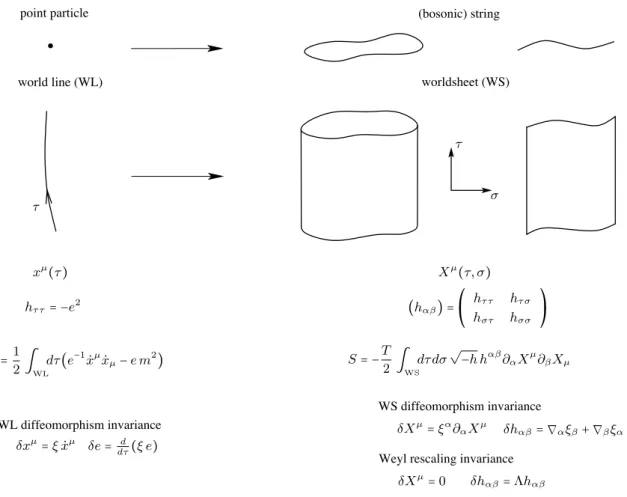
Naively the string theory can be viewed as a generalization of the point particle vision of the microscopic world. It postulates that the fundamental component of matter are extended objects of one spatial dimension, which has internal structure rather than point-like objects. In Fig.2.1 this generalization is shown schematically. In the passage from the point particle action to the bosonic string action, we emphasize the enlargement of local symmetry group due to the internal structure of strings. Handling properly these symmetries in the quantization of string theories leads to nontrivial constraints on the structure of spacetime and on the spectrum that string vibrations generate.
String theories in a curved spacetime background is in general a nonlinear sigma model, of which a full quantum description is not possible except for some special cases. Here for sake of exact quantization, we consider a Minkowskian background, which can be further compactified on some toroidal compact space.
point particle (bosonic) string
world line (WL) worldsheet (WS)
WL diffeomorphism invariance
WS diffeomorphism invariance
Weyl rescaling invariance τ σ τ xµ(τ ) Xµ(τ, σ) h⌧ ⌧= −e2 �h↵β� =� � h⌧ ⌧ h⌧ σ hσ⌧ hσσ � � S=1 2 �WL dτ�e−1x˙µx˙µ− e m 2 � S= −T 2 �WS dτ dσ√−h h↵β∂↵X µ ∂βXµ δe= d d⌧(ξ e) δxµ= ξ ˙xµ δh↵β= ∇↵ξβ+ ∇βξ↵ δXµ= ξ↵∂ ↵Xµ δh↵β= Λh↵β δXµ= 0
Figure 2.1: From scalar particle to bosonic string. Here µ labels spacetime dimension, α β label the worldsheet dimensions; τ is the propertime of the world line and the worldsheet, and σ the spatial coordinate of the worldsheet; hτ τ = −e2 is the world line metric and hαβ the worldsheet metric; xµ(τ ) and Xµ(τ, σ) are respectively the target
space coordinates of the particle and of the string; T = 1 2πl2
s
is the string tension; ξ is the infinitesimal generator of world line diffeomorpism and ξαthe worldsheet counterpart; Λ is the infinitesimal generator of Weyl rescaling.
Quantization schemes
To quantize string theories in a Minkowskian target space, one usually go through three different schemes: old covariant quantization, lightcone gauge quantization and BRST quantization. Each has its own domain of competence. In case of non-interacting strings where all these quantization schemes can be applied, they lead to equivalent physical Hilbert spaces related by isomorphisms. All string theory quantization in this chapter will be using lightcone quantization. Here we briefly comment these methods in order to justify our choice, as well as to motivate the CFT approach of string theory quantization.
Old covariant quantization
It is based on canonical quantization scheme, and is intended for giving the physical spectra of free string theories. One starts by imposing conformal (superconformal) gauge condition to bosonic string (superstring) theory, which fixes the worldsheet metric up to a Weyl rescaling. The action thus appears as a free CFT (SCFT), but is supplemented with first-class constraints. The latter are associated to the reparameterization (and local supersymmetry) freedoms of string coordinates. One then quantizes this CFT (SCFT) canonically, and in addition imposes the classical constraints at quantum level to squeeze out gauge redundancies. Weyl symmetry is violated at quantum level due to the presence of a nonzero central charge. However this conformal anomaly is irrelevant, since quantizing the theory against two different worldsheet metrics subject to conformal (superconformal) gauge condition leads to the same Hilbert space. Generically the quantum description suffers from negative-norm states in the Hilbert space, which are called ghosts. By requiring the absence of ghost states, one finds precise constraints on the spacetime dimension and the mass spectrum.
Lightcone quantization
It is also based on canonical quantization and deals only with the free string theories. By impos-ing the lightcone gauge condition, all reparametrization and local supersymmetry freedoms are completely fixed at classical level. One is thus left with a free 2-dimensional CFT or SCFT con-taining only transverse string coordinates. Radial quantization yields directly the exact physical Hilbert space, where all physical states span a representation space of the Virasoro algebra. Weyl invariance is not preserved at quantum level since there is a nonzero central charge. However just as in the old covariant quantization, this conformal anomaly is not harmful in itself, while the harm is reincarnated in the Lorentz algebra anomaly in spacetime. Demanding the cancelation of this anomaly, one gets the same constraints on the spacetime dimension and the same mass spectrum as in the former case. In the case where we care only about the free string spectrum, lighcone quantization is the most straightforward and economic way to achieve the goal, as will be the case for our computation of one-loop vacuum amplitudes.
BRST quantization
The BRST quantization invokes path integral method and is designed to rigorously compute string amplitudes to any level in loop expansion. For free string theories, the gauge fixing procedure leads to a 2-dimensional CFT or SCFT containing all the bosonic string coordinates and ghosts,
as well as all the fermionic string coordinates with superghosts in case of superstring theory. The action then loses all gauge freedom of worldsheet reparameterization and local supersymmetry but still preserves Weyl rescaling invariance, and in addition it acquires BRST invariance. These two local symmetries are generically not preserved at quantum level. By cancelation of the associated anomalies, the spacetime dimension number and the mass spectrum are constrained in the same way as the former two cases. One can further work out the Hilbert space, where physical states are indicated by its BRST cohomology classes.
Free CFT on complex plane
The canonical quantization of free string theory attributes to the quantization of the underlying free CFT’s on a complex plane, whose field contents vary in function of the type of strings and the method of quantization. Let the complex coordinate be z, and the free CFT be invariant under the conformal transforms z → f(z) and ¯z → ¯f(¯z) with f any holomorphic function. The associated conserved charges are T(z) and ¯T(¯z), whose operator product expansions (OPE) tell the central charges (c, ¯c) of the CFT:
T(z)T(w) = c�2 (z − w)4 + 2 (z − w)2T(w) + 1 z − w@wT(w) + . . . , (2.1)
and the same expression for ¯T(¯z), which implies ¯c. We will need to know that each holomorphic or anti-holomorphic free scalar contributes one unit of central charge and each free chiral fermion contributes one half. The mode expansions of T(z) and ¯T(¯z) yield Virasoro operators {Lk} and
{¯Lk}: T(z) = ∑z−k−2Lk and ¯T(¯z) = ∑ ¯z−k−2L¯k, which satisfy anomalous Virasoro algebra
[Lm, Ln] = (m − n)Lm−n+
c 12(m
3−m)δ
m+n, (2.2)
and the same thing for {¯Lk} with central charge ¯c. There exists the vacuum state �0� which is
annihilated by Lk≥−1 and ¯Lk≥−1. Primary fields φ(z, ¯z) are those which transform according to
T(z)φ(w, ¯w) = h (z − w)2 φ(w, ¯w) + 1 z − w@wφ(w, ¯w) + . . . , ¯ T(z)φ(w, ¯w) = h¯ (z − w)2 φ(w, ¯w) + 1 z − w@wφ(w, ¯w) + . . . , (2.3)
where h and ¯h are real constants, called the conformal weights of φ. Ground physical states are generated by primary states as
which is of conformal weight (h, ¯h), with L0�h, ¯h� = h�h, ¯h� and ¯L0�h, ¯h� = ¯h�h, ¯h�. The physical
spectrum can be generated by acting the negative modes L−k and ¯L−k (k> 0) on the ground state
�h, ¯h�, subject to certain physical constraints, for example the level-matching condition L0 = ¯L0 for
closed strings, the GSO conditions, invariance under orbifold projections or orientifold projections, etc. All descendent physical states based on the ground state �h, ¯h� span a representation (not necessarily irreducible) space of the Virasoro algebra, of highest weight (h, ¯h). At this point we can introduce the characteristic function of a Virasoro algebra representation, called conformal character. When holomorphic sector and the anti-holomorphic sector can have independent highest weights and descendent states, as is the case for closed strings, the conformal character based on ground state (h, ¯h) is χ(h,¯h)(⌧, ¯⌧) = Tr(h,¯h)qL0−24c q¯L¯0−24¯c = qh−24cq¯¯h−24c¯ � N DNqN� ¯ N ¯ DN¯q¯N¯, (2.5)
where q = e2⇡i⌧, and ⌧ is a complex parameter, which is defined on the upper complex plane to
guarantee the convergence of the series; the trace Tr(h,¯h) runs through all the descendent states based on the ground state �h, ¯h�, and DN ( ¯DN¯) is the degeneracy of the N-th ( ¯N-th) oscillator
level in the holomorphic (anti-holomorphic) sector. For the state L−m1. . . L−mkL¯−n1. . . ¯L−nl�h, ¯h�,
its oscillator levels are N = m1+ ⋅⋅⋅ + mk and ¯N = n1+ ⋅⋅⋅ + nl. Here we include the central charge
shift −c�24 and −¯c�24, in order to switch from the complex plane back to the initial worldsheet of free string theories. Often we need to consider the holomorphic and anti-holomorphic sectors separately, and we can define their conformal characters respectively as
χh(⌧) = q h−24c � N DNqN; χ¯¯h(¯⌧) = ¯q ¯ h−c¯ 24� ¯ N ¯ DN¯q¯N¯. (2.6)
When modeling free open string theories, the CFT is defined on the upper half complex plane and the holomorphic sector is identified with the anti-holomorphic sector: T(z) ≡ ¯T(¯z) ⇔ Lm ≡ ¯Lm.
In such case a generic state is L−n1. . . L−nk�h� (n1, . . . , nk > 0) and the corresponding conformal
character is
χh(⌧, ¯⌧) = Trhq
L0−24c = qh−24c �
N
DNqN, (2.7)
where q = e−2⇡Im⌧. The trace goes through all descendent oscillator states based on�h�. Therefore
Eq.(2.5) is the characteristic function of spectrum on the cylinder and Eq.(2.7) is the characteristic function of spectrum on the strip. They are closely related to string one-loop vacuum amplitudes, as is to be explained next.
One-loop vacuum amplitude
The computation of one-loop vacuum amplitudes in string theories can be summarized as Z1= �
DFdµ(⌧, ¯⌧)A1(⌧, ¯⌧), (2.8)
where ⌧ denotes collectively the parameters characterizing the geometric configuration of the worldsheet concerned, referred to as the Teichmüler parameter, which in our case can be identified with the ⌧ appearing in the conformal character Eqs (2.5) and (2.7); A1(⌧, ¯⌧) is the one-loop
vacuum amplitude computed against a specific geometric configuration ⌧ ; and DF is the minimum
parametric space of ⌧ containing all distinct configurations. Finally all the specific amplitudes A1(⌧, ¯⌧) are integrated up with measure dµ(⌧, ¯⌧), to give the total amplitude Z1. The amplitude A1(⌧, ¯⌧) is model-dependent, which requires knowledge of the physical modes circulating in the loop. Since we are dealing with non-interacting strings, all the three quantization schemes can work out A1(⌧, ¯⌧). The other two elements dµ(⌧, ¯⌧) and DF do not care about the physical modes on
the worldsheet, but care only about the worldsheet topology. Therefore only BRST quantization is qualified for finding them out, and hence qualified for computing Eq.(2.8) rigorously from A to Z. However, we will encounter only four types of topology at one-loop level, namely the torus, the Klein bottle, the annulus and the Möbios strip, whose dµ(⌧, ¯⌧) and DF are already known.
Thus we will simply take and use these results, and focus our attention on the computation of A1(⌧, ¯⌧). The latter can be most conveniently achieved with lightcone gauge quantization. Thus A1(⌧, ¯⌧) is just the conformal character of the lightcone Hilbert space, summed up over all possible highest weighs (integrate over continuous highest weighs). For closed and open strings, we have respectively, closed ∶ A1(⌧, ¯⌧) = � h,¯hsign(h, ¯h) × χ(h,¯h)(⌧, ¯⌧), open ∶ A1(⌧, ¯⌧) = � h sign(h) × χh(⌧, ¯⌧). (2.9)
The subtlety in the summation is that appropriate sign should be attributed to different characters, here denoted by sign(. . .), in order to implement physical conditions, for example GSO projection, modular invariance. It can be seen from Eqs (2.5) and (2.7) that A1(⌧, ¯⌧) can be expanded as
a sum of powers of q and ¯q. In case of closed string amplitude, the expansion containing both q = e2⇡i⌧ and ¯q = e−2⇡i¯⌧, physical spectrum can be read off from the level-matched part (q and ¯q
have the same power) of this expansion, with the powers of q¯q giving the squared masses, and the associated coefficient the degeneracy of this mass level. It should be mentioned that the level-matching condition is not derived from the underlying CFT, but is inherited from the worldsheet diffeomorphism invariance of the full string theory action. However the modes which do not satisfy
level-matching condition contribute to the closed string one-loop amplitude even though they are not in the free string spectrum. On the other hand for open strings, the expansion of A1(⌧, ¯⌧) is
uniquely in terms of q= e−2⇡Im⌧, and the physical spectrum is read off from this expansion in the
way that the power of q imply the masses squared, the coefficient is the degeneracy of this mass level. Finally we recall without proving that in the frame work of lightcone gauge the integral measures in Eq.(2.8) are
VD 2(2⇡)D � F d⌧1d⌧2 ⌧2 2
, with ⌧ = ⌧1+ i⌧2 (torus), (2.10)
VD 2(2⇡)D � ∞ 0 d⌧2 ⌧2 2 with ⌧ =��������� ��
2i⌧2 (Klein bottle),
1
2i⌧2 (annulus),
1 2 +
1
2i⌧2 (Möbius strip).
(2.11)
In the torus case, the integration domain F is defined by �⌧� > 1 and −1
2 < ⌧1 < 1
2, which is the
fundamental domain of SL(2, Z). Indeed the integral measure ⌧−2
2 d⌧1d⌧2 is invariant under the
transform ⌧ → a⌧+b
c⌧+d, with (a bc d) ∈ SL(2, Z).
2.2
Bosonic string
The bosonic string lives in 26 dimensional flat background spacetime. The classical Polyakov action, which describes 26 scalar fields {Xµ(⌧, σ)} (µ = 0, . . . , 25) on the worldsheet, and which
displays all symmetries, is already shown in Fig.2.1. The notation of worldsheet time ⌧ is in clash with the Teichmüler parameter in Eq.(2.8), but since we will never use the two together, there will be no risk of confusion. Imposing lightcone gauge condition which eliminates X0 and X1,
performing worldsheet Wick rotation ⌧ = −i⌧E and defining the complex coordinate z = e⌧E−iσ,
we reduce the initial gauge system to a 2D CFT on the z-plane with 24 transverse free scalar fields {X˜ı(z, ¯z)} = {Xi, XI}. Here we suppose that the theory is compactified on Td, and let
i = 2, . . . , D − 1 label non compact spacetime of dimension D = 26 − d, and I = D, . . . , 25 label compact ones. The action is
Sl.c.= T 2 � d
2z @X˜ı@X¯ ˜ı, (2.12)
where @ = @�@z and ¯@ = @�@¯z, and by d2z we mean dRez dImz. The string tension T is related to
the string length ls and to the Regge slope ↵′ by T = 2⇡↵1 ′ =
1 2⇡l2
s. The energy-momentum tensor is
TX(z) = −1 l2 s @X˜ı@X˜ı, T¯X(¯z) = −1 l2 s ¯ @X˜ı@X¯ ˜ı (2.13)
with central charge (cX, ¯cX) = (24, 24), and we let the associated Virasoro operators be {LX
k} and
{¯LX
k}. The quantization of this system follows the standard scheme for free CFT quantization.
The following contents adopts the language in [27] and will be very concise on mathematical aspects of CFT.
Closed bosonic string
The string coordinates satisfy periodic boundary conditions X˜ı(e2⇡iz) = X˜ı(z), whose mode
ex-pansion is X˜ı(z, ¯z) = XL˜ı(z) + XR˜ı(¯z), with (2.14) XLi =1 2x i−ils2 2 k iln z+ i ls √ 2 n�≠0 1 n ↵i n zn, X i R= 1 2x i−il2s 2 k iln z+ i ls √ 2 n�≠0 1 n ¯ ↵i n ¯ zn; XLI=1 2x I L−i l2 s 2 p I Lln z+ i ls √ 2 n�≠0 1 n ↵I n zn, X I R= 1 2x I R−i l2 s 2 p I Rln ¯z+ i ls √ 2 n�≠0 1 n ¯ ↵I n ¯ zn.
The zero modes are of interest since they contain physical information that the underlying CFT does not imply. Note that for compact directions the holomorphic and anti-holomorphic com-ponents have independent center-of-mass positions and momenta, {xI
L, x I R} and {p I L, p I R}. It is
because the closed strings can wrap around compact directions. All the center-of-mass position and momentum components have non-trivial commutation relations:
[xi, kj] = iδij, [xI L,R, p
J
L,R] = iδ
IJ, 0 for other commutators. (2.15)
The CFT vacuum state �0� is annihilated by all positive ↵-oscillators, and it can be shown that it is SL2 invariant, i.e. annihilated by L0,±1 and ¯L0,±1. A generic physical ground state is obtained
by acting on the vacuum the primary field Ocls
k,p(z, ¯z) =∶ei k
iXi(z,¯z)
ei pILXLI(z)+i pRIXRI(¯z)∶, (2.16)
where the superscript “cls” stands for “closed”, and ki and pI
L,R here are not operators but take
concrete values. The OPEs of Vk,p(z, ¯z) with TX(z) and ¯TX(¯z) tell that the conformal weight is
hX = l 2 s 4 �k 2+ p2 L�, ¯hX = l2 s 4�k 2+ p2 R�, (2.17)
so is the conformal weight of the corresponding ground states. The center-of-mass momentum in non compact directions ki can be of any value, while k− adjusts itself to ensure k+k−−kiki
onshell. However the values of pI
L,R are constrained by the compact space, which contain
compactification. A generic physical state �Xcls� can be the ground state or oscillator excitation
based on it:
�Xcls� = (osc.)Ok,pcls(0, 0)�0�=�(osc.); pL, pR; k�. (2.18)
where “osc.” denotes collectively negative-level oscillators. These states, with specific k and pL,R,
fit into a representation of the complex Virasoro algebra constituted by {LX
k , ¯LXk}, of highest
weight (hX, ¯hX) as shown in (2.17). Especially acting zero modes of the Virasoro operators on
them gives LX0 �Xcls� = � l2 s 4 �k 2+ p2 L� + N��Xcls�, ¯LX0 �Xcls� = � l2 s 4 �k 2+ p2 R� + ¯N��Xcls�, (2.19)
with N and ¯N non-negative integers denoting left and right oscillator levels. We recall the result from CFT that the tower of oscillator excitations of a single holomorphic worldsheet boson is characterized by the partition function q 1
24�⌘(⌧), where the expansion coefficient of the N-th
power of q = e2⇡i⌧ is the degeneracy of the oscillator level N. In the same way we have the
anti-holomorphic partition function ¯q241 �¯⌘(¯⌧). Thus using Eq.(2.19), one finds the conformal character
of the spectrum Eq.(2.18) to be χX k,p(⌧, ¯⌧) = Tr q L0−cX24q¯L¯0−¯cX24 = q l2s 4�k 2 +p2 L�q¯ l2s 4�k 2 +p2 R�⌘(⌧)−24⌘¯(¯⌧)−24, (2.20)
where the trace runs through all the oscillator excitations. Referring to the first line in Eq.(2.9) the total one-loop amplitude in vacuum is therefore
Z = VD 2(2⇡)D � F d2⌧ ⌧2 2 pL�,pR� d�k χ X k,p(⌧, ¯⌧) = VD 2(2⇡)D � F d2⌧ ⌧1+ D 2 2 � pL,pR ql 2 s 4p 2 Lq¯ l2s 4p 2 R ⌘(⌧)24⌘¯(¯⌧)24. (2.21)
The expansion of the integrand yields the lowest order (q¯q)−1 with negative power, showing that
the ground state is a tachyon. Also one can show that all states on the same mass level form a ten-sorial representation of the little group. Therefore the spectrum Eq.(2.18) contains no spacetime fermions. These drawbacks decide that the bosonic string cannot lead to sensible phenomenology.
Open bosonic string
The worldsheet scalar fields satisfy the Neumann boundary conditions @σXi�σ
=0,⇡ = 0, and we have
the mode expansions Xi(z, ¯z)=1 2x i−i l2 sk iln z ¯z+ (osc.), XI=1 2x I−i l2 sp Iln z ¯z+ (osc.) (2.22)
where the nonzero oscillator parts are the same to Eq.(2.14) but with all left-moving and right-moving oscillators identified: ↵˜ı
∗ = ¯↵˜ı∗. Especially the center-of-mass momenta and positions in
compact directions are no longer split into left-moving and right-moving parts, since open strings cannot wrap around compact directions, and hence in the internal momenta pI there is no winding
number. Also the center-of-mass momenta are defined differently from the case of closed string, to maintain the correct commutation relation with center-of-mass positions. The CFT vacuum is still denoted by �0�, and a generic physical ground state is generated by the primary field
Oop
k,p(z, ¯z) =∶e i kiXi
(z,¯z)ei pIXI
(z,¯z)∶, (2.23)
where ki can take any value and pI are constrained by the geometry of compact directions. It has
conformal weight
hX = ls2(k2+ p2). (2.24)
A generic physical state �Xop� is either a ground state generated by Eq.(2.23) or is a descendent
state with oscillator excitations, which is
�Xop� = (osc.)Ok,pop(0, 0)�0� ⊗ �ij� = �(osc.); p; k; ij�, (2.25)
satisfying
LX0 �Xop� = �ls2(k2+ p2) + N��Xop�, (2.26)
where N denotes collectively oscillator excitations; �ij� is the sector carrying Chan-Paton factors i and j, which is a non-dynamical sector introduced in order to implement non-Abelian gauge symmetry in spacetime. These states supply a representation of a Virasoro algebra of highest weight hX
as in Eq.(2.24). The one-loop amplitude is
Z = VD 2(2⇡)D� ∞ 0 d⌧2 ⌧1+ D 2 2 � p ql 2 s 2p 2 ⌘(2i⌧2)24 , where q= e−4⇡⌧2. (2.27)
This integral has UV divergence at the limit ⌧2 → 0. Although the pathology can be cured by
including closed string and implementing the orientifold projection, the theory still suffers from the problems of tachyonic ground state and lack of spacetime fermion. Therefore bosonic strings cannot be a phenomenologically viable theory and we move on to superstring theories.
2.3
Closed
N = (1, 1)
2superstring and type II strings
The N = (1, 1)2 has 10 dimensional target space. Its classical action is the supersymmetrized
version of the Polyakov action for bosonic strings S= −T
2 � d
2σ√−h�h↵β@
↵Xµ@βXµ+ 2i ¯ψµρ↵∂↵ψµ+ (worldsheet gravitino)�, (2.28)
where {ρ↵} are Dirac matrices in 2 dimensions. It is in effect a 2-dimensional supergravity with a
non-dynamical supergravity multiplet, 10 scalar fields {Xµ(τ, σ)} and 10 2-component Majorana
spinors {ψµ(τ, σ)}. By lightcone gauge fixation, followed by a Wick rotation τ = −iτ
E and a
coordinate change z = e⌧E−iσ, the original theory is brought down to an N = (1, 1)
2 SCFT on the
z-plane. It contains 8 free scalar fields {X˜ı} and their superpartners which are free
Majorana-Weyl spinors {ψ˜ı, ¯ψ˜ı} (i = 2, . . . , 9), with ψ and ¯ψ of opposite chirality. It is a free SCFT of central
charge (cX, , ¯cX, ¯) = (12, 12) where each holomorphic boson contribute one unit and fermion half
unit. The action is:
Sl.c.= T
2 � d
2z�∂X˜ı∂X¯ ˜ı+ i�ψ˜ı∂ψ¯ ˜ı+ ¯ψ˜ı∂ ¯ψ˜ı��, (2.29)
from which we derive the conserved charges of conformal transforms TX, (z) = −1 l2 s ∂X˜ı∂X˜ı+ 1 l2 s ψ˜ı∂ψ˜ı, T¯X, ¯(¯z) = −1 l2 s ¯ ∂X˜ı∂X¯ ˜ı+ 1 l2 s ¯ ψ˜ı∂ ¯¯ψ˜ı. (2.30) Here as for the bosonic string, we suppose the theory be compactified on a torus Td, where
d= 10 −D and D the spacetime dimension. The convention for the indices are i = 2, . . . , D −1 and I = D, . . . , 9. The quantization is straightforward: the bosonic part and the fermionic part can be quantized as independent CFT’s. The bosonic part has already been described in the last section, and the fermionic part is summarized as follows.
Spectrum of worldsheet fermions
Unlike the bosonic sector, the fermionic sector gives rise to Virasoro algebra representations of fixed highest weights. Recall from Ref. [27] that each free chiral worldsheet fermion can generate the representation [0] + 2[1
16] + [ 1
2], where the numbers in the brackets are the highest weights of
irreducible components. The representation [0] + [1
2] is generated when the chiral fermion takes
anti-periodic boundary condition, referred to as Neveu-Schwarz (NS) boundary condition. This leads to integer mode expansion of worldsheet fermions ψ˜ı(z) = ∑
rz−r− 1 2ψ˜ı r (r ∈ Z − 1 2), and the
conformal character of the resulting spectrum is1 χ �[0] + [12]� = � ✓3 ⌘ . (2.31) The representation [1
16] is generated when the chiral fermion takes periodic boundary condition,
referred to as Ramond (R) boundary condition. This results in half-integer mode expansion of worldsheet fermions ψ˜ı(z) = ∑
rz−r−
1
2ψ˜ı
r (r ∈ Z), where the the zero modes ψ˜0ı are crucial
to the emergence of spacetime fermions. Each [1
16] representation in the holomorphic sector is
characterized by conformal character
χ �[161]� = �
θ2
2η. (2.32)
For sake of global existence of worldsheet supercurrent, fermions of same chirality should take the same boundary condition. The left-moving and the right-moving fermions can be quantized independently. The spectrum of the 8 left-moving fermions is summarized as follows, where according to the choice boundary condition, the Hilbert space is split into the NS sector and the R sector.
NS sector
The NS sector is the �[0] + [1 2]�
8
representation of the Virasoro algebra, which contains the CFT vacuum and all the oscillator excitations with half-integer oscillators. The spectrum has conformal character
χ �[0] + [12]�8= θ
4 3
η4 . (2.33)
The spectrum (2.33) does not lead to sensible physical specturm, because it contains a tachyonic ground state. To fix this problem, we require a truncation of the spectrum by the GSO projection2.
In CFT language, one requires in the NS sector that physical states be those of integer highest weights among the irreducible components in �[0] + [1
2]� 8
. In the oscillator language, it amounts to requiring an odd number of ψ-oscillator excitations. The conformal character associated to this truncated spectrum is therefore
χNS GSO= 1 2� θ4 3 η4 − θ4 4 η4� = V8. (2.34) 1
For the elliptic η- and θ-functions, we adopt the conventions and notations in the appendix C of [30] for elliptic θ-functions.
2
Here the second term in the parenthesis ✓4
4�⌘4 is computed as χ �[0] + [ 1 2]�
8
, but all contribution from representations of half-integer highest weight has the sign reversed. Thus the subtraction of the two projects out the representations of integer highest weight representations.
R sector
The R sector of the Hilbert space is a �2[1 16]�
8
representation of Virasoro algebra. It contains a 28-fold ground state of conformal weight 8
16, which forms an SO(8) Dirac spinor in spacetime.
The zero modes in the oscillator expansion ψ˜ı
0 act on this ground state as Dirac matrices since
they satisfy the Clifford algebra {ψ˜ı 0, ψ
˜ |
0} = δ˜ı˜|. The raw R sector spectrum contains four times
the amount of NS sector modes. To achieve spacetime supersymmetry, we need to truncate the spectrum. First we remove half of the modes by imposing the Majorana condition, making the ground state a real spinor. We can thus express explicitly the ground state using bosonization formalism of worldsheet fermions, where this ground state is created out of the CFT vacuum by spin fields3. Second we introduce the GSO condition for the R sector by requiring that physical R
sector states should be of a definite chirality, and furthermore, two adjacent oscillator excitations should have opposite chirality. The associated conformal character is4
χR GSO = 1 2� θ4 2 η4 ± θ4 1 η4� = � S8 +, C8 −. (2.35) Here the first term in the parenthesis θ4
2�η4 is nothing but χ �16[ 1
16]8�, the conformal character
arising from the spectrum based on a Majorana ground state. The second term is obtained, based on the first term, by reversing the sign of the contribution from one chirality. The subtlety is that when going from one oscillator excitation to an adjacent one, the sign should be reversed for opposite chirality. The sign ambiguity in Eq.(2.35) accounts for the fact that one can project out any of the two chiralities.
Above is the quantization of left-moving fermions. The total conformal character is χ (τ) =χNS GSO(τ) − χ R GSO(τ) = θ4 3−θ44−θ24± θ41 2η4 = �1 a,b=0 (−1)a+b+µ abθ[ a b]4 2η4 = � V8−C8 µ= 0, V8−S8 µ= 1. (2.36) 3
Refer to, for instance, [28] for explicit construction of spin fields through bosonization of worldsheet fermions. A concise description can be found in the beginning of chapter 13 of [29]. With bosonization it is then straightforward to compute the conformal weight of the ground state using the equivalent free bosonic CFT.
4
The SO(2n)-characters {On, Vn, Sn, Cn} describe respectively the spectra whose ground states transform in
Here the R sector contribution takes minus sign because it represents fermionic contribution. In the second line, the index a takes value 0 and 1 for NS and R sector, and for a fixed a the sum over b effectuates the GSO projection. In the path-integral approach, a and b indicate the spin structures of the worldsheet fermions. The right-moving worldsheet fermions are quantized in the same way, and what we should obtain is an exact copy of the above results. It can be considered as obtained by adding “ ¯¯” wherever needed in Eqs (2.32)–(2.36).
Type II strings
Now we are at the point of building up the type II strings by assembling the results for worldsheet bosons and fermions of the SCFT (2.29). Tensoring up the bosonic and fermonic Hilbert spaces, we have the whole spectrum divided into four sectors according to the boundary conditions that the left-moving and the right-moving fermions take. These are NS-NS, R-R, NS-R and R-NS sectors, where the first two sectors yield spacetime bosons while the NS-R and R-NS sectors yield spacetime fermions. Now a generic type II state should take one of the following forms:
�Xcls� ⊗ � � NS� �R� � ⊗ � � NS�¯ �R�¯ �. (2.37)
Here in the braces the upper components are NS sector states and the lower components R sec-tor states, both satisfying the GSO conditions. Finally, physical states should be those among Eq.(2.37) satisfying the level matching condition. The sign ambiguity in the R sector GSO pro-jection leads to two distinct type II string theories: the type IIA (IIB) string arises, when the left-moving and the right-moving R sectors have the opposite (same) chirality for their ground states. To obtain the conformal character of type II spectrum, we gather the results for the bosonic sector Eq.(2.20) and for the sermonic sector Eq.(2.36), and take the product to obtain
χII(⌧, ¯⌧) =χ X k,p(⌧, ¯⌧)�χ NS GSO(⌧) + χ R GSO(⌧)��¯χ NS GSO(¯⌧) + ¯χ R GSO(¯⌧)� =�q l2s 4(k 2 +p2 L)q¯ l2s 4(k 2 +p2 R) ⌘8⌘¯8 � X �� a,b (−1)a+b+ab✓[ab]4 2⌘4 � �� ¯ a,¯b (−1)¯a+¯b+µ ¯a¯b✓¯[ ¯ a ¯b]4 2¯⌘4 � ¯ , (2.38)
where µ= 0 or 1 correspond to the type IIA or IIB string, and the subscripts X, ψ and ¯ψ are for indicating the sector that the conformal characters in the brackets come from. Note that different from the bosonic string we have only eight worldsheet bosons and they give η−8η¯−8. Due to the
fact that a, ¯a take the value 0 or 1 for NS or R sector, a+ ¯a is spacetime fermion number with a+ ¯a = 0 mod 2 for spacetime bosons and a + ¯a = 1 mod 2 for spacetime fermions. Referring to Eqs
(2.8) and (2.9), one can write down the total vacuum one-loop amplitude ZII = VD 2(2⇡)D � F d2⌧ ⌧1+ D 2 2 � pL,pR ql 2 s 4p 2 Lq¯ l2s 4p 2 R ⌘8⌘¯8 � a,b (−1)a+b+ab✓[ab]4 2⌘4 � ¯ a,¯b (−1)¯a+¯b+µ ¯a¯b✓¯[ ¯ a ¯ b] 4 2¯⌘4 = ����� ���� ���� ����� � VD 2(2⇡)D � F d2⌧ ⌧1+ D 2 2 Γ(d,d) ⌘8⌘¯8 �V8−S8�� ¯V8− ¯C8�, IIA (µ = 0) VD 2(2⇡)D � F d2⌧ ⌧1+ D 2 2 Γ(d,d) ⌘8⌘¯8 �V8−S8�� ¯V8− ¯S8�. IIB (µ = 1) (2.39)
Here we use the shorthand notation Γ(d,d) for the Narain lattice sum ∑ql
2 s 4p 2 Lq¯ l2s 4p 2 R corresponding
to the Td compactification, where d = 10 − D, and we will always use this notation. The exact
form of the internal radii, when all moduli are set free, is pIL,R= �m↵−ls−2n
βB
↵β�e∗↵I∓l−2s n ↵eI
↵ (2.40)
Here we suppose that the basis of the d-dimensional internal lattice is {eI
↵} with ↵ = D, . . . , 9
labeling distinct vectors, and {e∗↵
I } the dual lattice basis. The internal metric is obtained by
g↵β ∶= e↵IeβI. The amplitude (2.39) is modular invariant, thanks to the GSO projection. Expansion
of the integrand shows that the ground state is massless so that the spectrum is tachyon free. Numerically the above one-loop amplitude vanishes since we have V8= C8= S8. This is in fact the
consequence of spacetime supersymmetry, where the contribution from spacetime bosons cancels exactly that from spacetime fermions. At ground level, the spectrum contains a graviton in the NS-NS sector and two gravitini in the NS-R and the R-NS sector respectively. In case of maximal number of supersymmetry, it has 32 supercharges. The low energy effective theory in 10 dimensions is the N10 = 2 Abelian supergravity. However for phenomenological application, one
should implement non Abelian gauge symmetry, and one way to achieve this goal is to construct the type I string or the heterotic string.
Unoriented closed string
As preliminary knowledge for type I string, we anticipate here the notion of unoriented string. The worldsheet parity operator Ω, which reverses string orientation, is defined on the classical level such that Ω ∶ σ → 2⇡ − σ and the worldsheet time ⌧ left invariant. At quantum level, it sends a left-moving oscillator to its right-moving counterpart: pI
L Ω ←�→ pI R, ↵˜ın Ω ←�→ ¯↵˜ı n, ψ˜rı Ω ��→ ¯ψ˜ı r Ω ��→±ψ˜ı r
(+�− for NS/R sector) etc, and it acts trivially on the vacuum state. Thus its action on a generic state reverses the left and right excitations: