PROCESS FOR RECOVERING CARBOXYLIC ACIDS
FROM SUGAR CANE INDUSTRY BY-PRODUCTS
E. PISLOR (1), P.Y. PONTALIER (1), J. ALBET (1)
♦ (1) Université de Toulouse ; INP ; LCA (Laboratoire de Chimie AgroIndustrielle) ; ENSIACET, 118 Route de Narbonne, F-31077 Toulouse Cedex 4
France
INRA ; LCA Laboratoire de Chimie AgroIndustrielle) ; F-31077 Toulouse Cedex 4 FRANCE
e-mail : [email protected] ; [email protected] ; [email protected]
Abstract. Food industry by-products such as molasses and vinasses may provide an important
source of organic acids. The aim of this study is to compare three processes, precipitation, chromatography and liquid-liquid extraction, for the recovery of carboxylic acids from sugarcane molasses from Réunion Island. Precipitation was performed with different temperatures by addition of calcium chloride. The results revealed that precipitation can recover aconitic acid efficiently from molasses. Liquid-liquid extraction was carried out with TBP in n-dodecane. The results indicated that the selectivity depends on solution pH. Extraction with molasses is hindered by the appearance of a third phase. Chromatography was performed on ion exchange resin (Amberlite IRA 900 Cl) from Rohm & Haas. The extraction yields were low in the synthetic solutions and the recovery of carboxylic acids from molasses was impossible due to their high viscosity.
Key-words. recovery, organic acids, sugar cane industry by-products
Biorefineries play an important role in sustainable development by supplying the chemical and energy needs for society and by mitigating the environmental effects of fossil fuels and their rapid depletion. Sugar cane was originally cultivated to produce sugar and alcohol but is now also transformed to produce bioethanol. These productions generate a large quantity of co-products, such as molasses and vinasses, which may provide an important source of organic acids. Molasses are the non crystallized fraction of the sugar cane extract, while vinasses are the residues of the alcoholic distillation boiler.
The composition of those effluents, mainly nitrogen, carbon and potassium make them attractive as organic fertilizer. But as this practice may affect the soil properties new valorisation should be developed. According to their high carbon content, more specifically their organic components, molasses could be used as raw material to produce chemicals like organic acids. Aconitic and lactic acids appear to be the major organic carbon compound in sugar cane juice and industrial by-products [1]. Three processes have been identified for acid recovery: crystallisation, chromatography and solvent extraction [2, 3].
Crystallisation can be managed either by concentration of the solution to crystallise carboxylic acids [4] or by alkaline salt addition, such as calcium chloride or magnesium chloride, for acid salt precipitation [5]. The latest method has been developed on a plant scale in Raceland (Louisiana) using Godchaux Sugars process to produce calcium magnesium aconitate [6]. In order to obtain crude carboxylic acids, alkaline salts were dissolved with a strong acid, such as sulphuric acid, then the acid solution was filtered and the carboxylic acids were crystallised after evaporation [7]. Unfortunately, this process is not environmental friendly, because of the large quantity of waste produced during the dissolution – crystallisation step.
Solvent-extraction processes using carbon-bonded oxygen donor extractants have been used to recover organic acids [8] but phosphorus-bonded oxygen-bearing solvents and tertiary amines, such as Tributylphosphate and Triisooctylamine [9], seem to be the best extractants. This technique gives good recovery yields but has never been developed on industrial scale.
Finally, chromatography, using strong or weak base anion exchange resins, could be used to extract carboxylic acids from the fermentation broth [10] or the fermented sugar cane juice [11]. Regeneration or acid recovery is done using different eluents, like salt solutions or strong acids or bases. The aim of this study is to compare the three main processes (precipitation, chromatography and liquid-liquid extraction) for the recovery of carboxylic acids from sugarcane molasses with the present day technologies.
MATERIALS AND METHODS Chemicals and raw material
Model solutions were prepared with trans-aconitic, citric, malic and lactic acids from Fluka and Aldrich and pH adjusted with sodium hydroxide from Acros. Tributylphosphate (TBP) and n-dodecane, respectively 97 % and 90 % of purity, were supplied by Fluka. Milli-Q water obtained by Milli-Q system (Millipore Corp.) was used to dilute acids.
Molasses from the sugar cane plant of Le Gol and vinasses from the distillery Rivière du Mât (Réunion Island) have been characterized. (Table 1)
Lactic (ppm) Malic (ppm) Citric (ppm) Cis-Aconitic (ppm) Trans-Aconitic (ppm) Vinasse DRM 3 880 1 068 353 2 101 5 896 Molasse Le Gol 909 4 880 1 245 6 160 25 922
Table 1. The average acid concentration in by-products during sugar campaign 2007 Analytical method
Organic acid contents have been evaluated using a high performance ionic chromatography system Dionex ICS-2000 equipped with a IonPac AS11 HC (4 x 250 mm) column, a IonPac AG11 HC (4 x 50 mm) guard column, a suppressor ASRS Ultra II 4 mm and conductimetric conductor DS6. 25 µL of each sample, previously diluted depending on its original concentration and filtered at 0,45 µ m, was injected twice.
Precipitation
First of all, precipitation was tested on model solutions. Once the optimal temperature, pH, CaCl2 quantity and aconitic acid concentration were determined using Doehlert experimental design, experiences on molasses were carried out.
Model solution experiments
Model solutions containing trans-aconitic acid from 1.5 to 4 % in mass were prepared and the pH was adjusted to 6.3 with a solution of sodium hydroxide at 12 % in mass. 250 g of the model solutions were introduced in a three necks reactor and heated under reflux about 15 min with stirring (300 rpm) from 50 to 90 °C.
Salt solutions of calcium chloride were prepared dissolving 0.7 to 14 g of CaCl2 in 1 to 20 mL of distilled water according to the salt solubility.
The precipitation started when the salt solution was added to the solution of trans-aconitic acid, then temperature and stirring were maintained from 1 to 9 hours. At the end, stirring was stopped and the three necks reactor was left one hour at 25 °C in order to finalize the precipitation and decantate the solid. Finally, the solution was filtered under vacuum and the tricalcium aconitate was dried at 50 °C almost two days.
In order to evaluate the reaction yield (Equation 1), concentrations of initial trans-aconitic solution ([AAco]initial) and filtrate ([AAco]filtrate) were determined by HPIC.
By-product solution experiments
Molasses were diluted to 50° Brix by adjusting the solution pH and adding the precipitation agent solution. The calcium hydroxide solution was added to the molasses to raise the pH from 6.2 to 6.8. Salt solutions of calcium chloride were prepared dissolving 7 to 11.5 g of CaCl2 or 5 g of MgCl2 in 120 mL distilled water according to the salt solubility. 250 g of treated molasses were introduced in the reactor and heated at 60 or 90 °C under reflux. Mechanic stirring (300 rpm) was applied during 30 min before adding the salt solution, which is the starting point of the precipitation reaction. After 1 or 7h, stirring and heating were stopped and the reactor was cooled at room temperature during 1h. The precipitated molasses were centrifuged 15 min at 5500 G. The tricalcium aconitate solid was washed with 150 mL of deionized water and centrifuged again. Finally, the solid was dried 12 hours at 106 °C.
1 g of the precipitate was dissolved in 30 mL of 25 % sulphuric acid, heated 30 min at 80°C under mechanic stirring, cooled 30 min in fresh water and filtered under vacuum to eliminate CaSO4 solid wastes. Filtration cake was washed with deionized water in order to adjust the filtrate to 50 mL.
According to the concentration of acids in the filtrate and the initial solutions, solid purity (Equation 2) and precipitation yield (Equation 3) were calculated.
Equation 2 : P (%) = ([AAco]filtrate x Wfiltrate) / Wprecipitate) x 100
Equation 3 : Yp (%) = ( (Wprecipitate total x P) /([AAco]molasse x Wmolasse) ) x 100
[AAco]filtrate is the aconitic acid concentration in the filtrate; Wfiltrate is the mass of filtrate ; Wprecipitate is the mass of dissolved precipitate; Wprecipitate total is the whole mass of precipitate obtain after precipitation ; [AAco]molasse is the aconitic acid concentration in the molasse and Wmolasse is the mass of molasse introduced initially.
Solvent extraction Model solution experiments
An investigation of the partition coefficients of aconitic acid between water and solvent has been done. Experiments were carried out with model solutions of 0.5 % aconitic acid. The solvent mixture composed of solvent (TBP) and diluent (n-dodecane) were prepared. The volumic percentage ratio solvent:diluent was 30:70 or 60:40. Once the best ratio was defined, the separation of aconitic acid was studied with complex model solutions. Two types of solutions were prepared. In one hand, rich acid solutions were made of 1.6 % of aconitic acid; 1.2 % of citric acid and 0.5 % of malic acid and in another hand poor acid solutions were prepared with 0.3 % of aconitic acid, 0.05 % of citric acid and 0.09 % of malic acid (all percentages are in mass). Sodium hydroxide solution was introduced to the solutions in order to adjust their initial pH from 4.50 ± 0.04 to 5.52 ± 0.05.
25 mL of these aqueous solutions of acid were mixed with 15 or 30 mL of TBP and 35 or 20 mL of n-Dodecane and shaked during 3 hours. After settling for 1 hour 30, aqueous solution (raffinate) was collected and analysed by HPIC to evaluate the acid concentration after extraction. The partition coefficient (m), which is the ratio between the mass concentration of acid in the organic phase and in the aqueous phase and the extraction yield, which is the ratio between the mass of acids in the extracts and in the initial solutions, were calculated.
The organic phases which contain the carboxylic acids were regenerated by shaking 25 mL of extract with 25 mL of standard sodium hydroxide at 0.1 N during 3 hours and settling during 1h30. The aqueous phases were collected and analysed to calculate the regeneration rate, which is the ratio between the mass of acids in the aqueous phase and the mass of acids in the extract.
By-product solution experiments
25 mL of molasses were mixed with 30 mL of TBP and 20 mL of n-Dodecane and shaked during 3 hours. Unfortunately, settling is impossible because of the third phase created by emulsion between the molasses and the solvent. 15 min of centrifugation at 5500 G were necessary to break the third phase in order to collect the raffinate and the extract. The raffinate was analysed by HPIC and the extract was used for regeneration following the previous method.
Ion exchange resins
Amberlite IRA 900 chloride form (Rohm & Haas), which is an anionic strongly basic exchanger resin, was used for organic acid recovery from model solutions.
First of all, the solutions of trans-aconitic acid, concentrated at 0.5 % in mass, were prepared. The pH of these solutions was adjusted at 5.0 using a solution of sodium hydroxide at 12 % in mass. 50 mL of wet resin was packed on glass column. One liter of solution was applied on in the column at a flow rate of 0.14 mL/min. The fixation capacity of the resin was calculated using the inlet and outlet acids concentrations in the solutions.
Loaded resins were cleaned with 100 mL of Milli-Q water and the acids were eluted with 300 mL of a solution of 0.1 or 1 N sodium hydroxide. Measurements of pH variations were done during the whole experience using WTW pHmeter equipped with WTW SenTix 41 electrode.
RESULTS AND DISCUSSIONS Precipitation
The experiments on aconitic acid solutions showed that crystallisation steady state is reached after 7 h. In order to choose the best conditions for precipitating tricalcium aconitate from synthetic solutions, a Doehlert experimental design with three factors, aconitic acid concentration, temperature and initial pH of the solutions, was designed. A polynomial second degree equation has been established and statistically validated. The main conclusion is that the solutions should have a concentration of aconitic acid higher than 15 g/kg, the best yields were obtained for 30 g/kg.
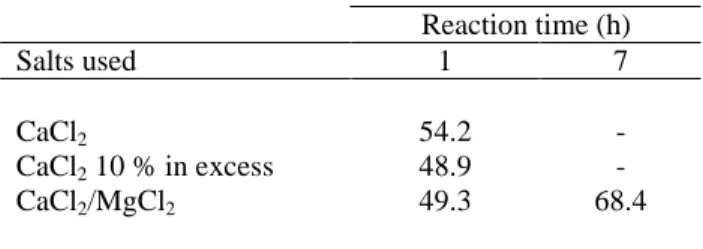
Experiments on molasses were performed at different temperatures, with two reaction times and with different salts. The results (Table 2) indicated a high precipitation rate, about 50% after 1 h with the three kinds of salts evaluated. As the precipitation rates were almost the same, only one experiment was done during 7 h. Then the precipitation rate was slightly increased to 70 % using CaCl2 and MgCl2 salts.
Reaction time (h)
Salts used 1 7
CaCl2 54.2 -
CaCl2 10 % in excess 48.9 -
CaCl2/MgCl2 49.3 68.4
Table 2. Recovery yields of aconitic acid (%) by precipitation from molasses using two reaction times and different chloride salts
Solvent extraction
The partition coefficients were calculated using results obtained on synthetic solutions of 5 g/kg of aconitic acid. The higher this coefficient is the better are the extractions of acids. The volumic percentage ratio TBP:n-dodecane of 60:40 gives the highest partition coefficients. For this reason, experiments on rich and poor acid solutions were done with this solvent mixture.
The rich acid solutions were similar to the molasses while the poor acid solutions were closer to the acid content in the vinasses. The extraction yields were high when pHs of the solutions were acid, close to 2. (Table 3) The extraction was efficient for the acids whatever the feed solution. However, the extraction yields of aconitic acid were the highest in both cases and the process yields reached from 80 % to 90 %.
The natural pHs of molasses and vinasses are respectively 5.5 and 4.5, much higher than 2. In order to define the influence of that parameter on the extraction yield, sodium hydroxide was added to the poor acid solutions to adjust pH to those two values. (Table3) When the pH was higher than the first acidity constant, the recovery yield of acids decreased or was null.
Feed Extraction Regeneration Process
Ys (%) Ys’ (%) Ys’’ (%)
Solution pH AAco ACit AMal AAco ACit AMal AAco
Rich acid 1.6 98.1±0.3 43.8±4.2 29.4±16.2 80.8±7.3 100 100 79.3±7.3
2.2 97.1±0.7 47.3±2.1 44.1±2.3 100 100 100 95.7±6.4
4.5 14.8±6.4 n n 83.0±23.7 n n 9.3±3.3
Poor acid
5.5 5.8±1.7 n n n n n n
Table 3. Yields of extraction and regeneration of aconitic, malic and citric acids, in percent, from two types of synthetic solutions
During the extraction with the molasses a third layer appeared, affecting the settling and sampling. As centrifugation before extraction did not shunt the formation of this third layer, a post-extraction centrifugation was carried out in order to separate the two phases. High extraction yields were obtained only after acidification of the molasses (Table 4). At natural pH, no acids were extracted, while both the malic and aconitic acids were extracted after acidification of the solution at a pH about 2. The process yields obtained on molasses are closer than those of the rich acid solutions (Table 4). The regeneration step is efficient since it allows the removals 100 % of the extracted acids.
Feed Extraction Regeneration Process
Ys (%) Ys’ (%) Ys’’ (%)
Solution pH AAco ACit AMal AAco ACit AMal AAco
5.5 n n n / / / n
Molasse
2.2 74.1±1.3 22.9±6.6 n 100 n n 77.8±6.0
Table 4. Yields of extraction and regeneration of aconitic, malic and citric acid, in percent, from molasses from Le Gol
Ion exchange resins
Experiments were carried out with a strong base anion exchange resin in chloride form. Previous results [10] indicated that the best fixation was obtained with a low anion exchange resin, but Saska and Zapata [11] used a strong cationic resin because it requires acidification of the media.
Extraction Regeneration
Yc (%) Yc’ (%)
Feed Regenerant AAco ACit AMal AAco ACit AMal
[AAco] = 5 g/kg NaOH 1 N 71 / / 63 / / NaCl 1 N 20 / / 80 / / [AAco] = 30 g/kg HCl 1 N 14 / / 84 / / [AAco] = 3 g/kg [ACit] = 0.5 g/kg [AMal]= 0.9 g/kg NaOH 1 N 100 94 51 35 100 62
Table 5. Percentage of carboxylic acids recovered by Amberlite IRA 900 chloride form using different feed solutions and two solutions of sodium hydroxide at 0.1 and 1 N
The capacity of the IRA 900 Cl resin was 100 g of aconitic acid per kg of wet resin. When the resin is saturated, it cannot retain the acid anymore. (Table 5)
The low capacity of the resin was only adapted to the solution with a low concentration. The recovery of the acid from the resin is more efficient under acidic treatment but the alkali treatment is non selective. A poor acid solution was eluted from the column. Fixation yields were efficient for citric and aconitic acids whereas malic acid which reached about 50 %.
CONCLUSIONS
The liquid-liquid extraction is the most efficient method among the three tested for the recovery of carboxylic acids from model solutions or from by-products. However it seems difficult to use this method for extracting the organic acids from the molasses because of the appearance of a third phase. In the case of by-products extraction, the precipitation was the most efficient technology, while the resins were limited by their low capacity and the high viscosity of the effluent. Aconitic acid, the main organic acid compound, was preferably extracted than the other acids in the three used methods. Unfortunately, the purity of the extract is not high because of the co-extraction of components such as colorants or other acids. As a consequence, after extraction a purification step should be performed in order to obtain a pure acid solution.
NOTATIONS
AMal : malic acid Wfiltrate : mass of filtrate in g ACit : citric acid Wprecipitate : mass of precipitate in g AAco : aconitic acid Wprecipitate total : mass of whole precipitate in g Yp : yield of precipitation in % Wmolasse : mass of molasses initially
introduced in g P : purity of precipitate in %
Ys : yield of extraction in solvent extraction method in %
[AAco]initial : aconitic acid concentration in the initial solution in g/kg
Ys’ : yield of regeneration in solvent extraction method in %
[AAco]filtrate : aconitic acid concentration in the filtrate in g./kg
Ys’’ : yield of global extraction in solvent extraction method in %
[AAco]molasse : aconitic acid concentration in the molasse in g./kg
Yc : yield of extraction in
chromatography method in % Yc’ : yield of regeneration in
chromatography method in %
1. Celestine - Myrtil, D.A. and A. Parfait, HPLC determination of organic acids in sugar cane and its industrial by-products. International Sugarcane Journal, 1988. 90: p. 28-32.
2. Regna, E.A. and P.F. Bruins, Recovery of Aconitic Acid from Molasses. Industrial and Engineering chemistry, 1956. 48(8): p. 1268-1277.
3. Joglekar, H.G., et al., Comparative assessment of downstream processing options for lactic acid. Séparation and Purification Technology, 2006. 52: p. 1-17.
4. Inskeep, G.C., G.G. Taylor, and W.C. Breitzke, Lactic Acid from Corn Sugar. Industrial and Engineering Chemistry, 1952. 44(9): p. 1955-1966.
5. Ambler, J.A. and E.J. Roberts, Separation of aconitic acid from molasses. U. S. Patent 2,481,557, 1949: p. 6.
6. Haines, H.W. and L.G. Joyner, Calcium Magnsium Aconitate. Industrial and Engineering Chemistry, 1955. 47(2): p. 178-186.
7. Ventre, E.K., H.C. Henry, and F.L. Gayle, Process for the production of aconitic acid. U. S. Patent 2,345,079, 1944.
8. Azzam, A.M. and M.H. Radwan, Separation of aconitic acid from molasses by solvent extraction. Fette, Seifen, Anstrichmittel, 1986. 88(3): p. 97-9.
9. Malmary, G.H., et al., Measurement of partition coefficients of carboxylic acids between Water and Triisooctylamine dissolved in various diluents. Journal of Chemical and Engineering Data, 1998. 43(5): p. 849-851.
10. Moldes, A.B., J.L. Alonso, and J.C. Parajo, Resin selection and single-step production and recovery of lactic acid from pretreated wood. Appl Biochem Biotechnol, 2001. 95(2): p. 69-81. 11. Saska, M. and N.G. Zapata, Feasibility of recovering aconitic acid from low purity sugarcane