T
T
H
H
È
È
S
S
E
E
En vue de l'obtention du
D
D
O
O
C
C
T
T
O
O
R
R
A
A
T
T
D
D
E
E
L
L
’
’
U
U
N
N
I
I
V
V
E
E
R
R
S
S
I
I
T
T
É
É
D
D
E
E
T
T
O
O
U
U
L
L
O
O
U
U
S
S
E
E
Délivré par l'Institut National Polytechnique de Toulouse
Discipline ou spécialité : Chimie Organométallique et de Coordination
JURY Anna MASDEU Hélène OLIVIER-BOURBIGOU Alain ROUCOUX Jean-Christophe PLAQUEVENT Philippe KALCK Montserrat GOMEZ Philippe SERP
Ecole doctorale : Sciences de la Matière
Unité de recherche : Laboratoire de Chimie de Coordination (LCC); Laboratoire Hétèrochimie
Fondamentale et Appliquée (HFA)
Directeur(s) de Thèse : Philippe SERP-Montserrat GOMEZ
Présentée et soutenue par Laura RODRIGUEZ PEREZ Le 14 décembre 2009
AUTEUR: RODRIGUEZ PEREZ Laura
DIRECTEURS DE THESE: SERP Philippe and GOMEZ Montserrat.
TITRE: «Nouveaux systèmes catalytiques en phase liquide ionique suportée sur nanotubes
de carbone».
RESUME:
Récemment, les liquides ioniques ont attiré l’attention de la communauté scientifique de la catalyse homogène en tant que solvants répondant aux principes de la chimie verte. De par leur nature chargée, ces phases ioniques sont idéales pour des réactions biphasiques avec des substrats organiques et permettent une récupération facile du catalyseur. Leur caractère ionique leur confère une organisation spatiale à l’échelle nanométrique permettant des phénomènes de solvatations particuliers et une réactivité spécifique. Néanmoins, ces solvants continuent à être onéreux et les supporter peut permettre à la fois de réduire de façon significative les quantités utilisées et de récupérer facilement le catalyseur immobilisé dans la phase liquide ionique.
Jusqu’à présent, la catalyse supportée sur liquides ioniques a mis en jeu des supports oxydes mésoporeux classiques comme la silice. Au cours de cette thèse, une étude comparative entre ces types de supports et des nanotubes de carbone multiparois a été réalisée pour différentes réactions catalytiques. Les nanotubes de carbone présentent une macrostructure très ouverte avec une mésoporosité importante. Ainsi, la limitation par transfert de masse dans la porosité du support est diminuée et la cinétique de la réaction, augmentée. Une première étape de fonctionnalisation des nanotubes de carbone a permis d’améliorer la compatibilité avec la phase liquide ionique. L’immobilisation stabilise le catalyseur (complexe métallique [Rh(nbd)(PPh3)2][PF6] ou nanoparticules de palladium) dans
la phase liquide ionique après formation d’un film autour des nanotubes. Les systèmes catalytiques supportés ont été utilisés pour différentes réactions tests : l’hydrogénation, le couplage C-C de Heck et la réaction séquentielle Heck/hydrogénation.
Des composites supports oxydes (SiO2 ou Al2O3)/liquide ionique ont été préparés afin
d’étudier les interactions spécifiques liquide ionique-surface et les comparer avec le liquide ionique pur.
MOTS CLES: Liquide ionique / Nanotubes de carbone / Catalyse en phase liquide ionique
supportée / Complexes / Rhodium / Nanoparticules / Palladium / Hydrogénation / Couplage C-C de Heck / Réactions séquentielles.
AUTHOR: RODRIGUEZ PEREZ Laura
PhD SUPERVISORS: SERP Philippe and GOMEZ Montserrat.
TITLE: «New catalytic systems based on carbon nanotubes supported ionic liquid phase». SUMMARY:
As catalytic support, carbon nanotubes present an open macrostructure with large mesoporosity which avoids mass transfer limitations. Ionic Liquids (ILs) have received much attention in the past years due to their importance in a broad range of applications. In catalysis, they are used to immobilize the catalyst in biphasic reactions and enable an easy separation. Their ionic character confers to these media a special organization of several nanometers that induces solvation phenomena and specific reactivity that can be linked either to confinement effects in the organized structure or to molecular interactions. However, these solvents remain expensive and the fact to support them onto carbon nanotubes as a thin film should permit to reduce significantly the volumes used.
In this PhD thesis in order to prepare carbon nanotubes-IL hybrid materials, multi-walled carbon nanotubes were covalently modified with imidazolium salt-based moieties. This functionalization allowed specific interactions between the IL thin film and the chemical moieties on the MWCNTs surface. Then, the catalyst (rhodium complex or palladium nanoparticles) was immobilized into the IL thin film. The catalytic performances have been evaluated in bench reactions: hydrogenation of 1-hexene for rhodium, and selective hydrogenation, Heck, and sequential Heck/hydrogentation process for palladium. Finally, a comparative study has been performed between carbon nanotubes and other classical mesoporous oxide supports, including silica. The carbon nanotubes based catalyst present better performances than their counterparts prepared on conventional supports.
Additionally, composites based on SiO2/IL or Al2O3/IL were prepared to carry out a
structural study with the aim of understanding their specific surface interactions and compare them to pure ionic liquid.
KEY WORDS: Ionic liquid / Multi-walled carbon nanotubes / Supported ionic liquid
phase catalysis / Complexes / Rhodium / Nanoparticles / Palladium / Hydrogenation / C-C Heck coupling / Sequential reactions.
TABLE OF CONTENTS
GLOSSARY ...9
INTRODUCTION AND OBJECTIVES ...13
1 BIBLIOGRAPHIC INTRODUCTION...17
1.1 Supported ionic liquid phase catalysts: preparation and characterization... 21
1.1.1 Supports involved in SILPC... 22
1.1.2 Ionic Liquids used in supported ionic liquid phase catalysis... 32
1.1.3 Nature of the catalyst involved in SILPC ... 34
1.1.3.1 Immobilized IL as catalyst... 34
1.1.3.2 Metal complexes immobilization... 36
1.1.3.3 Metal nanoparticles... 37
1.2 Supported ionic liquid phase catalysis: Applications... 41
1.2.1 Alkylation reactions ... 41 1.2.2 Hydroformylation reaction ... 42 1.2.3 Hydroamination reactions ... 43 1.2.4 Hydrogenation reactions... 45 1.2.5 Carbonylation reactions... 49 1.2.6 C-C coupling reactions... 49 1.2.6.1 Suzuki-Miyaura cross-coupling ... 49 1.2.6.2 Heck reaction ... 51 1.2.6.3 Aldol condensations... 52 1.2.7 Oxidation reactions... 52 1.2.8 Cyclopropanation reactions ... 54
1.2.9 Phase transfer reactions ... 55
1.2.10 Carbon dioxide fixation reactions... 55
1.2.11 Other reactions... 56
1.3 Structured reactors: monolithes, membranes, fibers, fixed bed ... 58
1.4 Conclusion... 59
2 MULTI-WALLED CARBON NANOTUBES SURFACE MODIFICATION ...71
2.1 Carbon nanotubes: generalities and history ... 71
2.1.1 Structure of carbon nanotubes ... 71
2.1.1.1 Single-walled carbon nanotubes ... 72
2.1.2 Synthesis of CNTs... 74
2.1.2.1 Arc discharge ... 74
2.1.2.2 Laser ablation... 74
2.1.2.3 Chemical vapour deposition (CVD) ... 74
2.1.3 Properties... 75
2.1.3.1 Physical properties... 75
2.1.3.2 Chemical properties ... 77
2.1.4 Potential and current applications... 80
2.2 Results and discussion... 81
2.2.1 Surface activation of multi-walled carbon nanotubes... 82
2.2.1.1 Synthesis ... 82
2.2.1.2 Characterization ... 82
2.2.2 Surface functionalization of multi-walled carbon nanotubes ... 84
2.2.2.1 Covalent approach ... 84
2.2.2.1.1 Synthesis... 84
2.2.2.1.2 Characterization... 86
2.2.2.2 Ionic approach... 89
3 SUPPORTED IONIC LIQUID CATALYTIC PHASE: PREPARATION AND CHARACTERIZATION ...99
3.1 Immobilization of a homogeneous catalysts... 99
3.2 Immobilization of heterogeneous catalysts ... 101
3.2.1 Palladium nanoparticles: generalities and history ... 101
3.2.1.1 Synthesis, stabilization and applications... 102
3.2.2 Metal nanoparticles synthesized in ionic liquid medium... 103
3.2.2.1 Synthesis of Pd nanoparticles ... 104
3.2.2.2 Nanoparticles from Pd(II) precursor ... 104
3.2.2.3 Nanoparticles from Pd(0) precursor... 105
3.2.3 Synthesis of heterogeneous supported ionic liquid phase catalyst ... 108
3.3 Characterization of supported IL composites ... 112
3.4 Structural study of the interactions between the support and the ionic liquid... 116
3.4.1 DSC analysis ... 117
3.4.2 XRD analysis... 118
3.4.3 NMR analysis... 120
3.4.4 Ionic Liquid surface mediated distillation ... 126
4 SUPPORTED IONIC LIQUID PHASE: APPLICATIONS IN CATALYSIS ...135
4.2 Heterogeneous supported ionic liquid phase catalysis: applications in Heck C-C coupling and
selective hydrogenation... 142
4.2.1 Hydrogenation reactions... 145
4.2.1.1 Results and discussion ... 145
4.2.2 C-C cross coupling reactions... 150
4.2.2.1 Introduction... 150
4.2.2.2 General remarks... 150
4.2.2.2.1 C-C cross-coupling reactions in ionic liquids and in supported catalytic liquid phase. 153 4.2.2.3 Results and discussion ... 154
4.2.3 Sequential reactions... 156
4.2.3.1 Results and discussion ... 157
5 EXPERIMENTAL SECTION...167
5.1 General aspects... 167
5.2 Characterization techniques... 168
5.2.1 Nuclear magnetic resonance spectroscopy ... 168
5.2.2 Infrared spectroscopy ... 168
5.2.3 Mass spectrometry... 168
5.2.4 Elemental analysis... 169
5.2.5 Differential scanning calorimetry... 169
5.2.6 Thermogravimetric analysis ... 169
5.2.7 X-ray diffraction... 169
5.2.8 Transmission electron microscopy ... 169
5.2.9 Gas chromatography... 170
5.2.10 X-ray Photoelectron Spectroscopy ... 170
5.2.11 Raman spectroscopy ... 171
5.2.12 Porosimetry and specific surface area ... 171
5.2.13 Thermal programme desorption... 171
5.3 Multi-walled carbon nanotubes functionalization... 171
5.3.1 MWCNTs purification... 171
5.3.2 MWCNTs activation ... 171
5.3.3 Ionic functionalization of the MWCNTs surface: CNT2-CNT9 ... 172
5.3.3.1 Covalent approach (CNT2-CNT8)... 172
5.3.3.2 Ionic approach... 174
5.4 Synthesis of metallic nanoparticles in ionic liquid... 174
5.5 Syntesis of supported ionic liquid phase... 174
5.5.1 Immobilization of [Rh(nbd)(PPh3)2]PF6 over a SILPC ... 175
5.6 Distillation procedures... 176
5.7 Catalytic procedures ... 176
5.7.1 General procedure for hydrogenation reaction using the complex [Rh(nbd)(PPh3)2]PF6 as catalytic precursor ... 177
5.7.2 General procedure for hydrogenation reaction using preformed nanoparticles as SILPC... 177
5.7.3 General procedure for Heck coupling reaction using preformed nanoparticles as SILPC ... 178
5.7.4 General procedure for catalytic sequential Heck/hydrogenation procedure using preformed nanoparticles as SILPC... 178
6 CONCLUSIONS ...183
7 RÉSUMÉ ...187
7.1 Introduction et objectifs... 189
7.2 Modification de la surface des nanotubes de carbone multi-parois... 192
7.2.1 Discussion des résultats... 194
7.3 Catalyseur en phase liquide ionique supportée : Preparation et caracterisation ... 198
7.3.1 Immobilisation d’un catalyseur homogène... 198
7.3.2 Immobilisation d’un catalyseur hétérogène... 199
7.3.3 Caractérisation des composites liquide ionique supportée ... 204
7.3.4 Etude structurale des interactions entre le support et le liquide ionique... 206
7.4 Phase liquide ionique supportée : Application en catalyse ... 207
GLOSSARY
AA Acetic acid
Acac Acetilacetonate
AC Active Carbon
ACC Active Carbon Clothe
AIBN Azobisisobutyronitrile
Am Maleic anhydride
ATG Thermogravimetrical analysis
BET Physical adsorption isotherm
BINAP 2,2'-bis(diphenylphosphino)-1,1'-binaphthyl
Bmim Butyl methyl imidazolium
CNFs Carbon nanoFibers
CNT Carbon nanotubes
Cod Cyclooctadinen
Cot Cyclooctatriene
CP/MAS NMR Cross polarization of nuclear magnetic resonance
CVD Chemical vapour deposition
Dba Dibenzylidene cetone
Dppf 1,1’-bis-(diphenylphosphino)-ferrocene
DP/MAS NMR Direct polarization of nuclear magnetic resonance
DSC Differential scanning calorimetry
EDX Energy dispersive X-ray spectroscopy
ee Enantiomeric excess
Emim 1-ethyl-3-methylimidazolium
FFT Fast fourier transform
GC Gas chromatography
GPa Giga pascal
Hmim 1-n-hexyl-3-methylimidazolium
HREM High resolution transition electron microscopy
IS Ion spray
ICP Inductively coupled plasma
ILs Ionic liquids
IR Infrared
MWCNTs Multi walled carbon nanotubes
Nbd Norbornadiene
NDEAP Diethylaminopropylated alumina
NHC NHC=N-heterocyclic carbine
NMP N-methylpyrrolidone
NMR Nuclear magnetic resonance
NPs Metallic nanoparticles
PdNPs Palladium metallic nanoparticles
PEG Poly(ethyleneglycol)
PGE Phenyl glycidyl ether
PS-DVB Polystyrene–divinylbenzene
Psmim Polystyrene-methylimidazolium
salen N,N'-bis(salicylaldehyde)-ethylenediimine
SAP Supported aqueous phase.
SAPC Supported aqueous phase catalysis
SAXS Small angle X-ray scattering
sc Supercritical
SEM Scaning electron microscope
SILCP Supported ionic liquid catalytic phase
SILP Supported ionic liquid phase
SLPC Supported liquid phase catalyst
SMF Sinthetic metal fibers
SWCNTs Single walled carbon nanotues
TEM Transition electron microscope
(TESP)mim N-3-(-3-triethoxysilylepropyl)-3methyl imidazolium
TFA Trifluoroacetic acid
TGA Thermogravimetry analysis
TGA-DSC Thermogravimetric analysis-differential scanning calorimetry
THF Tetrahydrofurane
TMGL 1,1,3,3-tetramethylguanidinium lactate
TOF Turnover frecuencies
TPD Temperature programme desorption
VOCs Volatile organic compounds
XPS X-ray photoelectron spectroscopy
INTRODUCTION AND OBJECTIVES
The research of low cost and environmentally benign catalytic systems has become one of the main subjects of modern synthetic chemistry. In this context, developments of highly active and selective catalysts are of prime importance. Heterogeneous catalysis is preferred in industrial processes compared to homogeneous catalysis because the extraction of the product and recoveries of the catalyst are relatively easier using heterogeneous systems. However, in various examples of heterogeneous catalysis, mass or heat transfer limitations in the solid catalyst may lead to an activity decrease and lower chemo- and stereo-selectivities in relation to homogeneous catalysis. Therefore, a catalytic system, which takes the advantages of both homogeneous and heterogeneous catalysis (i.e. good activity, high selectivity, easy extraction of the product and recovery of the catalyst) would greatly enhance the interest for catalytic industrial applications.
In this context, the concept of supported ionic liquid phase catalysis (SILPC) has gained much attention. The grafting of imidazolium onto a solid surface not only favours the heterogenization of expensive ionic liquids (ILs), but also offers a lot of opportunities to investigate immobilizations of homogeneous metal complexes or metal nanoparticles. Moreover, functionalized ILs recycling by this method is also possible. On the other hand, carbon nanotubes (CNTs) as catalytic support present a very open macrostructure with large mesoporosity, avoiding mass transfer limitations in catalytic reactions; thus, the use of carbon nanotubes should offer significant advantages to the supported ionic liquid phase catalysis (SILPC). Moreover, a surface functionalization should allow specific interactions between the ionic liquid film and chemical moieties covalently anchored on the nanotubes surface.
In the past two decades, metal nanoparticles have triggered an enormous interest in catalysis due to their frontier behaviour between classical homogeneous and heterogeneous catalysts. Consequently, they can lead to new reactivity trends obtaining target compounds for medical, pharmaceutical or agrochemical purposes. In spite of promising results, from a synthesis point of view, the use of solid catalysts is still preferred because of the inherent convenience for work-up procedure. In this respect, a new strategy has been developed, that is, the preparation of solid-supported metal nanoparticles using ILs. In this case, the IL acting as a stabilizer, also plays a crucial role for the catalyst immobilization.
The combination of an ionic liquid with a solid support is applied for chromatography, supported liquid membranes and for some electrochemical applications, in addition to the SILP catalysis. The physico-chemical characteristics of the corresponding composites depend on the support-ionic liquid interactions.
In this context, the objectives of this PhD thesis could be summarized as followed:
The effective functionalization and characterization of multi-walled carbon nanotubes (MWCNTs) containing ionic moieties, and the study of their affinity for the ionic liquid medium.
A structural study of the interactions between support and ionic liquid, including a full multi-nuclear NMR study at solid state.
The synthesis and characterization of palladium nanoparticles starting from different metallic precursors, with or without the presence of a stabilizing ligand in different ionic liquids.
The synthesis and characterization of supported ionic liquid phase catalysts based on functionalized MWCNTs using a Rh complex or metallic nanoparticles as catalytic active phase.
The application of the supported ionic liquid phase catalyst in hydrogenation reactions with Rh as catalytic active phase, studying: the influence of the nature of the support, the efficiency of MWCNTs functionalization, the optimization of the ionic liquid film thickness and the recycling of the system.
The application of SILPC with palladium nanoparticles in selective hydrogenantion, Heck C-C coupling and Heck coupling/hydrogenation sequential process, studying: the palladium precursor influence, the influence of the ligand, the influence of the different ionic liquids involved and the support on the nanoparticles catalytic behaviour.
CHAPTER I
1
BIBLIOGRAPHIC INTRODUCTION
In the last fifteen years, ionic liquids (ILs) have gained a wide popularity from the scientific community as innovative and environmentally friendly reaction medium.1,2 From a chemical point of view, they are constituted of organic cations and inorganic or organic anions. For applications as solvent, the most interesting ILs are those showing low melting points, typically below room temperature, and high thermal stability.3 The melting point for a
given anion-cation combination remains difficult to rationalize. However, some trends seem to emerge. Therefore, the charge delocalization over several atoms and the low symmetry showed by the cation and / or anion favour the formation of salts exhibiting low melting points.4 Nowadays, the 1,3-disubstituted imidazolium, pyridinium, pyrrolidinium, ammonium
and phosphonium moieties are the most frequently encountered type of cation. The most common anions are [PF6]−, [BF4]−, [CF3SO3]−, and [(CF3SO2)2N]− (Scheme 1.1).
N N R1 R2 N R1 N R1 R4 R3 R2 P R1 R3 R4 R2 ANIONS: Cl-, Br-, PF 6-, BF4-, CF3SO3-, SbF6-, (CF3SO2)2N-, CH3SO3-, OTs-, NO3-, CH3CO2-, CH2(OH)CO2-, R2 N R1 R2 R1,R2= alkyl R3 R3= H, alkyl R1= alkyl R2= H, alkyl
R1,R2,R3,R4= alkyl R1,R2= alkyl R1,R2,R3,R4= alkyl
CATIONS
Imidazolium Pyridinium Ammonium Pyrrolidinium Phosphonium
Scheme 1.1: Typical cations and anions used in ILs
These molten salts have peculiar physical properties4 such as:
Low vapour pressure. ILs could be a good and green alternative to organic solvents avoiding the emission of volatile organic compounds (VOCs) in the atmosphere.
Tunable polarities. They have the capacity to dissolved metal catalysts (salts or complexes), organic compounds, as well as gases and enzymes. Moreover, they are immiscible with many organic solvents which lead to biphasic systems.
Thermal stability. The melting point of common ILs is below room temperature, and the decomposition temperatures are generally found at more than 250°C, offering the possibility to use them in a large variety of chemical reactions.
Wide electrochemical window is shown by ammonium or phosphonium ionic liquids.
Electrical conductivity and ionic stability. These properties were firstly explored for electrochemical applications and in electronic adsorption spectroscopy.
Low toxicity for human health was reported. However the biodegradability and aquatic toxicity needs to be improved.
These properties make ILs good solvents for organic and inorganic synthesis1,5,6 and particularly for catalysis applications.2,7,4
Concerning the inorganic synthesis the apparition of ILs has opened new lines of investigation. The reaction medium for the production of inorganic materials is usually organic solvents, aqueous systems, or gas phase.8 The introduction of ILs in those processes
opened the way to produce new materials with different properties and structures. ILs act not only as template for the structures but they also stabilized them.9
For homogeneous metal-catalyzed organic processes, the separation of the products from the reaction mixture and the recovery of the catalyst constitute an important issue. Moreover, environmental constraints have become more stringent and require new solvent and processes.10 In this context, ILs appear as a green alternative to the classical homogeneous catalysis. They are used in biphasic processes as reaction solvent, or immobilizing phase on a support for transition metal catalysts or as organic catalyst.11
As solvents for catalytic reactions ionic liquids have been widely used due to their polar properties. They can interact with the solute via dipolar interactions and dispersion forces and act as strong hydrogen bond bases. Not surprisingly, ILs can have presents π-π interactions with aromatic compounds.7 The solubility of reactive gases such as H
2, CO and O2 in ILs,
important in many catalyzed reactions, depends mainly on the ILs anion. It follows the trend: CO2>>>C2H4≈CH4>O2>CO>H2.12,13
Taking into account their structures, ILs can be considered as polymeric superstructures stabilized by hydrogen bonds between the cations and the anions as illustrated by X-ray diffraction (XRD) structures studies.14 Therefore they can induce particular reactivity, for example in enantioselective catalysis.15 In the literature, a great number of examples using ILs
as catalytic solvent can be found.4 The right choice of the catalyst and appropriate ionic liquid
The immobilization of the catalyst in ILs is a useful strategy for recycling. Catalysts, especially cationic catalysts, remain in the ionic liquid phase upon product separation.16 Ionic
liquids can also act as nanoparticles stabilizers. Even though the stabilization mechanism has not been proved, ILs seems to create an electrostatic and steric barrier between the nanoparticles,17 a stabilization type DLVO (Derjaugin-Landau-Verwey-Overbeek) has been
proposed due to their polymeric structure.18 This suggestion has been corroborated by a
number of analysis of these systems, HREM (High Resolution transition Electron Microscopy) showing IL-metal surface interactions,19,20 SAXS (Small Angle X-ray
Scattering) indicating a protective layer of ionic cells around Pt and Ir nanoparticles19,21 and
XPS (X-ray Photoelectron Spectroscopy) detecting fluor, carbon and oxygen at the surface of clusters stabilized by [bmim][BF4] and [bmim][PF6] (bmim: 1-n-Butyl 3-Methylimidazolium
cation).19,21,22
In many processes carried out in ionic liquids, these molten salts can be used simultaneously as catalyst and solvent. Chloroaluminate (III) ionic liquids allow from moderate to high yields for electrophilic substitutions and condensation reactions.23 The adjustable nature of the Lewis acidity for those systems made them very attractive.24 Unfortunately, this concept suffers many disadvantages such as their sensitivity towards H2O
and O2 and the difficulty to separate them from product containing heteroatoms.7 Recent
developments in organocatalysis have shown that some reactions can be advantageously performed in ILs through hydrogen bonding interactions, particularly Diels–Alder cyclo-additions and their derivatives.25
However, ILs present different drawbacks when applied in catalysis as reaction medium.
For example, when different batches of ILs are used, the reaction yield and selectivity can vary due to the presence of impurities such as halides, and organic compounds of low volatility.26 The halides contamination has been overcome with
the uses of “halide free” synthesis methods of ionic liquids.27
Although ILs are usually regarded as “green solvents” it is not yet absolutely clear as many toxicological studies are still debatable.28 The lack of data about
biodegradability and potential toxicity of waste ILs at the end of their life cycle is a potential problem for their application.29
The use of large ILs amounts when it is used as solvent. From economical standpoint, even if being commercially available today, they remain expensive products.
Very pure ILs are needed to minimize the effects of impurities, and this induces heavy purification processes.30
The use of immiscible organic solvents for catalysts separation and recycling can solubilise little amounts of the ILs and the catalyst and reduce the recycling yields.
Relatively high viscosity. The reaction that proceeds in the inter-phase or in the diffusion layer of the catalyst can be slowed down due to slow diffusion of the substrates.
The prospect to design ionic liquids (“Task ionic liquids”),31 by introducing functional groups to confer specific chemical properties may be the solution to overcome the limits of ionic liquids in catalysis. The imidazolium cation unit is largely used to introduce functional groups such as alcohols,32 carboxylic acids,33 thiols,34 alkynes,35 alkenes,36 dienes,37 fluorous
chains38 and chiral moieties.39 Some examples of different task ionic liquids cations and
anions are shown in Scheme 1.2. Less developed than functionalized cations, some functionalized anions are also shown in Scheme 1.2. The presence of a functional group may improve the catalytic reaction in all, or in one of the following aspects: favouring the activation of the catalyst, generating new catalytic species, increasing the catalyst stability and optimizing the immobilization and thus the recyclability. The task IL should stay inert with respect to the reaction medium. However, these ionic liquids exhibit higher viscosity than that shown by the non functionalized analogs. The viscosity can be reduced using asymmetrical functionalized anions in combination with the functionalized cations.40 In this context one might control the chemical properties of an IL for a specific task but also adapt its physical properties.
Scheme 1.2: Different task ionic liquids cations and anions
In order to reduce the amounts of solvent used, an efficient strategy consists in supporting the ILs over different solids, leading to supported ionic liquid phases (SILP). This approach
materials as membranes for separation processes.43 A large variety of supports has been used
for these applications. In the catalysis field this concept has been applied also as supported ionic liquid phase catalysis (SILPC). The possibility to immobilize few amounts of ILs on the surface of a support material for catalysis applications has gained much attention in recent years.44,45 This concept seems to unify the advantages of both homogenous and heterogeneous
catalysis. Coating ionic liquid onto a solid surface not only minimized the quantity of ILs used, but also offers a new concept of immobilization of organometallic complexes and metal nanoparticles on a solid surface. The prepared materials present the advantage of being a solid that facilitates the catalyst separation from the reaction mixtures.
1.1 SUPPORTED IONIC LIQUID PHASE CATALYSTS: PREPARATION AND CHARACTERIZATION
In the eighties, Scholten46 and Hjortkjaer47 describe the immobilization of a catalytic
organic solution on a silica based solid catalyst, giving high efficiency and selectivity. But the concept became popular in 1989 when Davis and co-workers published a study in which a water soluble rhodium catalyst was immobilized on a thin film of water supported over a porous silica support (supported aqueous phase catalysis, SAPC).48 Organic compounds are
found in the organic phase and the reaction takes place in the water-organic inter-phase. The large interfacial area of the SAP catalyst and the fact that the catalyst remains on the support, leads to a highly efficient catalyst for organic transformation. The supported aqueous phase catalysis allows the heterogenization of homogeneous systems. But the supported liquid phase catalysis using organic solvents or water has not been applied with success in an industrial process. The main reason is the severe leaching of the immobilized liquid film. The mechanical forces of the continuous flow can physically remove the catalytic phase. In continuous gas-phase processes, evaporation of the liquid film from the support represents also an important drawback. Those disadvantages lead to short lifetime’s catalysts. In this context, SILP catalyst can offers great advantages due to their low vapour pressure and tuneable polarities. Moreover the solvent can be retained on the support in its fluid state even at high temperatures. That makes SILP catalyst highly suitable for continuous process. The ionic liquid phase can be fixed by chemical bond between either the cation or the anion of the ionic liquid and the support, or by physisorption of the ionic liquid on the support. SILPC has been studied over a large variety of solid supports mainly oxide supports using different ionic liquids which can immobilize organometallic complexes or metal nanoparticles as catalytic
precursors. In the next section, the characterization and preparation of SILP catalysts are described, focusing on the support, the ionic liquid and the catalyst nature.
Solid support material
+ -+ + + + + + + + + + - - ++ - + + + -- - -- -- + - - ++ - + + - + + - ++ - ++ - ++ - ++ -Ionic liquid layer + + -M M M M M M M Organic Phase Reactant Product
Figure 1.1: SILPC concept
1.1.1 Supports involved in SILPC
The main supports used in SILPC are inorganic oxides, particularly silica, which has been widely studied, but also carbon based supports and organic supports such as polymers and biopolymers.
Since the apparition of SILPC, mesoporous silica gel has emerged as the most common support used. Its mesoporosity, large surface area and concentration of -OH groups on the surface as well as its low cost make silica gel the more suitable support for SILPC. Other oxide supports have been used such as MgO,49 Al
2O3,50 TiO251 and ZrO251. Active carbon,52
molecular sieves,53 natural clays54 and organic supports55 have been also employed.
The first supported Lewis acid ionic liquid system was prepared by impregnation on a solid support surface.56,57 The previously dried support was treated with the minimal quantity of chloroaluminate ionic liquid (1-alkyl-3-methyl-imidazolium chloride/AlCl3), giving a wet
powder. The excess of ionic liquid was removed via Soxhlet extraction. The supports studied for this chloroaluminated catalyst were principally inorganic oxides. Mesoporous silica, acid treated montmorillonite and acid alumina were effective supports in contrast to non porous or microporous silica and neutral alumina. The treatment of these porous supports with AlCl3
has confirmed a covalent bond between the surface and the ionic liquid.58 The behaviour of
the immobilized chloroaluminates depends on the nature of the surface. De Castro et al.51
reported the disappearance of the band at ca. 3745 cm-1, assigned to the stretching vibration of
the OH bond of terminal Si-OH when the chloroaluminate ionic liquid was anchored to the surface, by FT-IR analysis of SiO FK700 self supported wafer. The re-apparition of this band
when removing the ILs by heat treatment at 450 °C suggests a covalent bond by the OH terminal groups with the ILs anion. A study of29Si and27Al NMR has confirmed the nature of
the bonding.59 The signals assigned to (SiO)2Si(OH)2 (Q2) and (SiO)3Si–OH (Q3) groups on 29Si NMR spectrum diminished in intensity after immobilization of the ionic liquid. Similar
NMR analysis performed with 27Al NMR showed that almost nothing of the Al
2Cl7− which
are typical for the pure ILs, remained on the surface. Supports with lower surface area such as TiO2 and ZrO2, lead to a severe leaching during the catalytic reaction resulting in low
activities due to the low amount of OH groups on the surface. Moreover, X-ray diffraction analysis shows for crystalline compounds like zeolites or bidimensional silica (MCM-41) materials, a partial destruction of the surface upon reaction with chloroaluminates. The formation of hydrogen chloride during the impregnation of the chloroaluminated ionic liquids anchored via the anion is the responsible of these damages (Scheme 1.3).
Scheme 1.3: Immobilization of an ILs on silica via the anion
The immobilization via the cation (Scheme 1.4) has been proposed to prevent the formation of HCl. Therefore, an organic anchoring group, as an imidazolium salt, was grafted on the surface and aluminium chloride was added to form the ionic complexes. NMR studies showed a strong interaction between the cation and the surface via one or two Si–O–Si bonds. This cation immobilization does not modify the crystalline structure of the silica MCM-41 support, as evidenced by X-ray diffraction analysis.59
Scheme 1.4: Immobilization of an ILs on MCM-41 via the cation.
The formation of solid SILP catalyst by sol-gel synthesis is another approach of immobilization via the cation. The result was a solid containing 1-propyl-3-methylimidazolium chloride groups bonded to the surface silicon atoms (TEOS) from which a hexagonal mesoporous silica can be prepared (Scheme 1.5). The functionalized solid was obtained from 1-(triethoxysilylpropyl)-3-methylimidazolium chloride added to a mixture of tetraethylorthosilicate and dodecylamin. In a second step, the addition of the metal halide (AlCl3) gave the functionalized solid (Scheme 1.5).60 In another study, a choline hydroxide
(ionic liquid = 2-hydroxyethyl)trimethylimidazolium hydroxide) was impregnated on magnesium oxide and used for aldol condensations.61
Scheme 1.5: Immobilization via the cation by a sol-gel technique.
Recently, Joni et al. reported the important leaching observed in isomerization reactions when a chloroaluminate ionic liquid is anchored to the surface via impregnation.62 This
leaching is due to the high ionic liquid loading to obtain an acidic catalyst. They indeed reported a critical loading value of ionic liquid, necessary to observe any reactivity. They emphasized the idea of neutralization of the acid catalyst with the basic groups of the silica surface. In order to obtain an acidic catalyst without leaching, the silica support was calcinated. The chemically modified support was inactive in isomerization reactions and ready for acidic ionic liquid immobilization. TPD (temperature program desorption) of ammonia showed the disappearance of the peak related to the OH groups desorption and the appearance of another peak at high temperature indicating the acidity of the surface. Only slight leaching was observed during the reaction.
Mehnert and co-workers have reported the first example of a non acidic ionic liquid containing a rhodium-based homogeneous catalyst confined onto a heterogeneous silica gel
give 1-butyl-3-(3-triethoxysilylpropyl)-4,5-dihydroimidazolium chloride (Scheme 1.6). The anion exchange was further performed using sodium tetrafluoroborate or hexafluorophosphate salts. In the immobilization step, a condensation reaction between pre-treated silica gel and the compound described above was carried out in a chloroform solution at reflux. Analysis of the surface coverage revealed ca. 0.4 ionic liquid fragments per nm2, which corresponds to
approximately 35 % of all the hydroxyl groups. Additional ILs, 1-butyl-3-methylimidazolium hexafluorophosphate ([bmim][PF6]) or 1-butyl-3-methylimidazolium tetrafluoroborate
([bmim][BF4]) containing the rhodium complexe, was added to form the SILP catalyst. Those
catalysts were used in hydroformylation and hydrogenation reactions of olefins and revealed a severe leaching when the ionic liquid concentration on the surface was over 50 %.
Scheme 1.6: Immobilization approach used by Mehnert and co-workers.63,64
Riisager, Fehrmann and co-workers have prepared supported ionic liquid phase catalysts by impregnation of silica gel for hydroformylation purposes in a continuous fixed bed reactor.65 [Rh(acac)(CO)
2], the appropriated ligand and the IL ([bmim][PF6] or
[bmim][n-C8H17OSO3]) were dissolved in dry methanol. A controlled amount of silica gel
was added resulting in a Rh loading of 0.2 % wt. In the literature, many examples of synthesis by impregnation via electrostatic interaction with a non acidic ionic liquid on either silica gel or aluminosilicate support (Al/MCM-41, Si/Al = 13) are described.66,67
The crystalline silica MCM-41 has been reported as a suitable support for hydroformylation reactions with non acidic ionic liquids and Rh-3,3′,3′′-phosphinidynetris(benzenesulfonic acid) trisodium salt, P(m-C6H4SO3Na)3,
(Rh-TPPTS) catalyst.68 The ionic liquid was physisorbed on the surface by simple wet
impregnation with dry methanol. Structural characterization of those Rh-SILP catalytic systems with TMGL (1,1,3,3-tetramethylguanidinium lactate) as ionic liquid have been reviewed.69 XRD studies for different amounts of ionic liquid showed no structural changes of
the MCM-41 support, the overall mesoporous hexagonal structure being maintained until 25 % wt ionic liquid loading. Nitrogen adsorption/desorption isotherms corroborated XRD results. No significant changes were observed before and after heat treatment of the supported
catalysts in toluene at 25 °C for 100 h. The lost of both pore volume and pore diameter increases with the amount of ionic liquid. The ionic liquid is dispersed in the inner walls of the mesoporous surface. SEM (Scanning Electron Microscope) images for materials up to 15 % wt ionic liquid present a smooth surface and HRTEM micrographs did no reveal remarkable differences between MCM-41 and the Rh-SILP catalyst, observing for both solids regular hexagonal arrays due to the ordered mesoporous material. These data reveal a high dispersion of the ionic liquid on the surface without modification of the solid support. Moreover, TGA-DSC (Thermogravimetric Analysis-Differential Scanning Calorimetry) for free TMGL and Rh-SILP catalyst samples showed the same temperature (227 °C) indicating no chemical transformation neither in the MCM-41 nor in the TMGL ionic liquid. Other crystalline silica supports as MCM-48 (mesoporous silica with three-dimensional channels) and SBA-15 (mesoporous silica with bi-dimensional hexagonal channels) were also recently used for SILPC.70 Good enantiomeric excess were obtained (up to 78 % ee) for the
acetophenone hydrogenation using ILs/MCM-48, in comparison with IL/MCM-41 (ee = 71 %) and for IL/SBA-15 (ee = 72 %). This fact might be attributed to the confinement effect of the three-dimensional channel of MCM-48 and the easy blockage of the one-dimensional channel of MCM-41 and SBA-15, which increases the diffusion resistance of the reactant to the active species in the channels.
A new concept to synthesize silica gel-immobilized ionic liquids was reported by Deng et al.71 This approach consists in physically confining an ionic liquid as [Rmim][X] (R = ethyl, butyl, decyl, cetyl; X = BF4, PF6) in the nanocavities of a silica gel by sol-gel methodology.
The cavities act as a nanoscale reactor in which the ionic liquid behaves as catalyst or solvent. The small size of the cavities prevents the ILs leaching specially for big molecular size ionic liquids, but they are big enough to prevent mass transfer limitations. Abnormal FT-Raman spectra were observed for this silica-gel-confined ionic liquid catalysts compared to bulky ionic liquids.72 This behaviour was confirmed by FT-IR spectroscopy and attributed to the
nano-effect (or restriction effect), as the abnormal bands on FT-Raman and FT-IR could be regulated by the particle-size of the ionic liquid (or the pore-size of the silica gel).73
Microporous active carbons cloth (ACC) has been also used as support. Several ionic liquids containing a transition metal salt were dissolved in acetone. A pre-dried commercial active carbon cloth (1500 m2g-1) was impregnated with the solution by capillarity. The
acetone was removed in an oven at 105 °C.52 The structure of the applied transition
metal/ACC catalyst is comparable to the SCILL (solid catalyst with ionic liquid layer) system where the solid is a real heterogeneous catalyst.74
Recently, other carbon supports such as carbon/metal hybrid fibers have been trapped the researches interest for their application in SILPC.75 Sintered metal fibers (SMF) show a
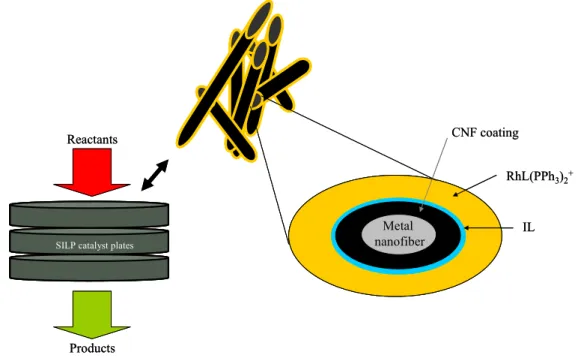
porosity degree up to 80–90 % with a high permeability. Their high mechanical strength, chemical and thermal stability, high conductivity and high specific surface make them suitable as supports. But, to improve the homogeneity of the ionic liquid layer on these supports, SMF were coated with carbon nano-fibbers (CNFs) and characterized by SEM. The deposition method consists in the direct growth of CNFs on the SMF by decomposition of ethane in the presence of hydrogen.76 SILP catalyst was prepared by simple impregnation
with a solution containing the ionic liquid and the rhodium homogenous catalyst in acetone (Figure 1.2). Those supports ensure the efficient use of the transition metal catalyst due to the high interface area. Moreover, their thermal conductivity avoids hot spots during exothermic hydrogenation reactions. RhL(PPh3)2+ Metal nanofiber CNF coating IL Reactants Products
SILP catalyst plates
RhL(PPh3)2+ Metal nanofiber CNF coating IL Reactants Products
SILP catalyst plates
Figure 1.2: SILP catalyst combining ILs, CNFs and SMF.75,76
Breitenlechner et al. used a diatomic earth (powder composed of the siliceous skeletons of diatoms, supplied by resteck: Chromosorb P, acid washed, silylated with Me2SiCl2) to the
SILP catalysis with a homogenous catalyst immobilized in [emim][OTf] (1-ethyl-3-methylimidazolium trifluoromethanesulfonate) for hydroamination reactions.77 The diatomic earth was added to a complex solution and stirred for 5 minutes. Fast cooling followed by cold drying ensures a homogenous thin layer of ionic liquid. Diatomic earth particles from 180 to 250 µm with pores of 1 µm could be observed by SEM. An ionic liquid film of 20 nm was also observed. Mercury porosimetry studies showed a decrease on inter and intra particle pore volume and a specific surface area reduction of 66 % was observed. 1H MAS NMR
studies suggest a strong interaction between the surface and the N-C (methyl of the ethyl group) due to the lost of its free rotation.
Clays such as laponite, bentonite and K10 montmorillonite, have been also studied.54
Laponite clay shows a lamellar structure with negative charges in the layers that can form ion pairs with ionic liquids. The free-flow powder solid is obtained by mixing the starting materials in dichloromethane, followed by drying under vacuum. The thickness of the ionic liquid film was estimated taking into account the lamellar nature of the laponite support and the measured surface area (370 m2g-1) between 1.8 Å to 10.8 Å for different amounts of ILs.
X-ray diffraction patterns of the laponite and the supported-IL film with different loading of ILs show that a part of the lamellar surface becomes accessible. It is believed that negative charges of the accessible support layers can modulate the selectivity of the catalytic process. This modulation is also due to the low mobility of the catalytic complex (prepared from CuCl, a chiral ligand and the 1-butyl-3-methylimidazolium hexafluorophosphate ionic liquid) in the thin film of ionic liquid. The authors refer to nearly two-dimensional nano-reactor behaviour with low yields but inversion of the overall selectivity reaction compared to the analogous homogeneous system.
Attapulgite, (H2O)4(Mg,Al,Fe)5(OH)2Si8O20)∙4H2O, formed by two bands of tetrahedral
silica units connected by a continuous plane of tetrahedral basal oxygen atoms, has a dented surface leading to high surface area, moderate exchange capacity and high acidity. Attapulgite can absorb ionic liquid like TMGL to form a SILP catalyst. IR bands show the effective absorption of IL by the apparition of four peaks at 1618 cm-1 attributed to the stretching of C=N and at 1587, 1650 and 1577 cm-1, corresponding to -NH and -NH2 indicating the
presence of ILs. The stretching of C=N shifted to higher frequencies points to the direct coordination between the N of TMGL+ and the Mg2+ ions in the support. N
2 sorption analysis
shows a decrease of the surface area from 181 m2/g in purified Atta to 164 m2/g for
Attapulgite-ILs.78
Even though inorganic materials are commonly used as support for SILPC, there are also some examples in the literature of organic materials. A polymer supported ionic liquid material [hmim][X] (hmim = 1-n-hexyl-3-methylimidazolium cation; X = BF4, OTf) was
prepared by the procedure depicted in Scheme 1.7. Its physical and chemical properties depend on the length and type of linker.79
Scheme 1.7: Synthesis of polymer supported ionic liquid ([hmim][X])
Polystyrene-methylimidazolium [Psmim][X] (X = BF4, PF6), a polymer supported ionic
liquid, was prepared by mixing the polymer and the ionic liquid (Figure 1.3).80 A similar
synthesis was previously described between poly(diallyldimethylammonium chloride) and [bmim][PF6].81
Figure 1.3: [Psmim][X], X = BF4-, PF6
-[PEGmim][Cl] was synthesized by anchoring the ionic liquid cation fragment to the polymer poly(ethyleneglycol) (PEG) (Scheme 1.8).82
Scheme 1.8: Synthesis of [PEGmim][Cl]
Biopolymers and polysaccharides as chitosan (biopolymer derived from the shell of crustaceans) were also used as ionic liquid support. Chitosan has already been used in SAP,
because of its high sorption capacity and stabilization of metal anions (such as those coming from Pt and Pd), physical and chemical versatility and chirality.83
A different approach to obtain a SILP consists in polymerizing IL monomers. Classical polymerization methodology using imidazolium monomers has been applied. A monomer/initiator mixture, with [bvim][Tf2N] (1-Butyl-3-vinylimidazolium
bis[(trifluoromethyl)sulfonyl]amide) as monomer, AIBN (2,2’-azobis(2-methylpropionitrile)) as radical initiator and [C8(vim)2][Tf2N]2 (1,1’-bis[1,8-octyl)-3-vinylimidazolium
bis[(trifluoromethyl)sulfonyl]amide) as cross linker, was mixed with PVA (poly(vinylalcohol)). After thermal treatment, a dense resin was collected by filtration.84
SILP polymeric monoliths were synthesized by covalent binding of alkyl imidazolium cations to the surface. The polystyrene–divinylbenzene (PS-DVB) resin was prepared using a solution of azobisisobutyronitrile (AIBN) in p-chloromethylstyrene, divinylbenzene, toluene, and 1-dodecanol. The subsequent alkylation with N-butilimidazole generates the SILP polymeric monolith (Scheme 1.9).85
+ Cl Cl PS PS N N C4H9 Cl + O O O OH O O O H N N Cl O OH O PS 1-butylimidazole AIBN
Scheme 1.9: Synthesis of SILP polymeric monolith.
FT-IR and Raman analyse of the modified monoliths show the characteristic bands of the ionic liquid and the elemental analysis indicates an ILs loading of 54.7 %wt. ILs properties are transfer to the solid phase as it can be noticed by a change in the microenvironment of the polymer monolith measured with a solvatochromic fluorescent probe. SEM images reveal a high pore size.
Supported ILs on membranes represent a different approach to prepare SILP catalyst. An air stable, room temperature ionic liquid [bmim][PF6] and poly(vinylidene
fluoride)hexafluoropropylene were copolymerized using Pd/C as catalyst.86 Other copolymerization processes with different membrane configuration were applied in separation chemistry.87
The functionalization of an inorganic or organic surface containing ionic liquid moieties has been carried out to give SILP catalysts. This strategy was applied with inorganic silica gel and multi-walled carbon nanotubes (MWCNTs). A thiol modified silica gel was functionalized with 1,2-dimethyl-imidazolium chloride, tetrafluoroborate or hexafluorophosphate anionic moieties, giving a monolayer of IL.88 Those functionalized silica
supports were used with and without additional ionic liquid.89 Moreover, this catalyst can be
removed from the support and replaced by fresh catalyst because it is only physisorbed. The covalent attachment of the ionic liquid decreases the specific surface area, the pore diameter and the pore volume in comparison with the unmodified silica gel. TGA analysis shows the loose of the organic part of the modified silica compounds at 400 °C, and 13C NMR spectra show the efficiency of the covalent attachment between the ionic liquid and the thiol linker. Lee and co-workers have functionalized MWCNTs with ionic liquid moieties. Interestingly, the change of the ionic liquid anion modulates the solubility of the nanotubes in different solvents.90 This property makes the modified MWCNTs soluble in ionic liquid and created an
IL-based catalytic system when Pd nanoparticles are immobilized on them (Scheme 1.10).91
1.1.2 Ionic Liquids used in supported ionic liquid phase catalysis
In this section, the different kind of supported ILs is described: those covalently anchored on the support and those only physisorbed.
In relation to the ILs covalent anchoring, DeCastro et al.60 have extensively studied acidic
ionic liquids such as chloroaluminates ionic liquids for their application as catalyst in Friedel-Craft reaction. Chloroaluminate ionic liquid is prepared by mixing the solid Lewis acids AlCl3
with an organic base such as a halide of imidazolium, pyridinium, sulfonium, phosphonium or ammonium salts. The acidic ionic liquid can be linked to the surface either by the anion or the cation as it has been explained earlier (section 1.1.1). The acidity of those ionic liquids can be modulated by varying the quantity of metal halide added. The control of the acidity for a wide range of values is very interesting from a catalytic point of view because the acidic strength of the catalyst can control the selectivity of some reactions. The side-chains of the ionic liquid cation can modulate the hydrophilicity or hydrophobicity of the SILP catalyst on the support. Other acidic ionic liquids are chloroferrates and chlorostanantes salts. Even though they are active in catalytic reactions, they do not react with the silanol groups when they are supported on silica, thus they experiment a severe leaching.92
Ionic liquids are not always forming a layer over the solid support as can be noticed in Scheme 1.10 using MWCNTs. Ionic liquid moieties can functionalize a surface and act as linkers keeping the catalyst fixed to the support. Kume et al. reports a silica gel modified with ionic liquid moieties such as N-3-(-3-triethoxysilylepropyl)-3methyl imidazolium based ([(TESP)mim][X], X = Cl, NO3, BF4, PF6) for hydrogenation reactions catalysed by
palladium species. Depending on the ionic liquid anion used, the palladium precursor Pd(OAc)2 can exist either as palladium carbene complex (X = Cl) or as Pd nanoparticles
(particles size in the range of 2-10 nm).93 Using a similar approach, You and co-workers have
prepared a novel task specific ionic liquid.94 This novel ionic liquid was developed via
anion-cation coupling of imidazolium hydroxide supported on polystyrene with L-proline. This catalyst do not need extra non-immobilized ionic liquid because it displays an efficient metal scavering ability, which could be related to electrostatic forces and steric protection of the L-proline -COO- group and the N atom (Scheme 1.11).
Scheme 1.11: Synthesis of polymer supported task-IL.
Task specific ionic liquids containing functionalized anions (polyoxometalates and peroxometalates) were also anchored via covalent modification.49,95,96,97
Neutral ionic liquids do not react with the surface because they are mainly attached by physisorption. The treatment of the surface with a substantial amount of those ILs between (5 to 50 % wt) results in the formation of a multilayer of free ionic liquid. An active catalyst can be dissolved in the inert ionic liquid phase, and act as a homogenous catalyst.63,64 The first
ionic liquids used with this approach were 1-butyl-3-methylimidazolium hexafluorophosphate, [bmim][PF6] or 1-butyl-3-methylimidazolium tetrafluoroborate
[bmim][BF4]. At present, those neutral ionic liquids are the more extended used. Their
properties make them good solvents for metal complexes, appropriate stabilizers for metal nanoparticles and permit to be easily recycled. But the choice of the ionic liquid for a given reaction can modify the selectivity in the same reaction conditions. For example in citral hydrogenation, the higher solubility of hydrogen in [bmim][BF4] than in [bmim][PF6]
produces different selectivity.98
Other ionic liquids physisorbed on the surface of a solid support for SILP catalyst applications are 1,1,3,3-tetramethylguanidinium lactate (TMGL) ionic liquid and other derivatives containing TMG as a cation: [TMG][TFA] (1,1,3,3-tetramethylguanidine trifluoroacetic acid ionic liquid), [TMG][AA] (1,1,3,3-tetramethylguanidine acetic acid).99
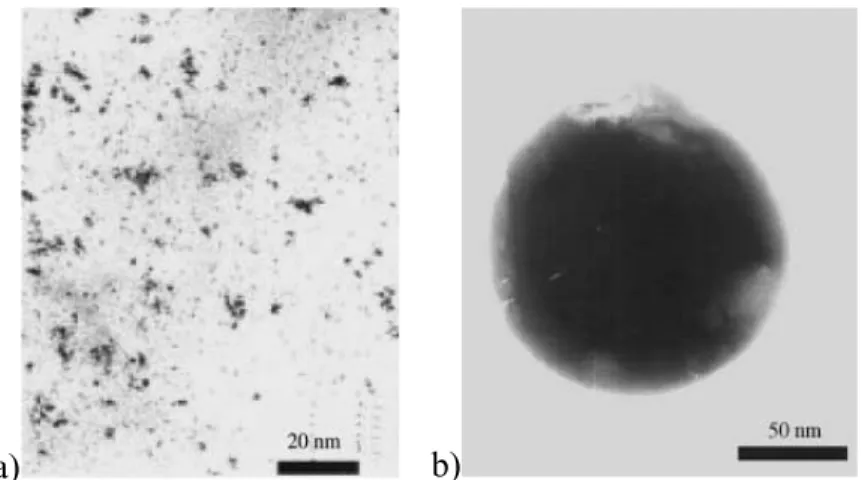
TMGL has been used due to its ability to coordinate to Pd nanoparticles. Palladium nanoparticles can aggregate to give bulk metal. TMGL ionic liquid has emerged as a good stabilizer avoiding PdNPs agglomeration. In this work the ionic liquid film supported over molecular sieve was estimated to 0.4 nm for an ILs loading of 20 % wt. TEM images of Pd nanoparticles show that they are in a range of 1-2 nm (Figure 1.4).53
a) b)
Figure 1.4: a) TEM micrograph of Pd nanoparticles dispersed in methanol/THF; b) TEM micrograph of molecular sieves with supported Pd nanoparticles. (Reproduced from53)
Non acidic ionic liquids have also been synthesized for their applications in SILP catalysis. [A336][PF6] was prepared from Aliquat 336®, a common phase transfer catalyst, exhibiting
good hydrogen solubility which makes it suitable for hydrogenation reactions.98
1.1.3 Nature of the catalyst involved in SILPC
1.1.3.1 Immobilized ILs as catalyst.
Not only acidic ILs, but also basic ILs have been largely immobilized onto different support materials to be used as catalyst. Acidic ionic liquids, including the well-known chloroaluminate based ionic liquids and the recently developed Brønsted acidic ones that contain trifluoromethyl sulfuric acid, proved to be effective catalysts for a variety of reactions.60,100 The immobilization of chloroaluminates on solid support has been described
earlier in section 1.1.1. Those SILP chloroaluminate catalysts were mainly used in Friedels-Craft acylations and in alkylation reactions showing better activity and selectivity than those obtained using free ionic liquid.60 Compared to chloroaluminate ionic liquids, Brønsted acidic
ionic liquids containing trifluoromethyl sulfuric acid have emerged as powerful catalysts due to their air and water stability. They can be supported either by covalent immobilization onto a silica support,100 by physical adsorption onto silica or encapsulated by sol-gel methods.101
These methods produce a material showing good performances in esterification of carboxylic acids with alcohols, nitration of benzene, Michael reaction of indole and condensation between indole and aromatic aldehydes.
Basic as well as acid ionic liquids have been immobilized for some catalytic studies. C. Paun et al. reported the Knoevenagel reaction mediated by a recyclable basic ionic liquid (BIL). Those basic ILs are derivatives of the Hünig’s base tethered ammonium salt with the
silica support.102 The supported catalyst presents a good activity. No degradation of the ionic
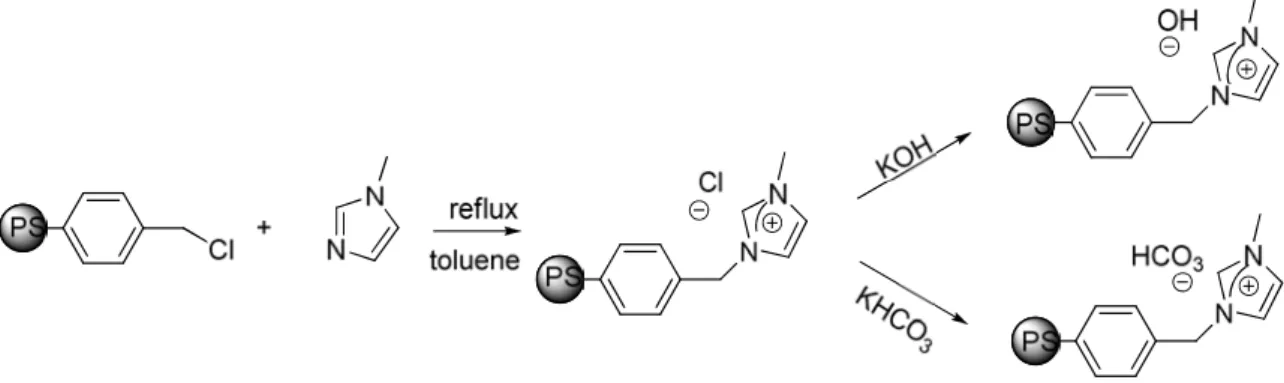
liquid was produced although the exothermicity of the reaction because the heat capacity of the silica support, and in consequence the catalyst could be recycled. The hydrolysis of propylene carbonate to 1,2-propylene glycol was also performed using a basic SILP catalyst.103 For these purposes, a polystyrene resin was used to support a basic imidazolium
hydroxide or imidazolium hydrogen carbonate (Scheme 1.12).
Scheme 1.12: Synthesis of basic ionic liquid supported on a polymer resin.
1-N-cetyl-3-methylimidazolium chloride ([C16mim]Cl) ionic liquid, applied as template for
the synthesis of MCM-48, presented good activity for Diels-Alder reactions.104 Surprisingly,
the homogeneous [C16mim]Cl system presents lower activity. Thus, a synergistic effect
between the surface and the ionic liquid could be the responsible of this behaviour. Another example of ionic liquid catalyst is [hmim][BF4] supported on a polymer for phase transfer
catalysis. Ammonium salts are well known for phase transfer catalysis in homogenous reactions. Chi’s group has proved the catalytic activity of the supported ionic liquid in this type of reactions underlining that longer alkyl linker in the ionic liquid leads to better catalytic activity due to the better accessibility to the ILs (Figure 1.5(a)).79,105 They also report a
synergistic effect when tert-butyl alcohol was used as solvent for fluorination reactions.106
This synergy has encouraged them to synthesize a new supported ionic liquid catalyst based on a quaternary ammonium salt prepared by a solid phase quaternization of the polymer with triethylamine, N-methylimidazole and N-(2-hydroxy-2-methylpropyl)imidazole (Figure 1.5(b)).107
Figure 1.5: a) Polymer supported ionic liquid with long alkyl linker. b) Supported ionic liquid phase catalyst over a polymer functionalized with an alcohol moiety
The copolymerization of [bvim][Cl] and DVB leads to a polymer supported ionic liquid55
which, as well as choline chloride/urea sieves supported ionic liquid,108 is able to catalyze the
cycloaddition of CO2 with epoxides. High yields were achieved when
1-propyl-3-N-butylimidazolium bromide ILs was combined with a salt such as ZnCl2,109 in relation to butyl
bromide supported on silica gel prepared by sol-gel method.110
Other organocatalysts are Chiral ionic liquids have been used as organocatalysts in asymmetric catalysis (Figure 1.6). The effect of supporting them onto a surface has permitted to overcome some of the drawbacks of those ionic liquids such as their high price and the difficulties to be recycled. One example is pyrrolidine-based ionic liquid, which could be recycled eight times for the Michael addition without loss of activity and selectivity.111
Figure 1.6: Chiral supported ionic liquid over a polymer
1.1.3.2 Metal complexes immobilization
Most of the common supported ionic liquids are based on 1,3-dialkylimidazolium cations and [PF6] or [BF4] anions. Their tuneable polarities make them good solvents for almost all
transition metal complexes. As examples can be cited Rh and Pd complexes containing phosphines, such as triphenylphosphine or TPPTS, chiral Mn(salen) and Cr(salen) complexes (salen = N,N'-bis(salicylaldehyde)-ethylenediimine). The most popular way to immobilize a transition metal complex is to dissolve it into an appropriate ionic liquid. For this purpose the complex and the ionic liquid are dissolved in an organic solvent, which is further removed under vacuum. In the SILP concept, this ionic liquid is anchored as a thin layer onto the support surface.
[1-octyl-3-(3-triethoxysilylpropyl)-4,5-dihydroimidazolium][PF6] ionic liquid, which is
covalently anchored to silica surface can suffer an anion exchange between PF6- of the ionic
liquid and a transition metal polyoxanion such as [W(=O)(O2)2(H2O)2(µ-O)]2-,
[γ-1,2-H2SiV2W10O40]4-, [PMo10V2O40]5- or also RuO4- to be applied in olefin epoxidation reactions
(W systems) and alcohol oxidation (Mo and Ru systems) (Scheme 1.13). Raman analyses confirm the maintenance of the peroxometalate structure in the anion exchange; 13C and29Si
Scheme 1.13: SILP anion exchange between PF6- and [W(=O)(O2)2(H2O)2(µ-O)]2-, to give
a catalyst system used in epoxidation reactions.
1.1.3.3 Metal nanoparticles
Transition metal nanoparticles (NPs) have attracted much interest from the scientific community in the last decade due to their properties lying between the bulk metal and the molecular state.112 One of their major applications is in catalysis113 owing to their surface properties in the borderline between homogenous and heterogeneous catalytic behaviour. The catalytic activity of metal nanoparticles depends strongly on their size, electronic properties, surface properties and the metal oxidation state. Otherwise the main disadvantage is the difficulty to stabilize appropriate size metal nanoparticles maintaining their catalytic properties. Ionic liquids appeared as good stabilizers since the first observations of Dupont’s group.114 Actually, ILs generate an electrostatic and steric stabilization of nanoparticles,
diminishing their aggregation. Narrow size distribution of nanoparticles can be achieved with or without any other added stabilizer. The advantages of multiphase ILs/NPs systems, such as easy recovery and recycling, can be improved from a work-up point of view supporting it onto a solid support. The solid catalysts are still preferred for the easy work-up procedures. In those systems, the ionic liquid has a double function as stabilizer but also as immobilization agent of metal nanoparticles to the surface. The first study of immobilization of NPs onto a solid surface by an ionic liquid was carried out by Zhao’s group in 2004.53 In this work, Pd nanoparticles were immobilized on molecular sieves using 1,1,3,3-tetramethylguanidinium lactate (TMGL) as ILs. Palladium nanoparticles were preformed from Pd(OAc)2 in
THF/methanol, and then immobilized in TMGL. TEM images show particles of mean diameter 1-2 nm witthou any sign of agglomeration. The guanidinium ions are known to coordinate metal nanoparticles and prevent their agglomeration. Despite the fact that the ionic liquid layer makes only 0.4 nm, the authors affirm that no palladium nanoparticles are in direct contact with the support due to the strong interaction between the support and the TMGL ionic liquid. Thus, the ILs forms a layer over the solid support and coat the Pd nanoparticles at the same time. Duponts’s group has preformed Rh nanoparticles from RhCl3∙3H2O in [bmim][BF4] under hydrogen atmosphere.115 Those particles were isolated and
then redispersed in [bmim][BF4]/EtOH. The solution was used to synthesize an acidic or basic
catalyzed xerogel with SiO2 by a sol-gel technique. The solid obtained contains 70 % of
Rhodium as Rh(0) nanoparticles. The acid-basic character of the xerogel does not influence the size of the Rh nanoparticles (mean diameter: 4.8 nm), but it modifies their shape. The acid catalyst gives plate like structures, while spherical nanoparticles were obtained with the basic.
Rh nanoparticles where also obtain by immobilization of a rhodium salt such as RhCl3·3H2O in an TMGL-based ionic liquid anchored on an attapulgite clay surface followed
by reduction with hydrogen at 300 °C.78 Rh nanoparticles of 5 nm have been observed by TEM and X-ray powder diffraction shows the effective pattern of crystalline rhodium but also some the presence of Rh(III). Rh NPs of 25 nm with high tendency to aggregation were synthetized by the same authors under the same conditions but without ILs, thus the ionic liquid plays a crucial role for NPs stabilization. Analogously, the synthesis of Ru nanoparticles supported on natural clays using [TMG][TFA] has been also reported116.
Irregular shape Ru nanoparticles of 3 nm could be observed in the outer surface of the montmorillonite natural clay by TEM and confirmed by EDS (Energy dispersive X-ray spectroscopy) analysis, but XRD shows no crystalline Ru peaks. XPS analysis does not reveal the presence of Cl, which points to the total reduction of Ru(III) to Ru(0) species but some Ru-O species were observed which can be related to oxidation by air contact. Authors have demonstrated that Ru nanoparticles are not only in the outer surface but also in the interlayers of the montmorillonite showing a smaller size (1.2 nm).117 More usual is the in situ synthesis of metallicnanoparticles. Therefore, metallic precursors such as H2[PdCl4], [Pd(acac)2] or
Pd(OAc)2 are immobilized in an ionic liquid and supported on a solid such as silica, carbon,
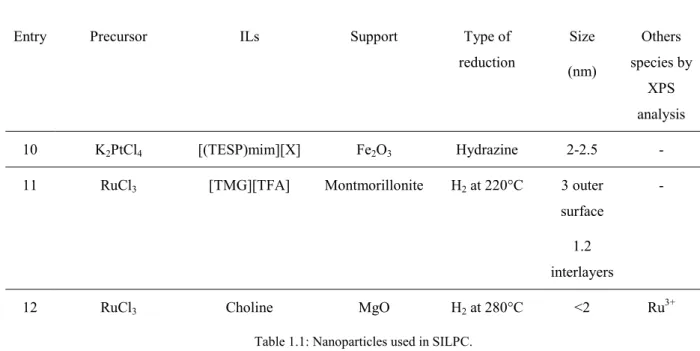
polymers, clays, etc. Palladium nanoparticles are obtained by in situ reduction of these species by thermal treatment or by adding a reducing agent. The nature of the solid support and the reaction conditions influence the size of NPs, conferring them different properties (Table 1.1). For example, the smallest particles (1.2 nm) were obtained in the interlayer of a montmorillonite support with [TMG][TFA] ionic liquid (entry 11, Table 1.1). An interesting in situ preparation of Pd nanoparticles is the reduction of a Pd-N-heterocyclic carbene complex during the catalytic reaction with the aid of the ionic liquid N-3-(3-trimethoxysilylpropyl)-3-methyl imidazolium chloride (entry 2).118 The nanoparticles show irregular shape and 10-40 nm size distribution. [Pd(acac)2] was reduced with H2at 150 °C in
[bmimOH][Tf2N] ionic liquid (entry 5).119 In-situ reductions of Pd(II) complexes such as
Pd(OAc)2 depend on the ionic liquid chosen for the immobilization. Thus, in
N-3-(-3-triethoxysilylepropyl)-3-methylimidazolium based ionic liquids ([(TESP)MIm][X], X = Cl, NO3, BF4 or PF6), palladium carbyne species (X = Cl-) or palladium nanoparticles with size
dialkyimidazolium ionic liquids (entry 7). The complex is immobilized and decomposed on the surface by alcohol reduction. Particles of 6 nm with 1-vinyl-3-butylimidazolium based ionic liquids ([vbim]X, X = Cl, BF4- orPF6- ) can be observed in TEM images (Figure 1.7
a-d);electron diffraction analysis evidences an fcc structure (Figure 1.7 e).120
a) b)
c) d)
e)
Figure 1.7: TEM and electron diffraction images of various supported Pd catalysts. (a) Pd/PS–IL[BF4], (b) Pd/PS–IL[PF6], (c) Pd/PS–IL[Cl], (d) Pd/SiO2–IL[Cl], and (e) electron
diffraction of Pd/PS–IL[Cl]. (reproduced from120)
A different approach is to support Pt nanoparticles onto modified ionic liquid magnetite (Figure 1.8). The ionic liquid modification prevents aggregation of the magnetic nanoparticles in organic or aqueous solution. The platinum salt K2[PtCl4] is absorbed via ion exchange with
![Figure 1.7: TEM and electron diffraction images of various supported Pd catalysts. (a) Pd/PS–IL[BF 4 ], (b) Pd/PS–IL[PF 6 ], (c) Pd/PS–IL[Cl], (d) Pd/SiO 2 –IL[Cl], and (e) electron](https://thumb-eu.123doks.com/thumbv2/123doknet/3733910.111986/40.896.137.791.248.915/figure-electron-diffraction-images-various-supported-catalysts-electron.webp)