HAL Id: hal-00306279
https://hal.archives-ouvertes.fr/hal-00306279
Submitted on 25 Jul 2008HAL is a multi-disciplinary open access archive for the deposit and dissemination of sci-entific research documents, whether they are pub-lished or not. The documents may come from teaching and research institutions in France or abroad, or from public or private research centers.
L’archive ouverte pluridisciplinaire HAL, est destinée au dépôt et à la diffusion de documents scientifiques de niveau recherche, publiés ou non, émanant des établissements d’enseignement et de recherche français ou étrangers, des laboratoires publics ou privés.
electron-emitting body
B. Thiébault, A. Hilgers, E. Sasot, Julien Forest, Vincent Génot, C. P.
Escoubet
To cite this version:
B. Thiébault, A. Hilgers, E. Sasot, Julien Forest, Vincent Génot, et al.. Investigation of electrostatic potential barrier near an electron-emitting body. NASA/CP-2004-213091, 2004. �hal-00306279�
INVESTIGATION OF ELECTROSTATIC POTENTIAL BARRIER NEAR AN ELECTRON-EMITTING BODY
POSTER SESSION 1
Benoît Thiébault, Alain Hilgers, Eloy Sasot, Julien Forest
Space Environments and Effects Section (ESA-ESTEC/TOS-EES), Keplerlaan 1, 2200 AG Noordwijk, The Netherlands
Email contact: [email protected]
Vincent Génot
Centre d'Etudes Spatiales des Rayonnements (CNES-CNRS/CESR) 9, avenue du Colonel Roche - Toulouse Cedex 4, France
Philippe Escoubet
Space Science Department (ESA-ESTEC), Keplerlaan 1, 2200 AG Noordwijk, The Netherlands
Abstract
Electrons emitted on spacecraft surfaces can generate negative potential barriers. This may affect the equilibrium potential of the spacecraft, which can be driven more negative and jeopardise plasma measurements by repelling low energy particles. This phenomenon is investigated with the help of a numerical method based on the turning point formalism to classify orbits and which is validated with a PIC code. Comparison with spacecraft data in the magnetosphere is performed.
Introduction
Photoemission on spacecraft is an important issue for the operation of plasma detectors in space. Outside the ionosphere, the photoemission current may significantly influence the electrostatic potential of the spacecraft, which has been observed to be driven up to a few tens of volts positive [1]. Furthermore, detectors can be directly contaminated by photoelectrons emitted from sunlit surfaces and propagating toward the detector entrance [2][3][4][5].
Several authors have investigated in the past the possibility of the occurrence of electrostatic potential barrier due to the photoelectron space charge [2] [6] [7]. In this paper this issue is analysed with the help of a fully self-cons istent numerical scheme presented by Parrot et al. [8]. Its application to the photoelectron sheath problem is validated by comparison with a particle in cell code (Forest et al, [10]). The model is then applied to the prediction of potential barriers around Geotail spacecraft. The results of this study predict a potential barrier located much closer to the spacecraft than indicated by earlier work.
Method
Thanks to the very long mean free path of the plasma particles and the short time scale to reach electrostatic equilibrium compared to change of the environment, collisions between particles and time dependence can be discarded. Furthermore, at
the high altitudes relevant to the spacecraft considered in this paper, the magnetic field effects can be neglected. The sheath structure around the electron emitting body is therefore believed to be well described by the Poisson-Vlasov system of equations with appropriate boundary conditions. The ambient plasma far away from the body and the photo-electron distribution at its source is assumed to be Maxwellian. Despite of the expected non-symmetry of the photo-electrons very close to the spacecraft it is assumed in the rest of the paper that their distribution, as well as the one of all plasma species are spherically symmetric.
With the above hypotheses, the Poisson-Vlasov system can be written as
Where Φ is the electrostatic potential, R the radial distance, ∆R is the Laplacian in
spherical coordinate for spherical symmetry, ρ is the charge density, fi is the density
probability distribution function of species i.
The turning point method, extensively described by Parrot et al. [8], is based on the analysis of the possible particles orbits using the turning point formulationto simplify and solve the Vlasov equation of the distribution function in a given potential.
Each number density
where Vi is the velocity, is calculated as a function of the radial distance and the
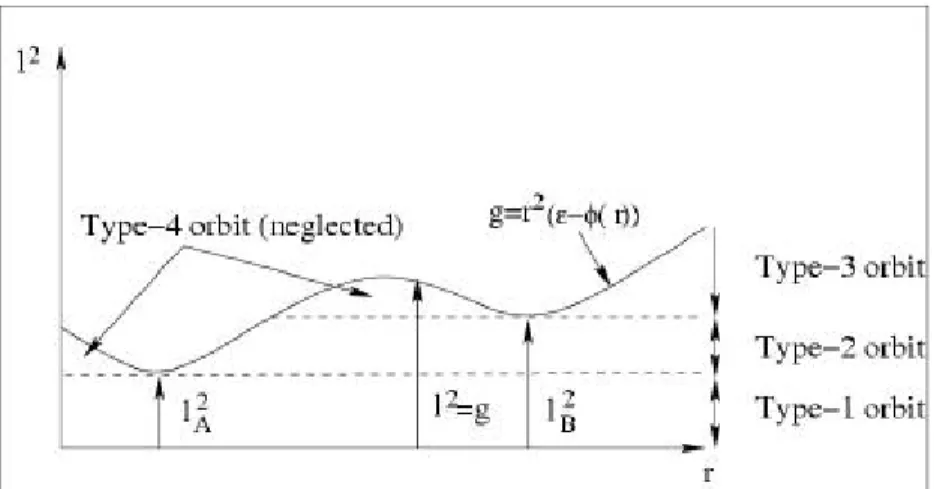
potential distribution via the identification of the domain of accessibility in function of momentum l and energy ε using the orbit classification shown on Figure1.
It is then straightforward to obtain for the normalised density
Figure 1. Orbit classification using the turning point formulation from Parrot et al. [8].
Once the density of each species is known one can compute the total electric charge and inject it in the Poisson equation, which is solved via a standard numerical scheme, e.g., Gauss-Seidel in one dimension. The solution to the Poisson-Vlasov system is then found iteratively using under-relaxation.
Test and validation of the method
To validate this method, two tests were performed. The first one is based on the comparison with the results obtained by Roussel [9] with the PIC code SILECS for a Langmuir probe in a dense Maxwellian plasma at rest without photoemission. The second test validates the photoelectron emission and propagation model with the use of the PIC simulation code, PicUp3D, developed by Forest et al. [10].
- Comparison with SILECS
Roussel [9] computed the sheath structure for a Maxwellian plasma around a spacecraft without photo-emission which he validated by comparison of the density profiles with Laframboise results [11]. The corresponding potential profiles are shown in Figure 2 together with the potential profile predicted by the turning point formulation based method.
Figure 2. Comparison of the turning point method prediction with the results from [9]
The curves are in good agreement in the potential range above 0.1 kBTe/qe.or distance
beyond 4 spacecraft radii. At lower potential or higher distance the turning point method predicts a slightly lower potential up to 0.01 kBTe/qe. It is not clear why such a
discrepancy appears. It may be due to the difference of simulation box size and of the boundary conditions.
- Comparison with PicUp3D
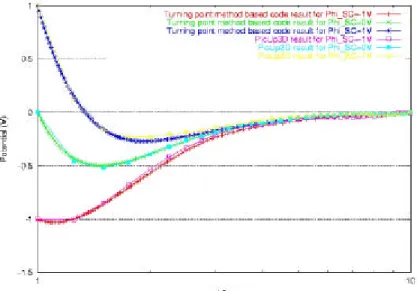
The PicUp3D [10] code is a simulation software dedicated to model spacecraft plasma interactions. It is an open source software written in java freely available on the web [12]. It is based on a 3D Particle-In-Cell (PIC) kinetic description of ions and electrons to simulate plasma dynamics. Several simulations have been performed for a Maxwellian plasma environment corresponding to a temperature of 1 eV for the ions and the electron and an electron density of 100 particles per cubic centimetre. With such a plasma, the Debye length is equal to 0.74 m, which is comparable to the size of the spacecraft. Therefore the PIC simulation can be made very accurate in a reasonable size computation box. The corresponding potential profiles are shown on Figure 3 below together with the profile computed with the turning point formulation based method.
Figure 3. Comparison of the turning point formalis m based method with simulations made with a PIC code for a small Debye length plasma.
The potential profiles shown on Figure 3 and computed with the two different methods are in very good agreement. Unlike the previously presented test, there is not even a discrepancy close to the edge of the simulation box, presumably because in the present test the same boundary conditions were used for both methods. This information is considered as a successful cross- validation test of the two methods especially for what regards their ability to simulate photo-electron expansion around a spacecraft.
Comparison with Geotail data
- Geotail observation
Zhao et al [7] have used the current balance equation to assess the value of the potential barrier around Geotail spacecraft:
Furthermore, they use a predefined and arbitrary parameterised potential profile to provide a barrier potential value and position. To this end Zhao et al. made the following hypotheses:
o The spacecraft is modelled as a sphere;
o The spherical symmetry applies on the potential and the plasma and photo-electron density;
o The ion and electron temperature is 100 eV and the plasma density is 1 cm-3
- Predicted potential barrier with the turning point formulation
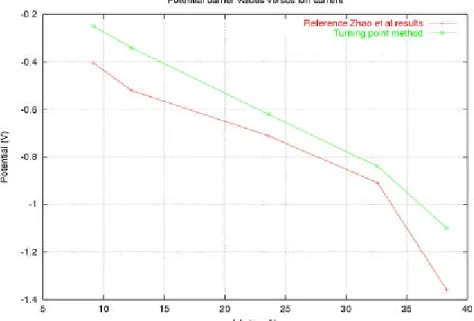
The turning point formulation based method was used to assess the characteristics of the potential barrier under the same set of hypotheses as used by Zhao et al. for the
spacecraft and environment model. The results for the potential and the barrier locations are shown on Figures 4 and 5 below.
Figure 4. Minimum potential deduced from Geotail observation and computed by the turning point formulation based method as a function of the spacecraft
potential.
Figure 5. Location of the minimum of the potential deduced from the empirical technique of Zhao et al. and computed by the TPF based method as a function of
the spacecraft potential
One can see that the potential profile computed by the two methods have the same shapes but differ by a constant value. It can be shown that the derivation of Zhao et al. actually is undefined within a constant value. We therefore conclude that our results on the potential are consistent with the ones of Zhao et al. The difference between the
barrier location is more significant. It was explained by Zhao et al., that their assessment of the location of the barrier may be strongly depending on the actual hypothesis they have made for the a priori and arbitrary shape of the barrier. Our results confirmed this fact and suggest that the barrier location is actually closer to the spacecraft and its distance from the spacecraft decreases with decreasing potential unlike predicted by Zhao et al. [7].
Conclusion
The turning point formulation method presented by Parrot et al. [8] to model electrostatic sheath in spherical symmetry has been validated by comparison with two different PIC codes. It has been used for simulating photo-electron sheath in a large Debye length regime around a spherical body. The prediction of a potential barrier and of its magnitude is consistent with the results of Zhao et al. [7] based on the observations made on Geotail spacecraft. There is a discrepancy, however, for what regards the barrier location estimated on one hand by the analytical approach of Zhao et al. and on the other hand by the numerical model used in this study. Examination of Zhao et al.’s hypotheses leads to conclude that our predictions are less biased and therefore more realistic. We conclude that in the case of Geotail any potential barrier is located much closer to the spacecraft than it was predicted before and that its location decreases for decreasing potential. A main limitation of the applicability of the current study to a real case is the assumption of a spherical symmetry for the distribution of the photo-electrons cloud. This is currently under investigation with the help of 3D simulation codes and will be the subject of a forthcoming paper.
Acknowledgments
This study has been performed in the frame of the Spacecraft Plasma Interaction Network in Europe (SPINE) activities (cf. www.spis.org). We acknowledge useful discussions with the participants of the 5th SPINE workshop and especially of the working group on electrostatic sheaths modelling lead by H. Laakso.
References
[1] Pedersen, A., C. A. Cattel, C.-G. Faelthammar, V. Formisano, P.-A. Lindqvist, F. Mozer, and R. Torbert, Quasistatic electric field measurements with spherical double probes on the GEOS and ISEE satellites, Space Sci. Rev., 37, pp 269-312, 1984.
[2] Guernsey, R.L., and Fu, J.H.M., Potential distribution surrounding a photoemitting plate in a dilute plasma, J. Geophys. Res., 75(16), 3193, 1970.
[3] Wrenn G. and Heikkila, Photo-electrons emitted from ISIS Spacecraft, in Photon and particle interactions with surfaces in space, 221-230, 1973.
[4] Szita, S., A. N. Fazakerley, P. J. Carter, A. M. James, P. Travnicek, G. Watson, M. Andre, A. Eriksson, and K. Torkar, Cluster PEACE observations of electrons of spacecraft origin, Ann. Geophys., 19, 1-10, 2001.
[5] Hilgers, A. , Interaction between biased sunlit electron collectors in an infinite-Debye- length magnetoplasma: electron temperature threshold effect , J. Geophys. Res., 100, 5705-5713, 1995.
[6] Whipple, E. C., Theory of the spherically symmetric photo-electron sheath: a thick sheath approximation and comparison with the ATS 6 observation of a potential barrier, J. Geophys. Res., 81, 601, 1976.
[7] Zhao H., Schmidt R., Escoubet C.P., Torkar K., Riedler W., Self-consistent determination of the electrostatic potential barrier due to the pho toelectron sheath near a spacecraft, Journal of geophysical research, Vol. 101, No. A7, 15,653--15659, 1996
[8] Parrot M.J.M. Storey L.R.O. Parker L.W. Laframboise J.G., Theory of cylindrical and spherical Langmuir probes in the limit of vanishing Debye number, Phys. Fluids, Vol. 25, No. 12, 2388--2400, 1982.
[9] Roussel J.-F., Spacecraft plasma environment and contamination simulation code: description and first tests, Journal of spacecraft and rockets, Vol. 35, No. 2, 205--211, 1998.
[10] Forest J., L. Eliasson, A. Hilgers, A New Spacecraft Plasma Simulation Software, PicUp3D/SPIS, in proceedings of 7th Spacecraft Charging Technology Conference, pp.515-520, ESA/SP-476, ISBN No 92-9092-745-3, ESA-ESTEC, Noordwijk, The Netherlands, 23-27 April 2001.
[11] Laframboise J.G., Theory of spherical and cylindrical Langmuir probes in a collisionless Maxwellian plasma at rest, Institute for aerospace studies, university of Toronto, 1966.
![Figure 2. Comparison of the turning point method prediction with the results from [9]](https://thumb-eu.123doks.com/thumbv2/123doknet/2337496.33114/5.894.246.643.117.400/figure-comparison-turning-point-method-prediction-results.webp)