HAL Id: tel-01468829
https://pastel.archives-ouvertes.fr/tel-01468829
Submitted on 15 Feb 2017HAL is a multi-disciplinary open access archive for the deposit and dissemination of sci-entific research documents, whether they are pub-lished or not. The documents may come from teaching and research institutions in France or abroad, or from public or private research centers.
L’archive ouverte pluridisciplinaire HAL, est destinée au dépôt et à la diffusion de documents scientifiques de niveau recherche, publiés ou non, émanant des établissements d’enseignement et de recherche français ou étrangers, des laboratoires publics ou privés.
Fine-grained object categorization : plant species
identification
Asma Rejeb Sfar
To cite this version:
Asma Rejeb Sfar. Fine-grained object categorization : plant species identification. Information Re-trieval [cs.IR]. Télécom ParisTech, 2014. English. �NNT : 2014ENST0046�. �tel-01468829�
2014-ENST-0046
EDITE - ED 130
Doctorat ParisTech
T H `
E S E
pour obtenir le grade de docteur d ´elivr ´e par
TELECOM ParisTech
Sp ´ecialit ´e Informatique et R ´eseaux
pr ´esent ´ee et soutenue publiquement par
Asma REJEB SFAR
10/07/2014
Fine-Grained Object Categorization: Plant Species Identification
Directeurs de th`ese: Nozha BOUJEMAA et Donald GEMAN
Jury
M. Alain TROUV ´E,Professeur, ENS Cachan Rapporteur
M. Franc¸ois FLEURET,Charg´e de recherche (HDR), Idiap Research Institute Rapporteur
Mme Franc¸oise PR ´ETEUX, Adjointe au directeur de la recherche, Mines ParisTech Examinateur
M. Benoˆıt POCHON,Responsable de l’´equipe R&D en multim´edia, Parrot Examinateur
M. Hichem SAHBI,Charg´e de recherche (HDR), LTCI Lab T´el´ecom ParisTech Examinateur
M. Donald GEMAN,Professeur, Johns Hopkins University Examinateur
Mme Nozha BOUJEMAA,Directrice de INRIA Saclay Ile de France Examinateur
TELECOM ParisTech
´ecole de l’Institut Mines-T´el´ecom - membre de ParisTech
Acknowledgements
First I would like to thank Dr. Nozha Boujemaa who gave me the opportunity to join the iMedia team under her guidance and especially to work with Professor Donald Geman.
I am really grateful to Professor Geman for guiding me deeply during my thesis, for his consistent support and continuous encouragement. This thesis would not have been possible without him. Exchanges of ideas and fruitful discussions with Don were the key success factors of this work. For me, he was the perfect advisor both humanly and scientifically.
I am also grateful to the members of my oral defense committee : Alain Trouv´e, Fran¸cois Fleuret, Fran¸coise Pr´eteux, Benoˆıt Pochon and Hichem Sahbi, for their time and insightful questions.
I would like to thank my parents, my sister and my brother for their love, emotional support and eternal encouragements. To them, I dedicate this thesis. Also, words fail me to express my gratitude to my husband Mohamed Riadh TRAD whose patience, guidance and persistent confidence in me, have taken the load off my shoulder.
Finally, thanks are due to all my friends and everyone who was a member of the IMedia Team.
ABSTRACT
Fine-Grained Object Categorization: Plant
Species Identification
We introduce models for fine-grained categorization, focusing on determining botan-ical species from leaf images. Images with both uniform and cluttered background are considered and several identification scenarios are presented, including different lev-els of human participation. Both feature extraction and classification algorithms are investigated.
We first leverage domain knowledge from botany to build a hierarchical represen-tation of leaves based on IdKeys, which encode invariable characteristics, and refer to geometric properties (i.e., landmarks) and groups of species (e.g., taxonomic cate-gories). The main idea is to sequentially refine the object description and thus narrow down the set of candidates during the identification task. We also introduce vantage
feature frames as a more generic object representation and a mechanism for focusing
attention around several vantage points (where to look) and learning dedicated features (what to compute).
Based on an underlying coarse-to-fine hierarchy, categorization then proceeds from coarse-grained to fine-grained using local classifiers which are based on likelihood ratios. Motivated by applications, we also introduce on a new approach and performance crite-rion: report a subset of species whose expected size is minimized subject to containing the true species with high probability. The approach is model-based and outputs a
confidence set in analogy with confidence intervals in classical statistics. All methods
R´
esum´
e
1
Introduction
La vision par ordinateur est la science permettant de doter les machines de la capacit´e `a ”comprendre” et `a interpr´eter le contenu d’une image au niveau s´emantique. La vision par ordinateur couvre les technologies de base de l’analyse automatique d’images qui est utilis´e dans de nombreux domaines. Les applications vont du traitement d’images de bas niveau `a l’annotation automatique d’images, l’interpr´etation de sc`enes et la reconnaissance d’objets.
Dans le cadre de cette th`ese, nous nous int´eressons `a la reconnaissance automa-tique d’objets, plus pr´ecis´ement aux objets appartenant `a un mˆeme concept de base telle que la reconnaissance des diff´erentes esp`eces de plantes via des images de feuilles. Distinguer les sous-concepts d’objets, peut s’av´erer extrˆemement difficile pour un ”sim-ple” utilisateur et n´ecessite souvent l’avis d’un expert, contrairement `a la distinction de concepts diff´erents (voiture, pi´eton, animal). Cette probl´ematique de reconnaissance qui aborde l’espace s´emantique dans une r´esolution tr`es fine est un domaine d’´etude de plus en plus actif, guid´e par les applications ainsi que le d´efi intellectuel. Nous nous int´eressons, en particulier, au domaine de la botanique. Nous ´etudions toute la chaine d’identification, notamment la repr´esentation et l’extraction des caract´eristiques discriminatives de l’objet, l’apprentissage et la recherche. Nous introduisons de nou-veaux m´ecanismes de repr´esentation de l’objet ainsi que de nouvelles m´ethodes de classification. Plusieurs sc´enarios semi-automatiques sont propos´es `a l’utilisateur pour l’identification d’esp`eces de plantes via diff´erents types d’images de feuilles.
2
Motivations
L’un des d´efis majeurs dans le domaine de l’intelligence artificielle et la vision par or-dinateur est de pouvoir doter les syst`emes informatiques de la capacit´e humaine `a dis-cerner des objets visuellement similaires. Cependant, contrairement `a la reconnaissance de concepts assez diff´erents (tels que la reconnaissance des voitures ou des personnes parmi d’autres objets), mˆeme les humains pourraient avoir des difficult´es dans la recon-naissance de (sous)cat´egories tr`es similaires appartenant `a un mˆeme concept de base (telles que les esp`eces de plantes ou les races de chiens). En effet, de telles cat´egories sont g´en´eralement reconnues par des sp´ecialistes. Dans le cas des esp`eces botaniques, la reconnaissance est d’autant plus difficile que les botanistes se servent souvent de guides d’identification contenant diff´erentes illustrations et propri´et´es v´eg´etales afin de faciliter la tˆache de l’identification.
Souvent, les taxonomistes pr´esentent des descriptions ´ecrites et organis´ees des esp`eces similaires de sorte que d’autres biologistes peuvent identifier les sp´ecimens inconnus. En botanique, cette tˆache implique des comparaisons entre les caract´eristiques d´ej`a enreg-istr´ees et celles observ´ees, puis l’attribution d’une plante `a un rang taxonomique parti-culier (ex. famille, genre), pour finalement arriver au niveau des esp`eces. Toutefois , en raison de la grande variation des caract´eristiques et le tr`es grand nombre de cat´egories de plantes actuellement connues dans le monde (plus de 200, 000 esp`eces), l’identification des esp`eces botaniques peut ˆetre une tˆache ardue et de longue haleine, mˆeme pour les experts. Trouver une esp`ece assez rapidement n´ecessite souvent de connaˆıtre `a l’avance le nom de la famille ou du genre concern´e. Cependant, un sp´ecialiste dans un genre (ou une famille) particulier(`ere) peut ne pas ˆetre familier avec un(e) autre. La difficult´e est de plus en plus importante avec la p´enurie actuelle de taxonomistes qualifi´es.
Un syst`eme d’identification automatique (ou semi-automatique) pourrait donc ˆetre d’une utilit´e particuli`ere dans de nombreuses applications. Les outils automatis´es peu-vent acc´el´erer la reconnaissance et ainsi aider les sp´ecialistes `a reconnaˆıtre ou d´ecouvrir de nouvelles esp`eces. Dans le cas de la botanique, acc´el´erer la collecte et la classification des observations est une ´etape cruciale vers le d´eveloppement durable de l’agriculture et la conservation de la biodiversit´e.
3
Challenges
Dans ce qui suit, nous nous int´eressons `a des objets appartenant `a un mˆeme concept, notamment les feuilles de plantes. Bien que de tels objets, pour la plus part, sont visuellement tr`es similaires (mˆeme couleur, forme g´en´erale, syst`eme de nervures..), ils peuvent n´eanmoins largement diff´erer au sein d’une mˆeme cat´egorie (esp`ece). Pis en-core, il peut mˆeme y avoir moins de variation d’aspect entre deux images de deux cat´egories diff´erentes qu’au sein d’une mˆeme cat´egorie. Et bien que la forme glob-ale s’av`ere suffisamment discriminante entre certaines cat´egories, d’autres cat´egories affichent des variations fines uniquement.
En particulier, les feuilles peuvent pr´esenter des apparences totalement diff´erentes dues au contexte local, tels que l’emplacement et les conditions climatiques. Par exem-ple, les feuilles ont souvent des couleurs et des formes plus ou moins diff´erentes tout au long des saisons. Une feuille morte a une texture tr`es diff´erente d’une en vie. Les mˆemes esp`eces peuvent pr´esenter des caract´eristiques assez diff´erentes dans deux r´egions diff´erentes. Aussi, les feuilles d’une mˆeme tige, peuvent changer graduellement de forme avec l’ˆage; un ph´enom`ene appel´e d´eveloppement h´et´eroblastique. Ainsi, les feuilles dites
juv´eniles issues d’une jeune plante, sont presque toujours diff´erentes des feuilles dites adultes.
Le fond des images peut ´egalement repr´esenter un probl`eme cl´e pour un syst`eme de reconnaissance automatique. Les images de feuilles sur fond naturel constituent, par exemple, un v´eritable d´efi pour la reconnaissance automatique et des algorithmes de segmentation. Le fait que lobjet d’int´erˆet soit situ´e au sein d’un environnement composite, dans lequel on risque de retrouver des objets de couleurs tr`es proches (feuil-lage, autres plantes), rend par exemple totalement inop´erantes les m´ethodes globales comme le seuillage pour s´eparer l’objet d’int´erˆet du fond. Dans l’ensemble, les condi-tions d’acquisicondi-tions sont peu maˆıtris´ees, ce qui peut produire des photographies difficiles `
a traiter.
Dans la litt´erature, la plus part des travaux sur l’identification ou la classification automatique des plantes, ont eu recours `a des images avec fond uniforme. D’ailleurs, plusieurs bases publiques sont constitu´ees de scans de feuilles sur fond blanc. Cependant, des bases plus r´ecentes contiennent de plus en plus d’ images de feuilles avec fond naturel.
4
Positionnement par rapport `
a l’´
etat-de-l’art
En raison des besoins et des d´efis mentionn´es ci-dessus, de plus en plus de travaux en vision se consacrent `a la cat´egorisation dite ”fine”, notamment la classification de (sous)cat´egories. Plusieurs m´ethodes ont ´et´e adapt´ees ou introduites pour discriminer des objets similaires et plusieurs approches ont eu recours `a l’intervention humaine [13, 109, 33] pour am´eliorer les performances.
G´en´eralement, le sc´enario standard ´etait de fournir `a l’utilisateur une estimation unique de la cat´egorie recherch´ee [35, 45, 119, 68, 117, 78, 13, 2]. Plusieurs autres travaux ont choisi de retourner les k premi`eres cat´egories les plus similaires [7, 67, 75], o`u k, g´en´eralement, varie de dix `a vingt afin de garantir un niveau de pr´ecision ´elev´e. Bien sˆur, on peut toujours retenir la bonne cat´egorie en retournant relativement un large ensemble d’estimations; ce qui a peu de valeur dans les applications r´eelles. En outre, se concentrer uniquement sur la liste des toutes premi`eres estimations pourrait ˆetre compl`etement inutile `a l’utilisateur, surtout si on ne garantit pas que la bonne r´eponse y figure.
Ici, nous nous concentrons sur (1) des strat´egies hi´erarchiques qui r´eduisent con-sid´erablement l’espace des candidats, (2) une description locale discriminante des diff´e-rentes (sous)cat´egories, (3) un nouveau crit`ere de performance: retenir le plus petit sous-ensemble possible d’esp`eces qui contiendrait le bonne estimation avec une probabilit´e ´elev´ee. En particulier, nous avons pu surpasser les performances d’autres m´ethodes de l’´etat-de-l’art et atteindre des taux de reconnaissance tr`es ´elev´es sur diff´erents ensembles de feuilles avec un fond uniforme.
En outre, la plupart des m´ethodes de l’´etat-de-l’art, dans le domaine de l’identification des plantes, sont bas´ees sur l’analyse des images de feuilles. Plus pr´ecis´ement, ces ap-proches sont g´en´eralement bas´ees sur des images d’une seule feuille sur un fond uniforme. Seuls quelques travaux ont abord´e le probl`eme d’identification de feuille sur un fond na-turel (complexe), ce qui est plus susceptible d’ˆetre le sc´enario r´eel. Les plus efficaces, dans ce cas, ´etaient ceux qui ont proc`ed´e `a un processus de segmentation, que ce soit manuel ou interactif [19, 20, 4]. Dans cette th`ese, nous abordons, en plus des images de feuilles avec fond uniforme, le cas des images avec fond non uniforme (naturel) dans le but de proposer les sc´enarios les plus utiles et les plus informatifs `a l’utilisateur.
N´eanmoins, aucun processus de segmentation n’est utilis´e dans ce cas.
5
Contributions
Dans le cadre de cette th`ese, nous ´etudions dans quelle mesure l’automatisation du processus d’identification des plantes peut-elle minimiser l’intervention humaine, tout en assurant des taux de reconnaissance ´elev´es. Pour cela, nous nous int´eressons `a diff´erents sc´enarios automatiques et semi-automatiques, pour atteindre le bon compromis entre une identification erron´ee mais enti`erement automatis´ee et une identification tr`es pr´ecise mais enti`erement manuelle.
Nous utilisons des strat´egies hi´erarchiques, bas´ees sur des caract´eristiques discrimi-natives de l’objet; le but ´etant de r´eduire consid´erablement l’espace des candidats. Le r´esultat peut ˆetre une estimation unique ou un ensemble d’estimations. Le degr´e de l’intervention de l’utilisateur peut alors varier d’inexistant `a significatif dans des situa-tions ambigu¨es. Il d´epend aussi des donn´ees. Par exemple, pour des photos naturelles de feuilles, le degr´e d’interaction entre l’utilisateur et le syst`eme peut ˆetre plus important que pour les images sur fond uniforme.
Plus formellement, soit Y l’ensemble des cat´egories et Y (I) la bonne cat´egorie de l’image I. Le but ultime est de pr´edire Y . Pour cela, nous ´etudions deux strat´egies: (i) proposer une liste ordonn´ee d’estimations. Seule la premi`ere estimation dans la liste est consid´er´ee dans le cas de r´ef´erence, le cas d’un sc´enario sans aucune intervention humaine, (ii) proposer un ensemble de confiance (CS) qui d´epend de I et tel que Y ∈ CS avec une probabilit´e tr`es ´elev´ee: P (Y ∈ CS) ≥ 1 − ǫ. Si la performance de la premi`ere strat´egie peut ˆetre mesur´ee par la fr´equence `a laquelle la bonne cat´egorie figure parmi les k meilleurs estimations, la performance de la deuxi`eme, est essentiellement mesur´ee par la taille du CS retourn´e.
Ces deux strat´egies sont bas´ees sur une repr´esentation hi´erarchique de Y. La hi´erarchie T permet de d´efinir des vecteurs descripteurs ainsi que des scores (discrim-inants) locaux Xt , t ∈ T . Nous ´etudions des approches utilisant de la connaissance
botanique ainsi que des approches plus g´en´eriques. Nous nous int´eressons en particulier `
a (1) de nouvelles repr´esentations d’objet ainsi que (2) de nouveaux algorithmes de classification.
5.1
Nouvelles repr´
esentations de l’objet
Une classification efficace est fortement li´ee `a une description discriminative de l’objet. Dans cette th`ese, nous explorons la description et la repr´esentation d’objets, plus par-ticuli`erement d’objets botaniques.
Nous introduisons, tout d’abord, une repr´esentation hi´erarchique de cl´es d’identification botaniques IdKeys dans le but d’imiter le processus d’identification d´ecrit par les botanistes eux-mˆemes. Une telle repr´esentation est appliqu´ee sur des images de feuilles sur fond uniforme, o`u une feuille est repr´esent´ee par un ensemble ordonn´e d’attributs correspon-dants `a des IdKeys. En particulier, ces cl´es codent des caract´eristiques invariables -ind´ependantes des esp`eces v´eg´etales ainsi que du contexte, comme l’endroit, les condi-tions climatiques ou la saison. Ils peuvent repr´esenter des propri´et´es g´eom´etriques qui ne sont pas directement observables, telles que des points de rep`ere, ou des groupes d’esp`eces pr´ed´etermin´es.
Ensuite, nous proposons une repr´esentation plus g´en´erique bas´ee sur ce nous avons appel´e des fenˆetres de description, dont les caract´eristiques cl´es sont l’emplacement, l’orientation et la description locale. Alors que l’emplacement de ses fenˆetres est le mˆeme pour toutes les esp`eces, ce sont les caract´eristiques locales qui permettent de lever l’ambiguit´e entre les estimations candidates. Deux aspects importants sont ´etudi´es dans le cadre de cette description (1) o`u pr´ecis´ement chercher? (2) que devrions nous calculer?
5.2
Classification
L’id´ee principale dans les sc´enarios d’identification propos´es, est de profiter d’une repr´e-sentation hi´erarchique T des donn´ees.
Nous construisons, d’abord, des classifieurs locaux, en utilisant le rapport de vraisem-blance et des fonctions discriminantes locales. La hi´erarchie est ensuite parcourue en largeur allant des classifieurs les plus ”grossiers” vers les plus ”fins”: `a chaque niveau, tous les enfants d’ un noeud t positif sont retenus et test´es au niveau suivant. Alors que les faux positifs peuvent ˆetre r´eduits successivement, si la bonne hypoth`ese est re-jet´ee au niveau d’un certain noeud, alors elle ne peut plus ˆetre r´ecup´er´ee. Les esp`eces
leurs rapports de vraisemblance .
Puis, par analogie avec les intervalles de confiance dans les statistiques classiques, nous construisons un mod`ele probabiliste qui permet de s´electionner un ensemble de
la confiance (CS). La taille de cet ensemble joue le rˆole de la largeur de l’intervalle de confiance dans les statistiques standards et la probabilit´e `a posteriori que la bonne cat´egorie appartienne `a l’ensemble de la confiance, joue le rˆole du degr´e de confiance. L’id´ee est de restreindre les ensembles candidats aux sous-ensembles {Ct, t ∈ T } et
d’int´egrer tous les ´el´ements de preuve `a partir des scores des diff´erents noeuds pour calculer la probabilit´e `a posteriori P (Y ∈ Ct|X = x), o`u X = {Xt, t ∈ T }. Pour cela,
nous utilisons la densit´e conditionnelle jointe p(x|c) des scores x = (xt, t ∈ T ), c ∈ Y.
(Nous supposons une distribution `a priori p(c) uniforme des esp`eces c ∈ Y.) Notre mod`ele est bas´e un r´eseau bay´esien gaussien.
6
R´
esultats
Nous avons proc´ed´e `a diff´erents tests de performance afin d’´evaluer les approches pro-pos´ees tout au long de cette th`ese. Plusieurs bases de feuilles ont ´et´e utilis´ees. Les feuilles consid´er´ees appartenaient `a diff´erentes r´egions dans le monde (exemples: Suisse [104], France [50], Etats-Unis) et ont ´et´e num´eris´ees de diff´erentes mani`eres. Des images avec fond uniforme ainsi que des images avec fond naturel ont ´et´e consid´er´ees.
Nous avons, tout d’abord, comparer la premi`ere strat´egie de classification, en util-isant les deux descriptions propos´ees, avec diff´erentes m´ethodes de l’´etat de l’art sous les mˆemes protocoles d’´evaluation. Des taux de reconnaissance de plus de 95% ont ´et´e atteints d`es la premi`ere estimation pour la plus part des images de feuilles avec fond uniforme. Plusieurs m´ethodes de l’´etat de l’art ont ´et´e surpass´ees.
Aussi, les ensembles de confiance retourn´es `a l’utilisateur contenaient en g´en´eral moins de 3 esp`eces (avec un taux de reconnaissance tr`es ´elev´e) ce qui peut ˆetre d’une ´enorme aide aux sp´ecialistes lors de la classifications de nouvelles collections de feuilles. Issus d’un clustering agglom´eratif, ces ensembles contiennent g´en´eralement des esp`eces visuellement tr`es similaires, ce qui peut ouvrir d’autres perspectives sur l’´etude des relations entre esp`eces.
fond naturel, notre approche ´etait meilleure que plusieurs m´ethodes, y compris celles qui ont eu recours `a la segmentation. Cependant, des pistes plus sp´ecifiques `a ce genre de probl´ematique sont encore `a creuser. Le manque de protocole lors de l’acquisition de la photo peut affecter l’apprentissage et l’efficacit´e des cassifieurs. Par exemple, des photos de feuillage touffu ou de tout l’arbre ne peuvent gu`ere aider pour identifier une photo d’une seule feuille.
7
Conclusion et perspectives
Dans le cadre de cette th`ese, nous avons ´etudi´e la probl´ematique de classification dite ”fine” en se concentrant sur la d´etermination des esp`eces botaniques `a partir d’images de feuilles. Le point fort de ce travail est le fait d’aborder l’ensemble de la chaˆıne d’identification. Nous nous sommes int´eress´es aussi bien `a la description et la repr´esentation de l’objet qu’ aux algorithmes de classification et des sc´enarios d’identification utiles `a l’utilisateur.
Nous nous sommes inspir´es du processus manuel des botanistes pour introduire une nouvelle repr´esentation hi´erarchique des feuilles. Nous avons aussi propos´e un nouveau m´ecanisme permettant d’attirer l’attention au tour de certains points caract´eristiques de l’objet et d’apprendre des signatures sp´ecifiques `a chaque cat´egorie.
Nous avons adopt´e une strat´egie de classification hi´erarchique utilisant une s´erie de classifieurs locaux allant des plus grossiers vers les plus fins; la classification locale ´etant bas´ee sur des rapports de vraisemblance. L’algorithme fournit une liste d’estimations ordonn´ees selon leurs rapports de vraisemblance. Motiv´es par les applications, nous avons introduit un autre sc´enario proposant `a l’utilisateur un ensemble de confiance contenant la bonne esp`ece avec une probabilit´e tr`es ´elev´ee. Un nouveau crit`ere de per-formance a ´et´e donc consid´er´e, la taille de l’ensemble retourn´e. Nous avons propos´e un mod`ele probabiliste permettant de produire de tels ensembles de confiance et d´emontr´e l’efficacit´e de cette strat´egie sur plusieurs bases de feuilles.
Diff´erents sc´enarios semi-automatiques ont ´et´e propos´es `a l’utilisateur pour l’aide `
a la d´ecision et `a l’identification d’esp`eces de plantes via diff´erents types d’images de feuilles. Des performances tr`es ´elev´ees ont ´et´e atteintes pour la reconnaissance des feuilles sur fond uniforme et des am´eliorations sont encore `a faire pour celles avec fond
naturel. Notons que notre m´ethode bas´ee sur les ensembles de confiance et l’intervention de l’utilisateur a r´ealis´e le meilleur score sur les photos de ImageClef2011 en surpassant mˆeme celles qui ont eu recours `a la segmentation.
Une interaction encore plus importante avec l’utilisateur peut am´eliorer les per-formances des syst`emes de reconnaissance des photos de feuilles, en particulier celles prises sans aucun protocole pr´e-d´efini. Aussi, traiter chaque type de photos (photos d’une feuille, d’une branche, d’un feuillage, ou de tout l’arbre) diff´eremment peut ˆetre une piste int´eressante.
Etendre notre travail en utilisant les diff´erentes strat´egies propos´ees dans le cadre de la classification des requˆetes d´efinies par de multiple images d’organes botaniques tels que fleurs et fruits peut am´eliorer le processus d’identification et de classification des collections de plantes. Aussi, nous serons int´eress´es de tester le m´ecanisme bas´e sur les ensembles de confiance afin d’organiser la recherche d’autres objets non-botaniques.
8
Organisation de la th`
ese
Cette th`ese est organis´ee comme suit:
• Chapitre 2 dresse l’´etat-de-l’art en relation avec les probl´ematiques abord´ees dans cette th`ese.
• Chapitre 3pr´esente deux nouvelles repr´esentations d’objets, notamment la repr´e-sentation hi´erarchique de cl´es d’identification, bas´ee sur des caract´eristiques bota-niques et les fenˆetres de description permettant de discriminer des classes tr`es simaires.
• Chapitre 4 introduit deux autres contributions qui concerne le domaine de la classification, la premi`ere ´etant bas´ee sur une premi`ere cat´egorisation grossi`ere puis un raffinement s´equentiel qui r´eduit `a chaque fois l’espace des estimations potentielles. La deuxi`eme ´etant un mod`ele probabiliste bas´e sur une analogie avec les intervalles de confiance en statistique.
• Chapitre 5d´etaille les diff´erents sc´enarios d’identification que nous proposons, notamment l’identification enti`erement automatique et semi-automatique en
util-isant une seule image ou des images multiples.
• Chapitre 6pr´esente les bases de donn´ees et les exp´eriences utilis´ees pour ´evaluer les techniques et les sc´enarios propos´es. Des comparaisons et des analyses critiques sont fournis.
• Chapitre 7 pr´esente le bilan des contributions ainsi que les diff´erentes perspec-tives.
Contents
1 Introduction . . . 7
2 Motivations . . . 8
3 Challenges . . . 9
4 Positionnement par rapport `a l’´etat-de-l’art . . . 10
5 Contributions . . . 11
5.1 Nouvelles repr´esentations de l’objet . . . 12
5.2 Classification . . . 12 6 R´esultats . . . 13 7 Conclusion et perspectives . . . 14 8 Organisation de la th`ese . . . 15 1 Introduction 31 1 Motivations . . . 32 2 Challenges . . . 34 2.1 Lack of data . . . 34
2.2 Diversity of morphological characteristics . . . 34
2.3 Image background complexity . . . 36
3 Positioning in the literature . . . 37
4 Contributions . . . 39
4.1 Object representations . . . 40
4.2 Classification algorithms . . . 42
4.3 Publications . . . 43
5 Outline of the thesis . . . 44 17
2 Related Work 45
1 About fine-grained categorization . . . 45
1.1 No human intervention . . . 46
1.2 Human intervention . . . 46
2 About leaves . . . 47
2.1 Generic approaches . . . 48
2.2 Botanical-based approaches . . . 49
2.3 Segmentation and cluttered background . . . 50
3 Hierarchical representation and search . . . 52
4 Class-selective rejection . . . 53 3 Object representation 55 1 Introduction . . . 55 2 Leaf definition . . . 56 3 IdKeys . . . 57 3.1 Motivation . . . 58 3.2 Hierarchical representation . . . 58 3.3 Feature extraction . . . 61
4 Vantage feature frames . . . 63
4.1 Motivation . . . 63
4.2 Definition . . . 64
4.3 Learning the frames . . . 66
4.4 Detecting the frames . . . 67
4.5 Learning the features . . . 67
4.6 Case of leaves . . . 69
4.7 Case of orchid flowers . . . 70
5 Summary . . . 70
4 Classification 73 1 Introduction . . . 73
2 Hierarchy construction . . . 74
4 Coarse-to-fine search and likelihood framework . . . 77 4.1 Coarse-to-fine search . . . 77 4.2 Likelihood ratios . . . 79 5 Confidence sets . . . 82 5.1 Statistical model . . . 83 5.2 Bayesian network . . . 84
5.3 Constructing the confidence set . . . 89
5.4 Relationship to non-Bayesian confidence sets . . . 91
6 Summary . . . 91 5 Identification scenarios 93 1 Introduction . . . 93 2 Baseline scenario . . . 93 3 Final disambiguation . . . 95 4 Initialization . . . 97 5 Multiple images . . . 97 6 Summary . . . 102 6 Experiments 103 1 Datasets . . . 103 1.1 Swedish leaves . . . 103 1.2 Flavia leaves . . . 104 1.3 Smithsonian leaves . . . 104 1.4 ImageClef leaves . . . 105 1.5 Orchid flowers . . . 106
2 Experiments and analyses . . . 106
2.1 IdKey estimation . . . 106
2.2 Vantage point detection . . . 108
2.3 Coarse-To-Fine (CTF) classification . . . 109
2.4 Confidence sets . . . 113
7 Conclusion 125 1 Summary of contributions . . . 125 2 Future work . . . 127
Bibliography 140
List of Figures
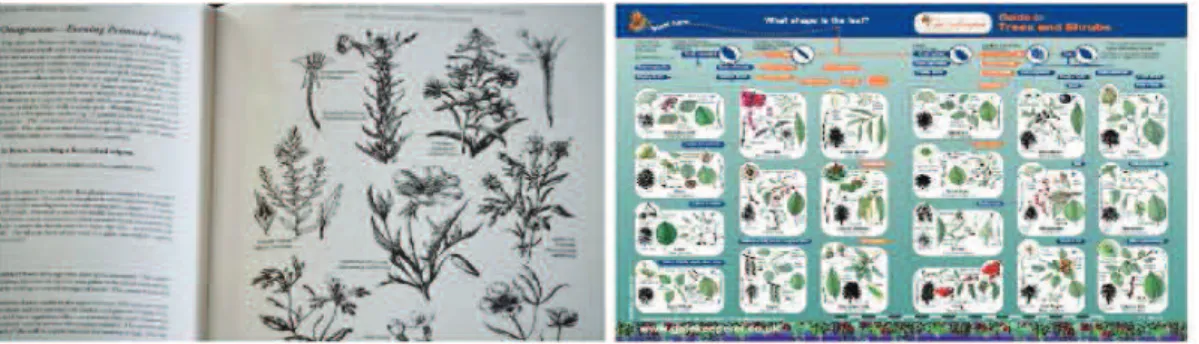
1.1 Examples of different recognition tasks. (1) Predict bounding boxes of instances of objects (top row). (2) Predict the presence/absence of a specific class with providing a detailed description of the pose of each detected instance (middle row). (3) Predict fine-grained categories of the same basic class (bottom row). . . 32 1.2 Illustrations from some filed guides. . . 33 1.3 Intra-class similarity and inter-class variation for leaves. Displayed are
two samples of Quercus ilex species on the top row and of Ilex aquifolium species on the bottom row. . . 35 1.4 Leaf global shape variation of Acer saccharinum species. . . . 36 1.5 Leaf margin variation of Quercus ilex species. . . . 36 1.6 Leaf texture variation of Diospyros kaki (top row) and Laurus nobilis
(bottom row) species. . . 37 1.7 Leaf color variation of Diospyros kaki (top row) and Ginkgo biloba
(bot-tom row) species. . . 38 1.8 Number of lobes variation of Ficus carica species. . . . 38 1.9 Leaflet shape and number variation of Sambucus canadensis species. . . 39 1.10 Leaflet relative position variation of Parthenocissus quinquefolia species. 39 1.11 Illustration of leaf heteroblasty for Gleditsia triacanthos species, i.e.,
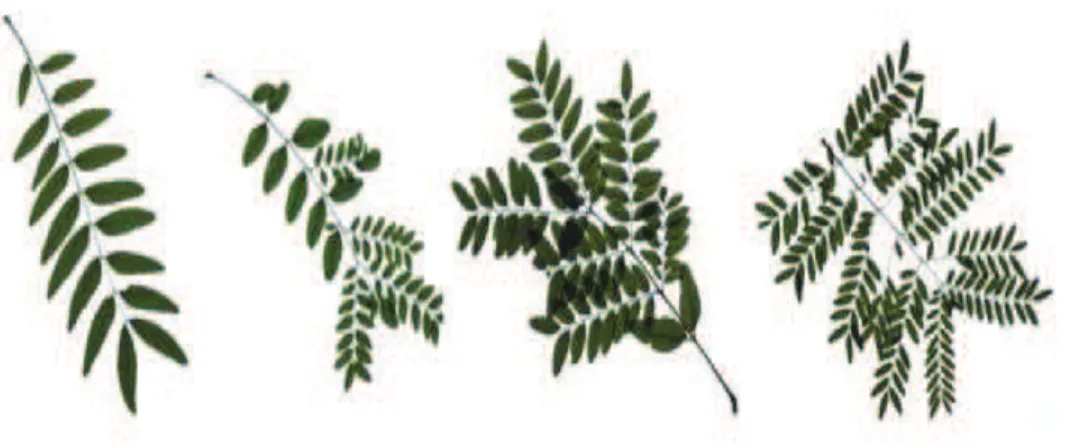
pro-nounced changes in leaf morphology during plant development. . . 40 1.12 Examples of unconstrained photographs. One can photograph a picked
leaf (top row), a branch (middle row) or a foliage (bottom row). . . 41 21
1.13 We consider three levels of user interaction in identifying the species of leaf images with either uniform and cluttered background: none (the baseline case of a fully automated system returning a point estimate); final disambiguation (the user receives a set of estimates); initialization and final disambiguation (the user also initializes the process by iden-tifying landmarks). The checks indicate the level we require to obtain useful/satisfactory results. . . 42 1.14 Simple hierarchical representations of four species. (a) A semantic
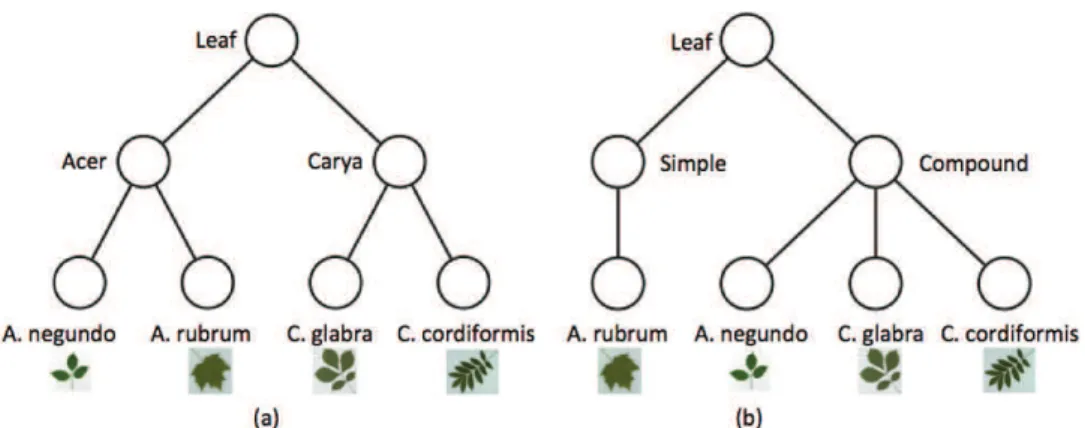
hi-erarchy: the second level represents leaf genera and the third level the species. (b) A hierarchy based on morphological leaf characteristics: the second level represents the leaf type (simple or compound) and the third level the species. A thumbnail from each species is displayed. . . 43 3.1 The main parts of a leaf. . . 56 3.2 Examples for blade divisions. Simple leaves are displayed in the top row
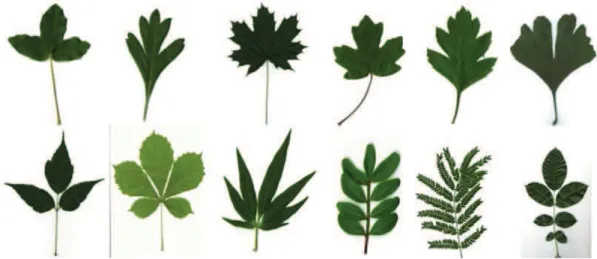
and compound leaves in the bottom row. . . 57 3.3 Tree-structured hierarchical representation of IdKeys . . . 60 3.4 Segmentation results with successful petiole removal. Displayed (from
the top to the bottom) are an input image, initial segmentation using Otsu algorithm, result after petiole removal. . . 61 3.5 Segmentation results with unsuccessful petiole removal. Displayed (from
the top to the bottom) are an input image, initial segmentation using Otsu algorithm, result after petiole removal. . . 62 3.6 Botanical idKeys estimation for species identification. . . 63 3.7 Local coordinate systems used for respectively (from left to right) leaf
type, base and apex estimations. . . 63 3.8 Multi-scale (local) windows defined relative to local coordinate systems.
Displayed are those used to extract features for respectively leaf type (in red), base (in blue) and apex (in green) estimation. s refers to the approximative width of the leaf. . . 64 3.9 Candidate frames for orchids and leaves. . . 65
3.10 A test leaf image is first segmented. Then the petiole is removed in order to compute the centroid (red point) as well as the approximate bounding circle of the leaf blade (red dashed circle). The base (blue point) and the apex (green point) are estimated using learned classifiers (f1, f2). The proposed locations for both landmarks are restricted to the
boundary points. The neighborhood of the first landmark detected is excluded from the list of candidate points for the next detection (blue dashed circle). . . 68 3.11 Recognition rates for leaf genera from the Smithsonian data (see §1) while
considering only the first genus returned and using M selected features. 69 3.12 Random sample of test images with the estimated vantage points for four
different leaf datasets. False detections are framed with a red box. Note that the entire detection process is considered erroneous if any vantage point is not accurately detected. . . 70 3.13 Examples of the five most discriminating local windows for different
species. Blue boxes refer to local windows relative to the coordinate system centered in the leaf base and green ones refers to those relative to the coordinate system centered in the leaf apex. . . 71 3.14 Random sample of test images with the estimated vantage points for
orchid flowers. False detections are framed with a red box. Note that the entire detection process is considered erroneous if any vantage point is not accurately detected. . . 71 3.15 Examples of the five most discriminating local windows for different
species. Blue boxes refer to local windows relative to the coordinate system centered in the bottom of the orchid labellum and green ones refers to those relative to the coordinate system centered in the central sepal. . . 72 4.1 Biological classification. There are seven main taxonomic ranks defined
by the international nomenclature codes: kingdom, phylum/division, class, order, family, genus, species. . . 73
4.2 Leaves of (a) Laurus nobilis, L. and (b) Viburnum tinus, L. species and (c) their respective positions in the APG classification. Note the visual similarity between the two leaf shapes despite the large distance between the species in the hierarchy (the first common ancestor of the two species is the root node). . . 74
4.3 A dendrogram representing a hierarchical clustering of 50 species of Smith-sonian leaves. Displayed are the nested groupings of species, similarity levels at which groupings change, and a thumbnail from each species. Many clusters match morphological classes. . . 76
4.4 The empirical distributions of local SVM scores of different hierarchical nodes of Figure 4.3. Each distribution is approximated by a Gaussian density (in red) with the estimated means and variances. . . 78
4.5 Example of a three-level hierarchy using three IdKeys. Two of the pos-sible values of the first key are kept (full nodes at the first level). Then we keep three possible values for the second key. Note that we are not keeping here all the combinations of these two and three values. How-ever, we are keeping exactly three combinations (corresponding to the paths formed by the full nodes except the root). Finally we keep only two paths which correspond to two triplets (each triplet corresponds to the retained values of the full nodes that form the path). Only these paths are considered for the species identification task. . . 79
4.6 SVM score ranges for twenty different species. Often scores are on dif-ferent scales. . . 81
4.7 Comparison between the SVM score distributions of two different cate-gories. Both distributions are approximated by Gaussians. . . 82
4.9 Illustration of the Markov property on a tree structure. The tree en-codes independence assumptions, by which each variable is independent of its non-descendants given its parent in the tree. There are no direct dependencies which are not already explicitly shown via arcs: (i) the grand parent Xp(t) and the child Xc1(t) (resp. Xc2(t)) are conditionally
independent given the parent Xt. (ii) The children Xc1(t) and Xc2(t) are
conditionally independent given Xt. {Xt, Xp(t), Xc1(t), Xc2(t)} are random
variables corresponding to nodes {t, p(t), c1(t), c2(t)}. . . 86
4.10 Histograms of correlation coefficients between differently situated pairs of nodes in the hierarchy for three different species. Top row: correlation coefficients between a node and its parent. Middle row: between siblings (nodes of a same parent node). Bottom row: between nodes from different halves of the hierarchy (no common ancestor except the root). Note that the largest of the (absolute) correlations tend to be between parents and children. . . 87 4.11 Example of correlation coefficients between a grand parent Xp(t) and a
child Xc(t) for different species. In red are conditional correlations given the parent Xtand in blue are the (absolute) correlations, unconditionally
to Xt. Note that the difference between both kinds of correlations is
generally very large. . . 88 4.12 Example of correlation coefficients between two children Xc1(t)and Xc2(t)
for different species. In red are conditional correlations given the parent Xt and in blue are the (absolute) correlations, unconditionally to Xt.
Note that the difference between both kinds of correlations is generally very large. . . 89 4.13 Example of T illustrating the key objects for 8 categories (c1, ..., c8). T
contains 14 nodes (not counting the root troot), labeled (t1, ..., t14).
Asso-ciated with each node t is a set of categories Ct, e.g., Ct1 = {c1, c2, c3, c4}.
Here, the true category is Y = c3, B(x) = {t1, t4}, (red circles) which are
5.1 Given an input leaf image, three scenarios are proposed. A fully-automated identification, i.e., baseline case (top row) and a semi-automated identi-fication with human intervention only at the end of the process, i.e., final disambiguation (middle row) or at both the beginning and the end for initialization and final disambiguation (bottom row). . . 94 5.2 A sample of test scanned leaves with non-singleton confidence sets (CS) of
species while a hierarchical clustering was used to get the CS candidates. For each CS, a training image from each species is displayed. For each test image, the red species is the true one. The CS are visually coherent. 95 5.3 Examples of leaf photographs manually marked. For each image,
dis-played are the leaf base (blue point), the leaf apex (red point) and a third boundary point (yellow point). The approximate width (marked as s at each image) of the leaf is defined as the distance between the yellow point and the apex-base line. . . 96 5.4 A sample of test leaf photos (cluttered background) with non-singleton
confidence sets (CS) of species. For each CS, a training image from each species is displayed. For each test image, the red species is the true one. 98 5.5 Species identification using botanical IdKeys and multiple image queries. 100 5.6 Examples of plant identification with multiple scanned leaf images, using
a hierarchical estimation of IdKeys within a likelihood framework. Each column shows one example. For each example the top row shows the query plant which is represented by three images, while rows 2-5 show the top four species returned (when they exist). Each species returned is displayed with both the most similar (on the left) and the most different (on the right) training image on average to the query and which belong to that species. Correct species are framed with a green box. . . 101 6.1 Samples from the Swedish dataset. One image from each species is shown.104 6.2 Samples from the Flavia dataset. One image from each species is shown. 104 6.3 Samples from the Smithsonian dataset. One image from each species is
6.4 Samples from the ImageClef2011 leaf scans. One image from each species is shown. . . 106 6.5 Samples from the ImageClef2011 leaf photos. One image from each
species is shown. . . 107 6.6 Samples from the Orchids dataset. One image from each species is shown.
Note that the color is not a discriminative feature; many differently col-ored orchids could belong to the same genus or species. . . 108 6.7 Botanical landmark estimation on the Swedish dataset. (a) Histogram of
the distances between the estimated terminal apex and the actual one. (b) Histogram of the distances between the estimated base and the actual one. . . 109 6.8 Random sample of test images with the estimated vantage points for both
Smithsonian leaves and orchids. False detections are framed with a red box. Note that the entire detection process is considered erroneous if any vantage point is not accurately detected. . . 110 6.9 Example of leaves for which the system mixes up the base and the apex.
Note that those leaves have either a very small or no petiole and reveal a very similar shape in their both extremities. . . 111 6.10 A dendrogram representing a hierarchical clustering of Swedish species.
Displayed are the nested groupings of species, similarity levels at which groupings change, and a thumbnail from each species. . . 114 6.11 A dendrogram representing a hierarchical clustering of Flavia species. . 115 6.12 The distribution of | C|, the size of the CS returned, for both methods of
constructing the CS when testing on the Swedish leaves. . . 116 6.13 The distribution of | C|, the size of the CS returned, while testing on the
Flavia leaves. . . 117 6.14 The distribution of | C|, the size of the CS returned, while testing on the
6.15 The histogram (in blue) of the posterior masses on the true species for the leaves in the Smithsonian dataset. The two tables compare the per-formance of CS1 and CS0 at the two extremes, i.e., when the posterior mass on the true species is very low and very high. In the former case (drastic estimation error), the CS1 strategy is able to recover (generate a CS with the true species) but CS0 does not for 10.4% of the images, but there are no images for which the opposite occurs, i.e., CS0 succeeds but CS1 does not. . . 118 6.16 Classification scores on the leaf photos of the ImageCLEF2011 dataset.
In red are the scores of the methods which use segmentation and in blue are the scores of those which do not use segmentation. . . 119 6.17 The distribution of | C|, the size of the CS returned, while testing on
ImageCLEF2011 leaf photos. The blue histogram is CS2 and the red is CS0, both with manual landmark identification. . . 120 6.18 The histogram (in blue) of the posterior masses on the true species for
the ImageClef2011 photos. The two tables compare the performance of CS2 and CS0 at the two extremes, i.e., when the posterior mass on the true species is very low and very high. Among the low ones, the the CS2 strategy succeeds and the CS0 strategy does not in 32.5% of the cases, but never the opposite. . . 121 6.19 Illustration of the performance per species on the ImageCLEF photo
subset. Each bin is labeled by two numbers separated by a slash. The first one refers to the number of training samples in the species considered and the second one refers to the number of testing samples. . . 121 6.20 Random sample of incorrectly identified imageCLEF2011 leaf photos. . 122
List of Tables
3.1 Cross-validated recognition rates for leaves (Smithsonian data §1) for each of seven possible sets of frames sets with centers l1, l2, l3. The best
result (in bold) is obtained with two frames centered at the base l1 and
apex l3. . . 67
4.1 Example of 5-fold cross validation to set ρt for an internal node. All of
ρt = {−3.5, −3, −2.5} achieve the highest true positive rate. The largest
value is kept, i.e., ρt = −2.5. . . 80
6.1 Accuracy of IdKey estimation on several leaf datasets. . . 107 6.2 Accuracy of vantage point detection on several leaf datasets. . . 109 6.3 Results of different methods on the Swedish data. . . 111 6.4 Performance of our CTF classification using IdKeys on the Smithsonian
data. . . 112 6.5 Performance of our CTF classification using VFF on the Smithsonian data112 6.6 Recognition rates using Vantage Feature Frames on Orchid flowers. . . . 112 6.7 Performance of CTF classification using IdKeys on the ImageClef2011 data113 6.8 Comparison between CS0 and CS1 on the Swedish dataset. . . 114 6.9 Comparison between CS0 and CS1 on the Flavia dataset. . . 115 6.10 Different results on the Flavia data while considering a single estimate
(top-1). . . 116 6.11 Performance of CS2 on different image types of ImageCLEF2011 photos. 122
Chapter 1
Introduction
Computer vision is the science of endowing machines with vision, or the ability to ”see”, to interpret and represent image content on semantic level. Computer vision covers the core technology of automated image analysis which is used in many fields. Applications range from low-level image processing to automated image annotation, scene interpretation and object recognition.
More specifically, automated object recognition, the focus of this dissertation, aims to address the issue of how to replicate or emulate human ability of recognizing and dis-criminating a multitude of object categories in images. Research in automated object recognition is currently very active, driven by applications as well as the intellectual challenge, and there have been notable recent advances using both discriminative learn-ing and object modellearn-ing for detectlearn-ing and localizlearn-ing instances of generic object classes such as cars, cats and people appearing in digital images [10, 23, 28, 44, 49, 108, 120].
Motivated by applications in areas such as botany, agriculture, medicine and forestry, there has also recently been considerable interest in more fine-grained discrimination, such as species or breed recognition; see Figure 1.1. Unlike the socalled basic-level recog-nition, which refers to recognizing and distinguishing between generic object classes, fine-grained recognition works within a single base-level category and aims to distin-guish among its (sub)categories. In other words, fine-grained recognition deals with the semantic space in a much higher resolution, that is, containing a large number of closely-related categories, and distinguishes itself from traditional object recognition
Figure 1.1: Examples of different recognition tasks. (1) Predict bounding boxes of instances of objects (top row). (2) Predict the presence/absence of a specific class with providing a detailed description of the pose of each detected instance (middle row). (3) Predict fine-grained categories of the same basic class (bottom row).
that studies a much coarser sampling of the semantic space.
Fine-grained recognition is generally more difficult than the basic-level recognition for both humans and computers. Differences between (sub)categories are often very fine and not noticeable to the common eye. This thesis deals with the problem of fine-grained recognition for determining botanical species from leaf images, but using a generic framework.
1
Motivations
One major challenge in artificial intelligence and computer vision research is endowing machines with human ability to discriminate among similar objects. However, unlike basic-level recognition, even humans might have difficulty with fine-grained categoriza-tion. (Sub)categories (e.g., species of plants, breeds of dogs) are usually recognized by experts, while one can recognize immediately basic categories. In the case of botani-cal species recognition, usually only a trained human expert (e.g., a botanist) can do the task, and usually not without following a complex identification procedure, using
Figure 1.2: Illustrations from some filed guides.
further filed guides [40]; see Figure 1.2.
Taxonomists often present organized written descriptions of the characteristics of similar species so that other biologists can identify unknown specimens. In botany, this task implies comparisons among stored and observed characteristics and then assigning a particular plant to a known taxonomic group, ultimately arriving at a species. How-ever, due to the large variation of patterns among fundamental features and the very large number of biologically relevant plant categories (more than 200,000 [99]), identi-fying botanical species can be an onerous and time-consuming task even for experts. Generally, the situation is the same in other domains of fine-grained categorization. Finding a species quickly often requires knowing in advance the name of the family or the genus involved, and an expert on one genus or family may be unfamiliar with an-other. The difficulty is further increased by the ongoing shortage of skilled taxonomists (known as the taxonomic impediment [18]).
Since very few people can successfully distinguish among a large number of species, an automated (or a semi-automated) visual system for this task could be valuable in many applications for both experts and non-experts. Automated tools can accelerate recognition and thus help botanists in recognizing plant species or conjecturing new ones. Speeding up the collection and classification of botanical observation data is a crucial step towards a sustainable development of agriculture and the conservation of biodiversity. Other possible uses of such automated systems include developing edu-cational tools, combating the illegal trade in endangered species and building accurate knowledge of, for example, poisonous plants.
2
Challenges
In this section, we discuss the challenges of fine-grained categorization, especially in the botanical field. In particular, we focus on the key ingredients: data, intra-species variability versus inter-species similarity, and the problem of cluttered images.
2.1
Lack of data
Unlike traditional datasets devoted to basic-level classification tasks and which contain different concepts such as animals, plants, and cars, a fine-grained image collection typ-ically contains hundreds of categories sharing the same basic concept. For example, the Stanford Dogs dataset [66] contains 120 kinds of dogs and there are more than 200 plant species in the Smithsonian leaf dataset [7]. To find the small-variations be-tween categories that share similar semantics, extra annotation is usually needed, such as taxonomic labels (e.g., family, genus, species), bounding boxes and part locations. Annotated data are generally a critical component for machine learning problems and especially for fine-grained problems.
Another crucial issue in machine learning and pattern recognition is the class im-balance problem [62], when the class distribution is highly imim-balanced due to the lack of data. In particular, in datasets which deal with taxonomic categories (e.g., species), the number of samples per category often depends on the rarity and the interest of the species. Collecting and integrating botanical observation data could be very challenging since it needs specialized social network and expert botanist validation [65]. However, the size of the data set obviously has an important role in building a good classifier. For unbalanced data sets, the decision boundary established by standard machine learning algorithms tends to be biased towards the majority class; therefore, minority class in-stances are more likely to be misclassified. Indeed, lack of examples makes it difficult to uncover regularities within small classes.
2.2
Diversity of morphological characteristics
Fine-grained categories are by definition very similar since they belong to the same basic concept. Another problematic issue is then the large intra-class variability in
Figure 1.3: Intra-class similarity and inter-class variation for leaves. Displayed are two samples of Quercus ilex species on the top row and of Ilex aquifolium species on the bottom row.
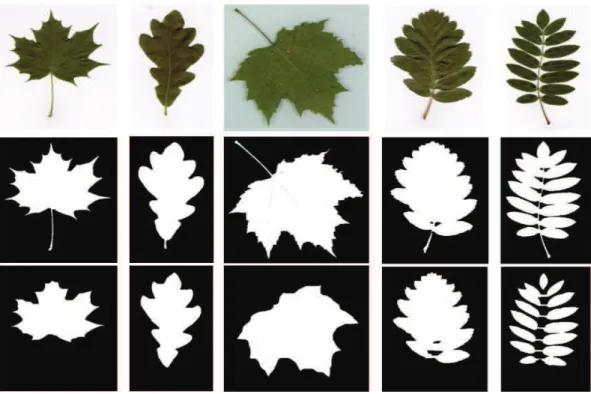
addition to the inter-class similarity. Taxonomic categories (e.g., genus or species) are often determined by subtle differences in shape and texture. In fact, there can even be less variation in appearance between two images from two different (sub)categories than within a single one, as illustrated in Figure 1.3. And whereas the overall shapes may be sufficiently different to distinguish between some species, other species may display only subtle differences.
In particular, plants may exhibit different shape characteristics due to local context, such as location, climatic conditions and age. For example, leaves often have different colors and shapes throughout the seasons. A dead leaf have a very different texture than a living one. The same species could exhibit very different characteristics in two different regions. Figures 1.4 to 1.10 illustrate the intra-class variability over several criteria including global shape, margin, texture, color, number of lobes as well as number, shape and relative positions of leaflets.
Leaves may also vary continuously or discretely even along a single stem as they develop (known as leaf heteroblasty); for example, leaves in Figure 1.11 come from the same plant.
Figure 1.4: Leaf global shape variation of Acer saccharinum species.
Figure 1.5: Leaf margin variation of Quercus ilex species.
2.3
Image background complexity
The background can also represent a key issue specific to an automatic recognition system. Cluttered background can serve as a challenging distractor, especially when the system assumes it is part of the object.
Most of the publicly available datasets used for plant species identification consist of leaf images on a uniform (white) background; examples include the Swedish [104], the Flavia [119] and the Smithsonian [7] datasets. However, the identification problem is far more challenging using cluttered images, which is the case of unconstrained photographs (e.g., branch and foliage photos, other plants in the background, or other objects such as fingers, yardsticks, grass, etc.). Such images were recently published in ImageClef benchmarks 12 and are accumulating at a staggering rate due to mobile devices and
applications3; see Figure 1.12.
1http://www.imageclef.org/2011/Plants
2http://www.imageclef.org/2012/Plants
Figure 1.6: Leaf texture variation of Diospyros kaki (top row) and Laurus nobilis (bot-tom row) species.
3
Positioning in the literature
Due to the aforementioned needs and challenges, there is now a body of literature in computational vision devoted to fine-grained recognition, including identifying botanical species, and designed for both experts and non-experts. A variety of methods were adapted or introduced to discriminate similar objects and several approaches have made use of human input to improve accuracy. Most of this work is summarized in Chapter 2.
Generally, the baseline scenario was to provide the user with a single estimate; examples include [35, 45, 119, 68, 117, 78, 13, 2]. Other researchers chose to report the k most similar classes [7, 67, 75], where k usually ranges from ten to twenty in order to make it likely the true species is among the k reported ones. Many of the most efficient approaches for fine-grained recognition achieved about 70% accuracy on the first estimate and about 90% on the top-10 estimates while considering challenging and relatively large datasets, i.e., containing more than one hundred species with high inter-class similarity and intra-class variability; examples include [74, 7, 67, 75]. Of course, retaining the true species while returning a relatively large set of estimates has limited value in real-world applications. Also, focusing only on the few first estimates without achieving near-perfect (human-level) performances could be essentially useless
Figure 1.7: Leaf color variation of Diospyros kaki (top row) and Ginkgo biloba (bottom row) species.
Figure 1.8: Number of lobes variation of Ficus carica species.
and uninformative for the user. Here, we focus on (1) hierarchical strategies, based on discriminative features, in order to drastically reduce the space of candidate sets of estimates and (2) a new performance criterion: report a subset of species whose expected size is minimized subject to containing the true species with high probability. In particular, we outperform previous methods and achieve near-perfect recognition rates on several leaf images with uniform background; see Chapter 6.
Most state-of-the-art methods in plant identification are obviously based on leaf image analysis and in few cases on flowers [90, 29]. More specifically, such approaches are generally based on images of a single leaf with uniform background [26, 114, 112, 104, 36, 34, 79, 45, 74, 117, 67, 85, 81, 83]. Only a few papers addressed the problem of identifying leaf images on cluttered backgrounds [113, 19, 20, 4] which is the more likely real-world scenario. In this case, the most efficient approaches were those based
Figure 1.9: Leaflet shape and number variation of Sambucus canadensis species.
Figure 1.10: Leaflet relative position variation of Parthenocissus quinquefolia species.
on a segmentation process, either manual or interactive; more details can be found in §2.3. In this work, we also investigate leaf images with natural cluttered background (in addition to those with uniform background) with the aim of proposing the most useful and informative identification scenario to the user. However, no segmentation process is required.
4
Contributions
We investigate to what extent automated plant identification can minimize human in-tervention while ensuring high recognition rates. To this end, we focus on different scenarios, with a human in the loop, to achieve something sensible between the two extremes of an inaccurate but fully automated identification and a very accurate but fully manual identification.
We use hierarchical strategies, based on discriminative features, in order to drasti-cally reduce the space of candidates. The output can be either a single estimate or a set of estimates. The degree of the user intervention can then range from non-existent to significant in ambiguous situations. It is also data-dependent. For example for natural photos of leaves, the degree of interaction between the user and the system may be more
Figure 1.11: Illustration of leaf heteroblasty for Gleditsia triacanthos species, i.e., pro-nounced changes in leaf morphology during plant development.
important than for images on uniform background. A brief summary of the different proposed scenarios (detailed in Chapter 5) is displayed in Figure 1.13.
More formally, let Y denote the complete set of (fine-grained) categories and let Y (I) denote the true category of image I. Our task is to predict Y . To this end, we investigate two strategies: the first is providing a ranked list of categories (the top-1 estimate is considered for the baseline case, i.e., without human intervention), the second is providing a confidence set (CS) which depends on I and such that Y ∈ CS with high probability, say P (Y ∈ CS) ≥ 1 − ǫ. While performance in the former is measured by the rate at which the true category appears among the top k estimates, performance in the latter is essentially measured by the expected size of CS.
Both strategies are anchored by a hierarchical representation of Y. The hierarchy T serves as a platform for defining features and local discriminant scores Xt, t ∈ T . We
investigate both botanical-based and more generic approaches. In particular, we focus on (1) novel object representations (see Chapter 3) as well as (2) novel classification methods, especially a novel framework for organizing the search; see Chapter 4.
4.1
Object representations
Efficient classification is related to discriminating object description. In this disser-tation, we explore improvements in object representation based on specific knowledge domain, and investigate both category-independent and category-dependent features.
Figure 1.12: Examples of unconstrained photographs. One can photograph a picked leaf (top row), a branch (middle row) or a foliage (bottom row).
First, we focus on a hierarchical representation of botanical identification keys (Id-Keys) with the aim of mimicking the process of identification described by botanists. Such a representation was applied on uncluttered leaf images where a leaf is represented by an ordered set of attributes corresponding to IdKeys; see §3. In particular, these keys encode invariable characteristics, i.e., are independent of the plant species as well as the context, such as geography, climatic conditions, season and instantiation. They could refer to geometric properties not directly observable, such as landmarks, or to predetermined groups of species.
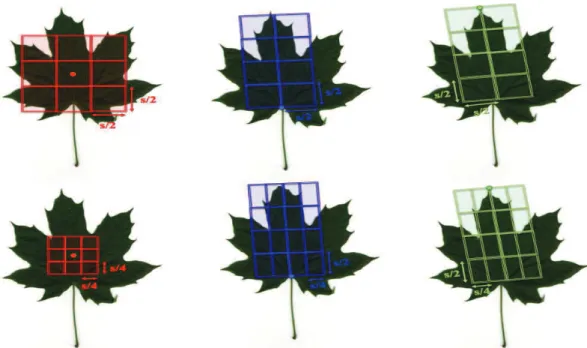
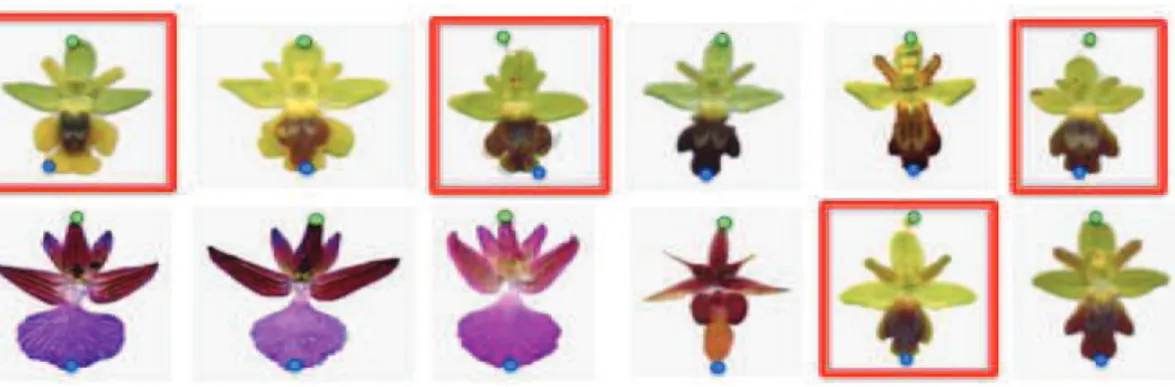
Second, we investigate a more generic representation based on vantage feature frames and in which landmarks are considered more like ”vantage points” in that orientation plays a role as well; in other words, where the landmarks are in relation to one another. And, whereas these landmarks are the same for each species, it is the local features which permit disambiguation. The vantage feature frames deal with two important aspects: where to look and what to compute; see §4.
Both representations serve to induce local discriminant functions and classifiers for an efficient identification.
Figure 1.13: We consider three levels of user interaction in identifying the species of leaf images with either uniform and cluttered background: none (the baseline case of a fully automated system returning a point estimate); final disambiguation (the user receives a set of estimates); initialization and final disambiguation (the user also initializes the process by identifying landmarks). The checks indicate the level we require to obtain useful/satisfactory results.
4.2
Classification algorithms
The main idea behind our classification methods in the proposed identification scenar-ios is to take advantage of a hierarchical representation T of the data. Examples of hierarchies of leaves are shown in Figure 1.14.
We first build local classifiers using likelihood ratio and local discriminant functions. The hierarchy is then processed breadth-first coarse-to-fine: at each level, all the children of a positive node t are retained and tested at the next level. Whereas false positives can be successively pruned, if the true hypothesis is rejected at a node containing it then it cannot be recovered. The positive species (i.e., terminal nodes) are finally sorted according to their likelihood ratios.
Then, in analogy with confidence intervals in classical statistics, we build a prob-abilistic model which enables confidence set (CS) selection. The expected size of the confidence set plays the role of the width of the confidence interval in standard statistics and the posterior probability that the true category belongs to the confidence set plays the role of the confidence level. The idea is to restrict CS candidates to the subsets {Ct, t ∈ T } and integrate all the evidence from the node scores to compute the posterior
probability P (Y ∈ Ct|X = x), where X = {Xt, t ∈ T }. To this end, we require the joint
conditional density p(x|c) of the scores x = (xt, t ∈ T ), c ∈ Y. (We assume the prior
distribution p(c) is uniform over species c ∈ Y.) We use a Gaussian Bayesian network. More details about the motivation and the modeling can be found in Chapter 4.
Figure 1.14: Simple hierarchical representations of four species. (a) A semantic hier-archy: the second level represents leaf genera and the third level the species. (b) A hierarchy based on morphological leaf characteristics: the second level represents the leaf type (simple or compound) and the third level the species. A thumbnail from each species is displayed.
4.3
Publications
Following is the list of publications related to our work:
• A. Rejeb Sfar, N. Boujemaa and D. Geman. Identification of Plants from Mul-tiple Images and Botanical IdKeys. In Proceedings of the ACM International
Conference on Multimedia Retrieval, 2013.
• A. Rejeb Sfar, N. Boujemaa and D. Geman. Vantage Feature Frames For Fine-Grained Categorization. In Proceedings of the IEEE Conference on Computer
Vision and Pattern Recognition, 2013.
• A. Rejeb Sfar, N. Boujemaa and D. Geman. Vantage Feature Frames For Botan-ical Species Identification. In the second workshop on Fine-Grained Visual
Cate-gorization, in conjunction with CVPR 2013 conference.
• A. Rejeb Sfar, N. Boujemaa and D. Geman. Confidence Sets for Fine-grained Cat-egorization and Plant Species Identification. In International Journal of Computer
5
Outline of the thesis
In this first chapter, we have informally introduced the different issues investigated in this thesis. The remaining part of this dissertation is structured as follows:
• Chapter 2reviews the literature that is relevant to the fine-grained categoriza-tion, especially the plant species identificacategoriza-tion, and place our work in the context of related research.
• Chapter 3 presents two novel object representations. The first representation refers to the IdKey hierarchy which is driven by specific knowledge domain. The second representation is the concept of vantage feature frames for fine-grained discrimination.
• Chapter 4 describes two novel classification frameworks, including the CTF search within the likelihood framework and the model-based approach using a statistical analogy.
• Chapter 5details the different identification scenarios that we propose, includ-ing fully-automated and semi-automated identifications usinclud-ing either a sinclud-ingle or multiple samples.
• Chapter 6presents data and experiments used to evaluate proposed techniques and scenarios. Comparisons and critical analyses are provided.
• Chapter 7 concludes the thesis with a summary of our contributions and some directions for further research.
Chapter 2
Related Work
Our work is related to existing work on fine-grained categorization [37, 78, 75, 90], especially work on plant species identification from leaf images [26, 118, 7, 67, 50]. Different approaches, described in this dissertation, relate to hierarchical classification and classification with class-selective rejection.
This chapter reviews the literature that is relevant to our work. Section 1 provides an overview of related research on fine-grained categorization, especially on some animal species categorization, including birds, insects and dogs. Previous approaches were divided into fully-automated methods (see §1.1) and those using human input (see §1.2). Section 2 describes stat-of-the-art methods on plant identification from leaf images. We discuss both generic (see §2.1) and botanical-based approaches (see §2.2). We also address the problem of cluttered leaf images in previous work in §2.3. Section 3 and Section 4 respectively, present the hierarchical classification and classification with class-selective rejection.
1
About fine-grained categorization
There is a growing body of work investigating identification of birds [37, 109, 123], insects [68, 78], dogs [97, 76, 75], flowers [90, 3] and leaves. Both images and sounds were studied, especially for birds.
1.1
No human intervention
Several fully-automated approaches have been used for fine-grained categorization. Lar-ios et al. [69] describes an automated identification system of stonefly larvae using con-catenated histograms of local appearance features. Such histograms involves both region detection and local representation. Shape-based methods, including boundary analyses, have been especially adapted for leaf images using an automatic segmentation [7, 16, 74]. Often, performance is sensitive to the quality of the contour resulting from the segmen-tation process, which naturally complicates distinguishing between categories with very similar shapes as well as identifying species from cluttered images. Other methods adapt systems for detecting instances of generic object classes [70, 110] by encoding an image as a bag of discrete visual codewords and basing classification on histograms of codeword occurrences; examples include [90, 69]. Some work [126] explore variations such as learning multiple non-redundant codebooks. Other [81, 83] adopt hashing tech-niques [94] for efficient embedding and matching of high-dimensional feature vectors or [123] use continuous template matching instead of discrete visual codewords for im-age representation. Again, however, the distinctions among fine-grained categories are sometimes too refined to be captured by variations in bags of visual words, hash tables or random templates.
1.2
Human intervention
To account for such distinctions, an increasing number of studies make use of human input in the identification task. In [13, 109], interactive systems are proposed wherein humans click on bird parts and answer questions about attributes (e.g., ”white belly”, ”red-orange beak”, ”sharp crown”). The main goal was to efficiently select the most informative questions to pose to the user in order to identify the unknown species as quickly as possible. While [13] incorporates only one type of user input (i.e., binary questions) and uses non-localized computer vision methods based on bag-of-words fea-tures, [109] allows heterogenous forms of inputs and incorporates a part-based model.
The authors of [65] propose an interactive mobile application for plant identification which is based on social images of different plant organs. The application provides to the user an easy access to a rich botanical knowledge which was collected and revised by