Optimization issues in phenotyping plateforms
Marián Brestič1, André Rossi2, Oksana Sytar1 and Marek Živčák1
1 Slovak Agricultural University in Nitra, 949 01 Nitra, Slovak Republic
[email protected], [email protected], [email protected]
2 Université Paris-Dauphine, PSL, LAMSADE, F-75016 Paris, France
Mots-clés : Biology, Phenotyping plateforms, Scheduling, Optimization
1
Introduction
The combined effects of climate change and population growth have made agriculture appear as one of the most important challenge of the century. In order to be able to produce food for everyone in the coming decades, there is an urgent need to build more knowledge about plants, and how to grow them in a sustainable way, i.e., how to produce enough biomass without resorting to pollutant chemicals inputs. Hence, plant biologists need to understand what makes plants resistant to diseases, parasites, insects and hydric stress, among other environment effects. The functional plant body, called the phenotype, is the result of the combination of the plan genotype with the environment : two plants with the same DNA will not have the same development under different environment conditions. As the so-called plant
performance is the result of phenotype, a lot of effort has recently been devoted to study plants
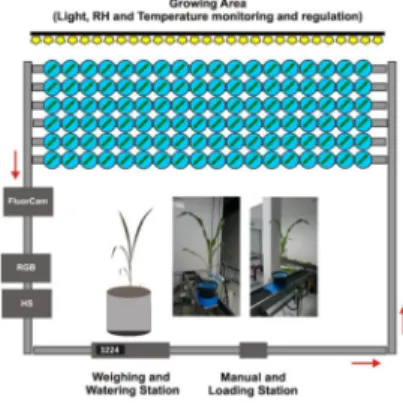
phenotype. More specifically, biologists run large scale experiments on hundreds or thousands of plants, for example to determine how resistant is a particular plant to a wide range of environment conditions. To this end, the plants are settled in pots, and these pots are moved by a conveyor belt from a cultivation chamber to different quantitative automated measurement stations, where RGB cameras, spectrography and other techniques are employed to monitor plants growth on a regular basis. The European project EPPN2020 [1] aims at gathering a large number of such facilities to share experience and accelerate the research progresses in plant biology. It currently involves 31 plant phenotyping platforms and 21 partners across Europe from 12 countries (including the Slovak University of Agriculture in Nitra), under the coordination of INRA, with a budget ofe10 million for four years. It can be observed that the phenotyping platforms available in EPPN2020 and everywhere else in the world have a very similar structure (see Figure 1).
2
Optimization problems
The exploitation of these phenotyping platforms poses some challenges that are analogous to the issues raised by traditional manufacturing or production systems, along with some specific features. We present below a list of problems that have been identified in the phenotyping platforms.
2.1 Maximizing the throughput
Phenotyping platforms are sometimes called high-throughput phenotyping platforms, for conveying the idea that they should be able to perform a many measurements in a short amount of time. Hence, as a first approach, a phenotyping platform can be modeled as a per-mutation flowshop. Indeed, the conveyor belt system does not allow a pot to overpass the pot that is located ahead of it on the conveyor belt, and since no by-passes are available, all the plants visit all the stations in the same order. As the biologists sometimes do not require all the plants to undergo al the measurements, a possible problem variant is to decide which plants to send to which measurement stations while fulfilling the minimum measurement requirements.
2.2 Ensuring an equal lighting to all plants
Plants development is very sensitive to light, so when comparing different kinds of environ-mental conditions, it is important to ensure that all the plants have received the same amount of light. Even if the phenotyping platforms in greenhouses like the one in Nitra are equipped with controlled agriculture-specific LEDs light systems, all the plants standing in the cultivation chamber do not receive the same amount of light, with differences that can reach 30%, which is sufficiently large to bias the results of the experiments. This is due to the fact that upgrading the lighting system would be very expensive, and would increase the energy consumption of the phenotyping platform. This problem is usually addressed by moving the plants randomly in the cultivation chamber during the night [2], which is considered a satisfactory approach only if applied over a sufficiently long period of time. Here also, optimization methods can be used to minimize the maximum gap between the amount of light received by any pair of plants in the system.
3
Conclusions et perspectives
The scheduling problems identified in this work will be presented in more details during the conference, along with some solutions applied to real instances.
4
Acknowledgment
This work was supported by a grant from Campus France, under the scheme of a Partenariat Hubert Curien Stefanik number 40491QC and corresponding Slovak project APVV-SK-FR-2017-0007.
Références
[1] EPPN2020. https://eppn2020.plant-phenotyping.eu/
[2] C. Brien, B. Berger, H. Rabie and M. Tester. Accounting for variation in designing green-house experiments with special reference to greengreen-houses containing plants on conveyor systems. Plant Methods, 9(5220), 2013.