HAL Id: hal-01397686
https://hal.archives-ouvertes.fr/hal-01397686
Submitted on 16 Nov 2016
HAL is a multi-disciplinary open access
archive for the deposit and dissemination of
sci-entific research documents, whether they are
pub-lished or not. The documents may come from
teaching and research institutions in France or
abroad, or from public or private research centers.
L’archive ouverte pluridisciplinaire HAL, est
destinée au dépôt et à la diffusion de documents
scientifiques de niveau recherche, publiés ou non,
émanant des établissements d’enseignement et de
recherche français ou étrangers, des laboratoires
publics ou privés.
Performance Analysis of Object Store Systems in a
Fog/Edge Computing Infrastructures
Bastien Confais, Adrien Lebre, Benoît Parrein
To cite this version:
Bastien Confais, Adrien Lebre, Benoît Parrein. Performance Analysis of Object Store Systems in
a Fog/Edge Computing Infrastructures. CloudCom, Dec 2016, Luxembourg, Luxembourg.
�hal-01397686�
Performance Analysis of Object Store Systems in a
Fog/Edge Computing Infrastructures
Bastien Confais
∗, Adrien Lebre
†, Benoˆıt Parrein
‡∗CNRS, IRCCyN UMR 6597,
1, rue de la No¨e, BP 92101, 44321 Nantes Cedex 3, France
†INRIA, LINA UMR 6241,
Mines de Nantes, 4 Rue Alfred Kastler, 44300 Nantes, France
‡Universit´e de Nantes, IRCCyN UMR 6597,
Polytech Nantes, rue Christian Pauc, BP 50609, 44306 Nantes Cedex 3, France
Abstract—Fog/Edge computing infrastructures have been pro-posed as an alternative of current Cloud Computing facilities to address the latency issue that prevent the development of several applications. The main idea is to deploy smaller data-centers at the edge of the backbone in order to bring cloud computing resources closer to the end-usages. While couple of works illustrated the advantages of such infrastructures in particular for IoT applications, the way of designing elementary services that can take advantage of such massively distributed infrastructures has not been yet discussed. In this paper, we propose to deal with such a question from the storage point of view. First, we propose a list of properties a storage system should meet in this context. Second, we evaluate through performance analysis three “off-the-shelf” object store solutions, namely Rados, Cassandra and InterPlanetary File System (IPFS). In particular, we focused (i) on access times to push and get objects under different scenarios and (ii) on the amount of network traffic that is exchanged between the different sites during such operations. Experiments have been conducted using the Yahoo Cloud System Benchmark (YCSB) on top of the Grid’5000 testbed. We show that among the three tested solutions IPFS fills most of the criteria expected for a Fog/Edge computing infrastructure.
I. INTRODUCTION
The advent of smartphones, tablets as well as IoT devices revolutionized the ways people are consuming IT services. While lots of applications take the advantage of the Internet and Cloud Computing solutions to extend devices’ capabilities in terms of computations as well as storage, reaching data centers (DCs) operated by giant actors such as Amazon, Google and Microsoft implies significant penalties in terms of network latency, preventing a large amount of services to be deployed [1]. The Fog Computing paradigm [2] has been proposed to overcome such a limitation: dedicated severs are deployed in micro/nano DCs geographically spread at the edge of the network so that it becomes possible to execute latency dependent applications as close as possible to the end-usages and keep non sensitive ones in traditional Cloud DCs.
Also known as Edge Computing, the advantages of of such infrastructures have been described through several scenarios [3], [4]. However all these studies focused on particular use-cases and do not investigate whether generic Fog/Edge services can be envisioned. In this paper, we propose to
address such a question for a cloud storage service. Concretely, we discuss an empirical analysis of three storage systems with the ultimate goal of delivering a system such as the Simple Storage Service (S3) of Amazon. S3 is one of the most used services offered by Amazon and a building block for hundred of cloud services. We believe that providing such a storage service for Fog/Edge Computing infrastructures can pave the way toward new services as well as IoT applications.
The three storage systems we studied are Rados [5], the ob-ject storage module of the Ceph proob-ject, Cassandra [6], a high performance key value store and InterPlanetary File System (IPFS) [7], a storage system which uses the concepts brought by BitTorrent. We selected these three systems because they propose software abstractions for the definition of geographi-cal areas without leveraging on a central server. We claim that such software-defined areas are important for the Fog/Edge Computing because it enables the storage system to consider the topology of the infrastructure (i.e., one software area corresponds to one particular micro DC, that is one Fog/Edge site). Considering the topology enables the development of advanced strategies that can favor local accesses with the goal of mitigating the traffic that is exchanged between each site as well as the impact each site may have on the others. Moreover, each of the selected systems relies on a different software architecture as well as communication protocols that allow us to see the pros and cons of the different development choices in a Fog/Edge Computing context.
The main contribution of our work is a deep performance evaluation enabling the identification of pros/cons of the strategies implemented by those three systems. Experiment have been done on top of Grid’5000 [8] by considering several data manipulation scenarios leveraging Yahoo Cloud Service Benchmark (YCSB) [9], a well-known benchmark tool particularly designed to benchmark object stores [10], [11].
The remaining of the paper is as follows. Section II defines the Fog/Edge computing model we consider and gives a list of characteristics a S3-like service should have in such a context. Section III presents an overview of the three storage systems. Evaluations are discussed in Section IV. Finally, Section V concludes this study and highlights some perspectives.
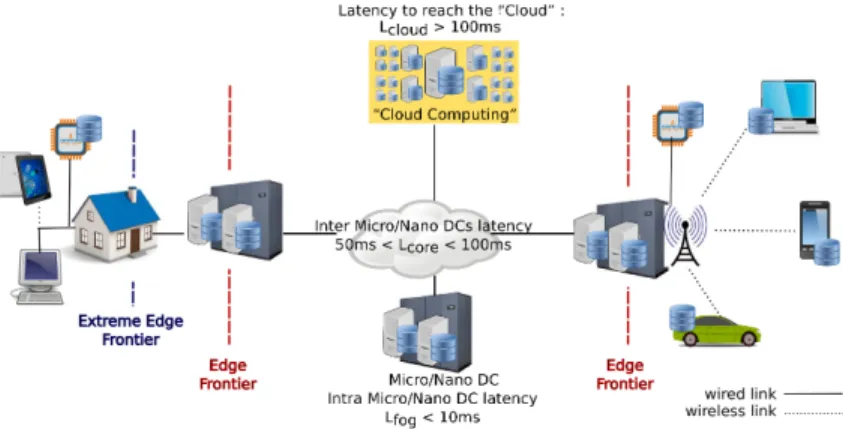
Fig. 1. Overview of a Cloud, Fog and Edge platform.
II. FOG/EDGECOMPUTING MODEL
In this section, we present the Fog/Edge architecture we are considering and a list of characteristics we claim an object storage system should have in such a context.
A. Fog/Edge Computing: a hierarchy of resources
Industrials as well as academics argue in favor of a new model of distributed computing composed of IT resources spread from the Cloud to the Extreme Edge. Such an in-frastructure follows a hierarchical topology from the point of views of distance and power capabilities: Cloud facilities are the farest elements in terms of network latencies but the ones that provide the largest computing and storage capabilities. Edge/Extreme Edge devices can benefit from local computing and storage resources but those resources are limited in comparison to the Cloud ones. Finally, Fog sites can be seen as intermediate facilities that offer a tradeoff between distance and power capabilities of IT resources [1], [12]. Moreover, Fog sites can complement each other to satisfy the needs between user’s devices and Cloud Computing centers [3], [13]. Figure 1 illustrates such a description. The Fog platform is composed of a significant number of sites that can be geographically spread over a large area. Each site hosts a limited number of servers that offer storage and computing capabilities. End-users devices (smartphones, tablets, laptops) as well as IoT devices can reach a Fog site with a rather low latency. We
consider that the latency between Fog sites (noted Lcore) is
up to 50 ms (mean latency of a Wide Area Network link) and
the latencies between users and their site (noted Lf og) is less
than 10 ms (latency of a wireless link). The latency to reach a
Cloud platform (noted Lcloud) from the clients is important in
comparison to other durations (about 200 ms) [14], [15] and unpredictable [1].
B. Storage requirements
Our objective is to study how a storage service such as a S3 object store system should be designed to deal with and take the advantage of Fog/Edge Computing infrastructure specifics. In addition to the scalability requirement that is intrinsic to such a massively distributed infrastucture, we advocate that a Fog/Edge computing storage service should meet the following properties:
• low access time (by favoring data locality);
• network containment between sites;
• availability of data in case of service partitionning;
• support for users mobility.
Low access time is the main characteristic behind the motivation for the Fog paradigm. The idea is to favor local accesses each time it is possible (i.e., each put into the object store should be handled by the closest site, assuming that each fog site delivers the same storage performance).
Network containment is the idea that an action on one site does not impact the other sites negatively. In other words, if one site faces a peak of activity, the performance of other sites should not change. We believe that such a criteria can be delivered by mitigating data transfers between sites each time an operation is performed.
The third feature is related to the partitioning of the storage service that can occur each time one site is disconnected from the other ones. While replication strategies between sites can ensure data availability, we claim that a Fog storage service should be able to run, at least, in a degraded mode in order to tolerate local accesses and provide appropriate mechanisms to reconsolidate the service once the disconnection is completed. Mobility support is the last property we have identified. The idea is to enable data to transparently follow its usages. To illustrate such a feature, you can imagine a user moving from one radio base station to another one. In such a situation, the storage service should be able to relocate sollicited data in a transparent manner from the previous site to the new one. Such a transparent relocation of data will mitigate remote acesses.
Last but not the least, we underline that discussing conis-tency model of the storage service we target is behind-the-scope of this first study. For the moment and for the sake of simplicity, we consider objects like files and documents of one user with no parallel accesses.
III. “OFF-THE-SHELF” DISTRIBUTED STORAGE SYSTEMS
Distributed file systems such as PVFS [16], Lustre [17], HDFS [18] and other WANWide-like proposals [19], [20] are not appropriated to the Fog/Edge Computing infrastructure we target because they all have been designed around the concept of an entity in charge of maintaining the storage namespace in a rather “centralized” manner. Because they
are leveraging P2P mechanisms, object and key/value store systems are better candidates to cope with the requirements we defined in the previous section. Among the different solutions that are available, we selected Rados [5], Cassandra [6] and IPFS [7] due to the fact that they provide software abstractions that enable the definition of areas that can be mapped to geographical sites. We present in the following paragraphs, an overview of those three systems.
A. Rados
Rados [5] is an object distributed storage solution which uses the CRUSH algorithm [21] to locate data in the cluster without requiring any remote communication from the clients. Rados uses two kinds of nodes: Object Storage Daemons (OSD) and Monitors. The formers are used to store data where as the latters maintain a tree (a.k.a. the “clustermap”) describing the cluster’s topology. Among the monitors, one is elected as the master and is in charge of maintaining a consisteny view of the clustermap (the Paxos algorithm is used to guarantee that there is only one master monitor). The “clustermap”, that is distributed to each client node is used by the CRUSH algorithm to locate objects.
Rados allows administrators to organize objects within pools. Each pool is associated to “placement rules”. In our context, we use placement rules to constraint objects of a particular pool to be located on one site. To write or read an object, clients must provide the name of the pool.
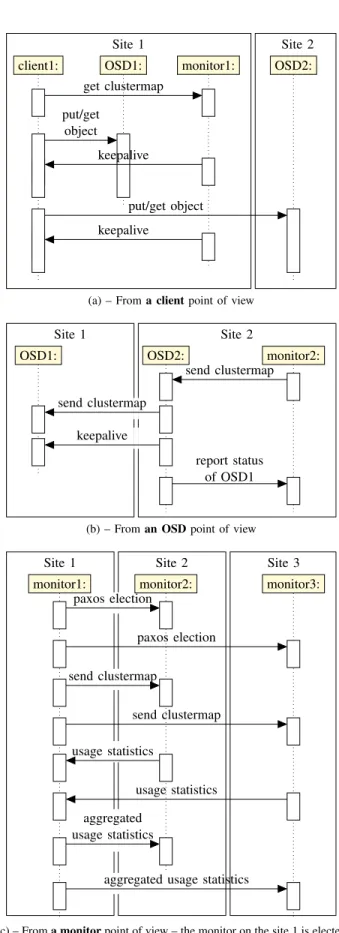
In case of network partitioning, data that is located in the partition where a master monitor can still be elected, is available. In other words, clients that belong to this partition can access the “clustermap” and thus any object that is reachable. On the other partitions, because clients cannot get the “clustermap” they cannot locate and thus access any object. Figure 2 shows the sequence diagram of exchanges we observe in a Rados deployment, respectively from a client (a), an OSD (b) and a monitor (c) point of view. In addition to the exchanges we described, Rados uses a large number of keepalives messages between the different nodes. This enables the system to swiftly react in case failures.
It is noteworthy to mention that Rados when no cache is configured, each time a client wants to accesss to an object, it is to pull it from the OSD where it is persistenly stored.
In overall, the inter-site overhead is a mixed of Paxos’ messages and usage statistics sent between the monitors, the amount of inter sites network traffic concerning the report of OSD status and the size of the “clustermap” each time a client needs to retrieve it. To mitigate as much as possible this overhead, it is possible to place one monitor per site. This minimizes the report of OSD status between sites as well as the overhead related to the clustermap retrievals.
B. Cassandra
Cassandra is a key value store designed on a one-hop distributed hash table (DHT) [6]. The keyspace is divided into ranges that are distributed among the nodes composing the system. A gossip protocol is used to distribute the topology
Site 1 Site 2 get clustermap keepalive put/get object keepalive put/get object
client1: OSD1: monitor1: OSD2:
(a) – From a client point of view
Site 1 Site 2 send clustermap send clustermap keepalive report status of OSD1
OSD1: OSD2: monitor2:
(b) – From an OSD point of view
Site 1 Site 2 Site 3 paxos election paxos election send clustermap send clustermap usage statistics usage statistics aggregated usage statistics
aggregated usage statistics
monitor1: monitor2: monitor3:
(c) – From a monitor point of view – the monitor on the site 1 is elected Fig. 2. Sequence diagrams of the network traffics observed in Rados.
of the system, the status of the nodes and the ranges affected to them. Once gossiped data is received, storage nodes can
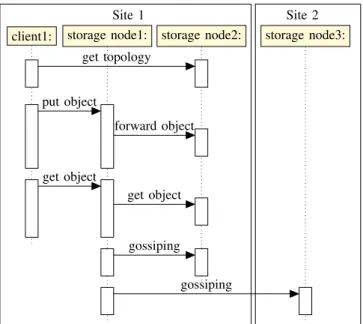
Site 1 Site 2 get topology forward object put object get object get object gossiping gossiping
client1: storage node1: storage node2: storage node3:
Fig. 3. Sequence diagrams of the network traffics observed in Cassandra.
locate any object without any extra communication.
A quorum, specified by users defines the number of replicas that has to be read or written for each request to validate the operation. Depending on the values used in this quo-rum, Cassandra can provide different levels of consistency. This quorum provides a trade-off between access time and consistency. Moreover, Cassandra exposes the same notion of pools that the one proposed by Rados. Entitled “keyspaces”, each pool is associated to a placement strategy. The “Net-workTopologyStrategy” for instance enables administrators to specify for each datacenter (and in our case, for each site) how many replicas of an object they want to store. For the purpose of our analysis, we defined a strategy where there is only one copy of an object in a particular site throughout the whole system. Such a strategy enables Cassandra to mitigate the traffic between sites each time an object is pushed into it. Having one replicate guarantees strong consistency.
Like Rados, users have to specify the keyspace’s name they want to use. The major exchanges related to the Cassandra protocol are illustrated on Figure 3: Clients retrieve the topol-ogy from the server they connect to. Based on the topoltopol-ogy they retrieved, they contact one of the nodes of the site they belong to. For performance purposes, requests are balanced in a round-robin way. That is, a client send requests alternatively from a server to another on within the same site. The request is then forwarded to the server, which has to handle it (the server is determined based on the aforementioned strategy).
Thanks to the “NetworkTopologyStrategy”, the gossip traf-fic is the only overhead that goes throughout the different sites. C. InterPlanetary File System
InterPlanetary File System [7] has been built on the BitTor-rent protocol [22] and the Kademlia DHT [23], both being well-known protocols for their ability to scale to a large
number of nodes. While the BitTorrent protocol is used to manipulate objects between the different peers of the system in an efficient manner, the Kademlia DHT is in charge of storing the objects’ location. We underline that it is only the locations and not the content of the objects that are stored in the DHT. Such a management of the data locations is an important difference in comparisons to Rados and Cassandra that have designed dedicated mechanisms to locate objects without extra communication from the clients viewpoint.
Figure 4 shows the major exchanges of IPFS. When a client wants to put an object. The client sends the object to a node. This node saves the object locally and then puts the location of the object in the kademlia DHT. Reciprocally, when a client wants to get an object, it has to contact one peer of IPFS that will use the Kademlia DHT to determine the node in charge of delivering the object. Based on the Kademlia reply, the request is forwarded to the correct node. This node will send the object to the initial IPFS peer that will make a copy before serving the client. Thanks to such an approach, IPFS supports the mobility of data in a native fashion. A future read will be satisfied by this node, closer to the client. Storage nodes send regurlarly keepalive messages to maintain the DHT.
It is noteworthy that IPFS uses immutable objects. Modify-ing an existModify-ing object creates a new one. Because objects are immutable, it is easier to maintain the consistency between all replicas of one object. Moreover, the BitTorrent protocol that is used to pull the data enables to retrieve the same object from several sources simultaneously.
Last but not the least, IPFS can work partially in discon-nected mode as long as both the object location can be found in the kademlia DHT and the node storing the object is reachable.
Site 1 Site 2 put location in DHT put object get find location in DHT get get get get get keepalive
client1: storage node1: storage node2: storage node3: client2:
find location in DHT
Fig. 4. Sequence diagram of the network traffics observed in IPFS from a client point of view. The read from “client2” can be performed using “storage node2” only after “client1” read from “storage node2”.
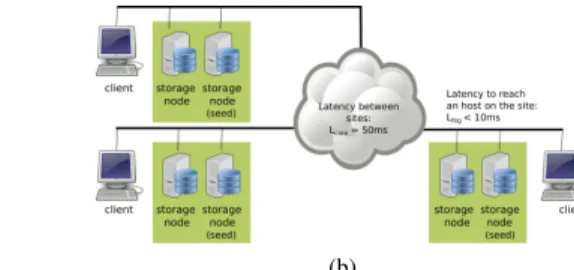
(a) (b) Fig. 5. Topology used to deploy Rados (a), Cassandra and IPFS (b) in a Fog environment.
Rados Cassandra IPFS
Data locality Yes Yes Yes
Network containment No Yes No
Disconnected mode No Yes Partially
Mobility support Partially Partially Natively
TABLE I
SUMMARY OFFOG CHARACTERISTICSa prioriMET FOR3DIFFERENT OBJECT STORES.
D. Summary
Table I summarizes how do Rados, Cassandra and IPFS fit the requirements that have been defined in Section II-B.
IV. EXPERIMENTS
In this section, we discuss evaluations we performed on the three systems. The first experiment (Section IV-B) focuses on local access times and on the amount of network traffic exchanged between sites. The second one (Section IV-C) measures the remote access time, when data is accessed from a site which does not store it.
A. Material and method
The Fog architecture as well as the way we deployed the different systems are presented in Figure 5(a).
For Rados, each site hosts one client, two storage servers (small sites) and one monitor. With Cassandra and IPFS, one server per site is configured as a seed node, so that other nodes can join the cluster without inter sites communications. With Rados each pool is associated to a placement rule to force data to be stored on a specific site and with Cassandra, the ”NetworkTopologyStrategy” is used as previously described in Section III-B. With IPFS, locality is natively supported because data is located on the node the client writes on.
Experiments are performed on the Grid’5000 testbed using the “paravance” cluster. Latencies between hosts are
emu-lated using the tc program. We use Lf og = 10 ms and
Lcore = 50 ms (as depicted in Figure 1). The throughput of
the network links is 10 Gbps. Because each system has its own consistency/replication strategy by default, we modified those configuration in order to write only one copy of the object. In addition to inserting new objects as fast as possible, it enabled us to fairly compare the systems.
The metrics we measure are the time taken to perform operations on each site and the amount of network traffic sent between the sites on that period. Flushing operation (sync operation) is not taken into account in the measurements.
Regarding IPFS and still in order to ensure fair compar-isons between the three systems, requests have been balanced
between the servers of a same site. This means that one object could have been written on one server and then a read request can be sent to the other server of the site ( resulting with an additional read copy on the server as described in Section III-C) Moreover, IPFS adds redundancy in the Kademlia DHT: for each object, the location is stored on 10 different nodes to support failures. we modify IPFS to avoid this replication of metadata.
The Yahoo Cloud System Benchmark [9] (YCSB) has been used to emulate data accesses. We use different access patterns in order to check if the storage systems may be used for different kinds of applications. Object sizes vary from 1 MB to 10 MB. Scenarios have been performed using 1, 7 and 11 sites. Each experiment has been performed at least 10 times (10 trials) to get consistency in results and stored data is erased between the trials.
Cassandra and Rados modules for YCSB already exist but we wrote the module for IPFS. The Rados module opens a connection in each thread, contrary to Cassandra module in which only the first thread establishes a connection to the cluster. The measured access times for Cassandra are high compared to what we measure with our “home-made” benchmark script. Indeed, the java garbage collector is called when the connection to the cluster is closed, increasing the access times very importantly by experience Therefore, we decided to remove this instruction. Writes are performed during the load phase of YCSB and reads during the run phase. The workload used performs only read operations of objects selected selected according to a uniform distribution.
B. Local read/write evaluation (experiment 1)
Alls clients (one per site) executes the access scenario simultaneously: all clients write objects on their site and read them. The goal is to evaluate data locality as well as network containment properties on each site.
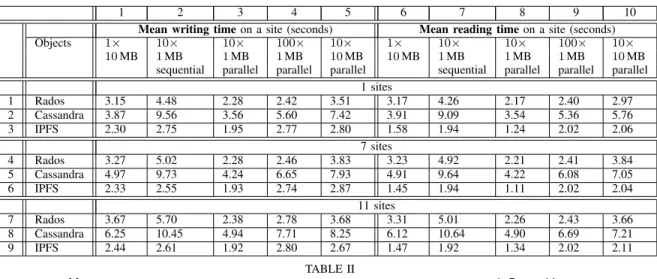
1) Writing and reading times: Table II shows the access
times measured with YCSB. All Standard deviations are less than 0.6 seconds and thus have not been reported.
The first observation is with Rados, access times do not increase significantly when sites are added. As an example, it takes 3.15 seconds to write one object of 10 MB on 1 site and 3.67 seconds on 11 sites. This comes from the use of the CRUSH algorithm: read or write on a site does not require any communication with nodes outside the site (the clustermap is obtained from the local monitor). Also, access times are similar for writing and reading. For example it takes 2.78
1 2 3 4 5 6 7 8 9 10
Mean writing time on a site (seconds) Mean reading time on a site (seconds)
Objects 1× 10× 10× 100× 10× 1× 10× 10× 100× 10×
10 MB 1 MB 1 MB 1 MB 10 MB 10 MB 1 MB 1 MB 1 MB 10 MB
sequential parallel parallel parallel sequential parallel parallel parallel
1 sites 1 Rados 3.15 4.48 2.28 2.42 3.51 3.17 4.26 2.17 2.40 2.97 2 Cassandra 3.87 9.56 3.56 5.60 7.42 3.91 9.09 3.54 5.36 5.76 3 IPFS 2.30 2.75 1.95 2.77 2.80 1.58 1.94 1.24 2.02 2.06 7 sites 4 Rados 3.27 5.02 2.28 2.46 3.83 3.23 4.92 2.21 2.41 3.84 5 Cassandra 4.97 9.73 4.24 6.65 7.93 4.91 9.64 4.22 6.08 7.05 6 IPFS 2.33 2.55 1.93 2.74 2.87 1.45 1.94 1.11 2.02 2.04 11 sites 7 Rados 3.67 5.70 2.38 2.78 3.68 3.31 5.01 2.26 2.43 3.66 8 Cassandra 6.25 10.45 4.94 7.71 8.25 6.12 10.64 4.90 6.69 7.21 9 IPFS 2.44 2.61 1.92 2.80 2.67 1.47 1.92 1.34 2.02 2.11 TABLE II
MEAN TIMES IN SECONDS TO WRITE AND READ ALL THE OBJECTS ON A SITE WITH1, 7AND11SITES.
0 5 10 15 20 25 1 x 10MB 10 x 1MB, sequential 10 x 1MB, parallel 100 x 1MB, parallel 10 x 10MB, parallel
Amount of data sent
between fog sites (MB)
rados ipfs cassandra (a) – 7 sites 0 5 10 15 20 25 1 x 10MB 10 x 1MB, sequential 10 x 1MB, parallel 100 x 1MB, parallel 10 x 10MB, parallel
Amount of data sent
between fog sites (MB)
rados ipfs cassandra
(b) – 11 sites
Fig. 6. Cumulated amount of network traffic exchanged between all the sites while clients write objects on their sites.
0 5 10 15 20 25 1 x 10MB 10 x 1MB, sequential 10 x 1MB, parallel 100 x 1MB, parallel 10 x 10MB, parallel
Amount of data sent between fog sites (MB)
rados ipfs cassandra (a) – 7 sites 0 5 10 15 20 25 1 x 10MB 10 x 1MB, sequential 10 x 1MB, parallel 100 x 1MB, parallel 10 x 10MB, parallel
Amount of data sent between fog sites (MB)
rados ipfs cassandra
(b) – 11 sites
Fig. 7. Cumulated amount of network traffic exchanged between all the sites while clients read objects located on their sites. seconds to write 100 objects on 11 sites and 2.43 seconds
to read them.
With Cassandra, high access times are due to the latencies
inside the sites (Lf og). It takes 0.94 seconds to write 100
objects of 1 MB one on site without extra latencies (not
presented in the Table II). However, with Lf og = 10 ms, it
takes 5.60 seconds (row 2, column 4). The forward mechanism due to the balance of requests between nodes (see Section III-B also increases the access times More generally, access times are increasing linearly with the number of sites. The gossip traffic between the nodes (described in the next section) has an influence on the access times. Adding more sites generates more gossip traffic and longer access times. As explained in the next part, the gossip traffic is asynchronous but the thread managing it and the thread executing the clients’ requests need synchronizations. Therefore, the number of nodes impacts the access times but it seems only be the consequence of an issue with the implementation.
We observe performance falls down with big sized objects. On 11 sites, writing 10×10 MB is 1.7 times longer than writing
10×1 MB (8.25 s vs 4.94 s ; row 8, columns 5 and 3) although with Rados and IPFS it is only approximately 1.2 times longer (3.68 s vs 2.38 s for Rados and 2.67 s vs 1.92 s for IPFS).
With IPFS, access times do not increase a lot when there are additional sites. For instance, it takes 2.30 seconds to write one object of 10 MB on 1 site (row 3, column 1) and 2.44 with 11 sites (row 9, column 1). Reading 100 objets of 1 MB, takes strictly the same time for 1, 7 and 11 sites (2.02 seconds) (rows 3, 6 and 9, column 9).
2) Amount of network traffic sent between sites: Figures 6
and 7 show the amount of network traffic sent between sites. The first comment is that for each system, the traffic that is exchanged between sites is relatively small in comparison to the amount of data stored (less than 2% of the amount of stored data).
For Rados, this traffic is the most important (7.5 MB both in writing and in reading for 100 × 1 MB on 7 sites) and increases with the number of monitors (i.e. the number of sites) with the same order of magnitude for writing and reading. As previously described, all monitors send usage statistics to the
1 2 3 4 5 6 7 8 9 10 11 12 13 14 15
Mean writing time on a local site (seconds) Mean reading time on a remote site (seconds)
First read Second read
Objects 1× 10× 10× 100× 10× 1× 10× 10× 100× 10× 1× 10× 10× 100× 10×
10 MB 1 MB 1 MB 1 MB 10 MB 10 MB 1 MB 1 MB 1 MB 10 MB 10 MB 1 MB 1 MB 1 MB 10 MB sequential parallel parallel parallel sequential parallel parallel parallel sequential parallel parallel parallel
1 Rados 3.19 4.49 2.24 2.53 3.53 15.36 26.12 6.06 5.11 10.35 14.58 27.48 6.97 5.18 10.19
2 Cassandra 3.37 10.01 3.49 6.27 6.76 13.90 30.92 9.12 20.97 26.88 14.06 30.75 9.11 18.66 26.28
3 IPFS 2.77 3.50 1.92 2.75 2.37 4.40 9.27 2.10 6.27 12.48 1.16 2.60 2.02 2.33 2.33
TABLE III
MEAN TIMES IN SECONDS TO WRITE ALL OBJECTS ON A SITE AND READ THEM TWICE FROM A REMOTE SITE. THERE ARE7SITES BUT ONLY ONE SITE IS USED TO WRITE AND ANOTHER ONE TO READ.
elected monitor which merges and redistributes them. This strategy becomes very costly when there is a huge number of monitors. The amount of metadata sent between the sites increases linearly with the number of objects, no matter their size. Indeed, this is because usage statistic packets have a size proportional to the number of accessed objects. This explains also the fact that we observe more data exchanged between the sites when 10 objects are written in a sequential way than in a parallel way. When objects are sent in a sequential way, more statistics are sent because the test is longer. The difference of exchanged data comes from the headers of statistics packets which are more important in this case. These metadata are sent asynchronously because these traffics do not impact the access times. As discussed in the section III-A it is possible to reduce the number of monitors (in our testbed we used one monitor per site). While such a strategy will decrease the network overheads related to monitors, it will increase the traffic related to the OSD status reportings and clustermap retrievals. We know Paxos is not a scalable algorithm but these exchanges of usage statistics confirm us that the number of monitors should be kept low.
With Cassandra, the amount of traffic is increasing in a linear way with the number of node because each second each host sends a gossip packet to another host, as explained in Section III-B.
Finally, the amount of metadata sent between sites with IPFS is linear to the number of manipulated objects on all the sites, no matter the size of the objects. While reading, IPFS does not send as much traffic between sites because there is no lookup in the DHT for every requested object. Only requests to a node which does not store the object require to access the DHT. If we add more storage nodes on the sites, clients will have a lower probability to request a node storing the data, and more often, the DHT will be used, generating more network traffic between sites and higher access times.
3) Summary: For this experiment, the three systems have
their advantages and their drawbacks in a fog context. Thanks to the CRUSH algorithm, Rados has the same performance in reading and in writing. But the amount of network traffic sent between the monitors and the use of the Paxos algorithm can become a scaling difficulty. Cassandra, is adapted to store small objects (performance falls down with big sized objects). But, because its access times depend a lot on the value of
Lf og, Cassandra will behave better in environments where the
value of Lf og is low and does not vary. For IPFS, The main
drawback is the global DHT, which generates more network traffic between the sites and higher access times when the number of accessed objects is increased.
C. Remote reading evaluation (experiment 2)
The second experiment aims to evaluate the mobility crite-ria. Concretely, we want to analyze what are the impacts on the access times when a client writes data on its local site and reads it from another one. We use the same topology as in the previous experiments with 7 sites. Rados, Cassandra and IPFS are deployed in the same way but only two sites among the seven are used. Others sites provide nodes to IPFS DHT and to Rados monitors.
One client creates objects on its site. Then, caches are dropped and another client located on another site reads the objects. Read is performed twice in order to analyze the benefits of having the implicit creation of a copy on the local site. For a given object, requests for both read operations are sent to the same storage node. We remind that for Rados and Cassandra, objects are not explicitly relocated on the site the user performs read (i.e. data placement constraints are not modified in Rados and in Cassandra). We just evaluate the time to perform a read remotely.
Table III shows the access times we get in this scenario. Standard deviations are all less than 0.8 seconds and thus still not reported. We observe the writing time is the same as in the previous experimentation when data are written on only one site (see row 1 to 3, columns 1 to 5 in Table II and Table III). We compare the writing time with the version using one site because here, operations are performed on only one site.
Regarding read accesses, for the first ones (columns 6 to 10), the Rados client contacts directly the OSD storing the requested object. So the increasing of access time in reading
is only due to the network latency Lcorebetween the client and
the storage node. It takes 15.36 seconds (row 1 column 6) to read 1 object of 10 MB remotely. This is roughly five times the time we measured in the previous experiment (3.17 seconds, row 1 column 6 in Table II)). With IPFS and Cassandra, requests are sent to a local storage node that locates the obbject and retrieves it before forwarding it to the client (as shown in Figures 3 and 4). This mechanism increases the reading time. Moreover, only half of the requests (the ones that requested objects to the node which does not store them) was forwarded. In this new experiment, because objects are stored remotely, the forward is performed for all requests.
For Cassandra, a remote read takes 13.90 seconds (row 2, column 6) whereas it lasted only 3.91 seconds in the previous experiment (row 2, column 6 in Table II). The metadata management does not imply an increasing of access time because with Cassandra, once the gossip propagated, every node can locate any object without any communication. For IPFS, a remote read for one object of 10 MB takes 4.40 seconds (row 3, column 6) whereas a local read took 1.58 seconds (row 3, column 6 in Table II). The access time is also increased by the DHT request which is sometimes not required for some local read.
The last part of Table III (columns 11 to 15) shows in the second read, for IPFS, the access time are in the same order of magnitude than the previous experiment. Namely, IPFS spends 1.16 seconds to read 1 object of 10 MB (vs 1.58 s in the previous experiment). Access times are low because the requested nodes serve a copy of objects they kept in the first read. Indeed, this second read is a local read.
For Rados and Cassandra, the access time does not evolve as expected. Indeed, the mobility of data is not explicit and thus the second access generates a remote read also. It might be possible to get similar behaviour by expliclty changing the placement rule of the pool (or the keyspace).
Once again, IPFS delivers the best performance.
V. CONCLUSION ANDFUTURE WORK
Fog/Edge Computing infrastructures are coming and Aca-demics as well as Industrials should revised current cloud ser-vices to meet the specifics of such massively distributed infras-tructures. In this work, we presented a list of characteristics for Fog storage systems and evaluated three “off-the-shelf” object store solutions (namely Rados, Cassandra and IPFS) using the Yahoo Cloud System Benchmark (YCSB). The performances are measured in terms of latency and network traffic. Globally, Rados (because of the Paxos traffic) and Cassandra (because the access time is proportional to the nodes number) encounter some difficulties to scale in the fog context. Among the three tested solutions, IPFS seems to provide lowest latencies both for local and remote accesses. The monitored inter site traffic is moreover relatively contained. However, the Kademlia DHT used in IPFS to ensure metadata management is not well suited for local activity expected in a Fog context. A locality-aware management of the meta-data within IPFS will be proposed in a future work to address this problem.
REFERENCES
[1] B. Zhang, N. Mor, J. Kolb, D. S. Chan, N. Goyal, K. Lutz, E. Allman, J. Wawrzynek, E. Lee, and J. Kubiatowicz, “The Cloud is Not Enough: Saving IoT from the Cloud,” in Proceedings of the 7th USENIX Conference on Hot Topics in Cloud Computing, ser. HotCloud’15, 2015, pp. 21–21.
[2] F. Bonomi, R. Milito, J. Zhu, and S. Addepalli, “Fog Computing and Its Role in the Internet of Things,” in Proceedings of the First Edition of the MCC Workshop on Mobile Cloud Computing, ser. MCC ’12, 2012, pp. 13–16.
[3] H. Dubey, J. Yang, N. Constant, A. M. Amiri, Q. Yang, and K. Makodiya, “Fog Data: Enhancing Telehealth Big Data Through Fog Computing,” in Proceedings of the ASE BigData & SocialInformatics 2015, ser. ASE BD&SI ’15, 2015, pp. 14:1–14:6.
[4] M. Aazam and E.-N. Huh, “Fog Computing and Smart Gateway Based Communication for Cloud of Things,” in Proceedings of the 2014 International Conference on Future Internet of Things and Cloud, ser. FICLOUD’14, 2014, pp. 464–470.
[5] S. A. Weil, A. W. Leung, S. A. Brandt, and C. Maltzahn, “RADOS: A Scalable, Reliable Storage Service for Petabyte-scale Storage Clusters,” in Proceedings of the 2nd International Workshop on Petascale Data Storage: Held in Conjunction with Supercomputing ’07, ser. PDSW ’07, 2007, pp. 35–44.
[6] A. Lakshman and P. Malik, “Cassandra: A Decentralized Structured Storage System,” SIGOPS Operating Systems Review, vol. 44, no. 2, pp. 35–40, Apr. 2010.
[7] J. Benet, “IPFS - Content Addressed, Versioned, P2P File System,” Tech. Rep., 2014.
[8] D. Balouek, A. Carpen Amarie, G. Charrier, F. Desprez, E. Jeannot, E. Jeanvoine, A. L`ebre, D. Margery, N. Niclausse, L. Nussbaum, O. Richard, C. P´erez, F. Quesnel, C. Rohr, and L. Sarzyniec, “Adding Virtualization Capabilities to the Grid’5000 Testbed,” in Cloud Com-puting and Services Science, ser. Communications in Computer and Information Science, I. Ivanov, M. Sinderen, F. Leymann, and T. Shan,
Eds. Springer International Publishing, 2013, vol. 367, pp. 3–20.
[9] B. F. Cooper, A. Silberstein, E. Tam, R. Ramakrishnan, and R. Sears, “Benchmarking Cloud Serving Systems with YCSB,” in Proceedings of the 1st ACM Symposium on Cloud Computing, ser. SoCC ’10, 2010, pp. 143–154.
[10] V. Abramova and J. Bernardino, “Nosql databases: Mongodb vs cassan-dra,” in Proceedings of the International C* Conference on Computer
Science and Software Engineering, ser. C3S2E ’13. New York, NY,
USA: ACM, 2013, pp. 14–22.
[11] V. Abramova, J. Bernardino, and P. Furtado, Evaluating Cassandra Scalability with YCSB. Cham: Springer International Publishing, 2014, pp. 199–207.
[12] “Fog computing: A platform for Internet of Things and analytics,” in Big Data and Internet of Things: A Roadmap for Smart Environments, ser. Studies in Computational Intelligence, N. Bessis and C. Dobre, Eds., 2014, vol. 546.
[13] C. C. Byers and P. Wetterwald, “Fog Computing Distributing Data and Intelligence for Resiliency and Scale Necessary for IoT: The Internet of Things,” Ubiquity, vol. 2015, pp. 4:1–4:12, Nov. 2015.
[14] R. D. Souza Couto, S. Secci, M. E. Mitre Campista, and L. H. Maciel Kosmalski Costa, “Network design requirements for disaster resilience in IaaS clouds,” IEEE Communications Magazine, vol. 52, no. 10, pp. 52–58, October 2014.
[15] M. Firdhous, O. Ghazali, and S. Hassan, “Fog Computing: Will it be the Future of Cloud Computing?” in Third International Conference on Informatics & Applications, Kuala Terengganu, Malaysia, 2014, pp. 8–15.
[16] P. H. Carns, W. B. Ligon L, R. B. Ross, and R. Thakur, “PVFS: A Parallel File System for Linux Clusters,” in Proceedings of the 4th Annual Linux Showcase & Conference - Volume 4, ser. ALS’00, 2000, p. 28.
[17] S. Donovan, G. Huizenga, A. Hutton, C. Ross, M. Petersen, and P. Schwan, “Lustre: Building a file system for 1000-node clusters,” in Proceedings of the Linux Symposium, 2003.
[18] K. Shvachko, H. Kuang, S. Radia, and R. Chansler, “The Hadoop Dis-tributed File System,” in Proceedings of the 2010 IEEE 26th Symposium on Mass Storage Systems and Technologies (MSST), ser. MSST ’10, 2010, pp. 1–10.
[19] F. Hupfeld, T. Cortes, B. Kolbeck, J. Stender, E. Focht, M. Hess, J. Malo, J. Marti, and E. Cesario, “The XtreemFS architecture a case for object-based file systems in Grids,” Concurrency and computation: Practice and experience, vol. 20, no. 17, pp. 2049–2060, 2008.
[20] O. Tatebe, K. Hiraga, and N. Soda, “Gfarm grid file system,” New Generation Computing, vol. 28, no. 3, pp. 257–275, 2010.
[21] S. A. Weil, S. A. Brandt, E. L. Miller, and C. Maltzahn, “CRUSH: Controlled, Scalable, Decentralized Placement of Replicated Data,” in Proceedings of the 2006 ACM/IEEE Conference on Supercomputing, ser. SC ’06, 2006.
[22] A. Legout, G. Urvoy-Keller, and P. Michiardi, “Understanding BitTor-rent: An Experimental Perspective,” Tech. Rep.
[23] P. Maymounkov and D. Mazieres, “Kademlia: A peer-to-peer informa-tion system based on the xor metric,” in Internainforma-tional Workshop on