Titre:
Title:
Comparison of two-dimensional flood propagation models: SRH-2D
and Hydro_AS-2D
Auteurs:
Authors
: Basile Lavoie et Tew-Fik Mahdi
Date: 2017
Type:
Article de revue / Journal articleRéférence:
Citation
:
Lavoie, B. & Mahdi, T.-F. (2017). Comparison of two-dimensional flood propagation models: SRH-2D and Hydro_AS-2D. Natural Hazards, 86(3), p. 1207-1222. doi:10.1007/s11069-016-2737-7
Document en libre accès dans PolyPublie
Open Access document in PolyPublieURL de PolyPublie:
PolyPublie URL: https://publications.polymtl.ca/2999/
Version: Version finale avant publication / Accepted versionRévisé par les pairs / Refereed Conditions d’utilisation:
Terms of Use: Tous droits réservés / All rights reserved Document publié chez l’éditeur officiel
Document issued by the official publisher
Titre de la revue:
Journal Title: Natural Hazards (vol. 86, no 3)
Maison d’édition:
Publisher: Springer
URL officiel:
Official URL: https://doi.org/10.1007/s11069-016-2737-7
Mention légale:
Legal notice:
This is a post-peer-review, pre-copyedit version of an article published in Natural
Hazards. The final authenticated version is available online at: https://doi.org/10.1007/s11069-016-2737-7
Ce fichier a été téléchargé à partir de PolyPublie, le dépôt institutionnel de Polytechnique Montréal
This file has been downloaded from PolyPublie, the institutional repository of Polytechnique Montréal
1
-
-1
-2Basile Lavoie1, Tew-Fik Mahdi Ph.D.2
3
1Département des génies Civil, Géologique et des Mines (CGM), École Polytechnique de
4
Montréal, C.P. 6079, succursale Centre-Ville, Montréal, QC H3C 3A7, Canada. Email: 5
2 Professor, Département des génies Civil, Géologique et des Mines (CGM), École Polytechnique
7
de Montréal, C.P. 6079, succursale Centre-Ville, Montréal, QC H3C 3A7, Canada (Corresponding 8
author). Email: [email protected]. Phone: (514) 4711 Ext.: 5874. Fax: (514) 340-9
4191 10
11
This article presents a comparison between two two-dimensional finite volume flood 12
propagation models: SRH-2D and Hydro_AS-2D. The models are compared using an 13
experimental dam-break test-case provided by Soares-Frazão (2007). Four progressively refined 14
meshes are used, and both models react adequately to mesh and time step refinement. 15
Hydro_AS-2D shows some unphysical oscillations with the finest mesh and a certain loss of 16
accuracy. For that test-case, Hydro_AS-2D is more accurate for all meshes and generally faster 17
than SRH-2D. Hydro_AS-2D reacts well to automatic calibration with PEST, whereas SRH-2D has 18
some difficulties in retrieving 19
Model comparison; Two-dimensional flow modeling; Hydro_AS-2D; 20
SRH-2D; Automatic calibration 21
2 D Hydraulic diameter 23 e Source term 24 g Gravitational acceleration 25 h Water depth 26
k Turbulent kinetic energy 27 n 28 Sfx, Sfy Energy slope 29 Sbx, Sby Bed slope 30 T Turbulence stress 31 u, v Velocity components 32
z Water surface elevation 33
zb Bed elevation
34
Eddy viscosity 35
0 Kinematic viscosity of water
36
t Turbulent eddy viscosity
37 Mass density 38 Shear stress 39
1 Introduction
40Flood propagation may induce important human and material losses and remains a major 41
challenge for hydraulic engineers due to the complexity of the phenomenon and therefore to 42
the difficulties that arise in their numerical modeling. Two-dimensional models are now widely 43
used in flood propagation modeling owing to the gain in precision they offer and their relatively 44
small time consumption. Different types of methods were used for the numerical modeling of 45
shallow water equations as finite differences, finite elements and finite volumes. For fluid flows, 46
the last is currently accepted as the most accurate and has been implemented in several models 47
such as TUFLOW-FV (BMTWBM 2014), RiverFlow2D (Hydronia 2015), SRH-2D (Lai 2008), 48
Hydro_AS-2D (Nujic 2003), HEC-RAS (Brunner 2016) and BASEMENT (Vetsch 2015). If these 49
models are usually validated by their designer, few model-to-model comparisons exist. It is yet 50
of great importance for practicing engineers to have objective and precise comparisons on 51
which they can rely for the choice of a flood propagation model. The aim of this paper is to 52
provide such a comparison for two models: Hydro_AS-2D, which is mainly used in European 53
countries, and SRH-2D, largely used in North America. 54
3 SRH-2D was validated against numerous experimental, analytical and river cases. Lai (2008) and 55
Lai (2010) showed that the model reacts correctly compared with the analytical solution of a 56
transcritical flow with a hydraulic jump in a 1D channel that was proposed by MacDonald (1996). 57
SRH-2D was also used to model the 2D diversion flow case measured by Shettar et Murthy 58
(1996) with the conclusion that the flow was better modeled along the walls by SRH-2D with the 59
k-epsilon turbulence model than with the parabolic model (Lai 2008; Lai 2010). Experimental 60
data of a channel with bend proposed by Zarrati et al. (2005) were modeled with SRH-2D and 61
showed that the computed water depth was less sensitive to mesh resolution than the velocity 62
(Lai 2008; Lai 2010). The model was used to evaluate the impact of a dam removal on the Sandy 63
River Delta with satisfactory results. A similar study was undertaken for the Savage Rapids dam 64
removal and achieved good results in modeling the water depth and hydraulic jump (Lai 2008; 65
Lai 2010). 66
Jones (2011) made a comparison of four two-dimensional hydrodynamic models: ADH (Berger et 67
al. 2013), FESWMS (Froehlich 2002), RMA2 (Donnell 2006) and Hydro_AS-2D (Nujic 2003). 68
Applied to three test-cases, Hydro_AS-2D proved to be the most stable and easy to use and was 69
able to run in some cases where other models could not. Hydro_AS_2D was also the fastest 70
model. 71
Tolossa (2008) and Tolossa et al. (2009) compared the two-dimensional hydrodynamic models 72
Hydro_AS-2D and SRH-W, which was the first released version of SRH-2D. The models were 73
compared on three river reaches and were able to appropriately recreate the water depth. The 74
authors report that SRH-W seems more sensitive to mesh refinement, meaning that a finer 75
mesh was needed to reach a precision comparable to Hydro_AS-2D. SRH-W was the fastest 76
model of this study. 77
4 Both models have been tested in numerous studies and have been proven to be reliable. 78
However, the previous comparisons and test-cases did not state which of SRH-2D and 79
Hydro_AS-2D could best predict the water depth. It is therefore the purpose of this paper to 80
provide a clear statement on which model is best for forecasting flow parameters. The 81
computation time will be compared as well to confirm or nuance previous studies. In addition, a 82
new feature, which has, to the best of our knowledge, never been used to compare 83
hydrodynamic models, is studied for the purpose of this comparison: automatic calibration. 84
Automatic calibration is becoming increasingly used in hydrodynamic and hydrologic modeling 85
(Ellis et al. 2009; Fabio et al. 2010; McCloskey et al. 2011; McKibbon et Mahdi 2010) because it 86 87 rrectly to an automatic 88 calibration. 89
2 Presentation of Models
902.1 SRH-2D Version 3
91SRH-2D solves the shallow water equations using the following form (Lai 2008; Lai 2010): 92 (Eq. 1) 93 (Eq. 2) 94 (Eq.3) 95
The friction is determined using the Manning equation: 96
5 (Eqs. 4 and 5)
97
Boussinesq equations are used to compute the turbulence stresses: 98 (Eq. 6) 99 (Eq. 7) 100 (Eq. 8) 101
where h is the water depth, u and v are the velocity components, z is the water surface 102
shear stress, g is the 103 0 t is the 104 105 coefficient. 106
SRH-2D proposes two turbulence models: k-epsilon and depth-averaged parabolic models. The 107
parabolic model is used in the present study because it is the only turbulence model used by 108
Hydro_AS-2D, and a proper comparison necessitates identical parameters. SRH-2D uses a 109
wetting drying front limit of 0.001 m. Below this value, water depth is considered to be equal to 110
0 m on the cell, and SRH-2D does not solve the shallow water equations (Lai 2010). 111
2.2 Hydro_AS-2D Version 4
112Shallow water equations, as solved by Hydro_AS-2D, are expressed in vectors (Nujic 2003): 113
(Eq. 9) 114
6 (Eq. 10)
115
(Eq. 11) 116
The bed slope is defined as follows: 117
(Eqs. 12 and 13) 118
The energy slope is computed following the Darcy Weisbach equation, and the friction 119
coefficient is determined with the Manning formula: 120
(Eq. 14) 121
f is the energy slope, zb is the bed elevation, and D is the
122
hydraulic diameter. 123
The default wetting drying front limit is set to 0.01 m but is lowered to 0.001 m for the current 124
study. Time steps are calculated automatically and continuously by Hydro_AS-2D over the 125
modeling. 126
2.3 SMS Version 12.1
127The Surface water Modeling System, SMS (AQUAVEO 2016), facilitates the required 128
pretreatment and post-treatment for hydraulic modeling of open channel flow. SMS includes 129
many characteristics of GIS software and uses them, for example, in the creation of quality 130
meshes. The results may be viewed in three dimensions, and many tools are available for their 131
7 treatment, which makes SMS very versatile and usable with multiple models (AQUAVEO 2016). 132
For the present study, SMS allows with great ease the use of the same mesh and boundary 133
conditions for the two models, SRH-2D and Hydro_AS-2D, which is necessary for a proper 134
comparison. 135
2.4 PEST Version 13
136PEST (Doherty 2005) is a software program that executes the automatic calibration and 137
sensibility analysis of any model based on input and output files. In this study, only the 138
automatic calibration module is used. Automatic calibration with PEST requires three main types 139
of files: template, instruction and control files (figure 1). 140
o Template files act as models for PEST when creating input files to calibrate the model 141
(i.e., SRH-2D and Hydro_AS-2D). 142
o Instruction files aid the
143
values that should be used for the calibration. 144
o The control file contains calibration instructions, such as stopping criteria and observed 145
values. It 146
refer. 147
PEST is therefore model independent and relatively simple to use, which makes it a powerful 148
tool for the calibration of two-dimensional hydrodynamic models. 149
3 Methodology
150The comparison of SRH-2D and Hydro_AS-2D is made on experimental data and aims to verify 151
the accuracy of both models, their sensitivity to spatial and time discretization, and their 152
response to automatic calibration. 153
8
3.1 Test-case
154
The two models are compared using an experimental dataset presented by Soares-Frazão (2007) 155
in which a dam break wave over a triangular bottom sill is studied. The rectangular channel has 156
a width of 0.5 m and a length of 5.6 m, and the sill height is 0.065 m with a symmetrical slope of 157
1/3.
158
The initial conditions (figure 2) are made of an upstream reservoir in which the water depth is 159
0.111 m and by a downstream pool, isolated from the rest of the channel by the sill, with a 160
water depth of 0.02 m. The central section is initially dry. The reservoir is isolated by a gate 161
whose sudden removal creates the propagation of the dam-break wave upon the channel. 162
All four boundaries of the channel consist of walls, meaning that the wave will successively 163
reflect against the downstream and upstream walls. The wave first propagates on the dry bed to 164
reach the sill where the water is partly reflected to the upstream part of the channel and partly 165
continues to reach the water pool located downstream of the sill. Reflections are then 166
simultaneously observed in the sections of the channel located on both sides of the sill. 167
Three gauges are positioned around the triangular sill to monitor the incidence of this feature 168
on the flow. The monitoring lasts 45 s, during which the water depths are available every 0.01 s, 169
for a total of 4501 measurements for each gauge. 170
3.2 Time Step and Mesh Sensitivity and Water Depth Accuracy
171The simulation is made with SRH-2D on four progressively refined meshes (figure 3) that are all 172
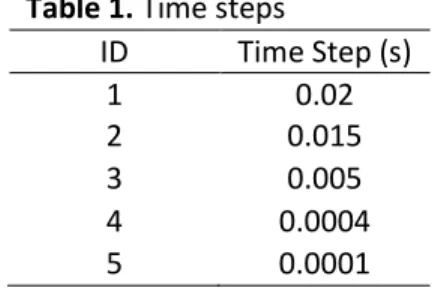
modeled with five time steps (tables 1 and 2). These twenty simulations are then used to 173
investigate the sensitivity of SRH-2D to these parameters and will ensure that a mesh and time 174
step independent solution is achieved. The time step providing the best results is afterward 175
used for the comparison with Hydro_AS-2D. Hydro_AS-2D computes the time step required to 176
9 fulfill the Courant condition, so the user does not have influence on that parameter. Therefore, 177
only the mesh sensitivity is evaluated for this model. The meshes used are the same as those 178
presented above for SRH-2D. 179
The comparison is then made on the four meshes, and the quality of the simulations is 180
quantified through the calculation of the root mean squared error (RMSE) considering the 181
calculated and measured water depth every 0.1 s for a total of 450 benchmark measurements 182
by gauge. 183
All simulations last 45 s, and the depth-averaged parabolic model is used for turbulence for both 184
SRH-2D and Hydro_AS-2D. The minimum water depth for the treatment of the wetting and 185
drying front is 0.001 m, and the maximum velocity is 15 m/s for Hydro_AS-2D. The wetting and 186
drying front limit is also 0.001 m for SRH-2D, but the maximum velocity is unknown. All wall 187
boundaries are assigned a no-slip condition. All calculations are made with a 64 GB server with 188
an Intel Xeon CPU E5-2630 v3 @2.40 GHz processor. 189
3.3 Response to Automatic Calibration
190The dam-break models, using SRH-2D and Hydro_AS-2D, are automatically calibrated with PEST 191
192
Soares-Frazão (2007) and the incidence of that calibration on the water depth RMSE. 193
The automatic calibration requires experimental measurements to compare the simulations and 194
195
the number of measurements, all available measurements cannot be used. The number of 196
benchmark values is therefore set to 27, meaning one measurement at each gauge every 5 s. 197
198
vary between 0.005 s/m1/3 and 0.05 s/m1/3 for both SRH-2D and Hydro_AS-2D.
10
4 Results and Discussion
200
4.1 Time Step and Mesh Sensitivity SRH-2D
201Figure 4 presents the evolution of RMSE relative to time step refinement for each gauge and 202
each mesh and shows a quick stabilization of the RMSE for the coarsest mesh, whereas the 203
finest mesh has a drastic reduction of its error between the first and fourth time steps (ex: from 204
0.0182 m to 0.0092 m for gauge 3). The error is insignificantly modified between the fourth and 205
fifth time steps (from 0.0092 m to 0.0087 m for gauge 3); these solutions can then be 206
considered to have reached time step independence. 207
The fifth time step gives the best solution for all meshes. It is used to compute the evolution of 208
water depth RMSE relative to mesh refinement, which can be observed in figure 5, and 209
diminishes with the mesh density (from 0.0094 m to 0.0087 m for gauge 3). 210
These results conform to theory because the time step needed to ensure stability, and 211
convergence is reduced proportionally to the grid size. SRH-2D has a good response to time step 212
and mesh density refinement. 213
4.2 Mesh Sensitivity Hydro_AS-2D
214Hydro_AS-2D continuously adjusts the time step during the simulation to ensure numerical 215
stability. Therefore, only the mesh sensitivity is addressed. Figure 6 shows a global reduction of 216
RMSE following the mesh refinement with the exception of gauges 1 and 3, which present a 217
slight increase for the fourth mesh (0.0004 m for gauge 1 and 0.0001 m for gauge 3). Similar 218
results were published by and Boz et al. (2014), who respectively 219
investigated the influence of mesh density on the resolution of shallow water equations with 220
11 the Q-scheme and the MUSCL Hancock scheme and on the resolution of the Navier Stokes 221
equations with the CFD code ANSYS CFX. 222
4.3 Water Depth Profiles and Oscillations
223Figure 7 shows the evolution of water depth in time for all meshes at gauge 1 as calculated by 224
Hydro_AS-2D. The mesh refinement greatly benefits the results for the first 15 s of the 225
simulation where the experimental and computed water depths become very similar. However, 226
the refinement seems to increase the oscillation amplitude beyond the 15th second. These
227
oscillations are not physically representative when compared to the experimental line. This 228
phenomenon may also be noted at a smaller scale for gauge 2 but is absent at gauge 3, which 229
may be because these oscillations are induced by the wall reflection. This phenomenon was also 230
noted by , who observed that the oscillation amplitude was increasing with 231
increasing mesh refinement but observed no dependence between the oscillation frequency 232
and the mesh density, which is not the case of the current study in which lower spatial 233
resolution seems to yield a higher oscillation frequency (figure 7). 234
SRH-2D has its general water depth results greatly improved by the mesh refinement, whereas 235
the experimental and computed depths become closer (figure 8). The augmented spatial 236
resolution also gives a better representation of the oscillations. Moreover, these oscillations are 237
offset in time but stay physically consistent with the experimental data unlike Hydro_AS-2D. 238
Comparing figures 7 and 8, Hydro_AS-2D seems to provide a better fit with the experimental 239
data for all meshes, especially for the first 15 s. 240
12
4.4 Water Depth RMSE
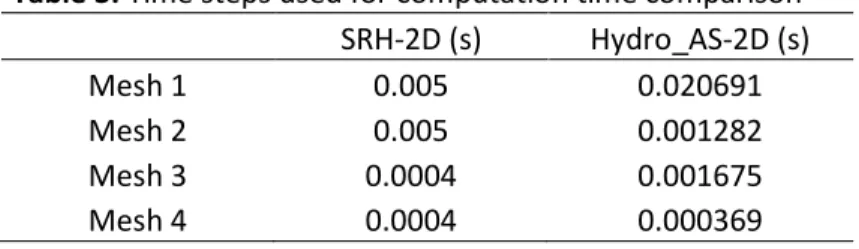
241
Figure 9 shows a comparison of computed water depth RMSEs for SRH-2D and Hydro_AS-2D 242
with all four meshes. The smallest time step is used for all SRH-2D simulations because it 243
provides the best results. For all meshes, Hydro_AS-2D is more accurate at all gauges and all 244
erved at the 245
third gauge (0.0094 m for SRH-2D versus 0.0038 m for Hydro_AS-2D with the coarsest mesh). 246
SRH-2D has its largest error at gauge 3, which is initially dry and may represent the difficulty of 247
modeling the wave propagation on a dry bed. This was noted as a current difficulty in numerical 248
modeling by Soares-Frazão (2007) and was one of the main purposes of the experiment used in 249
the current study. Hydro_AS-2D shows the most important error at gauge 2, which is placed 250
after the downstream side of the sill. This may be because the important slope of the sill creates 251
a flow that is not fully 2D and is therefore more difficult to represent by the model. 252
4.5 Computation time
253Computation time is highly related to the number of mesh elements and time steps. Only mesh 254
density influence is studied for Hydro_AS-2D because the model automatically adjusts the time 255
step. SRH-2D gives full control of these two parameters, so both mesh density and time step 256
sensitivity are considered. 257
Figure 10 shows the evolution of computation time relative to the time step of all meshes for 258
SRH-2D. The computation time increases with increasing mesh and time step resolutions. There 259
is a dramatic increase in the computational time for time step 5 (0.0001 s) compared with time 260
step 4 (0.0004 s), especially for the finest mesh (11.6 h versus 39.1 h). 261
Because the time step has such a drastic influence on the computation time, this parameter 262
must be properly chosen to form a reliable comparison and avoid the use of a very small time 263
13 step that would unnecessarily increase the computation time. Therefore, the chosen time step 264
for SRH-2D is the one allowing time step independence of the model and is selected based on 265
the results of figure 4 (section Time Step and Mesh Sensitivity). Table 3 summarizes the time 266
step used for the two models in the computation time comparison. The computation times are 267
pretty much equal for the first mesh, but Hydro_AS-2D is generally faster by an average factor of 268
7.51 h/h (figure 11). One should note that the largest difference is observed for the finest mesh 269
where Hydro_AS-2D is 15.8 times faster, whereas the time step is almost the same for both 270
SRH-2D HYDRO_AS-2D=0.00037 s). The capacity of Hydro_AS-2D to
271
parallelize the calculation can explain this difference between the two models. The code 272
structures may also impact the computation time, but this information is not available for these 273
models. 274
4.6 Response to Calibration
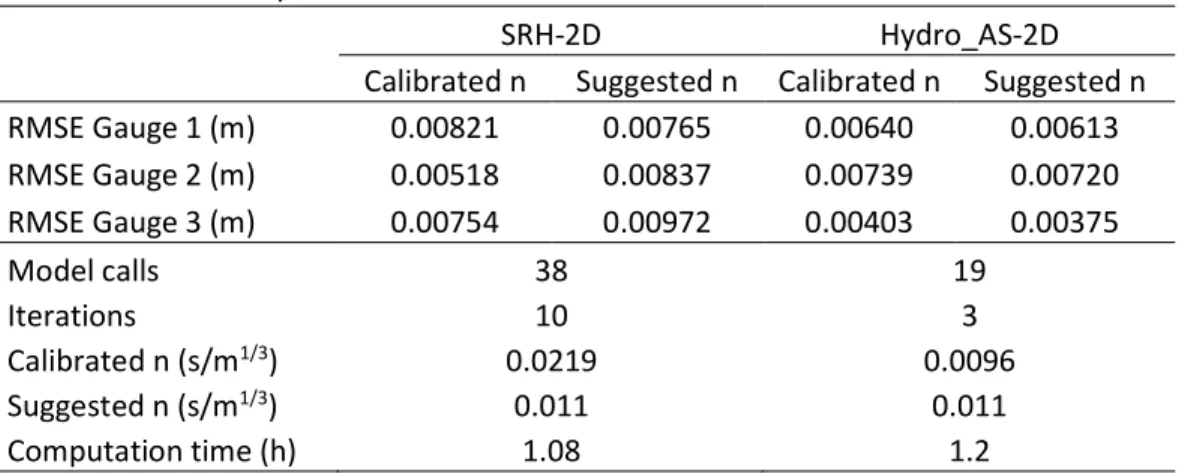
275Table 4 summarizes the results and parameters of the automatic calibrations with PEST for the 276
two models. SRH-2D necessitates 10 iterations and 38 model calls, whereas Hydro_AS-2D 277
completes the calibration in 3 iterations and 19 model calls. SRH-2D is slightly faster (1.08 h 278
versus 1.2 h), which is not surprising considering that this model has been shown to be faster for 279
the coarsest mesh, the only mesh used for the automatic calibration, when used with a time 280
step of 0.005 s (see section Computation Time). 281
Automatic calibration with Hydro_AS-282
s/m1/3, which is very similar to 0.011 s/m1/3 as suggested by Soares-Frazão (2007). SRH-2D, when
283
calibrated, gives a very different value of 0.0219 s/m1/3. Hydro_AS-2D provides very similar
284
; the maximal difference 285
is 0.0003 m, which is observed at gauge 3. This is consistent with the fact that the calibrated 286
14 -2D has a 287
good response to automatic calibration. When calibrated, SRH-2D shows a greater improvement 288
of its RMSE, which decreases by up to 0.0032 m at gauge 2. If only the water depth RMSE is 289
considered to qualify the automatic calibration, SRH-2D seems to be benefiting from a 290
ent that is approximatively twice the suggested coefficient. This is 291
unlikely because that parameter would lose its physical representativeness of the actual 292
293
time at gauge 1 (figure 12). The calibrated computed water depth becomes closer to the 294
experimental water depth in the second half of the experiment; however, it is clear that the 295
shape of oscillation is lost with the calibration and is better represented by the original 296
297
calibration is unsuitable for SRH-2D in that case. One can note that Hydro_AS-2D remains 298
generally more accurate than SRH-2D, the only exception being gauge 2 at which SRH-2D gives a 299
smaller RMSE. 300
5 Conclusion
301Two flood propagation models, Hydro_AS-2D and SRH-2D, were compared in terms of their 302
capacity to properly model an experimental dam-break test case. The two models were shown 303
to have a good response to mesh and time step refinement; however, Hydro_AS-2D showed 304
unphysical oscillations and an increase in the water depth RMSE at two of the three gauges with 305
the finest mesh. These observations support the idea that too much spatial resolution could 306
negatively affect the accuracy of a model as noted by and Boz et al. (2014). 307
Hydro_AS-2D computed lower RMSEs for all meshes and was therefore more accurate than 308
SRH-2D. Hydro_AS-2D was up to 15.8 times faster than SRH-2D. This contrasts with the results 309
15 of Tolossa (2008) and Tolossa et al. (2009), who found that W (the previous version of SRH-310
2D) was faster than Hydro_AS-2D. Hydro_AS-2D responded well to the automatic calibration of 311
312
whereas SRH-2D computed a very different coefficient that lowered the water depth RMSE but 313
with no physical representativeness of the actual channel. 314
This research has exposed some of the differences between two major hydrodynamic models 315
and clarified their respective assets to offer an objective point of comparison that will be helpful 316
for industrial and research engineers in choosing a modeling tool for flood propagation. 317
318
This research was supported in part by a National Science and Engineering Research Council 319
(NSERC) Discovery Grant, application No: RGPIN-2016-06413. 320
321
AQUAVEO (2016). "SMS 12.1 - The Complete Surface-water Solution." 322
< http://www.aquaveo.com/software/sms-surface-water-modeling-system-323
introduction>. (March 10, 2016). 324
Berger, R. C., Tate, J. N., Brown, G. L., et Savant, G. (2013). "Adaptive Hydraulics Users Manual." 325
Coastal and Hydraulics Laboratory Engineer Research and Development Center, 99. 326
BMTWBM (2014). "TUFLOW FV User Manual." Flexible Mesh Modelling, BMT WBM, Brisbane, 327
Australia, 183. 328
Boz, Z., Erdogdu, F., et Tutar, M. (2014). "Effects of mesh refinement, time step size and 329
numerical scheme on the computational modeling of temperature evolution during 330
natural-convection heating." Journal of Food Engineering, 8-16. 331
Brunner, G. W. (2016). "HEC-RAS River Analysis System User's Manual." US Army Corps of 332
Engineers, Davis, CA, USA, 960. 333
Doherty (2005). "PEST, Model-Independant Parameter Estimation, USer Manual: 5th Edition." 334
Watermark Numerical Computing. 335
Donnell, B. P. (2006). "RMA2 WES Version 4.5." I. King, J. V. Letter, W. H. McAnally, et W. A. 336
Thomas, eds., US Army, Engineer Research and Development Center, 277. 337
-338
Spatial Resolution for Two-Dimensional Shallow-Water Model Accuracy." Journal of 339
Hydraulic Engineering, 917-925. 340
Ellis, R. J. l., Doherty, J., Searle, R. D., et Moodie, K. (2009). "Applying PEST (Parameter 341
ESTimation) to improve parameter estimation and uncertainty analysis in WaterCAST 342
16 models." 18th World IMACS/MODSIM Congress, Modelling and Simulation Society of 343
Australia and New-Zealand Inc., 3158-3164. 344
Fabio, P., Aronica, G. T., et Apel, H. (2010). "Towards automatic calibration of 2-D flood 345
propagation models." Hydrology and Earth System Sciences, 10.5194/hess-14-911-2010, 346
911-924. 347
Froehlich, D. C. (2002). "User's Manual for FESWMS FST2DH." Federal Highway Administration, 348
209. 349
Hydronia (2015). "RiverFlow2D Plus Two-Dimensional Finite-Volume River Dynamics Model." 350
Hydronia, Pembroke Pines, FL, USA, 157. 351
Jones, D. A. (2011). "The Transition from Earlier Hydrodynamic Models to Current Generation 352
Models." Master of Science, Brigham Young University, Brigham. 353
Lai, Y. G. (2008). "SRH-2D version 2: Theory and User's Manual." U.S. Department of the interior 354
- Bureau of Reclamation, Denver. 355
Lai, Y. G. (2010). "Two-Dimensional Depth-Averaged Flow Modeling with an Unstructured Hybrid 356
Mesh." Journal of Hydraulic Engineering, 12-23. 357
Lin, Z. (2010). "Getting Started with PEST." The University of Georgia, Athens, GA. 358
MacDonald, I. (1996). "Analysis and Computation of Steady Open Channel Flow." Doctor of 359
Philosophy, University of Reading, Reading, UK. 360
McCloskey, G. L. l. E., R.J., Waters, D. K., et Stewart, J. (2011). "PEST hydrology calibration 361
process for source catchments - applied to the Great Barrier Reef, Quennsland." 19th 362
International Congress on Modelling and Simulation, Modelling and Simulation Society 363
of Australia and New-Zealand Inc., 2359-2366. 364
McKibbon, J., et Mahdi, T.-F. (2010). "Automatic Calibration Tool for River Models Based on the 365
MHYSER Software." Natural Hazards, 54(3), 879-899. 366
Nujic, M. (2003). "Hydro_AS-2D A Two-Dimensional Flow Model For Water Mangement 367
Applications User's Manual."Rosenheim, Deutschland. 368
Shettar, A. S., et Murthy, K. K. (1996). "A numerical Study of Division of Flow in Open Channels." 369
Journal of Hydraulic Research, 34(5), 651-675. 370
Soares-Frazão, S. (2007). "Experiments of dam-break wave over a triangular bottom sill." Journal 371
of Hydraulic Research, 10.1080/00221686.2007.9521829, 19-26. 372
Tolossa, G. H. (2008). "Comparison of 2D Hydrodynamic models in River Reaches of Ecological 373
Importance:Hydro_AS-2D and SRH-W." Institut für Wasserbau, Universität Stuttgart, 374
Stuttgart. 375
Tolossa, H. G., Tuhtan, J., Schneider, M., et Wieprecht, S. "Comparison of 2D Hydrodynamic 376
Models in River Reaches of Ecological Importance Hydro_AS-2D and SRH-W." Proc., 33rd 377
IAHR World Congress, 604-611. 378
Vetsch, D. (2015). "System Manuls of Basement." Swiss Federal Institute of Technology Zurich, 379
Zurich, 178. 380
Zarrati, A. R., Tamai, N., et Jin, Y. C. (2005). "Mathematical Modeling of Meandering Channels 381
with a Generalized Depth Averaged Model." Journal of Hydraulic Engineering, 131(6), 382
467-475. 383
384 385
17
Figure Captions
386
Fig. 1. Automatic calibration with PEST Adapted from Lin (2010) 387
Fig. 2. Channel geometry, initial conditions and gauges positions 388
Fig. 3. Meshes (0.5 m × 0.45 m zone) 389
Fig. 4. Water depth RMSE relative to time step refinement at Gauges 1-3 SRH-2D 390
Fig. 5. Water depth RMSE relative to mesh refinement SRH-2D 391
Fig. 6. Water depth RMSE relative to mesh refinement Hydro_AS-2D 392
Fig. 7. Water depth at gauge 1 for meshes 1-4 Hydro_AS-2D 393
Fig. 8. Water depth at gauge 1 for meshes 1-4 SRH-2D 394
Fig. 9. Comparison of computed water depth RMSEs Meshes 1-4 395
Fig. 10. Computation time relative to time step refinement SRH-2D 396
Fig. 11. Comparison of computation time 397
Fig. 12. Comparison of 398
gauge 1 SRH-2D 399
18 400
Table 1. Time steps 401
Table 2. Meshes 402
Table 3. Time steps used for computation time comparison 403
Table 4. Calibration parameters and results
19 405
Table 1. Time steps ID Time Step (s) 1 0.02 2 0.015 3 0.005 4 0.0004 5 0.0001
Table 2. eshes ID Number of Cells 1 1 353 2 5 412 3 21 648 4 86 592
Table 3. Time steps used for computation time comparison SRH-2D (s) Hydro_AS-2D (s) Mesh 1 0.005 0.020691 Mesh 2 0.005 0.001282 Mesh 3 0.0004 0.001675 Mesh 4 0.0004 0.000369
Table 4. Calibration parameters and results
SRH-2D Hydro_AS-2D
Calibrated n Suggested n Calibrated n Suggested n
RMSE Gauge 1 (m) 0.00821 0.00765 0.00640 0.00613 RMSE Gauge 2 (m) 0.00518 0.00837 0.00739 0.00720 RMSE Gauge 3 (m) 0.00754 0.00972 0.00403 0.00375 Model calls 38 19 Iterations 10 3 Calibrated n (s/m1/3) 0.0219 0.0096 Suggested n (s/m1/3) 0.011 0.011 Computation time (h) 1.08 1.2