www.ann-geophys.net/34/123/2016/ doi:10.5194/angeo-34-123-2016
© Author(s) 2016. CC Attribution 3.0 License.
Modulation of surface meteorological parameters by extratropical
planetary-scale Rossby waves
K. Niranjan Kumar1, D. V. Phanikumar1,2, T. B. M. J. Ouarda1,3, M. Rajeevan4, M. Naja2, and K. K. Shukla2,5 1Institute Center for Water and Environment (iWater), Masdar Institute of Science and Technology,
P.O. Box 54224, Abu Dhabi, United Arab Emirates
2Aryabhatta Research Institute of Observational Sciences, Nainital, India
3INRS-ETE, National Institute of Scientific Research, Québec (QC), G1K9A9, Canada
4Indian Institute of Tropical Meteorology, Dr. Homi Bhabha Road, Pashan, Pune, 411008, India 5Pt. Ravishankar Shukla University, Raipur, Chhatisgarh, 492010, India
Correspondence to: K. Niranjan Kumar ([email protected])
Received: 2 July 2015 – Revised: 26 November 2015 – Accepted: 30 December 2015 – Published: 25 January 2016
Abstract. This study examines the link between upper-tropospheric planetary-scale Rossby waves and surface me-teorological parameters based on the observations made in association with the Ganges Valley Aerosol Experi-ment (GVAX) campaign at an extratropical site at Aryab-hatta Research Institute of Observational Sciences, Naini-tal (29.45◦N, 79.5◦E) during November–December 2011. The spectral analysis of the tropospheric wind field from ra-diosonde measurements indicates a predominance power of around 8 days in the upper troposphere during the observa-tional period. An analysis of the 200 hPa meridional wind (v200 hPa) anomalies from the Modern-Era Retrospective Analysis for Research and Applications (MERRA) reanal-ysis shows distinct Rossby-wave-like structures over a high-altitude site in the central Himalayan region. Furthermore, the spectral analysis of global v200 hPa anomalies indicates the Rossby waves are characterized by zonal wave number 6. The amplification of the Rossby wave packets over the site leads to persistent subtropical jet stream (STJ) patterns, which further affects the surface weather conditions. The propagating Rossby waves in the upper troposphere along with the undulations in the STJ create convergence and di-vergence regions in the mid-troposphere. Therefore, the sur-face meteorological parameters such as the relative humid-ity, wind speeds, and temperature are synchronized with the phase of the propagating Rossby waves. Moreover, the present study finds important implications for medium-range forecasting through the upper-level Rossby waves over the study region.
Keywords. Meteorology and atmospheric dynamics (waves and tides)
1 Introduction
The boreal extratropical winter climate is generally con-stituted by strong jets and large-amplitude quasi-stationary planetary-scale (Rossby) waves. The background flow dic-tates the propagation of Rossby waves, which are linked to the strong vorticity gradient around the tropopause in extratropics (e.g., Hoskins and Ambrizzi, 1993; Bransta-tor, 2002; Schwierz et al., 2004b). Theoretical and obser-vational studies along with idealized numerical experiments have indicated that topographically and diabatically gener-ated vortex anomalies at upper and lower levels can serve as triggers for Rossby waves propagating into the extratrop-ics (Sardeshmukh and Hoskins, 1988; Hoskins and Karoly, 1981; Schwierz et al., 2004a; Niranjan Kumar and Ouarda, 2014). Also, a significant role in the amplification of the waves is played by the diabatic processes as demonstrated in a previous case studies (Massacand et al., 2001). The most dominant periods of the stationary planetary-scale waves (Rossby normal modes) corresponding to intrinsic periods are 2, 5, 8.3, and 12.5 days (Forbes, 1995). Moreover, Rossby waves have been recognized as important features that can influence the predictability of midlatitude weather systems, which have a forecast capability of 1–2 weeks (Shapiro and Thorpe, 2004; Hoskins, 2006).
and found that the forecasts had a higher than average skill on synoptic scales. The association between the long-lived Rossby wave trains and/or Rossby wave breaking and intense European cyclones is found mainly in the recent studies (e.g., Wirth and Eichhorn, 2014; Gómara et al., 2014).
It is well known from previous reports that Rossby waves remain in coherent over many days under favorable at-mospheric conditions. They also propagate over long dis-tances and can contribute to teleconnecting remote regions of the atmosphere (Chang and Yu, 1999; Niranjan Kumar and Ouarda, 2014). For example, Chang and Yu (1999) have shown that during December–January–February in the Northern Hemisphere, the Rossby wave packets are most coherent along a band that extends from northern Africa through southern Asia (maximum coherence) into the Pacific storm track. Moreover, knowledge of the evolution of coher-ent Rossby waves is crucial for weather forecasting since they set the stage for weather systems to evolve. Further-more, analyses of forecast errors of numerical weather pre-diction models have revealed a close link between the propa-gation of the error patterns and the propapropa-gation of upper-level Rossby waves (Davies and Didone, 2013; Grazzini, 2015). Therefore, the study of the characteristics of extratropical Rossby waves, such as propagation, breaking, and their or-ganization, is imperative for understanding and forecasting regional and local weather.
A significant fraction of weather-related loss of life and property in the extratropical latitudes is associated with se-vere convection (Pielke and Klein, 2001; Fritsch and Car-bone, 2004). During the 21st century, there are several types of extreme weather events (heat waves, droughts and heavy rainfall events) that the IPCC (2012) considers to be increas-ing and becomincreas-ing more frequent, more widespread, and/or intense in most parts of the world. A large number of re-cent extreme weather events have occurred in many parts of the world (for more details, refer to Coumou and Rahm-storf, 2012). Furthermore, the extreme events increase ap-proximately in proportion to the ratio of the climate warm-ing trend and short-term variability (Rahmstorf and Coumou, 2011). In several cases, these extreme weather events are
the extreme rainfall events were also recorded in the states of Himachal Pradesh and Jammu and Kashmir (Nibanupudi et al., 2015).
Thus, the state of Uttarakhand situated in the Indian Hi-malayan region is known to face disastrous climatic hazard events like floods and landslides. In order to improve pre-diction of the high-impact weather in this region, it is also necessary to have knowledge of the global-to-regional in-fluences on the evolution and predictability of high-impact weather. Furthermore, knowledge is still lacking on the char-acteristics of long waves that have a significant influence on background flow and the creation of flow patterns conducive to the development of heavy rainfall events. Therefore, the presence of synoptic features in the lower stratosphere along with the complex topography may have significant influence on the evolution of extreme weather events over the region. However, to date, only limited studies exist describing the links between synoptic-scale tropospheric activity in the re-gion and variability in the lower stratosphere.
Hence, the work presented here describes the observa-tions at an extratropical site at Aryabhatta Research Insti-tute of Observational Sciences (ARIES), Nainital (29.45◦N, 79.5◦E; 1958 m a.m.s.l.), located in the state of Uttarakhand. Over this site, a strong link has been found between the surface meteorological parameters and propagating upper-level Rossby waves. The surface meteorological observa-tions along with radiosondes launched in association with the Ganges Valley Aerosol Experiment (GVAX) campaign dur-ing November–December 2011 offered a unique opportunity to better understand the link between the upper troposphere and surface weather. The following Sects. 2, 3, and 4 elabo-rate successively on the data used in this study and on the re-sults and discuss them. Section 5 summarizes and concludes the present work.
2 Data description
The data were acquired through the measurements con-ducted at ARIES, Nainital, about 300 km northeast of New Delhi, India, during the GVAX campaign. GVAX was a
re-Figure 1. Zonal (a) and meridional (b) wind velocities measured by the radiosondes launched at 6-hourly intervals from an extratropical site at ARIES, Nainital (29.45◦N, 79.5◦E), between 1 November and 31 December 2011. The corresponding Fourier spectral amplitudes (m2s−2) of zonal and meridional perturbations are shown in (c) and (d), respectively. The contours in (c) and (d) are significant at a 90 % confidence level.
sult of a joint research collaboration between the Indian Space Research Organization (ISRO), the Indian Institute of Science (IISc), ARIES, and the US Department of En-ergy (DOE). First, the Atmospheric Radiation Measure-ment Mobile Facility (AMF-1) was deployed at ARIES Ob-servatory, Nanital, during June 2011–March 2012. In this study, the analysis is based on radiosondes (RS-92 Väisälä) launched every 6 h during November–December 2011. Pres-sure, humidity, wind, and temperature data were recorded ev-ery 2 s during ascent, giving a vertical resolution of roughly 10 m on average in the troposphere. We have also utilized the surface meteorological observations during the GVAX cam-paign. In situ sensors were used to measure the surface tem-perature, relative humidity (RH), and wind speed at a time interval of 1 min during the campaign period. For the present analysis, 1 min data are rearranged to obtain daily aver-ages. The detailed technical report about the radiosonde and surface meteorological observation system (SMOS) can be found online (http://www.arm.gov/publications/handbooks). To support the observations, we also make use of wind fields from Modern-Era Retrospective Analysis for Research and Applications (MERRA). MERRA is a reanalysis prod-uct generated by the National Aeronautics and Space Ad-ministration (NASA) Global Modeling and Assimilation Office (GMAO) using the Goddard Earth Observing Sys-tem (GEOS) version 5.2.0 (Rienecker et al., 2011; http: //gmao.gsfc.nasa.gov/research/merra/). MERRA has the ad-vantage of incorporating information from a variety of re-cent in situ satellite data streams – for example, the obser-vations from the Atmospheric Infrared Sounder (AIRS) and scatterometer-based wind retrievals. MERRA covers the pe-riod from 1979 to the present and continues to be updated with latency on the order of weeks. The model has a native
resolution of 72 layers in the vertical and 2/3◦×1/2◦in the horizontal. In addition to the 6-hourly 3-D analysis at the de-fault spatial resolution, MERRA also provides 3-hourly 3-D diagnostics at 1.25◦×1.25◦resolution on 42 vertical levels, and this has been used in this study
In addition, Tropical Rainfall Measuring Mission (TRMM) 3B42 (version 7) daily rainfall intensities are also used over the study region during the GVAX cam-paign period of November–December 2011. This product incorporates different types of sensors, namely microwave and infrared (Huffman et al., 2007, and references therein). TRMM-3B42 products were obtained at a spatial resolution of 0.25◦×0.25◦between 49.875◦S and 49.875◦N.
3 Results
Figure 1a and b portray the time–height cross section of hor-izontal winds from 1 November to 31 December 2011 based on 6-hourly radiosonde observations at an extratropical site of ARIES, Nainital. The zonal velocity is westerly through most of the troposphere and peaks at speeds in excess of 40 m s−1in the subtropical jet stream (STJ) at an altitude of 12 km (Fig. 1a). The STJ is typically centered around 30◦ lat-itude at an altlat-itude of about 12 km and is strongest in the win-ter season. Hence, Fig. 1a clearly depicts the strong STJ dur-ing winter over the observational site. The meridional wind field is displayed in Fig. 1b. It is apparent that the meridional winds depict alternating southerlies and northerlies in the up-per troposphere. In the upup-per atmosphere, these anomalous patterns in meridional winds, termed Rossby waves, become quite prominent and associated with the jet stream at the top of the troposphere in extratropical latitudes.
amplitudes in the upper troposphere of around 8 days in both zonal and meridional wind components. However, the merid-ional spectrum depicts larger amplitudes relative to the zonal spectrum in the STJ region. This could be due to the fact that the eastward moving jet, comprising the ridges and troughs associated with Rossby waves, has a greater meridional com-ponent compared to the zonal comcom-ponent. Nevertheless, the predominance power in horizontal winds indicates that these are linked with upper-tropospheric Rossby waves with peri-ods of around 8 days. Similar wave periperi-ods are also noted in previous reports (Forbes, 1995). It is also observed from Fig. 1c and d that the zonal and meridional spectrum peaks at different periods greater than 10 days. However, in this study we mainly focus on the spectral band of 6–10 days.
The vertical propagation characteristics of the Rossby waves are shown in Fig. 2. The height profiles of ampli-tude and phase of the selected harmonic component (around 8 days) are calculated by using the FSA method. The equa-tions for the estimation of the magnitude and phase are de-scribed elsewhere in Smith (1997). The amplitude of Rossby waves shows its maximum in the upper troposphere. After-wards it decreases with height in the troposphere, which fur-ther supports the result shown in Fig. 1b. However, it is in-teresting to note the phase propagation of Rossby waves as depicted in Fig. 2. The near-constant phase in the upper tro-posphere around 12 km indicates the source region of the Rossby wave activity. The notable feature is that the zonal velocity shows upward phase propagation of Rossby waves within the troposphere. In fact, the group velocity is orthog-onal to the phase velocity, with upward phase propagation corresponding to the downward energy propagation. Fig. 2 suggests that wave energy flows downward into the tropo-sphere from a source above in the upper tropotropo-sphere. How-ever, it is also true that the downward energy propagation occurs with a strong loss of amplitude in the troposphere as shown in Fig. 2. Due to the increase in mean atmospheric density with decreasing altitude, the amplitude of the waves decreases as they propagate downward in order to conserve wave energy. Nevertheless, it is interesting to see whether there is any effect of the upper-tropospheric Rossby waves
Figure 2. Height profiles of amplitude (m s−1) and phase (deg) of Rossby waves (period ∼ 8 days) in zonal winds observed by ra-diosonde measurements between 1 November and 31 December 2011.
on the surface meteorological parameters. This is because Rossby waves are long waves that play an important role in the formation of regions of divergence and convergence in the upper troposphere, further affecting the surface weather.
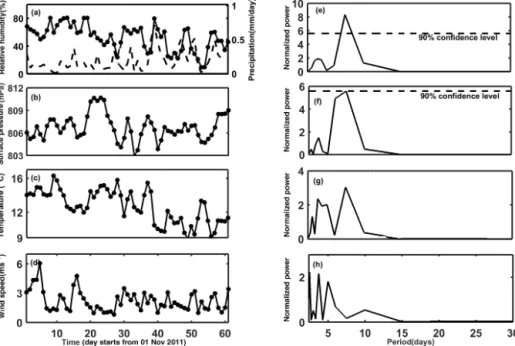
The surface meteorological observations during the GVAX campaign are shown in Fig. 3. For instance, Fig. 3 (left column) shows the time series of RH (a), pressure (b), temperature (c), and wind speed (d) from 1 November to 31 December 2011. RH, in particular, shows strong modu-lations, with a period of around 8 days. RH is an important parameter that explains the amount of moisture availability in the air, the formation of clouds, and rainfall. Therefore, the time series of rainfall acquired from the TRMM data averaged over a latitude–longitude grid box (28–32◦N, 78– 82◦E) is also overlaid along with RH in Fig. 3a. It is interest-ing to see that the rainfall time series oscillates with periods of between 6 and 10 days and closely follows the RH time series (Fig. 3a). This is more clearly seen in December 2011 than in November 2011 even though the percentage of RH is high. Nevertheless, the presence of moisture is not the only factor that determines rainfall as instability conditions asso-ciated with strong divergence and convergence at upper and lower levels, respectively, are also required. This will be fur-ther discussed in this section
The time series of surface pressure (Fig. 3b) also indi-cates the strong fluctuations in the 6–10-day period band. Furthermore, the time series of surface temperature is shown in Fig. 3c. It is known that RH is also dependent on air tem-perature. For instance, the combination of Fig. 3a and c in-dicates that an increase in temperature is reflected as a re-duction in RH and vice versa. Also, the interrelationship
be-Figure 3. Left column: time series of surface meteorological parameters such as (a) RH, (b) pressure, (c) temperature, and (d) wind speed at ARIES, Nainital, from 1 November to 31 December 2011. The rainfall measured by the TRMM is also overlaid in (a) during the ob-servational period (dashed line). Right column: the corresponding power spectrum estimated from Fourier analysis of (e) RH, (f) pressure, (g) temperature, and (h) wind speed perturbations.
tween the surface meteorological parameters has been well documented in several previous studies (e.g., Hardwick Jones et al., 2010 and references therein). The time series of sur-face wind speed during the observational period is shown in Fig. 3d. The highly dynamic nature of winds shows strong fluctuations compared with other surface parameters seen in Fig. 3.
Furthermore, confirmation regarding the modulations no-ticed in the time series of surface parameters is obtained through the FSA described previously (Fig. 3, right column). For instance, Fig. 3e shows the Fourier spectrum of RH. The horizontal dashed line indicates the statistical 90 % confi-dence level of the calculated spectral power. The RH spec-trum shows a significant power for a period of around 8 days. It is the only period which is greater than the 90 % confi-dence level. The significance of the largest peak in the spec-trum is computed based on the methodology described in Press et al. (1994). It is interesting to note here that both the upper-tropospheric Rossby waves and RH oscillate with the same periodicity. Also, the spectra of other surface param-eters such as pressure (Fig. 3f), temperature (Fig. 3g), and wind speed (Fig. 3h) indicate the strong power between 6-and 10-day periods. However, the wind speed spectrum is slightly shifted to higher frequencies. This may be due to the Doppler shift effect in the presence of background surface winds. The spectra of temperature and wind speed below in-dicate the statistical 90 % confidence level (not shown in the plots), yet they also indicate that there undoubtedly is an
ef-fect of the upper-tropospheric Rossby waves on the surface meteorological fields.
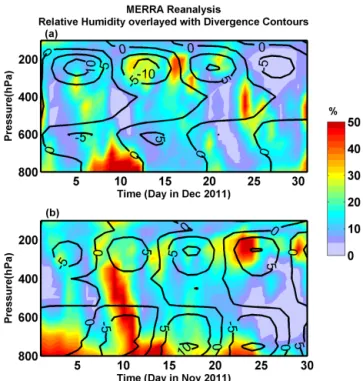
In order to have a closer look at physical mechanisms through which propagating Rossby waves in the upper tro-posphere can influence surface weather, MERRA global re-analysis data are analyzed. For example, Fig. 4 shows the time–pressure cross section of RH overlaid with divergence contours over Nainital. The divergence (F ) is computed us-ing the function defined by
O.F =∂u 0 ∂x +
∂v0
∂y, (1)
where u0and v0are the filtered zonal and meridional ampli-tudes, respectively, in the 6- and 10-day period band. Fig-ure 4a shows interesting featFig-ures of a series of divergence– convergence patterns with time in the upper troposphere (above 400 hPa) in December 2011. Conversely, one can also note the convergence–divergence patterns in the lower tropo-sphere below the 500 hPa pressure level. The strong upper-level divergence and convergence occur when deep troughs and ridges exist in the flow aloft. This will be discussed fur-ther in this section. Figure 4a shows that the strong upper-tropospheric divergence corresponds to lower-upper-tropospheric convergence during 5–11 December 2011. The convergence in the lower levels results in an increase in RH in the tropo-sphere below 200 hPa, while strong convergence in the up-per troposphere during 12–15 December 2011 results in di-vergence below 500 hPa. Hence, there is less moisture avail-able over the observational site. Similarly to Fig. 4a, Fig. 4b
Figure 4. Panel (a): pressure (hPa)-versus-time contour plot of rel-ative humidity (%) and overlaid divergence contours (in units of 10−6s−1) derived from MERRA reanalysis data (solid black lines) over the observational site between 1 and 31 December 2011. Panel (b): same as (a) but from 1 to 30 November 2011.
shows the time–pressure cross section of RH overlaid with divergence contours in November 2011. It may also be noted from Fig. 4b that the upper-tropospheric divergence leads to convergence at lower levels, especially in the first half of November 2011. However, the strength of the divergence at upper levels is comparatively less than the divergence values in Fig. 4a. This further supports the results in Fig. 3a where the rainfall in November 2011 is less compared to December 2011
The vertical section of circulation seen in Fig. 4 indi-cates that the anomalous ascending motion in the tropo-sphere appearing over the site is accompanied by anomalous upper-tropospheric divergence and lower-tropospheric con-vergence and vice versa. It is apparent that the concon-vergence– divergence pattern seen in the upper troposphere (Fig. 4) also influences the surface meteorological parameters (Fig. 3). As an example, the anomalous subsidence in the lower tropo-sphere due to strong convergence in the upper tropotropo-sphere results in less RH and rainfall from 12 to 15 December 2011, which is evident from Fig. 3a. Likewise, the strong divergence in the upper troposphere results in increased RH and rainfall from 8 to 11 December 2011 (Fig. 3a). Hence, Figs. 3 and 4 signify that the upper-tropospheric divergence– convergence occurs in conjunction with the anomalous prop-agation of Rossby waves and further modulates the surface parameters
The location of the jet stream is obtained by taking the max-imum wind velocity between the latitude band 20 and 45◦N for all the longitudes. Note that the STJs do not pursue a lati-tudinal course at their respective positions but instead mean-der. In particular, the upper-tropospheric signature of a syn-optic Rossby wave is evident as major lateral undulations of the jet stream (Fig. 5).
The curving of the jet stream poleward over the observa-tional site on 8 December 2011 is clear from Fig. 5a and b. Air moving poleward in the upper atmosphere undergoes di-vergence. This is also supported by Fig. 4, since a strong divergence exists in the upper troposphere over the obser-vational site on 8 December 2011. The upper-air divergence is compensated for by convergence in the lower troposphere (Fig. 4). By contrast, Fig. 5c and d show the jet stream swing towards the equator over the observational site on 12 De-cember 2011. We can observe that as the jet stream enters a trough, it narrows and air converges into it. A strong conver-gence is also evident in Fig. 4 on 12 December 2011 at higher level and is compensated for by divergence in the lower tro-posphere. Hence, the undulations in the STJ connected with the upper-tropospheric Rossby waves are responsible for the observed modulations seen in surface meteorological param-eters over the observational site of Manora Peak during the GVAX campaign in November–December 2011.
4 Discussion
The two key links observed in this study between the up-per air and surface are Rossby waves and the subtropical jet. However, the Rossby waves and STJ commonly work in tandem providing vertical motions and influence the daily weather. Hence, the changes to airflow patterns around the extratropical latitudes and in the Northern Hemisphere seem to influence prolonged spells of extreme weather. For in-stance, the dynamical forcing associated with the propagat-ing upper-tropospheric Rossby waves from the west Pacific played dominant role in initiating dry-spell conditions over the Great Plains region of the United States (Lyon and Dole,
Figure 5. Meridional wind anomalies (a) at 200 hPa pressure level (v200 hPa) overlaid with the position of subtropical jet stream (thick solid black line) and zonal wind (b) at 200 hPa pressure level on 8 December 2011 obtained from MERRA reanalysis. (c) and (d) Same as (a) and (b) except on 12 December 2011. The location of ARIES, Nainital (29.45◦N, 79.5◦E), is also indicated by the star in (a) and (c).
1995; Chen and Newman, 1998). Furthermore, Schubert et al. (2011) showed the stationary Rossby waves account for more than 30 % (60 %) of the monthly mean precipitation (surface temperature) over many regions of extratropical land areas and at the same time that they are major players in the development of short-term climate extremes. In addition, Schubert et al. (2011) stressed that the current general circu-lation models do not simulate and predict the development of such Rossby waves. More recent studies have also re-ported that month-long periods of extreme weather are as-sociated with anomalous jet stream circulation patterns char-acterized by amplified atmospheric planetary waves that me-ander around the globe (e.g., Petoukhov et al., 2013; Screen and Simmonds, 2014; Coumou et al., 2014). In particular, it has been found that regional weather is strongly influenced by persistent longitudinal planetary-scale waves with zonal wave numbers 6, 7, or 8 (Petoukhov et al., 2013; Coumou et al., 2014). Under certain conditions, these waves become trapped by midlatitude waveguides and are amplified by a quasi-resonant response to orographic and land–sea thermal forcing (Petoukhov et al., 2013). The quasi-resonant condi-tions associated with planetary-scale waves, however, require the formation of pertinent waveguides in the zonally aver-aged flow, and this formation process may involve highly nonlinear dynamics (Palmer, 2013). Nevertheless, the obser-vations in this study were made during the wintertime when a stronger subtropical jet stream (Fig. 1a) acts as a waveguide for the planetary-scale waves.
Therefore, we analyzed the extratropical meridional ve-locity from the MERRA reanalysis data to characterize the high-amplitude Rossby wave patterns during the
observa-tional period. Even if the amplified Rossby waves with a period of around 8 days are noted previously from Fig. 1, the zonal wave number of Rossby waves are now estimated from the longitudinal distribution of the v200 hPa anoma-lies over the globe in the extratropical latitudes. Figure 6 shows the power spectrum as a function of zonal wave num-ber estimated based on the FSA using the v200 hPa anoma-lies shown in Fig. 5a and b. It is apparent from the Fig. 6 that both the spectra show strong power near the zonal wave number 6, further supporting earlier studies. For ex-ample, Petoukhov et al. (2013) found the strong contribu-tion of quasi-stacontribu-tionary waves with zonal wave numbers 6, 7 and 8 to several recent severe regional weather extremes. Also, Coumou et al. (2014) demonstrated that the high-amplitude quasi-stationary Rossby waves with zonal wave numbers 6, 7, and 8 resulted in persistent weather condi-tions at the surface and hence in a midlatitude synchroniza-tion of extreme weather, while Teng et al. (2013) showed the heat waves over the United States (US) are affected by the planetary-scale wave number 5. Furthermore, Screen and Simmonds (2014) also demonstrated the link between am-plified Rossby waves and surface temperature as well as pre-cipitation extremes in the midlatitudes for the period 1979– 2012. From the above studies, it is apparent that the slow-propagating Rossby waves influence the surface weather. Moreover, the slow wave propagation would prolong cer-tain weather conditions and therefore lead to extremes on timescales of weeks. For instance, Fig. 4 shows that the di-vergence and condi-vergence persists for about 1 week over the observational site, which is further linked with the slow-propagating Rossby waves shown in Fig. 5a and c. Though
the longitudinal distribution of v200 hPa anomalies over the globe averaged for latitudes between 28–50◦N. Both spectra show strong power near the zonal wave number 6.
the propagating Rossby waves on a sub-monthly scale ob-served in this study do not lead to extreme surface weather conditions, they nevertheless modulate the RH and rainfall patterns and other surface meteorological parameters shown in Fig. 3 considerably.
While the study shows important implications of Rossby waves in relation to surface weather on the timescales of weeks, most of the previous studies discussed above are fo-cused on timescales of over 1 month. The position of the jet stream along with the characteristics of planetary-scale Rossby waves varies substantially from day to day; hence, analysis over longer timescales shows distinct monthly and seasonal patterns. However, more recent studies have inves-tigated the relationship between the sub-monthly predictabil-ity and characteristics of Rossby waves, such as their tempo-ral duration, spatial extension, and the area of genesis. For instance, using the 12 000-year integration of an atmospheric general circulation model, Teng et al. (2013) demonstrated that the heat waves over the USA were preceded by 15– 20 days by a pattern of planetary-scale waves. Furthermore, Grazzini (2015) reported that the predictive skill increases with the presence of long-period Rossby waves for medium-range forecasts. It is noted that the medium-medium-range forecast skill scores are above average when Rossby waves last for the duration of at least 8 days in the initial conditions. In contrast, bad medium-range forecast skill scores tend to be associated with shorter Rossby wave periods (Grazzini, 2015). In this context, the present study shows the Rossby waves last for at least 8 days in each phase over the study region (see, Fig. 4). Hence, there should be a fair chance of predictability for the timescales of weeks and above.
propagating Rossby waves established a considerable influ-ence in the surface meteorological parameters. A substan-tial modulation of Rossby waves is seen in the time series of surface RH and rainfall anomalies. The time series of other surface parameters also fluctuates according to the phase of upper-tropospheric Rossby waves. We further demonstrated the link between the Rossby waves and surface weather by analyzing the MERRA wind field data. The propagating Rossby waves in the upper troposphere along with the undu-lations in the jet stream create convergence and divergence regions in the mid-troposphere. Moreover, the convergence– divergence couplet modulates the surface meteorological pa-rameters during the observational period.
The characteristics of the planetary-scale waves observed in this study are consistent with those of previous studies. However, the present study further investigates the evolution of the upper-tropospheric circulation anomalies associated with the wet and dry conditions near the surface at the ob-servational site during winter. The winter seasonal anomaly is observed to be associated with several rapidly intensifying and decaying, large-amplitude, anomalous cyclonic and anti-cyclonic circulations. Furthermore, these anomalous circula-tions in the upper troposphere are linked with the propagating Rossby waves circumnavigating the globe. Hence, the study further implies that the hydrological extremes over the re-gion during the winter can be studied through the succession of events rather than as a single seasonal event. In addition, it can be concluded that improved process understanding and better coordinated modeling and observational studies will be needed to advance the medium-range forecasts over the study region.
Acknowledgements. Ganges Valley Aerosol Experiment (GVAX) was a collaborative effort between the US Department of Energy Atmospheric Radiation Measurement (ARM) Program, the Indian Institute of Science (IISc) and the Indian Space Research Organi-zation (ISRO), and the Aryabhatta Research Institute of Observa-tional Sciences (ARIES). The authors are thankful to the ARM Cli-mate Research Facility for providing the data utilized in the present study (http://www.archive.arm.gov). TRMM and MERRA
reanaly-sis data sets used in this effort were acquired as part of the activities of NASA’s Science Mission Directorate and are archived and dis-tributed by the Goddard Earth Sciences (GES) Data and Information Services Center (DISC) (http://mirador.gsfc.nasa.gov/). We are also thankful to the Global Modeling and Assimilation Office (GMAO) and the GES DISC for the dissemination of MERRA data. D. V. Phanikumar thanks the Director of ARIES for providing the neces-sary support.
The topical editor, V. Kotroni, thanks R. Kramer and one anony-mous referee for help in evaluating this paper.
References
Branstator, G.: Circum global teleconnections, the jet stream waveguide, and the North Atlantic Oscillation, J. Climate, 15, 1893–1910, 2002.
Chang, E. K. M. and Yu, D. B.: Characteristics of Wave Packets in the Upper Troposphere. Part I: Northern Hemisphere Winter, J. Atmos. Sci., 56, 1708–1728, 1999.
Chen, P. and Newman, M.: Rossby Wave Propagation and the Rapid Development of Upper-Level Anomalous Anticyclones during the 1988 U.S. Drought, J. Climate, 11, 2491–2504, 1998. Coumou, D. and Rahmstorf, S.: A decade of weather extremes,
Nature Climate Change, 2, 491–496, doi:101˙038/nclimate1452, 2012.
Coumou, D., Petoukhov, V., Rahmstorf, S., Petri, S., and Schellnhuber, H. J.: Quasi-resonant circulation regimes and hemispheric synchronization of extreme weather in bo-real summer, P. Natl. Acad. Sci. USA, 111, 12331–12336, doi:10.1073/pnas.1412797111, 2014.
Davies, H. C. and Didone, M.: Diagnosis and dynamics of forecast error growth, Mon. Weather Rev., 141, 2483–2501, 2013. Forbes, J. M.: Tidal and Planetary Waves, in: The Upper
Mesosphere and Lower Thermosphere: A Review of Exper-iment and Theory, edited by: Johnson, R. M. and Killeen, T. L., American Geophysical Union, Washington, D.C., USA, doi:10.1029/GM087p0067, 1995.
Fritsch, J. M. and Carbone, R. E.: Improving Quantitative Precipita-tion Forecasts in the Warm Season: A USWRP Research and De-velopment Strategy, B. Am. Meteorol. Soc., 85, 955–965, 2004. Gómara, I., Pinto, J. G., Woollings, T., Masato, G., Zurita-Gotor, P., and Rodríguez-Fonseca, B.: Rossby wave-breaking analysis of explosive cyclones in the Euro-Atlantic sector, Q. J. Roy. Meteor. Soc., 140, 738–753, doi:10.1002/qj.2190, 2014.
Goswami, B. N., Venugopal, V., Sengupta, D., Madhusoodanan, M. S., and Xavier, P. K.: Increasing trend of extreme rain events over India in a warming environment, Science, 314, 1442–1445, 2006. Grazzini, F.: Predictability of a large-scale flow conducive to ex-treme precipitation over the western Alps, Meteorol. Atmos. Phys., 95, 123–138, 2007.
Grazzini, F.: Atmospheric predictability and Rossby wave packets, Q. J. Roy. Meteorol. Soc., 141, 2793–2802, doi:10.1002/qj.2564, 2015.
Grazzini, F. and Van der Grijn, G.: Central European floods during summer 2002, ECMWF Newsletter, 18–28, 2003.
Guhathakurtha, P., Sreejith, O. P., and Menon, P. A.: Impact of cli-mate change on extreme rainfall events and flood risk in India, J. Earth Syst. Sci., 120, 359–373, 2011.
Hardwick Jones, R., Westra, S., and Sharma, A.: Observed relation-ships between extreme sub-daily precipitation, surface temper-ature, and relative humidity, Geophys. Res. Lett., 37, L22805, doi:10.1029/2010GL045081, 2010.
Hoskins, B.: Predictability of Weather and Climate, chapter: Pre-dictability from a dynamical meteorological perspective, Cam-bridge University Press, CamCam-bridge, UK„ 30–39, 2006. Hoskins, B. J. and Ambrizzi, T.: Rossby wave propagation on a
real-istic longitudinally varying flow, J. Atmos. Sci., 50, 1661–1671, 1993.
Hoskins, B. J. and Karoly, D. J.: The steady linear response of a spherical atmosphere to thermal and orographic forcing, J. At-mos. Sci., 38, 1179–1196, 1981.
Huffman, G. J., Bolvin, D. T., Nelkin, E. J., Wolff, D. B., Adler, R. F., Gu, G., Hong, Y., Bowman, K. P., and Stocker, E. F.: The TRMM Multisatellite Precipitation Analysis (TMPA): Quasi-global, multiyear, combined-sensor precipitation estimates at fine scales, J. Hydrometeorol., 8, 38–55, doi:10.1175/JHM560.1, 2007.
IPCC: Managing the Risks of Extreme Events and Disasters to Ad-vance Climate Change Adaption, edited by: Field, C. B., Barros, V., Stocker, T. F., Qin, D., Dokken, D. J., Ebi, K. L., Mastrandrea, M. D., Mach, K. J., Plattner, G. K., Allen, S. K., Tignor, M., and Midgley, P. M., Cambridge University Press, Cambridge, UK, 109–230, 2012.
Jenkins, G. W. and Watts, D. G.: Spectral Analysis and its Applica-tions, Holden-Day, San Francisco, CA, USA, 16–54, 1968. Joseph, S., Sahai, A. K., Sharmila, S., Abhilash, A., Borah, N.,
Chattopadhyay, R., Pillai, P. A., Rajeevan, M., and Kumar, A.: North Indian heavy rainfall event during June 2013: diagnostics and extended range prediction, Clim. Dynam., 44, 2049–2065, doi:10.1007/s00382-014-2291-5, 2015.
Lyon, B. and Dole, R. M.: A Diagnostic Comparison of the 1980 and 1988 U.S. Summer Heat Wave-Droughts, J. Climate, 8, 1658–1675, 1995.
Martius, O., Zenklusen, E., Schwierz, C., and Davies, H. C.: Episodes of Alpine heavy precipitation with an overlying elon-gated stratospheric intrusion: A climatology, Int. J. Climatol., 26, 1149–1164, 2006.
Massacand, A. C., Wernli, H., and Davies, H. C.: Influence of up-stream diabatic heating upon an alpine event of heavy precipita-tion, Mon. Weather Rev., 129, 2822–2828, 2001.
Nibanupudi, H. K., Gupta, A. K., and Rawat, P. K. Mountain Hazards and Disaster Risk: Mitigating Climatic and Human In-duced Disaster Risks Through Ecosystem Resilience: Harmoniz-ing Built and Natural Environments in the KHK Region, edited by: Nibanupudi, H. K. and Shaw, R., 139–158, doi:10.1007/978-4-431-55242-0, Springer, Tokyo, Japan, 2015.
Niranjan Kumar, K. and Ouarda, T. B. M. J.: Precipitation variabil-ity over UAE and global SST teleconnections, J. Geophys. Res.-Atmos., 119, 10313–10322, doi:10.1002/2014JD021724, 2014. Niranjan Kumar, K., Entekhabi, D., and Molini, A.:
Hydro-logical extremes in hyper-arid regions: A diagnostic char-acterization of intense precipitation over the Central Ara-bian Peninsula, J. Geophys. Res.-Atmos., 120, 1637–1650, doi:10.1002/2014JD022341, 2015.
Palmer, T. N.: Climate extremes and the role of dy-namics, P. Natl. Acad. Sci. USA, 110, 5281–5282, doi:10.1073/pnas.1303295110, 2013.
and trends of extreme rainfall events over India using 104 years of gridded daily rainfall data, Geophys. Res. Lett., 35, L18707, doi:10.1029/2008GL035143, 2008.
Rienecker, M. M., Suarez, M. J., Gelaro, R., Todling, R., Bacmeis-ter, J., Liu, E., Bosilovich , M. G., Schubert, S. D., Takacs, L., Kim, G.-K., Bloom, S., Chen, J., Collins, D., Conaty, A., da Silva, A., Gu, W., Joiner, J., Koster, R. D., Lucchesi, R., Molod, A., Owens, T., Pawson, S., Pegion, P., Redder, C. R., Reichle, R., Robertson, F. R. , Ruddick, A. G., Sienkiewicz, M., and Woollen, J.: MERRA: NASA’s Modern-Era Retrospective Anal-ysis for Research and Applications, J. Climate, 24, 3624–3648, doi:10.1175/JCLI-D-11-00015.1, 2011.
Sardeshmukh, P. D. and Hoskins, B. J.: The generation of global rotational flow by steady idealized tropical divergence, J. Atmos. Sci., 45, 1228–1251, 1988.
79, 155–158, 2000.
Smith, S. W.: The Scientist and Engineer’s Guide to Digital Signal Processing, San Diego, CA, California Technical Pub., 243–260, 1997.
Teng, H., Branstator, G., Wang, H., Meehl, G. A., and Washing-ton, W. M.: Probability of US heat waves affected by a sub-seasonal planetary wave pattern, Nat. Geosci., 6, 1056–1061, doi:10.1038/ngeo1988, 2013.
Wirth, V. and Eichhorn, J.: Long-lived Rossby wave trains as pre-cursors to strong winter cyclones over Europe, Q. J. Roy. Mete-orol. Soc., 140, 729–737, doi:10.1002/qj.2191, 2014.