Peat bogs in northern Alberta, Canada reveal
decades of declining atmospheric Pb
contamination
William Shotyk
1, Peter G. Appleby
2, Beatriz Bicalho
1, Lauren Davies
3, Duane Froese
3,
Iain Grant-Weaver
1, Michael Krachler
4, Gabriel Magnan
1, Gillian Mullan-Boudreau
1,
Tommy Noernberg
1, Rick Pelletier
1, Bob Shannon
5, Simon van Bellen
1, and Claudio Zaccone
6 1Department of Renewable Resources, University of Alberta, Edmonton, Alberta, Canada,2Department of Mathematical Sciences, University of Liverpool, Liverpool, UK,3Department of Earth and Atmospheric Sciences, University of Alberta, Edmonton, Alberta, Canada,4European Commission, Joint Research Centre, Directorate Nuclear Safety and Security, Karlsruhe, Germany,5Quality Radioanalytical Support, LLC, Grand Marais, Minnesota, USA,6Department of the Sciences of Agriculture, Food and Environment, University of Foggia, Foggia, Italy
Abstract
Peat cores were collected from six bogs in northern Alberta to reconstruct changes in the
atmospheric deposition of Pb, a valuable tracer of human activities. In each pro
file, the maximum Pb
enrichment is found well below the surface. Radiometric age dating using three independent approaches
(
14C measurements of plant macrofossils combined with the atmospheric bomb pulse curve, plus
210Pb
con
firmed using the fallout radionuclides
137Cs and
241Am) showed that Pb contamination has been in
decline for decades. Today, the surface layers of these bogs are comparable in composition to the
“cleanest”
peat samples ever found in the Northern Hemisphere, from a Swiss bog ~ 6000 to 9000 years old. The lack of
contemporary Pb contamination in the Alberta bogs is testimony to successful international efforts of the
past decades to reduce anthropogenic emissions of this potentially toxic metal to the atmosphere.
1. Introduction
Human activities have had a greater impact on the geochemical cycle of Pb than that of any other potentially
toxic heavy metal [Nriagu, 1978]. Atmospheric Pb contamination is a global phenomenon [Ng and Patterson,
1981; Boutron et al., 1994], the result of mining, smelting, re
fining, and metallurgical processing of Pb and
other metal sulphides, in addition to the combustion of coal and other fossil fuels [Shotyk and Le Roux,
2005]. During the twentieth century, gasoline Pb additives were the largest single source of anthropogenic
Pb to the atmosphere [Wu and Boyle, 1997], but Arctic ice cores provide remarkable records of hemispheric
Pb contamination extending back in time more than three millennia [Murozumi et al., 1969; Rosman et al.,
1997; Zheng et al., 2007]. An ice core from Devon Island, Nunavut, Canada, for example, has provided a
15,000 year record of atmospheric Pb deposition, with evidence of Pb contamination dating back to the time
of the Phoenicians, followed by the Greek and then Roman civilizations, with notable episodes of intense Pb
emissions during the Medieval Period from silver mining in central Europe, then the Industrial Revolution,
and later, from the introduction of leaded gasoline [Zheng et al., 2007]. The use of gasoline Pb additives,
first
introduced in the U.S., in 1923 [Nriagu, 1990], peaked in 1970, when global production reached 250,000 tons
per year [Wu and Boyle, 1997] and air Pb has been in decline ever since. High-resolution reconstructions of Pb
concentrations [McConnell et al., 2002] and stable Pb isotopes [Shotyk et al., 2005] of polar ice representing
the 19th and 20th centuries show that the elimination of leaded gasoline played a very important role in
the reduction of the global Pb problem, but that other technological changes and improvements were also
very important, given that Pb was emitted to the environment from many other sources. Lead in the
atmosphere, therefore, is derived from a complex mixture of natural and anthropogenic sources varying in
time and space. One of the challenges of environmental geochemistry is to develop ways and means of
reconstructing the changing sources of atmospheric Pb and their rates of deposition to terrestrial and aquatic
ecosystems [Bindler et al., 2008; Shotyk and Krachler, 2010].
Ombrotrophic (i.e., rain-fed) peat bogs are also excellent archives of atmospheric Pb, providing the
first
com-plete, long-term record (15,000 years) of atmospheric Pb deposition in Europe: there, anthropogenic inputs
have dominated continuously for more than 3000 years [Shotyk et al., 1998; Shotyk et al., 2001]. Detailed
his-tories of atmospheric Pb contamination have since been reconstructed using peat cores from bogs across
Geophysical Research Letters
RESEARCH LETTER
10.1002/2016GL070952
Key Points:
• There is effectively zero atmospheric Pb contamination in this region today • Atmospheric Pb contamination has
been in decline for decades • Bogs are excellent archives of
atmospheric Pb deposition Supporting Information: • Supporting Information S1 • Table S3 Correspondence to: W. Shotyk, [email protected] Citation:
Shotyk, W., et al. (2016), Peat bogs in northern Alberta, Canada reveal dec-ades of declining atmospheric Pb con-tamination, Geophys. Res. Lett., 43, 9964–9974, doi:10.1002/2016GL070952. Received 25 AUG 2016
Accepted 30 AUG 2016 Published online 27 SEP 2016
©2016. American Geophysical Union. All Rights Reserved.
Europe [Bränvall et al., 2001; Klaminder et al., 2003; Novák et al., 2003; Monna et al., 2004; Cloy et al., 2005, 2008;
Kylander et al., 2005; Le Roux et al., 2005; Bindler et al., 2008; Farmer et al., 2015]. With appropriate methods for
sample collection, handling, preparation, and age dating [Givelet et al., 2004] peat cores have provided
extre-mely detailed reconstructions of atmospheric Pb pollution histories, from Antiquity to the present day. The
Lindow Moss near Manchester, for example, showed evidence of atmospheric Pb contamination beginning
around 900 B.C., predating the arrival of the Romans in 50 B.C. and resulting from Iron Age Pb mining in
England [Le Roux et al., 2004]. Precisely dated peat cores from Denmark and the Faroe Islands showed that
atmospheric Pb contamination began its decline 25 years before the introduction of unleaded gasoline
[Shotyk et al., 2003, 2005]. Given that rates of atmospheric Pb deposition obtained from living Sphagnum
moss collected from bogs agree with data obtained from direct deposition measurements [Kempter et al.,
2010], rates of Pb accumulation obtained from peat cores appear to be reasonable re
flections of past rates
of atmospheric Pb deposition.
In contrast to the detailed reconstructions of atmospheric metal contamination in Europe, much less work
has been undertaken in North America. Except for recent studies of atmospheric Hg deposition reconstructed
using peat cores from Ontario [Givelet et al., 2003] and Maine [Roos-Barraclough et al., 2006; Norton et al.,
2015] there have been few studies of atmospheric Pb using peat cores from ombrotrophic bogs in North
America [Norton et al., 1997; Benoit et al., 1998; Weiss et al., 2002; Kylander et al., 2009; Pratte et al., 2013].
Careful age dating of peat cores from three bogs in southern Ontario showed that atmospheric Pb deposition
went into decline toward the end of the 1950s [Givelet et al., 2003], two decades before the introduction of
unleaded gasoline in Canada, in 1976. Subsequent work on one of those cores using stable Pb isotopes showed
that the predominant anthropogenic source of Pb in southern Ontario today is from the smelting and re
fining
of metallic ores in northern Ontario and Quebec [Shotyk and Krachler, 2010]. In western Canada, there are no
published peat bog reconstructions of atmospheric Pb deposition available for comparison.
Based on a recent survey of heavy metals using snowpack sampling, it was claimed that open pit mining and
upgrading of the Athabasca Bituminous Sands (ABS) in northeastern Alberta (AB) is a signi
ficant source of
atmospheric Pb along with many other chalcophile elements such as Ag, Cd, Sb, and Tl [Kelly et al., 2010].
To test this hypothesis, Sphagnum moss was collected at three sites from each of 22 bogs in the vicinity of
the ABS and total metal concentrations measured [Shotyk et al., 2014]. Sphagnum fuscum is the dominant
hummock-forming moss in peat bogs, and as such, it receives metals exclusively from the air [Crum, 1988].
This species is found in bogs across North America and Europe and has been used for many decades,
parti-cularly in Europe, for monitoring atmospheric heavy metal deposition [Shotyk et al., 2015]. After correcting for
differences in the abundance of mineral dust particles using Th, no signi
ficant contribution of anthropogenic
Pb could be found in the moss samples from the ABS region [Shotyk et al., 2014]. A subsequent study
con-firmed this result and, further, showed that metal concentrations in these moss samples were comparable
to the contemporary
“background” values for moss from central and northern Norway [Shotyk et al., 1996a].
While moss samples provide an indication of the extent of contamination in contemporary atmospheric
deposition, they provide no indication of the changing rates and sources of contaminants in the past. To
fill
this knowledge gap, peat cores were collected from
five bogs in the vicinity of the open pit mines and
bitumen upgraders in the ABS region, as well as a core from a bog 264 km upwind of this increasingly
indus-trialized region. The results obtained from these cores are then compared with peat cores collected from
ombrotrophic bogs in Europe to help put the results from the AB bogs into a global perspective.
2. Methods
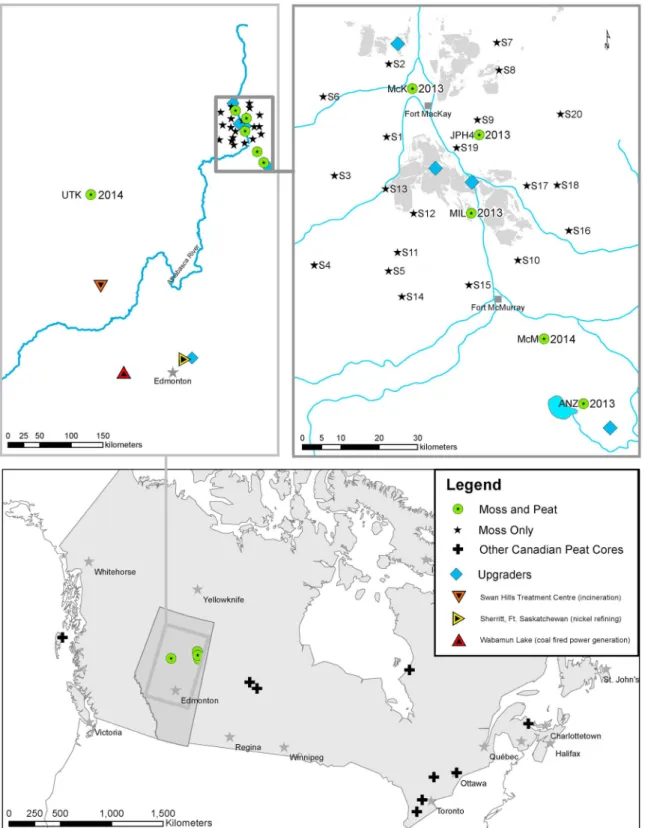
Peat cores were collected from ombrotrophic (rain-fed) bogs in northern AB (Figure 1 and Figure S1):
five sites
are in the vicinity of open pit mines and upgrading facilities of ABS, and one site is far removed from this area
and serves to provide a regional background signal. We provide the precise location of each coring site along
with the distance (in km) from the midpoint to the two central upgraders (supporting information Table S1).
Samples and certi
fied reference materials were dissolved and trace metals determined using inductively
coupled plasma-mass spectrometry (ICP-MS) in the ultraclean, metal-free SWAMP laboratory (supporting
information Table S2). The paleobotanical stratigraphy of each site was reconstructed (supporting
informa-tion Figure S2) and selected plant macrofossils age dated using
14C. The pH of the pore waters and the
ash content of the peats were used to identify the thickness of the ombrotrophic zone in each pro
file
Figure 1. Map showing the locations of the peat cores described in the text (McK, JPH4, MIL, McM, ANZ and UTK) as well as the year of collection. Also shown for comparison, the locations of the moss samples collected from peat bogs of this region which were also measured for trace metals, including Pb and Th (Shotyk et al., 2014). The shaded area in the map shown in the upper right corner refers to the locations of open pit bitumen mines. Also shown are the locations of the bitumen upgraders in the area of the Athabasca Bituminous Sands, namely Suncor, Syncrude, CNRL, and Nexen. The locations of coal-fired electricity generating stations near Lake Wabamun west of Edmonton, the bitumen upgrader east of Edmonton, the Ni refinery at Fort Saskatchewan, and the hazardous waste incinerator at Swan Hills, are also shown. The map of Canada shows the locations of peat cores collected in the past, but recently measured for Pb and Th in their surface layers [Shotyk et al., 2014]
(supporting information Figure S3). In addition to
14C (supporting information Tables S3 and S4), all six peat
cores were also dated using
210Pb (CRS Model) determined using gamma spectrometry, and the ages
con-firmed with established chronostratigraphic markers (
137Cs and
241Am). The degree of peat humi
fication
was evaluated using the main atomic ratios (C/N, H/C and O/C) of selected samples combined with stable
iso-topes (
δ
13C and
δ
15N) and bulk density (supporting information Table S5). Analytical details are provided in
the supporting information.
3. Results and Discussion
The Pb concentrations in the top living layer of each core are very low (Figure 2a): the maximum (1.6 mg/kg at
JPH4) is less than corresponding value for the Drizzle Bog (2.0 mg/kg) on Haida Gwai, a large island west of
British Columbia (Figure 1). The Pb concentrations in the top layer at ANZ and UTK (0.3 mg/kg) are
simi-lar to the corresponding values for the
“cleanest” peat samples ever found (0.28 ± 0.05 mg/kg, n = 17) in
the Swiss bog
“Etang de la Gruère” (EGR) and dating from 5320 to 8030
14C yr B.P. [Shotyk et al., 1998]. In each
bog, the Pb concentration pro
files reveal a prominent peak below the surface, ranging in depth from ~ 10 cm
at MIL to ~ 35 cm at UTK (Figure 2a). Part of the variation in Pb concentrations seen in any given peat pro
file will
have been caused by anthropogenic, atmospheric deposition, but part may be due to differences in the
abun-dance of mineral matter, re
flecting natural variations in atmospheric deposition of mineral dusts, peat
decom-position, and humi
fication, or both (supporting information Figure S1). Thorium, a conservative, lithophile
element which is easily measured using ICP-MS alongside Pb, can be used as an indicator of the abundance
of mineral particles (Figure 2b). To correct the Pb concentrations for these variations, Pb was normalized to
Th (Figure 3a). The Pb:Th ratios show maxima which are ~ 10 to 30 cm below the surface of each bog: this is
a clear and unambiguous indication that the maximum extent of Pb contamination in atmospheric aerosols
has been declining. Moreover, the Pb:Th ratios measured in the topmost layers of peat from these bogs (2.1 to
5.0) are comparable to the corresponding values for the cleanest peat samples ever found (2.3 to 4.6, average
3.4 ± 0.6, n = 18), namely those from the EGR bog in Switzerland [Krachler and Shotyk, 2004] and dating from
5320 to 8030
14C yr B.P. The crustal enrichment factor (EF) for Pb in the AB pro
files was calculated by
normal-izing the Pb:Th ratio (Figure 3a) to the corresponding ratio for the Upper Continental Crust [Wedepohl, 1995].
Figure 2. (A) Pb concentrations (mg/kg) in the six peat cores, listed in order of increasing distance from the mid-point between the two central bitumen upgraders. (B) Th concentrations (mg/kg).
Remarkably, the Pb EF at the surface of these bogs today ranges from only 1.9 to 2.5 (Figure 3b). A Pb EF = 1
indicates no Pb enrichment, relative to the Pb:Th ratio of crustal rocks, and an EF
≥ 2 may be considered the
minimum EF to signal an additional, anthropogenic Pb source, over and above the natural Pb contribution to
the atmosphere from soil-derived dust particles [Shotyk et al., 1998; Zheng et al., 2007]. In other words, the
extent of Pb contamination in the topmost layers of the AB bogs is so small, and it is dif
ficult to distinguish
contemporary Pb to Th ratios from the natural background values. The Th concentrations were also used to
calculate the natural concentrations of Pb in these pro
files and total Pb to calculate the concentrations of
anthropogenic Pb by difference: these calculations show that (i) in the past, natural Pb inputs were tiny,
com-pared to the supply of Pb from human activities, (ii) that anthropogenic inputs have been in decline for
dec-ades, and (iii) that today, anthropogenic and natural Pb concentrations have converged (supporting
information Figure S4).
3.1. Atmospheric Pb in AB, in Perspective
To put the data for the AB samples into context, the extent of Pb contamination in the top layers of these peat
bogs today is no more than that found in the EGR peat bog from Switzerland in the sample dating from 3000
14C yr B.P. (3710 to 3210 cal yr B.P.): that sample was the
first to have a Pb:Sc ratio double the natural
back-ground ratio [Shotyk et al., 1998]. In the Swiss bog, the backback-ground ratio was de
fined as the average of peat
samples (n = 17) dating from 5320 to 8030
14C yr B.P. which, in turn, were the lowest Pb:Sc (and Pb:Th) ratios
found throughout the Holocene. In other words, the extent of Pb contamination being recorded by the peat
bogs of northern AB today is no different than the intensity of atmospheric Pb contamination which occurred
during the Iron Age of central Europe. Again, to view the Pb EF values from AB in the context of global
atmo-spheric Pb contamination, the Pb EF in the Swiss peat samples dating from the Roman Period (1520 to
2100 cal yr B.P.) averages 10.3 (n = 7). So atmospheric Pb contamination in northern AB today is
approxi-mately 20% of that found in Switzerland during Roman times: this
finding has special significance
consider-ing that most of the Pb production durconsider-ing Roman times was from mines in Spain and the U.K. [Le Roux
et al., 2004] and was therefore supplied to the Swiss bog by long-range atmospheric transport.
Figure 3. (A) Pb:Th for each of the six peat cores. (B) Pb Enrichment Factor, calculated using the Pb and Th concentrations for the Upper Continental Crust (Wedepohl, 1995).
The cumulative mass of anthropogenic, atmospheric Pb which has been stored in the AB peat cores since
industrialization began is approximately 5% of the values reported for the cleanest peat bogs we have
stu-died in Switzerland or the remote Shetland and Faroe Islands, and only 10% of the value from the cleanest
peat bogs studied in Europe by our team to date, from eastern Finland (supporting information Table S6).
Compared to other peat bogs we have studied in Canada, the AB peat bogs contain no more than 5% of
the anthropogenic Pb found in bogs from southern Ontario, 25% of that found in the bog from Point
Escuminac National Park on the coast of New Brunswick, and only 70% of the Pb found in our cleanest peat
core from northern Quebec. The inventories of anthropogenic Pb in the AB peat cores are within a factor of 4
of the cleanest peat bog we have found in Canada to date, from remote Haida Gwai which is west of the coast
of British Columbia (supporting information Table S6). In fact, the average anthropogenic Pb inventory in the
AB bogs is within a factor of 7 times the industrial Pb burden (7 mg/m
2) preserved in the past
five centuries of
ice from Greenland [Hong et al., 1994].
3.2. Pb From the Industrial Development of Bituminous Sands?
Although it had been suggested that open pit mining and upgrading of bitumen in AB is a signi
ficant
source of Pb and other heavy metals to the environment [Kelly et al., 2010], the AB peat bogs provide
no evidence of this. First, the Pb:Th ratio of the topmost peat layers of the bogs in the vicinity of the
ABS mines and upgraders is actually slightly less than that of the remote site, UTK (Figure 3). Second,
the Pb:Th ratios of the top layers of all of the peat cores are similar to the background values for the
mid-Holocene [Krachler and Shotyk, 2004]. Third, the Pb:Th ratios have been in decline for decades. For
example, consider the peat core from JPH-4 which is exclusively ombrotrophic and only 12 km from the
midpoint between the two central upgraders: the maximum Pb EF value was found in peat dating from
1967, and Pb EF has been in decline ever since (Figure 4a). Thus, according to this peat pro
file, the extent
of Pb contamination in atmospheric aerosols in the ABS region of northern Alberta began its continual
decline when the industrial development of the bituminous sands was just beginning in 1967, with the
opening of the Great Canadian Oil Sands. This
finding is consistent with the results obtained from
Figure 4. (A) Pb EF versus time. The age-depth models employed210Pb dating (CRS model, validated using137Cs and241Am) along with14C age dates (supporting information Table S3) including those obtained using the atmospheric bomb pulse curve (B) Pb accumulation rates versus time. Lead accumulation rates were calculated as the product of peat accumulation rates (cm/yr), bulk density (g/cm3), and Pb concentrations (μg/g).
sediment cores taken in the Peace-Athabasca Delta which yielded a chronology of Pb accumulation which
was inversely related to oil production in the ABS region [Wiklund et al., 2012].
To further illustrate the recent declines in atmospheric Pb contamination, the peat accumulation rates, bulk
density, and Pb concentrations were used to calculate the Pb accumulation rates (Figure 4b). The
maxi-mum Pb accumulation rates (ARs) shown here (~ 1.5 mg/m
2/yr) are one third the maximum value recently
reported for the Hietajärvi peat bog, a background site within the Patvinsuo National Park in eastern
Finland [Shotyk et al., 2016b], and one tenth the maximum value (15 mg/m
2/yr) reported for peat cores
collected from the EGR bog in a rural setting of the Jura Mountains in Switzerland [Shotyk et al., 1998].
Compared to more industrialized regions of Europe, the Pb ARs for the bogs in northern AB are dwarfed by
the maximum values (mg/m
2/yr) reported for peat cores from bogs in northern Poland (16 [De Vleeschouwer
et al., 2009]), Scotland (60 [Farmer et al., 2006]), Denmark (105 [Shotyk et al., 2003]), England (147 [Rothwell
et al., 2010]), Sweden (150 [Bindler, 2011]), Germany (176 [Hettwer et al., 2003]), and the Czech Republic
(320 [Mihaljevi
č et al., 2006]).
3.3. Environmental Signi
ficance of Diminishing Atmospheric Pb Contamination
Lead poisoning was known in antiquity, having been described in the earliest writings on papyrus,
parch-ment, copper, and clay [Lessler, 1988; Hernberg, 2000; Needleman, 2004]. This knowledge, however, did not
prevent the introduction of Pb additives to gasoline. Since the
first discovery of Pb contamination along
road-ways in Vancouver, British Columbia by Warren and Delevault [1960], the environmental impacts of gasoline
Pb additives have generated a voluminous scienti
fic literature: according to Nriagu [1990], in 1978 alone
there were more than 5000 papers and reports on virtually every aspect of Pb in the environment. Despite
claims from industry that it was a
“gift from God” and “essential to civilization” [Rosner and Markowitz,
1985], the addition of tetraethyl Pb to gasoline was controversial from the start, partly because 15 workers
died and 300 became insane, due to occupational exposure when production
first began in American
factories [Needleman, 1997, 1998, 2000; Nriagu, 1998]. Decades later, an international survey would show
strong linear correlations between blood Pb concentrations and gasoline Pb concentrations in cities
worldwide, but thankfully blood Pb concentrations began their decline soon after the introduction of
unleaded gasoline in 1976 [Thomas, 1995; Thomas et al., 1999].
The environmental history of this fascinating element continues to unfold, with evidence of atmospheric Pb
contamination dating from the Bronze Age having been found in peat bogs from central Romania [Grüters,
2010], the Czech Republic [Veron et al., 2014], and most recently from the Iberian Peninsula [Martínez
Cortizas et al., 2016]. Environmental Pb contamination in Egypt has an even longer history [Véron et al.,
2006, 2013]. Pioneering work on skeletal Pb concentrations of ancient Peruvians by Clair Patterson [Ericson
et al., 1979; Settle and Patterson, 1980] suggested that Pb exposure by modern humans dwarfs natural levels
and has allowed blood Pb concentrations of unimpacted humans to be estimated [Smith and Flegal, 1992,
1995]. Human dental tooth enamel from archeological sites across Britain and Ireland since the Neolithic
illus-trate the connection between Pb use and body Pb burdens [Montgomery et al., 2010], with values from the
Roman Period up to 10,000 times natural levels; these individuals would have had blood Pb concentrations
corresponding to
“very severe” poisoning. Although blood Pb concentrations have widely declined [Petit
et al., 2015], there is no known safe level and this measure is now
“seen by society as evidence of its
commit-ment to its own health
” [Amaya et al., 2010].
The report of an additional, new source of Pb to the environment, from the industrial development of
ABS in northern AB [Kelly et al., 2010], raised considerable concern among First Nations communities
who feared for the safety and security of their indigenous food supply (primarily berries,
fish, and meat)
and therefore also for their traditional lifestyle. In fact, the declining concentrations and enrichments of
Pb seen in the peat bogs of northern AB are consistent with declines found in peat cores from
Ontario [Givelet et al., 2003; Shotyk and Krachler, 2010; Pratte et al., 2013] as well as Manitoba [Shotyk
et al., 2016c], northern Quebec, and coastal British Columbia (W. Shotyk, unpublished data, 2005 and
2007). Viewed in this light and considering the pronounced declines in the extent of atmospheric Pb
con-tamination found in bogs across Europe [Shotyk et al., 2001, 2003, 2005, and many other authors], it
would appear that the battle to end global atmospheric Pb contamination has been largely successful,
at least in Europe and North America.
4. Conclusion
Peat cores from
five bogs in northern Alberta show that atmospheric Pb contamination has been in decline
for decades and has reached the point where, today, it is dif
ficult to detect any Pb contamination, relative to
background levels, in the topmost layers of these ecosystems. Although it had been suggested that the
industrial development of the Athabasca Bituminous Sands is a signi
ficant source of Pb to the environment,
in fact, the extent of atmospheric Pb contamination has been in decline more or less since the industry began
and despite its rapid expansion.
References
Amaya, M. A., K. W. Jolly, and N. E. Pingitore Jr. (2010), Blood lead in the 21st Century: The sub-microgram challenge, J. Blood Med., 1, 71–78. American Geological Institute (1976), Dictionary of Geological Terms, Anchor Press.
Anon (1984), The Pocket Oxford Dictionary of Current English, Oxford Univ. Press. Appleby, P. G., and F. Oldfield (1978), The calculation of210
Pb dates assuming a constant rate of supply of unsupported210Pb to the sedi-ment, Catena, 5, 1–8.
Appleby, P. G., W. Shotyk, and A. Fankhauser (1997), Lead-210 age dating of three peat cores in the Jura Mountains, Switzerland, Water Air Soil Pollut., 100(3-4), 223–231, doi:10.1023/A:1018380922280.
Ayotte, G., and L. Rochefort (2006), Les Sphaignes du Québec, Univ. Laval, Quebec City.
Benoit, J. M., W. F. Fitzgerald, and A. W. Damman (1998), The biogeochemistry of an ombrotrophic bog: Evaluation of use as an archive of atmosphere mercury deposition, Environ. Res., 78(2), 118–133, doi:10.1006/enrs.1998.3850.
Bindler, R. (2011), Contaminated lead environments of man: Reviewing the lead isotopic evidence in sediments, peat, and soils for the temporal and spatial patterns of atmospheric lead pollution in Sweden, Environ. Geochem. Health, 33, 311–329.
Bindler, R., I. Renberg, and J. Klaminder (2008), Bridging the gap between ancient metal pollution and contemporary biogeochemistry, J. Paleolimnol., 40(3), 755–770, doi:10.1007/s10933-008-9208-4.
Boutron, C. F., J. P. Candelone, and S. Hong (1994), Past and recent changes in the large-scale tropospheric cycles of lead and other heavy metals as documented in Antarctic and Greenland snow and ice: A review, Geochim. Cosmochim. Acta, 58(15), 3217–3225, doi:10.1016/ 0016-7037(94)90049-3.
Bränvall, M. L., R. Bindler, O. Emteryd, and I. Renberg (2001), Four thousand years of atmospheric lead pollution in northern Europe: A summary from Swedish lake sediments, J. Paleolimnol., 25, 421–435.
Clark, K. A., and S. M. Blair (1927), The Bituminous Sands of Alberta, Edmonton: Sci. and Industrial Res. Council of Alberta. Report No. 18. Cloy, J. M., J. G. Farmer, M. C. Graham, A. B. MacKenzie, and G. T. Cook (2005), A comparison of antimony and lead profiles over the past
2500 years in Flanders Moss ombrotrophic peat bog, Scotland, J. Environ. Monit., 7(12), 1137–1147, doi:10.1039/b510987f.
Cloy, J. M., J. G. Farmer, M. C. Graham, A. B. MacKenzie, and G. T. Cook (2008), Historical records of atmospheric Pb deposition in four Scottish ombrotrophic peat bogs: An isotopic comparison with other records from western Europe and Greenland, Global Biogeochem. Cycles, 22, GB2016, doi:10.1029/2007GB003059.
Crum, H. (1988), A Focus on Peatlands and Peat Mosses, Univ. of Michigan Press, Ann Arbor.
Crum, H. A., and L. E. Anderson (1981), Mosses of Eastern North America, Columbia Univ. Press, New York.
De Vleeschouwer, F., N. Fagel, A. Cheburkin, A. Pazdur, J. Sikorski, N. Mattielli, V. Renson, B. Fialkiewicz, N. Piotrowska, and G. Le Roux (2009), Anthropogenic impacts in North Poland over the last 1300 years—A record of Pb, Zn, Cu, Ni and S in an ombrotrophic peat bog, Sci. Total Environ., 407, 5674–5684, doi:10.1016/j.scitotenv.2009.07.020.
Ericson, J. E., H. Shirahata, and C. C. Patterson (1979), Skeletal concentrations of lead in ancient Peruvians, New England J. Med., 300(17), 946–951, doi:10.1056/NEJM197904263001703.
Fairbridge, R. W. (1972), in The Encyclopedia of Geochemistry and Environmental Sciences, edited by R. W. Fairbridge, Dowden, Hutchinson, and Ross, Stroudsburg, Pa.
Farmer, J. G., A. B. MacKenzie, M. C. Graham, K. Macgregor, and A. Kirika (2015), Development of recent chronologies and evaluation of temporal variations in Pbfluxes and sources in lake sediment and peat cores in a remote, highly radiogenic environment, Cairngorm Mountains, Scottish Highlands, Geochim. Cosmochim. Acta, 156, 25–49, doi:10.1016/j.gca.2015.02.003.
Farmer, J., M. Graham, C. Yafa, J. Cloy, A. Freeman, and A. MacKenzie (2006), Use of206Pb/207Pb ratios to investigate the surface integrity of peat cores used to study the recent depositional history and geochemical behaviour of inorganic elements in peat bogs, Global Planet. Change, 53(4), 240–248, doi:10.1016/j.gloplacha.2006.03.006.
Garneau, M. (1995), Reference Collection of Seeds and Other Botanical Macrofossils From Meridional and Boreal Quebec, Geol. Surv. of Canada. Openfile 3048, Terrain Sci. Div., Sainte-Foy, Quebec.
Givelet, N., F. Roos-Barraclough, and W. Shotyk (2003), Predominant anthropogenic sources and rates of atmospheric mercury accumulation in southern Ontario recorded by peat cores from three bogs: Comparison with natural“background” values (past 8000 years), J. Environ. Monit., 5(6), 935–949.
Givelet, N., et al. (2004), Suggested protocol for collecting, handling and preparing peat cores and peat samples for physical, chemical, mineralogical and isotopic analyses, J. Environ. Monit., 6(5), 481–492, doi:10.1039/b401601g.
Grüters J. (2010), Geochemical evidence of the onset of the Bronze Age in central Europe from the peat bog‘Taul Negru’ [in German], Romania. B.Sc. thesis, Univ. of Heidelberg.
Hernberg, S. (2000), Lead poisoning in a historical perspective, Am. J. Ind. Med., 38(3), 244–254.
Hettwer, K., M. Deicke, and H. Ruppert (2003), Fens in karst sinkholes—Archives for long lasting “immission” chronologies, Water Air Soil Pollut., 149(1/4), 363–384, doi:10.1023/A:1025627218432.
Hong, S., J. P. Candelone, C. C. Patterson, and C. F. Boutron (1994), Greenland ice evidence of hemispheric lead pollution two millennia ago by Greek and Roman civilizations, Science, 265(9), 1841–1843, doi:10.1126/science.265.5180.1841.
Hua, Q., M. Barbetti, and A. Z. Rakowski (2013), Atmospheric radiocarbon for the period 1950–2010, Radiocarbon, 55(4), 2059–2072. Huntley, M. J., R. W. Mathewes, and W. Shotyk (2013), High-resolution palynology, climate change and human impact on a late Holocene
peat bog on Haida Gwaii, British Columbia, Canada, The Holocene, 23(11), 1572–1583, doi:10.1177/0959683613499051. Hurtig, M. (1985), Canadian Encyclopedia, Hurtig Publishers, Edmonton.
Acknowledgments
Thanks from W.S. to Alberta Innovates-Energy and Environment Solutions for funding (special thanks to John Zhou, Brett Purdy, and Dallas Johnson), to the University of Alberta, the Faculty of Agricultural, Life and Environmental Sciences, and Alberta Environment and Parks for munificent start-up support for the SWAMP laboratory, and to the Canada Foundation for Innovation for a generous equipment grant and match-ing funds from Alberta Enterprise and Advanced Education. The Land Reclamation International Graduate School of the University of Alberta and NSERC CREATE provided Gillian Mullan-Boudreau withfinancial and logistical support. Sarah Gooding, Tracy Gartner, Claudia Sabrina Soto Farfan, Melanie Bolstler, and Karen Lund provided administrative support. We thank Madeleine Jensen-Fontaine, Ehsanul Hoque, Lucas Arantes Garcia, and Brittney Wipf for their help in the laboratory as well as Pedro Henrique Simões and Cara Albright for their help in thefield. Anita Nowinka prepared many of thefigures, and Sandor Haas-Neill the bibliography. Special thanks to Melanie Vile, Kelman Wieder, and Kevin Devito for introducing us to the beauti-ful bogs of this province, and to Peter Outridge for reviewing an early version of the manuscript. We are grateful to the reviewers for helpful comments and suggestions. This paper is dedicated by W.S. to Jerome Nriagu, for decades of illuminating thought on this subject and so much inspiration.
Author contributions: W.S. design of the laboratories (metal-free ultraclean SWAMP, sample preparation, and ultra-low background gamma spectrometry laboratories), grant funding for the laboratories and analytical instruments; design and grant funding for the study; collection of the peat cores, design of the analytical protocol, supervision of staff, interpretation of the results, and writing the paper. P.A.210Pb age dating using Constant Rate of Supply model. B. B. supervision of acid digestion and trace metal determination using ICP-MS, including QA/QC protocol. L.D. pre-paration of samples for14C age dating using accelerator mass spectrometry (AMS) and modeling of14C age dates. D. F. preparation of samples for14C age dating using AMS and modeling of14C age dates. I.G.W. acid digestion and trace metal determination using ICP-MS. M.K. provided Pb and Th data, of ancient Swiss peat samples. G.M. plant macro-fossil stratigraphy and
selection/identification of samples for
14
C age dating using AMS. G.M.B. pH of pore waters and ash content of peats. T. N. design and construction of peat corer
Jones, J. M., and J. Hao (1993), Ombrotrophic peat as a medium for historical monitoring of heavy metal pollution, Environ. Geochem. Health, 15(2-3), 67–74, doi:10.1007/BF02627824.
Kelly, E. N., D. W. Schindler, P. V. Hodson, J. W. Short, R. Radmanovich, and C. C. Nielsen (2010), Oil sands development contributes elements toxic at low concentrations to the Athabasca River and its tributaries, Proc. Natl. Acad. Sci. U.S.A., 107(37), 16,178–16,183, doi:10.1073/ pnas.1008754107.
Kempter, H., M. Krachler, and W. Shotyk (2010), Atmospheric Pb and Ti accumulation rates from Sphagnum moss: Dependence upon plant productivity, Environ. Sci. Technol., 44(14), 5509–5515, doi:10.1021/es100366d.
Klaminder, J., I. Renberg, R. Bindler, and O. Emteryd (2003), Isotopic trends and backgroundfluxes of atmospheric lead in northern Europe: Analyses of three ombrotrophic bogs from south Sweden, Global Biogeochem. Cycles, 17(1), 1019, doi:10.1029/2002GB001921. Krachler, M., and W. Shotyk (2004), Natural and anthropogenic enrichments of molybdenum, thorium, and uranium in a complete peat bog
profile, Jura Mountains, Switzerland, J. Environ. Monit., 6(5), 418–426, doi:10.1039/b313300a.
Kylander, M. E., D. J. Weiss, A. Martínez Cortizas, B. Spiro, R. Garcia-Sanchez, and B. J. Coles (2005), Refining the pre-industrial atmospheric Pb isotope evolution curve in Europe using an 8000 year old peat core from NW Spain, Earth Planet. Sci. Lett., 240(2), 467–485, doi:10.1016/j. epsl.2005.09.024.
Kylander, M. E., D. J. Weiss, and B. Kober (2009), Two high resolution terrestrial records of atmospheric Pb deposition from New Brunswick, Canada, and Loch Laxford, Scotland, Sci. Total Environ., 407, 1644–1657.
Laine, J., P. Harju, T. Timonen, A. Laine, E.-S. Tuittila, K. Minkkinen, and H. Vasander (2009), The Intricate Beauty of Sphagnum Mosses—A Finnish Guide to Identification, Univ. of Helsinki, Dep. of Forest Ecol.
Le Roux, G., D. Weiss, J. Grattan, N. Givelet, M. Krachler, A. Cheburkin, N. Rausch, B. Kober, and W. Shotyk (2004), Identifying the sources and timing of ancient and medieval atmospheric lead pollution in England using a peat profile from Lindow bog, Manchester, J. Environ. Monit., 6(5), 502–510, doi:10.1039/b401500b.
Le Roux, G., D. Aubert, P. Stille, M. Krachler, B. Kober, A. Cheburkin, G. Bonani, and W. Shotyk (2005), Recent atmospheric Pb deposition at a rural site in southern Germany assessed using a peat core and snowpack, and comparison with other archives, Atmos. Environ., 39(36), 6790–6801, doi:10.1016/j.atmosenv.2005.07.026.
Lee, J. A., and J. H. Tallis (1973), Regional and historical aspects of lead pollution in Britain, Nature, 245(5422), 216–218, doi:10.1038/245216a0. Lessler, M. A. (1988), Lead and lead poisoning from antiquity to modern times, Ohio J. Sci., 88, 78–84.
Lindemann, M. (2010), Titanium and Lead in Peat as Indicators of Natural and Anthropogenic Aerosols (in German), Univ. of Heidelberg. Martínez Cortizas, A., L. López-Merino, R. Bindler, T. Mighall, and M. E. Kylander (2016), Early atmospheric metal pollution provides evidence
for Chalcolithic/Bronze Age mining and metallurgy in southwestern Europe, Sci. Total Environ., 545-546, 398–406, doi:10.1016/j. scitotenv.2015.12.078.
McConnell, J. R. J. R., G. W. Lamorey, and M. A. Hutterli (2002), A 250-year high-resolution record of Pbflux and crustal enrichment in central Greenland, Geophys. Res. Lett., 29(23), 2130, doi:10.1029/2002GL016016.
Mihaljevič, M., M. Zuna, V. Ettler, O. Šebek, L. Strnad, and V. Goliáš (2006), Lead fluxes, isotopic and concentration profiles in a peat deposit near a lead smelter (Pribram, Czech Republic), Sci. Total Environ., 372(1), 334–344, doi:10.1016/j.scitotenv.2006.09.019.
Monna, F., C. Petit, J.-P. Guillaumet, I. Jouffroy-Bapicot, C. Blanchot, J. Dominik, R. Losno, H. Richard, J. Lévêque, and C. Chateau (2004), History and environmental impact of mining activity in Celtic Aeduan territory recorded in a peat bog (Morvan, France), Environ. Sci. Technol., 38(3), 665–673, doi:10.1021/es034704v.
Montgomery, J., J. Evans, S. Chenery, V. Pashley, and K. Killgrove (2010),“Gleaming, white and deadly”: Using lead to track human exposure and geographic origins in the Roman period in Britain, J. Roman Archaeol., 78, 199–226.
Murozumi, M., T. Chow, and C. Patterson (1969), Chemical concentrations of pollutant lead aerosols, terrestrial dusts and sea salts in Greenland and Antarctic snow strata, Geochim. Cosmochim. Acta, 33, 1247–1294.
Needleman, H. (1997), Clamped in a straitjacket: the insertion of lead into gasoline, Environ. Res., 74(2), 95–103, doi:10.1006/enrs.1997.3767. Needleman, H. (2004), Lead poisoning, Annu. Rev. Med., 55(1), 209–222, doi:10.1146/annurev.med.55.091902.103653.
Needleman, H. L. (1998), Clair Patterson and Robert Kehoe: Two views of lead toxicity, Environ. Res., 78(2), 79–85, doi:10.1006/enrs.1997.3807. Needleman, H. L. (2000), The removal of lead from gasoline: Historical and personal reflections, Environ. Res., 84, 20–35, doi:10.1006/
enrs.2000.4069.
Ng, A., and C. Patterson (1981), Natural concentrations of lead in ancient Arctic and Antarctic ice, Geochim. Cosmochim. Acta, 45(11), 2109–2121, doi:10.1016/0016-7037(81)90064-8.
Nilsson, M., M. Klarqvist, and G. Possnert (2001), Variation in14C age of macrofossils and different fractions of minute peat samples dated by AMS, The Holocene, 11(5), 579–586, doi:10.1191/095968301680223521.
Norton, S. A., G. C. Evans, and J. S. Kahl (1997), Comparison of Hg and Pbfluxes to hummocks and hollows of ombrotrophic big heath bog and to nearby Sargent Mt. Pond, Maine, USA, Water Air Soil Pollut., 100(3-4), 271–286, doi:10.1023/A:1018380610893.
Norton, S. A., G. L. Jacobson, J. Kopácek, and T. Navrátil (2015), A comparative study of long-term Hg and Pb sediment archives, Environ. Chem., doi:10.1071/EN15114.
Novák, M., et al. (2003), Origin of lead in eight central European peat bogs determined from isotope ratios, strengths, and operation times of regional pollution sources, Environ. Sci. Technol., 37(3), 437–445, doi:10.1021/es0200387.
Nriagu, J. O. (1978), in Biogeochemistry of Lead in the Environment, edited by J. O. Nriagu, Elsevier Biomedical Press, Amsterdam. Nriagu, J. O. (1990), The rise and fall of leaded gasoline, Sci. Total Environ., 92(C), 13–28, doi:10.1016/0048-9697(90)90318-O.
Nriagu, J. O. (1998), Clair Patterson and Robert Kehoe's paradigm of“show me the data” on environmental lead poisoning, Environ. Res., 78(2), 71–78, doi:10.1006/enrs.1997.3808.
Petit, D., A. Véron, P. Flament, K. Deboudt, and A. Poirier (2015), Review of pollutant lead decline in urban air and human blood: A case study from northwestern Europe, Comptes Rendus Geosci., 347(5-6), 247–256, doi:10.1016/j.crte.2015.02.004.
Pratte, S., A. Mucci, and M. Garneau (2013), Historical records of atmospheric metal deposition along the St. Lawrence Valley (eastern Canada) based on peat bog cores, Atmos. Environ., 79, 831–840, doi:10.1016/j.atmosenv.2013.07.063.
Reimer, P. (2013), IntCal13 and Marine13 radiocarbon age calibration curves 0–50,000 years cal BP, Radiocarbon, 55(4), 1869–1887, doi:10.2458/azu_js_rc.55.16947.
Roos-Barraclough, F., N. Givelet, A. K. Cheburkin, W. Shotyk, and S. A. Norton (2006), A ten thousand year record of atmospheric mercury accumulation in peat from Caribou Bog, Maine, and its correlation to bromine and selenium, Environ. Sci. Technol., 40, 3188–3194. Rosman, K. J. R., W. Chisholm, S. Hong, J. P. Candelone, and C. F. Boutron (1997), Lead from Carthaginian and Roman Spanish mines
isoto-pically identified in Greenland ice dated from 600 B.C. to 300 A.D, Environ. Sci. Technol., 31(12), 3413–3416, doi:10.1021/es970038k. Rosner, D., and G. Markowitz (1985), A“gift of God”?: The public health controversy over leaded gasoline during the 1920s, Am. J. Public
Health, 75(4), 344–352, doi:10.2105/AJPH.75.4.344. as well as table for precise sectioning of
frozen peat cores; sample collection and preparation; preparation and measure-ment of samples for137Cs,210Pb, and
241
Am using ultralow background gamma spectrometry, including QA/QC. R.P. creation of maps showing all rele-vant geographic features and locations of bogs from this and previous studies, including both peat and moss only col-lection sites. B.S. design of calibration standards for137Cs,210Pb, and241Am using ultralow background gamma spectrometry; design of analytical pro-tocols for these fallout radionuclides in peat including QA/QC program; cali-bration of these instruments and train-ing of Noernberg. S.vB. responsible for plant macrofossil stratigraphy and selection/identification of samples for
14
C age dating using AMS. C.Z. peat core collection and preparation, and peat humification. The authors declare no competingfinancial interests.
Rothwell, J. J., K. G. Taylor, S. R. N. Chenery, A. B. Cundy, M. G. Evans, and T. E. H. Allott (2010), Storage and behavior of As, Sb, Pb, and Cu in ombrotrophic peat bogs under contrasting water table conditions, Environ. Sci. Technol., 44(22), 8497–8502, doi:10.1021/ es101150w.
Settle, D. M., and C. C. Patterson (1980), Lead in albacore: Guide to lead pollution in Americans, Science, 207(4436), 1167–1176, doi:10.1126/ science.6986654.
Shotyk, W. (1996a), Natural and anthropogenic enrichments of As, Cu, Pb, Sb, and Zn in ombrotrophic versus minerotrophic peat bog profiles, Jura Mountains, Switzerland, Water Air Soil Pollut., 90(3-4), 375–405, doi:10.1007/BF00282657.
Shotyk, W. (1996b), Peat bog archives of atmospheric metal deposition: Geochemical evaluation of peat profiles, natural variations in metal concentrations, and metal enrichment factors, Environ. Rev., 4(2), 149–183, doi:10.1139/a96-010.
Shotyk, W. (2002), The chronology of anthropogenic, atmospheric Pb deposition recorded by peat cores in three minerogenic peat deposits from Switzerland, Sci. Total Environ., 292(1-2), 19–31, doi:10.1016/S0048-9697(02)00030-X.
Shotyk, W., and G. Le Roux (2005), Biochemistry and cycling of lead, in Biogeochemical Cycles of the Elements, edited by A. Sigel, H. Sigel, and R. O. K. Sigel, Marcel Dekker, New York.
Shotyk, W., and M. Krachler (2010), The isotopic evolution of atmospheric Pb in central Ontario since AD 1800, and its impacts on the soils, waters, and sediments of a forested watershed, Kawagama Lake, Geochim. Cosmochim. Acta, 74(7), 1963–1981, doi:10.1016/
j.gca.2010.01.009.
Shotyk, W., H. W. Nesbitt, and W. Fyfe (1990), The behaviour of major and trace elements in complete vertical peat profiles from three Sphagnum bogs, Int. J. Coal Geol., 15, 163–190.
Shotyk, W., H. Wayne Nesbitt, and W. S. Fyfe (1992), Natural and anthropogenic enrichments of trace metals in peat profiles, Int. J. Coal Geol., 20(1-2), 49–84, doi:10.1016/0166-5162(92)90004-G.
Shotyk, W., A. K. Cheburkin, P. G. Appleby, A. Fankhauser, and J. D. Kramers (1997), Lead in three peat bog profiles, Jura Mountains, Switzerland: Enrichment factors, isotopic composition, and chronology of atmospheric deposition, Water Air Soil Pollut., 100(3-4), 297–310, doi:10.1023/A:1018384711802.
Shotyk, W., D. Weiss, P. Appleby, A. Cheburkin, R. Gloor, J. Kramers, S. Reese, and W. O. Van Der Knaap (1998), History of atmospheric lead deposition since 12,37014C yr BP from a peat bog, Jura mountains, Switzerland, Science, 281(5383), 1635–1640.
Shotyk, W., P. Blaser, A. Grünig, and A. K. Cheburkin (2000), A new approach for quantifying cumulative, anthropogenic, atmospheric lead deposition using peat cores from bogs: Pb in eight Swiss peat bog profiles, Sci. Total Environ., 249(1-3), 281–295, doi:10.1016/S0048-9697 (99)00523-9.
Shotyk, W., D. Weiss, J. D. Kramers, R. Frei, A. K. Cheburkin, M. Gloor, and S. Reese (2001), Geochemistry of the peat bog at Etang de la Gruère, Jura Mountains, Switzerland, and its record of atmospheric Pb and lithogenic trace metals (Sc, Ti, Y, Zr, and REE) since 12,37014C yr BP, Geochim. Cosmochim. Acta, 65(14), 2337–2360, doi:10.1016/S0016-7037(01)00586-5.
Shotyk, W., D. Weiss, M. Heisterkamp, A. K. Cheburkin, P. G. Appleby, and F. C. Adams (2002), New peat bog record of atmospheric lead pollution in Switzerland: Pb concentrations, enrichment factors, isotopic composition, and organolead species, Environ. Sci. Technol., 36(18), 3893–3900.
Shotyk, W., M. E. Goodsite, F. Roos-Barraclough, R. Frei, J. Heinemeier, G. Asmund, C. Lohse, and T. S. Hansen (2003), Anthropogenic contributions to atmospheric Hg, Pb, and As accumulation recorded by peat cores from southern Greenland and Denmark dated using the14C“bomb pulse curve,”, Geochim. Cosmochim. Acta, 67(21), 3991–4011, doi:10.1016/S0016-7037(03)00409-5.
Shotyk, W., et al. (2005a), Accumulation rates and predominant atmospheric sources of natural and anthropogenic Hg and Pb on the Faroe Islands, Geochim. Cosmochim. Acta, 69(1), 1–17, doi:10.1016/j.gca.2004.06.011.
Shotyk, W., J. Zheng, M. Krachler, C. Zdanowicz, R. Koerner, and D. Fisher (2005b), Predominance of industrial Pb in recent snow (1994–2004) and ice (1842–1996) from Devon Island, Arctic Canada, Geophys. Res. Lett., 32, L21814, doi:10.1029/2005GL023860.
Shotyk, W., et al. (2014), Sphagnum mosses from 21 ombrotrophic bogs in the Athabasca bituminous sands region show no significant atmospheric contamination of“heavy metals”, Environ. Sci. Technol., 48(21), 12,603–12,611, doi:10.1021/es503751v.
Shotyk, W., H. Kempter, M. Krachler, and C. Zaccone (2015), Stable (206Pb,207Pb,208Pb) and radioactive (210Pb) lead isotopes in 1 year of growth of Sphagnum moss from four ombrotrophic bogs in southern Germany: Geochemical significance and environmental implica-tions, Geochim. Cosmochim. Acta, 163, 101–125, doi:10.1016/j.gca.2015.04.026.
Shotyk, W., B. Bicalho, C. W. Cuss, M. J. Duke, T. Noernberg, R. Pelletier, E. Steinnes, and C. Zaccone (2016a), Dust is the dominant source of “heavy metals” to peat moss (Sphagnum fuscum) from the industrial development of the Athabasca Bituminous Sands in northern Alberta, Canada, Environ. Int., 92-93, 494–506, doi:10.1016/j.envint.2016.03.018.
Shotyk, W., N. Rausch, T. Nieminen, L. Ukomaanaho, and M. Krachler (2016b), Isotopic composition of Pb in peat and porewaters from three contrasting ombrotrophic bogs in Finland: Evidence of chemical diagenesis in response to acidification, Environ. Sci. Technol., doi:10.1021/ acs.est.6b01076.
Shotyk, W., N. Rausch, M. Krachler, and P. M. Outridge (2016c), Isotopic evolution of atmospheric Pb from metallurgical processing in Flin Flon, Manitoba: Retrospective analysis using peat cores from bogs, Environ. Pollut., doi:10.1016/j.envpol.2016.07.009.
Smith, D. R., and A. R. Flegal (1992), The public health implications of humans' natural levels of lead, Am. J. Public Health, 82(11), 1565–1566. Smith, D. R., and A. R. Flegal (1995), Lead in the biosphere: Recent trends, Ambio, 24(1), 21–23.
Thomas, V. M. (1995), The elimination of lead in gasoline, Annu. Rev. Energy Environ., 20, 301–324, doi:10.1146/annurev.energy.20.1.301. Thomas, V. M., R. Socolow, J. Fanelli, and T. Spiro (1999), Effects of reducing lead in gasoline: An analysis of the international experience,
Environ. Sci. Technol., 33, 3942–3948.
Véron, A. J., C. Flaux, N. Marriner, A. Poirier, S. Rigaud, C. Morhange, and J. Y. Empereur (2013), A 6000-year geochemical record of human activities from Alexandria (Egypt), Quat. Sci. Rev., 81, 138–147, doi:10.1016/j.quascirev.2013.09.029.
Véron, A., J. P. Goiran, C. Morhange, N. Marriner, and J. Y. Empereur (2006), Pollutant lead reveals the pre-Hellenistic occupation and ancient growth of Alexandria, Egypt, Geophys. Res. Lett., 33, L06409, doi:10.1029/2006GL025824.
Veron, A., M. Novak, E. Brizova, and M. Stepanova (2014), Environmental imprints of climate changes and anthropogenic activities in the Ore Mountains of Bohemia (Central Europe) since 13 cal. kyr BP, The Holocene, 24(8), 919–931, doi:10.1177/0959683614534746.
Vile, M. A., R. K. Wieder, S. Berryman, and D. Vitt (2013), Development of Monitoring Protocols for N & S Sensitive Bog Ecosystems, pp. 91 , Wood Buffalo Environmental Association: Fort McMurray, Alberta, Canada.
Wardenaar, E. (1987), A new hand tool for cutting peat profiles, Can. J. Bot., 65, 1772–1773.
Warren, H. V., and R. E. Delevault (1960), Observations on the biogeochemistry of lead in Canada, Trans. R. Soc. Canada, 54, 11–20. Wedepohl, K. H. (1995), The composition of the continental crust, Geochim. Cosmochim. Acta, 59, 1217–1232.
Weiss, D., W. Shotyk, and O. Kempf (1999a), Archives of atmospheric lead pollution, Naturwissenschaften, 86(6), 262–275, doi:10.1007/ s001140050612.
Weiss, D., W. Shotyk, P. G. Appleby, J. D. Kramers, and A. K. Cheburkin (1999b), Atmospheric Pb deposition since the industrial revolution recorded byfive Swiss peat profiles: Enrichment factors, fluxes, isotopic composition, and sources, Environ. Sci. Technol., 33(9), 1340–1352, doi:10.1021/es980882q.
Weiss, D., W. Shotyk, M. Gloor, and J. D. Kramers (1999c), Herbarium specimens of Sphagnum moss as archives of recent and past atmo-spheric Pb deposition in Switzerland: Isotopic composition and source assessment, Atmos. Environ., 33, 3751–3763.
Weiss, D., W. Shotyk, E. A. Boyle, J. D. Kramers, P. G. Appleby, and A. K. Cheburkin (2002), Constraining lead sources to the North Atlantic Ocean: Recent atmospheric lead deposition recorded by two ombrotrophic peat bogs in Scotland and Eastern Canada, Sci. Total Environ., 292, 7–18.
Wiklund, J. A., R. I. Hall, B. B. Wolfe, T. W. D. Edwards, A. J. Farwell, and D. G. Dixon (2012), Has Alberta oil sands development increased far-field delivery of airborne contaminants to the Peace-Athabasca Delta?, Sci. Total Environ., 433, 379–382, doi:10.1016/j.scitotenv.2012.06.074. Wu, J. F., and E. A. Boyle (1997), Lead in the western North Atlantic Ocean: Completed response to leaded gasoline phase-out, Geochim.
Cosmochim. Acta, 61(15), 3279–3283, doi:10.1016/s0016-7037(97)89711-6.
Zheng, J., W. Shotyk, M. Krachler, and D. A. Fisher (2007), A 15,800-year record of atmospheric lead deposition on the Devon Island Ice Cap, Nunavut, Canada: Natural and anthropogenic enrichments, isotopic composition, and predominant sources, Global Biogeochem. Cycles, 21, GB2027, doi:10.1029/2006GB002897.