UNIVERSITE DE SHERBROOKE
3 115b D074fl bSI b
FORMALIZATION OF THE STATIC SEMANTICS OF CONTRACTS 5-
/USING ATTRIBUTE GRAMMARS ^
par
QunWu
memoire presente au departement de mathematiques et d'informatique en vue de 1'obtention du grade de maitre es sciences (M.Sc.)
FACULTE DES SCIENCES
UNIVERSITE DE SHERBROOKE
1*1
National Library of Canada Acquisitions andBibliographic Services Branch
395 Wellington Street
Ottawa, Ontario
K1AON4
Bibliotheque nationale du Canada
Direction des acquisitions et des services bibliographiques
395, rue Wellington
Ottawa (Ontario) K1AON4
/our tile Votre r6?rence
Our lile Notre r616rence
The author has granted an
irrevocable non-exclusive licence
allowing the National Library of
Canada to reproduce, loan,
distribute or sell copies of
his/her thesis by any means and
in any form or format, making
this thesis available to interested
persons.
L'auteur a accorde une licence
irrevocable et non exclusive
permettant a la Bibliotheque
nationale du Canada de
reproduire, preter, distribuer ou
vendre des copies de sa these
de quelque maniere et sous
quelque forme que ce soit pour
mettre des exemplaires de cette
these a la disposition des
personnes interessees.
The author retains ownership of
the copyright in his/her thesis.
Neither the thesis nor substantial
extracts from it may be printed or
otherwise reproduced without
his/her permission.
Uauteur conserve la propriete du
droit d'auteur qui protege sa
these. Ni la these ni des extraits
substantiels de celle-ci ne
doivent etre imprimes ou
autrement reproduits sans son
autorisation.
ABSTRACT
The work presented in this thesis is about the Contracts language. It is often the case that groups of related objects cooperate to perform some tasks or maintain some invariants within an object-oriented system. Helm's Contracts language is a technique for specifying this kind of inter-object cooperations in terms of contracts. A contract in Contracts specifies the cooperations in terms of participating objects, obligations of the participants, dependencies between the participants, and the instantiation of the participants. Furthermore, a contract contains invariants which participants cooperate to maintain.
The results of this thesis are a formal specification and a partial implementation of the static semantics of the Contracts language. The syntax used for contracts comes from Holland's work and the formalization is done using attribute grammars. Attribute grammars give the formal definition of all context-free and context-sensitive language properties. They define each language construct only by its immediate environment and minimize the interconnection between the different parts of the language, which makes the definition easier to understand and more concise. The context-free part of the grammar has been implemented using Lex and Yacc.
Sommaire
Introduction
Le travail presente dans ce memoire concerne Ie langage Contracts, Les systemes orientes objet consistent en des groupes d'objets relies qui cooperent afin de realiser certaines taches ou de maintenir certains invariants. Le langage Contracts de Helm est une technique de specification de cooperations interobjets [Helm 90]. Un contrat, dans Contracts, specific les cooperations en termes d'objets participants, d'obligations des participants, de dependances entre participants et de 1'instanciation de ceux-ci. De plus, un contrat contient des invariants que les participants cooperent a maintenir.
Les resultats de ce memoire sont la formalisation de la semantique statique du langage Contracts en utilisant la notation de grammaires d'attributs [Wait 85], selon la syntaxe publiee dans [Holl 92], et 1'implementation de 1'analyse syntaxique et lexicale de Contracts en utilisant Lex et Yacc.
Techniques orientees objet et contrats
Le but principal des techniques orientees objet est d'ameliorer la fiabilite des systemes logiciels. La theorie des contrats intervient comme une approche plus systematique pour 1'obtention et la garantie de la fiabilite. Les groupes d'objets cooperant afin d'accomplir des taches ou de maintenir certains invariants, qui sont appeles compositions comportementales, sont un element important des systemes orientes objet. Les contrats visent a formaliser les collaborations et les relations comportementales entre objets, Selon
definies par une classe. II decrit les famous dont dispose un client donne pour interagir avec un serveur. Un contrat est une liste de requetes qu'un client peut formuler a un serveur. Le client et Ie serveur remplissent Ie contrat en executant uniquement les requetes que Ie contrat specifie et en repondant adequatement a ces requetes separement. Les travaux scientifiques recents reconnaissent 1'importance de telles cooperations. Us font reference au fait que les comportements inter-objets peuvent etre exprimes sous la forme de graphes
de responsabilites [Wirf89] et de collaborations [Wirf 90]. Une responsabilite est quelque
chose qu'un objet realise pour d'autres objets; c'est la base de la determination des contrats supportes par une classe. Un contrat constitue un ensemble cohesif de responsabilites sur lequel un client peut compter. Un graphe de collaborations est un outil d'aide a 1'analyse des voies de communication et a I'identification de sous-systemes potentiels. II montre graphiquement la collaboration entre classes et sous-systemes. II represente les classes, les contrats et les collaborations. II montre egalement les relations super-classe et sous-classe. Dans les graphes de collaborations, une super-classe represente les contrats supportes par toutes ses sous-classes. Mais 1'inference des dependances comportementales qu'elles impliquent est difFicile et celles-ci causent des problemes subsequents dans la conception, la comprehension et la reutilisation des logiciels orientes objet.II y a plusieurs usages differents du mot contrat dans Ie domaine de 1'oriente objet. Chaque usage est base sur Ie principe de 1'encapsulation et des consequences de 1'application de ce principe. Cependant, ces usages du mot contrat different principalement dans 1'etendue de leur definition en termes de nombre d'objets participants et des methodes que chaque participant supporte. Par exemple, Ie concept de contrat de Meyer ne fait intervenir que deux classes (la classe appelante, qui est Ie client, et la classe appelee, qui est Ie fournisseur) et une methode [Meye 92]. Le client invoque la methode implementee par Ie fournisseur. Le contrat est exprime enutilisant deux sortes d'assertions. La premiere espece d'assertions exprime les obligations et les benefices du contrat, qui sont appeles respectivement preconditions et postconditions. Les preconditions expriment des specifications qui font
appel a une routine a satisfaire pour etre correctes. Les postconditions expriment les proprietes qui doivent etre garanties apres Ie retour de 1'execution de la routine. La deuxieme espece d'assertions est constituee par les invariants de classe, qui sont les proprietes qui s'appliquent a toutes les instances de la classe, transcendant les routines particulieres. Meyer a introduit Ie concept de contrat dans Ie langage Eiffel, mais a un niveau plutot bas d'abstraction et de formalisme.
Le concept de contrat de Helm generalise Ie concept initial de contrat pour deux entites aux relations multiobjets. II s'attache a 1'interaction entre objets cooperants. II supporte la decouverte, la comprehension et la representation de 1'interaction entre objets. II fournit un vocabulaire pour la conception orientee interaction. Par comparaison avec d'autres notions de contrat, la contribution de Helm est la generalisation des dependances aux multiobjets, la saisie des dependances comportementales entre objets cooperants et un formalisme pour 1'abstraction.
Les contrats de Helm specifient les compositions comportementales sous la forme d'objets participants, d'obligations contractuelles de chaque participant, de preconditions sur les participants requises pour etablir un contrat et d'invariants que les participants doivent maintenir. Les obligations contractuelles sont des obligations de type et des obligations causales. Les obligations de type specifient certaines variables et interfaces externes qui sont supportees par les participants. Les obligations causales specifient des sequences ordonnees d'actions que doivent executer les participants, Les obligations causales sont 1'element essentiel des compositions comportementales. Par 1'intermediaire des obligations causales, les contrats rendent explicites les dependances comportementales entre les participants d'un contrat. II y a deux operations sur les contrats : 1'inclusion de contrat et Ie raffmement de contrat, Le comportement des participants d'un contrat peut etre specialise ou etendu grace a ces deux operations. Le raffinement permet la specialisation des obligations contractuelles et des invariants des contrats. Les contrats peuvent etre
raffines en specialisant les types de participants ou en derivant un nouvel invariant qui implique 1'ancien. Les obligations rafTinees se basent sur celles du contrat rafifme. Toutes les autres obligations du nouveau contrat sont heritees de 1'ancien contrat.
L'inclusion permet aux contrats d'etre formes de sous-contrats plus simples. La participation a un sous-contrat impose des obligations additionnelles aux participants au-dela et en plus de celles definies dans Ie contrat. Elles sont impliquees par les sous-contrats Indus plutot que reecrites. Les mecanismes d'inclusion et de rafFmement peuvent etre combines si necessaire. Tous deux fournissent Ie moyen d'exprimer des comportements complexes sous la forme de comportements plus simples et permettent aux contrats de creer et de reutiliser des abstractions grossieres basees sur les comportements. Les contrats utilisent des declarations de conformite pour definir comment 1'implementation d'une classe particuliere, et done de ses instances, rencontre les obligations d'un type de participants. Les contrats sont definis dans un langage de haut niveau, qui permet une description sommaire des comportements en termes de sequences ordonnees d'actions a effectuer et de conditions a rendre vraies.
Plusieurs chercheurs ont introduit et utilise Ie concept de contrat de Helm dans leurs travaux. Buhr et Casselman ont developpe une vision unifiee des architectures logicielles entermes de contrats, de roles et de "timethreads" [Buhr 92], Aussi bien les architectures cablees que les architectures non connectees se concentrent sur 1'expression des relations de cooperation entre composants et sur les interactions des composants entre eux. Us out affirme que 1'elaboration d'architectures connectees en roles et en contrats aide a montrer les aspects distincts, simples et separes de la conception. Voir les architectures non connectees en termes de contrats fournit un niveau plus eleve d'abstraction dans la conception. Lajoie et Keller ont developpe un modele multicouche pour la reutilisation d'un modele [Lajo 94]. Les contrats sont introduits dans leurs travaux comme une technique de description pour les specifications de haut niveau de comportements d'objets, Les travaux
de Holland sur les contrats portent a la fois sur la semantique statique et sur la semantique dynamique du langage [Holl 92] [Holl 93]. La semantique statique de chaque construction grammaticale est decrite sous la forme d'une fonction de validite et exprime des contraintes additionnelles qui ne peuvent etre exprimees par la grammaire. La semantique dynamique de chaque construction grammaticale est definie sous la forme d'une fonction :
MT ; T - (Etats - Etats).
Ceci signifie que chaque specimen de la construction T est afifecte a une fonction
(possiblement partielle) de Etats dans Etats. En utilisant ce style de specification, Holland
a construit un modele sequentiel de calcul.Grammaires d'attributs
Notre formalisation de la semantique statique du langage Contracts est faite en utilisant la notation de grammaires d'attributs [Wait 85]. Les arbres de structure sont utilises pour illustrer 1'application des regles de syntaxe des contrats a 1'analyse d'un texte dans ce langage. Chaque noeud de 1'arbre de structure correspond a 1'utilisation d'une regle et est dote d'attributs decrivant les proprietes de cette regle. L'attribution de chaque noeud dans 1'arbre structural collecte I'information sur son environnement. Les grammaires d'attributs sont utilisees pour representer les regles de I'attribution. Elles consistent en la definition formelle de toutes les proprietes de langage independantes et dependantes d'un contexte.
Une grammaire d'attributs associe un ensemble fini A(x) d'attributs a chaque symbole x appartenant au vocabulaire de la grammaire. Elle peut etre definie par des fonctions associees a chaque production dans la grammaire. Chaque attribut represente une propriete contextuelle d'un symbole et peut etre synthetise ou herite. Les attributs synthetises representent des proprietes du point de vue du sous-arbre derive du symbole dans 1'arbre de structure. Les attributs herites resultent de la consideration de 1'environnement. Les
attributs synthetises sont suffisants pour definir toute fonction d'un arbre de derivation. L'inclusion d'attributs herites peut resulter en d'importantes simplifications. D'autres techniques pour la definition semantique formelle de langages de programmation incluent 1'algorithme markovien de croissance de Bakker et Ie A.-calcul de Landin [Land 64] [Land65] [Land 66]. La difference la plus frappante entre ces methodes et les grammaires d'attributs est que ces techniques sont des processus qui sont definis par des programmes comme un tout, et ce, d'une fa9on plutot compliquee. On doit comprendre en entier un compilateur d'un langage avant de pouvoir comprendre la definition de ce langage. La grammaire d'attributs definit chaque construction du langage seulement par son environnement immediat, en minimisant les interconnections entre les differentes parties du langage. Cette localisation et ce partitionnement des regles semantiques tendent a rendre la definition plus facile a comprendre et plus concise. Les grammaires d'attributs donnent la definition formelle de toutes les propnetes du langage, non contextuelles et contextuelles, et constituent aussi une specification formelle de 1'analyse semantique.
Specification formelle de la semantique statique des contrats avec les grammaires
cTattributs
Dans notre travail, nous adoptons les conventions, fonctions et notations de Waite et Goos pour formuler la grammaire d'attributs pour Ie langage Contracts [Wait 85]. Chaque production de Contracts est exprimee en utilisant la notation EBNF et commence avec Ie mot-cle rule. La partie attributs commence avec Ie mot-cle attribution et une condition peut suivre Ie mot-cle condition.
Cette partie de notre travail definit les proprietes semantiques statiques du langage Contracts au moyen d' une grammaire d'attributs. Elle consiste en deux parties principales. La premiere partie traite de I'introduction des outils, incluant les definitions des structures
pour la presentation des identij&cateurs et des types, et de toutes les fonctions dans la suite. La seconde partie consiste en toutes les regles de Contracts, Cette partie determine les proprietes statiques de Contracts et introduit une structure de specification de Contracts: comment declarer les participants dans un contrat, comment definir les obligations de chaque participant (mcluant les variables et les methodes supportees), comment definir un contrat incluant ou raffinant quelques contrats existants et comment exprimer les invariants d'un contrat et de son instanciation. Dans cette partie, les principaux aspects de la semantique statique de Contracts sont discutes par 1'intermediaire de la grammaire d'attributs, comme 1'etendue d'un identificateur et les types et les difFerentes relations entre eux (par exemple, equivalence de types, compatibilite de types).
Implementation cTun analyseur syntaxique
Notre travail inclut aussi 1'implementation de 1'analyse syntaxique et lexicale de Contracts en utilisant Lex et Yacc. L'analyse lexicale traite de la division des intrants en unites significatives qui sont appelees "jetons". La pretraduction traite de la decouverte des relations existant entre les unites. Lex est un outil de construction d'analyse lexicale [Levi 92]. II genere une fonction C qui peut identifier des jetons en prenant un ensemble de descriptions, appele specification Lex. Yacc est un outil pour la generation d'un analyseur qui reconnait les phases valides de la grammaire [Levi 92]. II prend comme intrants une serie de regles, qui est appelee une grammaire Yacc.
Notre specification Lex pour Contracts consiste en trois parties : la definition, les regles et les sections de sous-routines des utilisateurs. La section de definition inclut un fichier genere par Yacc et contient toutes les definitions dejetons. La section des regles identifie les differents jetons utilises par Contracts, Us comprennent les mots reserves et quelques autres jetons de connexion tels que les identificateurs, les nombres et les operateurs. La
section des sous-routines des utilisateurs inclut les routines de traitement des erreurs et la routine principale. La routine principale ouvre un fichier nomme sur la Ugne de commande et appelle la pretraducteur. La valeur retoumee rapporte Ie fait que la pretraduction a reussi
ou echoue.
Notre grammaire Yacc pour Contracts comprend deux parties : la section des definitions et celle des regles. La section des definitions declare les symboles terminaux que 1'analyse lexicale passe au pretraducteur. Tous les symboles utilises comme jetons doivent etre definis explicitement dans la section des definitions. La section des regles comprend toutes les regles de grammaire, comme les regles de declaration de chaque participant, 1'inclusion, Ie raffinement des contrats existants de chaque participant, les invariants et 1'instanciation
d'un contrat.
Lorsqu'un scanner Lex et un analyseur Yacc sont utilises ensemble, 1'analyseur est la routine de haut niveau. L'analyseur appelle Ie scanner lorsqu'il a besoin d'un jeton depuis les intrants. Le scanner et 1'analyseur doivent se mettre d'accord sur ce que sont les codes des jetons. Ceci est resolu en laissant Yacc definir les codes des jetons dans un fichier ;
1'analyseur lexical utilise ces definitions numeriques des jetons en incluant Ie fichier,
Nous avons utilise notre analyseur pour verifier trois exemples tires de [Helm90]. Ces trois exemples sont Contracts DepthFirst, Dft-Connected et Dft-cycle. Nous avons aussi utilise notre analyseur pour verifier un exemple presente dans ce memoire.
ACKNOWLEDGEMENTS
First and foremost, I wish to extend special thanks to my research director Dr Michel Barbeau. He introduced me to the fascinating world of my research work. He gave me a lot of help in my courses, my research work, and the writing of this thesis. I will always bear this in mind.
My acknowledgements also to all the professors and students in our department.
I would also like to acknowledge the financial support of the ministere de 1'Industrie, du Commerce, de la Science et de la Technologie du Quebec,
CONTENTS
ABSTRACT...,..,...,....,...,.^ SOlVGvIAIRE... ACKNOWLEDGEMENTS...,...,...,...^ CONTE^^1S...^ UST OF FIGURES...,...,...,...,...,...,...,...,...^ CHAPTER 1-INTRODUCTION...^ 1.1 Introduction to Contracts....,...,...,..,...,,,....,...,...,...!1.2 Introducing Attribute Grammars...3
1.3 Result and Outline,...5
CHAPTER2-RELATED WORK... 2.1 Introduction....,...,...,...,...,...,,...,...,...,....,..^ 2.2 The Notion ofHelm's Contracts...6
2.3 HoUand's Work about Contracts.,...8
2.4 Buhr and Cassehnan's Work about Contracts...9
2.5 Lajoie and Keller's Work about Contracts... 11
2.6 Other Tools for Understanding Object Interactions,... 12
2.7 M^^sWo±...^^ 2.8 Wufs-Brokeetal.'s Work about Contracts... 16
2.9 Schrefl and Kappel's Work about Contracts,... 17
CHAPTER 3-THE STATIC SEMANTICS OF THE CONTRACTS LANGUAGE...21
3.1 Attribute Grammars,...21
3.2 Formal Definitions of Attnbute Grammars.,...25
3.3 An Attribute Grammar for Contracts...26
33.1 Utilities...,...^ 3.3.2 Productions...36 3.3.2.1 Basic Symbols...36 3.3.2.2 Contracts Structure...37 3.3.2.2.1 Participant Declarations...41 3.3.2,2,2 Contract Body...43 3.3.2,2.3 Expressions... 53 3.3.2.2.4 Invariants...61
CHAPTER 4-USmG LEX AND YACC TO CONTRACTS...62
4.1 Lex Specification of Contracts.,...63
4.2 Yacc Grammar of Contracts...64
4.3 Parser-Lexer Communication...64
4.4 Running Lex and Yacc...65
CHAPTER 5-EXAMPLE...^ CHAPTER 6-CONCLUSIONS...^^ APPENDDCA-Lex Specification of Contracts..,...75
APPENDDCB-Yacc Grammar of Contracts...78
LIST OF FIGURES
Figure 1
Figure 2
Figure 3Figure 4
Figure 5
Figure 6
Examples of Meyer's approach and Helm's approach... 15
Tree structure of string 101.01...22
Evaluated tree structure of string 101,01...23
Evaluated tree structure of string 101.01...24
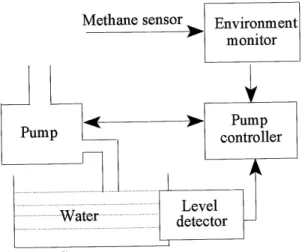
Computer-controlled mine drainage system...67
Chapter 1
Introduction
This work is about the formalization and partial implementation of the static semantics of the Contracts language. The syntax used for Contracts comes from [Holl 92], which is
more mature and slightly different from the original syntax published in [Helm 90], The
static semantics has been formalized using attribute grammars. The implementation has been done using Lex and Yacc.In the sequel, we introduce Contracts and attribute grammars, we state the results, and outline the contents of this thesis.
1.1 Introduction to Contracts
Improving the reliability of software systems is the mam goal of object-oriented techniques. Defensive programming is an often emphasized approach when discussing reliability
[Wirf89], This technique suggests that routines should be as general as possible. However,
the blind and often redundant checking in this technique causes much of the complexity and
affects the quality and reliability of systems.
The concept of contract pretends to be a more systematic approach for obtaining and guaranteeing reliability. Initially, a contract is a class related concept [Wirf89]. A contract describes how a given client can interact with a server. A contract is a list of requests that a client can make to a server. Both cooperate to fulfil the contract in the following way. The client makes only those requests that the contract specifies and the server responds
of contract, for two entities, to multiobject relations. It aims at explicitly specifying the important behavioral dependencies caused by object interactions. It focuses on the interaction of cooperating objects and supports the discovery, understanding, and representation of object interactions.
Understanding and representation of object interactions are also important with respect to reuse. Reuse is the cornerstone of the object-oriented technology. An abstract design can be expressed as a group of classes. Reusing this abstract design means both reusing the classes in the group and the relationships between them,
Helm's Contracts defines behavioral dependencies, called object interactions, within a group of objects which cooperate to accomplish some tasks or maintain some invariants. Each contract specifies the participating objects in interaction and also the function of each object that contributes to the interactions. Apart from the explicit representation of object interactions, Contracts also provides a module-like construct to structure and organize object-oriented implementations. Contracts breaks up the class behaviors and packages the pieces in cohesive contracts. This overcomes the problems caused by some other existing module architectures consisting of either a small number of very large modules or a spaghetti-like structure ofimport/export module relationships.
Contract refinement and contract inclusion are two important features of the Contracts language. They provide two distinct means to express complex behaviors by simpler ones. Through these techniques, components defined as contracts can be customized through type substitution and method overriding. Large-grained abstractions based on object interactions can be created and reused.
The creation of object-interactions is performed by an instantiation statement. An instantiation statement identifies objects as participants in a desired contract and specifies the methods which are used to establish the contract. This is different from the previous
programming language constructs in which object interactions are created by class constructors or certain sequences of method calls. Contract instantiation statements bring the benefits of I) explicitly expressing the behavioral composition and the objects involved in the interaction, ii) providing better and easier understanding of the application
architecture, and iii) facilitating the replacement of objects by functionally equivalent
objects, when a change is needed.Finally, a conformance statement establishes the fact that the behavior defined for a class conforms to the behavior required by a contract. It is used to determine the legal classes of objects allowed to participate in a particular contract. It can also be considered to be a
validation step, ensuring that an individual has the authority and ability to participate in a
contract. Contract conformance and contract instantiation are two steps to establish a contract between a group of objects in an object-oriented system.Comparing Contracts with other techniques for specifying inter-object relationships, the contributions of Helm's contract are the following: generalizing the dependencies to multiple objects, capturing the behavioral dependencies between cooperating objects, and
providing a formalism for abstraction. As the author claimed in [Helm 90], an initial shift
away from class-based design to one based on Contracts greatly facilitates the early identification, abstraction, and subsequent reuse of patterns of interactions between objects.1.2 Introducing Attribute Grammars
In this thesis, the formalization of the static semantics of the Contracts language is done using the notation of attribute grammars. Structure trees can be used to illustrate the use of the syntax rules of a language for analysing a text in that language. Each node of the structure tree corresponds to the use of a rule of the language and can be decorated with attributes describing the properties of that rule. The attribution of each node in the structure
tree collects information about the environment. Rules of attribution can be represented by attribute grammars which consist of the formal definition of all free and context-sensitive language properties.
An attribute grammar is based on a context-free grammar G = (V, N, S, 0). For each symbol xeV, there is a finite set A(x) of attributes which represents a context-sensitive property of x. Each attribute can be either a synthesized attribute or an inherited attribute and is defined by functions associated with each production in the grammar.
The initial use of attribute grammars is to define semantics by associating synthesized attributes with each nonterminal symbol and semantics rules with each production. Each nonterminal symbol is given exactly one attribute. Although synthesized attributes alone are sufficient, the inherited attributes lead to important simplifications. Inherited attributes facilitate the definition of a block structure, which is a common aspect of programming languages. Generally, inherited attributes are useful when apart of the meaning of some construction is determined by the context in which that construction appears.
The semantic rules are said to be well-defined if they are formulated in such a way that all attributes can always be defined at all nodes in any derivation tree. It is important to decide whether or not a given grammar has well-defined semantic rules, since there may be infinitely many derivation trees. The definition and theory of "well-definedness" can be found in [Wait 85], and an algorithm for testing "well-definedness" can be found in
[Knut68],
Some other techniques for the formal semantic definition of programming languages include Bakker's growing Markovian algorithm [Bakk 67] andLandin's /^-calculus. Both
have been used [Land 64] [Land 65] [Land 66] for the definition ofALGOL 60. The most
striking difference between these methods and attribute grammars is that the former are processes defined on programs as a whole in a rather intricate manner. One mustunderstand an entire compiler for the language before one can understand the definition of the language. The attribute grammar minimizes the interconnections between the different parts of the language by defining each language construct only with its immediate environment. Because of the localization and partitioning of the semantic rules, it makes the definition easier to understand and more concise. Attribute grammars give the formal definition of all context-free and context-sensitive language properties and also constitute a formal specification of the semantics analysis.
1.3 Results and Outline
The main result of this thesis is a formal specification, using attribute grammars, of the static semantics of Contracts, according to the syntax published in [Holl 92].
This thesis also resulted in an implementation, using Lex and Yacc, of the context-free part of this attribute grammar.
This thesis is organized as follows. We first review in Chapter 2 the work related to Contracts, Chapter 3 gives the formal specification of the syntax and static semantics of the Contracts language and the intuitive description of the dynamic semantics of each construct. Chapter 4 gives the results of the implementation of the context-free part of the attribute grammar of Contracts using Lex and Yacc. Chapter 5 gives an example that illustrates the application of Contracts to the specification of object interactions in a mine drainage control system problem [Barb 94], Finally, Chapter 6 gives the conclusions,
Chapter 2
Related Work
2.1 Introduction
This chapter is a survey of work related to ours. It includes the notion of Helm's Contracts which is the basis of our work, Holland's work based on Helm's Contracts with some differences and additions, Buhr's work about Contracts, and other works related to
Contracts.
As there are many different uses of the word "contract", this section compares and contrasts the different uses of the term contract in the object-oriented field. Each notion of contract discussed below is based on the principle of encapsulation and the consequences
of applying this principle. The notions differ mainly in the scope of their definitions in terms
of the number of objects participating in contracts and the methods each participant supports. This chapter also reviews some other techniques for the specification ofinter-object behavior, e.g., collaboration graphs and responsibilities. Finally, for the reason that our intention is to apply Contracts as a language of formal specification, formal specification of requirements in an object-oriented context is briefly discussed, that is, Hayes and Coleman's work.2.2 The Notion of Helm's Contracts
Hehn's Contracts is a technique for specifying the obligations on participating objects within
a behavioral composition. Such a behavioral composition involves groups of related objectscooperating to perform a task and maintain invariants [Helm 90], A contract specifies a behavioral composition in terms of; I) the objects participating in the composition, that is,
the participants; ii) the obligations of the participants; iii) the dependencies between the
participants; and iv) the instantiation of the contract. Participant obligations include: I) support of a certain interface described as typed variables and messages, it is called type obligations, ii) performance of sequences of actions and satisfaction of conditions in response to messages, and iii) satisfaction of preconditions at the instantiation of the contract and maintenance ofinvariants during the contract. The later two aspects are called causal obligations. Causal obligations capture the behavioral dependencies between objects.A contract contains invariants that participants cooperate to maintain and it also defines what actions should be initiated to resatisfy the invariants when they are violated. A contract includes preconditions on participants to establish the contract and the methods which instantiate the contract.
Contracts are defined in a high-level language, which allows abstract description of behavior in terms of ordered sequences of actions to be performed and conditions to be made true. The language supports the following basic actions in the original syntax in [Hehn 90]: sending a message, denoted by P-»M and the setting of an instance variable v, denoted by Av. The ordering of actions can be explicitly given by the operator " ; ", The language also provides the construct < ov : c : e > for the repetition of an expression "e" separated by the operator "o" for all variables "v" that satisfy "c".
For example, < ||v: v e Views: v —^ UpdateQ > means;
vl -»UpdateQ || v2^ UpdateQ || v3-. UpdateQ ... ifvl, v2, v3,...eViews. Conditions which participants are obliged to make tme appear in curly brackets { ... } and are expressed as logical formulae over the signatures (the names of the sorts and operators, together with the definition of domains and ranges) of participants.
There are facilities for refinement of contracts and inclusion of subcontracts in a given contract. Refinement makes possible specialization of a contract by the overriding or addition of participant obligations. Inclusion allows decomposition of a contract into simpler subcontracts. Both facilities are orthogonal and promote reuse of contracts.
Contracts make abstraction of actual classes of objects (e.g., C++ classes) describing the implementation of the participants. Indeed, several actual classes can meet the obligations of a participant. Conversely, a class can meet the obligations of several participants. The precise mapping of participants to actual classes is described by means of a conformance declaration. Syntactical details and an informal definition are presented in [Helm 90].
2.3 Holland's Work about Contracts
Holland's work about Contracts encompasses both static semantics and dynamic semantics
of the language [Holl 92][Holl 93]. Both aspects are discussed hereafter.
Static Semantics
In Holland's work, the static semantics of each grammar construct is described in terms of
a validity function;
VT: T^B
where T is an abstract syntax construct defined by the grammar and B={tme, false}. A static semantics usually expresses additional constraints which cannot be expressed by the grammar. For example, the semantics of a procedure call (denoted as procCall in the abstract syntax) includes a constraint saying that every procedure call must refer to a procedure defined in the program. It is defined as follows:
Vproccall; ProcCall x ProcEnv -4 B
Vproccall[[iCall, ProcEnv]] = {iCall.procName e domProcEnv}.
In Holland's work, the validity function V^ is not provided for every construct of Contracts. Our work about static semantics of contract is based on an attribute grammar and we define an attribute grammar rule for every construct of Contracts,
Dynamic Semantics
In Holland's work, the dynamic semantics for each grammar construct is defined in terms of a function;
MT : T - (State - State)
It means that each specimen of the construct T is mapped to a (possibly partial) function taking one element of State to another. By using this denotational semantics style method, Holland constructs a sequential model of computation,
2.4 Buhr and Casselman's Work About Contract
Buhr and Casselman's work [Buhr 92] aims to develop a unified view of software architectures in terms of contracts, roles, and timethreads. The main idea of contract in their paper is not only based on Helm's contract, but also comes from other terms for describing inter-object relations such as mechanisms and cooperations.
Buhr and Casselman developed the concepts of wired and wireless architectures. Architectures focus on the collaboration relationships between components and how these components interact with each other to accomplish system tasks. Two kinds of unifying models of software architectures are wired architectures and wireless architectures. Wired
architectures are static one. They only permit communication between the components which are wired together. Wireless architectures are relatively dynamic. They permit communication between any two components at any time. Wireless architectures are proposed to be suitable for data-centric design and wired architectures for behavior-centric design.
Contracts are the rules or protocols which the components must obey in accomplishing system tasks. They specify how groups of object cooperate with each other. Objects participate in contracts by playing roles. A role defines a type obligation, including a set of methods with thdr type signatures (the names of the sorts and operators, together with the definition of domains and ranges), and a causal obligation. Contracts can be viewed as entities of the design. Role playing is static in wired architectures and dynamic in wireless architecture.
In wired architectures, timethreads are proposed to express the major patterns of contracts. Contracts can be expressed by one or more timethreads. A timethread starts at some point of stimulus, go through all design elements which are activated by the stimulus sequentially, and ends at some point of the completion of all activities caused by the stimulus.
Contracts help us to understand a framework. Factoring wired architectures into roles and contracts help to show the distinct, simple, and separable aspects of a design. Viewing wireless architectures in terms of contracts provides a high level of abstraction of design. Representation based on contracts is useful for documenting object-oriented frameworks and also provide a tool for the design of them.
2.5 Lajoie and Kellerts work about Contracts
Software reuse is a means of improving the practice of software engineering. Object-oriented frameworks improve design-level reuse. A framework is a collection of abstract and concrete classes and the interfaces between them. A framework is the design for a
subsystem.
In a framework, there are collaborations between the objects in classes. The interaction among objects, however, cannot be expressed very well by frameworks. Micro-architectures have been introduced to codify design knowledge about object collaborations.
Lajoie and Keller [Lajo 94] developed a multi-layered model for framework documentation
and reuse. Description techniques for both micro-architectures [Gamm 93] and frameworksadopted and refined in their work include: design patterns [Alex 79], Contracts [Helm 90],
and Motifs [John 92]. Design patterns is a technique for describing micro-architectures at a very high level. They express how components interrelate and give a high-level representation for properly capturing and describing design experience. They can be described in an informal template-based manner. The Contracts technique is adopted as an intermediate representation between a micro-architecture and its corresponding design pattern. The contract definition in this work comes directly from Helm et al. and is also used as a construct for explicitly specifying interactions among groups of objects. The main adjustment to Contracts in this work is that: micro-architectures are allowed to be developed directly and from a guiding design pattern. Contracts are used to describe high-level specifications of object behavior, with emphasis on minimum details required to express participant interactions. Contrary to Helm's contracts, the object interactions are first class entities in the design space. This paradigm supports interaction-oriented design. In this paradigm, design is a two-step process, firstly, defining behavioral compositions by contracts, secondly, factoring contracts into classes definitions and hierarchies via thecontracts conformance declarations. Motifs are used to describe the general, high-level aspects of the framework rather than the design details of the micro-architectures. All
motifs have the same form which begins with a title followed by a detailed discussion of
how the situation may be adopted and ends with references to other related motifs as well as to relevant design patterns or contracts. The integrated description techniques proposed by the authors in their framework is to decrease a class framework's learning curve and consequently increase their reusability.In a word, design patterns and contracts are introduced as new techniques for describing micro-architectures at a very high level and an intermediate level respectively. Motifs are adapted to the description of the abstraction levels of framework design.
2.6 Other Tools for Understanding Object Interactions
Explicitly specifying inter-object relationships is not entirely new. Many recent publications recognize the importance ofinter-object behavior, which can be expressed in terms of both conceptual and graphical tools; e.g., responsibilities [Wirf 89] and collaboration graphs [Wirf90], mechanisms, and views. The first two terms are reviewed in this section.
A contract is a set of related responsibilities defined by a class. Responsibilities are the basis for determining the contract supported by a class. A responsibility is something one object does for other objects by either performing some action or responding with some information. It is the central idea for responsibility-driven design which focuses on what is the object responsible for and what information this object shares. A contract constitutes a cohesive set of responsibilities.
subsystems. A subsystem is a set of classes collaborating to fulfil a set of responsibilities.
A collaboration graph simplifies a design by identifying subsystems within a complex large
application and it clearly represents classes, contracts, collaborations, and superclass-subclass relationships. A superclass represents the contracts supported by all of itssubclasses.
2.7 Meyer's Work
As the complexity of applications increases, it is important to improve the ability of
software to be reused, refined, tested, maintained, and extended. Abstraction is an effective tool to improve these abilities of software. Many types of abstraction can be used. Encapsulation is a key form of abstraction by which complexity can be managed. Since programming in an object-oriented language does not ensure that the complexity of anapplication will be well encapsulated, good programming techniques need to be applied to
improve encapsulation.Meyer proposed the notion of "programming by contract". A notion of contract is used to
specify the relationship between the caller and the called routine of a class with associated
benefits and obligations [Meye 92]. It involves precisely two classes and one method. One of the classes (the caller class, called the client) invokes a method implemented by the other (the callee class, called supplier). The contract can be expressed using two kinds of assertions. The first kind of assertions are pre and postconditions expressed using the keywords require and ensure. The second kind are class invariants. The obligations and benefits of the contract are specified by preconditions and postconditions. The preconditions express requirements that must be satisfied for any call of a routine. The postconditions express properties that must be held after the return of the execution of the call. A class invariant is a property that applies to all instances of a class, transcendingparticular routines. It defines constraints among class instances and methods. Meyer introduced its notion of contract in the Eififel language, but at a rather low level of abstraction and formalism.
In contrast, Helm's notion of contract is used to specify the behavioral composition of several cooperating participants (may be more than two) and the invariants are global to all the participants. The main difference is that Helm's contract generalizes the contract notion to multiobject dependencies.
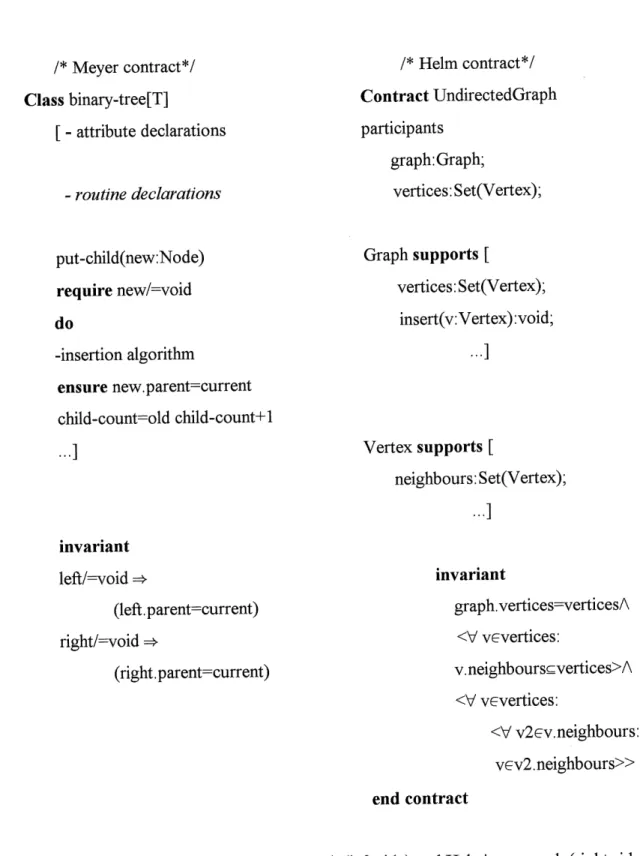
Let us consider the example of Fig 1, The left part of Fig. 1 defines the put-child contract
using Meyer's notion of contract. The contract is related to a class binary-tree describing a routine piit-child for adding a new child to a tree node, denoted as current. The require part of the contract requires that the child be accessible through a reference, which must be attached to an existing node object. The ensure part of the contract expresses that, in return of the execution of the call, the tree is updated. That is, the current node has one more child than before and current is the parent of the new node.The invariant of this contract states that node current is the parent of both the left and right children of node current, if these children exist. This contract shows that the client class gets the benefits of an updated tree where the current node has one more child than before. New has current as its parent now, but the obligations are that new is used as an argument and it references to an existing node. The supplier class of this contract gets the benefits
that: no need to do anything if the argument is attached to a void object and it must
guarantee that insertion of a new node as required./* Meyer contract*/
Class binary-tree[T]
[ - attribute declarations - routine declarations /* Helm contract*/Contract UndirectedGraph
participantsgraph: Graph;
vertices; Set(Vertex);
put-child(new:Node)
require new/=voiddo
-insertion algorithm ensure new.parent=current child-count=old child-count+1 ...] invariant left/=void => (left. parent=current) right/=void =^ (right. parent=current)Graph supports [
vertices: Set(Vertex);
insert(v:Vertex):void;
...] Vertex supports [neighbours: Set(Vertex);
...] invariant graph,vertices=verticesA <V vevertices: v.neighbourscvertices>A <V vevertices: <V v2ev. neighbours: vev2. neighbours» end contractThe right part of Fig. 1 defines the UndirectedGmph contract by using Helm's notion of contract. It consists oftwo kinds of participants: a graph object and a set ofvertices. The contractual obligations of the participants are expressed, with the "support" clauses and the invariant ensures that the participating objects do indeed represent an undirected graph.
2.8 Wirfs-Brock et al/s Work about Contracts
Wirfs-Brock et al. [Wirf89] proposed a responsibility-driven approach for object-oriented design. It is based on the client/server model which captures the interaction between two entities, the client and server. A client asks the server to provide services. A server provides a set of services corresponding to the request. A contract expresses the ways in which the two entities interact each other. It is constituted of a list of requests that can be made on the server by the client. To fulfil the contract, a client can only make the requests the contract specifies and the seryer only responds to the corresponding requests. Responsibilities are the individual services provided by the server. The client/server model focuses on what the server does for the client, not how the server does it. The server implementation is encapsulated away from the client. There are three kinds of clients in the model, external clients, subclass clients, and self clients. An external client is an object that sends messages to an instance of the class or the class itself. A subclass client is any class that mherits from the class. Subclass clients help to improve encapsulation by ensuring that all inherited behavior is part of the contract of the subclasses. A self client means any class should be viewed as client of itself.
To summarize, Wirfs-Brock et al.'s notion of contract involves two classes and one or more methods.
2.9 Schrefl and Kappel's Work about Contracts
Cooperation contracts, proposed by Schrefl and Kappel [Schr 91], have a similar syntactic form but a different model than Helm's contract. Cooperation contracts aim to explicitly express the interactions between several objects. They are defined in terms of partner types which participate in a contract and the functionality of the whole contract. Note that in Helm's, Meyer's and Wirfs-Brock et al.'s contracts, only a single object can receive a message. In the Cooperation contracts model, multiple objects can receive a given message. Cooperation contracts involve more than one class and can involve more than one method implementation.
Comparing Cooperation contracts with Helm's contracts, the similarity is that both contracts are defined over multiple types, called partner types and participant types separately. But there exist much differences between them; I) participant types are local to the contract, partner types are external to the contract; ii) the behavior specified in Helm's contract is distributed among the participants, whereas in Cooperation contracts, the behavior is globally attached to the whole; iii) Helm's contract specifies the cooperation relationships of all the participants in the contract, Cooperation contracts reflect the relationships between the partner types and the external clients; and iv) the refinement mechanism in Cooperation contracts only allows a method to be overridden and new methods to be added but does not allow adding new partner types, whereas Helm's contracts supports both of them.
There are also some other researchers that used the same term contract, e.g., Budd's interface contracts and subclass contracts [Budd 91]. Helm's Contracts is a generalization of all these contract concepts.
2.10 Hayes and Coleman's Work
For the reason that our final purpose is to formalize Helm's contract to be a specification language of the problem, we discuss hereafter Hayes and Coleman's work [Haye 91] about the formal specification of requirement in an object-oriented context. Their work also referred to the verification of consistency between the dynamic model and functional model of the same problem.
They introduce a set of formal models for object-oriented analysis. The models have mathematical basis so they have a precise semantics and constitute a consistent description of domains. In developing these models, the authors where mainly concerned about the issues ofunambiguity, abstraction, and consistency. In other words, models should have a single precise meaning, should not be cluttered with unnecessary details that can influence the design and implementation phases, and it should be possible to verify their consistency with other models of the same system.
These models are improvement of the OMT model by Rumbaugh [Rumb 91] and are
illustrated by applying them to the analysis of a simple drawing application which allows
the user to draw lines and boxes and move them with some constraints.OMT uses three diflferent models, namely, the object, dynamic, and functional models. The object model captures structure of the objects. The dynamic model captures the behavior of individual objects. Finally, the functional model represents the behavior of the whole
system.
In OMT, the object model uses entity-relationship diagrams to model the object classes, attributes, and relations. The dynamic model is concerned with temporal behavior and uses extended finite state machines. The overall system behavior is shown by the functional
model using data flow diagrams. Entity-relationship diagrams have a formal semantics. State machines and diagrams rely on natural languages and are prone to ambiguity. Moreover, there is no way to check the consistency of the objects or dynamic models with the functional models.
The authors of the current method state that the key to improve the precision of analysis is the introduction of mathematical basis for the above three models. They introduce a new model, the object structure model, that forms a link between the object model and both the functional and dynamic models. The mathematical formalism used is many sorted predicate logic with built in types (like char, natural, and type constructors such as set and sequence).
Every class is represented in the object structure model as an abstract structure which precisely states the types of the attributes and relationships in which an object of that class may participate. More precisely, given a class C a record type is associated containing:
o a field "self of type "C_id", that is the object identifier,
o afield "att" of type "Attjype" for each attribute "att" of type "Attjype" defined in the class, and
o a field "R" of type "set ofD_id" for every binary relation from a class C to a class D.
The paper does not show how general relations and inheritance are represented. In the functional model, operations on objects are specified in a declarative style by means of pre and postconditions, local to an object and/or global to the system (via parameters of type "System").
The dynamic model is based on the Objectcharts notation [Cole 92], an extension of
Harel's Statecharts with pre and postconditions associated to events. The effect of events on local attributes is defined using pre and postconditions. Objects communicate togetherusing synchronous events.
The issue of verification of consistency between models is addressed. Models have formal basis. However, proof of consistency relies on the ingenuity of the analyst. The following approach is suggested. Using the dynamic model, generate event traces of the system behavior. Then, determine if traces implement the declarative specification of the functional model by checking implications of pre and postconditions.
These models are related to the analysis phase of the software development process. The following analysis procedure is suggested by the authors;
1) Develop a natural language description of the problem.
2) Build an object model (entity-relationship model) together with a data dictionary of
classes, relations, and attributes.3) Derive an object structure model from the object model.
4) Use the object structure model to define the declarative functional model.
5) Use the object structure model to define a dynamic model together with diagrams
showing examples of how events flow through the system in response to systemoperations.
6) State test event traces and reasoned arguments to show that the dynamic and functional models are consistent.
Chapter 3
The Static Semantics of the Contracts Language
3.1 Attribute Grammars
An attribute grammar is developed by analyzing the meaning of each symbol in a grammar, assigning a meaning to each symbol using the concept of attribute, and giving rules of defining the attribute values of the symbols. Each attribute represents a specific (context-sensitive) property of a symbol. The attributes of each symbol can be either synthesized attributes which are passed bottom-up in the derivation tree, or inherited attributes which are passed top-down in the denvation tree (the grammar should be an L-attributed grammar in this case). The idea of defining semantics by associating synthesized attributes with each nonterminal symbol comes from Irons [Iron 61, Iron 63]. Although, synthesized attributes of a symbol (which come from the attributes of the descendants of the symbol) are sufficient to define any function of a derivation tree. The inclusion of inherited attributes of a symbol (which come from the attributes of the ancestors of this symbol) may result in important simplifications.
Let us consider the following context-free grammar which defines a binary number:
B-0 B - 1
(Gl) L- B
L- LB
N- L
where 0, 1, and "•" are terminal symbols; and B, L, and N are nonterminal symbols representing bits, list of bits, and number respectively. That means any binary number is a sequence of one or more O's and 1's followed optionally by a radix point and another sequence of one or more O's and 1's. For example, the string 101.01 is a binary number and it receives the structure pictured in Fig. 2.
Figure 2; Tree structure of string 101.01
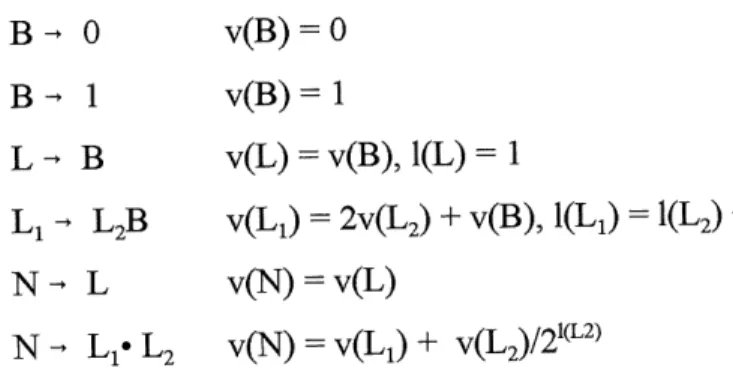
We can give a meaning to the above binary notation by assigning attributes to the nonterminal symbols as follows: each B has a value v(B) which is an integer, each L has two attributes: length 1(L) and value v(L), both are integers, and each number N has a value v(N) which is a rational number. Any desired number of attributes can be given to each nonterminal symbol. And now, we need to give the rules for calculating the value of each attribute according to the semantics of each production. Each rule of grammar Gl can be augmented as follows:
(G2)
B- L-LI-
N-0
1
B
L2B
L
v(B) = 0
v(B)=l
v(L) = v(B),
v(Li) = 2v(L
v(N) = v(L)
1(L) = 1
2)+v(B),l(LO=l(L2)+l
N - Li- 4 v(N) = v(LJ + v(4)/21(L2)
Fig. 2 can be expressed by showing the attributes at each level as in Fig. 3.
N(v=5.25) L(v=5,l=3) L(v=2,1=2) B(v-l) L(v=l,l=l) B(v=0) i B(v=1) 0 L(v=lJ=l) L(v=0,M) B(V=I) B(v=0)
Figure 3; Evaluated tree structure of string 101.01 (according to grammar G2)
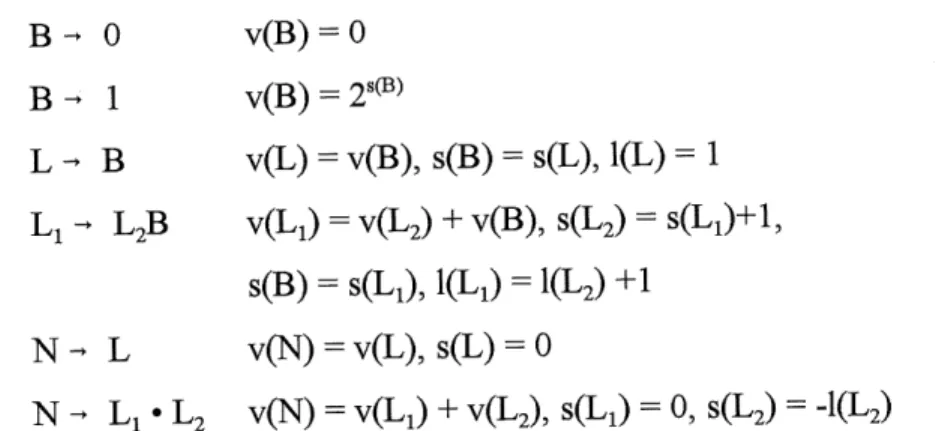
Up to now, we finished to form the attribute grammar for Gl. But let us continue to consider the following thing: how we can define the semantics if we want that the positional characteristics plays a role. For doing this, the following attributes can be defined: each B has two attributes, value v(B) which is a rational number and scale s(B) which is an integer.
Each L has three attributes, value v(L) which is a rational number, length 1(L), and scale
s(L), both are integers. Each N has a value v(N) which is a rational number, Then, the attributes can be defined as follows:(G3)
B- L-LI-
N-0
1
B
L^B
L
Li-Lv(B) = 0
v(B) = 2S(B)v(L)=v(B),s(B)=s(L),l(L)=l
v(L,) = v(L,) + v(B), s(L,) = s(Li)+l,
s(B) = s(Li), 1(L,) = 1(L,) +1
v(N)=v(L),s(L)=0
L, v(N) = v(LO + v(L^), s(LQ = 0, s(L,) = -\(L,)
The great differences between the grammar G3 and grammar G2 is that in grammar G2 all attributes were defined when the nonterminal symbol appeared on the left side of the corresponding production, that means there are only synthesized attributes here. All attributes are evaluated in one direction (bottom-up) in the deriving tree. In grammar G3, the attributes can be defined for nonterminal symbols which appear on both sides of the corresponding production. That means that inherited attributes are also included here, so the attributes are evaluated in both direction in the deriving tree. For example, in G3, V(B),V(L), L(L), and V(N) are synthesized attributes and S(B) and S(L) are inherited attributes.
The evaluated structure corresponding to the string 101.01 is shown as Fig. 4.N(v=5.25) L(v=5,1=3, s=0) ; L(v=0.25,1=2, s=-2) L(v=4,1=2, s=l) B(v=l, s=0) I<v=o:1=1- s=-l> B<v=a25. s=-2) ]^v=4,l=l,s=2)E(v=0,s=l) 1 B(v=4, s=2) 0 B(v=0, s=-l) 1
3.2. Formal Definitions of Attribute Grammars
This section gives the formal description of synthesized and inherited attributes using a
precise and general setting. Suppose we have a context-free grammar G=(V,N,S,P), where V is a finite vocabulary of terminal and nonterminal symbols, N c V is a set ofnonterminal symbols, ScN is a start symbol, which appears on the right-hand side of no production rule, and P is a set of production rules. Semantics can be added to G in the following manner: for each terminal or nonterminal symbol x e V, there is an associating finite set A(x) of attributes. Each attribute represents a specific property of symbol x and has a finite range. The attributes of each symbol x can be classified in two parts, the inherited attributes andthe synthesized attributes. The evaluation rules of inherited attributes AI(x) are: 1) the start
symbol S has no inherited attributes, i.e., AI(S) = 0, 2) for a given production, the inherited
attributes of the symbol on the right can be evaluated by other symbols in this production, i.e., for the production p: Xg ^ Xi...X^, the inherited attributes ofX^( i <> 0) are AI( X^)= { X,.a - f(Xj.b, ...A.c)} ({j, .., k} c {0, 1, .., n}-{i}). Here, we use "X.a" to indicate
that attribute "a" is an element ofAI(X), and 3) for each inherited attribute of the symbol on the left hand, if it exists, it inherits the attributes which have already been evaluated in the previous productions.
The evaluating rules of synthesized attributes AS(x) are: 1) the attributes of a terminal
symbol is empty, i.e., AS(x) = 0, if x is a terminal symbol, 2) for a given production, the synthesized attributes on the left hand can be evaluated by the attributes of symbols on the right hand or left hand, i.e,, for the production p; Xg ^ Xi...X^,AS(X,) - {Xo.a - f(^.b, ..,X,.c)} ({j, .., k) c {1, „„ n}).
For any given production p, there may be a condition B(X,.a,...,Xj.b), in addition to the attribution rules. A condition B(Xi.a,...,Xj.b) specifies a contextual property according to the static semantics. It must be fulfiled by a sentence.
Definition 3.1. An attribute grammar is a 4-tuple, AG = (G,A,R,B), where G = (V,N,S,P) is a context-free grammar, A = u A(X) (Xe T uN) is a finite set of attributes, R
= u R(p) (p eP) is a finite set of attribution rules and B= uB(p) (p eP) is a finite set of
conditions,Definition 3.2. For each p: Xo^Xi.. .X^ e P, the set of defining occurrences of attributes is AF(p) = { Xi.a | ie {0, 1,..., n} and X,.a - f(,..) e R(p) }. An attribute X^.a (i=0, l,..,n)
is called derived or synthesized if there exists a production p: X^ ^ ^ and X^.a is in AF(p);
it is called inherited if there exists a production q: Y^ ^iX,u and X^.a is in AF(q).Synthesized attributes of a symbol are evaluated by considering the subtree derived from this symbol in the structure tree. Inherited attributes are evaluated by considering the environment of this symbol,
3.3. An Attribute Grammar for Contracts
In the following, we adopt the conventions, functions, and notations from Waite and Goos [Wait 85] to give the attribute grammar for the Contracts language. The basis document for the syntax of this grammar is Holland's paper [Holl 92]. Each production peP is expressed using EBNF notation and marked by the keyword rule. The attributes of each production p are marked by the keyword attribution and conditions may follow the keyword condition.
3.3.1. Utilities
For simplification purposes, the following conventions are used. A synthesized attribute of the left-hand side of a production may be omitted if there is only one symbol on the right-hand side and this attribute is same-named with that of right hand, e.g., for the rule statements : := statement, we omit the attribution rules. Simple assignments of inherited attributes of the left-hand side to same-named inherited attributes of any number ofright-hand symbols may be omitted.
We also use the assumption that for every record type R used to describe attributes, there exists a function N_R which has the parameters corresponding to the fields of record R. This function creates a new record of type R and assigns the parameter values to the fields
of R.
For representing every definition of an identifier, the following variant record is used;
type
definition_class = ( obj ect_defimtion, type_definition,unknown_definition);
definition = recorduid:integer;
ident: symbol;
case k; definition class of
object_definition: (obj ect_type: mode);
type_definition: (defmed_type: mode);
unknown_defmition: ()The variant object_definition is used to refer to object identifiers. Objects are the concrete instances of values that operations are operated upon. The variant type_definition is used to refer to type identifiers. The definition class unknown _definition is used to deliver a value if no definition is available for an identifier,
Records of type definition are collected into linear lists, referenced as the environment and definition attributes, by every construct that uses an identifier. The type of the environment attribute is:
definition table = T dt element;
dt element = recordfirst: definition;
rest: definition table
end;Types classify values according to the operations which can be performed on them and the applicable coercions. The following record is used to build attributes describing types:
type
type_class = (
bad_type, void_type, bool_type, int_type, real_type, ref_type, set_type, proc_type, obligation_type, unidentified_type, identified_type, contract_type); mode = record
case k:type_class of
badjype, void_type, bool_type, int_type, real_type:();
ref_type; (target: T mode);
set_type: (element: T mode );
contract_type: (parameters: definition_table) ;
obligation_type;(
variables: definition table,
methods: definition_table);
unidentified_type: (identifier; symbol);
identified_type:(definition:integer)
end;
Type bad_type is used to indicate that errors have made it impossible to determine the proper type. Type void_type is used in the case that a result of a procedure is to be
discarded. The type unidentified Jype is used when a type identifier occuring in a
declaration is not yet identified. The type identified Jype is used when a type identifier
occurmg in definition has already been identified,In the following, we introduce functions used in this thesis. They come from [Wait 85].
If we want to look for the definition of a symbol in a definition table, the function current ^definition can be used. It searches the environment sequentially from left to right and selects the first definition for the desired identifier.function current_definition(s; symbol; dt : definition_table): definition;
begin
ifdt=nil
then current definition:=nil else if dtt. first. ident=s
then current definition :=dtT. fir st
else current_definition:=current_definition(s, dtt. rest)
end;
If we want to find the type defined by an identifier in a definition table, the function
identify Jype can be used. It searches the environment sequentially from left to right andselects the first type defined by the identifier.
function identify_type(s: symbol; dt:definition_table):mode;
(* Find the type defined by an identifier *)
begin
if dt=nil then identify_type:=N_mode(badJype)
else with dtt .first doif soident then
identify_type:=identify_type(dt t .rest)
else (* s=ident *)if k<>type_definition then
identify Jype: =N_mode(bad_type)
else identify_type:=N_mode(identified_type, uid)
end;The function lookup finds a definition from its unique integer identifier.
function lookup(def: integer; dt: definition_table): definition;
begin
ifdt=nil
then "attribute grammar error" else
ifdtt.first.uid=def then lookup := dtt .first
else lookup := loohip(def, dtt .rest)
end;In order to check the consistency of expressions and statements (e.g., expression: :=name) and identify the operator used in expressions (e.g., expression; :=expression+expression), the types of the operands must be taken into account. Two attributes primode and postmode are defined for this purpose. The attribute primode describes the type determined directly from a node and its descendants. It is a synthesized attribute. The attribute postmode describes the type expected when a result is used as an operand by other nodes. It is a type required m a context and this attribute is inherited. The function deproc is used to obtain the primode of a name.
Function deprocft) recursively tests the type_class of t. If t belongs to a non-proc_type or procjype with parameters, the function returns t itself, otherwise, if t belongs to a proc_type without parameters, the function keeps testing the type_class oft.resultt .
function deproc(t: mode): mode;
begin
ift.k <> proc_type then deproc := t else ift.parameters <> nil then deproc := t else deproc := deproc(t.resultt)
end;
Function compare _parameters(fl, f2) tests whether or not the two lists/-/,/2 include the same numbers of elements. If not the function returns false, otherwise, it further tests whether or not each pair of the elements which have the same sequence number in/7,/2
function compare _parameters(fl, £2: definition_table):boolean; (* Compare parameter lists for equivalent types *)
begin
iffl=nil then compare_parameters:=£Z=nil else if£2=nil then compare j3arameters:=false else
compare_parameters: =
type_equivalent(
fl t. first. object_type, £21. first. object_type) and compare_parameters(fl t .rest, £2 T .rest)
end;
Function type_equivalent tests whether or not tl and t2 are semantically equivalent. If tl and t2 do not belong to the same type class, the function returns false, otherwise the function returns tme except in the following three cases which need further test: 1) if they are both ref_type, the function returns tme if their target types are type_equivalent, otherwise, the function returns false, 2) if they are boihproc_type, the function returns tme if their parameters and their result are type_equivalent, and 3) if they are both identified Jype, the function returns tme if the definitions of these two types are equal.
function type_equivalent(tl, t2:mode);boolean; (* Compare two types for equivalence *)
begin
iftl.k<>t2.k then type_equivalent:=false else/*tl.k=t2.k*/
casetl.kof
type_equivalent(t 1 .target t, t2 .target T) proc_type: type_equivalent:=
compare j3arameters(tl. parameters, t2. parameters) and type_equivalent(tl .result t, t2.result T);
identified_type:
type_equivalent: =t 1. definition=t2. definition otherwise type_equivalent:=true
end end;
Coercible is one kind of relation expressed by recursive functions over types: a type tl is
coercible to a type t2 if it is either compatible with t2 or can be converted to t2 by a
sequence of coercions. Function coercibleftl, t2) means tl is coercible to t2 in the followmg cases: 1) tl and t2 are semantically equivalent or 2) if they are not semanticallyequivalent then i) tl can be any type if the type class of t2 is voidjype or badjype, ii) tl
belongs to bad_type, iii) t2 can be realjype if ^7 is intJypQ, iv) tl.target\ must be
coercible to t2 if tl is refjype or v) tl.result} must be coercible to ^2 if tl \sprocjype
with no parameters.function coercible(tl, t2 : mode):boolean;
begin
iftype_equivalent(tl, t2) or
t2.k=void_type or t2.k=bad_type then coercible: =tmeelse
casetl.kof