HAL Id: hal-01184439
https://hal.inria.fr/hal-01184439
Submitted on 14 Aug 2015
HAL is a multi-disciplinary open access
archive for the deposit and dissemination of
sci-entific research documents, whether they are
pub-lished or not. The documents may come from
teaching and research institutions in France or
abroad, or from public or private research centers.
L’archive ouverte pluridisciplinaire HAL, est
destinée au dépôt et à la diffusion de documents
scientifiques de niveau recherche, publiés ou non,
émanant des établissements d’enseignement et de
recherche français ou étrangers, des laboratoires
publics ou privés.
Acyclic Coloring of Graphs of Maximum Degree ∆
Guillaume Fertin, André Raspaud
To cite this version:
Guillaume Fertin, André Raspaud. Acyclic Coloring of Graphs of Maximum Degree ∆. 2005
Euro-pean Conference on Combinatorics, Graph Theory and Applications (EuroComb ’05), 2005, Berlin,
Germany. pp.389-396. �hal-01184439�
Acyclic Coloring of Graphs of Maximum
Degree ∆
Guillaume Fertin
1and Andr´e Raspaud
21
LINA FRE CNRS 2729, Universit´e de Nantes - 2 rue de la Houssini`ere - BP 92208 - F44322 Nantes Cedex 3 [email protected]
2
LaBRI UMR 5800, Universit´e Bordeaux 1 - 351 Cours de la Lib´eration - F33405 Talence Cedex [email protected]
An acyclic coloring of a graph G is a coloring of its vertices such that: (i) no two neighbors in G are assigned the same color and (ii) no bicolored cycle can exist in G. The acyclic chromatic number of G is the least number of colors necessary to acyclically color G, and is denoted by a(G). We show that any graph of maximum degree ∆ has acyclic chromatic number at most ∆(∆−1)2 for any ∆ ≥ 5, and we give an O(n∆2) algorithm to acyclically color any graph of maximum degree ∆ with the above mentioned number of colors. This result is roughly two times better than the best general upper bound known so far, yielding a(G) ≤ ∆(∆ − 1) + 2 [ACK+04]. By a deeper study of the case ∆ = 5, we also show that any graph of maximum degree 5 can be acyclically colored with at most 9 colors, and give a linear time algorithm to achieve this bound.
Keywords: Acyclic chromatic number, acyclic coloring algorithm, maximum degree
1
Introduction
In this paper, we address the acyclic coloring problem. An acyclic coloring of a graph G is a coloring of its vertices such that: (i) no two neighbors in G are assigned the same color and (ii) no bicolored cycle can exist in G. In other words, an acyclic coloring of G is a proper coloring of G such that any two classes of colors induce a graph G0which is a forest (that is, an acyclic graph). The minimum number of colors necessary to acyclically color G is called the acyclic chromatic number of G, and is denoted by a(G).
For a family F of graphs, the acyclic chromatic number of F , denoted by a(F ), is defined as the maximum a(G) over all graphs G ∈ F . Acyclic coloring has been largely studied in the past 25 years ; in particular, a(F ) has been determined for several families F of graphs such as planar graphs [Bor79], planar graphs with “large” girth [BKW99], 1-planar graphs [BKRS01], outerplanar graphs (see for in-stance [Sop97]), d-dimensional grids [FGR03], graphs of maximum degree 3 [Gr¨u73] and of maximum degree 4 [Bur79]. In the last two cases, in particular, it was shown that:
• 4 colors are sufficient to color any graph of maximum degree 3, and there exists a graph G of max-imum degree 3 for which any acyclic coloring requires 4 colors. It was proved recently in [Sku04] that there exists a linear time algorithm that acyclically colors any graph of maximum degree 3 in 4 colors.
390 Guillaume Fertin and Andr´e Raspaud • 5 colors are sufficient to color any graph of maximum degree 4, and there exists a graph G of
maximum degree 4 for which any acyclic coloring requires 5 colors.
However, little is known concerning the acyclic chromatic number of graphs of maximum degree ∆, for general ∆. Most of the results on this topic come from Alon et al. [AMR90], where the following results were proved: (1) asymptotically, there exist graphs of maximum degree ∆ with acyclic chromatic number in Ω( ∆
4 3
(log ∆)13) ; (2) asymptotically, it is possible to acyclically color any graph of maximum
de-gree ∆ with O(∆43) colors ; (3) a trivial greedy polynomial time algorithm exists that acyclically colors
any graph of maximum degree ∆ in ∆2+ 1 colors. More recently, the latter result was improved by
Al-bertson et al. [ACK+04]. In that paper, the authors showed a result concerning another type of coloring,
called star coloring. However, their result directly implies that in any graph G of maximum degree ∆, a(G) ≤ ∆(∆ − 1) + 2.
The main drawback concerning results (1) and (2) is that they come from probabilistic arguments ; thus their proofs are existential but not constructive. Moreover, as mentioned in [AMR90], at this time there is no example of graphs of maximum degree ∆ needing Ω( ∆
4 3
(log ∆)13) colors, and we have no algorithm that
performs an acyclic coloring of graphs of maximum degree ∆ with O(∆43) colors (or even o(∆2) colors).
Acyclic coloring algorithms for graphs of maximum degree ∆, to our knowledge, has barely been stud-ied, except for the two above mentioned results and the result from Skulrattanakulchai [Sku04] that is specialized to the case ∆ = 3. In this paper, the algorithms we provide can be considered as a follow-up and a generalization of Skulrattanakulchai’s work; they also consist in an improvement of the result from [ACK+04], since we roughly divide by 2 the upper bound on a(G) for graphs G of maximum degree ∆. However, our method still uses O(∆2) colors. Nevertheless, when applied to small values of ∆, our
method gives upper bounds that prolongate the knowledge we already have for the cases ∆ = 3 [Gr¨u73] and ∆ = 4 [Bur79]. In particular, for ∆ = 5, we obtain that any graph of degree 5 can be acyclically colored in 9 colors (as well as a linear time algorithm to do so).
The paper is organized as follows: in Section 2, we first give an O(n∆2) time algorithm to
acycli-cally color any graph of order n and degree ∆ ≥ 4 in ∆(∆−1)2 − odd(∆) + 1 colors, where odd(∆) = 1 if ∆ is odd, and 0 otherwise. Then, we improve this bound by 1 (while preserving the algorithm complexity) in Section 3, for any ∆ ≥ 6 ; this gives us the main theorem of this paper, namely Theorem 2. Finally, in Section 4, we focus on the case ∆ = 5, where we prove that there exists a linear time algorithm to color any graph of maximum degree 5 with 9 colors. Due to space considerations, most of the proofs will be omitted in this extended abstract.
2
An Algorithm using at most
∆(∆−1)2−odd(∆) + 1 Colors (∆ ≥ 4)
In this section, we give a polynomial time algorithm to acyclically color any graph of maximum degree ∆ ≥ 4 in ∆(∆−1)2 − odd(∆) + 1 colors, where odd(∆) = 1 if ∆ is odd, and 0 otherwise. So far, the best constructive algorithm to acyclically color any graph of degree ∆ uses ∆(∆ − 1) − 2 colors [ACK+04]. Our algorithm improves this upper bound by, roughly, dividing it by 2 (cf. Theorem 1). Before proving the theorem, we will describe the main ideas of the algorithm, introduce some useful notations, and give intermediate lemmas that will lead us to the result.
First, let us explain the main ideas of the proposed algorithm. The algorithm, somewhat intuitive, works in a greedy way: at any step, we suppose that we have colored a certain number of vertices in an acyclic way. The next step then consists in taking arbitrarily an uncolored vertex u, and depending on the colors of its neighbors and of the vertices at distance 2 from u, of assigning a “valid” color to u (that is, a color that still satisfies the acyclicity of the current coloring). The algorithm processes as such for every uncolored vertex, and thus stops after n loops, where n is the order (ie, number of vertices) of the graph. We will show that each loop can be achieved in O(∆2) time ; hence, since ∆ ≤ n − 1, this clearly shows that our
algorithm is polynomial. We also note that if ∆ = O(1), then our algorithm is linear.
Before going into further details, we introduce some notations: for any integer ∆ ≥ 4, let C(∆) =
∆(∆−1)
2 when ∆ is odd, and C(∆) =
∆(∆−1)
2 + 1 when ∆ is even. For any vertex u of graph G, let nu
be the number of neighbors of u that are already colored. Clearly, nu ≤ ∆. Among those nu vertices,
pudifferent colors are used, with pu≤ nu. Among those puclasses of colors, we also distinguish the p0u
colors having strictly more than one representative among the neighbors of u. Any colored neighbor of u whose color is represented at least twice among the neighbors of u will be called a non single vertex, or NS vertex. Similarly, any colored neighbor of u whose color is represented only once among the neighbors of u will be called a single vertex. Let I be a partially (properly and acyclically) colored instance of our problem. If I is such that any NS neighbor v of u has itself an NS neighbor, we will say that instance I satisfies property PI(u).
Lemma 1 Let G be a graph of maximum degree ∆. For any partially colored instance I using at most C(∆) colors, and any uncolored vertex u, if property PI(u) is not satisfied, then it is possible to modify I
intoI0, such thatPI0(u) is satisfied, while preserving the use of at most C(∆) colors.
Sketch of Proof: Consider a graph G of maximum degree ∆, and a partially colored instance I, using at most C(∆) colors. Consider also an uncolored vertex u such that property PI(u) is not satisfied. We can
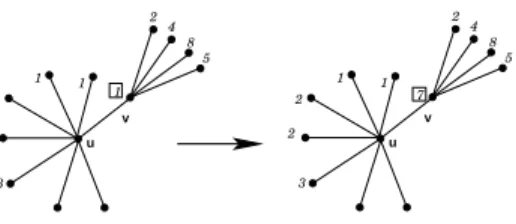
show that it is possible to change the color of every NS neighbor v of u such that all its colored neighbors are single vertices, in such a way that (i) v becomes a single vertex, and (ii) the new instance I0remains proper and acyclic. We do this simply by changing the color of vertex v, that is by assigning to v a color that is not used among the neighbors of u (an illustration of such a modification is given in Figure 1). We know that no bicolored cycle can be induced by this modification ; moreover, we can prove that we have enough colors available to do so.
This implies that if we carry out this operation for every such neighbor of u, we end up in the situation where the modified instance I0remains proper and acyclic, and satisfies property PI0(u). 2
7 1 u v 1 1 2 2 3 2 4 8 5 u v 1 1 2 2 3 2 4 8 5
392 Guillaume Fertin and Andr´e Raspaud Lemma 2 For any graph G of maximum degree ∆, and any uncolored vertex u such that the partially colored instanceI satisfies property PI(u), it is always possible to find a color for u in [1; C(∆)] such
that the coloring remains acyclic.
These two results now allow us to detail the acyclic coloring algorithm A we suggest. Acyclic Coloring of G with at most C(∆) Colors
1: while there remains at least one uncolored vertex in G do
2: Let u be an uncolored vertex of G
3: if property PI(u) is not satisfied then
4: Modify the color of some neighbor(s) of u, so that the new instance I0satisfies PI0(u) 5: end if
6: Color u in such a way that the new instance remains proper and acyclic
7: end while
We now, thanks to Lemma 1, that line 4 of A can be carried out without exceeding the maximum number of colors allowed. Moreover, Lemma 2 shows that the same thing holds for line 6 of A. Thus, we can state the following theorem.
Theorem 1 There exists an O(n∆2) time algorithm to acyclically color any graph of order n and
maxi-mum degree∆. This algorithm uses at most: (a) ∆(∆−1)2 + 1 colors for any even ∆ ≥ 4 (b) ∆(∆−1)2 colors for any odd∆ ≥ 5
Sketch of Proof: The algorithm is A, given previously. As mentioned earlier, its correctness is given by Lemmas 1 and 2. What remains to be proved here is the time complexity of A. In each loop, the most time-consuming parts of A are lines 4 and 6. However, both can be achieved in O(∆2) time (in each case, we just need to look at the neighbors and vertices at distance 2 from u, and there are O(∆2) such vertices). Since there are n loops altogether, the O(n∆2) time complexity follows. 2
3
How to spare one Color when ∆ ≥ 6
As mentioned in the introduction, more detailed computations can lead to an improvement in the number of colors used by our algorithm. More precisely, it is possible to spare one color when ∆ ≥ 6. This is the purpose of Theorem 2 of this section. Before proving this theorem, we give two intermediate results, in Lemmas 3 and 4 below.
Lemma 3 Let ∆ ≥ 6 be even, and let I be a partially and acyclically colored instance using at most C0(∆) = ∆(∆−1)
2 colors. Letu be an uncolored vertex of I. If nu = ∆ and pu = p 0
u = ∆2, then there
exists a way to recolor one of the neighbors ofu, still using at most C0(∆) colors, in such a way that p0 u
Lemma 4 Let ∆ ≥ 7 be odd, and let I be a partially and acyclically colored instance using at most C0(∆) = ∆(∆−1)2 − 1 colors. Let u be an uncolored vertex of I. If nu = ∆ and pu = p0u =
∆−1 2 , then
there exists a way to recolor one of the neighbors ofu, still using at most C0(∆) colors, in such a way thatp0ustrictly decreases.
The acyclic coloring algorithm A presented in proof of Theorem 1 can then be adapted to use one color less, provided that ∆ ≥ 6. This is the purpose of the following theorem.
Theorem 2 There exists an O(n∆2) time algorithm to acyclically color any graph of order n and maxi-mum degree∆ ≥ 6. This algorithm uses at most:
(a) ∆(∆−1)2 colors when∆ is even
(b) ∆(∆−1)2 − 1 colors when ∆ is odd
Sketch of Proof: Here, we use a slight variant, say A0, of algorithm A of proof of Theorem 1, as shown below. The idea is the following: we can show that for any uncolored vertex u, there are enough colors to choose from, even if we decrease C(∆) by one. That is, we can show that there is a way (1) to modify any instance I not satisfying property PI(u) into an instance I0(in which the coloring remains proper and
acyclic) satisfying property PI0(u) and (2) to color u in such a way that the coloring remains proper and
acyclic, thereby proving the correctness of our modified algorithm A0. Acyclic Coloring of G with at most C0(∆) Colors - ∆ ≥ 6
1: while there remains at least one uncolored vertex in G do
2: Let u be an uncolored vertex
3: if property PI(u) is not satisfied then
4: Modify the color of a neighbor of u, such that the new instance I0satisfies PI0(u) 5: end if
6: if ∆ is even and p0u= pu= ∆2 and nu= ∆ then
7: Modify the color of any neighbor of u, in such a way that p0ustrictly decreases (Lemma 3)
8: end if
9: if ∆ is odd and p0u= pu= ∆−12 and nu= ∆ then
10: Modify the color of a neighbor of u whose color appears twice, in such a way that p0ustrictly decreases (Lemma 4)
11: end if
12: Color u in such a way that the new instance remains proper and acyclic
13: end while
Let us now comment the complexity of algorithm A0: for each “operation” (modification of the in-stance, or coloring of u), A0takes O(∆2) time (roughly, in each case, we only need to look at distance 2 from u). Since we have n loops (where n is the order of the graph G), we end up with a complexity of
394 Guillaume Fertin and Andr´e Raspaud
4
A Linear Time Algorithm using at most 9 Colors when ∆ = 5
By an even deeper analysis, we are also able to extend Theorem 2 to the case where ∆ = 5.
Proposition 1 For any graph G of maximum degree 5, a(G) ≤ 9 and there exists a linear time algorithm to acyclically colorG in at most 9 colors.
Sketch of Proof: The coloring algorithm for ∆ = 5 is not much different from algorithm A0, but there are more specific cases to treat. For sake of readability, it is not included here, but can be seen in Appendix. During each loop, the coloring decision is made in constant time, since we need to look at distance at most 3 from u, and thus search for the colors of at most ∆3= 125 vertices. Hence, altogether, we end up with
a linear time algorithm that colors acyclically any graph of degree 5 with at most 9 colors. 2
5
Conclusion
In this paper, we have provided a non trivial polynomial time algorithm to acyclically color any graph of maximum degree ∆ ≥ 5 in ∆(∆−1)2 − odd(∆) colors. This algorithm takes O(n∆2) time, hence it is
linear when ∆ is a constant. Roughly, this algorithm uses half of the colors used by the best deterministic algorithm known so far [ACK+04]. The above results can also be applied for small values of ∆ in order to obtain upper bounds for a(G) ; for instance, if we take ∆ = 5, our results show that any graph of maximum degree ∆ can be acyclically colored in at most 9 colors. This result can be seen as a follow up to the results of [Gr¨u73] and [Bur79], yielding respectively that any graph G of maximum degree 3 satisfies a(G) ≤ 4 and any graph of maximum degree 4 satisfies a(G) ≤ 9. Though we believe the upper bound of 9 colors in the case ∆ = 5 is not tight, it still is a great improvement compared to the bound of ∆(∆ − 1) + 2 = 22 given previously by the result in [ACK+04]. We also note that there exist graphs
of maximum degree 5 with acyclic chromatic number 6, such as the complete graph K6, the complete
bipartite graph K5,5or the circulant graph C8(1, 2, 4). However, we do not know any graph of maximum
degree 5 needing strictly more than 6 colors. Finally, we would like to end this paper by recalling some open problems already mentioned in [AMR90], that is: is it possible to display examples of graphs G of maximum degree ∆ for which (1) a(G) = O(∆43) (or even a(G) = o(∆2)) ? (2) a(G) = Ω( ∆
4 3
(log ∆)13) ?
References
[ACK+04] M.O. Albertson, G.G. Chappell, H.A. Kierstead, A. K¨undgen, and R. Ramamurthi. Coloring
with no 2-colored P4’s. The Electronic Journal of Combinatorics, 11(1), 2004.
[AMR90] N. Alon, C. McDiarmid, and B. Reed. Acyclic colourings of graphs. Random Structures and Algorithms, 2:277–288, 1990.
[BKRS01] O.V. Borodin, A.V. Kostochka, A. Raspaud, and E. Sopena. Acyclic colouring of 1-planar graphs. Discrete Applied Mathematics, 114(1-3):29–41, 2001.
[BKW99] O.V. Borodin, A.V. Kostochka, and D.R. Woodall. Acyclic colourings of planar graphs with large girth. J. London Math. Soc., 60(2):344–352, 1999.
[Bur79] M.I. Burstein. Every 4-valent graph has an acyclic 5 coloring (in russian). Soobˇsˇc. Akad. Nauk Gruzin, SSR 93:21–24, 1979.
[FGR03] G. Fertin, E. Godard, and A. Raspaud. Acyclic and k-distance coloring of the grid. Informa-tion Processing Letters, 87(1):51–58, 2003.
[Gr¨u73] B. Gr¨unbaum. Acyclic colorings of planar graphs. Israel J. Math., 14(3):390–408, 1973. [Sku04] S. Skulrattanakulchai. Acyclic colorings of subcubic graphs. Information Processing Letters,
92(4):161–167, 2004.
[Sop97] E. Sopena. The chromatic number of oriented graphs. Mathematical Notes, 25:191–205, 1997.
6
Appendix : An O(n) Algorithm using at most 9 Colors - ∆ = 5
We present here the detailed algorithm that we use in the case ∆ = 5.
1: while there remains at least one uncolored vertex in G do
2: Let u be an uncolored vertex
3: if property PI(u) is not satisfied then
4: Modify the color of a neighbor of u, such that the new instance I0satisfies PI0(u) 5: end if
6: if p0u= 2 and nu= 5 then
7: if p0u= pu= 2 then
8: Let v be a neighbor of u whose color is represented twice (v has at most 4 colored neighbors)
9: if nv≤ 3 then
10: Color u in such a way that the new instance remains proper and acyclic
11: else
12: (thus nv= 4)
13: if p0v= pv= 2 then
14: if all the neighbors of v are such that p0≥ 2 then
15: Color u in such a way that the new instance remains proper and acyclic
16: else
17: Let w a neighbor of v such that pw≤ 1.
18: Recolor w in such a way that p0vdecreases (⇒ p 0 v≤ 1)
19: end if
20: else
21: Color u in such a way that the new instance remains proper and acyclic
22: end if
23: end if
24: else if p0u= pu+ 1 = 2 then
25: Let v be a neighbor of u whose color is represented exactly twice (v has at most 4 colored neighbors)
26: if nv≤ 3 then
27: Color u in such a way that the new instance remains proper and acyclic
28: else
29: (thus nv= 4)
396 Guillaume Fertin and Andr´e Raspaud
31: if all the neighbors of v are such that p0≥ 2 then
32: Color u in such a way that the new instance remains proper and acyclic
33: else
34: Let w a neighbor of v such that pw≤ 1.
35: Recolor w in such a way that pvincreases (⇒ pv= 2)
36: end if
37: else if p0v= pv= 2 then
38: if All the neighbors of v are such that p0≥ 2 then
39: Color u in such a way that the new instance remains proper and acyclic
40: else
41: Let w a neighbor of v such that pw≤ 1.
42: Recolor w in such a way that p0vdecreases (⇒ p 0 v= 1)
43: end if
44: else
45: Color u in such a way that the new instance remains proper and acyclic
46: end if
47: end if
48: else
49: Color u in such a way that the new instance remains proper and acyclic
50: end if
51: else
52: Color u in such a way that the new instance remains proper and acyclic
53: end if