HAL Id: pastel-00752987
https://pastel.archives-ouvertes.fr/pastel-00752987
Submitted on 16 Nov 2012
HAL is a multi-disciplinary open access
archive for the deposit and dissemination of sci-entific research documents, whether they are pub-lished or not. The documents may come from teaching and research institutions in France or abroad, or from public or private research centers.
L’archive ouverte pluridisciplinaire HAL, est destinée au dépôt et à la diffusion de documents scientifiques de niveau recherche, publiés ou non, émanant des établissements d’enseignement et de recherche français ou étrangers, des laboratoires publics ou privés.
surfaces under plasma exposure
Daniil Marinov
To cite this version:
Daniil Marinov. Reactive adsorption of molecules and radicals on surfaces under plasma exposure. Plasma Physics [physics.plasm-ph]. Ecole Polytechnique X, 2012. English. �pastel-00752987�
Thèse présentée pour obtenir le grade de DOCTEUR DE L’ECOLE POLYTECHNIQUE
Spécialité : Physique des Plasmas
Présentée par
Daniil Marinov
Reactive adsorption of Molecules and Radicals on Surfaces
under Plasma Exposure
Thèse soutenu le 19 Octobre 2012
Jury composé de :
Gilles Cartry, Rapporteur Richard Engeln, Rapporteur Antoine Rousseau, Directeur Olivier Guaitella, Co-directeur Achim von Keudell
Vasco Guerra
Khaled Hassouni, President
MC, PIIM, U Provence
Assistant Professeur, TU Eindhoven DR, CNRS-LPP, Ecole Polytechnique IR, LPP, Ecole Polytechnique
Professeur, RUB Bochum Assistant Professeur, IST Lisbon Professeur, LIMHP, U Paris XIII
First of all I would like to thank Antoine Rousseau for giving me the chance to pursue my PhD in France and Olivier Guaitella for co-supervising this thesis. Antoine, Olivier, I thank you for offering me an exciting topic on which I have been working during these three years. I sincerely appreciate your confidence in me, your patience, your availability and continuous encouragement. While working on this thesis I have enjoyed the freedom to test different ideas but I have always felt your support. I would like to thank you for giving me many occasions to present my work at international conferences where I could meet other members of plasma physics community and also discover beautiful places all around the world.
I would like to thank Yuri Ionikh who introduced me to the world of plasma physics and showed me the right direction to follow. I also appreciate his support and valuable advice during my work on the thesis.
I thank Gilles Cartry and Richard Engeln for reporting my thesis and also Vasco Guerra, Achim von Keudell and Khaled Hassouni for their agreement to participate in the jury. Many of the results presented in this manuscript are obtained in collaboration with people from different laboratories as well as with the members of LPP. I thank Jean-Paul Booth and Nishant Sirse for teaching me the secrets of TALIF. I thank Vasco Guerra for sharing with me his knowledge on kinetic modeling. I thank Achim von Keudell, Carles Corbella and Teresa de los Arcos for XPS measurements which have changed my vision of atomic recombination on surfaces. I thank Juergen Roepke and his group at INP Greifswald for intense and fruitful experimental campaigns with quantum cascade lasers. Special thanks to Marko Huebner and Dmitri Lopatik form INP for long hours spent in the lab and for showing me the hints of measurements with QCLs. I also thank Paul Gravejat for enlightening discussions on the mechanisms of surface processes (but also nganga, and la problematique de la véracité) and for the help with catalytic film deposition.
I thank all the LPP researchers and especially Pascal Chabert, Ane Aanesland and Svetlana Starikovskaya from low temperature plasma team for many informal discussions that have shown me new horizons. Thanks to Jean Guillon, Mickael and Jonathan for technical support of the experiment. I wish to thank Cathy, Elodie, Catherine, Edouard, Olivier, Philippe, Bruno and Nicolas for their help with administrative and IT questions. Of course, I thank all the PhD students and post-docs who made LPP the most enjoyable place to work in: Jerome, Lara, Christelle, Ilya, Jaime, Andrei, Malik, Sergey, Lorenzo, Pierre-Alexandre, Noureddine, Claudia, Ana, Emilie, Paul, Laurent, Joseph, Sedina, Eugenio, Binjie. In the continuation of this list I wish to thank again Olivier who has been not only my supervisor but also a good friend.
I wish to thank my parents and my sister for their support during all the years of my studies and for making a long trip from Saint-Petersburg to assist at my defense. I warmly
the same time as me. That is great that we have been sharing everything! Ilya, thank you for organizing lots of amazing “sorties culturelles” and fantastic trips. And finally, very special thanks to Anna for bringing new bright colors in my (parisian) life and for her support and patience during the writing of this thesis.
1
I. Introduction ... 7
I.1 Plasma-surface interactions: historical overview ... 7
I.2 Context of the study ... 8
I.3 Organization of the thesis ... 9
1. Chapter I: Surface reactivity in N2/O2 plasmas ... 11
1.1 Interaction of radicals with surfaces: basic concepts ... 11
1.1.1 Adsorption ... 11
1.1.1.1 Physisorption ... 12
1.1.1.2 Chemisorption ... 13
1.1.2 Mechanisms of surface reactions ... 14
1.1.3 Surface reactions: thermodynamic viewpoint ... 15
1.2 Modelling of surface reactivity in plasmas ... 16
1.3 Mesoscopic modelling of atomic recombination on surfaces ... 17
1.3.1 Surface kinetics in N2/O2 mixtures ... 20
1.3.2 Role of plasma exposure ... 20
1.4 Surface reactions in N2/O2 plasmas: review of experimental studies ... 21
1.4.1 Recombination of O and N atoms on surfaces ... 21
1.4.2 Molecule production/conversion on surfaces ... 22
1.5 Research questions ... 23
1.6 Research strategy ... 24
1.7 Definitions and notations ... 25
2. Chapter II: Experimental setup and diagnostic techniques ... 27
2.1 Discharge setup ... 27
2.1.1 Reactor and gas system ... 27
2.1.2 Pulsed discharge systems ... 28
2.1.2.1 Direct current glow discharge ... 28
2.1.2.2 Radiofrequency capacitive discharge ... 30
2.2 Diagnostics employed ... 31
2.2.1 Tuneable diode laser absorption spectroscopy in mid-infrared range ... 31
2.2.1.1 Principles of laser absorption spectroscopy ... 31
2
2.2.1.3 Pitfalls of laser absorption measurements ... 32
2.2.1.4 Diode laser spectrometer ... 33
2.2.1.5 Three-channel quantum cascade laser spectrometer ... 35
2.2.2 Time resolved emission and absorption spectroscopy in UV-Vis range. ... 38
2.2.2.1 Optical emission spectroscopy for gas temperature determination ... 39
2.2.2.2 OES setup and data treatment. ... 40
2.2.2.3 Time resolved measurements of ozone concentration ... 42
2.2.3 TALIF measurements of atomic oxygen. ... 43
2.2.3.1 Principles and calibration of O TALIF measurements. ... 43
2.2.3.2 Laser setup ... 44
2.2.4 Mass spectrometric gas analysis ... 46
2.2.5 XPS surface diagnostics ... 47
2.2.6 Summary on used diagnostics ... 48
3. Chapter III: Adsorption and reactivity of N atoms on silica surface under plasma exposure ... 49
3.1 Introduction ... 49
3.1.1 Experimental procedures ... 49
3.2 Determination of the coverage of Nads: XPS study ... 51
3.2.1 Dynamics of N adsorption on SiO2 ... 51
3.2.2 Species responsible for nitridation: ions or neutrals? ... 54
3.2.3 Reactivity of SiOxNy under plasma exposure ... 54
3.2.4 Conclusions on XPS study ... 56
3.3 Reactivity of Nads: Isotopic study ... 57
3.3.1 Experimental details ... 57
3.3.2 Characterization of the discharge: measurements of N2 dissociation degree ... 59
3.3.2.1 Dissociation of N2 in pulsed dc discharge ... 59
3.3.2.2 Dissociation in pulsed rf discharge ... 62
3.3.2.3 Estimation of atomic nitrogen exposure on the surface ... 63
3.3.3 14N adsorption on SiO2 under 28N2 plasma exposure ... 64
3.3.4 Reactivity of grafted 14N atoms under 30N2 plasma exposure ... 67
3.3.4.1 Evidence for a distribution of reactivity of Nads ... 67
3.3.4.2 Do Nads participate in surface recombination of N atoms?... 69
3
3.4 Recombination of Nads with O atoms ... 71
3.4.1 Experimental details ... 71
3.4.2 Kinetics of NO production on the surface ... 73
3.4.2.1 Proof of recombination mechanism Nads + O → NO ... 73
3.4.2.2 Kinetics of NOx in the probe discharge ... 74
3.4.2.3 Estimation of the coverage of Nads that produce NO... 75
3.4.2.4 NO production on the surface under continuous O2 plasma exposure .... 77
3.4.3 Investigation of adsorption and reactivity of N using measurements of NO production on the surface ... 78
3.4.3.1 Kinetics of adsorption ... 78
3.4.3.2 Are Nads* active for recombination of N on the surface? ... 80
3.5 Discussion and conclusions ... 82
3.5.1 Summary and conclusions on used diagnostics ... 85
4. Chapter IV: Adsorption and reactivity of oxygen atoms on oxide surfaces under plasma exposure ... 87
4.1 Introduction ... 87
4.1.1 Experimental procedures ... 88
4.2 Chemisorption of O on silica-like surfaces: isotopic study ... 88
4.2.1 Experimental details ... 88
4.2.2 Do O atoms of the material participate in surface reactivity? ... 90
4.2.3 16O adsorption on the surface under 32O2 plasma exposure ... 92
4.2.4 Conclusions on the isotopic study ... 94
4.3 Adsorption of atomic oxygen on Pyrex and related reactivity towards NO ... 94
4.3.1 Experimental details ... 95
4.3.2 Evidence of NO oxidation by adsorbed O atoms ... 96
4.3.3 Determination of the surface coverage of adsorbed O atoms ... 97
4.3.4 Evidence of a distribution of reactivity adsorbed O atoms ... 98
4.3.5 Conclusions on the study of Oads reactivity on Pyrex ... 99
4.4 On the role of Oads for VOC oxidation... 99
4.4.1 Context of the study: influence of the chemical nature of the surface on the reactivity of Oads ... 100
4.4.2 C2H2 oxidation by adsorbed oxygen atoms on TiO2 ... 101
4.4.2.1 Experimental details ... 101
4
4.4.2.3 Oxidation of adsorbed reaction intermediates ... 103
4.4.3 Discussion and conclusions on the study of Oads reactivity on TiO2 ... 105
4.5 Investigation of ozone formation on surfaces ... 106
4.5.1 Experimental details ... 107
4.5.2 Ozone production in bare silica tube ... 107
4.5.3 Ozone production in the presence of high specific surface material ... 111
4.5.3.1 Influence of gas pressure and surface pretreatment ... 113
4.5.4 Modelling of ozone production in bare silica tube ... 114
4.5.5 Conclusions on the ozone production study ... 117
4.6 Conclusions ... 118
5. Chapter V: Study of surface vibrational relaxation of N2 ... 121
5.1 Introduction ... 121
5.2 Kinetics of vibrationally excited nitrogen ... 121
5.2.1 Role played by N2(v) in nitrogen containing plasmas ... 121
5.2.2 Electron impact excitation/de-excitation of N2(v) ... 122
5.2.3 Vibrational relaxation of N2(v) in the gas phase ... 124
5.2.4 Vibrational relaxation on surfaces: motivation of the study ... 125
5.3 Study of N2(v) relaxation using infrared titration ... 127
5.3.1 Principles of the infrared titration technique ... 127
5.3.2 Experimental procedure ... 127
5.3.3 Validity of the diagnostics ... 128
5.3.3.1 Gas temperature and its influence on the relaxation measurements ... 130
5.3.3.2 Dissociation and re-association of titrating molecules ... 131
5.3.3.3 Vibrational excitation of titrating molecules ... 132
5.4 Modeling of vibrational kinetics in N2-CO2 ... 133
5.4.1 Relevant relaxation processes ... 133
5.4.2 Model description ... 135
5.4.2.1 Gas phase processes ... 135
5.4.2.2 Heterogeneous processes ... 136
5.4.2.3 Numerical solution ... 137
5.4.3 Validation of the model ... 137
5.4.4 On the possibility of experimental determination of N2 dependence on v .... 138
5
5.4.6 Determination of N2 for silica. The influence of CO2 admixture ... 142
5.4.7 Conclusions on the study of the N2 – CO2 system ... 145
5.4.8 Data analysis using characteristic relaxation times ... 145
5.5 Application of the IR titration for determination on catalytic and plasma-pretreated surfaces ... 149
5.5.1 The effect of plasma pretreatment ... 149
5.5.2 Vibrational relaxation on TiO2. ... 152
5.5.3 Vibrational relaxation on other catalytic surfaces ... 154
5.5.4 Vibrational relaxation on silica surface in air plasma. ... 155
5.6 Infrared titration as a plasma diagnostics tool: determination of the vibrational temperature of N2 ... 155
5.6.1 Formulation of the method and its application to the N2 – CO2 system ... 155
5.6.2 On the vibrational temperature measurements in N2 - N2O and N2 - CO ... 156
5.7 Conclusions ... 158
6. Chapter VI: General conclusions and outlook ... 161
6.1 General conclusions ... 161
6.2 Summary of the main results ... 162
6.3 Implication for modelling of surface recombination ... 163
6.4 Future work ... 164
6.5 New diagnostic techniques ... 166
7
I.1 Plasma-surface interactions: historical overview
The word plasma was introduced in 1928 by Irving Langmuir [1] who was struck by the analogy between blood plasma that transports red and white corpuscles and a discharge column acting as a sub-stratum carrying molecules, ions and electrons. It is interesting to note that Langmuir got the Nobel Prize in Chemistry in 1932 for his achievements in surface science. Langmuir clarified the true nature of surface adsorption and established the existence of monolayers as two-dimensional structures on the surface. Therefore, it wouldn't be exaggerating to say that both plasma science and surface science as we know them today were started by the same person almost a century ago.
The importance of surface catalyzed processes in reactive plasmas has been recognized since the early 1920s. Low pressure glow discharges in glass tubes were used in those times as a source of molecular and atomic spectra. In 1920 Wood made an observation of recombination of atomic hydrogen on glass surface in his study of Balmer series in a long discharge tube [2]. In the following, recombination of atomic hydrogen on different catalytic surfaces in a broad temperature range was thoroughly studied and the first models describing the recombination process were proposed [3,4] by the end of 1940s.
Following the advent of numerous techniques for detection of atomic species (catalytic probes, mass-spectrometry, optical emission spectroscopy, electron paramagnetic resonance), the number of studies of the surface catalyzed recombination of atoms has rapidly increased in 1950 – 1960s ([5] and references therein). In those times interaction between radicals and catalytic surfaces was investigated by the catalysis community and many ideas coming from classical heterogeneous catalysis with stable molecules were adopted in order to explain reaction mechanisms. In the majority of works, recombination of atoms was studied in flow-tube experiments in the post-discharge zone. Thus, plasma was used only as a source of radicals and there was no direct interaction between the plasma and the studied surface.
Plasma-surface interactions became an expanding field of research in 1970s when the potential of plasmas for material processing was realized. Unique properties of etching reactive plasmas used for microelectronics applications were investigated in details. In the classical work [6] a synergetic effect between Ar+ ions and reactive XeF2 molecules for
poly-Si etching was discovered in beam experiments. It was found that when poly-Si surface is exposed to both Ar+ and XeF2 the etch rate is not simply a sum of the etch rates obtained under ion
bombardment or neutral gas flow but increases by an order of magnitude. Later on, synergetic effects between charged and neutral species were observed in the process of film growth in low temperature plasmas [7]. Therefore, it was finally realized that the unique property of reactive plasmas is that they produce at once flows of radicals, excited species and ions on the surface.
8
Today study of plasma-surface interactions is a growing field of research which is driven by a great number of applications. Plasma processing of surfaces is widely used for microelectronics, material science, thin films and coatings. Plasma surface interactions play a key role in nuclear fusion, atmospheric re-entry and plasma medicine.
In the space, reactions of radicals and formation of molecules on solid surfaces is one of the most important problematic of astrochemistry. In the interstellar medium reactions between gas phase species are very rare and the chemistry takes place on the surface of dust particles. Regardless a long lasting history of research on surface processes in reactive molecular plasmas this field is still barely studied and poorly understood, especially compared to the present knowledge of the mechanisms of gas phase reactions. Surface is still the “terra incognita” for plasma science. This can be clearly observed in the kinetic modelling of low pressure discharges. State of the art discharge models include dozens of gas phase reactions between stable and excited species taking into account individual electronic and vibrational levels. However, surface processes are often introduced using effective reaction coefficients that are not known a-priory and used as tuning parameters. These adjustable parameters reduce the accuracy and predictive capability of the models. Therefore, there is a real need for a deeper understanding of mechanisms of surface processes in reactive plasmas.
I.2 Context of the study
One of the promising applications of low temperature plasmas is the destruction of air pollutants. High reactivity and low gas temperature of non-equilibrium plasmas are very attractive for low energy cost oxidation of volatile organic compounds (COV). A combination of low temperature plasmas with heterogeneous catalyst was proposed in 1990s in order to improve the efficiency and selectivity of pollutant destruction [8][9][10][11][12].
The research activity on plasma-catalyst coupling for VOC abatement has started at the Laboratory of Plasma Physics in the beginning of 2000s with the PhD works of Olivier Guaitella, Frederic Thevenet and Lina Gatilova. It was shown that introduction of a porous catalytic material (SiO2 or TiO2) in atmospheric pressure dielectric barrier discharge (DBD)
increases the efficiency of oxidation of C2H2 (which was selected as a model pollutant).
Improvement of CO2/CO selectivity was also observed. Increase of the lifetime of atomic
oxygen due to its stabilization on the surface of the catalyst was proposed as an explanation of observed synergetic effects. However, the mechanisms of plasma-catalyst interaction in DBDs are very difficult to study due the complexity of the discharge phenomena at atmospheric pressure.
The originality of the approach developed at LPP consisted in the utilization of a low pressure (~1 mbar) dc discharge for investigation of elementary processes on the surface of real catalytic materials that were previously studied in atmospheric pressure DBDs. The use of pulsed dc discharge allowed much better control over the plasma parameters and various in-situ and time resolved diagnostics were applied. Similar synergetic effects in C2H2 destruction
9 elementary kinetics of air plasmas at mbar pressures was studied. Production of O atoms, NO and NO2 molecules, and electronically excited species N2(B3 C3) was measured and
modelled in [14][15][16].
This effort resulted in quite a complete understanding of the gas phase kinetics in pulsed dc discharge in air and air/C2H2 mixtures. However, surface processes were still barely
understood although it was shown that they play a very important role in low pressure conditions. How radicals are lost and molecules are formed and how vibrational energy is relaxed on surfaces under plasma exposure remained unclear even for such simple non-catalytic reactor wall materials as silica or Pyrex, to say nothing about real high specific surface catalysts.
Understanding of surface processes in N2/O2 containing plasmas at mbar pressures was
therefore the aim of my thesis. The interest of this work is more general than just air pollution control. The research questions that will be addressed are relevant to any application where N2/O2 plasmas meet the surface.
Plasmas containing N2 and O2 play an important role for a great number of applications.
Many of these applications rely on the processes that take place on surfaces in contact with the plasma. In addition to air pollution control mentioned above we can name nitridation [17], deposition of thin films [18], treatment of polymers [19], and thermal protection on re-usable space vehicles [20]. In some cases plasma-surface interactions are inevitable; they arise from the presence of reactor walls and influence the kinetics of the plasma. This is the case of atomic sources [21] as well as any type of low pressure plasmas in N2/O2 mixtures [22].
I.3 Organization of the thesis
In Chapter 1 of this thesis we give an outlook on the present understanding of reaction mechanisms of radicals on surfaces. Theoretical and experimental approaches to the study of surface reactions in N2/O2 containing plasmas are reviewed. The open questions concerning
the role of chemisorbed atoms in surface catalyzed processes are outlined. Finally, we formulate our objectives and research strategy. We propose the approach which consists in the pretreatment of the surface by N2 or O2 plasma followed by probing of the coverage and
reactivity of adsorbed atoms.
In Chapter 2 the experimental setup and the used diagnostics are presented.
In Chapter 3 we investigate adsorption and reactivity of N atoms on silica surface under N2
plasma exposure. We apply surface diagnostics such as XPS in order to determine the coverage of adsorbed N atoms and follow the modification of the chemical composition of the surface by plasma. Production of N2 and NO molecules on the surface catalysed by adsorbed
nitrogen atoms is studied by mass spectrometry and laser absorption spectroscopy in order to get insight in the reactivity of Nads. Different methods of titration of Nads are compared.
In Chapter 4 we study adsorption and reactivity of oxygen atoms on oxide surfaces (silica, Pyrex, TiO2) under O2 plasma exposure. Reactivity of adsorbed O towards stable molecules
10
(NO, C2H2) and radicals (18O) is investigated using laser absorption spectroscopy and mass
spectrometry. In order to get insight into the reactivity of weakly bonded oxygen atoms, we study ozone production from recombination (O+O2)wall on silica surface.
In Chapter 5 we study relaxation of vibrationally excited nitrogen molecules on the surface using a new infra red (IR) titration technique. A short dc discharge pulse is used to excite a mixture containing a small amount of CO2, N2O or CO in N2. Due to a very efficient
vibrational energy transfer between N2 and IR tracers, their vibrational excitation is an image
of the vibrational excitation of N2. In the afterglow, the vibrational relaxation of titrating
molecules is monitored in-situ using quantum cascade laser absorption spectroscopy (QCLAS). Relaxation measurements have been interpreted in terms of a numerical model of non-equilibrium vibrational kinetics. Probability of N2 vibrational quantum loss (N2) on the
11
1. Chapter I: Surface reactivity in N
2
/O
2
plasmas
1.1 Interaction of radicals with surfaces: basic concepts
Interaction between gas phase species and surfaces is a general problem that has been studied with relation to a number of applications ranging from supersonic flights to heterogeneous catalysis. Today, the global picture of gas-surface interactions is well established and can be found in textbooks [23]. In this section we introduce the basic concepts required for description of surface reactions of radicals. One particular case, which is central for our study – interaction of O and N atoms with silica like surfaces is considered as an example.
1.1.1 Adsorption
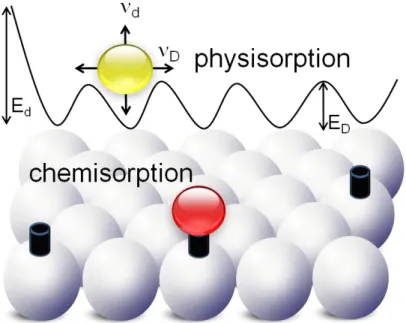
What happens when gas phase atoms arrive on a surface? The first step is the adsorption, i.e. formation of a bond between atoms and the surface. Depending on the nature of this bond, two cases are distinguished – physical and chemical adsorption, schematically these cases are represented in Figure 1. 1.
12
1.1.1.1 Physisorption
Physisorption is a result of the Van der Waals interaction between gas phase species and the surface. Van der Waals forces originate from the attraction between induced electric dipoles and therefore physical adsorption is a collective effect of interaction between impinging species and atoms of the surface. Figure 1. 1 shows schematically the potential energy of this interaction which is modulated following the position of surface atoms. These periodic potential wells are called physisorption sites. The depth of the potential wells in the direction perpendicular to the surface is the energy of desorption; typically it is found in the range Ed ~
0.01 – 0.2 eV per particle [23]. Apart from being desorbed, physisorbed species may also move (diffuse) in the direction parallel to the surface. The energy barrier that atoms need to overcome in order to hop between neighbouring physisorption sites is obviously smaller than the energy of desorption.
In order to describe physisorption of atoms on silica-like surfaces several parameters have to be considered:
The surface density of physisorption sites [F]. The value of [F] coincides with the number of atoms on the surface (typically ~1015 cm-2). It is usually supposed in the models that all the physisorption sites are identical, i.e. the surface is homogeneous.
The fractional coverage of physisorption sites F. This parameter is simply the ratio
of the number of occupied physisorption sites to the total number of physisorption sites.
The energies of desorption Ed and diffusion ED. These parameters represent the
depths of potential wells in the direction perpendicular (Ed) and parallel (ED) to the
surface. Typically, in the models Ed ~ 0.5 eV [5]. The activation energy for diffusion
ED is supposed to be a fraction of the activation energy for desorption Ed, according to
[24] on glass surfaces ED/Ed ~ 0.5.
The characteristic frequencies of desorption (d) and diffusion (D). For
illustration purposes, one can imagine that physisorbed atoms oscillate in the potential wells. The frequency of these oscillations in perpendicular (d) and parallel (D)
directions is the frequency at which an atom attempts to leave the surface or hop on the neighbouring physisorption site. The characteristic residence time of an atom on a physisorption site with respect to desorption (d) and surface diffusion (D) can be
written as follows [25]:
(1. 1)
Typically, for atoms adsorbed on silica-like materials d ~ 1015 s-1 and D ~ 1013 s-1
[5]. In (1. 1) the dependence of the characteristic times on Twall is exponential.
Therefore, the temperature of the surface is a very important parameter for processes involving physisorbed atoms.
13
Sticking coefficient s. This parameter accounts for the probability of an atom to be physisorbed in a single collision with the surface. The value of s depends on the surface coverage, where is the sticking coefficient on clean surface. Usually, in the models of surface atomic recombination it is supposed that . However, as mentioned in [26] this assumption may break down when the kinetic energy of impinging species is increased.
1.1.1.2 Chemisorption
Oxygen and nitrogen atoms have unpaired electrons and therefore they may efficiently form a chemical bond (ionic or covalent) with the surface. In contrast to physisorption, formation of this chemical bond is possible only on specific places on the surface which are called chemisorption sites. The binding energy in the case of chemisorption is typically found in the range ~ 0.4 – 8 eV [23] per particle.
Parameters required for description of chemisorption on silica-like surfaces are similar to those considered above for the case of physisorption:
Are chemisorbed atoms necessarily stable?
Generally speaking, words “chemisorbed” and “stable” shouldn’t be used as synonyms. The lifetime of chemisorbed species can be calculated using (1. 1); result of calculation with a typical value of d ~ 1015 s-1 [25] at room temperature is shown in the graph:
0,5 1,0 1,5 2,0 10-10 10-5 100 105 1010 1015 1020
s
Echemd [eV]One can see that for in the range 0.4 – 2 eV the value of changes over 25 orders
of magnitude. Species with ≤ 1 eV have the lifetime on the surface of the order
of 1 minute and less; therefore, they can’t be considered as absolutely stable. In order to be able speak about the stability of adsorbed species, their lifetime on the surface should be compared with other characteristic times in the system.
14
The surface density of chemisorption sites [S].The density of chemisorption sites [S] is always smaller than the density of physisorption sites [F]. For silica-like surfaces, the literature values of [S]/[F] are scattered in the range 10-3 – 10-1 [5] [22] [26] [27][28]. One of the reasons of such a big uncertainty is rather fundamental – in fact, the nature of chemisorption sites is not yet clear. It is believed that chemisorption sites are associated with non-saturated Si atoms, impurities and surface defects. But to the best of our knowledge the density of chemisorption sites has never been measured directly. As in the case of physisorption, in the models all the chemisorption sites are supposed to be identical and homogeneously distributed on the surface.
The fractional coverage of chemisorption sites S. This is the ratio of the number of
occupied chemisorption sites to the total number of chemisorption sites.
The energy of desorption . As the nature of chemisorption sites on silica-like
surfaces is not well understood, the value of is generally an unknown parameter.
In the models, chemisorbed atoms are supposed to be irreversibly trapped by surface sites. In [5] the value ~ 3 eV was found for both O and N chemisorbed on fused
silica. Due to this high desorption energy, thermal desorption and diffusion of chemisorbed atoms is discarded in the models when surface temperature is not too high.
Activation energy for chemisorption. Usually it is supposed that adsorption of atoms on vacant chemisorption sites proceeds with zero activation energy, i.e. there is no potential barrier for chemisorption.
1.1.2 Mechanisms of surface reactions
As we have seen above, chemisorbed atoms are trapped by active sites, while physisorbed species may diffuse along the surface. Due to the existence of these mobile species there exist two mechanisms of surface processes: i) Eley-Rideal (E-R) according to which reaction takes place in a direct impact between gas phase species and adsorbed species ii) Langmuir-Hinshelwood (L-H) that proceeds via diffusion on the surface. Schematically, E-R and L-H mechanisms are shown in Figure 1. 2. Occupation of free adsorption sites, recombination of atoms and chemical reactions on the surface may proceed according to one of these two mechanisms. Surface diffusion and L-H reactions become pronounced at lower temperatures when physisorbed species spend more time on the surface. At higher temperatures direct E-R mechanism is dominating.
15 Figure 1. 2 Schematics of Langmuir-Hinshelwood and Eley-Rideal mechanisms.
An important parameter for description of atomic recombination on surfaces is the activation
energy of recombination . Recombination of atoms A on the surface
(1. 2)
where S states for a chemisorption site is similar to the chemical reaction BC + D → B + CD. According to [29], if this exchange reaction is exothermic, its activation energy can be estimated as 0.055D(B-C) where D(B-C) is the bond strength in the molecule BC.
Nitrogen and oxygen atoms chemisorbed on silica-like surfaces are strongly bound with the bond energy of few electron volts. Therefore, the recombination process should have the energy barrier of the order of ~ 0.2 eV [5]. It is supposed in the models that is the same for both L-H and E-R recombination mechanisms. The value of determines the
temperature dependence of the reaction rate of (1. 2):
(1. 3) where k0 is a so-called steric factor.
1.1.3 Surface reactions: thermodynamic viewpoint
As any other type of chemical reactions, reactions on the surface in equilibrium conditions are determined by the laws of thermodynamics. According to the classical thermodynamics, at constant temperature and pressure spontaneous chemical reactions proceed with a reduction of Gibbs free energy ( ), where (H – enthalpy, S – entropy and T – temperature of the system). Following this general rule, let us consider a recombination reaction between adsorbed species Aads and species B coming from the gas phase. Product AB
is supposed to leave the surface. As an example of such reaction one may consider recombination of atoms (O+Oads, O+Nads, N+Nads) or production of molecules on the surface
16
(1. 4)
Condition (1. 4) signifies that depending on the nature of the reaction partner B different species Aads may be potentially involved. Let’s consider for example two recombination
reactions: (i) O+Oads→O2 and (ii) O2+Oads→O3. Standard enthalpies of formation and
absolute entropies of reacting species are listed in Table 1. 1 [30].
(kJ/mol) (kJ/mol·K)
O 249 0.161
O2 0 0.205
O3 142,7 0.239
Table 1. 1 Thermodynamic data for O, O2 and O3 [30].
For reaction (i) calculation using (1. 4) at 300 K yields and for reaction (ii) , where is the heat of adsorption of O. The value of
is not known, typically in condensed phase absolute entropy is found in the range 0.02 – 0.1 kJ/(mol K). Therefore, the maximum uncertainty related to the entropy term is rather small, only of the order of ±10 kJ/mol (or ±0.1 eV). The physical meaning of the condition in this case is very simple – the adsorption energy of Oads at the surface should be smaller than
the bond energy of O in the product molecules. For (i) this means that (Oads)<D(O2)5
eV and for (ii) (O
ads)<D(O3) 1 eV.
This example demonstrates that the binding energy of adsorbed species is the key parameter that determines surface reactivity.
1.2 Modelling of surface reactivity in plasmas
Processes introduced in the previous section play a role of elementary steps in surface reactions. What we call a mechanism of surface reaction is in fact a sequence of elementary steps by which products are formed. From the theoretical viewpoint we can distinguish three levels of description of surface reactions in reactive plasmas.
“Macroscopic” level. The elementary reaction mechanisms in this case are ignored and surface reactions are characterized using effective probabilities (). An example of this approach can be found in [31][32][33]. Values of and their dependencies on the conditions are usually unknown and they are adjusted in order to reach the best agreement with the experiment. From a perspective of plasma modelling the predictive power of this approach is very limited.
17
Mesoscopic level. In this case the kinetics of surface reactions is described in terms of the fractional coverage of active sites governed by a set of differential equations. Elementary processes on the surface (adsorption, desorption, diffusion, recombination) are supposed to occur with defined rates. A great number of mesoscopic models was developed in the past in order to explain recombination of atoms in low pressure plasmas and afterglows [5][22][26][27][28] and in the conditions relevant to the atmospheric re-entry [34][35][36]. Mesoscopic description may be considered on a more microscopic scale by using Monte-Carlo technique as it was done in [37]. Monte-Carlo methods allow inclusion of the effects of local interactions between adsorbed species.
Simulation on the atomic level. This approach gives a complete picture of surface reactivity from the first principles without introduction of any empirical parameters. It has been developed over the past 10 years in [35][38][39][40] for description of O and N atoms recombination on SiO2 surfaces. Ab-initio modelling of surface
recombination is split in two parts. First, using density functional theory (DFT) computation the electronic structure of the crystalline solid interacting with incoming gas phase species is calculated. This gives a gas-surface interaction potential and a spectrum of lattice phonons that are used for semi-classical molecular dynamics simulation of the recombination process. In addition to calculation of recombination probability, ab-initio calculations provide information about energy accommodation between recombining species and the surface. Although this approach is very promising, so far it has been applied only to adsorption and recombination of atoms on model SiO2 clusters composed of less than 100 atoms. Extrapolation to real conditions
is not straightforward due to the complexity of real disordered surfaces containing various defects and impurities. Effects of plasma exposure is yet another complication in real systems.
We conclude that at present mesoscopic approach presents the most useful and reliable way to describe and predict surface reactivity in plasmas.
1.3 Mesoscopic modelling of atomic recombination on surfaces
We have described a number of elementary processes that come into play when atoms interact with surfaces. The overall result of this interaction that is observable in the experiment is the loss of gas phase atoms which can be characterized by the recombination probability . By
definition is the probability that impinging gas phase atoms A will recombine on the surface with the formation of volatile molecular species A2. It shouldn’t be mixed with the effective
loss probability that takes into account all the processes leading to losses of atoms on the surface (adsorption and recombination). Values of for N and O atoms on silica-like surfaces have been intensively measured experimentally. The aim of the modelling is to reproduce experimental results based on the defined set of elementary processes.
18
Here we will sum up the main results of the models of atomic recombination on silica-like surfaces developed in [5][26][27][28]. In these models only recombination in the post-discharge is described.
When the surface is exposed to a flux of atoms, chemisorption sites become almost fully occupied, i.e. S1. This is explained by the fact that chemisorbed atoms leave
the surface only via recombination which is a thermally activated process. Population of chemisorption sites is faster (it has no energy barrier) and it compensates losses of chemisorbed atoms.
Surface recombination takes place between chemisorbed atoms and impinging gas phase atoms (E-R) or diffusing physisorbed atoms (L-H). Recombination between two physisorbed atoms is usually discarded because of a low fractional coverage of physisorption sites. This result breaks down and requires special treatment at very low surface temperatures as it is mentioned in [26].
The exact values of the parameters of elementary surface processes ([S], Ed, ED, , d, D,
steric factors for chemisorption and recombination) are not known a-priori. With an appropriate adjustment of these parameters measured in the experiment, temperature dependence of may be reasonably well reproduced by models. For example, variation of the recombination probability of atomic oxygen on pyrex as a function 1000/Twall measured
and modelled in [28] is shown in Figure 1. 3. One can see that exhibits a complex non-monotonous temperature dependence. Similar results were obtained in [5] for O and N recombination on silica. The high-temperature branch of the dependence on SiO2 was
studied in [34][35] in conditions relevant to the atmospheric re-entry.
Figure 1. 3 Measured and modelled in [28] recombination probability of O atoms on pyrex at different surface temperatures.
19 Three characteristic temperature regions were distinguished in [28]:
High temperatures (Twall > 330 K): desorption of atoms from physisorption sites is
faster than surface diffusion. Only E-R mechanism is efficient. The slope of the dependence of versus 1000/Twall is determined by the activation energy of E-R
recombination.
Intermediate temperatures (160 K < Twall < 330 K) where both E-R and L-H
mechanisms have comparable efficiency.
Low temperatures (Twall < 160 K). Physisorbed atoms have sufficiently long residence
time on the surface and L-H mechanism is dominating. The decrease of the value of with decreasing the temperature is determined by the activation energy of L-H recombination.
We can see that the measured variation of is reproduced reasonably well. But a question may arise: does the model describe the reality or it is just an effective way to fit the evolution of observed in the experiment? Another question which is related to the first one – is the set of parameters of elementary processes obtained from the best agreement with the experiment unique? Regardless a huge number of published experimental and theoretical studies these questions are still open. The reason for this is that the recombination of atoms on the surface is a result of an interplay between many elementary processes. The rates of these processes are generally unknown. Deduction of several parameters from one measured quantity () is an ill-posed problem from both physical and mathematical viewpoints.
Let us show to what extent the fitting procedure is “unstable” and dependent on the assumptions made about the parameters of the model. Consider for example the high temperature part of in Figure 1. 3. It is well established that at high temperatures only E-R recombination is efficient because physisorbed atoms are immediately desorbed back into the gas phase. This has been recently confirmed by molecular dynamic simulations [35]. The
dependence on 1/Twallcan be well fitted with
(1. 5)
In the mesoscopic model of Kim&Boudart [5], coefficient b is interpreted as an activation energy of ER recombination. In later work of Bedra et.al [35] this coefficient is vaguely called “the total recombination activation energy” and ab-initio calculations performed in the same study show that ER recombination process itself has no energy barrier. Similar barrierless behaviour of recombination reactions Oads+O and Oads+N was found in ab-initio
calculations performed in [40]. It is evident that there is a conflict between mesoscopic and microscopic interpretation of the activation barrier for recombination.
Understanding of the pre-exponential factor a is not much better. According to [5],
where is the steric factor for E-R recombination (see expression (1. 3)). In principle,
both and are unknown. If we suppose that =1 as it was done in [5], expression (1.
5) immediately gives the density of chemisorption sites . However, if we assume
20
obtained from the high temperature measurements influences in turn the best fit parameters of L-H processes that come into play at intermediate and low temperatures.
We can see that the description of recombination of one sort of atoms in a gas containing only one sort of molecules is already a difficult task with many unknown parameters. The complexity increases manyfold when we just mix N2 and O2!
1.3.1 Surface kinetics in N2/O2 mixtures
Extension of models for pure gases to mixtures has been done for Pyrex [22], silica-based thermal protection systems [42] and metallic surfaces [43]. According to these models N and O atoms may compete for active sites or even occupy different types of sites. Recombination pathways include formation of O2 and N2 as in pure gases but also NO in association between
O and N. NO produced on the surface may undergo further heterogeneous reactions forming NO2 or N2O. Theoretical description of the ensemble of these processes requires introduction
of a great number of parameters.
1.3.2 Role of plasma exposure
The picture of surface reactivity discussed so far doesn’t take into account any effect of plasma exposure. So what is the possible influence of charged and excited species produced in the plasma on the surface reactivity? In low pressure plasmas, positive ions are accelerated towards reactor walls in the near wall sheath [44] and gain kinetic energy which easily exceeds ~10 eV. This energy in enough to break chemical bonds formed between the surface and chemisorbed species and even between atoms of the material (in quartz bond energy of oxygen atoms is of the order of 5 eV [45]). Therefore, ion bombardment may remove atoms from occupied active sites, create new sites (by creating defects) or even modify structure of the surface. Moreover, ions may activate chemical reaction due to a local supply of thermal energy to the surface. Similar effects are expected from exposure to UV photons and excited species carrying few electron volts of energy.
These examples clearly demonstrate that there is a need for further studies that would limit the number of unknowns and shed light on the role of plasma exposure for mesoscopic description of surface reactivity in N2/O2 plasmas.
21
1.4 Surface reactions in N2/O2 plasmas: review of experimental studies
A great number of studies of surface catalyzed reactions in N2/O2 containing plasmas is
available in the literature. Two main groups of processes under investigation may be distinguished:
Recombination of N and O atoms on surfaces.
Production/conversion of molecules on the surface.
Most of the studies were performed at low pressures (p ~ 1 mbar) because in low pressure conditions surface processes dominate the overall chemical kinetics of the plasma and the mechanisms of heterogeneous reaction may be investigated in details.
1.4.1 Recombination of O and N atoms on surfaces
Recombination probabilities of oxygen () and nitrogen () atoms on different surfaces have been measured by many authors. As a general rule, the value of depends on:
Type of recombining atoms.
Type of the material. For the same chemical composition of the material there is a dependence on the crystalline structure and surface morphology.
Pretreatment history.
Surface temperature.
Plasma exposure on the surface and conditions in the plasma (pressure, gas mixture). Catalytic properties of silica-based materials (silica, Pyrex, various glasses) have been studied intensively in connection with atomic sources and thermal protection systems on reusable space vehicles. Several experimental techniques for determination were employed:
Spatial post discharge. Atoms produced in a discharge are transported by the gas flow outside the plasmas zone and the value of is deduced from the measured profiles of atomic concentrations. Using this technique recombination probability of O atoms () was determined on silica [33][46] and Pyrex [47] at 300 K and as a function of the wall temperature between 194 K and 1250 K on silica [5][48]; was measured on silica [5][33][49] and Pyrex [50] at different temperatures.
Temporal post discharge. The value of is deduced from the time evolution of atomic concentrations in a pulsed discharge during plasma OFF phase. Recombination of atoms takes places on the surface that was exposed to the discharge during plasma ON. This technique was used for determination on silica [21][27]and Pyrex [28] [51].
Stationary discharge. Under continuous plasma exposure recombination probabilities are found from the measured gradients of atomic concentration in front of the studied surface or by means of global modelling. This technique was employed for
22
measurements on silica at high temperatures relevant for re-entry conditions [34][35] [20] and at 300K [52] as well as on Pyrex [22][53] at various temperatures.
Spinning wall technique: Recently, a so-called spinning wall technique for the study of surface catalyzed processes in reactive plasmas has been developed by the group of V. Donnelly [54]. With this method, a cylindrical section of the wall of the plasma reactor is rotated and periodically exposed to the plasma and then to a differentially pumped mass spectrometer. Using spinning wall technique the products of L-H recombination may be detected 0.5 – 40 ms after plasma exposure. This information is complementary to the measurements of the total recombination probability. Recombination of atomic oxygen on stainless steel, anodized aluminium and SiO2
using the spinning wall technique was investigated in [54][55].
A summary of the published measurements of can be found in a recent review [56]; comparison of the values of determinedby different authors is done in [46]. Analysis of the results for silica and Pyrex reveals a significant scatter of the published values depending on the experimental conditions and notably on the technique that was employed for
determination. For the same material the values of measured in stationary discharges or temporal post discharges are systematically higher (by at least one order of magnitude) than those found in the flowing post discharge where there is no contact between the plasma and the studied surface.
In [27] it was shown that the effect of plasma exposure on the value of may persist during many minutes after the end of the wall treatment by a discharge. In [57] the effect of O2 and
N2 plasma pretreatment on the recombination of atomic oxygen on silica and Pyrex surface
was studies and interpreted in terms of population and depopulation of surface active sites under plasma exposure. It was suggested that ion bombardment “clean” active sites and increase therefore catalytic activity of the surface, while O atoms passive the surface when they stick to chemisorption sites.
1.4.2 Molecule production/conversion on surfaces
While heterogeneous atomic recombination is a “classical” process that has been studied for several decades, only recently the role of the surface as a source of new molecules in reactive plasmas has been recognized. New molecules may be produced in surface reactions of atoms, for example (O+N)wall→NO or (O+NO)wall→NO2. Therefore, losses of atoms and production
of new molecules are closely coupled. However, investigation of molecule formation on surfaces requires a special approach because surface terms have to be separated from production of molecules in the gas phase. This is usually done by a combination of measurements of species concentrations with kinetic modelling.
In [43][58][59] formation of NO, NO2 and N2O in recombining N2 – O2 plasmas in a stainless
steel vessel at a pressure ~ 0.1 – 1 mbar was investigated. Measured concentrations of NxOy
were compared with the results of a kinetic model. The evidence of NO, NO2 and N2O
23 recombination between mobile adsorbed O, N and NO and impinging gas phase species. A set of sticking coefficients and activation energies for different surface reactions was obtained from the best fit between measured and calculated concentrations.
In [31][32][60][61] molecule formation was studied in a hollow-cathode discharge with NO, NO2, N2O and N2/O2 used as precursors at a pressure p ~ 1 mbar. An important role of NxOy
production reactions on the stainless steel cathode surface was demonstrated. Probabilities of heterogeneous NO, NO2 and N2O formation were obtained from the best agreement between
measurements and kinetic modelling.
Recently production of NO from surface recombination of N and O atoms on silica has been evidenced in [33][62]. Measurements of O, N and NO concentrations were performed in a side arm reactor with the wall temperature ranging between 300 K and 1200 K. It was found that the reaction rate of (N+O)wall→NO is comparable in magnitude to (N+N)wall→N2 and
(O+O)wall→O2 in the whole temperature range.
Here we conclude that the fact of production and conversion of molecules on the surface in low pressure N2/O2/NxOy plasmas is well established. However, mechanisms of surface
reactions in such complex environment are far from being fully understood. First, due to a great number of different elementary processes that take place simultaneously (in [43] 17 recombination reactions on the surface were considered). And second, the rates of surface reactions in cited works are not measured directly but obtained from the best agreement between experiment and simulations. Gas phase kinetics in N2/O2 plasmas itself is very
complex. For example, in order to describe NO production in air discharge a number of reactions with electronically and vibrationally excited N2 has to be considered [16][63]. The
rates of these reactions are not known with a good precision. Therefore, the “formula” [Surface Production]=[Measured Production]-[Modelled Gas Phase Production]
is limited in accuracy, although it allows in many cases to evidence the importance of surfaces for molecule production.
1.5 Research questions
In order to get insight into elementary processes in N2/O2 plasma – surface interactions simple
systems with reduced number of relevant reactions (on the surface as well as in the gas phase) should be studied. Ideally, it would be desirable to isolate and investigate one surface reaction at a time. The objective of this thesis is to investigate chemisorption and reactivity of N and O atoms on oxide surfaces (silica, Pyrex, TiO2) under plasma exposure. The following question
will be addressed:
Can atoms be chemisorbed? Although introduced in the models, chemisorbed N and O atoms on silica-like surfaces have never been observed experimentally, so this question is the first to be answered.
24
What are the main processes of adsorption and desorption?
How chemisorbed atoms catalyse production of molecules on the surface and participate in surface recombination of atoms?
1.6 Research strategy
In this thesis we will study adsorbed atoms that are sufficiently stable and have a lifetime on the surface of at least few minutes. Therefore, once being adsorbed these atoms remain attached to the surface even after the end of plasma/atomic flux exposure. This opens a way to separate in time the adsorption step and the study of grafted species. We propose the approach which consists in the pretreatment of the surface by N2 or O2 plasma followed by probing of
the density and reactivity of adsorbed atoms. We must acknowledge that the idea of this approach was inspired by work of G. Cartry [57], dosing experiments of R.Zijlmans [43] and fruitful discussions with Prof. D. Schram.
The role of the studied surface in our experiments is played by the inner wall of the discharge tube which can be made of silica, Pyrex or silica with a sol-gel film of an oxide catalyst (TiO2). For ex-situ surface diagnostics, small samples of the same materials are treated in the
discharge in the same conditions as employed for the pretreatment of the reactor surface. Schematically the experimental sequence is shown in Figure 1. 4.
Figure 1. 4 Schematic of the experimental procedure.
The so-called “intermediate step” may be just pumping of the reactor or exposure of the pretreated surface to elevated temperatures, UV light or Ar plasma in order to investigate the stability of adsorbed atoms. During the third step the surface is probed in three possible ways:
Ex-situ x-ray photoelectron spectroscopy (XPS) analysis. This diagnostics is mainly applied after N2 plasma exposure in order to monitor nitridation of SiO2.
Reactivity of adsorbed atoms under plasma exposure: after the pretreatment the discharge tube is filled with an alternative gas (for example O2 after N2 plasma
treatment or 36O2 after 32O2 plasma treatment) and a discharge is started in closed
reactor. Molecules produced on the surface in recombination between gas phase and adsorbed atoms are detected using laser absorption spectroscopy or mass spectrometric diagnostics.
Reactivity of adsorbed atoms in the post discharge: after plasma pretreatment a controlled amount of probe molecules (NO, NO2, C2H2) is admitted in the reactor.
25 catalyzed by adsorbed atoms are monitored by laser absorption and mass spectrometric diagnostics.
In the following chapters we will separately investigate adsorption and reactivity of nitrogen (Chapter 3) and oxygen (Chapter 4) atoms on various surfaces using proposed experimental methods.
1.7 Definitions and notations
In the following chapters we will see that different types of O and N atoms on the studied surface may exist. Here we will give some definitions:
We denote Nads and Oads – adsorbed atoms that have a residence time on the surface at least
~103 s, so they can be detected in the experimental sequence shown in Figure 1. 4.
We will find that in some conditions there exist sub-groups of stable adsorbed atoms Nads
and Oads that are more reactive; we will use and to denote these atoms.
For atoms that leave the surface during the pumping of the reactor after the pretreatment we use and . These atoms may be either physisorbed of weakly chemisorbed.
And finally we will see that oxygen atoms belonging to the crystalline network of oxide materials (such as silica or Pyrex) may also contribute to surface reactivity. But we will not use any special notation for these atoms.
27
2. Chapter II: Experimental setup and
diagnostic techniques
2.1 Discharge setup
2.1.1 Reactor and gas system
A dedicated experimental setup for investigation of interaction between low pressure plasmas and catalytic surfaces has been created in the Low Temperature Plasmas group during the PhD works of Olivier Guaitella [64] and Lina Gatilova[65]. With some further modifications and addition of new diagnostics the same setup is used in this study.
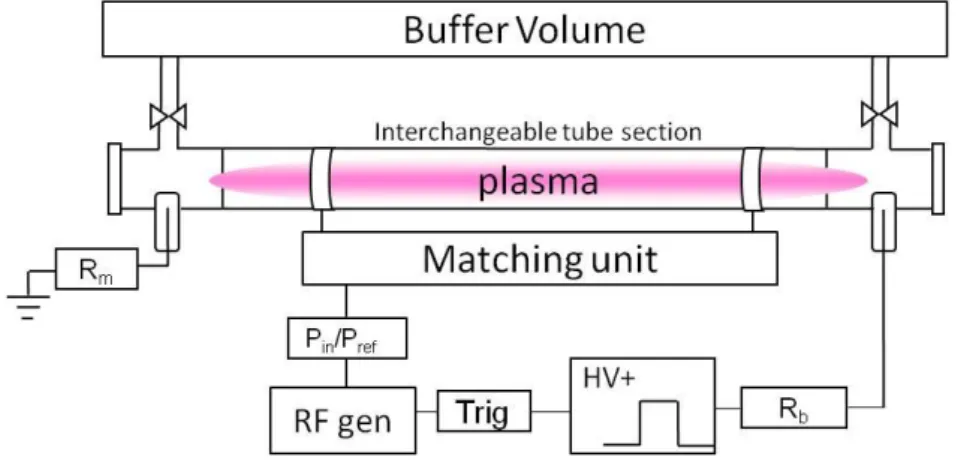
Figure 2. 1 shows the view of the setup. Plasma is ignited in a cylindrical reactor of 2 cm inner diameter and 60 cm full length. Discharge tube consists of three parts. Central part has a length of 40 cm and it is installed between two Pyrex sections using specially designed vacuum connections. This part can be easily dismounted. Therefore, reactors made of different materials or containing different catalysts can be studied without any modification of the system. In the present geometry plasma is in contact only with the studied surface what significantly simplifies the analysis of the results. Two fast pneumatic valves isolate the reactor from the rest of the system in order to perform experiments in static conditions with no gas flow. With the low leak rate (3·10-5 sccm) adsorption/desorption reactions on the catalytic surfaces may be followed during hours without a strong influence of the atmospheric impurities. KBr windows are fixed on each end of the tube allowing infrared laser absorption diagnostics inside the reactor.
Figure 2. 1 Experimental setup (1) – interchangeable discharge tube section, (2) – buffer volume, (3) – high voltage electrode, (4) – grounded electrode, (5) – pneumatic valves, (6) – mass-flow controllers
28
The vacuum system is pumped using an oil-free scroll pump (Edwards XDS10) to a base pressure of 0.1 Pa. Introduction of working gases is performed using 3 mass flow controllers (10, 100 and 500 sccm). When working in flowing conditions, gas pressure is adjusted by changing the pumping rate using a valve at the reactor outlet. Pure gases Ar, N2, O2 with the
typical level of impurities <3 ppm and prefabricated gas mixtures containing 1% of NO, NO2,
N2O, CO, CO2 or C2H2 diluted in argon or N2 are employed in the experiments.
When reactivity of plasma-pretreated surfaces is studied, it is essential to introduce in the reactor a gas mixture containing a well defined number of probe molecules. The buffer volume is used to prepare the desirable gas mixtures and rapidly inject them in the reactor using the pneumatic valves. Then the valves are closed again and the evolution of the gas phase species may be followed by different in-situ diagnostics. Due to the operation in static conditions with precise dosing of reactive gases we are able to perform experiments with specially pretreated surfaces in which kinetics of gas phase species in a single discharge pulse is investigated.
2.1.2 Pulsed discharge systems
The focus of this thesis is the investigation of surface processes in low pressure N2/O2
plasmas. From the view point of the discharge type our objective was to create the plasma in the most simple and well controlled way. For this reason direct current (dc) glow discharge and radiofrequency (rf) capacitively coupled discharge are selected. In this study, pulsed discharge technique is used in order to investigate kinetic processes in plasmas. The advantage of pulsed discharges compared to continuous ones is that processes having different characteristic timescales (electronic excitation, vibrational excitation, dissociation, gas heating, etc..) may be easily controlled and separated by an appropriate selection of the discharge pulse duration.
2.1.2.1 Direct current glow discharge
A pulsed dc glow discharge is ignited by applying a high voltage to a pair of electrodes via aballast resistor. The schematic of the discharge setup is shown in Figure 2. 2. Power supply consists of a capacitance bank charged by a continuous (0-30 kV) power supply, high voltage pulses are formed using a triggered solid state switch. Positive pulses with the rise time of 1s and up to 10 kV in amplitude are obtained. The maximum pulse duration is limited by the energy stored in the capacitance and by the amplitude of the desired discharge current. Discharge current is adjusted by choosing the value of the ballast resistor (Rb=15-70 k) and
the applied high voltage.
Electrical diagnostics of the dc discharge consists in the measurements of current and voltage waveforms. The discharge voltage is measured with a high voltage probe (LeCroy PPE20kV). The discharge current is deduced from the voltage drop on an Rm=18.4 series resistor
29 using an oscilloscope (LeCroy 44Xi, 400 MHz). Typical voltage and current waveforms are shown in Figure 2. 3.
Figure 2. 2 Schematic of the experimental setup. Both dc and rf discharge power supplies are shown.
0 1 2 3 4 5 6 0 10 20 30 40 50 60 U [ kV] I [m A] t [ms] 0,0 0,5 1,0 1,5 2,0
Figure 2. 3 Discharge voltage and current waveforms, N2 p=133 Pa.
The main advantages of using a pulsed dc discharge for investigation of plasma-surface interactions are the following:
Easy control of the discharge parameters (discharge current, pulse duration).
Discharge column is homogeneous along the reactor axis – different parts of the discharge tube undergo the same plasma exposure.
Easy in-situ diagnostics. Homogeneity of the discharge column allows for a number of quantitative in-situ diagnostics (laser absorption, UV absorption). Local species concentrations may be obtained from measurements averaged along the discharge axis.
Very well studied discharge type. The pulsed dc discharge system used in this work was characterized in the PhD works of O. Guaitella [64] and L. Gatilova[65]. Kinetics of dc discharges in N2 [66], O2 [67] and their mixtures [16][63] similar to one used in