BREED
HOL DP-BBB MON
No. of cows 55 553 1 002 745
No. of herds 997 22 20
Production traits LSM SE LSM SE LSM SE ∆% Daily milk yield
(kg/day)
24.4 A 0.2 13.2 B 1.9 20.9 C 1.0 - 46 % Milk fat content
(g/dl milk) 4.08
A 0.00 3.66 B 0.02 3.96 C 0.01 - 10 %
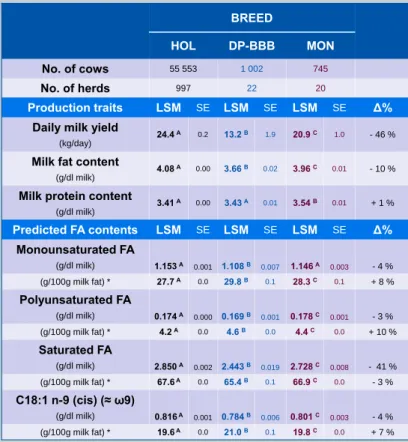
Milk protein content (g/dl milk) 3.41 A 0.00 3.43 A 0.01 3.54 B 0.01 + 1 % Predicted FA contents LSM SE LSM SE LSM SE ∆% Monounsaturated FA (g/dl milk) 1.153 A 0.001 1.108 B 0.007 1.146 A 0.003 - 4 % (g/100g milk fat) * 27.7 A 0.0 29.8 B 0.1 28.3 C 0.1 + 8 % Polyunsaturated FA (g/dl milk) 0.174 A 0.000 0.169 B 0.001 0.178 C 0.001 - 3 % (g/100g milk fat) * 4.2 A 0.0 4.6 B 0.0 4.4 C 0.0 + 10 % Saturated FA (g/dl milk) 2.850 A 0.002 2.443 B 0.019 2.728 C 0.008 - 41 % (g/100g milk fat) * 67.6A 0.0 65.4 B 0.1 66.9 C 0.0 - 3 % C18:1 n-9 (cis) (≈ ω9) (g/dl milk) 0.816A 0.001 0.784 B 0.006 0.801 C 0.003 - 4 % (g/100g milk fat) * 19.6A 0.0 21.0 B 0.1 19.8 C 0.0 + 7 %
Aim
Using milk components predicted bymid-infrared (MIR) chemometric methods, the aim of this study was to investigatedifferences
between milk compositionof DP-BBB, Holstein (HOL), and Montbeliarde (MON) cows in Walloon Region of Belgium in order to have
arguments to promote DP-BBB milk to consumer.
Material and Data
1,039 single-breed herds
56,704 selected cows (at least 90% purebred)
497,030 test-day (TD) milk yields and mid-infrared records
from routine milk recording between January 2007 and April 2011
Fatty acids (FA) contents predicted using the mid-infrared
calibration equations developed by Soyeurt et al., 2011
(J. Dairy Sci., 94, 4, 1657-1667)
When MIR spectrometry helps to promote
a local and vulnerable breed
F.G. Colinet
1, F. Dehareng
2, P. Dardenne
2, H. Soyeurt
1,3& N. Gengler
1,31 University of Liège, Gembloux Agro-Bio Tech, Animal Science Unit, B-5030 Gembloux, Belgium
2 Walloon Agricultural Research Center, Valorisation of Agricultural Products Department, B-5030 Gembloux, Belgium 3 National Fund for Scientific Research, B-1000 Brussels, Belgium
Thedual purpose Belgian Blue breed(DP-BBB) is a vulnerable breed rooted in the tradition of the Walloon Region of
Belgium. Those animals have interesting feature (e.g., robustness, good longevity, and ease of calving). Due to its dual purpose type, income generated by both milk and meat is more stable and more flexible in responding to market fluctuations.
Inside the INTERREG IVa projectBlueSel, several partners inWalloon Region of Belgiumand inNorthern Francework
jointly on the conservation and the use of the genetic heritage of the dual purpose Blue Breeds in this cross-border region. One objective of this project is the valorization of these breeds. In particular, through DP-BBB milk advertising, direct selling by DP-BBB farmers could be promoted.
Session 44, abstract 19, Frédéric COLINET EAAP Annual Meeting, Stavanger, Norway,
August 29th - September 1st2011 Union Européenne -Fonds Européen de Développement Régional INTERREG efface les frontières
The authors acknowledge the financial support of the European Union (European Regional Development Fund) and the Walloon Region of Belgium (SPW-DGO3 Agriculture, Natural resources and Environment) through the INTERREG IVa project BlueSel. H. Soyeurt (Postdoctoral Researcher) and N. Gengler (Research Associate) acknowledge the National Fund for
Scientific Research for the financial support. F.G. Colinet acknowledges the National Fund for Scientific Research for travel grant for attending EAAP annual meeting 2011.
Statistical analysis
Milk production and composition traits were analyzed separately as continuous traits using GLM procedure of SAS according to the model that included the following fixed effects:
Breed
Herd nested within breed
Year of the TD recording (5 levels)
Month of the TD recording (12 levels)
Parity (3 levels: 1st, 2ndand 3thparity)
Lactation stage (12 classes of 30-d intervals)
Presented values are Least Square Means of breed, LSM (± Standard Error, SE). LSM are compared using Pdiff statement.
Table 1: LSM of breed effect (± SE) for production traits and predicted FA contents in milk. ∆% corresponds to the relative difference between DP-BBB and Holstein LSM with the Holstein breed as reference. Presence of letters corresponds to differences highly significant between breeds (P value < 0.0001).
Results
On average, each cow had 8 TD-records with MIR spectra. Global P-value of each model was < 0.0001.
Adjusted means for the three breeds and the relative differences between DP-BBB and HOL using the HOL as reference are presented in Table 1:
DP-BBB milk fat content and daily milk yield were the
lowest;
Milk protein content was almost the same in DP-BBB and
HOL and the highest in MON;
Milk saturated FA content was the lowest in DP-BBB;
DP-BBB mono- and polyunsaturated FA contents in milk
fat were the highest;
DP-BBB milk fat contained more Omega-9 than HOL and
MON milk fat.
Conclusion
Using new technologies, like the prediction of additional milk components from MIR spectrometry, differences in milk compositions could be highlighted.
Results indicated that milk from DP-BBB cows seems to be
slightly more favorable for human healthcompared to HOL, with
differences due to breeds themselves, but also to environmental effects as herd management and feeding.
* Any corrections for the bias and the slope were used to calculate the FA content in milk fat. Therefore, it involves a decrease of accuracy (more details in Soyeurt et al., 2011). However, additional GLM including a regression on the milk fat content as fixed effect were used separetely for each predicted FA contents in milk. The obtained results were consistent with results presented in this table (data not shown).