HAL Id: inria-00410473
https://hal.inria.fr/inria-00410473
Submitted on 21 Aug 2009
HAL is a multi-disciplinary open access
archive for the deposit and dissemination of
sci-entific research documents, whether they are
pub-lished or not. The documents may come from
teaching and research institutions in France or
abroad, or from public or private research centers.
L’archive ouverte pluridisciplinaire HAL, est
destinée au dépôt et à la diffusion de documents
scientifiques de niveau recherche, publiés ou non,
émanant des établissements d’enseignement et de
recherche français ou étrangers, des laboratoires
publics ou privés.
DHTJoin: Processing Continuous Join Queries Using
DHT Networks
Wenceslao Palma, Reza Akbarinia, Esther Pacitti, Patrick Valduriez
To cite this version:
Wenceslao Palma, Reza Akbarinia, Esther Pacitti, Patrick Valduriez. DHTJoin: Processing
Con-tinuous Join Queries Using DHT Networks. Distributed and Parallel Databases, Springer, 2009,
pp.291-317. �10.1007/s10619-009-7054-7�. �inria-00410473�
Esther Pacitti · Patrick Valduriez
Received: date / Accepted: date
Abstract Continuous query processing in data stream management systems
(DSMS) has received considerable attention recently. Many applications share the same need for processing data streams in a continuous fashion. For most distributed streaming applications, the centralized processing of continuous queries over distributed data is simply not viable. This paper addresses the problem of computing approximate answers to continuous join queries over distributed data streams. We present a new method, called DHTJoin, which combines hash-based placement of tuples in a Distributed Hash Table (DHT) and dissemination of queries by exploiting the embedded trees in the under-lying DHT, thereby incuring little overhead. DHTJoin also deals with join attribute value skew which may hurt load balancing and result completeness. We provide a performance evaluation of DHTJoin which shows that it can achieve significant performance gains in terms of network traffic.
Keywords Data Stream Management, · Continuous Join Queries · DHT
Networks · Distributed Query Execution · Load Balancing · Result Complete-ness
Wenceslao Palma · Reza Akbarinia
INRIA and LINA, University of Nantes, France Tel.: +33-2-51-125961 Fax: +33-2-51-125812 E-mail: [email protected] Reza Akbarinia E-mail: [email protected] Esther Pacitti
INRIA and LIRMM, University of Montpellier 2, France E-mail: [email protected]
Patrick Valduriez
INRIA and LIRMM, France E-mail: [email protected]
1 Introduction
Recent years have witnessed major research interest in Data Stream Man-agement Systems (DSMS), which can manage continuous and unbounded se-quences of data items. There are many applications that generate data streams including financial applications [7], network monitoring [34], telecommunica-tion data management [6], sensor networks [4], etc. Processing a query over a data stream involves running the query continuously over the data stream and generating a new answer each time a new data item arrives. However, the un-bounded nature of data streams makes it impossible to store the data entirely in bounded memory. This makes difficult the processing of queries that need to compare each new arriving data with past ones. For example, real data traces of IP packets from an AT&T data source [13] show an average data rate of approximately 400 Mbits/sec, which makes it hard to keep pace for a DSMS. Moreover, a DSMS may have to process hundreds of user queries over multiple data sources. For most distributed streaming applications, the naive solution of collecting all data at a single node is simply not viable [8]. Therefore, we are interested in techniques for processing continuous queries over collections of distributed data streams. This setting imposes high processing and memory requirements. However, approximate answers are often sufficient when the goal of a query is to understand trends and making decisions about measurements or utilizations patterns.
One technique for producing an approximate answer to a continuous query is to execute the query over a sliding window [14] that maintains a restricted number of recent data items. This allows queries to be executed in finite mem-ory, in an incremental manner by generating new answers each time a new data item arrives. Moreover, in the majority of real world applications empha-sizing recent data is more informative and useful than old data. Notice that a sliding window is a natural method for approximation that is part of the query semantics expressed by the user in the query. The size of a window is specified using either a time interval (time-based) or a count on the number of tuples (count-based). In this work we consider time-based windows.
In continuous query processing the join operator is one of the most im-portant operators, which can be used to detect trends between different data streams. For example, consider a network monitoring application that needs to issue a join query over traffic traces from various links, in order to monitor
the total traffic that passes through three routers (R1, R2 and R3) and has
the same destination host within the last 10 minutes. Data collected from the
routers generate streams S1,S2and S3. The content of each stream tuple
con-tains a packet destination, the packet size and possibly other information. This query can be posed using a declarative language such as CQL [2], a relational query language for data streams, as follows:
q1: Select sum (S1.size)
From S1[range 10 min], S2[range 10 min], S3[range 10 min]
in the DHT and dissemination of queries. We evaluated the performance of DHTJoin through simulation. The results show the effectiveness of our solution compared with previous work.
This paper is an extended version of [28] with the following added value. First, we present a dissemination system (Section 3.1) based on the trees formed by DHT links that uses O(n − 1) messages. This yields an
impor-tant reduction of network traffic compared with the O(nlogn2 ) messages
gener-ated by the dissemination system proposed in our previous work. Considering that nodes that fail (or leave the network) during query execution may cause problems in the generation of join results and the dissemination of queries, we propose a solution to deal with node failures (Section 4). In Section 5, we show analytically that DHTJoin can scale up the processing of continuous join queries using multiple peers and improves the completeness of join results lin-early as memory capacity is increased. In Section 6, we provide a new solution to handle data skew during the execution of continuous join queries. Finally, in Section 7 we report experimental results that show the effectiveness of our approach.
1.1 Contributions
In summary, we propose a novel method (DHTJoin) for the execution of con-tinuous join queries with the following contributions:
– DHTJoin identifies, using query predicates, a subset of tuples in order to
index the data required by the user’s queries, thus reducing network traffic. This is more efficient than the approaches based on structured P2P over-lays, e.g. PIER [16] and RJoin [17], which typically index all tuples in the network. Furthermore, our approach dynamically indexes tuples based on new attributes when new submitted queries contain differents predicates.
– We provide an analytical evaluation of the best number of nodes to obtain
a certain degree of completeness given a continuous join query.
– DHTJoin tackles the dynamic behavior of DHT networks during query
execution and dissemination of queries. When nodes fail during query dis-semination, DHTJoin uses a gossip-based protocol that assures 100% of network coverage. When nodes fail during query execution, DHTJoin prop-agates messages to prevent nodes of sending intermediate results that do not contribute to join results, thereby reducing network traffic.
Table 1: Symbols used in this paper Symbol Description n number of nodes m number of streams S= {S1, S2, ...., Sm} set of streams Ai j j-th attribute of stream Si
λi arrival rate of stream Siin tuples/sec
S[Wi] sliding window of stream Si
Wi window size of S[Wi] in seconds
Q= {Q1, Q2, ...., Qn} set of queries
P set of equijoin predicates of a query Qi
QP= {QP1, QP2, ...., QPn} set of query plans
sel join selectivity ∈ [0..1]
m(Si) function that returns the memory
as-signed to Situples
– DHTJoin provides an efficient solution to deal with overloaded nodes as
a result of data skew. The key idea is to distribute the tuples of an over-loaded node to some underover-loaded nodes, called partners. When a node gets overloaded, DHTJoin discovers partners using information in the routing table and determines what tuples to send them using the concept of do-main partitioning. We show that, in this case, DHTJoin incurs only one additional message per joined tuple produced, thus keeping response time low.
1.2 Organization
The rest of this paper is organized as follows. In Section 2, we introduce our system model and define the problem. In Section 3, we describe DHTJoin. In Section 4, we discuss how DHTJoin deals with node failures. In Section 5, we provide an analysis of result completeness of our algorithms which relates memory constraints, stream arrival rates and result completeness. In Section 6, we describe how DHTJoin deals with data skew. In Section 7, we provide a performance evaluation of our solution through simulation using Java. In Section 8, we discuss related work. Section 9 concludes.
2 System Model and Problem Definition
In this section, we introduce a general system model for processing data streams over DHTs, with a DHT and data model, and a stream processing model. Then, we state the problem. For readability, Table 1 summarizes the main symbols used in this paper.
a identifier denoted by nodeid. Nodes insert data in the form of relational
tuples and queries are represented in a relational query language for data streams such as CQL [2]. Tuples belonging to the same stream are inserted by the same node and continuous queries are originated at any node of the network. Tuples and queries are timestamped to represent the time that they are inserted in the network by some node. We assume that data and query sources are equipped with well-synchronized clocks by using the public domain Network Time Protocol (NTP) designed to work over packet-switched and variable latency data networks and already tested in distributed DSMS [35]. Each tuple has a unique key generated using the name of the node that inserts it, the name of the relation to which it belongs and its timestamp. Additionally,
each query is associated with a unique key qid used to identify it in query
processing, optimization tasks and to relate it to the node that submitted it. Let us now formally define continuous join queries and the type of
continu-ous queries that we consider in our approach. Let S = {S1, S2, ...., Sm} be a set
of data streams. Each data stream Sihas a relational schema (Ai1, Ai2, ...., Aini),
where each Ai
jis an attribute. We use equijoin and conjunctive predicates, i.e.,
the where clause uses exclusively conjunctions of atomic equality conditions.
Let Qi = (S′,P) be a continuous join query defined over S′ ⊆ S and
com-posed by P that represents a set of equijoin predicates. As in [43][17], we identify two types of join queries depending on the attributes involved in P. A query of type 1 is a join query with a set of equijoin predicates as following:
P = {(S1.A1k = S2.A2k), (S2.A2k = S3.A3k), ..., (Sm−1.Am−1k = Sm.Amk)}, i.e.,
the join attribute is the same in all the relations of the query (e.g. query q1
of Sect. 1). A query of type 2 is a join query with a set of equijoin
pred-icates as following: P = {(S1.A1k = S2.A2k), (S2.A2l = S3.A3l), (S3.A3m =
S4.A4m), ...., (Sm−1.Amnm−1 = Sm.Amnm)}, i.e., the join attributes are different
and adjacent joins must have a common relation.
2.2 Stream Processing Model
A data stream Si is a sequence of tuples ordered by an increasing timestamp
where i ∈ [1..m] and m ≥ 2 denotes the number of input streams. At each
time unit, a number of tuples of average size li arrives to stream Si. We use λi
Many applications are interested in making decisions over recently observed tuples of the streams. This is why we maintain each tuple only for a limited
time. This leads to a sliding window S[Wi] over Si that is defined as follows.
Let Wi denotes the size of S[Wi] in terms of seconds, i.e. the maximum time
that a tuple is maintained in S[Wi]. Let T S(s) be a function that denotes
the arrival time of a tuple s and t be current time. Then S[Wi] is defined as
S[Wi] = {s|s ∈ Si∧ (t − T S(s) ≤ Wi}. Tuples continuously arrive at each
instant and expire after Wi time steps (time units). Thus, the tuples under
consideration change over time as new tuples get added and old tuples get deleted. In practice, when arrival rates are high, the window sizes are long and the memory dedicated to the sliding window is limited, it becomes full rapidly and many tuples must be dropped before they naturally expire . In this case, we need to decide whether to admit or discard the arriving tuples and if admitted, which of the existing tuples to discard. This kind of decision is made using a load shedding strategy [32][36] which yields that only a fraction of the complete result will be produced.
2.3 Problem Definition
In this paper, we address the problem of processing join queries over data streams. We view a data stream as a sequence of tuples ordered by mono-tonically increasing timestamps. The nodes are assumed to synchronize their clocks using the public domain Network Time Protocol (NTP),thus achieving accuracies within milliseconds [3]. Each tuple and query have a timestamp that may be either implicit, i.e. generated by the system at arrival time, or explicit, i.e. inserted by the source at creation time.
This paper focuses on query execution (not query optimization). Thus, we assume the existence of a query optimizer that translates a query represented in CQL [2] into a query plan in the form of an operator tree. Since an MJoin operator [37] is used by default to specify join operations, only the join order needs to be specified by the optimizer, i.e. the choice of how to execute MJoin operators (e.g. which nodes) is done at runtime using our method. Each query
Qi has a query plan QPi that specifies the ordering of the join operations.
Formally, the problem can be defined as follows. Let S = {S1, S2, ...., Sm}
be a set of data streams, and QP = {QP1, QP2, ...., QPn} be a set of query
plans of the following set of continuous join queries Q = {Q1, Q2, ...., Qn},
where Qi= (S′,P) is a continuous join query defined over S′⊆ S and P
rep-resents a set of equijoin predicates. Our goal is to provide an efficient method to execute QP over S in terms of network traffic.
3 DHTJoin Method
In this section, we describe our solution, DHTJoin, for processing continuous join query processing using DHTs. The main issues for processing continuous
Fig. 1: A DHTJoin example using a query of type 2
queries in DHTs are the following: how to route data and queries to nodes in an efficient way; how to provide a data storage mechanism for storing relational data; and how to provide a good approximate answer to join queries.
DHTJoin has two steps: dissemination of queries and indexing of tuples. A query is disseminated using the embedded tree inherents to DHTs networks and a tuple inserted by a node is indexed, i.e., stored at another node using DHT primitives. However, a node indexes a tuple only if there is a query that contains an attribute of the arriving tuple in P. To this end, a node stores locally a disseminated query and once it receives a tuple it checks for already disseminated queries that contain an attribute of the arriving tuple in P.
We describe the design of DHTJoin based on Chord which is a simple and very popular DHT. However, the techniques used here can be adaptable to others DHTs such as Pastry [31] and Tapestry [41].
To process a query, we consider different kinds of nodes. The first kind is Stream Reception Peers (SRP) for indexing tuples to the second kind of nodes, the Stream Query Peers (SQP). In Figure 1, nodes 3, 6 and 7 correspond to SRP because they receive tuples belonging to streams z, y, and x respectively. SQP are responsible for executing query predicates over the arriving tuples using their local sliding windows, and sending the results to the third kind of
node(s), the User Query Peers (UQP). In Figure 1, nodes 1 and 4 are SQP
because node 1 computes the join predicate X.B = Y.B of query q2(submitted
at node 0) and node 4 performs the join predicate Y.C = Z.C of q2. In addition,
node 0 is a UQP because query q2was submitted at this node.
To support dissemination of queries, a node must be a dissemination node (i.e. executes a dissemination protocol) while to index tuples, a node must be a DHT peer. Note that the difference between SRP, SQP and UQP is functional and the same node can support all these functionalities.
3.1 Disseminating Queries
Each new query issued by users should be disseminated to all nodes because by
using S′ and the set of predicates P of a query a node decide which tuples and
attributes should be indexed. The query dissemination system consists of a set of DHT nodes. A query can originate at any of the nodes and is disseminated using a tree [5].
To disseminate a query, DHTJoin dynamically builds a dissemination tree as proposed in [11]. The basic idea is to consider that in a DHT as Chord a lookup operation can be perceived as a binary search [11] that generates a binary tree using the nodes (links) stored in the routing table. The root of the tree is the node that submits the query (an UQP node). The query is disseminated from the root node to all nodes of the DHT using a divide-and-conquer approach. When a node receives a disseminated query, it is stored locally in a query table (QT ), thus allowing to know what is the attribute of an arriving tuple that must be used in the indexing process. This is important
since a tuple si is indexed using an attribute Aij only if it is contained in the
set P allowing to decrease network traffic and providing a better utilization of local SQP resources by avoiding the indexing of tuples using an attribute that is not being involved in a query.
To disseminate a query, an UQP node creates a dissemination message
Dmsg= (nodeid, qid, Qi, QPi, ts,R) containing its own node identifier nodeid,
an unique query identifier qid, the query Qi = (S′,P), the query plan QPi, a
timestamp ts that denotes the arrival time of Qi and a range of dissemination
R. A node that receives a Dmsg store the query in its QT and creates a new
Dmsgpreserving the nodeid, the qid, the timestamp ts, the query Qiand the
query plan QPi, and changing R. For example, using a fully-populated Chord
ring with 8 nodes, each one contains a routing table of log(n) entries called
fingers. The ith entry in the table at node n contains the identity of the first
node that succeeds or equal n+2i. A dissemination message initiated at node 0
is sent to finger nodes 1, 2 and 4 (see Figure ??) giving them the disseminations limits [1,2), [2,4) and [4,0) respectively. The disseminations limits are used to restrict the forwarding space of a node and they are constructed using as a upper bound the finger i + 1. Each node applies the same principle reducing the search scope. When node 2 receives the dissemination message with limits [2,4) it examines the routing table and sends the message to node 3. Once
Fig. 2: A dissemination tree formed using DHT links of a 8-node Chord ring
node 4 receives the dissemination message it examines the routing table and sends the message to nodes 5 and 6 with limits [5,6) and [6,0) respectively. In the same way, node 5 does not continues with the dissemination process (since there are no nodes between [5,6)) and node 6 disseminates the message to node 7. This forwarding process generates n − 1 messages and a tree of depth log(n), which fixes the latency of query dissemination.
3.2 Indexing Tuples
The indexing of tuples allows DHTJoin to distribute the query workload across multiple DHT nodes. Let us describe how DHTJoin indexes tuples
for streams S = {S1, S2, ...., Sm}. Let si be a tuple belonging to Si. Let
A= (Ai
1, A i 2, ...., A
i
ni) be the set of attributes in si and val(si, A
i
j) be a
func-tion that returns the value of the attribute Ai
j ∈ A in tuple si. Let h be a
uniform hash function that hashes val(si, Aij) into a DHT key, i.e. a number
which can be mapped to a nodeid. A node that index a tuple si∈ Sicreates a
message Index = (Si, si, Aij, ts) containing the stream Si which the tuple
be-longs to, the tuple si being indexed, the attribute used to index the tuple and
a timestamp ts that denotes the arrival time of the tuple. Let S[Wi] denote a
sliding window on stream Si. Recall that we use time-based sliding windows
where Wiis the size of the window in time units. At time t, a tuple sibelongs
to S[Wi] if it has arrived in the time interval [t − Wi, t].
For indexing a tuple si that arrives at an SRP, each tuple obtains an index
key computed as key = h(val(si, Aij)). The attribute Aij in si is chosen by
searching locally in the QT for queries that contains Ai
j in P. Then to index
si the SRP node creates a Index message and sends it to a SQP (the node
responsible for key in the DHT), by performing put(key, Index). Thus, tuples of different streams having the same key are put in the same SQP node and are stored in sliding windows where they are processed to produce the result of a specific join predicate.
3.3 Query Execution
Query processing in a DSMS entails the generation and execution of a query plan. This paper focuses on the execution part. For simplicity, we assume that the query plan is an operator tree that specifies the ordering of operations (i.e. join order) and it is included in the Dmsg message of the query dissemination step (see Section 3.1).
Queries of type 1 are executed using partitioned parallelism with SQP nodes implementing the MJoin operator [37]. A query plan contains an op-erator tree for each stream present in the query (see Figure 3) that could be optimized locally, thus generating a new operator tree. Each node in the op-erator tree represents a join opop-erator and an edge represents the next stream to probe. Queries of type 2 are executed using pipelined parallelism (see Fig-ure 5). For queries of type 2, the query plan is assumed to be generated by a centralized query optimizer based on a cost model which captures information regarding data (e.g. tuples’ arrival rates) and operators (e.g. cost of a join) [43]. Each node in the operator tree represents a join operator implemented using MJoin and an edge represents the next step in the pipeline.
In this section, we describe the execution of queries of type 1 and 2 in DHTJoin.
3.3.1 Queries of Type 1
In this type of queries, DHTJoin uses partitioned parallelism [23] where differ-ent nodes execute independdiffer-ently the same query plan on differdiffer-ent data parti-tions. By default, DHTJoin instantiates an MJoin operator [37] for queries of type 1. Mjoin considers n inputs streams symmetrically and allows the tuples from the streams to arrive in an arbitrary interleaved fashion. The basic algo-rithm of MJoin creates as many hash tables (states) as there are join attributes in the query. When a new tuple from a stream arrives into the system, it is probed with the other n − 1 streams in some order to find the matches for the tuple. The order in which the streams are probed is called the probing sequence. Figure 3 shows an MJoin operator for a 3-way continous join query expressed using CQL [2]. There are three hash tables corresponding to the three join attributes of the query and three probing sequ ences. An MJoin operator is ready to accept a new tuple on any input stream at any time. Upon arrival, the new tuple is used to probe the remaining hash tables, thus generating a result as soon as possible. MJoin implements a lightweight tuple router that, considering the probing sequence, routes the arriving tuples to the remaining hash tables. The following steps are executed when a new tuple x ∈ X arrives:
– xis inserted into the X hash table.
– The probing sequence for an X tuple is Y → Z (see Figure 3).
– x is used to probe the hash table on Y to find the tuples that satisfy
the join predicate X.dest = Y.dest. Intermediate tuples are generated by
Fig. 3: MJoin operator for a 3-way join query of type 1
– If any result tuples were generated, they are routed to the Z hash table in
order to find the tuples that satisfy the join predicate Y.dest = Z.dest. MJoin integrates sliding windows as follows. Let us consider the MJoin operator of Figure 3. Each hash table stores the tuples that fall within the
current window period which, in the case of q1,correspond to 10 minutes for
the streams X, Y and Z. For example, for each arriving tuple x ∈ X, before probing the hash table on Y , the Y tuples that are outside of the window
S[WY] are eliminated. If an intermediate result tuple xyi is generated, the Z
tuples that are outside of the window S[WZ] are eliminated before the probe
step.
Choosing a probing sequence is very important in MJoin because it must ensure that the smallest number of intermediate results is generated. This process is supported by heuristic-based ordering algorithms [14][37]. MJoin is very attractive when processing continuous queries over data streams because the query plans can be changed by simply changing the probing sequence. Thus, each SQP node that processes a query of type 1 can optimize the execution plan of the query independently.
Let us illustrate how DHTJoin perfoms query processing with the following query of type 1:
q1: Select sum (X.size)
From X[range 10 min], Y [range 10 min], Z[range 10 min] Where X.dest = Y.dest = Z.dest
Fig. 4: Execution of a query of type 1 in DHTJoin
Query q1 is submitted at node 0 and disseminated, using the strategy
pro-posed in Section 3.1, over the entire network as soon as it is submitted. SRP
nodes 7, 6 and 3 index xi, yi and zi tuples and check locally in their QT
whether q1contains in P an attribute belonging to the arriving tuples. Recall
that in a query of type 1, the join attribute is the same in all relations, so that all the tuples having the same attribute value are located in the same SQP
node without producing intermediate results. Therefore, q1 can be executed
independently at different SQP nodes, each using an MJoin operator. In our
example, SQP nodes 1 and 4 process q1on different partitions of X, Y and Z
streams using an MJoin operator (see Figure 4). The results produced by SQP nodes 1 and 4 are sent directly to the UQP node (whose address was provided
in the Dmsg m essage when q1 was disseminated).
3.3.2 Queries of Type 2
DHTJoin executes queries of type 2 using pipelined parallelism [23] where different nodes run in a pipelined fashion such that tuples output by a node can be fed to another node as they get produced. Recall that DHTJoin partitions
the streams by hash functions. For example, let us consider query q2 with the
following set of predicates {(X.B = Y.B), (Y.C = Z.C)}. Streams X and Y are indexed based on the value of attribute B while stream Z is indexed based on the value of attribute C which is placed at a node different from where
For queries of type 2, we assume that the query optimizer generates a query plan based on a bushy tree of binary joins that has the potential of executing independents subtrees concurrently. Local operators are executed using an MJoin operator and can be optimized as for queries of type 1.
Let us illustrate how DHTJoin perfoms query processing using the follow-ing query of type 2:
q2: Select Y.B, Z.C
From X[range 5 min], Y[range 5 min], Z[range 5 min] Where X.B=Y.B and Y.C=Z.C
This query specifies an equijoin among X, Y and Z streams over the last
5 minutes. Query q2 is submitted at node 0 and disseminated over the entire
network as soon as it is submitted. Thus, after a while, all nodes know the existence of this query and are able to index the incoming streams (tuples).
We assume that the query plan generated for q2 is (X ⊲⊳B Y) ⊲⊳C Z). Once
an X-, Y - or Z-tuple arrives at nodes 7, 6 and 3 respectively, each node
checks locally in its QT whether the query q2 contains in P an attribute
belonging to the arriving tuple (see Figure 1). If so, nodes 7, 6 and 3 execute
the task of an SRP. For instance, in our example, node 7 indexes xi because
the attribute B ∈ X is in the set P of q2. Node 7 creates a message Index =
(X, xi, B, ts), generates an index key using key = h(val(xi, B)) and indexes
the tupl e using put(key, Index). The equijoin predicate X.B = Y.B belonging
to q2is evaluated at a SQP (node 1) only with tuples that arrive in the system
after the query.
Sliding windows are used at each SQP node, as for queries of type 1, as
follows. For example, at node 1 in Figure 1, tuples expired in S[WY] are
inval-idated upon the arrival of X-tuples. The load shedding procedure is executed
over S[WX]’s buffer if there is not enough memory space to insert the arriving
tuple.
The SQP node 1 searches in the query plan of q2 what is the next step
to follow and concludes that the intermediate results xiyj must be sent to
another node using the value of C attribute belonging to the Y-tuple. Thus the
SQP node 1 creates a message Index = (XY, xiyj, C, max(T S(xi), T S(yj)),
generates an index key using key = h(val(yj, C)) and index the intermediate
by SQP node 4 are immediately sent to the appropriate UQP node (whose address is provided when starting query dissemination).
3.4 DHTJoin on Other DHTs
The design of DHTJoin is based on Chord which is a simple and very popular DHT. However, the dissemination technique and the indexing of tuples used can be adapted to others DHTs such as Pastry [31] and Tapestry [41]. In the dissemination of queries, recall that the basic idea (using Chord) is to consider a lookup operation as a binary search in spite of its ring geometry. The routing algorithms in Pastry and Tapestry are both similar in spirit to the PRR’s routing algorithm [29] which is based on a tree hierarchical organization. This makes of Pastry and Tapestry a good choice to implement the query dissemination.
We consider Pastry as an example and demonstrate how to apply query dissemination using the mechanism proposed in [5]. In Pastry each node has a unique nodeId assigned from a identifier space of 128 bits. Application-specific objects are assigned unique identifiers called keys from the same identifier space. Assuming a network of size n, each Pastry node maintains a routing
table of log2bn rows with 2b entries each. For the purpose of routing, the
nodeId and keys can be thought of as a sequence of L digits in base 2b. The
mechanism to route a message is prefix-based, i.e. the routing is achieved by forwarding the message to a node that shares a common prefix by at least one
more digit. Pastry can route a message to any node in log2bnhops. For ease of
explanation, we use b = 1, L = 3 and a network of 8 nodes. A dissemination
message initated a node 000 contains the query id qid and the message is sent
to the 3 nodes of its routing table 100, 010 and 001 adding the routing table row r of each node. When a node receives a dissemination message, it searches in the routing table all the nodes located in rows greater than r (if any) and disseminates the message to them. This process is repeated at each node that receives the message, thus generating a dissemination tree of depth log(n).
Regarding the indexing of tuples, we use primitives which represent ca-pabilities that are common to all DHTs. DHTs typically provide two basic operations [9]: put(k, data) stores a key k and its associated data in the DHT using some hash function; get(k) retrieves the data associated with k in the DHT. Thus, we can process continuous join queries in other DHTs.
4 Dealing with Node Failures
In this section, we discuss how DHTJoin deals with node failures during query execution. By node failure, we mean various situations by which a DHT node stops participating in query execution (e.g. because it crashes). We address this issue considering two situations: (1) Failure of a node during query dis-semination. Recall that the dissemination of queries allows to decrease network
In DHTJoin, continous join queries are originated at any node of the DHT and disseminated using a tree. The dissemination of queries achieves a network coverage of 100%, takes O(logn) hops to reach every node in the network and generates n − 1 messages. However, dynamic changes of the structure of the DHT network can disturb the dissemination. The failure of a node in the tree structure generated by the dissemination makes the entire subtree under this node unreachable. To provide realibility in the dissemination of queries, we propose to use a gossip based protocol as a complementary to our tree based dissemination.
Basically, gossip proceeds as follows: a node niknows a group of other nodes
or contacts, which are maintained in a list called n′
is view. Periodically nodei
selects a contact nodej from its view to gossip: nodeisends its information to
nodej and receives back other information from nodej.
We integrate gossip to DHTJoin’s dissemination procedure as follows. The view maintained by the nodes is the neighbor list present in DHTs. All nodes that receive a disseminated query forward periodically the query to a ran-domly chosen neighbor. To this end, a node creates a gossip message Gmsg and executes send(receiver, Gmsg) where receiver is the destination node of message Gmsg.
Our algorithm to gossip query dissemination messages proceeds as follows. A message Gmsg is generated at any node that has already received a
user-level query Qi. A message Gmsg = (Qi, qid, QPi, T S(Qi), Ld) contains a query
Qi, a unique query identifier qid, a query plan QPi, a timestamp T S(Qi) and
a partial dissemination list Ld composed by the nodes of its local view to
which the message has been sent (not necessarily received by all nodes of
Ld due to the dynamic nature of the network) and the node that sent the
message to it. To process a gossip message, a node that receives a message
Gmsg = (Qi, qid, QPi, T S(Qi), Ld) chooses a random node nr from its view
and forwards the message (Qi, qid, QPi, T S(Qi), Ld∪ nr) to nr only if it has
not been already chosen in previous gossip rounds.
4.2 Failures during Query Execution
DHTJoin distributes the query workload across multiple DHT nodes and pro-vides a mechanism that avoids indexing tuples using attributes not contained
Fig. 5: Query Plan of a 5-way continuous join query of type 2
in the set P of a query. However, when a node fails, another node can gen-erate partial results irrespective of whether they produce join query results. In this section, we address the problem of indexing partial results that never contribute to generate join results.
For example, let us consider the following query plan (V ⊲⊳ W ) ⊲⊳ ((X ⊲⊳
Y) ⊲⊳ Z) for a query of type 2 where there are nodes connected by a
producer-consumer relationship, whereby a producer node generates tuples to be pro-cessed by a consumer node [40]. The query plan (see Figure 5) shows the relations between producers and consumers. We assume that a join operator
Opi resides at node ni. Operator Op3 is a producer of X ⊲⊳ Y ⊲⊳ Z tuples for
Op4 and a consumer w.r.t Op2 and SRP of stream Z. Recall that in a query
of type 2, the operators are placed at different SQP nodes and the query plan
is provided in the query dissemination step. If the node n1 fails, the indexing
of V ⊲⊳ W intermediate result tuples is stopped, thus yielding no join results
because of no matching tuples in node n4. Furthermore, if no matching tuple
of V ⊲⊳ W appears at node n4 before expiration of X ⊲⊳ Y ⊲⊳ Z tuples, the
resources involved in sending, processing and storing these tuples are wasted.
To address this problem, we propose the following solution. If node n4,
where Op4 is executed, detects that V ⊲⊳ W tuples are not being generated
by node n1 it sends a message to node n3 to alert that it is not necessary to
send X ⊲⊳ Y ⊲⊳ Z tuples. Consequently, as the demand of Op3as a consumer
has changed, it propagates the alerting message to node n2and to the SRP of
stream Z only if there does not exist another query that needs X ⊲⊳ Y ⊲⊳ Z
tuples generated by Op3. This condition is verified at all the operators that
receive an alerting message. Once the communication with n1 is established
again, node n4 sends a resume message to n3 in order to continue with the
production of tuples and node n3propagates the resume message it proceeds. If
Input: the query q
1: for all the descendents ∈ query plan of q do 2: alertM SG← {q, {suspend|resume}} 3: send(myID,alertMSG)
4: end for
In Procedure 1, a consumer sends an alert message to all the other produc-ers of the query plan of query q. The consumer sends a suspend message when it detects that there are tuples not being generated by a producer. Otherwise, it sends a resume message.
Procedure 2 Handle AlertMSG(consumerID, alertMSG)
Input: consumerID, the identifier of the consumer node in the Chord ring. alertMSG is a message containing the identification of the query q and the type of action {suspend,resume}
1: if notExists(qi∈ QT 6= q) then
2: propagate AlertMSG(myID, alertMSG); 3: end if
4: if (action is suspend) then 5: suspend(q)
6: else 7: resume(q) 8: end if
In Procedure 2, Line 1 verifies that there does not exist another query in
QT that needs the tuples generated by the producer that receives the message.
If so, the producer acting as a consumer sends the message to its descendents (Line 2) in the query plan of q. Finally, the producer performs appropiate operations to suspend (Line 5) or reactivate (Line 7) locally the production of tuples related to q. By eliminating unnecessary intermediate results, this optimization yields an important reduction of network traffic and a better utilization of local resources.
5 Analysis of Result Completeness
The notion of result completeness is important in distributed and P2P databases since partial (incomplete) query answers are often only possible [26][19]. Result
completeness is thus defined as the fraction of results actually produced over the total results (which could be produced under perfect conditions). In data streaming applications, the potential high arrival rates of streams impose high processsing and memory requirements. However, approximate answers are of-ten sufficient when the goal of a query is to understand trends and making decisions about measurement or utilization patterns. Query approximation can be done by limiting the size of states maintained for queries [18]. In our anal-ysis we focus in the case where the memory allocated to maintain the state of a query is not sufficient to keep the window size entirely, thus reducing the received join results and completeness. DHTJoin provides more memory to store tuples, but we consider that determining the number of computing resources necessaries to achieve a certain degree of completeness for a given query is an important aspect in the setup phase of DHTJoin.
In this section, we propose formulas which relate peer memory constraints, stream arrival rates, and result completeness. We will use these formulas in our performance evaluation and they could be useful to a DHTJoin user (e.g. an application developer) to define and tune a DHT network for specific ap-plication requirements. We provide the necessary equations to calculate the completeness in a 2-way join and afterwards we generalize our results for a m-way join.
For ease of analysis, we make simplifying assumptions: the tuples are uni-formily distributed across the DHT network; the memory assigned to store tuples is the same at each peer; we use the average rate to characterize the rate of arrivals of incoming tuples and stream tuples arrive in monotonically increasing order of their timestamps. We use the notations specified in Table 1. In order to illustrate our analysis, let us consider the following join query
over two streams S1 and S2:
Q: Select *
from S1[range 5 min], S2[range 5 min]
where S1.x= S2.x
The expected tuple arrival rate of streams S1and S2at each node of the DHT
is λ1 n and
λ2
n respectively. Thus, the expected number of join tuples generated
by S1 and S2 over sliding windows at each node can be estimated as
T(S1, S2) = sel × (
W1λ1
n ) × (
W2λ2
n ) (1)
Each node needs a memory space for storing tuples in its local sliding
window equivalent to W1λ1 n and W2λ2 n . In general, if ( Wiλi n > m(Si)) we have
a loss rate (Lr) to store tuples equivalent to:
Lr(Si) = ( 0, Wiλi n ≤ m(Si) Wiλi n − m(Si), otherwise (2)
Assuming that memory is insufficient to retain all the tuples in W1 and
W2, the loss of join tuples L of S1 and S2 is:
L(S1) = sel × Lr(S1) × (
W2λ2
Fig. 6: A join state including stored and non stored tuples
L(S2) = sel × Lr(S2) × (
W1λ1
n ) (4)
Let αi be the Si-tuples stored in the memory space m(Si) and βi be the
Si-tuples not stored due to memory constraints (see Figure 6). We can rewrite
equations (3) and (4) as:
L(S1) = sel × β1× (α2+ β2) = (sel × α2× β1) + (sel × β1× β2)
L(S2) = sel × β2× (α1+ β1) = (sel × α1× β2) + (sel × β1× β2)
Notice that the tuples related to expression (sel × β1× β2) are counted in
both L(S1) and L(S2). This expression can be rewriten as: (sel × Lr(S1) ×
Lr(S2)). The total loss of join tuples T L of S1⊲⊳ S2 is the sum of the loss of
join tuples L(S1) and L(S2) minus the tuples counted twice:
T L(S1, S2) = L(S1) + L(S2) − (sel × Lr(S1) × Lr(S2)) (5)
The completeness C of a S1⊲⊳ S2 join query is the fraction of total results
T(S1, S2) minus the loss of tuples T L(S1, S2) and total results T (S1, S2), using
equation (1) and equation (5) C is:
C=T(S1, S2) − T L(S1, S2)
T(S1, S2)
(6) Developing expressions in (6) allows us to simplify C to:
C= n
2
× m(S1) × m(S2)
W1λ1× W2λ2
(7) Moreover, we can write (7) as:
n=
s
C× (W1λ1) × (W2λ2)
m(S1) × m(S2)
(8) This equation allow us to evaluate how many peers are necessary to process a 2-way join query.
Now we generalize our analysis to m-way joins as following. Recall that the total loss of join tuples T L is the sum of the loss of join tuples minus the tuples counted more than one time. The sum of the loss of join tuples can be
easily extended to an m-way join asPm
i=1L(Si). However, the expression that
represents the tuples counted more than one time is more difficult to generalize. We use the same method of rewriting (3) and (4) to find the expression that
represents the case of tuples counted more than one time. Thus in a S1 ⊲⊳
S2⊲⊳ S3join we rewrite L(S1),L(S2) and L(S3), discovering that (sel
2 × β1× β2× α3), (sel 2 × β1× β3× α2) and (sel 2
× β2× β3× α1) are counted twice
and (sel2
× β1× β2× β3) is counted t riple. Rewriting αi and βi we arrive at
the following expression: sel2
Lr(S1)Lr(S2)m(S3) + sel 2 Lr(S1)Lr(S3)m(S2) + sel2 Lr(S2)Lr(S3)m(S1) + 2sel 2 Lr(S1)Lr(S2)Lr(S3).
Repeating the same method with m-way joins (m ≥ 4) and analyzing the resulting expressions, we arrive at the following general expression for a
S1⊲⊳ S2⊲⊳ .... ⊲⊳ Smjoin: m X k=2 X S′⊆S |S′|=k X S′′⊆S |S′′|=m−k S′′∩S′=∅ (selm−1(k − 1)Y a∈S′ Lr(a) Y b∈S′′ m(b))
Now, the general case of (5) can be expressed as:
T L(S1, S2, ...., Sm) = m X i=1 L(Si)− m X k=2 X S′⊆S |S′|=k X S′′⊆S |S′′|=m−k S′′∩S′=∅ (selm−1(k − 1)Y a∈S′ Lr(a) Y b∈S′′ m(b)) (9)
The completeness C of a S1⊲⊳ S2⊲⊳ .... ⊲⊳ Smjoin query, using the general
form of (1) and equation (9) is:
C= T(S1, S2, ...., Sm) − T L(S1, S2, ...., Sm)
T(S1, S2, ...., Sm)
(10) Developing expressions in (10) allows us to simplify C to:
C=n mQm i=1m(Si) Qm i=1Wiλi (11) and to obtain n= m s C×Qm i=1Wiλi Qm i=1m(Si) (12) It is clear from our analysis that (11) is independent of selectivity which is reasonable in the context of continuous join queries. As our analysis shows, DHTJoin can scale up the processing of continuous join queries using multiple
using join attribute values. So far, we assumed that the hash function yields uniform distribution of the join attribute values. However, it is well known that parallel join algorithms suffer from join attribute skew, i.e. certain join attribute values are much more frequent than others [27], which hurts load balancing and thus response time. It is important to note that data skew oc-curs naturally in many data streaming applications [39]. For example, in online analysis of transaction logs generated by telephone call records, some numbers used for online tv contests register a huge number of phone calls. In network monitoring applications, malicious traffic traces show that an abnormally high number of source addresses are connected to a single destination address. In DHTJoin, data skew in join attribute values may hurt load balancing of join execution. Furthermore, it may reduce the completeness of join results be-cause the overloaded nodes cannot maintain all received tuples in their sliding window.
In the context of parallel join algorithms, specific solutions have been pro-posed to deal with data skew. A common solution is to capture join attribute distribution [15][38][21]. However, this requires scanning the joined relations before join execution which is not feasible with continuous data streams. The sampling solution proposed in [10] is also not possible since the arrival of tuples in an arbitrary interleaved way makes the sampling imprecise.
Therefore, we propose a new solution to deal with data skew. The key idea is to distribute the tuples of an overloaded node to some underloaded (or lightly loaded) nodes, called partners. There are several issues to address: 1) How to determine that a node is overloaded; 2) How to find partner(s) node(s); 3) What data to migrate and how to execute a join query Q; and 4) When to start data redistribution.
We say that a node is overloaded if it is not capable of storing all arriving tuples that are not expired. Recall that a load shedding process eliminates stored tuples before they are expired. Each node has a memory space assigned to store tuples belonging to each stream. Thus, detecting whether a node is overloaded is made locally. A node considers that the redistribution of tuples
to a partner node must begin when a certain threshold δ is exceeded. Let cn
be the storing capacity of node n, i.e. the number of tuples it can store, and
sn be the number of tuples it actually stores. Then, a node n is considered as
overloaded when sn
cn > δ, where 0 < δ ≤ 1.
Once a node n becomes overloaded, it should find a partner node. For this, it contacts the nodes in its finger table. Each contacted node sends its free
storing capacity and the partner is the closest node (with smaller latency) whose free capacity is higher than the requirement of n. If there is no partner with enough free capacity to store the tuples of n, several partners are chosen from the finger table.
We use the concept of domain partitioning over the join attribute in or-der to determine what data to send to the partner(s) node(s). Consior-der an
attribute a be a join attribute belonging to stream Si and let Da be its
do-main of values. Da is partitioned into m nonempty sub-domains d1, d2, ...., dm
such that their union is equal to Da and the intersection of any two different
sub-domains is empty. When a node is not overloaded, it is responsible for
the entire domain Da of the join attribute. Once a node n is overloaded, the
domain is partitioned uniformly into two sub-domains, e.g. d1 and d2, and a
partner node is selected, e.g. n1. Node n gets responsible for the sub-domain
d1 and partner node n1 gets responsible for the sub-domain d2. Each
over-loaded node constructs a local index that stores the upper and lower bounds of the generated sub-domains and the address of their respective responsibles. When one partner is not capable of storing the tuples of the overloaded node n, several partners are chosen and the index of n is set accordingly.
If a partner n1becomes overloaded, it informs n. Then, node n reorganizes
the sub-domain of which n1 is responsible by dividing it and searches among
its neighbors for a new responsible n2. The index is then updated with the
new reorganization of sub-domains and node n1is contacted in order to inform
it that tuples must be sent to node n2. Thus, the responsability of the
sub-domain is shared between n1 and n2.
To execute a continuous join query R ⊲⊳ S, the overloaded node n executes
the same steps as in the non-overloaded case for each incoming tuple ri ∈ R,
with only one additional access to the local index: 1) riis used to purge tuples
in S stored at the partner node registered in the index, 2) ri is probed with
tuples in S stored at partner node(s) registered in the index, and 3) the value
of the join attribute of ri is examinated and riis stored in the node indicated
by the index. The same steps are executed for a S tuple.
In summary, to obtain a join result DHTJoin must first index each incom-ing tuple which incurs O(logN ) messages (see Section 3.2). Then, if a node is overloaded, it redistributes tuples to a partner node. The redistribution adds only one message per tuple (to send from the overloaded node to the part-ner node).Thus, to obtain a join result DHTJoin uses O(logN ) + 1 messages, keeping the response time slow.
7 Performance Evaluation
In this section, we provide an extensive performance evaluation of our method through simulation, compared with a baseline method.
Simulator.To test our DHTJoin method, we built a Java-based simulator,
using Chord which is a simple and efficient DHT. We use a discrete event sim-ulation package SimJava to simulate the distributed processing. The network
causes the query to be rewritten a nd reindexed at a different node.
Data generation. We generate arbitrary input data streams consisting
of synthetic asynchronous data items with no tuple-level semantics. We have a schema of 10 relations, each one with 10 attributes. In order to create a new tuple we choose a relation using an uniform distribution and assign values to all its attributes using a Zipf distribution with a default parameter of 0.9. The max value of the domain of the join attribute is fixed to 1000. Unless otherwised specified, tuples on streams are generated at a constant rate of
λi= 30tuples/second .
Query generation.Unless otherwise specified, queries are generated with
a mean arrival rate of 0.02, i.e., a query arrives to the system every 50 seconds on average. We generate queries of type 1 to evaluate the tuples’ arrival rate and query’s arrival rate. The effect of number of joins was evaluated using queries of type 2. In all experiments, we use time-based sliding windows of 50 seconds. The default duration of our experiments is 300 seconds.
In the rest of this section, we evaluate network traffic and the effectiveness of the approaches proposed in Section 4 to deal with node failures.
7.1 Network Traffic
In this section, we investigate the effect of tuples’ arrival rate, query’s arrival rate and number of joins on the network traffic. The network traffic is the total number of messages needed to index tuples and disseminate a query in DHTJoin or to index tuples and perform query rewriting in RJoin. The network traffic of RJoin and DHTJoin grows as the tuples’ arrival rate grows. In RJoin, as more tuples arrive, the number of messages related to the indexing of tuples and query rewriting increases (see Figure 7(a)). DHTJoin generates significantly less messages than RJoin. The reason is that before indexing a tuple, DHTJoin checks for the existence of a query that requires it, but RJoin indexes all tuples twice (even if there is no query for them). In Figure 7(b), we show that, as more queries arrive, RJoin generates more query rewriting messages. However, DHTJoin generates more messages only if new submitted queries contain attributes not prese nt in the set of predicates P of already submitted queries. Figure 7(c) shows that more join require more network traffic. RJoin generates more query rewriting when there are more joins in the queries. However, in DHTJoin the network traffic increases only if the arriving
0 200 400 600 800 1000 1200 1400 30 40 50 60 30 40 50 60 Number of Messages (x1000)
Tuple Arrival Rate DHTJoinIndex DHTJoinDiss RJoinIndex RJoinQRewriting RJoin DHTJoin
(a) Effect of tuple arrival rate
0 200 400 600 800 1000 0.02 0.04 0.06 0.08 0.02 0.04 0.06 0.08 Number of Messages (x1000)
Query Arrival Rate DHTJoinIndex DHTJoinDiss RJoinIndex RJoinQRewriting RJoin DHTJoin
(b) Effect of query arrival rate
0 200 400 600 800 1000
2Way 3Way 4Way 2Way 3Way 4Way
Number of Messages (x1000) Number of Joins DHTJoinIndex DHTJoinDiss RJoinIndex RJoinQRewriting RJoin DHTJoin
(c) Effect of number of joins
Fig. 7: Effec of tuple, query arrival rates and number of joins on the network traffic
queries require attributes that are not present in the already disseminated queries. The reason is that with the dissemination of queries, DHTJoin can avoid the unnecessary indexing of tuples that are not required by the queries. In summary, due to the integration of query dissemination and hash-based placement of tuples our approach avoids the excessive traffic generated by RJoin which is due to its method of indexing tuples.
7.2 Node Failures
We now investigate the effect of the approach proposed in Section 4.2 in order to deal with node failures during query execution. In our experiments, we
repeat the same scenario of Figure 1 with λi = 400tuples/sec. In Figure 8,
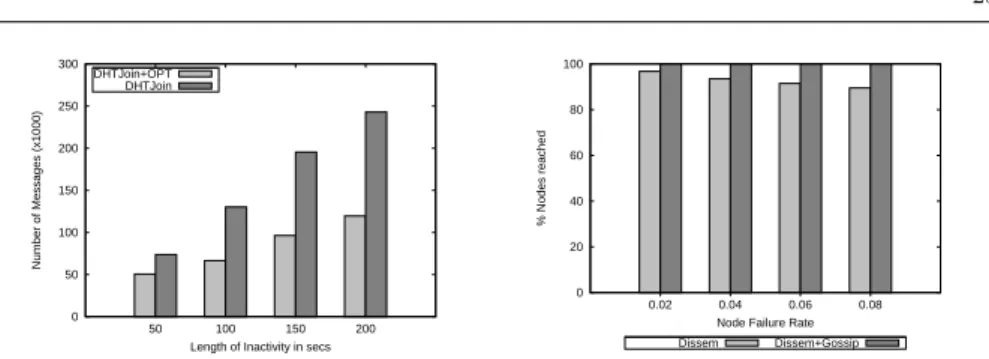
we show that, as the period of inactivity (time between fail and recovery) of a stream source gets longer, the generation of tuples that never contribute to join results increases. However, by eliminating unnecessary intermediate results, this optimization yields an important reduction of network traffic.
Fig. 8: Reduction of intermediate results and its impact on network traffic
Fig. 9: Effect of dealing with node failures during the dissemination procedure
7.3 Failures During Dissemination
The failure of a node in the tree structure generated by the dissemination procedure makes the entire subtree under this node unreachable. To provide reliability in the dissemination of queries, we proposed a gossip based protocol (see Section 4.1). To evaluate the effectiveness of our approach regarding an increment of node’s failure rate we originate queries every 100 seconds on average and we increment the node’s failure rate (see Figure 9). We consider a first scenario where the queries are disseminated using the technique described in Section 3.1 and a second scenario where the queries are disseminated using the same technique in complement with gossip. Figure 9 shows that with node failures the dissemination cannot achieve a network coverage of 100%. However, the dissemination of queries complemented with gossip can obtain a network coverage of 100% in spite of an increase in n ode failures.
8 Related Work
Unstructured P2P networks typically use a simple flooding scheme which is inefficient in terms of response time and consumes much network traffic. Furthermore, they are not suitable for efficient processing of continuous join queries as they do not provide guarantees of any kind. Structured networks (i.e. DHT) provide more efficient key-based search. Because applications that process streams from different sources are inherently distributed and because distribution is a well accepted approach to improve both performance and scalability [8][35] of a DSMS, using a DHT is a natural choice to face the challenges motivated by the processing of continuous join queries. DHTJoin exploits the power of a DHT in two major ways. First, to disseminate queries using a tree based on the information stored in the DHT routing table. This information is maintained by the DHT protocol and does not entail any extra processing cost for DHTJoin. In a network of n nodes, the dissemination gen-erates n − 1 messages and a tree of depth log(n), which bounds the latency of query dissemination. Second, to index tuples for query processing and detect a failure on a node that participes in query processing tasks.
A DHT can serve as the hash table that underlies many parallel hash-based join algorithms. However, our approach provides Internet-wide scalability. Our work is related to many studies in the field of centralized and distributed continuous query processing [16][12][36][6][24]. In PIER [16], a query processor is used on top of a DHT to process one-time join queries. Recent work on PIER has been developed to process only continuous aggregation queries. PeerCQ [12] was developed to process continuous queries on top of a DHT. However, PeerCQ does not consider SQL queries and the data is not stored in the DHT. Borealis [36], TelegraphCQ [6] and DCAPE [24] have been developed to process distributed continuous queries and many of their technique s for load-shedding and load balancing are orthogonal to our work. In Seaweed [25] a scalable query infrastructure built on top of a DHT to process one-shot queries rather than continous queries. However, Seaweed does not use the DHT to distribute data but to replicate metadata and to disseminate queries. An algorithm for suporting ranked join queries in P2P networks was introduced in [42]. Irrelevant top-k tuples are pruned of local nodes before they are sent to be probed for join matches. However, this work does not consider continuous queries. The most relevant previous work regarding the utilization of a DHT network to process continuous queries is [17] which proposes RJoin, an algorithm that uses incremental evaluation. This incremental evaluation is based on tuple indexing and query rewriting over distributed hash tables. A major difference in our work differs is that DHTJoin avoids indexing tuples that cannot contribute to generate join results and deals with the dynamic behaviour of peers.
To disseminate a query, DHTJoin dynamically builds a dissemination tree as proposed in [11]. However, this work does not consider the dynamic be-haviour of nodes. To solve this problem, we propose a gossip-based solution that considers the utilisation of the neighbor list to provide fault tolerance. The probabilistic dissemination algorithm Randcast proposed in [20] spreads messages very fast but fails to reach every node in the network. The protocol proposed in [22] assures a good tradeoff between message overhead and relia-bility guarantee using a specific connection graph. However, its main drawback is the maintenance of such graph that requires global knowledge of member-ship. In our work, the structure that supports the membership protocol is supported by the DHT and does not require global knowledge of membership for its maintenance.
Result completeness has been studied in the context of P2P databases. A solution to estimate the completeness has been proposed in [19] for one-time queries. Completeness is computed at the peer level using the notion of rout-ing graphs. The routrout-ing graphs trace the routes that a one-time query and its sub-queries take through the network. In the Seaweed query infrastucture [25], data summaries and availability models are used in order to predict query completeness and response times to one-shot queries. Our work instead consid-ers continuous queries and completeness is calculated at the data level, which is finer grain and more precise than with data summaries.
ecuted continuously and tuples arrives at high rate, scanning completely a relation is no longer feasible. The algorithm proposed in [10] attempts to solve this problem by sampling the inner relation before the join begins. However, in data streaming applications, tuples arrive in an arbitrary interleaved fashion which makes sampling unprecise. Our solution is novel and chooses at run time partner nodes to store the tuples of the overloaded nodes, using information of the routing table.
9 Conclusion
In this paper, we proposed a new method, called DHTJoin, for processing continuous join queries using DHTs. DHTJoin combines hash-based placement of tuples and dissemination of queries using the trees formed by the underlying DHT links. DHTJoin takes advantage of the indexing power of DHT protocols and dissemination of queries to avoid the placement of tuples that cannot contribute to generate join results. We showed analytically that DHTJoin can scale up the processing of continuous join queries using multiple peers and improves the completeness of join results linearly as the memory capacity is increased.
We also addressed the problem of join attribute skew which may hurt load balancing and yield the loss of result tuples at overloaded nodes. Our solution chooses at run time partner nodes to store the tuples of the overloaded nodes, using information of the routing table. It keeps response time low, adding only one message to produce each join tuple.
To validate our contribution, we implemented DHTJoin, as well as RJoin which is the most relevant state of the art solution in the context of processing continuous join queries using DHTs. Our performance evaluation shows that DHTJoin yields significant performance gains due to the mechanims of index-ing tuples and the elimination of unnecessary intermediate results. Our results also demonstrate that the total number of messages of DHTJoin is always less than that of RJoin wrt tuple arrival rate, query arrival rate and number of joins. We show that the problem of node failures during the dissemination of queries can be complemented with a gossip based protocol that allows, in spite of node failures, a network coverage of 100%. We also showed that our approach to deal with node failures during query execution prevents nodes
of sending intermediate results that do not contribute to join results, thereby reducing network traffic.
As future work, we plan to address the problem of efficient execution of top-k join queries over data streams using DHTs, taking advantage of the best position algorithms [1] which can be used in many distributed and P2P systems for efficient processing of top-k queries.
References
1. R. Akbarinia, E. Pacitti, and P. Valduriez. Best position algorithms for top-k queries. In VLDB, pages 495–506, 2007.
2. A. Arasu and J. Widom. A denotational semantics for continuous queries over streams and relations. SIGMOD Record, 33(3):6–12, 2004.
3. M. Bawa, A. Gionis, H. Garcia-Molina, and R. Motwani. The price of validity in dynamic networks. In SIGMOD Conference, pages 515–526, 2004.
4. P. Bonnet, J. Gehrke, and P. Seshadri. Towards sensor database systems. In Mobile Data Management, pages 3–14, 2001.
5. M. Castro, M. B. Jones, A.-M. Kermarrec, A. I. T. Rowstron, M. Theimer, H. J. Wang, and A. Wolman. An evaluation of scalable application-level multicast built using peer-to-peer overlays. In INFOCOM, 2003.
6. S. Chandrasekaran, O. Cooper, A. Deshpande, M. J. Franklin, J. M. Hellerstein, W. Hong, S. Krishnamurthy, S. Madden, V. Raman, F. Reiss, and M. A. Shah. Tele-graphcq: Continuous dataflow processing for an uncertain world. In CIDR, 2003. 7. J. Chen, D. J. DeWitt, F. Tian, and Y. Wang. Niagaracq: A scalable continuous query
system for internet databases. In SIGMOD Conference, pages 379–390, 2000. 8. G. Cormode and M. N. Garofalakis. Streaming in a connected world: querying and
tracking distributed data streams. In SIGMOD Conference, pages 1178–1181, 2007. 9. F. Dabek, B. Y. Zhao, P. Druschel, J. Kubiatowicz, and I. Stoica. Towards a common
api for structured peer-to-peer overlays. In IPTPS, pages 33–44, 2003.
10. D. J. DeWitt, J. F. Naughton, D. A. Schneider, and S. Seshadri. Practical skew handling in parallel joins. In VLDB, pages 27–40, 1992.
11. S. El-Ansary, L. O. Alima, P. Brand, and S. Haridi. Efficient broadcast in structured p2p networks. In IPTPS, pages 304–314, 2003.
12. B. Gedik and L. Liu. Peercq: A decentralized and self-configuring peer-to-peer informa-tion monitoring system. In ICDCS, pages 490–499, 2003.
13. L. Golab, T. Johnson, N. Koudas, D. Srivastava, and D. Toman. Optimizing away joins on data streams. In SSPS, pages 48–57, 2008.
14. L. Golab and M. T. ¨Ozsu. Processing sliding window multi-joins in continuous queries over data streams. In VLDB, pages 500–511, 2003.
15. K. A. Hua and C. Lee. Handling data skew in multiprocessor database computers using partition tuning. In VLDB, pages 525–535, 1991.
16. R. Huebsch, J. M. Hellerstein, N. Lanham, B. T. Loo, S. Shenker, and I. Stoica. Querying the internet with pier. In VLDB, pages 321–332, 2003.
17. S. Idreos, E. Liarou, and M. Koubarakis. Continuous multi-way joins over distributed hash tables. In EDBT, pages 594–605, 2008.
18. J. Kang, J. F. Naughton, and S. Viglas. Evaluating window joins over unbounded streams. In ICDE, pages 341–352, 2003.
19. M. Karnstedt, K.-U. Sattler, M. Haß, M. Hauswirth, B. Sapkota, and R. Schmidt. Esti-mating the number of answers with guarantees for structured queries in p2p databases. In CIKM, pages 1407–1408, 2008.
20. A.-M. Kermarrec, L. Massouli´e, and A. J. Ganesh. Probabilistic reliable dissemination in large-scale systems. IEEE Trans. Parallel Distrib. Syst., 14(3):248–258, 2003. 21. M. Kitsuregawa and Y. Ogawa. Bucket spreading parallel hash: A new, robust, parallel
hash join method for data skew in the super database computer (sdc). In VLDB, pages 210–221, 1990.
27. M. T. ¨Ozsu and P. Valduriez. Principles of Distributed Database Systems, Second Edition. Prentice-Hall, Englewood Cliffs, New Jersey, 1999.
28. W. Palma, R. Akbarinia, E. Pacitti, and P. Valduriez. Efficient processing of continuous join queries using distributed hash tables. In Euro-Par, pages 632–641, 2008.
29. C. G. Plaxton, R. Rajaraman, and A. W. Richa. Accessing nearby copies of replicated objects in a distributed environment. Theory Comput. Syst., 32(3):241–280, 1999. 30. S. Ratnasamy, P. Francis, M. Handley, R. M. Karp, and S. Shenker. A scalable
content-addressable network. In SIGCOMM, pages 161–172, 2001.
31. A. I. T. Rowstron and P. Druschel. Pastry: Scalable, decentralized object location, and routing for large-scale peer-to-peer systems. In Middleware, pages 329–350, 2001. 32. U. Srivastava and J. Widom. Memory-limited execution of windowed stream joins. In
VLDB, pages 324–335, 2004.
33. I. Stoica, R. Morris, D. R. Karger, M. F. Kaashoek, and H. Balakrishnan. Chord: A scalable peer-to-peer lookup service for internet applications. In SIGCOMM, pages 149–160, 2001.
34. M. Sullivan. Tribeca: A stream database manager for network traffic analysis. In VLDB, page 594, 1996.
35. N. Tatbul, U. C¸ etintemel, and S. B. Zdonik. Staying fit: Efficient load shedding tech-niques for distributed stream processing. In VLDB, pages 159–170, 2007.
36. N. Tatbul and S. B. Zdonik. Window-aware load shedding for aggregation queries over data streams. In VLDB, pages 799–810, 2006.
37. S. Viglas, J. F. Naughton, and J. Burger. Maximizing the output rate of multi-way join queries over streaming information sources. In VLDB, pages 285–296, 2003.
38. J. L. Wolf, P. S. Yu, J. Turek, and D. M. Dias. An effective algorithm for parallelizing hash joins in the presence of data skew. Wishful Research Result RC 15510, IBM T.J. Watson Research Center, 1990.
39. Y. Xu, P. Kostamaa, X. Zhou, and L. Chen. Handling data skew in parallel joins in shared-nothing systems. In SIGMOD Conference, pages 1043–1052, 2008.
40. Y. Yang and D. Papadias. Just-in-time processing of continuous queries. In ICDE, pages 1150–1159, 2008.
41. B. Y. Zhao, L. Huang, J. Stribling, S. C. Rhea, A. D. Joseph, and J. Kubiatowicz. Tapestry: a resilient global-scale overlay for service deployment. IEEE Journal on Selected Areas in Communications, 22(1):41–53, 2004.
42. K. Zhao, S. Zhou, K.-L. Tan, and A. Zhou. Supporting ranked join in peer-to-peer networks. In DEXA Workshops, pages 796–800, 2005.
43. Y. Zhou, Y. Yan, F. Yu, and A. Zhou. Pmjoin: Optimizing distributed multi-way stream joins by stream partitioning. In DASFAA, pages 325–341, 2006.