HAL Id: hal-02269428
https://hal.archives-ouvertes.fr/hal-02269428
Submitted on 22 Aug 2019
HAL is a multi-disciplinary open access
archive for the deposit and dissemination of
sci-entific research documents, whether they are
pub-lished or not. The documents may come from
teaching and research institutions in France or
abroad, or from public or private research centers.
L’archive ouverte pluridisciplinaire HAL, est
destinée au dépôt et à la diffusion de documents
scientifiques de niveau recherche, publiés ou non,
émanant des établissements d’enseignement et de
recherche français ou étrangers, des laboratoires
publics ou privés.
Modeling and Validation of ARINC653 architectures
Julien Delange, Laurent Pautet, Fabrice Kordon
To cite this version:
Julien Delange, Laurent Pautet, Fabrice Kordon. Modeling and Validation of ARINC653 architectures.
ERTS2 2010, Embedded Real Time Software & Systems, May 2010, Toulouse, France. pp.1-8.
�hal-02269428�
Modeling and Validation of ARINC653 architectures
Julien Delange
1, Laurent Pautet
1, Fabrice Kordon
21: TELE COM Paris Tech – LTCI UMR 5141, 46 rue Barrault, F-75634 Paris CEDEX 13, France 2: LIP6, Université Pierre et Marie Curie, 4 place Jussieu, 75252 Paris Cedex 05, France
Abstract: A vionics systems must be carefully
designed due to their criticality since fault may lead to loss of life. Thes e systems must be verified and certified. However, design of avionics arc hitectures becomes more and more complex due to an increasing demand of new functionalities. It makes very diffic ult to analyze systems and detect potential faults that may cause damages.
This paper presents an approac h to model and validate avionics systems. Architecture requirements, properties and constraints are described with the Architecture Analysis and Design Language (AA DL) and its associated A RINC653 annex. Then, we apply validation rules to check system correctness and constraints enforcement. This approac h provides a high-level view of the system and eases the development of avionics system by validating their requirements at a model-level, before any implement ation efforts
Keywords: AADL, ARINC653, validation,
model-based, Ocarina, REAL.
1. Introduction
Context Safety-critical systems have strong requirements to be enforced all over the development process. To prevent damages from occurring errors, safety-critical architectures are based on dedicated s ervices isolating soft ware components and enforcing safety requirements.
The A RINC653 standard addresses such issues and introduces the concept of partitioned architectures for the design of avionics software. The main purpose is to increase system reliability and dependability. To do so, ARINC653-compliant operating systems (OS) isolate software components in terms of space and time and provide fault detection/recovery mechanisms. They also provide configuration tables to associate recovery procedures with each pot ential fault that may occur at runtime.
Problem We identify three problems in the design of
ARINC653 architectures in terms of representation and analysis.
First, it is difficult to design A RINC653 architectures due to their amount of requirements and their associated services (communication, fault management, etc.). Since the ARINC653 standard does not provide an abstract repres entation of t he architecture, ARINC653 systems analysis and review are made by means of code analysis, which is tedious, error-prone and OS dependent.
Second, critical servic es of A RINC653 architectures and OS must be analyzed before implementation efforts. These services (hierarchical scheduler, fault recovering, etc.) must be automatically validated to ensure that specified requirements can be fulfilled.
Third, t he partitioning strategy must be verified to check that failure in a partition cannot affect another one. This is of particular interest since ARINC653 architectures can host components having different criticality levels. Thus, a fault that occurs in a component at a given criticality can impact other components at a higher criticality level. This behavior must be detected and avoided as soon as possible in the development process.
Proposed Approach To overcome these problems,
we propose to model and validate A RINC653 systems to check for safety requirements. To do so, we rely on a modeling language providing an appropriate semantics for safety-critical arc hitectures with isolation requirements. We need a modeling language that enables automation of verification efforts.
Among c urrently proposed languages, the Architecture A nalysis and Design Language (AADL) introduces a component-based approach t o describe both hardware and software as pects of the system. It defines several components that are aggregated by engineers to model t he system according to its requirements and properties.
This paper proposes an approach to model and validate A RINC653 systems with AADL. This new represent ation of this kind of architecture eases system analysis and validation.
We describe ARINC653 partitioned architectures with t heir time and space isolation concerns (hierarchical scheduling, partitions confinement in memory segments, etc.). Modeling patterns are based on the last version of the AA DL (version 2). It introduces new components relevant for the modeling of A RINC653 constraints. These
patterns are being integrated in the AADL standard as an annex document (the ARINC653 annex ).
We also int roduce validation rules to enforce ARINC653 requirements in AA DL models. These rules check for isolation correctness (m emory, scheduling, and communications requirements) as well as potential impact bet ween components having different criticality levels.
We then show how these modeling patterns and associated verification rules c an help systems designers to develop safer systems. We also present the tools that support our modeling patterns and our verification rules.
Outline Section 2 presents the ARINC653 standard
and the specific services and requirements of ARINC653 architectures and OS. Section 3 introduces the AA DL m odeling languages and describes our modeling patterns to model A RINC653 architectures. Section 4 details ARINC653 requirements validation using AA DL models. It first presents our AADL-dedicated validation language, REAL, and details its use for A RINC653 sy stems validation. Finally, section 5 concludes and gives an overview of incoming work on this topic.
2. ARINC653
2.1. Overview of the standard
ARINC653 [1] is an industrial standard that defines a set of services for the design of safety -critical avionics systems. The main principle consists in partitioning applications according t o their criticality level. A partition is isolated in space and time and exec utes software components as if it was running on a dedicated processor.
Figure 1 - Overview of an ARINC653 system
Partitions are executed on top of a dedicated kernel/middleware: the ARINC653 module. The conceptual model behind A RINC653 is illustrated in figure 1. In this example, the system contains t wo partitions with different criticality levels: the one of partition 1 being higher than the one of partition 2. A connection bet ween the two partitions is supervis ed by the ARINC653 module to ensure that data sent by partition 1 is only received by partition 2.
The module handles both partitions time and space isolation. As a consequence, it manages
address spaces (to store and isolate partitions code and data) and time slots (to execute partitions). 2.2 Time and space partitioning policies
ARINC653 isolates applications so a failure in a partition cannot affect other partitions that run on the same processor. This isolation is achieved through two partitioning policies:
1. Time partitioning: each partition is execut ed during a fixed and pre-defined time slice. The ARINC653 module schedules partitions using a cyclic algorithm repeated at a given period, called the major time frame. Typically, the value of the major time frame is equal to the sum of partitions time frames. At each major time frame, inter-partitions communication buffers are also flushed (dat a sent by one partition is available to its recipients).
2. Space partitioning: each partition owns a dedicated address space for its execution. In addition, inter-partitions communications are supervised by the module. This ensures that only allowed entities exchange data through a communication channel.
2.3 Services
The following subsections detail A RINC653 services. 2.3.1. Intra-partition communication services
Intra-partition communication services propose interfaces to enable communication between A RINC653 processes, located in the same partition. They do not use any module/kernel service and remain internal to the partition.
The standard defines four mechanisms:
1. Buffer stores multiple messages in message queues. Two queuing policies are propos ed (FIFO, Priority).
2. Blackboard stores one instance of a message until it is cleared or overwritten by a new instance.
3. Event is a notification service to indicate the completion of a job (wait/notify concept).
4. Semaphore service is used to control access to shared resources (e.g. counting semaphores). 2.3.2 Inter-partition communication services
Inter-partitions communication services propose functions to exchange data across partitions. They are supervised by the module, which ensure data transport. Communication policy (list of connected partitions ) is statically defined by the system designer so that partitions cannot create covert channels.
Inter-partitions communications are flus hed at each major time frame: data s ent by a partition is
only received by its recipients during the next scheduling period. This behavior ensures communication determinism and eas es buffers dimensioning.
The standard defines the following inter-partition communication functionalities:
1. Queuing ports store multiple messages in queues. This service behaves like the buffer service.
2. Sampling ports carry successive updat ed messages of the same type. They are similar to the blackboard.
2.3.2 Health Monitoring service
The health-monitor service defines mechanisms to catch potential errors at run-time. E rrors can be caught at different levels (module/kernel, partition, process/task), depending on their nature (scheduling, exec ution error, etc.) and t he component they are issued from (module, partition or process).
For eac h potential error, the system designer specifies an appropriate rec overing policy (for example, restart or stop the faulty component) in order to keep the system stable. He can also provide a dedicat ed recovery procedure.
2.4. ARINC653 systems constraints
Due t o their partitioning policy, ARINC653 systems have strong requirements that must be validated:
Time isolation policy must guarantee that:
1. Each partition is scheduled at least one time during each scheduling period.
2. The value of the major time frame is consistent with partitions time frames.
Space partitioning policy must allocate a distinct memory segment for each partition.
Healt h Monitoring (HM) policy must ensure that all potential faults are bound to a recovery policy. Designers must ensure that each level of t he layered architecture (module, partition, process) uses a recovering policy for each potential fault. Such a validation is difficult to achieve hrough code review since it requires a good knowledge of the ARINC653 operating system internals. In addition, it is of special interest to analyze ARINC653 architectures at a specification -level. It helps certification engineers by finding faults that are difficult to det ect, such as the impact bet ween partitions evaluated at different criticality levels . For example, a partition at a low criticality level could impact another evaluated at a higher criticality level through a communication channel. If a fault is rais ed in the first partition, it could stop sending data to the other. The absence of fresh data in the highest-critical partition could lead to an application error. As
a consequenc e, the fault raised in the lowest-critical partition is propagated t o the highest one. For that reason, impacts of faults between partitions having different criticality levels must be analyzed.
3. Modelling ARINC653 architecture s
3.1. Introduction to architecture modeling with AADL AADL [2] is a standard published by the Society of Automotive E ngineers (SAE). It defines a component-c entric language to model both soft ware and hardware components. It focuses on t he definition of block interfaces, and s eparates t he implementations from these interfaces.
An AADL description is made of components. The standard defines soft ware components (data, thread, thread group, subprogram, process), execution platform components (memory, bus, processor, device, virtual processor, virtual bus) and hybrid component (system ).
Components describe elements of the architecture. Subprograms model application code. Since it is not an architectural element, it is reduced to a referenc e to another external piec e of code. Threads model the active part of an application (such as POSIX threads). Processes model address spaces containing threads. Processors model micro-processors and a minimal operating system (mainly a scheduler). Virtual processors model a part of the proc essor and could be understood in different ways: part of the physical processor, virt ual machine, etc. Memories model hard disks, RAMs. Buses model networks, wires. Virtual buses are not formally a hardware component, they are bound to c onnections in order to describe their requirements. They can be used for several purpos es (modeling protocol stacks, security layers, etc.). Devices model sensors or actuators. Systems represent composite components that are build from hardware components, software components or a combination of the two. For example, a system may represent a board with multiple processors and memory chips.
Components hierarc hy of an AADL model is composed of several components and sub-components. The topmost component is an AADL system that cont ains processes, processors and ot her architecture components.
The interface specification of a component is called a type and provides features (e.g. communication ports). Comp onents communicate one with another by connecting their features (t he connections section). Each component describes their internals: subcomponents, connections between these sub-c omponents, etc.
An implementation of a thread or a subprogram component can specify call sequences to other subprograms, thus describing the execution flows in the architecture. Since there c an be different implementations of a given component type, it is possible to select the actual components to be put into the architecture, without having to change t he other components, thus providing a c onvenient approach to application configuration.
AADL allows properties to be associated with AADL model elements. Properties are typed and represent name/ value pairs that represent components characteristics and constraints. Examples are the period and execution time of threads, the implement ation language of a subprogram, etc. The standard includes a pre-declared set of properties and users can int roduce additional properties through property definition declarations. For int erested readers, an int roduction to the AADL can be found in [3].
Other languages can be integrated in AADL models by means of annex libraries. These languages can be added on eac h component to describe other aspects. Some annex languages have been designed, such as the behavior annex [11] or the error model annex [12]. It provides a convenient way to specify other aspects of t he system (fault propagation, behavior, etc).
AADL provides two major benefits for building safety-critical systems. First, compared to other modeling languages, AADL defines low-level abstractions i ncluding hardware descriptions. Second, the hybrid system components help refining the architecture as they can be detailed lat er on during the design process.
3.2 ARINC653 modeling patterns
This section presents patterns we designed for the modeling of ARINC653 [1] architectures. It follows the same organization as section 2.3. This work is also included in the A RINC653 annex document of the AADL, proposed for standardization by SAE. 3.2.1 Mapping partitions
An ARINC653 module (see section 2.1) is represented in AA DL by means of a processor component. It models the underlying A RINC653 module that provides time and space isolation. It contains partitions runtime as subcomponents and defines isolation requirements with AADL properties. Partitions are specified with two AADL components: 1. A virtual processor for the modeling of
runtime c oncerns (tasks scheduling, partition resources, etc).
2. A process that describes the content of the partition (thread, data, etc).
The association between thes e components is defined with the Actual_Processor_Binding AADL property. The virtual processor is contained in a processor to model its containment in its related module.
Space isolation (memory segments allocation) is specified by associating the process to a memory component with the AADL property Actual_Memory_Binding. Memory components describe segment requirements (size, etc).
3.2.2 Mapping ARINC653 processes
AADL threads model ARINC653 processes bec ause they share the same concept: an instruction flow constrained by some requirements (period, deadline, execution time and so on – described with AA DL properties). A RINC653 processes are contained in a partition so that AADL threads are contained in an AADL process.
Inter and intra-partition communications are mapped in AADL by connecting c omponents ports. When t wo connected threads belong to t he same process, the connection models an int ra-partition service. When they belong to distinct process components, it represents an inter-partition communication channel.
3.2.3 Mapping intra-partition communication
An ARINC653 buffer is represented with a connection of AA DL event data ports bet ween AADL thread components.
Modeling of A RINC653 blackboards is made with the connection of AADL data ports bet ween several AA DL threads. AADL data ports do not queue data; and thus, are semantically equivalent to the concept of ARINC653 blackboards.
ARINC653 events are described using AADL event ports between several AADL thread components. AADL event ports queue signals without any data. Thus, this concept is the same as the ARINC653 events.
The ARINC653 semaphore mechanism is represented using a shared AADL data component between several AA DL threads. The concurrency characteristic of the semaphore is specified using the Concurrency_Control_Protocol property. 3.3.4 Mapping inter-partition communication
An ARINC653 queuing port is represented by connecting AADL event data ports bet ween several AADL process components. AADL event data ports queue incoming data with respect to a given queuing policy, which corresponds to the concept of ARINC653 queuing ports.
The modeling of ARINC653 sampling port service is achieved wit h the connection of AA DL data ports between several AADL process
components. AADL data ports do not queue data and thus, are semantically similar to A RINC653 sampling ports.
AADL properties are associated to ports to specify their characteristics (queuing policy, etc.). 3.5 Health monit oring mapping
The Health Monitoring service detects faults at different levels (module, partition, process) and executes a recovering procedure for each one. For its description with AA DL, we int roduce a property to represent faults (ARINC653::HM_Errors) and associate it with anot her property that models recovering procedures (ARINC653::HM_Actions). Both properties are associated to a component (processor, virtual processor or thread) that models a layer of the ARINC653 architecture (respectively module, partition or process).
3.6 Example
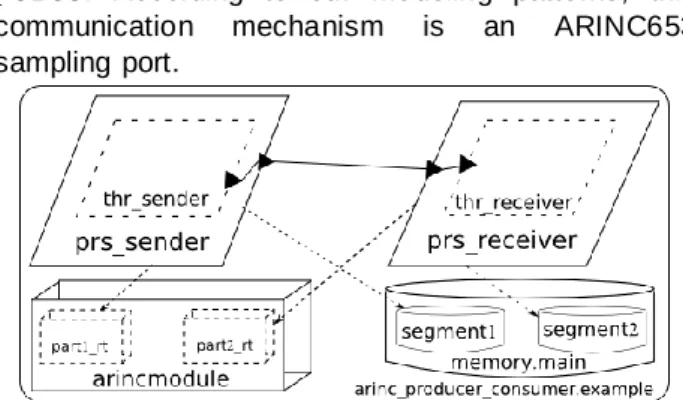
The modeling of an A RINC653 system with AADL is illustrated in figure 2. Two partitions (isolated in a memory segment) are execut ed on top of an ARINC653 module. One partition sends data to the other (an inter-partition channel).
The A RINC653 module is depicted with the AADL processor (arincmodule) and contains two
virtual processor components (part1_rt and
part2_rt) that represent partitions execution environment. Partitions content is specified using an AADL process, each partition having its own (prs_sender for the first partition, prs_receiver for the second).
An AADL component (main ) models the organization of the memory with its segments (AA DL memory sub-components). Partition address spaces (AADL process components) are then associated with them to specify the space isolation policy.
Each partition (AADL process) contains one task (an AADL thread component ). We introduce an inter-partition communication channel between the partitions to model an int er-partition communication channel.
Partitions are connected using AADL data ports. According to our modeling patterns, this communication mechanism is an ARINC653 sampling port.
Figure 2 - ARINC653 example with AADL
4. ARINC653 architecture s validation
This section shows how we use a constraint language to enforce in critical systems: time isolation, fault coverage and assessment of the all the fault-recovery strategy.
4.1. Introduction to REAL
REAL [13] (Requirements Enforcement Analysis Language) is a constraint-based language for AA DL. It aims at checking c onstraints on architectural descriptions at the specification step, saving significant time over verification at execution time.
REAL conc ept is similar to formal methods such as B [14] by checking requirements on a set of elements using a dedicated language. It allows one to build sets whose elements are AADL entities (connections, components or subprogram calls). Verification can then be performed on either a set or its elements by stating Boolean expressions. The basic unit of REAL is a theorem. A theorem verifies an expression over all the elements of a set that is called the range set.
In order to write c omplex expressions, one can use predefined sets, which contain the instances of t he AA DL model of a given type, or build intermediary sets, using relations bet ween elements of sets (e.g. returns the elements of the set A which are subc omponents of any elements of the set B).
Finally, subtheorems calls can be used to build loc al or global variables, or to check pre-required constraints on the model. Callee theorems inherit at run-time from the caller environment (t he local_set), and the user can pass parameters. Thus, it is possible to design a library of theorems that will be used by higher-level, user-defined theorems. Such work has been done for schedulability analysis, response-time analysis and soft ware-hardware adequacy.
A basic example of a REAL theorem is illustrated in listing 1. This theorem checks that all processor components contained in the model have at least one virtual proc essor. On the model in figure 2, this theorem is verified: the main processor (arincmodule) contains two virtual processors (part1_rt and part2_rt ).
theorem Processor_Contains_Partitions_Runtime foreach cpu in Processor_Set do
vps := {x in Virtual_Processor_Set | Is_Subcomponent_Of (x, cpu)}; check (Cardinal (vps) > 0);
end Processor_Contains_Partitions_Runtime; Listing 1 – REAL theorem example
Next sections present theorems to verify ARINC653 constraints (c.f section 2.4) using AA DL models.
4.2. Time isolation
Time isolation is enforced by validating that:
1. Each partition contained in an A RINC653 module is execut ed at least one time during each scheduling period.
2. The consistency of the major time frame according to partitions time frames.
The first theorem (listing 2) checks that each processor component (ARINC653 module) references at least one time each contained virtual processor (ARINC653 partition) in its allocated time frames (AADL property ARINC653::Slots_Allocation). Its validation ensures that each partition is executed at least one time during each period.
theorem Partitions_Execution foreach cpu in Processor_Set do
vps := {x in Virtual_Processor_Set | Is_Subcomponent_Of (x, cpu)}; check (Is_In (vps,Get_Property_Value (cpu, “ARINC653::Partitions_Slots”))); end Processor_Contains_Partitions_Runtime;
Listing 2 – Theorem for partition execution enforcement
The second theorem (listing 3) checks that the major time frame of each AADL processor component (A RINC653 module) is equal to the sum of partitions time frames (property ARINC653:: Partitions_Slots). This ensures that the scheduling period is consistent with partitions time frames (see section 2.2 for a description of the requirements of the major time frame).
theorem Scheduling_Major_Frame foreach cpu in Processor_Set do Check
(Float
(Property (cpu,
"ARINC653::Module_Major_Frame")) =
Sum (Property (cpu,
"ARINC653::Partition_Slots")))); end Scheduling_major_frame;
Listing 3 – Theorem for ARINC653 major time frame validation
4.3. Space isolation
To ensure space isolation, we have t o verify that each memory segment is associated with a single partition. Theorem on listing 4 checks that each
AADL memory component (a segment of t he main memory) is associated with a single AADL process component (which cont ains partitions resources – data, tasks, etc.).
theorem Memory_Bound foreach s in System_Set do mainmem := {y in Memory_Set|Is_Subcomponent_Of (y, s)}; partmem := {x in Memory_Set|Is_Subcomponent_Of (x, mainmem)}; partitions := {x in Process_Set | Is_Bound_To (x, partmem)};
check (Cardinal (partitions) = 1); end Memory_Bound;
Listing 4 – Theorem for the validation of space isolation
This theorem also checks model correctness, ensuring that system memory is divided into several s egments. It first retrieves the main memory component (mainmem) and analyzes its memory sub-components (in partmem) that represent memory segments.
By doing so, this theorem ensures that system designer divides the main memory into several memory segments dedicat ed to a partition.
theorem check_error_coverage foreach thr in Thread_Set do Prs := {x in Process_Set | Is_Subcomponent_Of (thr, x)}; VP := {x in Virtual_Processor_Set | Is_Bound_To (Prs, x)}; CPU := {x in Processor_Set | Is_Subcomponent_Of (VP, x)}; var errors :=
List ("Module_Config", "Module_Init", "Module_Scheduling", "Partition_Scheduling", "Partition_Config", "Partition_Handler", "Partition_Init", "Deadline_Miss", "Application_Error", "Numeric_Error", "Illegal_Request", "Stack_Overflow", "Memory_Violation", "Hardware_Fault", "Power_Fail"); var actual_errors :=
(property (CPU, "ARINC653::HM_Errors") + property (VP, "ARINC653::HM_Errors") + property (thr, "ARINC653::HM_Errors")); Check (Is_In (errors, actual_errors) and Is_In (actual_errors, errors)); end Check_Error_Coverage;
Listing 6 – Theorem for the validation of the fault coverage policy
4.4 Fault coverage
In A RINC653 architectures, errors m ay be raised at three different layers of the architecture (module, partition, process).
To check that all faults are recovered, we verify that al faults are handled during the execution of each A RINC653 process (AADL thread component). To do so, the associated theorem (listing 6) analyses each thread component (process level), its associated process and virtual processor components (partition level) and the processor that supports the partition (module level).
For each AA DL thread component (t hat represents an ARINC653 process), the theorem computes the list (in the actual_errors variable) of the errors recovered by the thread itself but also by its associated virtual processor (A RINC653 partition) and processor (ARINC653 module). Then, it compares this list to the one of all potential errors (variable errors) that may be raised in the architecture. theorem Check_Omission_Transient foreach src in process_set do thr := {x in Thread_Set | Is_Subcomponent_Of (x, src)}; spart := {x in Virtual_Processor_Set | Is_Bound_To (src, x)}; dst := {x in Process_Set | Is_Connected_To (src, x)}; dpart := {x in Virtual_Processor_Set | Is_Bound_To (dst, x)}; var allowed_actions := List ("Partition_Restart", "Process_Restart", "Confirm"); var src_actions :=
(Property (spart, "ARINC653::HM_Actions") + Property (thr, "ARINC653::HM_Actions")); check
(
((cardinal (src) > 0) and (cardinal (dst) >= 0) and (is_in (allowed_actions, src_actions)) and (max (property(dpart,"ARINC653::Criticality"))< max (Property (spart,"ARINC653::Criticality")))) Or
(Not (Is_In(allowed_actions, src_actions)))); end Check_Omission_Transient;
Listing 7 – Theorem for the analysis of partitioning policy trade -off, transient errors
4.5 Assessment of the fault-recovery strategy Another validation theorem checks that a recovery procedure in a partition at a low criticality level could impact another partition at a higher level. When a
fault is raised in a process, the recovery policy impacts its partition. These entities (processes of t he partition) stop sending or receiving data t o/from t he other partitions. This could be an issue if they are classified at a different criticality level.
To detect this issue, we distinguish two types of errors:
Transient errors are temporary and happen
when the recovering policy of the sender restarts the process or its partition. In that case, data is not sent for a temporary period. It impacts receiver components for period but once t he recovering strategy is finalized, the system continues to operate as normal.
Permanent errors happen when the recovery
policy stops the process or its partition. Data is no longer sent, which can potentially affect recipients, especially if they are classified at a high c riticality level. In that case, data will not be sent unless the task or its partition is restarted.
theorem Check_Omission_Permanent foreach src in process_set do thr := { in Thread_Set | Is_Subcomponent_Of (x, src)}; spart := {x in Virtual_Processor_Set | Is_Bound_To (src, x)}; dst := {x in Process_Set | Is_Connected_To (src, x)}; dpart := {x in Virtual_Processor_Set | Is_Bound_To (dst, x)}; var allowed_actions := List ("Partition_Stop", "Process_Stop_And_Start_Another", "Process_Stop"); var src_actions :=
(Property (spart, "ARINC653::HM_Actions") + Property (thr, "ARINC653::HM_Actions")); check
((
(Cardinal (Src_Prs) > 0) and (Cardinal (Dst_Prs) >= 0) and
(Is_In (allowed_actions, src_actions)) and (Max
(Property (dpart,"ARINC653::Criticality")) < Max
(Property (spart,"ARINC653::Criticality")))) Or
(Not (Is_In (allowed_actions, src_actions)))); end Check_Omission_Permanent;
Listing 8 – Theorem for the analysis of partitioning policy trade -off, permanent errors
Analysis of the partitioning policy is illustrated in two theorems. The first one (listing 7) detects transient errors between partitions having different criticality levels. The second (listing 8) detects permanent errors.
They analyze eac h AADL process component (ARINC653 partitions) and its connected process (ARINC653 partitions that receive data from t he former partition). Then, it retrieves the list of recovery
actions (in src_actions) that are used when a fault is raised in the source partition (spart).
Then, this theorem checks that:
The receiver is classified at the lower criticality level if the fault-recovery policy of the sender generates transient data omission.
The fault-recovery policy of the sender may not lead to transient omission.
Theorem 8 follows the same validation pattern looks for permanent errors. Compared to theorem 7, the values of the allowed_actions variable contain recovery actions that imply a permanent data omission.
5. Conclusion
This paper presents an approach for the modeling and validation of ARINC653 architectures.
To do so, we first introduce modeling patterns to represent ARINC653 systems and their characteristics using the AADL modeling language. We then define, thanks to the REAL language, a set of theorems that check dedicated properties on the AADL model. This verification rules allow engineers to check for a set of predefined rules ensuring state-of-the-art correctness properties.
Altogether, these two cont ributions set up an automat able approach to ensure a good design of safety-critical systems with regards to safety properties. Such an approach is a particular interest for avionics systems that rely on partitioned architectures and have to fulfill strong c ertification requirements. It helps AADL models to be processed by certification tools to system design prior to implementation by means of code generation.
6. References
[1] Airlines Electronic Engineering Committee: "Avionics Application Software Standard Interface", Aeronautical Radio INC. December 2005.
[2] SAE: "Architecture Analysis and Design Language
v2.0 (AS5506)", September 2008.
[3] Peter Feiler, David Gluch and John Hudak: "The
Architecture Analysis and Design Language (AADL) : An Introduction", Technical Report,
Software Engineering Institute, Feb 2006.
[4] Peter Feiler and Jorgen Hansson: "Flow Latency
Analysis with the Architecture Analysis Design Language (AADL)", Technical Report, Software
Engineering Institute 2007.
[5] Bechir Zalila, Jérôme Hugues and Laurent Pautet: "Ocarina User Guide", TELECOM ParisTech, Technical Report, 2006.
[6] Software Engineering Institute: "Open Source
AADL Tool Environment (OSATE)", 2006.
[7] AADL Committee: "AADL official web site",
http://aadl.info.
[8] TELECOM ParisTech: "TELECOM ParisTech
official portal", http://aadl.telecom -paristech.fr.
[9] William Barnes: "ARINC 653 and why it’s important
for an safety-critical RTOS", 2004.
[10] John McDermid: "Software Hazard and Analysis", Technical Report, Jan 2004.
[11] R. Frana. J-P Bodeveix, M. Filali and J.F Rolland : "The AADL Behavior Annex – Experiments and Roadmap", In 12th IEEE conference on Engineering Complex Computer Systems, 2007.
[12] A. Rugina, P,H, Feiler K, Kanoun and M, Kaaniche: "Software Dependability Modeling Using an
Industry-Standard Architecture Description Language", In Proceeding of the 4th European Congress ERTS, 2008.
[13] Olivier Gilles and Jérôme Hugues: "Validating
requirements at model-level", In Ingénierie Dirigée
par les modèles (IDM'08), June, 2008.
[14] J. R. Abrial : "The B-Book : Assigning Programs to