HAL Id: hal-01074879
https://hal.archives-ouvertes.fr/hal-01074879
Submitted on 15 Oct 2014
HAL is a multi-disciplinary open access
archive for the deposit and dissemination of
sci-entific research documents, whether they are
pub-lished or not. The documents may come from
teaching and research institutions in France or
abroad, or from public or private research centers.
L’archive ouverte pluridisciplinaire HAL, est
destinée au dépôt et à la diffusion de documents
scientifiques de niveau recherche, publiés ou non,
émanant des établissements d’enseignement et de
recherche français ou étrangers, des laboratoires
publics ou privés.
Mining a Multimodal Corpus for Non-Verbal Signals
Sequences Conveying Attitudes
Mathieu Chollet, Magalie Ochs, Catherine Pelachaud
To cite this version:
Mathieu Chollet, Magalie Ochs, Catherine Pelachaud. Mining a Multimodal Corpus for Non-Verbal
Signals Sequences Conveying Attitudes. International Conference on Language Resources and
Evalu-ation, May 2014, Reykjavik, Iceland. �hal-01074879�
Mining a Multimodal Corpus for Non-Verbal Signals Sequences
Conveying Attitudes
Mathieu Chollet
1, Magalie Ochs
2, Catherine Pelachaud
21Institut Mines-Telecom ; Telecom Paristech ; CNRS-LTCI 2CNRS-LTCI ; Telecom Paristech
46 rue Barrault, 75013 Paris, France
{mathieu.chollet, magalie.ochs, catherine.pelachaud}@telecom-paristech.fr Abstract
Interpersonal attitudes are expressed by non-verbal behaviors on a variety of different modalities. The perception of these behaviors is influenced by how they are sequenced with other behaviors from the same person and behaviors from other interactants. In this paper, we present a method for extracting and generating sequences of non-verbal signals expressing interpersonal attitudes. These sequences are used as part of a framework for non-verbal expression with Embodied Conversational Agents that considers different features of non-verbal behavior: global behavior tendencies, interpersonal reactions, sequencing of non-verbal signals, and communicative intentions. Our method uses a sequence mining technique on an annotated multimodal corpus to extract sequences characteristic of different attitudes. New sequences of non-verbal signals are generated using a probabilistic model, and evaluated using the previously mined sequences.
Keywords: Non-verbal behavior, Interpersonal attitudes, Sequence mining
1.
Introduction
Embodied Conversational Agents (ECAs) are increasingly used in training and serious games. In the TARDIS project1, we aim to develop an ECA that acts as a virtual recruiter to train youngsters to improve their social skills. Such a virtual recruiter should be able to convey different interpersonal attitudes(or interpersonal stances), that can be defined as “spontaneous or strategically employed af-fective styles that colour interpersonal exchanges(Scherer, 2005)”. Our goal is to find out how interpersonal attitudes are expressed through non-verbal behavior, and to imple-ment the expression of interpersonal attitudes in an ECA.
Most modalities of the body are involved when convey-ing interpersonal attitudes (Burgoon et al., 1984). Smiles can be signs of friendliness (Burgoon et al., 1984), per-forming large gestures may be a sign of dominance, and a head directed upwards can be interpreted with a dominant stance (Carney et al., 2005). A common representation for interpersonal stance is Argyle’s bi-dimensional model of at-titudes (Argyle, 1988), with an affiliation dimension rang-ing from hostile to friendly, and a status dimension rangrang-ing from submissive to dominant (see Figure 1).
A challenge when interpreting non-verbal behavior is that every non-verbal signal can be interpreted with differ-ent perspectives: for instance, a smile is a sign of friend-liness (Burgoon et al., 1984); however, a smile followed by a gaze and head aversion conveys embarassment (Kelt-ner, 1995). Non-verbal signals of a person in an interac-tion should also be put in perspective to non-verbal signals of the other participants of the interaction: an example is posture mimicry, which can convey friendliness (LaFrance, 1982). Finally, the global behavior tendencies of a person, such as performing large gestures in general, are important
1http://http://www.tardis-project.eu/
when interpreting their stance (Escalera et al., 2010). These different perspectives have seldom been studied together, and this motivates the use of multimodal corpora of inter-personal interactions in order to analyze their influence on attitude perception in a systematic fashion.
In previous work, we proposed a framework for anal-ysis and expression of non-verbal behavior, composed of multiple layers focusing on a particular perspective of non-verbal behavior interpretation on time windows of different lengths. To build this model, we annotated a corpus of job interview enactment videos with non-verbal behavior anno-tations and interpersonal attitude annoanno-tations. In this paper, we focus on a layer of the model which deals with how se-quences of non-verbal signals displayed while speaking can be interpreted as the expression of dominance and friendli-ness attitudes. While it has been proved that the sequenc-ing of non-verbal signals influences how they are perceived (With and Kaiser, 2011), the literature on the topic is still limited. To gather knowledge about this layer, we use a data mining technique to extract sequences of non-verbal signals from the corpus. We then propose a model to gener-ate other sequences and evalugener-ate them using the sequences previously extracted from the corpus.
The paper is organized as follows. In Section 2, we present related models of interpersonal attitude expression for ECAs and their limits. We then introduce our multi-layer framework for non-verbal behavior analysis and ex-pression. Section 4 describes the multimodal corpus and how it was annotated. Section 5 details a data mining method we propose to gather knowledge about how se-quences of non-verbal behavior are perceived. Finally, Sec-tion 6 discusses a method for generating and evaluating be-havior sequences using the extracted data.
2.
Related work
Models of interpersonal attitude expression for virtual agents have already been proposed. For instance, in (Ballin and Crabtree, 2004), postures corresponding to a given at-titude were automatically generated for a dyad of agents. Lee and Marsella used Argyle’s attitude dimensions (see Figure1), along with other factors such as conversational roles and communicative acts, to analyze and model behav-iors of side participants and bystanders (Lee and Marsella, 2011). Cafaro et al. (Cafaro et al., 2012) conducted a study on how smile, gaze and proximity cues displayed by an agent influence the first impressions that the users form on the agent’s interpersonal attitude and personality. Ravenet et al.(Ravenet et al., 2013) proposed a user-created corpus-based methodology for choosing the behaviors of an agent conveying an attitude along with a communicative inten-tion. These models, however, only consider the expression of a few signals at a given time, and do not consider longer time spans or sequencing of signals.
Figure 1: The Interpersonal Circumplex, with Argyle’s attitude dimensions. The sample coordinate represents a friendly and slightly dominant interpersonal attitude.
Other works have gone further by also considering global behavior tendencies and reactions to the interactants’ be-haviors: the Laura agent (Bickmore and Picard, 2005) was used to develop long term relationships with users, and would adapt the frequency of gestures and facial signals as the relationship with the user grew. However, domi-nance was not investigated, and the users’ behaviors were not taken into account as they used a menu-based inter-face. Prepin et al. (Prepin et al., 2013) have investigated how smile alignment and synchronisation can contribute to stance building in a dyad of agents. Although not di-rectly related to dominance or friendliness, Sensitive Arti-ficial Listeners designed in the Semaine project (Bevacqua et al., 2012) produce feedback and backchannels depending of the personality of an agent, defined by extraversion and emotional stability.
Even though different perspectives of interpretation of non-verbal behavior we mentioned have been integrated in models of ECAs, the existing models of interpersonal atti-tude expression consider only consider one perspective at a time, with a limited number of modalities. Moreover, no model of attitude expression seems to consider how non-verbal signals are sequenced. In the next section, we present a theoretical model to the integration of these dif-ferent perspectives.
3.
A multi-layer framework for the
expression of interpersonal attitudes
In previous work (Chollet et al., 2012), we defined a multi-layer framework to encompass the different non-verbal be-havior interpretation perspectives (See Figure 2). The Sig-nallayer looks at the interpretation of signals in terms of communicative intentions (e.g. a hand wave means greet-ing someone). In the Sentence layer, we analyze the se-quence of signals happening in a dialogue turn (e.g. a smile followed by a head aversion means embarrassment). The Topiclayer focuses on the inter-personal behavior patterns and tendencies (e.g. adopting the same posture as the in-terlocutor is a sign of friendliness). Finally, the Interac-tionlayer encompasses the whole interaction and looks at global behavior tendencies (e.g. smiling often is a sign of friendliness). These different layers allow to interpret teractants’ interpersonal attitudes at every instant of the in-teraction, taking into account their behavior, their reactions to other interactants’ behaviors, and their global behavior tendencies.
Figure 2: This figure illustrates the multi-layer model in a job interview setting. On the left are represented the layers of the model, and on the right which behavioral features they analyze.
Here is an example of how the different layers work in an interaction. Imagine a recruiter who is annoyed by a can-didate because he thinks his foreign language skills do not meet the requirements for a job. The recruiter spreads his right hand towards the candidate while asking the question “You claim to be proficient in English. Can you prove it to me?”. The candidate looks down for a while, thinking and hesitating. He looks up at the recruiter and tries an an-swer with a faint smile, then moving his head to the side. While the candidate is speaking, the recruiter frowns, and then shakes his head as the candidate finishes. All this time, the recruiter kept looking at the candidate.
In the example, the gesture performed by the recruiter is used to show a question is asked and that he gives the speaking floor to the candidate. These two communicative functions are handled by the Signal layer. When replying, the candidate smiles and then averts his head away from the recruiter. In that case, the Sentence layer considers the se-quencing of signals: the smile could have been interpreted as a sign of friendliness at first, however followed by a head
aversion it is a sign of submissiveness. The recruiter be-havioral replies to the candidate’s answer, the frown and head shake, are analyzed by the Topic layer as sign of domi-nance and hostility. Finally, the fact that the recruiter barely averted gaze during the interaction is a sign of dominance revealed by the Interaction layer.
In order to build a model for each layer, our approach consists of automatically extracting knowledge from a mul-timodal corpus of interactions during which interpersonal attitudes are expressed. In this paper, we focus on the Sen-tencelayer: it is known that the sequencing of non-verbal signals influence how these behaviors are perceived (With and Kaiser, 2011), however since relatively little accounts exist on this phenomenon, automated methods of knowl-edge extraction are particularly relevant for this layer. In the next section, we present our multimodal corpus and its annotation process.
4.
Multimodal corpus of interpersonal
attitude expression
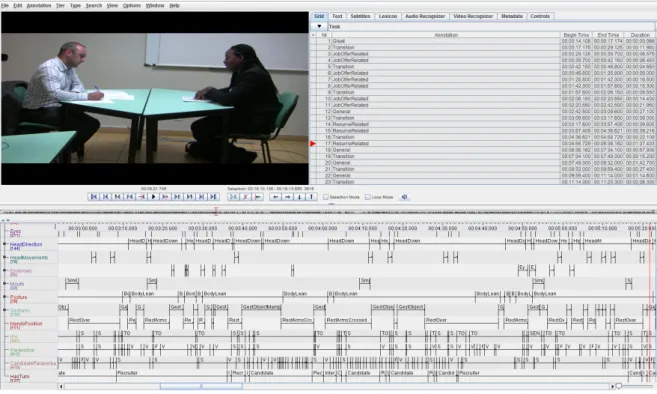
As part of the TARDIS project, a study was conducted with practitioners and youngsters from the Mission Locale Val d’Oise Est, a French job coaching association. The study consisted in creating a situation of job interviews between 5 practitioners and 9 youngsters. The setting was the same in all videos (see Figure 3). The recruiter and the young-ster sat on each side of a table. A single camera embracing the whole scene recorded the dyad from the side. From this study was gathered a corpus of 9 videos of job interview lasting approximately 20 minutes each. We decided to use these videos to investigate the sequences of non-verbal sig-nals the recruiters use when conveying interpersonal atti-tudes. In order to study how recruiters express interpersonal attitudes, we annotated three videos of job interview enact-ments, for a total of slighty more than 50 minutes. We con-sider full body non-verbal behavior, turn-taking, task and interpersonal attitude.
Numerous coding schemes exist to annotate non-verbal behavior in multimodal corpora. A widely used system for facial expressions is the Facial Action Coding System (Ek-man and Friesen, 1977). A very exhaustive coding scheme for multimodal behavior is the MUMIN multimodal cod-ing scheme, that was used for the analysis of turn-takcod-ing and feedback mechanisms (Allwood et al., 2007). For the non-verbal behavior annotation, we adapted the MUMIN multimodal coding scheme to our task and our corpus. The following modalities were considered : gestures (e.g. adap-tors, deictics), hands rest positions (e.g. over or under table, arms crossed), postures (e.g. leaning backwards), head movements (e.g. nods, head tilted downwards), gaze (e.g. looking at interlocutor, downwards), facial expres-sions (Since the videos were recorded from the side, we only considered simple facial expressions, e.g. smiles, eye-brow movements). We used Praat (Boersma and Weenink, 2001) for the annotation of the audio stream and the Elan annotation tool (Wittenburg et al., 2006) for the visual an-notations. A single annotator annotated the three videos.
To measure the reliability of the coding, three minutes of video were randomly chosen and annotated a second time
one month after the first annotation effort, and we computed Cohen’s kappa score between the two annotations. It was found to be satisfactory for all modalities (κ >= 0.70), except for the eyebrow movements (κ >= 0.62), which low score can be explained by the high camera-dyad dis-tance making detection difficult. The highest scores were for gaze (κ >= 0.95), posture (κ >= 0.93) and gestures (κ >= 0.80). This annotation processes amounted to 8012 annotations for the 3 videos. The para-verbal category has the highest count of annotations, between 483 to 1088 per video. On non-verbal annotations, there were 836 annota-tions of gaze direction, 658 head direcannota-tions, 313 gestures, 281 head movements, 245 hands positions, 156 eyebrow movements and 91 smiles. Important differences in behav-ior tendencies exist between recruiters: for instance the first recruiter performed many posture shifts: 5.6 per minute, to compare with 2.2 for the second recruiter and 0.6 for the third one. The second recruiter smiles much less than the others: 0.4 smiles per minute versus 2.4 per minute for both the first and third recruiters.
As the interpersonal attitudes of the recruiters varies through the videos, we chose to use GTrace, successor to FeelTrace (Cowie et al., 2011). GTrace is a tool that al-lows for the annotation of continuous dimensions over time. Users have control over a cursor displayed on an appropri-ate scale alongside a playing video. The position of the cursor is sampled over time, and the resulting sequence of cursor positions is known as trace data. We adapted the software for the interpersonal attitude dimensions we con-sidered. Though the software allows for the annotation of two dimensions at a time using a bi-dimensional space, we constrained it to a single dimension to make the annotation task slightly easier. As we focus here on how sequences of non-verbal signals are interpreted in terms of attitudes, we filtered the audio streams to make the speech unintelligi-ble. Indeed, attitudes are also expressed through the choice of words and topics, and through prosody cues. Thus, it is very probable that hearing the recruiter’s speech would have influenced the annotators, and having the speech fil-tered out assures us that the annotators are only influenced by non-verbal behavior. We asked 12 persons to annotate the videos. Each annotator had the task of annotating one dimension for one video, though some volunteered to anno-tate more videos. As the videos are quite long, we allowed them to pause whenever they felt the need to. With this pro-cess, we collected two to three annotation files per attitude dimension per video (Chollet et al., 2013).
In a nutshell, the corpus has been annotated at two lev-els: the non-verbal behavior of the recruiters and their ex-pressed attitudes. Our next step was to identify the corre-lations between the non-verbal behaviors and the interper-sonal attitudes. As a first step, we have focused on the non-verbal signals sequences expressed by the recruiters when they are speaking (i.e. at the Sentence level, Section 3.). In the next section, we describe a novel method for extracting knowledge about non-verbal behavior sequences from the multimodal corpora.
Figure 3: Video of the study in the Elan (Wittenburg et al., 2006) annotation environment
5.
Mining non-verbal behavior sequences
It is only fairly recently that the importance of the dynamic features of expressions has been highlighted. Keltner et al. found that the sequencing of head aversion, gaze aversion and smile differentiate between embarassment, amusement and shame (Keltner, 1995). With found unique character-istic behavioral sequences for the expression of enjoyment, hostility, embarassment, surprise and sadness (With, 2010). To our knowledge, this work is the first attempt at discover-ing sequences of non-verbal signals that are characteristic of interpersonal attitudes expression.
A number of tools and techniques exist for the systematic analysis of sequences of events in sequential data. Tradi-tional sequence analysis (Bakeman and Quera, 2011) tech-niques typically revolve around the computation of sim-ple contigency tables measuring the occurence of one type event of event after another one. Such methods are not well suited to longer sequences of events (i.e. made of more than 2 events) and to cases where noise can happen (i.e. be-haviors unrelevant to a particular sequence that can happen in the middle of it). Magnusson proposed the concept of T-patterns(Magnusson, 2000), sequences of events occur-ing in the same order with “relatively invariant” temporal patterns between events. The THEME software automati-cally detects T-patterns and was used in (With and Kaiser, 2011) to detect characteristic sequences of signals for emo-tion expression. Finally, sequence mining techniques have been widely used in task such as protein classification (Fer-reira and Azevedo, 2005), and recent work has used this technique to find sequences correlated with video game players’ emotions such as frustration (Martínez and Yan-nakakis, 2011).
In order to extract significant sequences of non-verbal
sig-nals conveying interpersonal attitudes from our corpus, we chose to use sequence mining techniques. To the best of our knowledge, this technique has not yet been applied to anal-yse sequences of non-verbal signals. In the following part, we describe the procedure used to mine frequent sequences in our corpus, and we then describe the result of applying this procedure on our data.
5.1. Applying sequence mining to our multimodal corpus
To apply the frequent sequence mining technique to our data, we proceed through the following six steps.
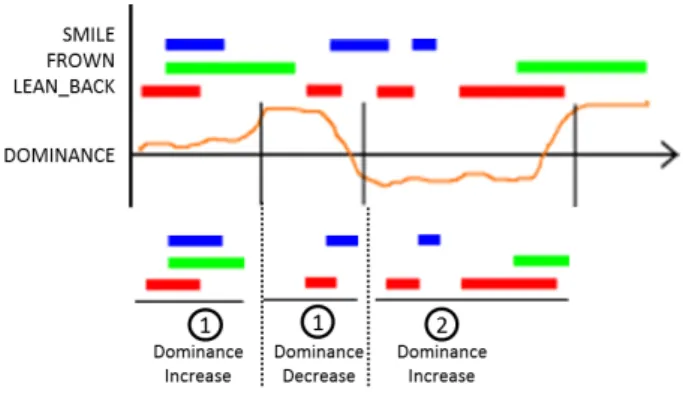
The first step consists of parsing the non-verbal anno-tations files, coded in the ELAN format, filtering the an-notation modalities and time segments to investigate (e.g. we only consider here behavior sequences while speaking, therefore we discard the segments when the recruiter is lis-tening) and converting every interaction’s annotations into a list containing all the non-verbal behaviors in a sequence. The second step’s objective is to find events to segment the interactions: indeed, frequent sequence mining tech-niques require a dataset of sequences. In our case, our data consists of 3 continuous interactions. Since we investigate which sequences of signals convey attitudes, we decide to segment the full interactions with attitude variation events: attitude variation eventsare the timestamps where an atti-tude dimension begins to vary. To this end, we parse the attitude annotations files, smoothe them and find the times-tamps where the annotated attitude dimension starts to vary. More details can be found in (Chollet et al., 2013).
We found that the attitude variation events in our data came with a wide range of values, i.e. in some cases the annotators moved the cursor a lot, indicating he annotators
perceived a strong change in the recruiters’ attitude from the recruiter’s behavior, while sometimes the cursor move-ments were more subtle. We chose to differentiate between small and strong attitude dimension variations, therefore we used a clustering technique to identify the 4 clusters corresponding to small increases, strong increases, small decreases and strong decreases. To this end, we used a K-means clustering algorithm with k = 4.
The fourth step consists of segmenting the full interac-tion sequences with the attitude variainterac-tions events obtained from step 2. Following this procedure, we obtain 219 seg-ments preceding dominance variations and 245 preceding friendliness variations. We found dominance segments to be longer in duration, averaging at 12.7 seconds against 8.3 for friendliness segments. These two sets are split further depending on which cluster the attitude variation event be-longs to. For instance, we have 79 segments leading to a large drop in friendliness, and 45 segments leading to a large increase in friendliness (see Table 1).
Figure 4: Step 1 through 4 consist of pre-processing the data before performing sequence mining. Attitude vari-ations events are detected and used to segment the non-verbal behavior stream. The result is a set of non-non-verbal behavior segments for each type of attitude variation event.
Step five consists of applying the frequent sequence mining algorithm to each set of segments. We used the commonly used Generalized Sequence Pattern (GSP) fre-quent sequence mining algorithm described in (Srikant and Agrawal, 1996). The GSP algorithm requires as an input a minimum support, i.e. the minimal number of times that a sequence has to be present to be considered frequent, and its output is a set of sequences along with their support. For in-stance, using a minimum support of 3, every sequence that is present at least 3 times in the data will be extracted. The GSP algorithm based on the Apriori algorithm (Agrawal and Srikant, 1994): first, it identifies the frequent individ-ual items in the data and then extends them into larger se-quences iteratively, pruning out the sese-quences that are not frequent enough anymore.
However, the support is an insufficient measure to anal-yse how a sequence is characteristic of a type of attitude variation event. For instance, having the gaze move away and back to the interlocutor happens very regularly in an interaction. Thus it will happen very often before all types
Figure 5: This figure illustrates the data mining process. All the segments for a given type of attitude variation event (here, an increase in dominance) are gathered. The result of the GSP algorithm is the set of sequences along with their support
of attitude variation events (i.e. it will have a high support), even though it is not sure that it characteristic of any of them. The objective of step 6 is to compute quality mea-suresto assess whether a sequence is really characteristic of a type of attitude variation events. Based on (Tan et al., 2005), we choose to compute confidence and lift quality measures for every sequence. The confidence represents how frequently a sequence is found before a particular type of attitude variation event. The lift represents how more fre-quently the sequence occurs before a type of attitude vari-ation event than in other cases (the higher the value, the more likely it is that there is dependence between the se-quence and the attitude variation).
Variation Cluster Segment Frequent type Center Count Sequences
Friendliness Large Increase 0.34 68 86
Friendliness Small Increase 0.12 66 72
Friendliness Small Decrease -0.11 77 104
Friendliness Large Decrease -0.32 36 67
Friendliness Total 247 329
Dominance Large Increase 0.23 49 141
Dominance Small Increase 0.09 66 244
Dominance Small Decrease -0.13 80 134
Dominance Large Decrease -0.34 24 361
Dominance Total 219 879
Table 1: Description of results for each attitude variation type
In the next part, we describe the sequences we extracted when applying this procedure to our corpus.
5.2. Results
As a first step, we study which signal occurs before an at-titude variation perception. For this purpose, we perform Student T-test.
To obtain a reasonable number of potentially relevant se-quences, we have chosen to only identify the sequences present in our corpus at least 10 times (using a large min-imum support would yield very few sequences, while a small minimum support would yield a very large number of sequences). The output of the GSP algorithm with a min-imal support of 10 occurrences is a set of 879 sequences for dominance variations, and a set of 329 sequences for friendliness variations (see table 1). In average we found friendliness sequences to contain 2,91 signals, and domi-nance sequences to contain 3,58 signals.
The results show that smiles were significantly more common before large increases in friendliness than in all other cases (Small increase: p = 0.005 < 0.05, small de-creases p = 0.001 < 0.05, large dede-creases p = 0.011 < 0.05). Head nods happened significantly more often be-fore large increases in friendliness than large decreases (p = 0.026 < 0.05). The same was found for head shakes, which appeared more before large increases in friendliness than small decreases (p = 0.023 < 0.05) or large decreases (p = 0.024 < 0.05). Leaning towards the candidate was found to be more common before small increases in dom-inance than large decreases (p = 0.013 < 0.05). Simi-larly, adopting a straight posture was more common before small increases in dominance, compared to small decreases (p = 0.040 < 0.05) and large decreases (p = 0.001 < 0.05). A head averted sideways was found to be more com-mon before small increases in dominance than before large decreases (p = 0.019 < 0.05). The same was found for crossing the arms (p = 0.044 < 0.05).
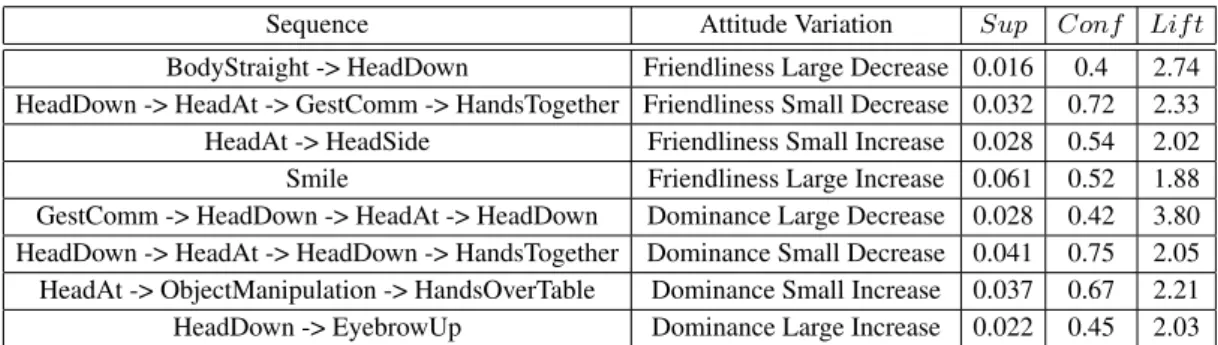
In table 2 we show the top scoring (i.e. highest Lift score) extracted sequences for every attitude variation type found using this process. The Sup column corresponds to the support of the sequence and the Conf column to the confi-dence of the sequence.
6.
Generating new sequences
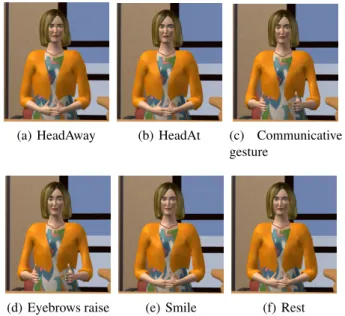
Our goal is to build a framework for attitude expression by Embodied Conversational Agents considering the sequenc-ing of non-verbal signals, among other features. To that end, we have developed a module for our ECA platform that can animate the agent using the sequences extracted with the mining process detailed in Section 5. An exam-ple of such an animation is shown in Figure 6. However, solely relying on the sequences extracted in the previous step limits the variability and expressivity of our characters’ behavior: the extracted sequences only consist of a subset of the possible sequences of signals that can be produced. Also, circumstances can occur where the agent has to ex-press communicative intentions that can only be displayed with a particular set of signals (e.g. an emotion), and that no extracted frequent sequence contains these signals for the appropriate attitude variation.
In order to cope with these two limitations, we decided to build a probabilistic model for generating sequences. We adopted a Bayesian Network (BN) representation (see Fig-ure 7): in the graphical representation of the network, ar-rows represent conditional dependence between variables. In our case, the attitude variation influences the types of
(a) HeadAway (b) HeadAt (c) Communicative gesture
(d) Eyebrows raise (e) Smile (f) Rest
Figure 6: Exemple of the non-verbal sequenceHeadAt → GestComm → EyebrowU p → Smileexpressed by the vir-tual agent.
signal appearing in the sequence, and each signal influences which type of signal appears directly after it. Thus we can note that P (Si+1|Si, Si−1, ..., S1, A) = P (Si+1|Si, A),
where S represents signals, i is the index of a signal in the sequence, and A is the chosen attitude variation.
Figure 7: A “rolled” representation of the Bayesian Net-works we use for generating new sequences of behavior.
For simplicity, we trained a BN for dominance variations and another BN for friendliness variations. We used the Weka open-source machine learning software (Hall et al., 2009) to train the networks, using the extracted frequent se-quences as input data. Choosing a sequence length, we can generate a very large set of sequences using the networks. We can also constrain the generated sequences to contain a particular subsequence of signals, e.g. signals that are mandatory to produce some communicative intentions.
Any generated sequence can be evaluated with two cri-teria. The first one is the probability of a given sequence computed with the Bayesian Networks. Due to the struc-ture of the networks and the way they are trained, this tends to reward the sequences containing the types of signals that
Sequence Attitude Variation Sup Conf Lif t BodyStraight -> HeadDown Friendliness Large Decrease 0.016 0.4 2.74 HeadDown -> HeadAt -> GestComm -> HandsTogether Friendliness Small Decrease 0.032 0.72 2.33 HeadAt -> HeadSide Friendliness Small Increase 0.028 0.54 2.02
Smile Friendliness Large Increase 0.061 0.52 1.88
GestComm -> HeadDown -> HeadAt -> HeadDown Dominance Large Decrease 0.028 0.42 3.80 HeadDown -> HeadAt -> HeadDown -> HandsTogether Dominance Small Decrease 0.041 0.75 2.05 HeadAt -> ObjectManipulation -> HandsOverTable Dominance Small Increase 0.037 0.67 2.21 HeadDown -> EyebrowUp Dominance Large Increase 0.022 0.45 2.03
Table 2: Top scoring sequences for each attitude variation event
are most frequent (e.g. head movements), but not the se-quences that could be the most discriminant (e.g. smiles, adaptor gestures). In a nutshell, the most likely sequences of a given attitude variation type are rewarded, but not the most discriminant. The second criteria classifies any given sequence into a type of attitude variation using the method described in (Jaillet et al., 2006). This method relies on the concept of confidence we described in Section 5. It consists of extracting the k subsequences of the generated sequence that have the best confidence score in our data. The gener-ated sequence is then classified using majority voting, i.e. the attitude variation type that is the most frequent in the k subsequences is considered to be the class of the sequence.
7.
Conclusion
In this paper, we presented a knowledge extraction method for non-verbal behavior sequences based on a data min-ing technique, and a method for generatmin-ing and evaluatmin-ing new behavior sequences. Our next step is to evaluate the extracted and generated sequences by integrating the net-works in our Embodied Conversation Agent platform. We will use the results to validate whether the extracted se-quences are correctly recognized by users when they are directly reproduced by an agent, and to validate if the gen-erated sequences are correctly classified, that is whether the users agree with the output of the classification method we described in the previous paragraph. Finally, we will tune our model to adjust the importance of the two criteria we proposed for sequence evaluation : how likely is a sequence to be produced, and how confident we are that the sequence is characteristic of the chosen attitude variation.
Acknowledgment
This research has been partially supported by the Euro-pean Community Seventh Framework Program (FP7/2007-2013), under grant agreement no. 288578 (TARDIS).
8.
References
Agrawal, R. and Srikant, R. (1994). Fast algorithms for mining association rules in large databases. In Proceed-ings of the 20th International Conference on Very Large Data Bases, VLDB ’94, pages 487–499, San Francisco, CA, USA. Morgan Kaufmann Publishers Inc.
Allwood, J., Kopp, S., Grammer, K., Ahlsen, E., Oberza-ucher, E., and Koppensteiner, M. (2007). The analysis of
embodied communicative feedback in multimodal cor-pora: a prerequisite for behavior simulation. Language Resources and Evaluation, 41:255–272.
Argyle, M. (1988). Bodily Communication. University pa-perbacks. Methuen.
Bakeman, R. and Quera, V. (2011). Sequential Analysis and Observational Methods for the Behavioral Sciences. Cambridge University Press.
Ballin, D., Gillies M. and Crabtree, B. (2004). A frame-work for interpersonal attitude and non-verbal commu-nication in improvisational visual media production. In Proceedings of the 1st European Conference on Visual Media Production, CVMP ’04, pages 203–210.
Bevacqua, E., Sevin, E., Hyniewska, S. J., and Pelachaud, C. (2012). A listener model: introducing personal-ity traits. Journal on Multimodal User Interfaces, 6(1-2):27–38.
Bickmore, T. W. and Picard, R. W. (2005). Establish-ing and maintainEstablish-ing long-term human-computer rela-tionships. ACM Transactions on Computer-Human In-teraction, 12(2):293–327.
Boersma, P. and Weenink, D. (2001). Praat, a system for doing phonetics by computer. Glot International, 5(9/10):341–345.
Burgoon, J. K., Buller, D. B., Hale, J. L., and de Turck, M. A. (1984). Relational Messages Associated with Nonverbal Behaviors. Human Communication Re-search, 10(3):351–378.
Cafaro, A., Vilhjálmsson, H. H., Bickmore, T., Heylen, D., Jóhannsdóttir, K. R., and Valgarðsson, G. S. (2012). First impressions: users’ judgments of virtual agents’ personality and interpersonal attitude in first encounters. In Proceedings of the 12th international conference on Intelligent Virtual Agents, IVA’12, pages 67–80, Berlin, Heidelberg. Springer-Verlag.
Carney, D. R., Hall, J. A., and LeBeau, L. S. (2005). Beliefs about the nonverbal expression of social power. Journal of Nonverbal Behavior, 29(2):105–123.
Chollet, M., Ochs, M., and Pelachaud, C. (2012). Inter-personal stance recognition using non-verbal signals on several time windows. In Workshop Affect, Compagnon Artificiel, Interaction, WACAI ’12.
Chollet, M., Ochs, M., and Pelachaud, C. (2013). A multi-modal corpus approach to the design of virtual recruiters. In Workshop Multimodal Corpora, Intelligent Virtual Agents, IVA ’13, pages 36–41.
Cowie, R., Cox, C., Martin, J.-C., Batliner, A., Heylen, D., and Karpouzis, K. (2011). Issues in Data Labelling. Springer-Verlag Berlin Heidelberg.
Ekman, P. and Friesen, V. (1977). Manual for the Facial Action Coding System. Palo Alto: Consulting Psycholo-gists Press.
Escalera, S., Pujol, O., Radeva, P., Vitria, J., and Anguera, M. (2010). Automatic detection of dominance and ex-pected interest. EURASIP Journal on Advances in Sig-nal Processing, 2010(1):12.
Ferreira, P. G. and Azevedo, P. J. (2005). Protein se-quence classification through relevant sese-quence mining and bayes classifiers. Progress in Artificial Intelligence, 3808:236–247.
Hall, M., Frank, E., Holmes, G., Pfahringer, B., Reute-mann, P., and Witten, I. H. (2009). The WEKA data mining software: An update. SIGKDD Exploration Newsletter, 11(1):10–18, November.
Jaillet, S., Laurent, A., and Teisseire, M. (2006). Se-quential patterns for text categorization. Intelligent Data Analysis, 10(3):199–214.
Keltner, D. (1995). Signs of appeasement: Evidence for the distinct displays of embarrassment, amusement, and shame. Journal of Personality and Social Psychology, 68:441–454.
LaFrance, M. (1982). Posture mirroring and rapport. In Davis, M., editor, Interaction Rhythms: Periodicity in Communicative Behavior, pages 279–299. New York: Human Sciences Press.
Lee, J. and Marsella, S. (2011). Modeling side partici-pants and bystanders: The importance of being a laugh track. In Proceedings of the 11th International Confer-ence on Intelligent Virtual Agents, IVA’11, pages 240– 247, Berlin, Heidelberg. Springer-Verlag.
Magnusson, M. S. (2000). Discovering hidden time patterns in behavior: T-patterns and their detection. Behavior Research Methods, Instruments, Computers, 32:93–110.
Martínez, H. P. and Yannakakis, G. N. (2011). Mining multimodal sequential patterns: a case study on affect detection. In Proceedings of the 13th international con-ference on multimodal interfaces, ICMI ’11, pages 3–10, New York, NY, USA. ACM.
Prepin, K., Ochs, M., and Pelachaud, C. (2013). Beyond backchannels: co-construction of dyadic stancce by re-ciprocal reinforcement of smiles between virtual agents. In International Conference CogSci (Annual Conference of the Cognitive Science Society).
Ravenet, B., Ochs, M., and Pelachaud, C. (2013). From a user-created corpus of virtual agent’s non-verbal be-haviour to a computational model of interpersonal atti-tudes. In Proceedings of the 13th International Confer-ence on Intelligent Virtual Agenst, IVA ’13, Berlin, Hei-delberg. Springer-Verlag.
Scherer, K. R. (2005). What are emotions? and how can they be measured? Social Science Information, 44:695– 729.
Srikant, R. and Agrawal, R. (1996). Mining sequential pat-terns: Generalizations and performance improvements. Advances in Database Technology, 1057:1–17.
Tan, P.-N., Steinbach, M., and Kumar, V. (2005). Intro-duction to Data Mining (First Edition). Addison-Wesley Longman Publishing Co., Inc., Boston, MA, USA. With, S. and Kaiser, W. S. (2011). Sequential
pattern-ing of facial actions in the production and perception of emotional expressions. Swiss Journal of Psychology, 70(4):241–252.
With, S. (2010). Structural analysis of temporal patterns of facial actions: Measurement and implications for the study of emotion perception through facial expressions. Ph.D. thesis, University of Geneva.
Wittenburg, P., Brugman, H., Russel, A., Klassmann, A., and Sloetjes, H. (2006). Elan: a professional framework for multimodality research. In Proceedings of Language Resources and Evaluation Conference, LREC ’11.