HAL Id: hal-01408476
https://hal.archives-ouvertes.fr/hal-01408476
Submitted on 5 Dec 2016
HAL is a multi-disciplinary open access
archive for the deposit and dissemination of
sci-entific research documents, whether they are
pub-lished or not. The documents may come from
teaching and research institutions in France or
abroad, or from public or private research centers.
L’archive ouverte pluridisciplinaire HAL, est
destinée au dépôt et à la diffusion de documents
scientifiques de niveau recherche, publiés ou non,
émanant des établissements d’enseignement et de
recherche français ou étrangers, des laboratoires
publics ou privés.
intelligent manufacturing & services systems (IMS
2
)
French research group
Olivier Cardin, Fouzia Ounnar, André Thomas, Damien Trentesaux
To cite this version:
Olivier Cardin, Fouzia Ounnar, André Thomas, Damien Trentesaux. Future industrial systems: best
practices of the intelligent manufacturing & services systems (IMS
2) French research group. IEEE
Transactions on Industrial Informatics, Institute of Electrical and Electronics Engineers, 2017, 13 (2),
pp.704-713. �10.1109/TII.2016.2605624�. �hal-01408476�
Abstract—Development of future industry has become an
active research area in the recent years. A structured national workgroup, called IMS², has emerged in France over the last decade. The aim of this paper is, regarding four highlighted general research topics (namely agility, new technologies, sustainability and industrial dissemination), to synthetize the general research works on intelligent manufacturing and to demonstrate the principal contributions developed within the framework of this national workgroup. After a critical evaluation of the proposed approaches towards alternative solutions, this paper suggests a 2030 roadmap for the workgroup.
Index Terms—Agility, sustainability, cyber-physical systems,
future industrial systems.
I. INTRODUCTION
HE last decade showed an increasing interest of the international community in the challenges associated with future industrial systems. Numerous initiatives have since arisen to structure and support the initiatives of both academic and industrial partners through public-private partnerships or separated consortiums. Among them, the worldwide program IMS (Intelligent Manufacturing Systems), European framework program Factories of the Future, and national actions, such as Industry4.0, can be cited.
The French research community in manufacturing control is structured around the national MACS research group (Modeling, Analysis and Control of Systems) of the CNRS (French National Scientific Research Center), which gathers more than 2500 researchers in more than 200 research laboratories. In this group, a working group (WG) called IMS² (Intelligent Manufacturing & Services Systems) deals with the range of problems of the future intelligent-oriented
Copyright (c) 2009 IEEE. Personal use of this material is permitted. However, permission to use this material for any other purposes must be obtained from the IEEE by sending a request to [email protected].
O. Cardin is with the LUNAM Université, IUT de Nantes – Université de Nantes, IRCCyN UMR CNRS 6597, 2 avenue du Prof. Jean Rouxel, 44475 Carquefou, France (e-mail: [email protected]).
F. Ounnar is with the Aix Marseille Univ, CRET-LOG, Centre de Recherche sur le Transport et la LOGistique, Aix-en-Provence, France (e-mail: [email protected]).
A. Thomas is with the Lorraine University, CRAN (Automatic Research Center of Nancy), Nancy, France (e-mail: [email protected]).
D. Trentesaux is with the University of Valenciennes and Hainaut-Cambrésis, UVHC, LAMIH UMR CNRS 8201, France (e-mail: [email protected]).
manufacturing control concepts, and specifically the contribution of what is called nowadays cyber-physical systems (CPS) as a key enabler of future industrial systems [1].
The aims of this paper is to synthetize the general problems of intelligent manufacturing and demonstrate the principal contributions developed within the framework of this national workgroup1 in four general research topics concerning
intelligent manufacturing systems, namely agility, new technologies, sustainability and industrial dissemination.
This paper is organized as follows. First, the general scientific topics that need to be addressed for the development of future industrial systems are synthesized from an analysis of corresponding international roadmaps. Then, an overview of IMS² contributions is proposed and a critical evaluation of the research efforts of this group is conducted towards the international positioning relative to those problems. Finally, last section analyses the results with regards to these topics and elaborates a roadmap for future research in the community to cope with the challenges exposed before.
II. OVERVIEWOFRESEARCHGENERALTOPICS ABOUTFUTUREINDUSTRIALSYSTEMS
A. International roadmaps
Four long-term paradigms will guide the transformations that European manufacturing needs to undergo regarding Manufacturing vision 2030 [2]: factory and nature (green/sustainable); factory as a good neighbor (close to the worker and the customer); factories in the value chain (collaborative); factory and humans (human centered). Programs mainly based around FoF (Factories of the Future) or SPIRE (Sustainable Process Industry) and at a least extent EEB (Energy-efficient Buildings) are coordinating scientific and industry efforts into these directions. Similarly to European events, the “recovery plan” launched in US foresees a specific chapter dealing with “Manufacturing and green jobs” which establishes the setting-up of an “Advanced Manufacturing Fund” for the development of advanced manufacturing strategies. In order to support the operational implementation of this program, the “Council of Advisors on Science and Technology” suggested supporting important research initiatives in the advanced manufacturing sector related to development of new technologies and design methodologies supporting the production of highly innovative
1 http://www.univ-valenciennes.fr/gdr-macs/index.php
Future Industrial Systems: Best Practices of the
Intelligent Manufacturing & Services Systems
(IMS²) French Research Group
Olivier Cardin, Fouzia Ounnar, André Thomas, Damien Trentesaux, Member, IEEE
products and materials [3]. The American National Institute of Science and Technology (NIST) has expressed for the last decade several challenges related to future industry in a global roadmap considering the development of CPS. Recently, a public workgroup on CPS2 has been settled in order to foster
the activity around this concept.
French National Research Agency (ANR3) draws every year
a roadmap for “Stimulating industrial renewal”. This roadmap is derived from the French National Research Strategy4. Since
2010, this holistic view of industry also took shape, addressing the concept of System Factory, connected to a worldwide supply chain, next to the developments of the technologies for virtual factories use. Same as NIST does, a highlight is defined on smart and connected factories, comprising topics such as generic information model and cybersecurity. Finally, flexibility and agility of systems are strongly connected to the development of innovative and effective processes and technologies. The “Factories of the Future” Project was also approved by the Interministerial Committee for Economic Planning (CIPE) within the Italian Research National Program (PNR)5. ActionPlanT (roadmap project of the strategic
Germany initiative ‘Industry 4.0’6) has established a
manufacturing roadmap for Horizon 2020, which outlines a bold vision, where megatrends and key ICT innovations can fulfil five underlying ambitions for European enterprises: on-demand, optimal, innovative, green, and human centered. This vision goes beyond the shop floor and focuses on the manufacturing enterprises and their collaborating stakeholders in the holistic supply chain. Based on the technological concepts of CPS, the Internet of Things, and the Internet of Services, Industry 4.0 provides the vision of Smart Factory [1].
B. General topics of intelligent manufacturing
Table I positions these international roadmaps towards federative topics they address. The main interest of this positioning is to observe that the programs, although with different terminologies, have a consistent view of the different aspects where research and innovation efforts need to focus for efficiency and acceptability improvements of next generation industrial systems. From this perspective, it is possible to synthetize three general topics that shall lead intelligent manufacturing research efforts in the next few years, namely agility; new technologies; and sustainability, which need to be completed by a fourth one dealing with industrial dissemination that is transversally expressed throughout all the programs. This section intends to detail these topics and to draw a short overview of representative international granted projects aligned with the roadmaps. The presentation of these projects is made accordingly to the introduced three first topics. The necessary interoperability between industrial systems must also be dealt with in a
2 www.cpspwg.org 3 www.agence-nationale-recherche.fr/fileadmin/aap/2016/ANR-Plan-Action-2016-details-defis.pdf 4 www.enseignementsup-recherche.gouv.fr/cid78802/strategie-nationale-de-recherche-bilan-des-travaux-des-10-ateliers.html#atelier3 5 www.miur.it/UserFiles/3239.pdf 6 www. actionplant-project.eu
transversal way inside the projects relevant to the four topics mentioned above, but is not studied in this paper.
TABLEI
INTERNATIONAL ROADMAPS TOPICS General
topics Agility Technologies Sustainability
Program In te r-o p er a b il it y / c o ll a b o ra ti o n N e tw o rk ed en te rp r is e In fo rm a ti o n m o d e l A d v a n ce d P ro ce ss C y b er -se cu ri ty H u m a n & S o ci et y S u st a in a b il it y EU X X X X X NIST X X X X ANR X X X X X PNR X X X ActionPlanT X X X X X 1) Agility of organizations
This topic concerns the development of collaborative, mobile, smart, and adaptive systems. These are intended to be able to change, reconfigure, and evolve rapidly with time, according to the market demand. Typically, key challenges concern the development of the digital factory and next generation of manufacturing systems, designing flexible interoperable networks of production systems that can be reconfigured, increasing the understanding, systematization, and acceptance of holonic manufacturing systems (HMS) concepts, and defining a framework for collaboration in a non-hierarchical manufacturing network context. Some various representative European projects are presented in table II in relation to this first topic.
TABLEII
PROJECTS DEALING WITH AGILITY IN MANUFACTURING Project Acronym Year Key feature related to agility
INET 2011 Non-Hierarchical Manufacturing Networks NGMS 2011 Digital Factory
ADDFACTOR 2013 Central knowledge-based design and local distributed manufacturing 2) Manufacturing technologies
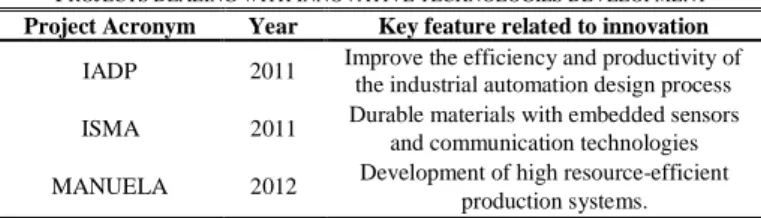
The aspect of technological advances and high-tech manufacturing processes is of great importance and is expected to have a high impact on the next generation of manufacturing in the near future. Typically, this topic concerns the development of revolutionary technologies to respond to the future industrial constraints and the proposition of decision support systems and simulation toolboxes to improve the process plant operation, safety, maintenance, and quality. It also concerns the providing of a design environment to describe control strategies, communications schemes, and automation hardware. Table III shows some representative EU projects of this topic.
TABLEIII
PROJECTS DEALING WITH INNOVATIVE TECHNOLOGIES DEVELOPMENT Project Acronym Year Key feature related to innovation
IADP 2011 Improve the efficiency and productivity of the industrial automation design process ISMA 2011 Durable materials with embedded sensors
and communication technologies MANUELA 2012 Development of high resource-efficient
3) Sustainable manufacturing
Integration of sustainability considerations (economy, society, and environment) into manufacturing management systems is now compulsory. Typically, this topic concerns the development of new forms of highly competitive resources, manufactured products, and processes, which are environment-aware, society-aware, and human-oriented including the supply chain level. Another aspect is related to energy efficient manufacturing where the objective is to deliver energy management standards and a technology framework for next-generation sustainable manufacturing. Table IV contains representative EU projects of this field.
TABLEIV
PROJECTS DEALING WITH SUSTAINABILITY IN MANUFACTURING Project Acronym Year Key feature related to sustainability
SuPLIGHT 2011 Holistic Eco-Design DiFAC 2012 Collaborative Manufacturing
Environment IProSPER 2015 Sustainable Energy Efficient Manufacturing
III. IMS² RESPONSE OVERVIEW AND CONTRIBUTIONS A. IMS² in a nutshell
The WG IMS², as it was briefly introduced, is one among the 27 WGs of the CNRS research group MACS. It is composed of around 140 French members. It was created a decade ago to study service or manufacturing control systems and architectures characterized by a set of autonomous entities whose relationships are not necessarily integrated hierarchically. In other words, heterarchical relationships may exist, involving negotiation or cooperation mechanisms among entities. The group has inherited its theoretical foundations from artificial intelligence (AI), distributed AI, operations research, soft computing, control theory, discrete-event modeling and simulation, ambient intelligence, information science, robotics or mechatronics, to name just a few domains. Intelligence can be embedded into material, components, product, resources, or distant facilities, which allows these entities to participate actively in the global process efficiency. Holonic and multi-agents modellings are typical approach that can be used. Emerging optimization / multicriteria decision aid mechanisms (e.g., reinforcement learning, stigmergy, potential fields, swarming, analytic hierarchy/network process) can also be used efficiently and the existing technical solutions are credible today thanks to the CPS technologies. The typical issues addressed by this WG concern localization, performance management and robustness, proof of properties, sustainability, safety and security, interoperability with the existing information systems and deployment methodologies, to mention only a few. Typical applications are related not only to the production phase of the product life cycle, but also to the services involved in the supply chain activities, or in energy distribution and healthcare systems domains. The design, development, use, and recycling phases and the whole life cycle of products, services, and processes must be considered within the global context of product lifecycle management.
B. IMS² added value to the research community
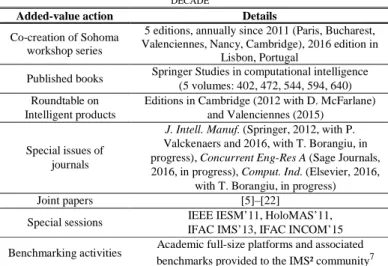
The operational activities of the WG IMS² involve mainly: (i) Two or more meetings each year – mainly devoted to the French research community; international guest researchers may be invited; (ii) Co-supervision of PhD students; (iii) Establishment of consortiums for project calls (French or European calls); (iv) Transfer of scientific developments to scholars, industrialists, and engineering schools. Aside from classical meetings, there are many activities which the WG IMS² initiated and that would have not existed without this WG. One typical representative added value is the co-creation with a Romanian team from Bucharest of the SOHOMA workshop series. This action has led to publishing five books edited by Springer. Table V lists some representative added-value joint actions.
C. Research effort classification
The activity of the WG IMS² is presented and structured in the remainder of this document using an analysis framework. This classification is composed of three axes, representing what is impacted, how and for what purposes. First, a criteria based on the framework of [4] is used to represent what level of aggregation is considered, with the following possible values: (i) Component level; (ii) Machine level; (iii) Shop-floor level; (iv) Enterprise level; (v) Logistic level; (vi) Energy system level. Second, a criteria based on the five categories (5C) proposed by [1] is used: C1 – Connection; C2 – Conversion; C3 – Cyber; C4 – Cognition; C5 – Configuration. Finally, the third axis is based on the topics defined before, and illustrates the objective of the work, either in terms of agility, technologies or sustainability.
TABLEV
REPRESENTATIVE ADDED-VALUE JOINT ACTIONS OF IMS² IN THE LAST DECADE
Added-value action Details
Co-creation of Sohoma workshop series
5 editions, annually since 2011 (Paris, Bucharest, Valenciennes, Nancy, Cambridge), 2016 edition in
Lisbon, Portugal
Published books Springer Studies in computational intelligence (5 volumes: 402, 472, 544, 594, 640) Roundtable on
Intelligent products
Editions in Cambridge (2012 with D. McFarlane) and Valenciennes (2015)
Special issues of journals
J. Intell. Manuf. (Springer, 2012, with P.
Valckenaers and 2016, with T. Borangiu, in progress), Concurrent Eng-Res A (Sage Journals, 2016, in progress), Comput. Ind. (Elsevier, 2016,
with T. Borangiu, in progress) Joint papers [5]–[22]
Special sessions IEEE IESM’11, HoloMAS’11, IFAC IMS’13, IFAC INCOM’15 Benchmarking activities Academic full-size platforms and associated
benchmarks provided to the IMS² community7 D. IMS² Contributions to future industrial systems general topics
Numerous early WG contributions concerned the study of the intelligent product (IP) concepts and applications that could be classified in {Shop-floor; C1; Agility} in the previously described framework. First of all, several experiments were conducted to prove the concept (to make the
concept credible) of IP and product-driven systems, paving the way for CPS [9], [23]. All these experiments led to highlighting of opportunities to implement this kind of systems [24]. At the same time, to help implementing such solutions, several control-emulation system architectures were proposed [25], [26]. Consequently, a necessary step was to define the concepts, terminology and expose the relevant paradigm associated with this notion [27], [28]. Table VI displays an extensive overview of the contributions of the WG to this subject and also those developed in the remainder of this document.
TABLEVI
OVERVIEW OF IMS² ACADEMIC CONTRIBUTIONS Paradigm definition Control design Decision making Performance evaluation and benchmarking In te ll ig e n t p ro d u ct [5] [6] [27] [29] [30] [41] [31], [41], [43]–[46] [10] [24] [25] [11], [26], [47] [48]–[52] H et e ra rc h ic a l co n tr o l a rc h it ec tu re H M S [40] [42] [17] [53] [8][12] [14] [28] [43] [40] [34], [54]– [56] [28] [15] [32], [57]– [63] [16], [33], [64], [65] M u lt i-a g en t [13][18] [46] [35], [66]– [68] [19], [21], [69] 1) IMS² contributions to the agility general topic
This paradigm got then formalized into more generic and innovative control architectures, enabling the use of tools and concepts inherited from the field of computer science in the industrial context. Typically, bio-inspired techniques are used to integrate the products’ advanced detection and monitoring functionalities in the loop [29]. The implementation of such models led to the problem of decision making, which was investigated in many ways, with stigmergic approaches [30], [31], potential fields [24], multicriteria decision aid methods [32] or negotiations via contract-net protocol [10].
Many performance evaluations, commonly made using discrete-event simulation, were performed on academic testbeds, and a dedicated approach to generate them was proposed [33]. The pertinence of including the reactivity enabled by the intelligence of the product into the classical production activity control, organized around a predictive scheduling of the orders to run in the manufacturing workshop, was highlighted [34]. Therefore, the activities extended to the holonic paradigm, leading to the notion of heterarchical control of systems [35]. The HMS concept was more than 10 years old at that time, and therefore, the community mainly worked on the efficient implementation of these solutions. Similarly to the classical holonic reference architecture (PROSA [36], ADACOR [37], HCBA [38], or D-MAS [39]), several attempts have been made to propose generic control architectures: PROSIS, enabling an isoarchic control using real time and multicriteria decision rules [40], VSM for HMS proposed a meta-model of HMS architecture systems [41], ORCA-FMS, enabling an online evolution of the control policy for each entity of the control architecture
independently [34] and H²CM for hybrid production systems [42], all this towards {Shop-floor; C3; Agility} systems. The contribution of some members of the WG IMS² to the definition of an improved version of ADACOR can also be pointed out [17].
Considering manufacturing systems, some studies were also led in the field of reconfigurable manufacturing and assembly lines systems (RMS), one of them being described in the Industrial applications section [70]. Based on an industrial case, a generic framework denoted RAMS was proposed in order to model efficiently both the systems and the reconfiguration activities [71], [72]. Methodologies for the design of manufacturing systems enabling efficient reconfiguration methods were also proposed [73].
2) IMS² contribution to the general topic of the development of new technologies
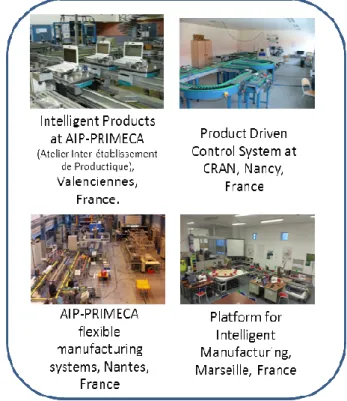
As stated in Table VI, numerous academic performance evaluations of the proposed control architectures and implementation were executed. In the early years, the WG was created around the laboratories having a strong activity of platform development, aiming at implementing CPS at size 1. These academic workshops are built around automated transfer loops conveying products on pallets around 3 to 12 machines, manual, robotic, or automated, as illustrated in Fig. 1. The intelligence is either embedded on the pallet or container (RFID tag [43][59], embedded CPU [12], Arduino chips [30], WSN mote [56], etc.) or in the IP (RFID tag embedded in wood or textile raw material [74]) defining {Machine; C3; Agility} systems.
Figure 1. Four of the IMS² platforms
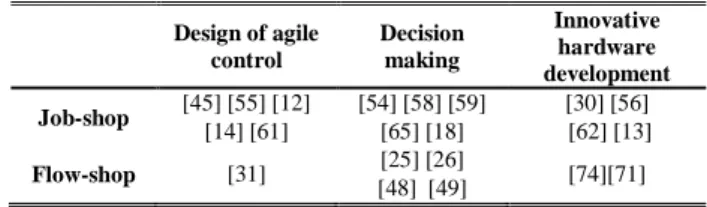
Many performance evaluations and benchmarking were performed, both in the job-shops and flow-shops. As demonstrated in Table VII, the main contributions were focused on the design of innovative control and the associated
decision making techniques. In addition, the respective involved teams also took the opportunity to develop new CPS hardware. The idea is generally to design active transporters or products thanks to Auto-ID technologies (barcode, RFID, etc.). The objective is to carry the computation and operation abilities with the product and make them capable of interacting with their environment, making their own decisions, and executing these by themselves. For example, a low-cost and low-consumption pallet equipped with Arduino, Zigbee, batteries, and steering actuators was developed on an Elcom-based conveyors system [30], a pull control based on the RFID associated with products was tested [29], and a control solution for manufacturing systems based on the WSN technology was proposed to explore new ways of improving the embedded intelligence on holonic entities [56].
TABLEVII
OVERVIEW OF IMS² PLATFORM EXPLOITATIONS Design of agile control Decision making Innovative hardware development Job-shop [45] [55] [12] [14] [61] [54] [58] [59] [65] [18] [30] [56] [62] [13] Flow-shop [31] [25] [26] [48] [49] [74][71] 3) IMS² contribution to the sustainability general topic
Sustainability in manufacturing can be dealt with in many ways [20]. The main focus that the WG IMS² treated is relative to the definition of choreographies able to decrease the environmental impact of manufacturing [75],[68],[7] (i.e. {Shop-floor; C3; Sustainability}). In particular, this activity is aiming at defining innovative scheduling methods able to optimize both the productivity and the energy consumption of the systems. Another research axis is dealing with the production of energy itself, either from traditional [42] or renewable sources [60] (i.e. {Energy system; C3; Sustainability}). This axis aims at increasing the flexibility of the control of these systems in order to cope with the specificities of these systems. In traditional systems, a generic and fractal reference architecture was developed [42] in order to ease the development of control systems for such production facilities, usually of very large sizes. The flexibility added to the orchestration of the system also enables the control to cope more easily with the numerous disturbances happening on the system. The development of the energy distribution grids is also a matter of great importance with the management of energy coming from renewable sources. A decentralized control energy system multi-sources and multi-users was thus proposed [60]. Indeed, the random nature of power generation requires a high flexibility of the distribution management in order to avoid systematically storing the energy.
4) Key results of IMS² in the general topic of industrial dissemination
After validation of the scientific proposals, implementations in industrial context were deployed. The historical field of research of the WG being the industrial systems, the first implementations took place in the workshops of local industries willing to handle the complex dynamic systems where classical scheduling did not find any satisfying solution
(Table VIII).
Then, a holonic-based production activity control (PAC) replaced a hoist scheduling problem solver in an aeronautic parts surface treatment line [76], in the same PAC domain a re-scheduling approach was proposed for the car supply industry [31], a Holonic Manufacturing Execution System was implemented in a Latin-American car glasses manufacturer [78], the holonic principles were deployed to monitor a complex transportation system [80] with Bombardier who led the SURFER project with the objective of a {Machine; C4; Agility} system, the dynamic behavior of the scheduling procedure for maintenance tasks in petroleum industry was enhanced by the use of heterarchical approaches [77], and a scheduling of a production line using the AHP method was tested in vascular prostheses industry [20]. To help in decision making processes in Just in Time contexts, several intelligent approaches were proposed, such as “active kanbans” [49] or reactive demand flow technology systems [33], [70] for line reconfiguration towards a {Shop-floor; C3; Agility} system, and also multicriteria decision aid methods taking into account contradictory interests in a {Shop-floor; C3; Agility} system [61]. The implementation of IP in trucks for parcel delivery is indeed very promising [79], and many potential benefits are foreseen in the contexts such as the Physical Internet [81]. A major breakthrough in the classical implementation of HMS was also the industrial case of fault diagnosis of trains [80], proving that the potential of fractality of holons was indeed pertinent in the case of large-scale systems.
TABLEVIII
OVERVIEW OF IMS² INDUSTRIAL IMPLEMENTATIONS Dynamic scheduling of highly constrained systems Maintenance, traceability and safety Handling high volume upstream data flows Decision support systems Industry [76] [77] [78] [61] [48] [49] [78] [70] [72] [73] Transport [9] [79] [80] [79][81] Services [47] [82]
IV. CRITICAL EVALUATION OF IMS² CONTRIBUTION TO RESEARCH FIELD AND STRUCTURATION
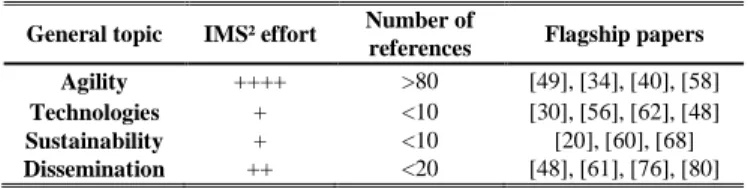
This section intends to synthetize the efforts made by IMS² in comparison to the four introduced topics. As Table IX states, the first topic regarding agility in manufacturing was a great concern for the community, with over 80 reference papers in the last decade. The key results of IMS² deal with the definition of new holonic reference architectures, enabling this paradigm to cope with new manufacturing concerns [17], [26], [34], [40], [42], [48], [49]. On an international point of view, these initiatives are the only ones that can be found in literature in the recent years, which constitutes important breakthroughs for future implementations. Indeed, these new architectures are meant to be more appropriate to future implementation concerns in terms of adaptability and changeability of the manufacturing context.
While the concept of CPS was always present in the different implementations, it was often based on the integration of existing technologies. This explains why very few papers presented innovations about the technology itself,
aiming rather at demonstrating the breakthrough in the use of CPS. However, several developments were made on the subject of embedded intelligence, either directly inside the product [74] or in the transporter of the product [13], [30], [56], [62]. These developments were reliable tools to enable proofs of the developed concepts but were not industrially disseminated. Also, the group is currently becoming interested in sustainability and energy footprint of agile manufacturing control, as the references listed in this field are quite recent and their number is constantly growing with time. Considering international literature on this point, a focus on human acceptability of future industrial systems is a major concern that is not but should be treated by the group.
TABLEIX OVERVIEW OF IMS² POSITIONING General topic IMS² effort Number of
references Flagship papers Agility ++++ >80 [49], [34], [40], [58]
Technologies + <10 [30], [56], [62], [48]
Sustainability + <10 [20], [60], [68]
Dissemination ++ <20 [48], [61], [76], [80]
As exposed previously, industrial dissemination has always been a major pillar of IMS² activities. Those implementations constituted important proofs of the concepts developed in parallel: product-driven control, active products or holonic paradigm among others. In comparison to the previously described industrial projects, those initiatives are not integrated in larger research project, but are in direct application in the local workshops of the concerned industries. This specificity is favored by the distribution of the group members on the territory. On the other side, it is the size of the whole IMS² which increases the number of different industrial point of views and enhances the genericity of the developed concepts. Above these strictly thematic concerns, thanks to this original national dynamic, it has led to creating a real synergy between the French concerned labs. This synergy has materialized and led to common research actions. WG IMS² has now reached its first objective related to the construction of a stable core federation of French and international teams in the French-speaking countries (Romania, Canada, Morocco, Tunisia, Algeria, Belgium, Switzerland…), and this WG must now evolve. For that purpose, a process has been started to design a challenging roadmap for this WG. The strengths of the WG could be explained by the fact that each research team has its own platform embedding various types of Auto-ID technologies and control modes. On the other hand, IMS² has resulted in a lot of real industrial applications leading to induce the research inquiry with the accurate scale of the addressed topics. Moreover, the consortium teams have at least 10 to 15 years of experience on this subject based on complementary and/or similar research backgrounds (operations research, discrete event simulation, logistic and industrial management, traceability, and so on).
V. IMS²2030 ROADMAP
The roadmap of the WG IMS² has been designed consistently with the needs expressed by the industrial partners working with its members. One main prospect
outputted from various big projects concerns the way CPS can contribute to the optimization of the whole system life-cycle (e.g. LCC life-cycle cost). This optimization can be done inside a single phase of the system life cycle, often production and maintenance. It can also be done at a broader point of view, through different phases of the life cycle. Typically, one can consider different feedback loops from use, maintenance and disassembly phases to the design phase of new systems, being production resources and products, and to their overhaul during their use phase. This vision is aligned with the concept of “intelligent product”. More, considering the whole system as a fleet of cooperative CPS (sub-systems) will ease the interaction with logistics and maintenance centers, enabling the integration of new organizational processes such as industrial internet or opportunistic maintenance. CPS oriented approach will also ease the capitalization of knowledge from aging and near retirement operators. Last, by extending the lifespan of systems and infrastructures, constructor will also orient their decision towards sustainability, including opportunistic energy savings, deconstruction and re-use of functional manufactured part whose history is known thanks to the CPS principles. This industrial testimony could be federated into the projection of the evolutions of complex industrial systems in the near future merging a vertical integration of the control with a horizontal one through interoperability of information based on the technological element, development of new technologies of ICT, environmental and actual cooperation with humans. IMS² 2030 roadmap has been established according to this projection. It has been structured consistently with the four introduced topics and is detailed in the following.
A. Agility of systems enhancement
In the next decade will occur the development of truly changeable systems, namely adaptive and reconfigurable flexible systems (RMS). During the last decade, our work mainly focused on reconfigurability at the level of the control architectures with predefined layout topologies (i.e. FMS) or in industrial contexts, enabling the definition of fully flexible reference architectures and their performance evaluation. The next step is to go further in the domain of development of reconfigurable control architectures based on variable topologies, dedicated to RMS that are being technologically available. These late implementations may exploit Automated Guided Vehicles (AGV). The arrival of other mobile entities in workshops such as drones gives new perspectives to the sensing capabilities of the system. However, a huge effort still needs to be brought to the coordination of these mobile entities and their sensing abilities in a semi-structured environment such as the shop floors. The effort on Intelligent Product is still to be carried, as the possession of information by the product is however an efficient way to enable a late and online customization of the manufacturing. This concept is meant to become the actual way to make distinct manufacturing systems interoperable considering the life cycle of products and all the other resources. To do so, the control systems of each system need to be able to operate with a
common standard expressed a priori. The methodological aspects and the way agile IMS-based control architectures may be designed are also to be addressed. Indeed, many architectures exist, but few works have been done to propose how to deploy, implement, apply such architectures considering, for example, the costs, targeted performances, safety, etc. Typically, questions such as when, why, and how to give the decision power to objects in a distributed/ decentralized way or when it is a suitable time to give it to the ERP or to the objects are now crucial to address [83]. Future industrial systems will also be impacted by the development of cloud technologies, and especially the notion of Cloud Manufacturing will actually take shape. In a cloud-based manufacturing system, the shop floor is classically controlled in its hard real-time layer by enhanced controllers and the near real-time functionalities are exported into the cloud. There, a multi-agent based control architecture is shared between different companies, introducing their own parameters for the connection to their actual shop floor. Doing so, they can benefit from the dissemination of efficient negotiation and optimization methods and pave the way for a real integration of the whole supply chain and collaboration between subcontractors. More specifically regarding logistics and supply chain, the scientific progress proposed by IMS2 group
will contribute to the deployment of the concept of Physical Internet through the establishment of an open, global, efficient and sustainable logistics system based on CPS.
B. Breakthrough in Technology
On the technological aspect, many advances might be expected on the shop floor level. First of all, the growing interest on vision and on wireless sensor networks and RFID technologies faced in the last few years is meant to lead to the development of a truly disseminated network of data, with a globalized access to information throughout the geometry and lifecycle of the objects. Such a concept clearly modifies the way the technology was designed at first. A new approach of these technological components needs to be defined in order to cope with these aspects of dissemination and distribution of information, considering the RFID tag as a member of a network of data of a CPS and not only as an autonomous carrier. The next few years should focus on the integration of the various results of emulation-based performance evaluations into innovative hardware of CPS, such as those recently introduced in [30] or [56].
A second aspect deals with the development of communication and interoperability standards and ontologies able to be recursively operated through the whole control architecture, from the actuator to the cloud [84]. We believe that the adaptation of service-orientation and web-services approach, coming from computer science field, is going to be the next major breakthrough in the future industrial systems. At the lowest level, the interface between the service layer and the implementation methods needs to be more accurately defined. Initiatives and standards such as IEC 61499 or OPC UA are promising leads, but more generic and open standards could be preferably developed for a global interoperability of
systems and products. A third aspect directly intervenes in the design of the controllers themselves, might they be robot controllers or classical PLC. The current invocation mechanism of programs and methods needs to be brought a step further in order to enrich the description of the methods and ease the self-discovery of the capabilities of the whole system. Furthermore, this is a necessary step for cobotic field, which is expected in full expand in the next few years. The collaboration between the human and the cobot being the base of its efficiency, a higher level of semantic is needed for enhancing the use of multi-purposes robots.
C. Sustainability
Environmental concerns, industrial ecology, diminishing non-renewable resources, stricter legislation and inflated energy costs, increasing consumer preference for environmentally friendly products will foster the development of sustainable and eco-friendly manufacturing systems. Efforts to develop sustainable manufacturing systems must jointly consider products, processes, and systems [7], [20]. In a circular economy, a major function to address in the future is the recyclability phase of the product or of the system. A lot of scientific questions have to be addressed: what to recycle? When and where have components or sub-assemblies to be sent to recycling firm? How to manage the reverse logistic? Some research works have been launched [85], but huge opportunities still exist in this domain. Even if it can be considered as a “local” and low-level concern, a typical prospect that the IMS² WG aims to address soon concerns the scheduling function, which is one of the most critical function in manufacturing (i.e. with the most level of risk of unsustainability [7]), and to pay attention not only to energy, but also to other environmental footprints such as wastes and GHG, as well as other means required to realize the schedules, in a predictive and reactive way. In such as context, CPS can be useful since they can provide through cooperation and aggregation balanced predictive and reactive decisions, based on a global view of the manufacturing processes and relevant accurate, up-to-date information, from lower levels (production control, PLC) to business levels. A first widening of this scope is to link the scheduling function with other critical function at the manufacturing level, such as maintenance and safety studies. Indeed, elaborating a scheduling without any attention paid to maintenance may lead to risky, potentially hazardous thus unstainable situations. Meanwhile, even this first widening still deals with a single phase, the manufacturing phase. Thus, a second widening would concern the different phases of the product and the resources lifecycle, from their design to their recycling. The IMS² WG is convinced that CPS, as well as other close concepts such as “intelligent products” and “product-services system” PSS could be highly profitable. Social aspects are also seldom addressed in our community. They must be considered in the future activities of the WG IMS². This must be done at the operator level (e.g., the impact of scheduling on the welfare of operators, capitalization of operators’ knowledge into CPS…) to help them in their daily decisions
[49], [81], [86], but also at a supervisory level. Indeed, CPS systems may have a drawback coming from their ability to self-adapt and self-reorganize themselves: the confidence level of the human supervisor or other human-in-the-loop dealing, communicating or cooperating with CPS must be carefully addressed.
VI. CONCLUSION
In the current economic and social context, the IMS² challenges must be targeted by more and more research teams and must be developed and applied in industrial, logistic, and service (health contexts, communicating networks, and so on) domains. In the current Internet of Things context, the IMS² principle could be easily implemented; the algorithms, heuristics, and all tools coming from the operational research community have to be adapted to take into account the distributed/centralized aspects of the architecture of the decision system. Emerging concepts as coordination, cooperation, consensus in agents / holons communities, have to be studied, and new models have to be proposed to result in a new way to take dynamic, predictive, reactive, and real time decisions.
Occidental factories of the future will implement these kinds of technologies and concepts. However, as previously discussed, even if the IMS² principles are accepted and chosen as future objectives in the international industrial and research communities, we have to note that French institutions and major automatic control and computer sciences labs are still too hesitant to support this kind of initiative and research subject despite the leading activities of the WG IMS² in that field. Thus, a growing role of the WG IMS² is to foster the intelligent manufacturing approaches in France in order to promote more and more French research labs working in that field. IMS² is an innovative structure in Europe, and the results of the first years of existence are promising for the future. Such similar structures are emerging, such as AIDI8 in Italy
for example, which emphasizes the impact perceived by the community to this kind of initiative.
ACKNOWLEDGMENT
The authors thank the French CNRS and the MACS Research Group for their support to the creation and activities of the workgroup IMS².
REFERENCES
[1] J. Lee, B. Bagheri, and H.-A. Kao, “A Cyber-Physical Systems architecture for Industry 4.0-based manufacturing systems,” Manuf.
Lett., vol. 3, pp. 18–23, 2015.
[2] EFFRA, “Factories of the Future: Multi annual roadmap for the contractual PPP under Horizon 2020.” European Factories of the Future Research Association - Publications Office of the European Union, 2013.
[3] A. Anderson, “Report to the President on Ensuring American Leadership in Advanced Manufacturing.” Executive office of the President, 2011.
8 http://www.aidi-impianti-industriali.it/
[4] G. Engels, A. Hess, B. Humm, O. Juwig, M. Lohmann, J.-P. Richter, M. Voss, and J. Willkomm, “A Method for Engineering a True Service-Oriented Architecture.,” in ICEIS (3-2), 2008, pp. 272–281. [5] D. Trentesaux, B. Grabot, and Y. Sallez, “Intelligent products: a spinal
column to handle information exchanges in supply chains,” in APMS
2013, State College, USA, 2013.
[6] D. Trentesaux and A. Thomas, “Product-Driven Control: A State of the Art and Future Trends,” in INCOM 2012 Proceedings, 2012, pp. 716– 721.
[7] A. Giret, D. Trentesaux, and V. Prabhu, “Sustainability in manufacturing operations scheduling: A state of the art review,” J.
Manuf. Syst., vol. 37, pp. 126–140, 2015.
[8] F. Gamboa Quintanilla, S. Kubler, O. Cardin, and P. Castagna, “Product Specification in a Service-Oriented Holonic Manufacturing System Using Petri-Nets,” in IMS 2013, São Paulo, Brazil, 2013, vol. 11, pp. 342–347.
[9] D. Trentesaux, T. Knothe, G. Branger, and K. Fischer, “Planning and Control of Maintenance, Repair and Overhaul Operations of a Fleet of Complex Transportation Systems: A Cyber-Physical System Approach,” in Service Orientation in Holonic and Multi-agent
Manufacturing, Springer, 2015, pp. 175–186.
[10] T. Borangiu, S. Raileanu, D. Trentesaux, T. Berger, and I. Iacob, “Distributed manufacturing control with extended CNP interaction of intelligent products,” J. Intell. Manuf., vol. 25, no. 5, pp. 1065–1075, 2014.
[11] G. Zambrano Rey, A. Bekrar, V. Prabhu, and D. Trentesaux, “Coupling a genetic algorithm with the distributed arrival-time control for the JIT dynamic scheduling of flexible job-shops,” Int. J. Prod. Res., vol. 52, no. 12, 2014.
[12] Y. Sallez, T. Berger, S. Raileanu, S. Chaabane, and D. Trentesaux, “Semi-heterarchical control of FMS: From theory to application,” Eng.
Appl. Artif. Intell., vol. 23, no. 8, pp. 1314–1326, Dec. 2010.
[13] T. Berger, Y. Sallez, S. Raileanu, C. Tahon, D. Trentesaux, and T. Borangiu, “Personal Rapid Transit in an open-control framework,”
Comput. Ind. Eng., vol. 61, no. 2, pp. 300–312, 2011.
[14] T. Borangiu, S. Raileanu, D. Trentesaux, and T. Berger, “Open manufacturing control with agile reconfiguring of resource services,” J.
Control Eng. Appl. Inform., vol. 12, no. 4, pp. 10–17, 2010.
[15] G. Zambrano Rey, T. Bonte, V. Prabhu, and D. Trentesaux, “Reducing myopic behavior in FMS control: A semi-heterarchical simulation– optimization approach,” Simul. Model. Pract. Theory, vol. 46, pp. 53– 75, Aug. 2014.
[16] J. Barbosa, P. Leitão, E. Adam, and D. Trentesaux, “Self-organized Holonic Manufacturing Systems Combining Adaptation and Performance Optimization,” in Technological Innovation for Value
Creation, Springer, 2012, pp. 163–170.
[17] J. Barbosa, P. Leitão, E. Adam, and D. Trentesaux, “Dynamic self-organization in holonic multi-agent manufacturing systems: The ADACOR evolution,” Comput. Ind., vol. 66, pp. 99–111, Jan. 2015. [18] P. Leitão, J. Barbosa, and D. Trentesaux, “Bio-inspired multi-agent
systems for reconfigurable manufacturing systems,” Eng. Appl. Artif.
Intell., vol. 25, no. 5, pp. 934–944, 2012.
[19] J. Barbosa, P. Leitão, E. Adam, and D. Trentesaux, “Nervousness in Dynamic Self-organized Holonic Multi-agent Systems,” in Highlights
on Practical Applications of Agents and Multi-Agent Systems, J. B.
Pérez, M. A. Sánchez, P. Mathieu, J. M. C. Rodríguez, E. Adam, A. Ortega, M. N. Moreno, E. Navarro, B. Hirsch, H. Lopes-Cardoso, and V. Julián, Eds. Springer Berlin Heidelberg, 2012, pp. 9–17.
[20] A. Thomas and D. Trentesaux, “Are Intelligent Manufacturing Systems Sustainable?,” in Service Orientation in Holonic and Multi-Agent
Manufacturing and Robotics, Springer, 2014, pp. 3–14.
[21] D. Trentesaux, C. Pach, A. Bekrar, Y. Sallez, T. Berger, T. Bonte, P. Leitão, and J. Barbosa, “Benchmarking flexible job-shop scheduling and control systems,” Control Eng. Pract., vol. 21, no. 9, pp. 1204– 1225, Sep. 2013.
[22] O. Cardin, D. Trentesaux, A. Thomas, P. Castagna, T. Berger, and H. B. El-Haouzi, “Coupling predictive scheduling and reactive control in manufacturing hybrid control architectures: state of the art and future challenges,” J. Intell. Manuf., pp. 1–15, Aug. 2015.
[23] G. Morel, H. Panetto, M. Zaremba, and F. Mayer, “Manufacturing enterprise control and management system engineering: paradigms and open issues,” Annu. Rev. Control, vol. 27, no. 2, pp. 199–209, 2003. [24] T. Berger, Y. Sallez, B. Valli, A. Gibaud, and D. Trentesaux, “Semi-heterarchical Allocation and Routing Processes in FMS Control: A
Stigmergic Approach,” J. Intell. Robot. Syst., vol. 58, no. 1, pp. 17–45, 2010.
[25] T. Klein and A. Thomas, “Opportunities to reconsider decision making processes due to Auto-ID,” in IESM 2007, 2007.
[26] R. Pannequin, G. Morel, and A. Thomas, “The performance of product-driven manufacturing control: An emulation-based benchmarking study,” Comput. Ind., vol. 60, no. 3, pp. 195–203, 2009.
[27] Y. Sallez, T. Berger, D. Deneux, and D. Trentesaux, “The Lifecycle of Active and Intelligent Products: The Augmentation Concept,” Int J
Comput Integr Manuf, vol. 23, no. 10, pp. 905–924, 2010.
[28] F. Ounnar, B. Archimede, P. Pujo, and P. Charbonnaud, “HLA distributed simulation approaches for supply chain,” in Simulation for
Supply Chain Management, Wiley-ISTE (Ed.), 2008, pp. 257–294.
[29] R. Pannequin and A. Thomas, “Another interpretation of stigmergy for product-driven systems architecture,” J. Intell. Manuf., vol. 23, no. 6, pp. 2587–2599, 2012.
[30] F. Gamboa Quintanilla, O. Cardin, and P. Castagna, “Evolution of a Flexible Manufacturing System: From Communicating to Autonomous Product,” in Service Orientation in Holonic and Multi Agent
Manufacturing and Robotics, vol. 472, Springer, 2013, pp. 167–180.
[31] R. Pannequin and A. Thomas, “Stigmergy: a design pattern for product-driven systems,” in INCOM 2009 Proceedings, 2009, pp. 2089–2094.
[32] F. Ounnar, P. Pujo, L. Mekaouche, and N. Giambiasi, “Customer– supplier relationship management in an intelligent supply chain network,” Prod. Plan. Control, vol. 18, pp. 377–387, 2007. [33] H. El Haouzi, A. Thomas, and J. F. Pétin, “Contribution to reusability
and modularity of manufacturing systems simulation models: Application to distributed control simulation within DFT context,” Int.
J. Prod. Econ., vol. 112, no. 1, pp. 48–61, Mar. 2008.
[34] C. Pach, T. Berger, T. Bonte, and D. Trentesaux, “ORCA-FMS: a dynamic architecture for the optimized and reactive control of flexible manufacturing scheduling,” Comput. Ind., vol. 65, no. 4, pp. 706–720, May 2014.
[35] N. Aissani, B. Beldjilali, and D. Trentesaux, “Use of machine learning for continuous improvement of the real time heterarchical
manufacturing control system performances,” Int. J. Ind. Syst. Eng., vol. 3, no. 4, 2008.
[36] H. Van Brussel, J. Wyns, P. Valckenaers, L. Bongaerts, and P. Peeters, “Reference architecture for holonic manufacturing systems: PROSA,”
Comput. Ind., vol. 37, no. 3, pp. 255–274, Nov. 1998.
[37] P. Leitão and F. Restivo, “ADACOR: A holonic architecture for agile and adaptive manufacturing control,” Comput. Ind., vol. 57, no. 2, pp. 121–130, Feb. 2006.
[38] J.-L. Chirn and D. C. McFarlane, “A holonic component-based approach to reconfigurable manufacturing control architecture,” in 11th
International Workshop on Database and Expert Systems Applications Proceedings, 2000, pp. 219–223.
[39] P. Verstraete, B. Saint Germain, P. Valckenaers, H. Van Brussel, J. Van Belle, and H. Karuna, “Engineering Manufacturing Control Systems Using PROSA and Delegate MAS,” Int J Agent-Oriented
Softw Eng, vol. 2, no. 1, pp. 62–89, Jan. 2008.
[40] P. Pujo, N. Broissin, and F. Ounnar, “PROSIS: An isoarchic structure for HMS control,” Eng. Appl. Artif. Intell., vol. 22, no. 7, pp. 1034– 1045, Oct. 2009.
[41] C. Herrera, S. Belmokhtar, and A. Thomas, “Viable System Model Approach for Holonic Product Driven Manufacturing Systems,” in
Service Orientation in Holonic and Multi-Agent Manufacturing Control, Springer, 2012, pp. 169–181.
[42] C. Indriago, O. Cardin, N. Rakoto, P. Castagna, and E. Chacòn, “H2CM: A holonic architecture for flexible hybrid control systems,”
Comput. Ind., vol. 77, pp. 15–28, Apr. 2016.
[43] Y. Dubromelle, J. P. Prunaret, F. Ounnar, and P. Pujo, “RFID synchronisation for ambient services in a holonic and isoarchic control model,” Int. J. Radio Freq. Identif. Technol. Appl., vol. 4, no. 3, p. 272, 2014.
[44] Y. Sallez, T. Berger, and D. Trentesaux, “A stigmergic approach for dynamic routing of active products in FMS,” Comput. Ind., no. 3, pp. 204–216, 2009.
[45] F. Fontanili and T. Van Oudenhove, “An Experimental Platform for e-Manufacturing and Advanced Control,” in 17th IFAC World Congress, 2008.
[46] C. Pach, G. Zambrano, E. Adam, T. Berger, and D. Trentesaux, “Roles-Based MAS Applied to the Control of Intelligent Products in FMS,” in
Holonic and Multi-Agent Systems for Manufacturing, Springer, 2011,
pp. 185–194.
[47] J.-C. Huet, J.-L. Paris, K. Kouiss, and M. Gourgand, “A new reengineering methodology for the product-driven system applied to the medication-use process,” Decis. Support Syst., vol. 55, no. 2, pp. 599–615, May 2013.
[48] H. El Haouzi, J.-F. Pétin, and A. Thomas, “Design and validation of a product-driven control system based on a six sigma methodology and discrete event simulation,” Prod. Plan. Control, vol. 20, no. 6, pp. 510– 524, Sep. 2009.
[49] T. Klein, A. Thomas, and P. Thomas, “An emulation-based execution control system evaluation tool: application to a furniture manufacturing group,” Int. J. Simul. Process Model., vol. 6, no. 3, p. 187, 2011. [50] S. Mirdamadi, F. Fontanili, and L. Dupont, “Discrete event
simulation-based real-time shop floor control,” in ECMS 2007, 2007, pp. 235–240. [51] A. Véjar and P. Charpentier, “Generation of an adaptive simulation
driven by product trajectories,” J. Intell. Manuf., vol. 23, no. 6, pp. 2667–2679, 2012.
[52] P. Charpentier and A. Véjar, “From Spatio-Temporal Data to Manufacturing System Model,” J. Control Autom. Electr. Syst., pp. 1– 9, 2014.
[53] G. Zambrano Rey, C. Pach, N. Aissani, A. Bekrar, T. Berger, and D. Trentesaux, “The control of myopic behavior in semi-heterarchical production systems: A holonic framework,” Eng. Appl. Artif. Intell., vol. 26, no. 2, pp. 800–817, Feb. 2013.
[54] E. Adam, T. Berger, Y. Sallez, and D. Trentesaux, “Role-based manufacturing control in a holonic multi-agent system,” Int. J. Prod.
Res., vol. 49, no. 5, pp. 1455–1468, 2011.
[55] Y. Sallez, D. Trentesaux, T. Berger, and C. Tahon, “Product-based and resource-based heterarchical approaches for dynamic FMS
scheduling,” Comput. Ind. Eng., vol. 46, no. 4, pp. 611–623, 2004. [56] P. Pujo, F. Ounnar, and T. Remous, “Wireless Holons Network for Intralogistics Service,” in Service Orientation in Holonic and
Multi-agent Manufacturing, Springer, 2015, pp. 115–124.
[57] G. Zambrano Rey, N. Aissani, A. Bekrar, and D. Trentesaux, “A Holonic Approach to Myopic Behavior Correction for the Allocation Process in Flexible-Job Shops Using Recursiveness,” in Service
Orientation in Holonic and Multi-Agent Manufacturing Control,
Springer, 2012, pp. 115–128.
[58] O. Cardin and P. Castagna, “Using online simulation in Holonic Manufacturing Systems,” Eng. Appl. Artif. Intell., vol. 22, no. 7, pp. 1025–1033, Oct. 2009.
[59] O. Cardin and P. Castagna, “Proactive production activity control by online simulation,” Int. J. Simul. Process Model., vol. 6, no. 3, pp. 177– 186, 2011.
[60] F. Ounnar, A. Naamane, P. Pujo, and N.-K. M’Sirdi, “Intelligent Control of Renewable Holonic Energy Systems,” Energy Procedia, vol. 42, pp. 465–472, 2013.
[61] F. Ounnar and P. Pujo, “Pull control for job shop: holonic
manufacturing system approach using multicriteria decision-making,”
J. Intell. Manuf., vol. 23, no. 1, pp. 141–153, Feb. 2012.
[62] C. Pach, A. Bekrar, N. Zbib, Y. Sallez, and D. Trentesaux, “An effective potential field approach to FMS holonic heterarchical control,” Control Eng. Pract., vol. 20, no. 12, pp. 1293–1309, Dec. 2012.
[63] F. Gamboa Quintanilla, O. Cardin, A. L’Anton, and P. Castagna, “A Petri net-based methodology to increase flexibility in service-oriented holonic manufacturing systems,” Comput. Ind., vol. 76, pp. 53–68, Feb. 2016.
[64] E. Adam, G. Zambrano, C. Pach, T. Berger, and D. Trentesaux, “Myopic Behaviour in Holonic Multiagent Systems for Distributed Control of FMS,” in Trends in Practical Applications of Agents and
Multiagent Systems, Springer, 2011, pp. 91–98.
[65] F. Ounnar, P. Pujo, M. Hachicha, and Y. Dubromelle, “Study of an intelligent and multicriteria scheduling service, using academic benchmarks,” Int. J. Comput. Integr. Manuf., pp. 1–11, 2015. [66] N. Aissani, A. Bekrar, D. Trentesaux, and B. Beldjilali, “Dynamic
scheduling for multi-site companies: a decisional approach based on reinforcement multi-agent learning,” J. Intell. Manuf., vol. 23, no. 6, pp. 2513–2529, Aug. 2011.
[67] N. Zbib, C. Pach, Y. Sallez, and D. Trentesaux, “Heterarchical production control in manufacturing systems using the potential fields concept,” J. Intell. Manuf., vol. 23, no. 5, pp. 1649–1670, Oct. 2012. [68] C. Pach, T. Berger, Y. Sallez, T. Bonte, E. Adam, and D. Trentesaux,
systems using potential fields,” Comput. Ind., vol. 65, no. 3, pp. 434– 448, Apr. 2014.
[69] O. Cardin, N. Mebarki, and G. Pinot, “A study of the robustness of the group scheduling method using an emulation of a complex FMS,” Int.
J. Prod. Econ., vol. 146, no. 1, pp. 199–207, Nov. 2013.
[70] A. Manceaux, H. Bril-El Haouzi, A. Thomas, and J.-F. Pétin, “Dynamic Rebalancing of an Assembly Line with a Reachability Analysis of Communicating Automata,” in Advances in Production
Management Systems, Springer, 2014, pp. 597–604.
[71] I. Chalfoun, K. Kouiss, A.-L. Huyet, N. Bouton, and P. Ray, “Proposal for a Generic Model Dedicated to Reconfigurable and Agile Manufacturing Systems (RAMS),” Procedia CIRP, vol. 7, pp. 485– 490, 2013.
[72] I. Chalfoun, K. Kouiss, N. Bouton, and P. Ray, “Specification of a Reconfigurable and Agile Manufacturing System (RAMS),” Int J Mech
Eng Autom, vol. 1, no. 6, pp. 387–394, 2014.
[73] N. Benkamoun, W. ElMaraghy, A.-L. Huyet, and K. Kouiss, “Architecture Framework for Manufacturing System Design,”
Procedia CIRP, vol. 17, pp. 88–93, 2014.
[74] S. Kubler, W. Derigent, A. Thomas, and É. Rondeau, “Embedding data on ‘communicating materials’ from context-sensitive information analysis,” J. Intell. Manuf., vol. 25, no. 5, pp. 1053–1064, Mar. 2013. [75] D. Trentesaux and V. Prabhu, “Sustainability in Manufacturing
Operations Scheduling: Stakes, Approaches and Trends,” in Advances
in Production Management Systems, Springer, 2014, pp. 106–113.
[76] E. Chové, P. Castagna, and R. Abbou, “Hoist Scheduling Problem: Coupling reactive and predictive approaches,” in INCOM 2009
Proceedings, 2009, pp. 2077–2082.
[77] N. Aissani, B. Beldjilali, and D. Trentesaux, “Dynamic scheduling of maintenance tasks in the petroleum industry: A reinforcement approach,” Eng. Appl. Artif. Intell., vol. 22, no. 7, pp. 1089–1103, 2009.
[78] P. Blanc, I. Demongodin, and P. Castagna, “A holonic approach for manufacturing execution system design: An industrial application,”
Eng. Appl. Artif. Intell., vol. 21, no. 3, pp. 315–330, 2008.
[79] S. Brahim-Djelloul, D. Estampe, S. Lamouri, and C. Deschamps, “Product-oriented transportation using RFID technology: A simulation-based study,” in IESM 2013, 2013, pp. 1–9.
[80] A. Le Mortellec, J. Clarhaut, Y. Sallez, T. Berger, and D. Trentesaux, “Embedded holonic fault diagnosis of complex transportation systems,”
Eng. Appl. Artif. Intell., vol. 26, no. 1, pp. 227–240, Jan. 2013.
[81] C. Pach, Y. Sallez, T. Berger, T. Bonte, D. Trentesaux, and B. Montreuil, “Routing Management in Physical Internet Crossdocking Hubs: Study of Grouping Strategies for Truck Loading,” in Advances
in Production Management Systems, Springer, 2014, pp. 483–490.
[82] T. Louati, F. Ounnar, P. Pujo, and C. Pistoresi, “Multicriteria Decision Making Service for an Intelligent Control of Individuals Flow in Restricted Area,” in INCOM 2012 Proceedings, 2012, vol. 14, pp. 685– 690.
[83] M. Li, H. Bril-El Haouzi, A. Thomas, and A. Guidat, “Fuzzy decision-making method for product holons encountered emergency breakdown in product-driven system: an industrial case,” in Service Orientation in
Holonic and Multi-agent Manufacturing, Springer, 2015, pp. 243–256.
[84] H. Panetto, M. Dassisti, and A. Tursi, “ONTO-PDM: Product-driven ONTOlogy for Product Data Management interoperability within manufacturing process environment,” Adv. Eng. Inform., vol. 26, no. 2, pp. 334–348, 2012.
[85] W. Derigent and A. Thomas, “End-Of-Life information sharing for a circular economy : existing literature and research opportunities,” presented at the SOHOMA’15, Cambridge - UK, 2015.
[86] N. Mebarki, O. Cardin, and C. Guérin, “Evaluation of a New Human-Machine Decision Support System for Group Scheduling,” in Analysis,
Design, and Evaluation of Human-Machine Systems, 2013, vol. 12, pp.
211–217.
Olivier Cardin is currently assistant
professor in the University of Nantes, where he teaches robotics, discrete-event simulation and automated production. He received his PhD in automatic control from the University of Nantes in 2007. He is also member of the IRCCyN-CNRS, Nantes, France. His research interests are in the area of production activity control of flexible and agile manufacturing systems. He is a co-chairman of workgroup IMS² ‘‘Intelligent Manufacturing Systems and Services’’ in the CNRS French research group MACS.
Fouzia Ounnar is associate professor at
Aix Marseille University (CRET-LOG, France) where she teaches Industrial Engineering. She holds a PhD in Automatics and Production at the Laboratory of Automatics of Grenoble – France. Her main research interests are Logistics and Supply Chain Management, Multicriteria Decision Making, Holonic Manufacturing System, Isoarchic Production Control System. She is author and co-author of more than 70 peer reviewed publications in journals, chapters of books and conference proceedings.
André Thomas is currently Professor at
ENSTIB (High School of Wood Sciences and Timber Engineering) and in charge of the ISET research department at CRAN-CNRS—University of Lorraine. Certified in value management and CFPIM, he works with companies producing manufactured goods for research projects. His research topic is “Hybrid control” of Supply Chain. Hybrid control means to use centralized tactical planning and distributed short term decision-making systems to control material flow (thanks to instrumented products) on shop floors and into the Supply Chains. He is author of books, several papers in scientific and technical reviews. He has developed several training tools in industrial engineering in the field of improvement and management of production systems.
Damien Trentesaux (M’14) is full
professor at the University of Valenciennes and Hainaut-Cambrésis (France) and is deputy head of the automatic control department of the LAMIH UMR CNRS 8201. His areas of interest concern the control and the optimization of discrete event systems (manufacturing, transport, logistics, and services). Prof. Trentesaux is author and co-author of more than 100 peer reviewed publications in journals, books, and chapters of books and conference proceedings. He is member of the IEEE IES and the IFAC TC 5.1 on Manufacturing Plant Control.