O
pen
A
rchive
T
oulouse
A
rchive
O
uverte
(OATAO)
OATAO is an open access repository that collects the work of some Toulouse
researchers and makes it freely available over the web where possible.
This is an author’s version published in:
http://oatao.univ-toulouse.fr/
20506
Official URL:
https://doi.org/10.1016/j.cocis.2016.09.015
To cite this version:
Roger, Kevin Nanoemulsification in the vicinity of phase inversion: Disruption of
bicontinuous structures in oil/surfactant/water systems. (2016) Current Opinion in
Colloid & Interface Science, 25. 120-128. ISSN 1359-0294
Any correspondance concerning this service should be sent to the repository administrator:
[email protected]
Nanoemulsification in the vicinity of phase inversion: Disruption of
bicontinuous structures in oil/surfactant/water systems
Kevin Roger
Laboratoire de Génie Chimique, Université de Toulouse, CNRS, INPT, UPS, Toulouse, France
Keywords: Nanoemulsion Phase inversion Bicontinuous Low-energy Self-assembly Non-equilibrium Surfactant Emulsification
A B S T R A C T
Oil/surfactant/water systems may undergo phase inversion upon tuning the preferred curvature of the sur-factant layer. The longstanding relationship between nanoemulsification and phase inversion is discussed in view of recent mechanistic advances. The name “phase inversion emulsification” is shown to result from a historical confusion. Both nanoemulsification and phase inversion are controlled by the properties of the surfactant layer but phase inversion is shown to be unnecessary to obtain nanoemulsions. Nanoemulsions can be obtained in the vicinity of phase inversion through the disruption of equilibrium bicontinuous net-works. A first pathway involves a change of the interaction between the surfactant layer and water at a precise location in the parameter space and under shear. A non-equilibrium micellar solubilization of oil, named superswelling, leads to an ideal nanoemulsion after quenching. All the surfactant is used to cover the interfaces and none is wasted in the continuous phase. The sub-PIT (Phase Inversion Temperature) method falls within this category. A second pathway involves the addition of water to a water-deprived system. Oil phase separates within a bicontinuous sponge phase matrix at a precise location in the parameter space and leads to a nanoemulsion upon further addition of water. Larger droplets are obtained and some surfactant is wasted, which demonstrates that this pathway is different and less efficient, although easier to imple-ment. It is shown that the identification of the two access states in the nanoemulsification pathways, the superswollen microemulsion and the separating sponge phase, is essential when using surfactant blends. On the contrary, phase inversion is not only irrelevant but also damaging to the success of the emulsification process.
1. Introduction
Mixing two liquids at the molecular scale is often desired to com-bine different molecular properties within a single matrix. However, it is rarely possible as the driving force for phase separation, the interaction energy, often overcomes the driving force for mixing, entropy. Two liquids are thus rarely fully miscible but rather possess a finite solubility into one another. Exceeding this solubility leads to phase separation. However, the experimentalist can still act by controlling the length scale of this phase separation. This is done by tuning the dispersion of one phase into the other, a process known as emulsification. In an emulsion, two immiscible liquids are forced into contact at the numerous interfaces formed through dispersion. Since these two liquids are immiscible, their interaction energy favors phase separation and interfacial contacts are energetically costly. The smaller the droplets, the larger the total interfacial area and thus the higher the free energy cost of producing an emulsion. The forma-tion of emulsions consisting of droplets smaller than the hundreds of
E-mail address:[email protected](K. Roger).
nanometers, known as nanoemulsions, thus represents the ultimate emulsification challenge.
Mechanical methods largely prevail industrially in the prepara-tion of emulsions. To access droplets’ sizes below the hundreds of nanometers, it is necessary to use high pressure homogenizers, or microfluidizers[1]. Most of the energy input is dissipated in the fluid, which leads to increased temperatures and progressive wear of the chambers. Some species may be damaged by the large mechanical stresses and temperatures involved in the chambers. These devices also require frequent maintenance and a large energy supply. How-ever, the most critical issue is the necessary use of large excesses of surfactant to produce nanoemulsions, which means that most of the surfactant is wasted as micelles in the aqueous phase, rather than adsorbed at oil/water interfaces. Using large excesses of surfactant is necessary because rapid recombination occurs after fragmentation, and can thus only be hindered by a faster adsorption of a surfactant monolayer.
Alternative methods rely on harvesting a system’s free energy to create a large number of interfaces. If stabilizing species then cover these interfaces, a metastable nanoemulsion is obtained. One set of methods rely on triggering phase separation by a change in solvent
quality for a solute dissolved in a good solvent. This can be per-formed through the addition of a bad solvent, a chemical reaction or a change in temperature, pH or salinity[2]. This article is dedicated to another set of methods, which rely on tuning the interactions within the surfactant layer separating oil and water.
This current opinion starts with a detailed historical perspective on these methods, commonly known as phase inversion emulsifica-tion methods. This will show how this unfortunate terminology arose from historical confusions over a half-century span of investigations. This current opinion argues that a quantitative description is now available to understand, describe and control this set of methods. The formation of nanoemulsions is shown to proceed through the disruption of bicontinuous structures, which exist in the vicinity of phase inversion. Undergoing phase inversion is an unnecessary step, which justifies a change of terminology. The practical gains of the mechanistic understanding are detailed in close connection with the engineering of these methods. It is emphasized that phase inver-sion can actually prevent successful nanoemulsification in complex mixtures.
2. Nanoemulsification and phase inversion: a historical perspective
The development of emulsification methods based on a change in the surfactant layers properties naturally follows the advances of surfactant science. In the 1960s, it was recognized that the Hydrophilic/Lipophilic Balance (HLB) concept, which only takes into account the isolated molecular structure of amphiphiles, failed to predict the phase behavior of oil/water/surfactant systems. Nonethe-less, the effect of molecular structures on phase behavior could be efficiently described through the phase inversion parameter. This quantity corresponds to a parameter value, typically temperature or composition, at which a system switches from water continuous structures to oil continuous structures. This concept was developed in systems containing oxyethylenated surfactants, the structure of which consists of a hydrophobic alkane chain and a hydrophilic oligomeric ethylene oxide chain. Shinoda and Saito were pioneers in the use of this class of surfactants[3], which possesses unusual hydration properties. Increasing the temperature notably decreases the hydration of the hydrophilic head, due to changes in the inter-action between this head and surrounding water molecules[4]. The opportunity to devise new emulsification methods closely followed the studies of phase behavior. In their 1969 founding paper, Shinoda and Saito described an emulsification method based on stirring an oil/water/surfactant system in the vicinity of its phase inversion, followed by a rapid cooling. They showed that this method, named emulsification by the PIT method, leads to the formation of much smaller droplets than stirring at any other temperatures. They stated that the optimal temperature for stirring was “about 2–4◦C below”
the phase inversion temperature. They also compared their method to emulsification through crossing of the phase inversion tempera-ture and found that emulsification by the inversion method is not as good as emulsification by the PIT-method. Therefore, they dismissed phase inversion itself as the mechanism for emulsification. Unfor-tunately, this subtle distinction in their terminology was generally missed. Also contrary to some beliefs, they did not obtain nanoemul-sions at that time. This is probably due to the high oil/surfactant ratio they used in their composition (48.5% water, 48.5% oil, 3% surfactant). Five years later, Lin, Kurihara and Ohta investigated a different path-way in which water is added to a solution of oil and surfactant[5]. They emphasized its similarity to Shinoda and Saito emulsification method despite a different trigger, a composition change, and the crossing of the phase inversion composition (PIC). They observed micrometric droplets with optical microscopy.
The two following decades witnessed only a few contributions. Sagitani and coworkers [6] described an emulsification method combining two triggers, temperature and water addition. Salager and coworkers[7]conceptualized the notion of phase inversion. They divided it into two categories: transitional, induced by intermolec-ular interactions changes, and catastrophic, induced by changes in the oil/water volume ratio. At the same time, progresses were made linking the phase inversion parameter to a mesoscopic quantity, the preferred curvature of the surfactant layer, and a macroscopic quan-tity, the interfacial tension. The interfacial tension was shown to be minimal at the phase inversion parameter. This added to the incor-rect idea that the emulsification method described by Shinoda and Saito proceeded through an easier fragmentation in the vicinity of phase inversion.
In the 1990s, Förster and coworkers were the first to detail a nanoemulsification method inspired from the original method of Shinoda and Saito [8,9]. A coarse oil/water emulsion was heated above the phase inversion temperature, which Shinoda and Saito described as “emulsification above the inversion method” in oppo-sition to “emulsification by the PIT-method” (a few degrees below the PIT). The inverted emulsion was then quickly cooled down to room temperature, which resulted in the formation of a nanoemul-sion. Since this pathway crossed the phase inversion temperature, a tentative explanation based on the ultra-low interfacial tensions in the vicinity of phase inversion was put forward. However, Förster et al. also noticed that their system self-assembled at equilibrium, in the vicinity of the PIT, into microemulsions (equilibrium mixtures of oil, water and surfactant). They also stated that “the influence of stir-ring and cooling was comparatively small”. Minana-Perez, Salager and coworkers later emphasized that this microemulsion phase was actually required in order to obtain nanoemulsion by stating that “no miniemulsion was formed in absence of microemulsion at optimum formulation”[10].
Solans, together with several co-workers (Esquena, Gutierrez, Izquierdo, Forgiarini, Solé. . . ), recognized the importance of phase behavior in respect to nanoemulsification. In the 2000s, they exten-sively studied both the temperature-controlled process first discov-ered by Shinoda and Saito, later developed by Förster, and the com-position process of Lin and coworkers[11•–15•]. They demonstrated
the relevance of establishing phase diagrams, which contain the variations of the preferred curvature of surfactant films, to classify the different emulsification pathways they encountered. Quanti-tative data was obtained and showed notably that the surfactant concentration was a key parameter to control the nanoemulsifica-tion process. However, the exact link between the pathway taken and the emulsification outcome remained elusive in the absence of a quantitative model.
Meanwhile, Salager postulated an emulsification mechanism based on the disruption of bicontinuous structures in microemul-sions. However, the size of the droplets he obtained through inversion was much larger than the size of the microemulsion domains [16]. Undertaking a similar study as the original one by Shinoda and Saito confirmed that the minimum droplet sizes were actually obtained a few degrees below the phase inversion tempera-ture. In parallel, an experimental study by Sajjadi showed that water addition could lead to transitional or catastrophic inversion but that only transitional phase inversion leads to nanoemulsions[17]. The postulated mechanism was fragmentation at low interfacial ten-sions in the vicinity of the PIT. Anton and coworkers observed that multiple heating/cooling cycles were improving the emulsification when undergoing phase inversion [18]. Taisne and Cabane mon-itored the phase inversion pathway, changing temperature, using small angle neutron scattering in an attempt to unveil the struc-tural transformations taking place[19]and confirmed that several pathways existed. Fragmentation at the phase inversion was also proposed as the mechanism for nanoemulsification. This was latter
pursued with the work of Cabane and Sonneville[20]in which water was added to undergo phase inversion. Fernandez and cowork-ers [21]emphasized the importance of bicontinuous or lamellar structures in the emulsification process and observed that the oil/surfactant ratio was a key parameter, contrarily to the interfacial tension. Meanwhile, Olsson and coworkers showed that microemul-sion droplets could be quenched by a rapid cooling [22,23]. This resulted in the obtention of nanoemulsions through the crossing of an equilibrium self-assembly phase, a microemulsion, without undergoing phase inversion.
Retrospectively, the work of Roger, Cabane and Olsson stems from the combination of these different approaches, with the aim to achieve a quantitative understanding. The two historical nanoemul-sification processes, temperature-induced and composition-induced, were revisited in a series of three articles[24–26]. The outcome was a mechanistic understanding of the emulsification pathways based on quantitative measurements and their successful modeling. Nanoemulsions were shown to form through the disruption of bicon-tinuous structures, only at a precise location in the parameter space. The whole process did not require any crossing of the phase inversion parameter. The temperature-induced emulsification was renamed as the sub-PIT method, since the emulsification occurred in the vicin-ity of the PIT. This corresponds to the historical emulsification by the PIT method of Shinoda and Saito, but not to the latter develop-ments initiated by Förster. The composition-induced emulsification was renamed as the sup-PIC method for the same reason that it was unnecessary to cross the phase inversion composition. A sum-mary of these findings will be presented in the following section as this constitutes the basis of our current understanding on these nanoemulsification methods.
Following closely in time, the works of McClements and cowork-ers[27]and Heunemann and coworkers[28]described the surfactant leaching method as a variant of the phase inversion composition method. In this method, the composition of the surfactant film changes as water is added due to a progressive solubilization of a short co-surfactant. One immediate disadvantage is that some sur-factant is wasted in the aqueous phase through the leaching. The sub-PIT method was adapted by others who added ionic surfac-tants and confirmed the proposed mechanism[29,30]. Other works were devoted to the formulation of various nanoemulsions. How-ever, in many studies and articles, the quantitative tools that are now available remain unmentioned and unused. In a recent review[31], Perazzo et al. write that a comprehensive picture is still lacking for phase inversion emulsification. A similar view is taken in another review by Kumar et al.[32]. It is this author’s hope that this text, the fourth Current Opinion in Colloid and Interface science dedicated to this issue[12,33,34], will settle this issue and give both the histor-ical and scientific tool to control nanoemulsification in the vicinity of phase inversion.
3. Mechanisms of nanoemulsification in oil/water/surfactant systems: disruption of bicontinuous structures
3.1. Ideal emulsification
An interesting angle one can adopt when discussing an emulsifi-cation process is to compare the outcome to an ideal emulsifiemulsifi-cation. An ideal emulsification process consists in the emulsification of oil and water with the minimal amount of surfactant needed to cover all the interfaces with a monolayer. There is no excess surfactant wasted in one of the phases to form micelles. This is ideal because it is desirable to limit to the minimum the use of a surfactant, mainly for cost, toxicity and sustainability. The mean droplet size of this ideal emulsion can be easily calculated from simple geometrical arguments. As an illustration we can consider an ideal emulsion of
oil droplets, of radius Rgeo, dispersed in water. The volume of the
droplets corresponds to the volume of oil: Vo= 4
3pR
3
geo (1)
The area of the droplets corresponds to the volume of surfactant divided by a characteristic length ls, typically the thickness of the
surfactant layer: Vs
ls = 4pR 2
geo (2)
Introducing the volume fractions of respectively surfactant and oil, 0sand 0o, this yields:
Rgeo= 3.ls
.
0o
0s (3)
The interfacial curvature in an ideal emulsion is thus 1/Rgeo, and can
be designed as the geometrical curvature. This quantity can be used to discuss the efficiency of an emulsification process. If the droplets’ curvature is larger than the geometrical curvature, some surfactant is wasted as micelles. If the droplets’ curvature is smaller than the geometrical curvature, the droplets are not covered by a fully packed surfactant layer and coalescence quickly occurs upon contact. 3.2. Emulsification through non-equilibrium self-assembly
The definition of an ideal emulsification process leads to the ques-tion of its practical feasibility. In the top-down approach, the oil volume is divided by mechanical fragmentation into droplets. A suf-ficient mechanical input must be used to produce droplets smaller or equal to Rgeo. Droplets smaller than Rgeoare not covered by a packed
surfactant monolayer and thus recoalesce until they reach this size. Coalescence is then limited, as first described by Whitesides and Ross for particle-stabilized emulsions[35•]. However, as shown by Taisne
and Cabane, droplets’ radius are above 100 nm in the surfactant-poor regime, independently of the homogenizer pressure [36]. A large excess of surfactant is required to shift the competition between fragmentation and recoalescence to reach lower sizes. Mechanical methods are thus unsuitable to achieve ideal emulsification.
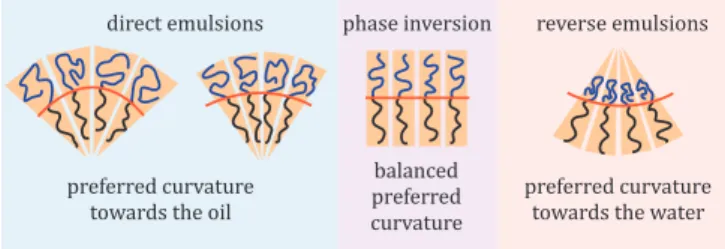
Alternatively, the bottom-up approach consists in gathering molecules together to form droplets. This can be achieved in practice through various precipitation pathways, such as solvent-shifting[2]. Another type of pathway involves surfactant self-assembly. Let us consider a dispersion of surfactant micelles in water. The hydropho-bic core of the micelle could solubilize some oil molecules. This swelling is controlled by the preferred curvature of the surfac-tant layer, which is the curvature that an unconstrained surfacsurfac-tant layer would adopt at its thermodynamic equilibrium. This meso-scopic quantity originates from the balance of intermolecular inter-actions at the interface between the different molecular species: amphiphilic, oil and water molecules, as schemed inFig. 1. The extent of micellar swelling can thus be controlled by tuning the preferred curvature of the surfactant layer. For a given oil/surfactant ratio, there exists a value of the preferred curvature which corresponds to the full solubilization of the oil in the micelles. The system then con-sists in a dispersion of oil-swollen micelles in water, which is called a spherical microemulsion. This spherical microemulsion corresponds to ideal emulsification as all the surfactant is used at the interface and the preferred curvature at which the microemulsion is formed is thus 1/Rgeo. Swollen micellar dispersions are equilibrium systems
but they can be quenched to metastable states, which is one pathway to achieve ideal nanoemulsification. This approach was validated by Olsson and coworkers at large surfactant concentrations [23].
Fig. 1. The preferred curvature of the surfactant layer can be turned towards the oil, yielding direct self-assembly structures and emulsions, or turned towards the water, yielding reverse self-assembly structures and emulsions. Phase inversion occurs when the preferred curvature is zero. The preferred curvature can be tuned for example by changing the interactions between the hydrophilic head and water or adding water to a water deprived surfactant layer.
However, at lower surfactant concentrations, the phase behavior is actually far richer than in this naive picture, due to the for-mation of bicontinuous networks. Rather than forming droplet-like microemulsions at the adequate values of the preferred curvature to solubilize the oil, the geometrical curvature, the system forms bicon-tinuous microemulsions, eventually coexisting with an excess of oil and an excess of water. A thermodynamic explanation behind the formation of these structures has been put forward by Tlusty, Safran and coworkers[37]. Ideal nanoemulsification through equilibrium micellar swelling is thus unachievable over most of the useful sur-factant range due to the formation of these bicontinuous structures. This current opinion focuses on two methods that overcome this limitation through the disruption of bicontinuous structures along non-equilibrium pathways.
3.3. Tuning hydration through temperature changes
Temperature has been an important tool in surfactant sci-ence due to the extensive use of oxyethylene-based surfactants. The hydrophilic head of this class of surfactants dehydrates with increased temperature, which has been explained by a change in its preferential conformation equilibrium induced by temperature[4]. An extensive body of literature is now available on the phase behav-ior of these systems and has been rationalized through the use of the preferred curvature concept. As displayed inFig. 1, the molecu-lar effect of temperature on the hydration of amphiphiles’ hydroplilic head directly translates as a decrease in the surfactant layer’s pre-ferred curvature until a change of its sign, from turned towards the oil to turned towards the water, occurring at a specific temperature, the Phase Inversion Temperature (PIT). This concept enables an easy description of micellar solubilization of oil, which corresponds to the formation of droplet-like microemulsions. Indeed, at low tempera-tures, the hydrophilic heads are strongly hydrated and the preferred curvature is high and turned towards the oil. This preferred cur-vature is by definition the curcur-vature of equilibrium self-assembly structures, surfactant micelles. As the temperature increases, the preferred curvature decreases, which drives micellar swelling. If an excess of oil is available, it can be solubilized in the micellar core. When the preferred curvature has reached a low enough value for the micelles to contain all the oil in their core, an equilibrium one-phase system is obtained. This equilibrium dispersion of swollen micelles is a droplet-like microemulsion. At a set oil/water ratio, it is straightforward to calculate the equation of the equilibrium bound-ary separating the one-phase dispersion of swollen micelles from the two-phase separation of swollen micelles and excess oil, also called the (micro)emulsification failure boundary. Indeed, at this boundary the surfactant layer’s curvature is the geometrical curvature corre-sponding to ideal emulsification. In principle, an easy way to produce a nanoemulsion would be to form the microemulsion and then cool it down quickly enough to bring it into a metastable state where it
would retain its structure for a long time, due to steric repulsions between hydrated oxyethylene layers[23]. However, the formation of bicontinuous networks at low surfactant concentrations prevents ideal emulsification. Since these bicontinuous networks are obtained at low surfactant concentrations, they possess very low preferred curvatures and thus are formed in a temperature range lying in the vicinity of the Phase Inversion Temperature (PIT).
Roger et al. demonstrated that under gentle stirring this compli-cated equilibrium phase behavior was considerably simplified[24, 26]. Indeed, droplet-like microemulsions were obtained on a curve that was the extension at lower surfactant concentrations of the equilibrium droplet-like microemulsion boundary, as displayed in
Fig. 2. Experimentally, this non-equilibrium boundary could be easily determined as a minimum in turbidity and was thus referred to as a “clearing boundary”. Furthermore, this non-equilibrium boundary was also shown to separate successful from unsuccessful emulsifica-tion. At a given composition, a nanoemulsion could only be obtained if the temperature corresponding to this boundary was reached or exceeded. If the temperature remained below, only coarse emul-sions were obtained, whereas a successful emulsification yielded narrow size distributions. Additionally, the experimental droplet size matched the geometrical size predicted for ideal emulsification. The droplet’s curvature was the geometrical curvature and the droplet’s size was thus determined only by a single composition parameter: the oil/surfactant ratio (seeFig. 2). This nanoemulsification method thus makes a fully efficient use of the surfactant, which is a unique feature amongst emulsification methods.
The non-equilibrium solubilization boundary lied in the vicinity of phase inversion, but nonetheless below. This emulsification method was thus termed as a sub-PIT pathway, in order to remove the historical ambiguity of the emulsification by the PIT-method coined by Shinoda and Saito. Phase inversion was thus shown to be irrelevant to the nanoemulsification itself. This assertion was rein-forced by the observation that nanoemulsification occurred only at a precise temperature for a given composition, on the non-equilibrium emulsification boundary. A fragmentation mechanism due to low interfacial tensions can thus be excluded for this nanoemulsifica-tion process. Indeed, nanoemulsificananoemulsifica-tion should become easier as the temperature approaches the PIT, independently of the com-position parameter. Instead, the non-equilibrium emulsification boundary was shown to correspond quantitatively to the match-ing of the geometrical curvature with the preferred curvature. This supports a nanoemulsification mechanism through non-equilibrium self-assembly: disruption of the bicontinuous network coexisting with excess oil and water yields a collection of monodisperse spher-ical droplets if the preferred curvature matches the geometrspher-ical curvature. This process is akin to the formation of an equilibrium droplet-like microemulsion but only occurs outside of equilibrium through a shear-induced disruption of the equilibrium bicontinu-ous network. This behavior was described as superswelling and the non-equilibrium dispersion of oil-superswollen micelles was named a superswollen microemulsion. This “Access State” acts as a template the final nanoemulsion and determines the droplets’ size, which could vary in the 10–100 nm diameter range.
3.4. Tuning hydration through water addition
A more direct approach to changing the surfactant hydration is to add water to a water-deprived oil and surfactant mixture, rather than modifying the intermolecular interactions between the surfactant and water as done when changing temperature. Furthermore this approach is general to all families of surfactant molecules, although restricted to oil in water emulsions.
Starting from a fully dehydrated state, the system can form either an oil and surfactant solution, if the surfactant is soluble in the oil, or phase separates. Water addition will lead to an increase in the
Fig. 2. (A) Cut of the equilibrium phase prism at constant oil/water ratio. The purple dots correspond to the superswelling boundary at which all the oil is solubilized into micelles under shear. The blue line corresponds to the equality between the geometrical curvature and the preferred curvature and matches this experimental superswelling boundary. (B) Mean droplet diameter as a function of the oil/surfactant ratio corresponding to rapid cooling from the purple dots on the superswelling boundary. The orange line represents the calculation of the geometrical radius and also matches the experimental data with no fitting parameter. The insert displays the visual aspect of the sample through the temperature cycle and the corresponding microstructure. Cooling from the superswelling boundary or from above the phase inversion temperature yielded the same nanoemulsion for this pure ternary system C16E8/water/hexadecane.
Source: Data from Roger et al.[24].
surfactant hydration and thus turn progressively the preferred cur-vature from turned towards the water to turned towards the oil. This is very similar to the effect of a change in hydration through tuning the interactions with temperature. The major difference is a concomitant change in the volume fractions upon water addition. A typical sequence of the equilibrium phases will consist in dispersion of water-swollen micelles, followed by a lamellar phase, a bicontin-uous cubic or a bicontinbicontin-uous sponge phase, a hexagonal phase and a dispersion of oil-swollen micelles possibly coexisting with excess oil, as displayed inFig. 3. The Phase Inversion Composition (PIC) will lie in the lamellar phase for which the preferred curvature is essentially zero, which corresponds to a constant surfactant/water
ratio, as observed experimentally (typically 1–2 water molecules per oxyethylene group[25]).
A rapid addition of water results in the formation of fine oil in water nanoemulsions. This pathway has sometimes been described as a catastrophic phase inversion operated by the change in volume fractions, in contrast to a transitional phase inversion, operated by a change in the surfactant layer properties. However, this descrip-tion is not correct as this pathway also corresponds to changes in the surfactant preferred curvature, similarly to the temperature driven pathway. Catastrophic phase inversion exists and can form emul-sions, sometimes multiple ones, but their droplet size is much larger as described by Liu, Friberg and coworkers[38].
Fig. 3. (A) Phase diagram at T = 50◦C of the C16E8/water/hexadecane ternary system. L2: reverse droplet-like microemulsion, La: lamellar phase, L4: direct bicontinuous sponge
phase, V1: bicontinuous cubic phase, H1: hexagonal phase, L1: direct droplet-like microemulsion. (B) Simplified diagram showing in white the initial compositions that lead to a
successful nanoemulsification upon rapid water addition and in gray the unsuccessful ones. The line separating the two domains is the locus of the sponge phase L4. (C) Variation
of the droplet mean diameter with the oil/surfactant ratio in the case of a successful emulsification. This requires a starting composition in the white area of (B) and thus a pathway that crosses the sponge phase. The red line is the calculation from the curvature of the surfactant film in this sponge phase. It matches quantitatively the experimental data with no fitting parameters and thus demonstrates that the sponge phase templates the final nanoemulsion.
Roger, Cabane and Olsson[25]studied this pathway using the same model system as for their study on the sub-PIT pathway. They established the phase diagram at a constant temperature, which is displayed inFig. 3. For a given oil/surfactant ratio, which determine the volume/area ratio, several initial compositions were used prior to water addition. Two cases were observed. If the initial composi-tion contained a little amount of water, a structure mixing oil, water and surfactant at the mesoscopic scale was obtained. The addition of a large amount of water leads to the same nanoemulsion indepen-dently of the initial composition. If the initial composition contained more water, the initial state was a dispersion of oil swollen micelles in water in equilibrium with excess oil. Water addition resulted in a coarse emulsion and not a nanoemulsion.
The most hydrated structure that leads to the formation of a nanoemulsion was the bicontinuous sponge phase, or at higher surfactant fractions the bicontinuous cubic phase. The preferred cur-vature of this sponge phase is already turned towards the oil, as in the final nanoemulsion. The successful nanoemulsification pathway starting from this sponge phase does not involve crossing the phase inversion composition. Indeed, the bicontinuous sponge phase con-tains more water than the phase inversion composition, which lies in the lamellar phase. This nanoemulsification pathway can thus be designated as a sup-PIC pathway. Similarly to the sub-PIT method, the crucial requirement of the pathway is to cross a bicontinuous state, which lies in the vicinity of phase inversion. Phase inversion itself is irrelevant.
Since the sponge phase was located in the phase diagram, the curvature of its surfactant film could be calculated as a function of the oil/surfactant ratio. This curvature was found to quantitatively match the curvature of the nanoemulsion droplets resulting from water addition to the sponge phase (seeFig. 3). This demonstrates that the bicontinuous sponge phase acts as a template and gives access to the final emulsion and it was thus designated as an “access state”. Nanoemulsification proceeds through the templated oil phase separation in a sponge phase followed by further dilution.
3.5. Two different disruptions of bicontinuous structures
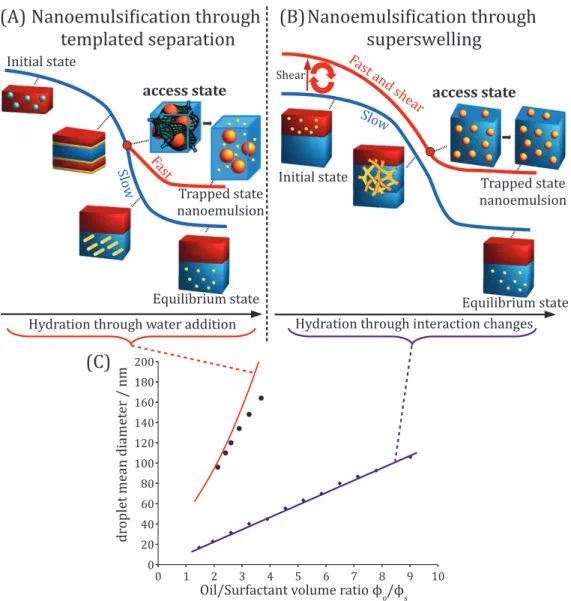
The two methods, through temperature variations and through composition variations, have often been associated as similar. In both cases, the mechanistic studies of these processes show that an equi-librium bicontinuous network is disrupted, either by shear in the sub-PIT pathway or by the addition of water in the sup-PIC path-way (see Fig. 4). However, these studies also reveal an essential difference between the two methods, which results practically in large differences regarding droplet diameter, polydispersity and thus the efficiency of the method. Indeed, the sub-PIT pathway involves the disruption of a bicontinuous network coexisting with excess oil and excess water, at a precise location in the parameter space (composition, temperature). This location corresponds to the equal-isation of the geometrical curvature, which corresponds to ideal emulsification, with the preferred curvature, which is controlled by temperature. The access state is then a superswollen droplet-like microemulsion that directly templates the final nanoemulsion. On the contrary, in the sup-PIC pathway, disruption of the bicontinuous network, with no excess oil or water, occurs through a composition change. The oil phase separates from the network as the preferred curvature increases due to an increase in hydration. This separation is templated by the surfactant film of the collapsing bicontinuous structure, thus yielding a well-defined droplet size. However, the curvature of the surfactant layer in this structure is much lower than the geometrical curvature, as displayed inFig. 4. The droplets are thus much bigger than if the surfactant was efficiently used. The excess surfactant is found in small micelles coexisting with the emulsion droplets.
The detailed mechanistic knowledge that is now available tells us that nanoemulsification through a change in temperature is not equivalent to nanoemulsification through the addition of water. In both cases, nanoemulsions are produced by harvesting the free energy of bicontinuous networks, the structure of which corre-sponds to high interfacial areas and a low preferred curvature, turned towards the oil. However, in the temperature method, it is possible to find a state at which the preferred curvature matches the geo-metrical curvature. The free energy harvest is thus optimal. In the composition method, some of this free energy is lost in the form of surfactant micelles.
4. Practical gains from a mechanistic understanding
These mechanistic insights are not only rich in conceptual impli-cations but also in practical ones. In this section, I will discuss three examples showing how these results could impact the imple-mentation of these low-energy nanoemulsification methods at the lab-scale, to produce model systems, or at the industrial scale, to manufacture emulsions.
4.1. Distinguishing trigger and disruption types: towards tailored methods
One difficulty in the phase inversion terminology is the catego-rization by the trigger type rather than by a mechanistic characteris-tic. As detailed in the previous section, phase inversion is irrelevant and the two historical triggers, temperature and water addition, cor-respond to different mechanisms. However, one should not jump to the conclusion that the first mechanism, the formation of a super-swollen microemulsion, is only achievable by temperature variation. Similarly the addition of water may not only result in the tem-plated phase separation in a bicontinuous sponge phase. Indeed, any change in the preferred curvature at high water content can lead to nanoemulsification according to the superswelling mechanism. This may even occur through water addition.
Let us consider for example the effect of a salt such as sodium chloride on surfactant hydration. Even if the surfactant is uncharged, such as for the polyoxyethylene type, salt will drastically modify the hydrophilic head’s hydration if its concentration is high enough (around 1 mol/liter for non-ionic surfactants). Therefore, at constant temperature and high water content, it is possible to undergo phase inversion by adding salt. Salt behaves exactly like temperature and there is a salt concentration that allows formation of a superswollen microemulsion. If water is added to this superswollen microemul-sion, hydration increases as the salt is diluted and a nanoemulsion is obtained. The mechanism is exactly the same as when changing the temperature in oil/water/polyoxyethelene surfactant systems. But the trigger is water addition, which makes it look like the composition-induced method. Similarly the addition of cold water to a superswollen microemulsion will also result in the obtention of the same nanoemulsion droplets, as with a cooling at constant volume.
In practice, one should identify what modifies the preferred cur-vature of the surfactant layer in order to determine which nanoemul-sification mechanism can be attained, and thus which droplet size and polydispersity. If the curvature is modified through a change in the interaction between the hydrophilic head and water, the mech-anism in place is the formation of a superswollen microemulsion at the exact boundary where the preferred curvature matches the geometrical curvature. Monodisperse emulsions are produced with a fully efficient surfactant use. If the curvature is changed through addition of water molecules to a water-deprived surfactant layer, the mechanism occuring is the templated oil phase separation in a bicontinuous sponge phase. Nanoemulsions with higher polydis-persity and sizes are obtained and some surfactant is wasted into micelles. We are limited only by our creativity to design pathways.
Fig. 4. Summary of the two mechanisms of nanoemulsification through the disruption of bicontinuous structures. Data from Roger et al.[24,25]. (A) Water is added to a homoge-neous bicontinuous network the curvature of which is already turned towards the oil. Oil phase separates within this network and the droplets adopt the sponge phase’s curvature before being trapped in a metastable state by further dilution. Some surfactant is wasted as small micelles in water. (B) The interactions between the surfactant head and water are modified so that the preferred curvature matches the geometrical curvature. Shearing the system in this location of the parameter space breaks the equilibrium bicontinu-ous network coexisting with excess oil and water into a dispersion of oil-superswollen micelles, named superswollen microemulsion. All the surfactant is used at the interfaces. The final nanoemulsion is obtained by trapping this non-equilibrium state through a rapid hydration of the surfactant. (C) Mean droplet diameter for nanoemulsions produced through the two mechanisms. For nanoemulsification through templated phase separation, the diameter is given by the curvature of the sponge phase. Droplets are much smaller for nanoemulsification through superswelling since all the surfactant is efficiently used. The diameter is then given by the geometrical curvature.
4.2. Avoiding phase inversion
Access states, which are the only important states a system must cross to produce a nanoemulsion, lie on the right side of phase inver-sion. The right side means that they correspond to the same sign of the surfactant layer’s preferred curvature as in the final nanoemul-sion. It is thus unnecessary to undergo phase invernanoemul-sion. This is a clear advantage in terms of industrial design since the large changes in fluid properties, such as viscosity and heat capacity, occurring at phase inversion, are challenging process-wise.
4.3. Understanding the problems: what about mixtures?
To finish this current opinion, I would like to emphasize that many decades of research efforts have been necessary to gain a quantitative mechanistic understanding of nanoemulsification in the vicinity of phase inversion. Although seducing for industry, many industrial implementations have been hindered. This is partly
explained by pathways crossing phase inversion and uncertainty regarding the types of triggers and systems that could be used. However, the strongest difficulty probably resides in the use of surfactant mixtures. In their mechanistic studies, Roger, Cabane and Olsson used a pure ternary system, with highly purified surfac-tants. However, in most literature and in the industry, surfactant blends are used. If a system is homogeneous, the surfactant layer consists in the mixture of the system’s different amphiphilic species. However, if the system phase separates, amphiphilic species may segregate. This segregation will depend on the interactions between the different amphiphilic species. Similar amphiphilic species will segregate less than different ones. Crossing the phase inversion is particularly dangerous in terms of phase separation and segrega-tion. Indeed, if the different amphiphilic species are spatially segre-gated in different self-assembly structures, they may not recombine quickly enough to form the access state upon a rapid increase of hydration. This will in turn compromise the nanoemulsification process.
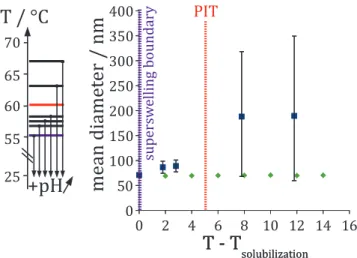
Fig. 5. Original data. Mean diameter of nanoemulsion droplets prepared either by a rapid pH increase in a mixed surfactant system C16E8/oleic acid (blue squares) or a
rapid cooling for a pure surfactant system C16E8(green diamonds), from various initial
states controlled by the temperature. For the pure system, all the initial states located at or above the superswelling boundary give the same nanoemulsion, the droplets of which are at the geometrical curvature. For the mixed system, this ideal nanoemul-sion is only obtained if the starting point is on the superswelling boundary where the access state is formed. If the temperature is increased a few degrees above a coarser emulsion is obtained. If the temperature is increased above the phase inversion, a very coarse emulsion is obtained. Phase inversion is then not only useless but damaging to the success of the process.
I will now provide an original illustration of this concept. If we add an amphiphile such as oleic acid to the water/hexadecane/C16E8
system we add two elements of complexity[39]. The first is the addi-tion of a second amphiphile, which may or may not mix with the other surfactant. The second is the additional pH trigger to tune the surfactant layer’s properties. Indeed, since the hydrophilic head of oleic acid is a carboxylic acid moiety, it will be weakly hydrophilic and uncharged at low pH but conversely very hydrophilic and nega-tively charged at high pH. The addition of oleic acid in its uncharged acidic form will modify the preferred curvature and thus shift down system’s PIT, and thus the location of the superswelling boundary. An increase in pH will shift the PIT up by a much larger factor. Here the experiment will consist in sequentially using the two parameters. Temperature can be used to decide of the initial location: at the exact superswelling boundary, or above it, or above phase inversion tem-perature. In the absence of oleic acid, a rapid cooling from either of these locations would yield the same nanoemulsions as displayed in
Fig. 5by green dots. However, if oleic acid is added and the tempera-ture maintained constant, the addition of a base triggers the sudden increase of the preferred curvature through the conversion of oleic acid into oleate anions. The emulsification’s outcome varies strongly with the initial location, controlled by temperature (Fig. 5). If the starting point is at the superswelling boundary we obtain the exact same nanoemulsion as for the simple temperature quench. How-ever, if the initial location is slightly above, coarser emulsions are obtained. If this initial location is on the other side of phase inversion temperature, then very coarse emulsions are obtained. The droplets are still sub-micronic but they are polydisperse and much larger, indicating an important waste of surfactant. In this case, phase inver-sion is detrimental to the emulsification process. This likely explains some of the difficulties encountered to obtain satisfactory nanoemul-sions using some surfactant blends. Furthermore, this knowledge brings hope to overcome this difficulty since we have now identified the ideal starting location within the parameter space for successful emulsification: the access state.
Acknowledgments
Kevin Roger thanks Bernard Cabane and Ulf Olsson for a fruit-ful and essential collaboration over the years on this topic. Conxita Solans is acknowledged for discussions and feedback on this work and Gwen Christiansen for a careful reading of this manuscript..
References•
[1] Mason TG, Wilking JN, Meleson K, Chang CB, Graves SM. Nanoemulsions: for-mation, structure, and physical properties. J Phys Condens Matter 2006;18: (41)R635.
[2] Botet R, Roger K. How do interactions control droplet size during nanoprecipi-tation? Curr Opin Colloid Interface Sci 2016;1: (1).
[3] Saito H, Shinoda K. The solubilization of hydrocarbons in aqueous solutions of nonionic surfactants. J Colloid Interface Sci 1967;24: (1)10–5.
[4] Lindman B, Medronho B, Karlström G. Clouding of nonionic surfactants. Curr Opin Colloid Interface Sci 2016;22:23–9.
[5•] Lin TJ, Kurihara H, Ohta H. Effects of phase inversion and surfactant location on
the formation of o/w emulsions. J Soc Cosmet Chem 1975;26:121–39.
[6•] Sagitani H. Making homogeneous and fine droplet o/w emulsions using
non-ionic surfactants. J Am Oil Chem Soc 1981;58: (6)738–43.
[7] Salager JL, Miñana-Pérez M, Pérez-Sánchez M, Ramfrez-Gouveia M, Rojas CI. Surfactant oil water systems near the affinity inversion part iii: the two kinds of emulsion inversion. J Dispers Sci Technol 1983;4: (3)313–29.
[8] Förster T, Schambil F, von Rybinski W. Production of fine disperse and long-term stable oil-in-water emulsions by the phase inversion temperature method. J Dispers Sci Technol 1992;13: (2)183–93.
[9•] Förster T, Rybinski WV, Wadle A. Influence of microemulsion phases on the
preparation of fine-disperse emulsions. Adv Colloid Interface Sci 1995;58: (2-3)119–49.
[10] Miñana-perez M, Gutron C, Zundel C, Anderez JM, Salager JL. Miniemulsion for-mation by transitional inversion. J Dispers Sci Technol 1999;20: (3)893–905.
[11] Esquena J, Solans C. Trends in Colloid and Interface Science XII, chapter study of low energy emulsification methods for the preparation of narrow size distribution W/O emulsions. Darmstadt: Steinkopff; 1998,235–9.
[12] Gutiérrez J, González C, Maestro A, Solè I, Pey C, Nolla J. Nano-emulsions: new applications and optimization of their preparation. Curr Opin Colloid Interface Sci 2008;13: (4)245–51.
[13•] Izquierdo P, Esquena J, Tadros TF, Dederen JC, Feng J, Garcia-Celma MJ, Azemar
N, Solans C. Phase behavior and nano-emulsion formation by the phase inver-sion temperature method. Langmuir 2004;20: (16)6594–8. PMID: 15274560.
[14•] Forgiarini A, Esquena J, González C, Solans C. Formation of nano-emulsions
by low-energy emulsification methods at constant temperature. Langmuir 2001;17: (7)2076–83.
[15] Solè I, Maestro A, González C, Solans C, Gutiérrez JM. Optimization of nano-emulsion preparation by low-energy methods in an ionic surfactant system. Langmuir 2006;22: (20)8326–32.
[16] Salager JL, Forgiarini A, Lopez JC, Marfisi S, Alvarez G. Dynamics of near-zero energy emulsification. 2004, http://citeseerx.ist.psu.edu/viewdoc/summary? doi=10.1.1.662.701.
[17] Sajjadi S. Nanoemulsion formation by phase inversion emulsification: on the nature of inversion. Langmuir 2006;22: (13)5597–603. PMID: 16768482.
[18] Anton N, Gayet P, Benoit J-P, Saulnier P. Nano-emulsions and nanocapsules by the {PIT} method: an investigation on the role of the temperature cycling on the emulsion phase inversion. Int J Pharm 2007;344: (1-2)44–52. New Trends in Drug Delivery Systems.
[19] Taisne L, Cabane B. Emulsification and ripening following a temperature quench. Langmuir 1998;14:4744–52.
[20] Sonneville-Aubrun O, Babayan D, Bordeaux D, Lindner P, Rata G, Cabane B. Phase transition pathways for the production of 100 nm oil-in-water emul-sions. Phys Chem Chem Phys 2009;11:101–10.
[21] Fernandez P, André V, Rieger J, Kühnle A. Nano-emulsion formation by emulsion phase inversion. Colloids Surf A Physicochem Eng Asp 2004;251: (1-3)53–8.
[22••] Morris J, Olsson U, Wennerström H. Homogeneous nucleation in a
monodis-perse oil-in-water emulsion. Langmuir February 19 1997;4: (13)606–8.
[23] Olsson U, Bagger-Jörgensen H, Leaver M, Morris J, Mortensen K, Strey R. Formation and dynamics of self-organized structures in surfactants and poly-mer solutions. chapter Stable. metastable and unstable oil-in-water droplets Darmstadt: Steinkopff; 1997. p. 6–13.
[24•] Roger K, Cabane B, Olsson U. Formation of 10-100 nm size-controlled
emulsions through a sub-pit cycle. Langmuir 2010;26: (6)3860–7. PMID: 19899785.
[25••] Roger K, Cabane B, Olsson U. Emulsification through surfactant hydration: the
pic process revisited. Langmuir 2011;27: (2)604–11. PMID: 21171639.
[26•] Roger K, Olsson U, Zackrisson-Oskolkova M, Lindner P, Cabane B. Superswollen
microemulsions stabilized by shear and trapped by a temperature quench. Langmuir 2011;27: (17)10447–54. PMID: 21714541.
[27] Rao J, McClements DJ. Stabilization of phase inversion temperature nanoemul-sions by surfactant displacement. J Agric Food Chem 2010;58: (11)7059–66. PMID: 20476765.
[28] Heunemann P, Prevost S, Grillo I, Marino CM, Meyer J, Gradzielski M. For-mation and structure of slightly anionically charged nanoemulsions obtained by the phase inversion concentration (pic) method. Soft Matter 2011;7:5697–710.
[29] Dario MF, Santos MSCS, Viana AS, Arêas EPG, Bou-Chacra NA, Oliveira MC, Con-ceicção Oliveira M, Minas da Piedade ME, Baby AR, Velasco MVR. A high loaded cationic nanoemulsion for quercetin delivery obtained by sub-pit method. Colloids Surf A Physicochem Eng Asp 2016;489:256–64.
[30] Mei Z, Liu S, Wang L, Jiang J, Xu J, Sun D. Preparation of positively charged oil/water nano-emulsions with a sub-pit method. J Colloid Interface Sci 2011;361: (2)565–72.
[31] Perazzo A, Preziosi V, Guido S. Phase inversion emulsification: current understanding and applications. Adv Colloid Interface Sci 2015;222:581–99. Reinhard Miller, Honorary Issue.
[32] Kumar A, Li S, Cheng C-M, Lee D. Recent developments in phase inversion emulsification. Ind Eng Chem Res 2015;54: (34)8375–96.
[33] Solans C, Izquierdo P, Nolla J, Azemar N, Garcia-Celma M. Nano-emulsions. Curr Opin Colloid Interface Sci 2005;10: (3-4)102–10.
[34•] Solans C, Solé I. Nano-emulsions: formation by low-energy methods. Curr Opin
Colloid Interface Sci 2012;17: (5)246–54.
[35•] Whitesides TH, Ross DS. Experimental and theoretical analysis of the
lim-ited coalescence process: stepwise limlim-ited coalescence. J Colloid Interface Sci 1995;169: (1)48–59.
[36] Taisne L, Walstra P, Cabane B. Transfer of oil between emulsion droplets. J Colloid Interface Sci December 1996;184: (2)378–90.
[37•] Tlusty T, Safran SA. Microemulsion networks: the onset of bicontinuity. J Phys
Condens Matter 2000;12: (8A)A253.
[38] Liu Y, Carter EL, Gordon GV, Feng QJ, Friberg SE. An investigation into the relationship between catastrophic inversion and emulsion phase behaviors. Colloids Surf A Physicochem Eng Asp 2012;399:25–34.
[39] Roger K. Self-assembled nanoemulsions through physico-chemical methods. Ph.D. thesis, . UPMC.; November 2013.