O
pen
A
rchive
T
OULOUSE
A
rchive
O
uverte (
OATAO
)
OATAO is an open access repository that collects the work of Toulouse researchers and
makes it freely available over the web where possible.
This is an author-deposited version published in : http://oatao.univ-toulouse.fr/
Eprints ID : 16597
To link to this article : DOI:10.1002/zaac.201600133
URL : http://dx.doi.org/10.1002/zaac.201600133
To cite this version : Saffon-Merceron, Nathalie and Barthélémy,
Marie-Claire and Laurent, Christophe and Fabing, Isabelle and
Hoffmann, Pascal and Vigroux, Alain An Unusual 3D Zinc-Organic
Framework Constructed from Paddle-Wheel-Based Carboxylate
Sheets Bridged by Acetate Ions. (2016) Zeitschrift für anorganische
und allgemeine Chemie, vol. 642 (n° 11-12). pp. 709-713. ISSN
0044-2313
Any correspondence concerning this service should be sent to the repository
administrator: [email protected]
DOI: 10.1002/zaac.201600133
An Unusual 3D Zinc-Organic Framework Constructed from
Paddle-Wheel-Based Carboxylate Sheets Bridged by Acetate Ions
Nathalie Saffon-Merceron,
[a]Marie-Claire Barthélémy,
[c]Christophe Laurent,
[c]Isabelle Fabing,
[b]Pascal Hoffmann,*
[b]and Alain Vigroux*
[b]Keywords: Metal-organic frameworks; 2,6-Naphthalenedicarboxylate; Zinc; Paddle-wheel MOF; Bridging acetate ligand;
Super-critical CO2activation
Abstract. A zinc-2,6-naphthalenedicarboxylate metal-organic
frame-work, (H2NEt2)[Zn2(AcO)(NDC)2]·nDEF (1) (DEF =
N,N-diethyl-formamide, AcO = acetate), was solvothermally synthesized in the presence of small amounts of acetic acid and characterized by single-crystal and powder X-ray diffraction and thermogravimetric analysis. Compound 1 is an anionic 3D paddle-wheel MOF, in which the zinc-naphthalenedicarboxylate sheets are linked together by bridging
acet-Introduction
Crystalline metal-organic frameworks (MOFs) have at-tracted considerable attention during the last decade largely because they have significantly expanded the potential capa-bilities of classically porous materials such as zeolites, metal oxides, or activated carbons.[1]MOFs are constructed by
join-ing metal-containjoin-ing units, referred to as secondary buildjoin-ing units (SBUs), with organic linkers. The modular assembly of a large variety of metal SBUs and organic linkers has led to more than 20,000 different MOFs being reported and charac-terized within the past decade.[2] The hybrid nature of MOFs
thus provides a wealth of opportunities for discovering intri-guing and fascinating new structures and, more importantly, for engineering new functional materials for a wide range of potential uses including catalysis, separation, gas storage, and drug delivery.[3]
One of the most common SBUs formed by metals and carb-oxylates is the square M2(O2CR)4paddle-wheel unit, in which
two metal atoms are bridged by four carboxylates in syn-syn
* Dr. P. Hoffmann Fax: +33-561-556-011
E-Mail: [email protected] * Prof. Dr. A. Vigroux
E-Mail: [email protected]
[a] UPS, Institut de Chimie de Toulouse, ICT FR 2599 Université de Toulouse,
118 route de Narbonne 31062 Toulouse, France
[b] UPS, LSPCMIB, UMR CNRS 5068 Université de Toulouse,
118 route de Narbonne 31062 Toulouse, France
[c] Institut Carnot CIRIMAT, UMR CNRS UPS INP 5085 Université de Toulouse
118 Route de Narbonne 31062 Toulouse, France
ate ions. Compound 1 exhibits large square channels (13⫻13 Å), which contain DEF molecules and, alternatively, charge-balancing di-ethylammonium cations in situ generated by the hydrolysis of DEF under the solvothermal conditions used. The anionic host framework of 1 is unstable upon removal of guest DEF molecules suggesting that host-guest hydrogen bond interactions are crucial for maintaining the structural integrity of this compound.
mode.[4,5] These paddle-wheel units can be linked into
two-dimensional (2D) networks using linear dicarboxylates. In this case, the axial sites of the SBU are either unoccupied or coor-dinated to terminal capping ligands, typically monodentate neutral molecules. This type of arrangement, in which the pad-dle-wheel SBU acts as a square planar node (with four points of extension) has been observed with many different metal atoms in a vast number of 2D carboxylate MOFs, although zinc and copper are by far the most frequently encountered metals. The square M2(O2CR)4paddle-wheel units can also be
linked into 3D frameworks by using, in addition to linear di-carboxylate linkers, bidentate neutral molecules (typically lin-ear ditopic nitrogen donors). In this case, the paddle-wheel SBU acts as a six-connecting (octahedral) structural unit, in which the axial sites are occupied by the bidentate neutral li-gands acting as pillaring agents, thus extending the 2D metal-dicarboxylate layers into 3D structures. As far as it is known, 2D metal-dicarboxylate sheets have never been reported to link into a 3D framework unless neutral pillaring ligands are pres-ent in the reaction mixture. Herein, the synthesis, structural characterization, and stability of an unprecedented anionic 3D paddle-wheel-based MOF of formula unit (H2NEt2)[Zn2(AcO)
(NDC)2] (1), constructed from the linkage of
zinc-2,6-naph-thalenedicarboxylate (Zn-NDC) layers through axially coordi-nated acetate ions are reported.
Results and Discussion
The extensively studied Zn-aromatic dicarboxylic acid-DEF system (DEF = N,N-diethylformamide) are further explored for the purpose of discovering new zinc-dicarboxylate MOF struc-tures based on commercially available linear dicarboxylate
lin-kers. The synthesis of zinc-dicarboxylate MOFs is frequently performed by heating a mixture of aromatic dicarboxylic acid and zinc(II) nitrate, typically in its hexahydrate or tetrahydrate form, in a system solvent that usually contains N,N-diethylfor-mamide (DEF) or N,N-dimethylforN,N-diethylfor-mamide (DMF). This pro-cedure, when carefully applied to a wide variety of rigid and linear dicarboxylic acids, reliably produces large single crys-tals of isoreticular MOFs (IRMOFs), which consist of Zn4O
units connected by the dicarboxylate struts to form a common cubic topology. IRMOF-1 of formula Zn4O(BDC)3 (BDC =
1,4-benzenedicarboxylate), originally named MOF-5,[6] and
IRMOF-8 of formula Zn4O(NDC)3(NDC =
2,6-naphthalened-icarboxylate) are two representative structures of this series prepared under common solvothermal conditions.[7] Recently,
the effect of adding small amounts of formic acid under the MOF-5 synthesis conditions was explored and the formation of new Zn-BDC MOF structures was discovered.[8] With the
aim of discovering new Zn-NDC based MOFs, the phase selec-tion effect that small amounts of added acetic acid might exert on the NDC-Zn system under solvent and reaction conditions previously described for the preparation of IRMOF-8 was similarly investigated.[7,9–11]
Synthesis of (H2NEt2)[Zn2(AcO)(NDC)2]·nDEF (1)
Initially, IRMOF-8 was synthesized using common solvo-thermal routes in DEF by varying metal:ligand ratios between 2 and 3.5, incubation times between 18 and 36 h, and tempera-ture ranges between 80 and 130 °C.[7,9,12]X-ray diffraction of
the single crystals so obtained indicates that the material corre-sponds to doubly interpenetrated phases of either IRMOF-8 or its recently described analogues.[9–12]When the latter
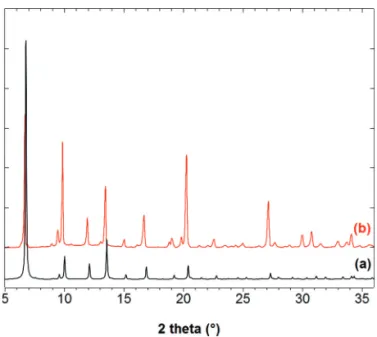
synthe-ses were conducted in the presence of added acetic acid (10 equiv. relative to 2,6-naphthalenedicarboxylic acid), the corresponding IRMOF-8 crystals formed erratically during the heating period. However, within the temperature range of 80 to 130 °C, the absence of crystal formation during the first 5 h of heating was always noticed. It was therefore decided to limit the heating time to 5 h to prevent IRMOF-8 crystals from building up. By carrying out the reaction during 5 h at 130 °C, after cooling to room temperature the slow formation (5–10 d) of colorless needle-like crystals as the unique crystalline prod-uct was observed. Single-crystal and powder X-ray diffraction (PXRD) analyses (Figure 1) indicated that the framework 1 of formula (H2NEt2)[Zn2(AcO)(NDC)2]·nDEF was obtained.
However, it should be noted that small reflections in addition to those expected for phase-pure 1 are observed in Figure 1. The latter are not consistent with the PXRD data of IRMOF-8[9] and could well result from a partial degradation of the
material under the conditions used for recording the PXRD patterns, probably via the adsorption of water molecules con-tained in the air.
Crystal Structure
Single-crystal X-ray diffraction measurements revealed that
1 crystallizes in the tetragonal space group P42/mbc. The
Figure 1. PXRD pattern simulated (1.54056 Å) from the single-crystal
data of 1 (a), and measured (1.541874 Å) from a sample of 1 (b).
asymmetric unit consists of the Zn(AcO)(NDC) motif and a disordered diethylammonium cation arising from the hydroly-sis reaction of DEF. It is indeed well known that formamide-based solvents like DMF or DEF may undergo a significant degree of hydrolysis under solvothermal conditions depending on the initial water content [Equation (1)].
HCONEt2+ H2O씮 HCO2H + HNEt2↔ HCO2–+ H2NEt2+ (1)
It has been shown that anionic MOFs having diethylammo-nium ions as counter-cations can arise either in partially hy-drated DEF[8,13]or in anhydrous DEF to which
diethylammo-nium chloride had been added,[13] suggesting that the
dieth-ylammonium cations (either added or resulting from the hy-drolysis of DEF) play a templating role in the crystallization of anionic networks. Similarly, MOFs having dimethylammo-nium ions as counter-cations have been described as resulting from the hydrolysis reaction of DMF.[13,14]
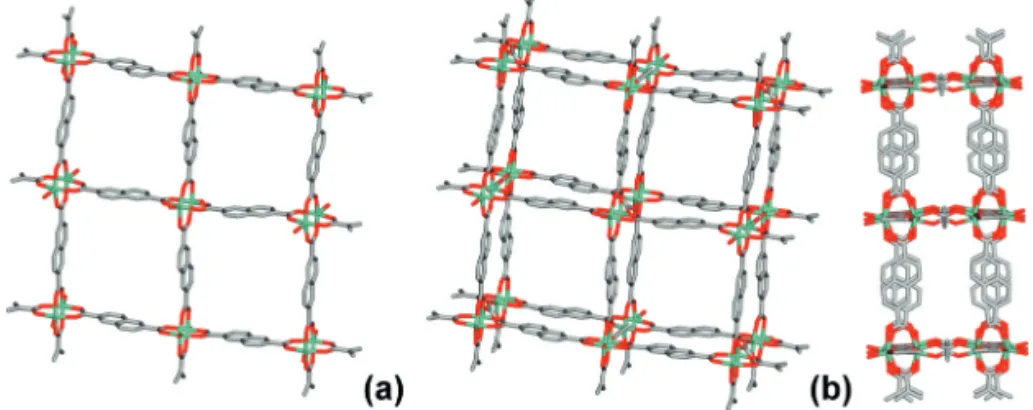
Compound 1 is constructed from dimeric zinc clusters with a typical paddle-wheel structure, which are interconnected by NDC dianions to form a perfect 2D square-grid parallel to the
ab plane. The axial sites of the Zn2 paddle-wheel units are
occupied by acetate ions, which are tightly coordinated to the zinc with a Zn1–O5 distance of 1.95(5) Å. The acetate ions unexpectedly act as bridging agents, thus giving rise to infinite anionic chains along the c axis (Figure 2). As a result, a non-interpenetrated 3D anionic architecture with large square chan-nels of approximate dimensions 13⫻13 Å is created (Fig-ure 3). Within the infinite anionic chains, the two bridging oxygen atoms of acetates are alternatively oriented in opposite directions towards the charge-balancing diethylammonium cat-ions. Consequently, the anionic framework of 1 exhibits chan-nels that are alternatively occupied and unoccupied by the di-ethylammonium counter-cations (Figure 4).
Similarly to diethyl- or dimethylammonium cation, the formate ion derived from hydrolysis of DEF or DMF
Figure 2. View of two adjacent paddle-wheel SBUs of 1
intercon-nected by an acetate ion and its (disordered) diethylammonium counter-cation (color code: Zn: green; C: gray; H: white; N: blue; O: red).
[Equation (1)] may also be found in the resulting frame-work.[8,15] However, in the present case, it is the conjugate
base of added acetic acid, which has served as anionic linker. As far as it is known, compound 1 provides the first reported
Figure 3. Crystal structure of 1 involving 2D paddle-wheel based Zn-NDC layers (a), interconnected by bridging acetates into a 3D framework
(b) (hydrogen atoms and diethyl ammonium cations are omitted. Color code: Zn: green; N: blue; O: red; C: gray).
Figure 4. (a) View of the anionic framework of 1 with channels alternatively occupied and unoccupied by the diethylammonium counter-cations.
(b) Inter-layer acetate linkages involved in framework 1 with the disordered diethylammonium counter-cations. Hydrogen atoms are omitted except for the diethylammonium cations in view (a) (color code: Zn: green; C: gray; H: white; N: blue; O: red).
example of a 3D paddle-wheel-based MOF in which an anion acts as a bridging ligand to extend 2D carboxylate layers into a 3D structure.
Thermogravimetric Analysis (TGA), Flowing SC-CO2 Activation, and N2Adsorption Isotherm
The thermogravimetric analysis (TGA) performed on a sam-ple of as-synthesized 1 showed a continuous mass loss of 45 % in the temperature range 25–270 °C (Figure 5). This mass loss can be assigned to the removal of three DEF molecules and one diethylammonium acetate per formula unit (calcd. 43.8 %). The remaining residue decomposes between 320 °C and 440 °C and, according to PXRD, leads to the formation of ZnO after being heated above 450 °C. The total mass loss of the sample is about 82 %, in accordance with the calculated value of 83.6 % for (H2NEt2)[Zn2(AcO)(NDC)2]·3DEF.
The lack of a well-defined plateau at ca. 30 % mass loss, which would have been consistent with the removal of three DEF molecules and the occurrence of a guest-free 3D frame-work, actually suggests that hydrogen bonded DEF molecules constitute an important element in ensuring the stability of the acetate-based 3D framework of 1. One method to assess the crystallographic aperture of 1 is to measure the BET (Bru-nauer-Emmett-Teller) surface area from a desolvated sample.
Figure 5. TGA curve of as-synthesized 1, revealing a 45 % weight loss
between 18 and 272 °C corresponding to the loss of 3DEF and one diethylammonium acetate (calcd. 43.8 %), and a total weight loss of about 82 % (calcd. 83.6 %) leading to the formation of ZnO in accord-ance with the molecular formula (H2NEt2)[Zn2(AcO)(NDC)2]·3DEF.
For activating 1, it was therefore opted for the recently re-ported flowing supercritical CO2 (SC-CO2) procedure[16]
which is often the only possibility to desolvate fragile frame-works without network transformation.[17] However, as
sug-gested by elemental analysis (refer to Experimental Section) and TGA, activation of 1 by flowing SC-CO2affords a
deacet-ylated sample, referred to as 1-SC, which exhibits a negligible BET surface area of 54 m2·g–1 (Figure 6), revealing a
struc-tural collapse of the framework during DEF removal.
Figure 6. Nitrogen sorption isotherm of 1-SC at 77 K after activation
by flowing SC-CO2[adsorption (⫻) and desorption (O)].
Conclusions
A zinc-2,6-naphthalenedicarboxylate metal-organic frame-work (1) was solvothermally synthesized. Although 1 is based on one of the most common SBUs – the square Zn2(O2CR)4
paddle-wheel unit – it represents the first example of a 3D paddle-wheel MOF, in which the zinc-dicarboxylate sheets are connected into a three-dimensional structure through an ionic bridging agent (i.e., the acetate ion). The resulting an-ionic framework of 1 exhibits large square channels containing DEF molecules and charge-balancing diethylammonium cat-ions. Attempts to remove DEF solvent molecules without dam-aging the three-dimensional framework of 1 were unsuccess-ful, even when the relatively mild conditions of the flowing supercritical CO2 procedure were used. It has been reported
that zinc-paddle-wheel based MOFs frequently undergo partial or complete collapse due to axial ligand exchange or distortion of the dimeric zinc SBU under dry conditions.[18]Such
chemi-cal sensitivity is likely to be even more pronounced for anionic paddle-wheel frameworks like 1 as extra-framework counter-cations also play a crucial role in structural integrity.
Experimental Section
General: All reagents and solvents were purchased from commercial
sources (Sigma Aldrich or Alfa Aesar) and were used without further purification. Synthesis of 1 was carried out in 2–5 mL glass vials. Elemental analyses were measured with a EuroVector EuroEA. Ther-mogravimetric analysis was performed in flowing air (heating rate 3 K·min–1) with a Setaram TAG-16 analyzer. The samples were held
in platinum pans. Micromeritics ASAP 2020 (USA) was used to mea-sure the surface area of the sample using nitrogen adsorption/desorp-tion isotherms. A known amount of sample (49.1 mg) was loaded into the BET sample tube and degassed under vacuum (10–5Torr) at room
temperature for 1 h. The BET specific surface area was calculated from the adsorption isotherm. Single-crystal X-ray diffraction were performed with a Bruker-AXS kappa APEX II Quazar diffractometer with Mo-Kαradiation (λ = 0.71073 Å) at 153(2) K. The powder X-ray
diffraction patterns were collected with an XPert Pro (Theta-Theta mode) Panalytical powder diffractometer with λ (Cu-Kα1, -Kα1) =
1.54059, 1.54439 Å.
Synthesis of (H2NEt2)[Zn2(AcO)(NDC)2]·(DEF)n (1): 2,6-Naph-thalenedicarboxylic acid (H2NDC, 139.7 mg, 0.64 mmol, 1.0 equiv.)
and Zn(NO3)2·6H2O (680.0 mg, 2.24 mmol, 3.5 equiv.) were dissolved
in DEF (16 mL) containing acetic acid (366μL, 10.0 equiv.) and se-aled in a glass vial. The vial was heated to 130 °C for 5 h. After cooling to room temperature, the reaction mixture was allowed to stand 7–10 d until colorless needle-like crystals formed. The crystals were collected by filtration, washed with DEF several times and kept under fresh DEF until required for characterization. Yield: 200 mg (63 % based on H2BDC and n = 3). A number of attempts to obtain
satisfac-tory elemental analysis have proved to be unsuccessful, possibly be-cause of facile solvent loss and concomitant hydration. However, the identity of the as synthesized bulk material was confirmed by compar-ing the X-ray powder diffraction pattern with that simulated from the crystal structure (Figure 1).
Flowing SC-CO2Activation: As synthesized DEF-solvated crystals
of 1 (88.7 mg) were transferred into a 2.1 mm i.d⫻50 mm stainless steel column. The column was connected to a supercritical CO2system
(SFC-PICLAB Analytic apparatus equipped with HPLC K-501 Knauer pumps) with a back pressure regulator set at 100 bar. The CO2was
pumped at a flow rate of 2 mL·min–1 and the column was heated at
35 °C through a column heater. Detection was achieved with a UV/ Vis monitor (Smartline UV 2600 Knauer detector) set at 210 nm. Un-der such conditions, a flowing time of 3 h was required to get zero detection. Thus, after flowing of CO2for 3 h, the flow was stopped
and supercritical CO2in the column was gradually released to
atmo-sphere. The activated sample (1-SC, 59.4 mg) in the column was trans-ferred to a sorption cell in a N2glove box and the surface area was
measured. Elemental analysis for 1-SC (C 49.76, H 3.96, N 2.07 %) is in agreement with the chemical formula Zn2(NDC)2(DEF)(H2O)2
(C29H27NO11Zn2: calcd. C 50.02, H 3.91, N 2.01 %).
Structure Determination and Refinement: Intensity data for
com-pound 1 were collected at a temperature of 153(2) K using Mo-Kα
radiation (wavelength = 0.71073 Å) with a Bruker-AXS APEX II Qua-zar diffractometer using a 30 W air-cooled microfocus source (ImS) with focusing multilayer optics. Phi- and omega scans were used. The data were integrated with SAINT, and an empirical absorption correc-tion with SADABS was applied (SAINT; Bruker AXS Inc.: Madison, Wisconsin, 2000; SADABS, Program for data correction, Bruker-AXS). The structure was solved by direct methods, using SHELXTL Software Package, and refined using the least-squares method on
F2.[19] All non-H atoms were treated anisotropically. The hydrogen
atoms were fixed geometrically and treated as a riding model. The diethylammonium cation was found disordered over two positions. The disorder was modeled using some restraints: SAME, SADI, SIMU, DELU and ISOR. Attempts were made to model the disorder of the solvent (presumably N,N-diethylformamide) but were unsuccessful. Therefore, the SQUEEZE function of PLATON[20]was used to
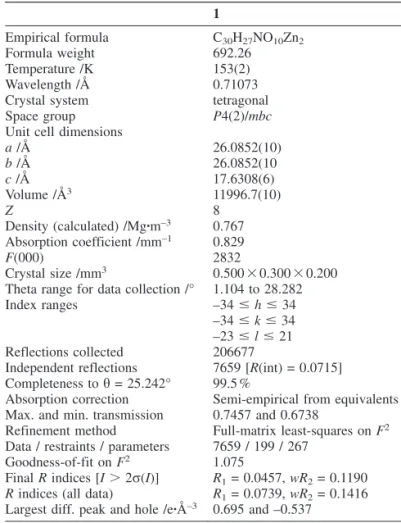
elimin-ate the contribution of the electron density in the solvent region from the intensity data, and the solvent-free model was employed for the final refinement. Crystallographic data and structure refinement results are summarized in Table 1.
Crystallographic data (excluding structure factors) for the structure in this paper have been deposited with the Cambridge Crystallographic Data Centre, CCDC, 12 Union Road, Cambridge CB21EZ, UK. Copies of the data can be obtained free of charge on quoting the depository number CCDC-1403903 for compound 1 (Fax: +44-1223-336-033; E-Mail: [email protected], http://www.ccdc.cam.ac.uk).
References
[1] G. Férey, Chem. Soc. Rev. 2008, 37, 191–214.
[2] H. Furukawa, K. E. Cordova, M. O’Keeffe, O. M. Yaghi, Science
2013, 341, 974–986.
[3] 2012 Metal-organic frameworks issue, Chem. Rev. 2012, 112, 673–1268; http://pubs.acs.org/toc/chreay/112/2.
[4] M. Köberl, M. Cokoja, W. A. Herrmann, F. E. Kühn, Dalton
Trans. 2011, 40, 6834–6859.
[5] S. I. Vagin, A. K. Ott, B. Rieger, Chem. Ing. Tech. 2007, 79, 767– 780.
[6] H. Li, M. Eddaoudi, M. O’Keeffe, O. Yaghi, Nature 1999, 402, 276–279.
[7] M. Eddaoudi, J. Kim, N. Rosi, D. Vodak, M. O’Keeffe, O. M. Yaghi, Science 2002, 295, 469–472.
Table 1. Crystal data and structure refinement for 1. 1
Empirical formula C30H27NO10Zn2
Formula weight 692.26
Temperature /K 153(2)
Wavelength /Å 0.71073
Crystal system tetragonal
Space group P4(2)/mbc
Unit cell dimensions
a /Å 26.0852(10) b /Å 26.0852(10 c /Å 17.6308(6) Volume /Å3 11996.7(10) Z 8 Density (calculated) /Mg·m–3 0.767 Absorption coefficient /mm–1 0.829 F(000) 2832 Crystal size /mm3 0.500⫻0.300 ⫻0.200
Theta range for data collection /° 1.104 to 28.282
Index ranges –34ⱕ h ⱕ 34
–34ⱕ k ⱕ 34 –23ⱕ l ⱕ 21
Reflections collected 206677
Independent reflections 7659 [R(int) = 0.0715] Completeness toθ = 25.242° 99.5 %
Absorption correction Semi-empirical from equivalents Max. and min. transmission 0.7457 and 0.6738
Refinement method Full-matrix least-squares on F2
Data / restraints / parameters 7659 / 199 / 267
Goodness-of-fit on F2 1.075
Final R indices [I⬎ 2σ(I)] R1= 0.0457, wR2= 0.1190
R indices (all data) R1= 0.0739, wR2= 0.1416
Largest diff. peak and hole /e·Å–3 0.695 and –0.537
[8] N. Saffon-Merceron, M.-C. Barthélémy, C. Laurent, I. Fabing, P. Hoffmann, A. Vigroux, Inorg. Chim. Acta 2015, 426, 15–19. [9] J. I. Feldblyum, A. G. Wong-Foy, A. J. Matzger, Chem. Commun.
2012, 48, 9828–9830.
[10] Q. Yao, J. Su, O. Cheung, Q. Liu, N. Hedin, X. Zou, J. Mater.
Chem. 2012, 22, 10345–10351.
[11] J. J. Perry IV, P. L. Feng, S. T. Meek, K. Leong, F. P. Doty, M. D. Allendorf, J. Mater. Chem. 2012, 22, 10235–10248.
[12] A. Dailly, J. J. Vajo, C. C. Ahn, J. Phys. Chem. B 2006, 110, 1099–1101.
[13] A. D. Burrows, K. Cassar, R. M. W. Friend, M. F. Mahon, S. P. Rigby, J. E. Warren, CrystEngComm 2005, 7, 548–550. [14] W. Chen, J.-Y. Wang, C. Chen, Q. Yue, H.-M. Yuan, J.-S. Chen,
S.-N. Wang, Inorg. Chem. 2003, 42, 944–946.
[15] H. F. Clausen, R. D. Poulsen, A. D. Bond, M.-A. S. Chevallier, B. B. Iversen, J. Solid State Chem. 2005, 178, 3342–3351. [16] B. Liu, A. G. Wong-Foy, A. J. Matzger, Chem. Commun. 2013,
49, 1419–1421.
[17] J. E. Mondloch, O. Karagiaridi, O. K. Farha, J. T. Hupp,
Cryst-EngComm 2013, 15, 9258–9264.
[18] J. I. Feldblyum, M. Liu, D. W. Gidley, A. J. Matzger, J. Am.
Chem. Soc. 2011, 133, 18257–18263.
[19] G. M. Sheldrick, Acta Crystallogr. Sect. A 2008, 64, 112–122. [20] A. L. Spek, Acta Crystallogr. Sect. C 2015, 71, 9–18.
![Figure 6. Nitrogen sorption isotherm of 1-SC at 77 K after activation by flowing SC-CO 2 [adsorption ( ⫻) and desorption (O)].](https://thumb-eu.123doks.com/thumbv2/123doknet/3108214.88221/5.975.92.466.834.1199/figure-nitrogen-sorption-isotherm-activation-flowing-adsorption-desorption.webp)