O
pen
A
rchive
T
OULOUSE
A
rchive
O
uverte (
OATAO
)
OATAO is an open access repository that collects the work of Toulouse researchers and makes it freely available over the web where possible.This is an author-deposited version published in : http://oatao.univ-toulouse.fr/ Eprints ID : 17431
To link to this article : URL :
http://www.eurekanetwork.org/sites/default/files/MicroTAS2016_Preliminary Program.pdf
To cite this version :
Iranzo, Audrey and Tzedakis, Théodore and
Chauvet, Fabien Acoustic bubbles microstreaming-induced
fragmentation of ramified iron electrodeposits in a microchannel.
(2016)
Any correspondence concerning this service should be sent to the repository administrator: [email protected]
ACOUSTIC BUBBLES MICROSTREAMING-INDUCED
FRAGMENTATION OF RAMIFIED IRON ELECTRODEPOSITS IN A
MICROCHANNEL
A. Iranzo, T. Tzedakis and F. Chauvet
Laboratoire de Génie Chimique, FERMAT - Université de Toulouse, CNRS-INPT-UPS,
FRANCE
ABSTRACT
We report on the use of a high aspect ratio microchannel (Hele-Shaw’s cell) in which ramified iron deposits are electrochemically formed and next subjected to acoustic vibrations in order to fragment them into fine particles. Both the electrodes and a piezoelectric element are integrated in the microchannel. High speed visualization allows to highlight the key role of the co-produced H2 bubbles
(during the electrodeposition step) which generate microstreaming when subjected to vibrations. The resulting flow pattern sets in motion the ramified iron branches and bring them to bubbles surfaces where they are fragmented into submicrometric particles of iron.
KEYWORDS: Microstreaming, Bubbles Surface Deformations, Electrodeposition, Fragmentation INTRODUCTION
Microstreaming induced by oscillating bubbles subjected to acoustic waves is a well-known phenomenon which is used in microfluidic systems to realize specific operations ([1]) such as particles manipulation, micromixing, micropumping and also deformation/rupture of lipid membranes [2]. Here, we report that the mechanical stresses generated by acoustic microstreaming in a microchannel are also able to efficiently fragment metallic ramified branches made of electrodeposited iron.
EXPERIMENTAL
The microchannel used consists of two 50 µm thick metallic plates (iron or copper electrodes) separated by 9 mm and assembled between a glass plate and a PZT disk (lead/zirconate/titanate piezoelectric, resonance frequency=4 kHz), Figure 1. A typical experimental sequence begins by applying a constant current to electrochemically form the metallic branches arranged in a columnar morphology, Figure 2a. Next, the PZT is activated and the fragmentation process is visualized by a high speed camera, Figures 2b-d. A specific image processing is applied to access the quantity of unfragmented branches as a function of time (Figure 3).
RESULTS AND DISCUSSION
The formation of metallic branches inside the microchannel is achieved using two different iron salts as precursor for metallic ions reduction: FeCl2 and CuSO4. Here, the main difference between
these precursors is that copper presents a more noble character than iron and this induces differences in the reduction process. Indeed, using FeCl2, the reduction of the metallic ions is accompanied by the
reduction of protons leading to the formation of a H2 bubbles network between the branches (Figure
2a), whereas using CuSO4 no bubbles are formed. When activating the PZT without bubbles (copper),
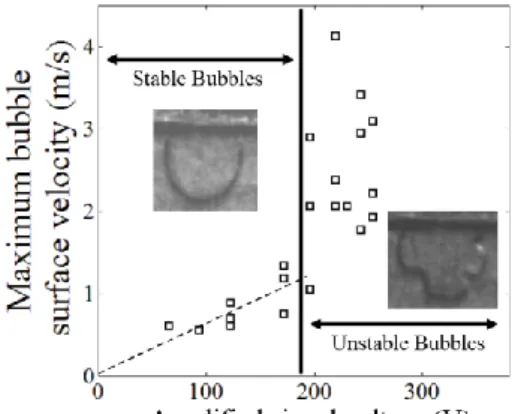
the fluctuations of the microchannel depth (PZT vibration) induce a global fluid motion inside the mi-crochannel not strong enough to totally fragment the metallic branches. In comparison, when bubbles are present (iron), branches disappear quickly and totally, see Figure 3. A typical fragmentation scene, as shown in Figures 2b-d, reveals that branches are transported close to a bubble surface (by a vortex flow of the microstreaming pattern [3,4]) where they are fragmented into fine particles forming a “cloud”. The compressibility of the bubbles allows them to contract/dilate that induces high bubbles surface velocities [3]. Close to the bubbles surface, the resulting viscous shear stress is responsible for the fragmentation of the iron branches. However, such a significant fragmentation is only observed when the bubbles oscillate with surface deformations. We have experimentally characterized the occur-rence of this non-linear regime as function of the voltage, the frequency and the bubbles size. Keeping a constant frequency, maximum surface velocities for bubbles of same size, are plotted as a function of the voltage in Figure 4; the velocity increases linearly for voltages <190 V (quasi-static displacements of the surface) and it could be increased up to 4 times, reaching 4 m/s when surface deformations occur.
This significant velocity increase allows to reach required viscous shear stresses to fragment the branches. The produced-particles size distribution (measured with a morphological optical analyzer Morphologi G3, Malvern) shows a significant proportion of submicrometric particles (not shown).
Figure 1: sketch of the experimental set-up
CONCLUSION
Electrochemically formed iron branches could be fragmented into submicrometric particles in a vibrating and a high aspect ratio microchannel if bubbles are present and if the applied voltage (Vpp) is sufficiently high to induce bubbles surface deformations. The fragmentation of the metallic branches are due to the fast deformations of the instable bubbles surface.
ACKNOWLEDGEMENTS
We thank the Fermat federation for the loan of the high speed camera. REFERENCES
[1] T.M. Squires and S.R. Quake, “Microfluidics: Fluid physics at the nanoliter scale”, Reviews of
Modern Physics, 77(3), 977-1026, 2005
[2] P. Marmottant and S. Hilgenfeldt, “Controlled vesicle deformation and lysis by single oscillating bubbles”, Nature, 423, 153-156, 2003
[3] R.H. Liu, J. Yang, M.Z. Pindera, M. Athavale and P. Grodzinski, “Bubble-induced acoustic mi-cromixing”, Lab on a Chip, 2, 151-157, 2002
[4] J. Collis, R. Manasseh, P. Liovic, P. Tho, A. Ooi, K. Petkovic-Duran and Y. Zhu, “Cavitation microstreaming and stress fields created by microbubbles”, Ultrasonics, 50, 273-279, 2010 CONTACT: F. Chauvet; phone: +33 5 61 55 74 68; [email protected]
Figure 2: a) visualization of the ramified iron branches after the growth step and just before the start of the fragmentation ([FeCl2]=0.1 M, I=1 mA),
b-d) magnified views of a fragmentation scene by oscillating bubbles; red arrows: motion of the branches towards bubbles surface; blue arrows: expulsion of a cloud of particles (Vpp=122 V, f=4 kHz, square wave, 1500 FPS)
Figure 4: maximum bubble surface velocity measured for bubbles of same size (600 µm) as a function of the voltage supplied to the PZT (f=4 kHz); velocities are obtained measuring surface displacements on magnified visualiza-tions of bubbles such as those shown as insets Figure 3: amount of unfragmented branches as a function of time for copper and iron branches ([FeCl2]= [CuSO4]=0.1 M, I=1 mA, Vpp=254 V,