Development of design tools for convection mitigation
techniques to preserve permafrost under northern
transportation infrastructure
Thèse
Xiangbing Kong
Doctorat en génie civil
Philosophiæ doctor (Ph. D.)
Development of design tools for convection mitigation
techniques to preserve permafrost under northern
transportation infrastructure
Thèse
Xiangbing Kong
Sous la direction de :
Guy Doré, directeur de recherche
Fabrice Calmels, codirecteur de recherche
RÉSUMÉ
Les infrastructures de transport jouent un rôle majeur dans le développement socio-économique des régions nordiques. La construction de remblais combinés aux changements climatiques engendrent des impacts négatifs sur le pergélisol sous-jacent, causant la dégradation des infrastructures. Des techniques de mitigation ont été proposées et testées pour limiter la dégradation du pergélisol. Toutefois, il y a peu d'informations disponibles sur les procédures de conception ou sur des lignes directrices. Le but de cette recherche est de développer des outils d'ingénierie améliorés pour les techniques de stabilisation convectives, se concentrant sur le remblai à convection d'air (ACE) et le drain thermique. Plus spécifiquement, l'approche du bilan thermique est proposée pour déterminer la condition thermique de remblais conventionnels et pour permettre la sélection de la technique de mitigation la plus appropriée pour extraire la chaleur en excès transmise au sol, si le système est actuellement instable, ou pour donner un facteur de sécurité considérant une instabilité future estimée. Quatre modèles thermiques ont été développés et calibrés à partir de données mesurées sur des sites expérimentaux. Un abaque de bilan thermique pour les remblais conventionnels ainsi que plusieurs abaques de capacité d'extraction de chaleur pour l'ACE et le drain thermique ont été développés et validés utilisant, respectivement, des simulations numériques et les données de sites d'essais du Yukon et du Nord du Québec, Canada. Ces abaques permettent aux concepteurs et ingénieurs de concevoir des remblais à convection d'air et des drains thermiques optimisés pour limiter, ou même éviter, le dégel du pergélisol à des sites spécifiques.
Mots clés: Dégradation du pergélisol; Infrastructure de transport; Outils de conception; Remblais à convection
ABSTRACT
Transportation infrastructure plays a vital role in the social and economic development of northern regions. The construction of embankments and climate change can lead to negative impacts on the underlying permafrost, causing degradation of the infrastructure. Mitigation techniques have been proposed and tested to limit permafrost degradation. However, there is limited information on the design procedures or guidelines. The purpose of this research is to develop improved engineering tools for convective stabilization techniques, focussing on air convection embankment (ACE) and heat drain. More specifically, the heat balance approach is proposed to determine the thermal condition of conventional embankments and to allow the selection of suitable mitigation techniques to extract the amount of extra heat flowing into the foundation, if the system is currently unstable, or give a safety factor considering estimated future instability. Four thermal models have been built and calibrated with field data from experimental sites. One heat balance chart for conventional embankments and, several heat extraction capacity charts for ACE and heat drain have been developed using numerical simulations and have been validated using data from test sites in Yukon and Northern Quebec, Canada. These charts allow designers and engineers to design optimized ACE and heat drain to limit or even avoid the thawing of permafrost at specific sites.
Keywords: Permafrost degradation; Transportation infrastructure; Design tools; Air convection embankment
TABLE OF CONTENTS
RÉSUMÉ ... ii
ABSTRACT ... iii
TABLE OF CONTENTS ... iv
LIST OF TABLES ... vi
LIST OF FIGURES ... vii
ACKNOWLEDGEMENTS ... iv
FOREWORD... v
General introduction ... 1
Context ...1 Problem description ...1 Thesis organization ...2Chapter 1 Literature review ... 3
1.1 Permafrost ...3
1.2 Permafrost degradation and its effect on transportation infrastructure ...3
1.3 Heat transfer principles ...7
1.4 Mitigation techniques ...10
1.5 Summary of the considerations for method implementation ...26
1.6 Design tools for convective techniques ...30
Chapter 2 Research gaps and project objective ... 34
Chapter 3 Thermal modeling of heat balance through embankments in permafrost regions ... 35
Foreword ...35
Résumé ...35
Abstract ...36
3.1 Introduction ...36
3.2 Study site ...38
3.3 Ground thermal regime ...39
3.4 Numerical simulation ...43
3.5 Analysis, validation and discussion ...50
3.6 Conclusion ...56
Acknowledgements ...57
3.7 References ...57
Chapter 4 Modeling the thermal response of air convection embankment in permafrost regions ... 60
Foreword ...60
Résumé ...60
Abstract ...61
4.1 Introduction ...61
4.2 Site description and ground thermal regime ...63
4.3 Thermal modeling ...67
4.4 Conclusion ...82
Acknowledegments ...83
4.5 References ...83
Chapter 5 Field and numerical studies on the thermal performance of air convection embankment to
protect side slopes in permafrost environments ... 86
5.2 Field site and ground thermal regime ...88
5.3 Thermal modeling ...93
5.4 Analysis, validation and discussion ...97
5.5 Conclusion ... 102
Acknowledgements ... 103
5.6 References ... 103
Chapter 6 Investigation on the heat extraction capacity of the heat drain for thermal stabilization of
embankments on thaw sensitive permafrost ... 106
Foreword ... 106
Résumé ... 106
Abstract ... 107
6.1 Introduction ... 107
6.2 Study site and temperature data measured ... 109
6.3 Numerical simulation ... 113
6.4 Conclusion ... 124
Acknowledgements ... 125
6.5 References ... 125
Chapter 7 Thermal stabilization of embankments built on thaw sensitive permafrost ... 128
Foreword ... 128
Résumé ... 128
Abstract ... 128
7.1 Introduction ... 129
7.2 Methodology ... 129
7.3 Development of analysis and design charts for embankment built on thaw sensitive permafrost ... 131
7.4 Practical engineering application ... 139
7.5 Conclusion ... 141
Acknowledgements ... 141
7.6 References ... 141
Chapter 8 Discussion ... 143
8.1 Research critical review ... 143
8.2 Additional research ... 144 8.3 Practical application ... 146
Conclusion ... 148
Bibliographie ... 150
Appendix A ... 155
Appendix B ... 164
Appendix C ... 167
LIST OF TABLES
Table 1. 1: Values of shape factor, (Goering, 2002). ... 13
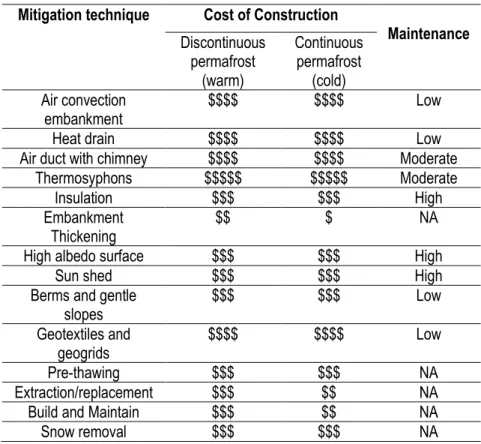
Table 1. 2: Applicability, cost and maintenance (McGregor et al., 2010). ... 26
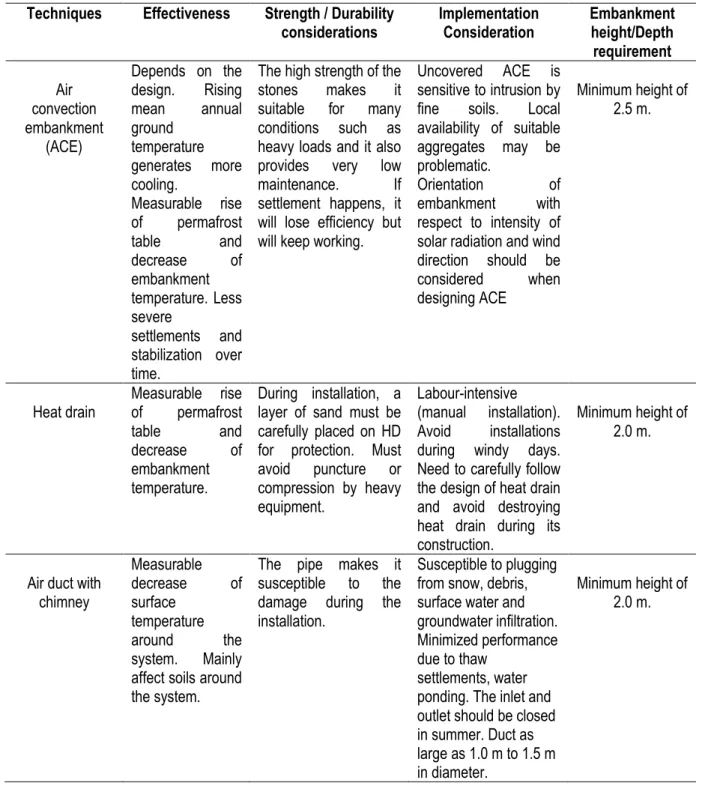
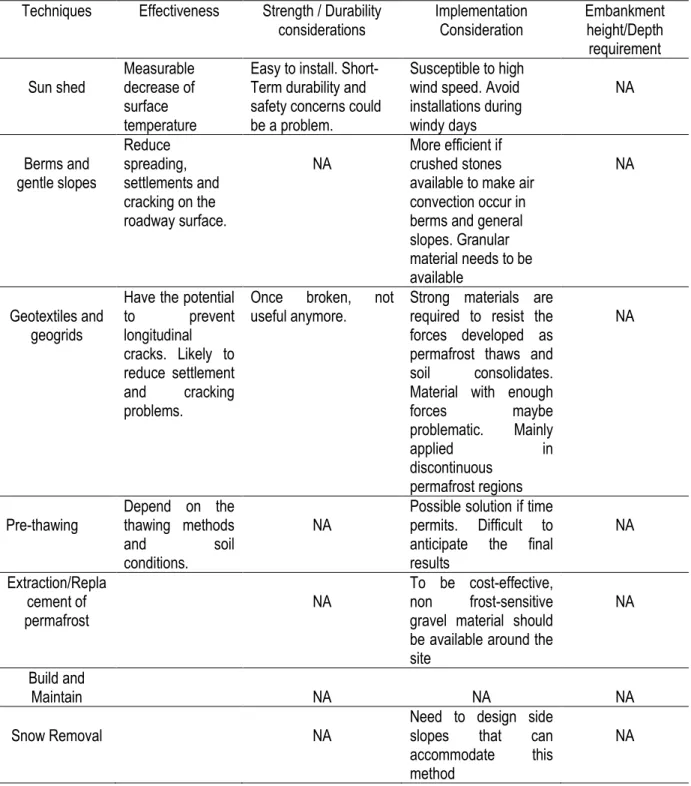
Table 1. 3: Effectiveness, implementation considerations, height requirements and strength/durability considerations (Calmels et al., 2016). ... 27
Table 3. 1: The values of experimental parameters. ... 44
Table 3. 2: Physical parameters measured in the foundation soil at Beaver Creek (de Grandpré et al., 2012). ... 45
Table 3. 3: Summary of model iterations. ... 47
Table 3. 4: N-factor used in I2. ... 48
Table 3. 5: Final determined n-factor for different thermal boundaries. ... 48
Table 3. 6: Regression equations between heat balance at the embankment-soil interface, embankment thickness and thermal gradient. ... 52
Table 4. 1: Material properties for the ACE layer and foundation soil. ... 72
Table 4. 2: Summary of n-factor values used in the thermal model. ... 73
Table 4. 3: Relationships between heat extraction capacity at the embankment-soil interface, embankment thickness and temperature difference (T) between MAWAT and permafrost temperature. ... 81
Table 5. 1: Material properties for the rock layer and non-rock layer. ... 94
Table 5. 2: Summary of n-factor used in the model. ... 95
Table 5. 3: Regression equations between heat extraction capacity of shoulder ACE at the embankment-soil interface, embankment thickness and temperature difference (ΔT) between MAWAT and permafrost temperature. ... 100
Table 5. 4: Regression equations between heat balance at the embankment-soil interface, embankment thickness and thermal gradient for conventional embankments... 101
Table 6. 1: Thermal properties used in the model. ... 116
Table 6. 2: Summary of n-factor used in the model. ... 118
Table A. 1: Description of tested mitigation techniques at Beaver Creek site (modified from M-Lepage, 2015). ... 156
Table C. 1: Regression equations between heat balance at the embankment-soil interface, embankment thickness and thermal gradient. ... 168
Table C. 2: Relationships between heat extraction capacity at the embankment-soil interface, embankment thickness and temperature difference (T) between MAWAT and permafrost temperature. ... 169
LIST OF FIGURES
Figure 1. 1: Concepts of permafrost degradation due to the construction of transportation infrastructure... 4
Figure 1. 2: Increase of mean annual air temperature in Alaska, Canada and Russia (modified from Hinzman et al., 2005). ... 5
Figure 1. 3: Predicted surface air temperature change (Assessment, A. C. I., 2004). ... 5
Figure 1. 4: Permafrost hazard potential in the northern hemisphere (yellow: undifferentiated roads and trails; blue: railroads; red: airfields) (Nelson et al., 2001). ... 6
Figure 1. 5: Engineering problems: a) sinkhole; b) longitudinal cracking; c) guardrail sinking. ... 6
Figure 1. 6: Differential settlement. ... 7
Figure 1. 7: Heat transfer modes in a porous medium with a relation to particle size and degree of water saturation (Côté et al., 2011, cited from Johansen, 1975). 1- conduction, 2- redistribution of moisture, 3- vapour distribution due to the moisture gradient, 4- free (natural) convection in water, 5- free (natural) air convection, 6-heat radiation. ... 7
Figure 1. 8: Influence of temperature and soil types on uniaxial compression strength of three typical soils (modified from Andersland and Ladanyi, 2004). ... 11
Figure 1. 9: Schematic of wintertime pore air circulation in the ACE (Goering, 2003). ... 12
Figure 1. 10: Four ACE configurations. ... 14
Figure 1. 11: Air duct systems (a) used along Alaska Highway in North America; (b) used along Qinghai-Tibet railway in China. ... 16
Figure 1. 12: heat drain; a) 25 mm-thick heat drain made of a corrugated plastic core covered by geotextile (Beaulac, 2006); b) Schematic diagram in the shoulder of embankments (Jørgensen et al., 2008). ... 17
Figure 1. 13: Installing heat drain in the shoulder of Tasiujaq airstrip, Northern Quebec, Canada. ... 18
Figure 1. 14: Installing heat drain in the shoulder of the embankment at Salluit, Northern Quebec, Canada. ... 18
Figure 1. 15: The working principle of thermosyphon (Doré and Zubeck, 2009). ... 19
Figure 1. 16: Four types of thermosyphons: a) Thermopile; b) Vertical; c) Sloped; d) Flat looped (Canadian Standards Association, 2014). ... 20
Figure 1. 17: Installation of thermosyphons by Arctic Foundation Inc in Alaska (Wagner, 2014). ... 21
Figure 1. 18: Hairpin thermosyphons (McGregor et al., 2010). ... 21
Figure 1. 19: The thermal imped of heat transfer in the embankment fill (Doré and Zubeck, 2009). ... 22
Figure 1. 20: Illustrations of the design Microsoft Excel spreadsheet proposed by University of Alaska Fairbanks. . 32
Figure 1. 21: Temperature difference triggering air convection (Sun et al., 2005)... 33
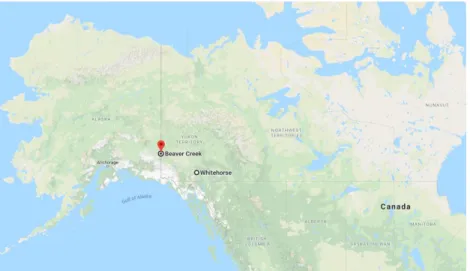
Figure 3. 1: The location of the Beaver Creek experimental site, along the Alaska Highway, Yukon, Canada (Source: GoogleEarth). ... 39
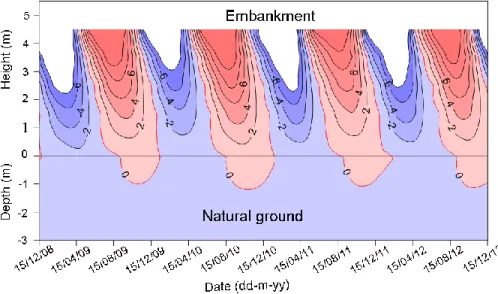
Figure 3. 2: Thermal behavior of the Beaver Creek experimental embankment under the centerline of the reference section (BH1)... 40
Figure 3. 3: Mean annual ground temperature (MAGT) envelope under the centerline of the reference section (BH1) in 2010... 41
Figure 3. 4: Mean annual ground temperature (MAGT) profiles with depth under the centerline of the reference section (BH1) from 2009 to 2012. ... 41
Figure 3. 5: Temperature profiles on November 5th along the depth in the side slopes of the reference section (BH2) from 2009 to 2012. ... 42
Figure 3. 6: Temperature profiles on November 5th along the depth at the toe of the reference section (BH3) from 2009 to 2012. ... 42
Figure 3. 7: The physical domain of the embankment and foundation. ... 43
Figure 3. 8: Thermal functions used in the model: (a) unfrozen water content versus temperature for silt; (b) thermal conductivity and heat capacity for silt (Johansen, 1975). ... 45
Figure 3. 9: Graphical comparison between measured air temperature and simulated sinusoidal temperature. ... 46
Figure 3. 10: Comparison of 4-year average temperature profiles with depth at the centerline of the embankment measured at the site and obtained with simulations I2, I2a, and I2b. ... 49 Figure 3. 11: Comparison of maximum, minimum and average temperature profiles with depth at the centerline
thermal gradient. ... 53
Figure 3. 13: Critical thermal gradient as a function of embankment thickness. ... 53
Figure 3. 14: Validation of heat balance using Tasiujaq airstrip temperature data. ... 54
Figure 3. 15: Evolution of the active layer thickness with time at the centerline of Tasiujaq airstrip. ... 55
Figure 3. 16: Evolution of ground temperature at the depth of 9.0 m below embankment surface at the centerline of Tasiujaq airstrip. ... 55
Figure 4. 1: The location of the Beaver Creek experimental site, along the Alaska Highway, Yukon, Canada (Lipovsky, 2015). ... 64
Figure 4. 2: Air convection embankment (ACE) at Beaver Creek, Yukon: a) diagram of the ACE; b) during the construction of the ACE; c) after the construction of the ACE. ... 65
Figure 4. 3: Evolution of embankment and ground temperature with time under the centerline for the ACE section at the Beaver Creek experimental site. ... 66
Figure 4. 4: Natural ground temperatures variation with time at -2.5 m under the centerline of the ACE section. ... 67
Figure 4. 5: Evolution of embankment and ground temperature with time under the side slope for the ACE section at the Thermal behavior of the Beaver Creek experimental site. ... 67
Figure 4. 6: Physical domain of the embankment and foundation (unit: m). ... 69
Figure 4. 7: Thermal conductivity of crushed rocks, considering thermal radiation. ... 70
Figure 4. 8: Comparison between measured air temperature and simulated sinusoidal temperature. ... 73
Figure 4. 9: Comparison of measured mean annual soil temperatures and simulated mean annual soil temperatures under the centerline of the ACE in 2009 and 2013. ... 75
Figure 4. 11: Comparison of measured soil temperatures and simulated soil temperatures under the centerline of the ACE in: a) December 2013; and b) July 2013. ... 77
Figure 4. 12: Comparison of measured soil temperatures and simulated soil temperatures under the side slope of the ACE in: a) December 2013; and b) July 2013. ... 77
Figure 4. 13: Comparison of heat balance based on the calibrated model and field data under the centerline. ... 79
Figure 4. 14: Heat extraction capacity of the ACE at the embankment-soil interface as a function of embankment thickness and temperature difference (T) between MAWAT and permafrost temperature. ... 81
Figure 4. 15: Heat balance chart at the embankment-soil interface as a function of embankment thickness (H) and thermal gradient in the ground (a); Heat extraction capacity chart for the ACE at the embankment-soil interface as a function of embankment thickness and temperature difference (T) between MAWAT and permafrost temperature (b). ... 81
Figure 5. 1: The location of the Beaver Creek experimental site, Yukon, Canada (Lipovsky, 2015). ... 89
Figure 5. 2: The shoulder ACE section at Beaver Creek, Yukon. (a) General view; (b) Typical rock diameter. ... 90
Figure 5. 3: Thermal behavior of the Beaver Creek experimental embankment under the side slope of the embankment (BH2). ... 91
Figure 5. 4: Thermal behavior of the Beaver Creek experimental embankment under the centerline of the embankment (BH1). ... 91
Figure 5. 5: Mean monthly ground temperature at the embankment-soil interface under the side slope of the embankment (BH2). ... 92
Figure 5. 6: Mean monthly ground temperature at the embankment-soil interface under the centerline of the embankment (BH1). ... 92
Figure 5. 7: Physical domain of the embankment and subgrade (unit: m). ... 93
Figure 5. 8: Comparison between the measured air temperature and simulated sinusoidal temperature. ... 94
Figure 5. 9: Comparison of MAGT profile and modeled MAGT profile with depth under the side slope (BH2) in 2009 and 2013. ... 96
Figure 5. 10: Comparison of measured temperature profile and modeled temperature profile with depth under the side slope (BH2) in: a) January 2012; b) July 2012... 97
Figure 5. 11: Comparison of measured temperature profile and modeled temperature profile under the centerline (BH1) in: a) January 2012; b) July 2012. ... 97
Figure 5. 12: Schematic of heat extraction index and induction index in the ground in one year. ... 98 Figure 5. 13: Heat extraction capacity of shoulder ACE through the embankment-soil interface as a function of
thermal gradient. ... 101
Figure 5. 15: Evolution of ground temperature at the depth of 2.5 m below the ground surface at Puvirnitup airstrip, Northern Quebec, Canada. ... 102
Figure 6. 1: The location of Tasiujaq experimental site, Northern Quebec, Canada (Source: GoogleEarth). ... 109
Figure 6. 2: Heat drain installed at Tasiujaq airstrip, Northern Quebec, Canada. (a) heat drain; (b) during the installation; (c) layers of sand under and above. ... 110
Figure 6. 3: Net air index measured from 2008 to 2011 at Tasiujaq airstrip, Northern Quebec, Canada. ... 111
Figure 6. 4: Monthly averaged temperature difference between air outlet and inlet from January to December 2009. ... 112
Figure 6. 5: Measured temperature profiles with depth under the side slope in 2009. ... 112
Figure 6. 6: Thermal behavior of the embankment fill and foundation soil under the side slope... 113
Figure 6. 7: The physical domain of the embankment and foundation. ... 116
Figure 6. 8: Comparison between measured air temperature and simulated sinusoidal temperature. ... 117
Figure 6. 9: Measured mean annual ground temperatures and modeled mean annual ground temperatures at the embankment-soil interface, from 2008 to 2011. ... 119
Figure 6. 10: Comparison between the field data and numerical simulation of the maximum, minimum and average temperature profiles with depth, in the side slope, in 2009. ... 119
Figure 6. 11: Heat extraction capacity of heat drain at the embankment-soil interface as a function of the embankment thickness, heat drain length (L) and temperature difference ( ΔT ) between MAWAT and permafrost temperature. ... 122
Figure 6. 12: The view of the roadway with heat drain installed in the shoulder at Salluit, Northern Quebec, Canada, providing the validation data. ... 122
Figure 6. 13: Comparison of modeled long-term heat extraction capacity and measured three years’ heat exaction capacity of heat drain, in the shoulder of the road embankment of Salluit. ... 123
Figure 6. 14: Validation of heat extraction capacity using Salluit temperature data. ... 123
Figure 6. 15: Evolution of ground temperature at the depth of 3.0 m below the embankment-soil interface under the side slope of embankment at Salluit, Northern Quebec, Canada. ... 124
Figure 7. 1: Principle of thermal stabilization. ... 130
Figure 7. 2: Experimental gentle slope built on the Tasiujaq airstrip in Nunavik, Quebec. ... 131
Figure 7. 3: Calibration of a 2D thermal model using thermal data collected at the Tasiujaq test site. ... 132
Figure 7. 4: Design chart for the selection of embankment slope for thermal stabilization under the center of the slope using the ITC method. ... 132
Figure 7. 5: SM (safety margin) as a function of the increase in mean annual air temperature (MAAT). ... 133
Figure 7. 6: High albedo surface with the cool gray colour on bituminous surface treatment (BST) on a test site on the Alaska highway in Yukon. ... 134
Figure 7. 7: Comparison between the field data and numerical simulation for maximum, minimum and average temperature profiles with depth for high albedo surfaces. ... 134
Figure 7. 8: Albedo required to stabilize permafrost as a function of embankment thickness (H) and required ITC (Richard 2018)... 135
Figure 7. 9: SM (safety margin) as a function of the increase in mean annual air temperature (MAAT) and embankment thickness (H) for the albedo surface. ... 135
Figure 7. 10: ACEs at the Beaver Creek experimental site: a) ACE on side slopes uncovered; b) Full-width ACE during construction. ... 136
Figure 7. 11: Comparison of maximum, minimum and average temperature profiles with depth between the field data and numerical simulation for: a) Full-width ACE under the centerline; b) ACE on side slopes uncovered under the side slope. ... 137
Figure 7. 12: Heat extraction capacity at the embankment-soil interface as a function of embankment thickness and temperature difference (ΔT) between MAWAT and permafrost temperature for: a) Full-width ACE under the centerline; b) ACE on side slopes under the center of the slope. ... 137
Figure 7. 13: Heat drain: a) placed in the shoulder of an embankment (Beaulac, 2006); b) the geocomposite used to drain heat; c) under construction in the shoulder of the Tasiujaq airstrip, Northern Quebec, Canada. ... 138 Figure 7. 14: Comparison of maximum, minimum and average temperature profiles with depth between the field
Figure 7. 15: Heat extraction capacity of the heat drain at the embankment-soil interface as a function of embankment thickness, length of the flat portion of the heat drain (L) and temperature difference (ΔT)
between MAWAT and permafrost temperature. ... 139
Figure 7. 16: Example of thermal analysis of embankment stability under the side slope: a) heat balance assessment chart for conventional embankments; b) heat extraction capacity chart for ACE on side slopes. ... 140
Figure 8. 1: Engineering design charts under the side slope: a) heat balance chart for conventional embankments; b) heat extraction capacity chart for ACE on side slopes. ... 147
Figure A. 1: The location of the Beaver Creek experimental site, along the Alaska Highway, Yukon, Canada (Lipovsky, 2015). ... 155
Figure A. 2: The experimental test site at Beaver Creek, Yukon. ... 155
Figure A. 3: Schematic of Beaver Creek experimental site – Section 4 and 5 were interchanged (see red arrow) during the construction. Yellow point: borehole positions (modified from M-Lepage, 2015). ... 156
Figure A. 4: Full air convection embankment (S1) a) during construction; b) after construction. ... 157
Figure A. 5: Heat drain across the whole embankment (S2) a) during construction; b) after construction. ... 158
Figure A. 6: ACE on side slopes covered (S3) a) during construction; b) after construction. ... 159
Figure A. 7: Heat drain in the side slope (S4) a) during the construction; b) after the construction. ... 159
Figure A. 8: Control section (S5). ... 160
Figure A. 9: Snow/sun shed (S6) after construction. ... 160
Figure A. 10: Longitudinal culvert (S7) a) during construction; b) after construction. ... 161
Figure A. 11: Heat drain in side slopes with insulation (S8) a) during construction; b) after construction. ... 161
Figure A. 12: Air convection embankment on side slopes uncovered (S9) after construction. ... 162
Figure A. 13: Snow cleaning technique (S10) after construction. ... 162
Figure A. 14: Grass-covered embankment on the side slope (S11) after construction. ... 162
Figure A. 15: High albedo surface (S12) after construction... 163
Figure B. 1: The location of the Tasiujaq Airstrip test site, Northern Quebec (Doré et al., 2007). ... 164
Figure B. 2: The location of the experimental techniques along Tasiujaq Airstrip (Ficheur and Doré 2010). ... 164
Figure B. 3: Schematic illustration of the Tasiujaq Airstrip test site, Northern Quebec (Doré et al., 2012). ... 165
Figure B. 4: Construction of the gentle slope (8H:1V) (Doré et al., 2007). ... 165
Figure B. 5: Construction of the air convection embankment (Doré et al., 2012). ... 165
Figure B. 6: Installation of the heat drain (Doré et al., 2012)... 166
Figure C. 1: Heat balance through the embankment-soil interface at the centerline of the embankment as a function of embankment thickness (H) and thermal gradient. ... 167
Figure C. 2: Heat balance through the embankment-soil interface at the side slope of the embankment as a function of the embankment thickness (H) and thermal gradient. ... 167
Figure C. 3: Heat extraction capacity of the full ACE at the embankment-soil interface as a function of embankment thickness and temperature difference (T) between MAWAT and permafrost temperature. ... 168
Figure C. 4: Heat extraction capacity of the shoulder ACE through the embankment-soil interface as a function of embankment thickness and temperature difference (ΔT) between MAWAT and permafrost temperature. .. 169
Figure C. 5: Heat extraction capacity of heat drain at the embankment-soil interface as a function of the embankment thickness, heat drain length (L) and temperature difference (T) between MAWAT and permafrost temperature. ... 170
ACKNOWLEDGEMENTS
First of all, I would like to thank my supervisor Prof. Guy Doré for the research project opportunity and also for being patient and supportive in the research progress. Thank you very much for giving me all this time to proceed and for the valuable research discussion and guidance through my project. I really appreciate the chance I had to work with Prof. Guy Doré, and this is one of the best decisions in my life.
I also want to thank my co-supervisor Dr. Fabrice Calmels (Yukon College) for the research meeting, discussion and enthusiastic comments that contributed to improving the research project. The research discussions with you are an invaluable part of this project and they are inspirational. Thank you for your time and your excellent knowledge of permafrost.
I also thank Mrs. Chantal Lemieux for her research advice, technical support and document review. During the study, she gives tremendous help. I also thank Mr. Jean-Pascal Bilodeau for his passions on research, which is really encouraging. Talking with them created favourable conditions during the whole Ph.D. study.
I warmly thank every ARQULUK fellow student. The discussions and help from them are tremendous to me. Special thanks to Dr. Heather Brooks for the kindly research skills sharing and personal talking on many related topics in the process of research project. Also thanks to ARQULUK partners for supporting the research program.
I extend my sincere thanks to my parents, brothers and grandma for the family support. Without their encouragements, it would have been hard for me to finish my Ph.D. project.
FOREWORD
This thesis is in a paper-based format and it includes 8 chapters. Chapter 1 presents the state of knowledge related to this project. Chapter 2 identifies the knowledge gaps and states the objective of this project. Chapter 3 to 7 include five peer-reviewed papers. Chapter 8 and Conclusion present the discussion and conclusion obtained from this project. The papers included in this thesis are:
Chapter 3
Kong, X., Doré, G., Calmels, F. (2019). Thermal modeling of heat balance through embankments in permafrost regions. Cold Regions Science and Technology, 158, 117-127.
Chapter 4
Kong, X., Doré, G., Calmels, F., Lemieux C. Modeling the thermal response of air convection embankment in permafrost regions. Cold Regions Science and Technology. (under review, should be accepted with minor modifications required from the editor).
Chapter 5
Kong, X., Doré, G., Calmels, F., Lemieux C. Field and numerical studies on the thermal performance of air convection embankment to protect side slopes in permafrost environments. Cold Regions Science and Technology. (under review).
Chapter 6
Kong, X., Doré, G., Calmels, F., Lemieux C. Investigation on the heat extraction capacity of the heat drain for thermal stabilization of embankments on thaw sensitive permafrost. Cold Regions Science and Technology. (under review).
Chapter 7
Kong, X., Doré, G. Thermal stabilization of embankments built on thaw sensitive permafrost. Journal of Cold Regions Engineering. (under review).
these papers mainly oversaw the work, reviewed the contexts and improved the research methodology and results analysis and presentation.
General introduction
Context
This project is part of the ARQULUK northern engineering research program, chaired by Prof. Guy Doré at the Department of Civil and Water Engineering of Université Laval. The program focused on the development of innovative tools to support designing and managing transportation infrastructure built on permafrost, considering climate change. The research program’s objectives were to develop a better understanding of factors contributing to permafrost degradation, improve investigation techniques for thaw-sensitive permafrost to locate and characterize problem areas, and develop cost-effective protection techniques.
This project is part of the last objective and has developed design tools for convection mitigation techniques to limit permafrost degradation and thus preserving northern infrastructure.
Problem description
Permafrost underlies about 24% of the northern hemisphere's land surface (Brown, 1997) and permafrost is important to be considered when designing transportation infrastructure. Permafrost is often ice-rich and sensitive to changes in its thermal regime. The construction of infrastructure embankments and climate change disturb the thermal equilibrium, leading to a larger amount of heat flowing into the foundation. Permafrost degradation is problematic for infrastructure stability, mostly due to the risk of excessive thaw settlements. The two main types of engineering problems related to permafrost degradation are the differential settlements and the lateral spreading. Those can affect the comfort and safety of road users, as well as increase maintenance cost.
Linear infrastructure built on permafrost is commonly affected by the deformations resulting from the thawing of underlying frozen soils in permafrost regions (Kondratiev, 2010). Ground thermal regime equilibrium requires approximately 3 years in the case of the summer construction, or up to 5 years for the winter construction conditions (Lingnau, 1985). In order to prevent dramatic thawing of permafrost, road construction strategies must be adapted to northern environments (M-Lepage et al., 2012). Global warming is happening at a fast rate in Arctic areas with air temperature increasing at least 1.5 to 2 times larger than in the rest of the word (Kaplan and New, 2006). However, the effect of global warming was seldom considered in the design of civil infrastructure (Doré et al., 2016). Under such conditions, much of the northern civil infrastructure is located in the high hazard region (Nelson et al., 2001). As a result, maintenance and design practices will be impacted by climate change (Warren et al., 2004).
New knowledge and better understanding of permafrost degradation and mitigation techniques to limit or even avoid permafrost degradation are required to secure the stability of civil infrastructure in northern regions, in response to climate change.
Thesis organization
This thesis is in the paper-based format, and it includes 8 chapters. Each peer-reviewed paper has a research background and the state of knowledge in Chapter 1 may have some repetitions in peer-reviewed papers. The content of each chapter is presented in the following paragraphs:
Chapter 1 presents the state of knowledge related to this project, including permafrost, permafrost degradation and its associated effect on transportation infrastructure, heat transfer principles, mitigation techniques, method application considerations and available design tools for methods based on natural convection. Chapter 2 identifies the knowledge gaps and states the objective of this project.
Chapters 3 to 7 include the five peer-reviewed papers. Chapter 3 was published in the journal “Cold Regions Science and Technology”. Chapters 4, 5 and 6 have been submitted to the journal “Cold Regions Science and Technology”, and they are at different states of the review process.Chapter 7 has been submitted to Journal of Cold Regions Engineering. In each paper (Chapters 3 to 6), data measured on field sites are first analyzed to determine the ground thermal regime. Then, one model is developed and described in detail, including material types and properties, meshing and boundary conditions. The models have been calibrated to the measured data and validated using additional data from other field sites. The methodology used assured the reliability of heat balance charts and heat extraction capacity charts developed as part of the project.
Chapter 8 presents the discussion including a research critical review, a description of practical engineering application, and recommendations for future research.
Chapter 1 Literature review
1.1 Permafrost
Frozen ground is generally classified into two categories: seasonally frozen ground with freezing and thawing on an annual base, and perennially frozen ground. Permafrost refers to soil, rock, ice and organic material, with temperatures at or below 0 °C for at least two consecutive years. This definition is applied without regard to material composition, phase of water, or cementation. The presence of permafrost is determined by local factors, such as, but not limited to, the type of vegetation, climate conditions, and soil types. Climate cannot provide a reliable indication of the existence of permafrost. For example, permafrost can exist at the locations with the mean annual air temperature above 0 °C (Goodrich, 1982), due to the difference between air temperature and surface temperature, but mainly due to the differences in the thermal conductivity of soils in frozen and unfrozen states (Klene et al., 2001).
Permafrost covers about 24% of the exposed land area in the northern hemisphere (Davis, 2001) and about half the Canadian landmass is underlain by permafrost (Smith, 2011).
1.2 Permafrost degradation and its effect on transportation
infrastructure
Permafrost is sensitive to the change of thermal disturbance, especially when ice-rich, in warm regions (-1 °C ~ 0 °C) (Goering and Kumar, 1999). Permafrost generally supports the load of embankments and traffics sufficiently. Mechanical changes in the foundation directly affect the normal operations of roads.
The main physical causes of permafrost degradation around a transportation embankment are: (1) changing ground surface properties; (2) the modification of surface topography and drainage patterns; and (3) climate change (expected increase of air temperature and precipitation) (Doré et al., 2016).
The construction of transportation infrastructure changes the ground surface, tending to warmer conditions (Goering and Kumar, 1999). In addition to that, embankment slope, surface and orientation influence the amount of solar energy absorbed by the ground. The embankment surface covered by mineral soils or asphaltic materials has low albedo and absorbs more solar heat, compared to the pre-exiting vegetation cover, such as trees or shrubs (Dumais and Doré, 2016). The presence of embankments can be considered as an insulation layer with low thermal conductivity and the underlying permafrost is generally better protected along the centerline. Under the slopes of the embankment, the embankment fill thickness is less and the geometry
into the ground due to the melting of snow and precipitations and also tends to accumulate at the toe of the embankment slope. Snow highly insulates the side slope surfaces, which reduce heat extraction during winter and leads to engineering problems that usually occur first along the toe of embankments. The insulation capacity of the snow cover is a direct function of thickness and is inversely related to snow density. Linear transportation infrastructure, such as roads, railways and airstrips, are likely cross surface and subsurface water flow paths and water is therefore often concentrated along the embankment. As a result, more water flow along the ditch or along embankments (Doré, et al., 2016). It is often difficult to predict the adverse impact of water flow on the thermal stability of the underlying permafrost in field sites (Calmels et al., 2016). Figure 1.1 shows these concepts, descripted above.
Figure 1. 1: Concepts of permafrost degradation due to the construction of transportation infrastructure.
Climate change, associated with changes in the air temperature, precipitation conditions, wind patterns and extreme weather events, plays an important role in permafrost degradation. In Alaska, the mean annual air temperature rose from -3.6 °C to -2.2 °C with an increase of 1.4 °C in the last century (Wendler and Shulski, 2009). With the associated global warming record since the second half of 20th century, permafrost degradation has significantly affected transportation infrastructure in permafrost regions (Doré, et al., 2016). The MAAT (mean annual air temperature) warming trend observed in Alaska, Canada and Russia, is shown in Figure 1.2. Global warming trend was also observed on Qinghai-Tibet plateau, China. The mean increase per year of active layer thickness inferred from ground temperature data (1995 to 2000) is about 4.0~8.4 cm, 0.8 ~6.5 cm and 3~5 cm for high-mountain, high-plain and mid-lower mountain areas, respectively (Wu et al., 2010). Global warming trend will continue and more severe changes are expected in Arctic regions than the rest of the world (Figure 1.3) (Assessment, A. C. I., 2004). Global warming is often not considered in the design of transportation infrastructure (Doré et al., 2016). Therefore, much of infrastructure will be at high risk, in response to global warming (Figure 1.4, Nelson et al., 2001).
Figure 1. 2: Increase of mean annual air temperature in Alaska, Canada and Russia (modified from Hinzman et al., 2005).
Figure 1. 4: Permafrost hazard potential in the northern hemisphere (yellow: undifferentiated roads and trails; blue: railroads; red: airfields) (Nelson et al., 2001).
Engineering problems such as longitudinal cracking, differential settlement, sinkholes and guardrail settlements, are commonly observed in the northern area (Figure 1.5 and Figure 1.6). Due to the environmental restrictions in Arctic areas, it is important to regulate construction activities to minimize the impacts of construction on the permafrost.
Figure 1. 5: Engineering problems: a) sinkhole; b) longitudinal cracking; c) guardrail sinking.
Figure 1. 6: Differential settlement.
1.3 Heat transfer principles
Porous medium is defined as a material consisting of a solid matrix with interconnected voids (Nield and Bejan, 2006). Heat transfer modes in the porous medium, are classified into three types: heat conduction, convection and radiation. The soil texture and degree of saturation have a significant influence on the heat transfer mode (Figure 1.7). In the theoretical study of heat transfer in soils, homogeneous and uniform heat transfer were generally assumed and soils were considered as “unit cell” to simplify the heat transfer (De Vries, 1958).
Figure 1. 7: Heat transfer modes in a porous medium with a relation to particle size and degree of water saturation (Côté et al., 2011, cited from Johansen, 1975). 1- conduction, 2- redistribution of moisture, 3- vapour distribution due to the
moisture gradient, 4- free (natural) convection in water, 5- free (natural) air convection, 6-heat radiation.
where Sr is the degree of saturation and d10 is the particle diameter (10% of the whole material mass has
1.3.1 Heat
conduction
In the soil medium, conduction can be complex because of co-existence of multiple phases and the arrangement between those (Pham, 2013). Heat conduction is defined as the transfer of heat occurring through one material without bulk motion, with heat passing from warmer to colder regions. It occurs in all the soils constituents, such as soil solid, water and air in the pores, and it is the main mode of heat transfer in soils, as convection and radiation have small or negligible effects, due to the low porosity. In general, heat transfer through the solid grains in contact accounts the main part of conduction.
Higher soil dry density and degree of saturation lead to a bigger amount of heat transferred by conduction (Farouki, 1981). Heat flux due to conduction can be calculated using the Fourier’s conduction law, expressed as:
dz dT k
q (1.1)
where qheat flux; kthermal conductivity of soils; dTtemperature difference; dzdepth difference.
1.3.2 Heat convection
It is the mode of energy transfer between a solid surface and an adjacent liquid or gas that is in motion, and it includes the combined effect of conduction and fluid motion. Convection only occurs in the fluid, such as air and water. Based on the difference of driving forces, convection can be classified into forced convection and natural convection. Natural convection occurring in fluids is due to the change of density with temperature. At a lower temperature, the density of fluids is larger, resulting in downward displacement and the lighter warm fluid will tend to move upward. A dimensionless parameter, the Rayleigh numberRa, can be used to quantify the strength of natural convection, and it is expressed as (Goering, 2002):
vk T gKH C Ra (1.2) where C,, and v are the heat capacity, thermal expansion, and kinematic viscosity of the fluid, respectively. gis the gravitational acceleration.Kand k are the intrinsic permeability and thermal conductivity of the material, respectively. T is the temperature difference between top and bottom boundaries. Natural convection draws much attention in the engineering application, such as roadways and rock-fill dams. The stability analysis for a horizontal layer with impermeable boundaries of uniform temperature at the base and upper surface, indicate that: 1)Ra<40, convection is negligible and conduction is the predominant heat
is disordered and unstable (Straus, 1974). For the same temperature difference T, a larger layer thickness
Hcould provide a larger value of Ra, resulting in stronger natural convection. This leads to the practical design theory that increasing embankment thickness was considered to be a good solution to provide enough natural convection in air convection embankment (ACE), with high permeability to extract heat from the ground in winter (Esch, 1983; McHattie and Goering, 2009). The effects of natural convection in ACE were experimentally determined by Johansen (1975) and Goering (1998). More information about ACE can be found in Chapter 2.4.1. The effect of air convection in a rock-fill dam was also largely studied (e.g., Mukhetdinov, 1971; Lebeau and Konrad, 2009).
Another important parameter is Nusselt number, which represents the ratio of the heat transferred by convection to that to that due to thermal conduction alone, and it is defined as:
T k z q Nu 40 1 Ra (1.3)
where q = actual upward heat transfer through the layer, z = layer height, T = temperature difference, and Ra = Rayleigh number. In summer, heat transfer occurs by conduction with Nu = 1. In winter, Nu > 1, if
natural convection happens.
Forced convection occurs when currents of fluids are forced to move through the porous medium due to the external forces acting on fluids, such as wind and subsurface water flow. Forced convection has a high potential to transfer heat transfer in the porous medium. Johansen (1975) indicated that even a small wind speed (2.0 m/s) could induce a huge heat transfer in the 50 cm thick ACE, with the effective thermal conductivity increasing by approximately two times in winter (from 0.45 W/m-K to 1.46 W/m-K). Convection can be expressed as a function of the convection coefficient and the temperature difference between surface temperature and moving air close to the surface. The relationship (Newton’s law) can be expressed as:
) (Ts Ta h
q (1.4) whereq,h are heat flux and convection coefficient, respectively. Ts, Ta are surface temperature of pipe and air temperature, respectively. Convection coefficient h increases with wind speed v, and for the smooth embankment surface, it can be simplify determined using empirical function (McAdams, 1954):
where h is a function of the surface drag coefficient, air density, specific heat of air, air Prandtl number and
winder speed, and it is difficult to assess h for water flow in a porous medium (Doré and Zubeck, 2009).
1.3.3 Heat radiation
Thermal radiation is a mode of heat transfer by the emission of electromagnetic waves without support, compared to conduction and convection. All materials can emit energy that is moving randomly and can be absorbed, reflected or transmitted when reaching one surface. The net radiation q from hotter materials to colder materials can be assessed using Stefan-Boltzmann law using the following equation:
) T ε T σ(ε q 114 2 24 (1.6)
where σ is the constant Stean-Boltzmann coefficient equals to 5.7E-8 W/m2-K4. 1
ε and ε2 are the emission coefficient of hot and cold solid materials, respectively, and T1, T2 are respectively temperatures for the cold and hot solid materials. For different materials, the emission coefficient can change a lot. For example, the typical values for soils and sandstones are 0.90~0.95, 0.59, respectively. Within a pore medium, like fine-grained soils, the heat transfer by conduction and convection is much higher than by radiation, and as a result, radiation is often neglected (Lunardini, 1981). However, within the medium with large particle size, such as crushed rocks, increasing the particle size will increase the effect of radiation, which cannot be neglected (Côté et al., 2011). Considering the overall heat transfer, the effect of radiation in sand, accounts for less than 1% (Farouki, 1981), however, it rises to 10% in the gravel-size material with a particle size of 20 mm (Wakao and Kato, 1969). The proportion of radiation in heat transfer increase with the pore area and temperature (Farouki, 1981).
1.4 Mitigation techniques
Recent studies describe mitigation techniques used to stabilize embankments built over thaw-sensitive permafrost. They are generally classified into four categories: (1) Methods based on wintertime heat extraction from the ground, such as air ducts, air convection embankment (ACE), thermosyphons and heat drain; (2) Methods based on reducing heat intake to permafrost in the summer, such as high-albedo surface, sun shed and insulation; (3) Methods based on embankment reinforcement, such as geogrids and geotextiles; (4) other methods, such as pre-thawing, excavation and replacement, built and maintain, and snow removal.
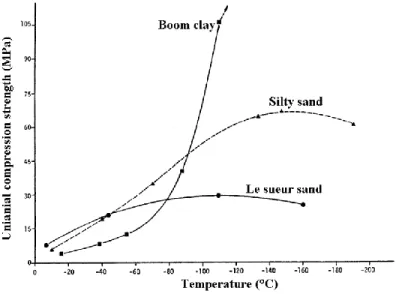
The mechanical properties of permafrost, such as shear strength, stiffness and compression strength, are sensitive to its thermal state and long-term stability of embankments heavily relies on favorable ground thermal conditions. Some typical results of strength vs. temperature for different types of soils are shown in Figure 1.8.
The successful design of linear transportation infrastructure primarily relies on the long-term thermal stability of the underlying permafrost in permafrost environments (Doré and Zubeck, 2009).
Figure 1. 8: Influence of temperature and soil types on uniaxial compression strength of three typical soils (modified from Andersland and Ladanyi, 2004).
1.4.1 Methods based on wintertime convection to extract heat from embankments
Convective techniques are used to augment wintertime heat extraction to preserve permafrost underneath transportation embankments.
1.4.1.1 Air convection embankment (ACE)
The concept of ACE was first reported in Russia (Vinson et al., 1996), then tested and developed in several countries, such as USA (Alaska), Canada and China. ACE involves the use of a highly porous, poorly graded material with a low fine content to construct the main portion of the embankment (Goering, 2002, 2003, Cheng et al., 2008). During winter, the upper portion of the embankment is cooled by the cold air temperature. The temperature difference between the ACE layer surface and bottom induced unstable air density, which is the reason leading to pore air circulation in ACE layer (Figure 1.9). Natural convection can lead to heat transfer at a rate that may be more than an order of magnitude larger than conduction only. In summer, the air temperature is higher than ground/embankment temperature, no convection can occur as the air in the embankment remains denser and no air convection occurs (Goering, 2003). In those conditions, ACE layer plays the role of a thermal insulation barrier, due to the high porosity and low thermal conductivity (Goering, 2002). Both effects lead to larger wintertime cooling rate and less summertime warming rate.
Figure 1. 9: Schematic of wintertime pore air circulation in the ACE (Goering, 2003).
ACE is a good solution to decrease ground temperatures if competent rocks are available around the field site. Although ACE has a good potential to preserve permafrost, in some cases, it cannot stabilize it where a large amount of groundwater flow occurs in permafrost environments. The combination with other techniques, such as insulation, ventilation pipes, and thermosyphons, is a good solution to better stabilizae permafrost(e.g., M-Lepage et al., 2012). Based on previous research, the thermal effectiveness of ACE is closely related to the following factors:
Different boundary conditions (impermeable and permeable)
There are two types of boundaries: impermeable and permeable boundaries. The air-permeable boundary involves that the ambient air can directly enter the air convection embankment, whereas it cannot enter through the air – impermeable boundary. The selection of impermeable or permeable boundaries heavily depends on the actual conditions of boundaries. In terms of the road surface (asphalt or concrete) and ground surface, they are considered to be impermeable (e.g., Goering, 2002). For the side slope covered by snow, it can be regarded as permeable boundaries. The airflow speed in the snow is small and Darcy’s law can be used to characterize the airflow (Shimizu, 1970). The strength of air convection in snow layer also highly depends on the permeability, which closely relates to crystal size and density (Shimizu, 1970; Calonne et al., 2012; Zermatten et al., 2014). The relationship between permeability and crystal size, density can be estimated using a widely used empirical equation (Shimizu, 1970; Wu et al., 2005):
2 s)
0.0078
0.077exp(-K D (1.7)
where D and s are the mean diameter of snow particles and snow density, respectively. It is recommended
to place a geotextile layer on top of ACE layer to prevent small soil particles migration into the void, and the rock layer should be placed above the water table to prevent water from filling the voids. It is also highly
However, the open ACE cannot preserve “cold” air in ACE in summer, leading to a rapid warming of the layer. This is particularly the case when warm air is forced by wind to enter the ACE layer. One solution is to place a thin gravel layer on side slopes and to install ventilation pipes to connect ACE layer and the atmosphere (Jørgensen et al., 2008).
Size of stones
If the size of the stones is too small, it will be difficult for the cold air to flow in ACE, having a limited effect on the cooling capacity and maybe no cooling at all. The stone size is directly affecting the permeability of airflow and effective thermal conductivity. In general, the determination of permeability needs three parameters, such as porosity, size gradation, and effective particle diameterd10(Hazen, 1911). One of the common mathematical equations to relate permeability with the three parameters listed above is the Kozeny-Carman equation (Chapuis, 2004): 2 3 2 10 2 1 n n d f C K (1.8) where f is the specific surface. The constant C depends on the fluid properties and the geometry of the pore channels. For the arrangements of spheres of uniform size, 2
/ f
C is suggested to be 0.0056 (Côté et al.,
2011).
Fair et al. (1993) proposed the equation of permeability considering all the size gradations following the work of Poiseuille on hydraulic flow in materials, cited by Goering (2002):
a D P n n K 100 1 5 1 3 2 (1.9) where K, n, and Pare permeability, porosity, and the percentage of stone by weight held between adjacent stone limits, respectively. Da, are the geometric mean of stone size, and stone shape factor for irregular stone grain, respectively. The values of is shown in Table 1.1 (Goering, 2002).Table 1. 1: Values of shape factor, (Goering, 2002).
Shape of stone Shape factor Ration to spherical factor
Spherical 6.0 1.00
Rounded 6.1 1.02
Worn 6.4 1.07
Sharp 7.0 1.17
capacity (e.g., Goering and Kumar, 1999; Zhang et al., 2007). Since uniform stone size assures maximum permeability, the stones used should have a similar particle size range, as much as possible. For practical engineering application, the ideal ACE is composed of 150-300 mm angular stones (McGregor et al., 2010), assuring a high voids ratio (voids vs. stones) and a better cooling rates during winter.
Thickness of rock layer
There are two very important parameters, Rayleigh number (Ra) and Nusselt number (Nu) to assess the strength of wintertime air convection. There is a criticalRa triggering the air convection in porous medium, described in Section 2.3. Since ACE does not have the same physical domain and thermal boundaries described above, air convection in ACE occurs at a lower Rayleigh number. In the field site, the critical Rayleigh number drops to as much as 20 or 13 (Saboundjian and Goering, 2003). Increasing ACE thickness provides a larger value ofRa, resulting in stronger natural convection to extract heat from permafrost underneath transportation infrastructure.
ACE configuration
In current practice, ACE has been used in three different configurations: interlayer or full-width ACE, ACE on side slopes, ACE on toes and U-shape ACE (Figure 1.10). ACE on side slopes is mostly used to cool the ground soil underneath the side slopes, considering the permafrost degradation usually first occurs around the toe of embankments due to the insulation of the snowpack. The overlying sand and gravel directly affect the efficiency of the interlayer ACE. U-shape ACE combines all the benefits of the two other configurations (M-Lepage, 2015). The required embankment thickness should be at least an order of 1.5 m to 2.0 m to obtain adequate wintertime heat extraction (Esch, 1996).
Figure 1. 10: Four ACE configurations.
ACE on side slopes Full ACE
ACE on toes U-shape ACE
1.4.1.2 Air duct system
The thermal conductivity of snow is relatively low, compared to that of the soil. Air duct systems (Figure 1.11a) placed in the embankment shoulders, have been used to generate natural convection and promote ground cooling to counteract the insulation of snow cover. In winter, airflow is induced by the temperature difference and air circulation facilitates heat extraction from the ground. In summer, the air inlets and outlets need to be closed to prevent warm air from flowing into the system and warming the surrounding ground. Researches on air duct systems have been carried out as early as the 1980s. Both field experiments at Bonanza Creek (Esch, 1983) and on Alaska Highway near Northway (Zarling et al., 1988) indicate that a bigger diameter seems to have a better heat extraction capacity, and both reduced lateral spreading and cracking problems, but without eliminating those. A more recent experimental test site was constructed at Beaver Creek, Yukon in 2008. The embankment with air duct system has a thickness of about 6.0 m and a length of 54 m. The diameter of the pipes is 0.75 m, and it has a longitudinal length of 18 m and is buried underneath the shoulder. One end of the culvert section is connected to an air inlet buried perpendicular to the embankment alignment towards the toe of the slope, and to the vertical air outlet placed in the shoulder about 2.0 m above the pavement surface. The temperature data collected at the test site from 2008 to 2011 indicates that air duct system has elevated the permafrost table by between 1 and 3 m (Coulombe et al., 2012). It has proven to be one of the most effective techniques used in Beaver Creek (M-Lepage, 2015; Doré et al., 2016).
Airflow is due to the pressure gradient generated by the temperature difference between the air in the longitudinal section of the culvert and the air at the outlet. The net pressure is balanced by velocity pressure and frictional pressure. The velocity is expressed as (Zarling, 1984):
2 1 0 0 )/( ) ( ) / 1 /( 4gh fLe D T Ti T Ti V (1.10)where V, D andLe are average air velocity, inside duct diameter and equivalent length of duct, respectively. 0
T ,Ti,fare outside temperature, inside temperature, and Darcy-Weisbach friction factor respectively. h, g are stack height and gravity acceleration, respectively. Based on the Equation (1.10), several main factors affecting the velocity of air flow are listed:
Duct diameter – The larger diameter decreases the average airspeed, however, it increases the cross section area, which allows more air flow inside the system. Ducts as large as 1.0 to 1.5 m in diameter would have the best useful life cycle and would resist plugging by snow, water or ice (Esch, 1996).
Stack height - A taller stack will increase the chimney effect pressure difference, resulting in greater air flow, which was confirmed by field experiments (Zarling et al., 1984)
Smoothness of air duct inner wall - The airspeed can increase with surface smoothness. For airflow with low velocity, laminar flow dominates.
Another type of ventilation ducts used is the horizontal air ducts transversely embedded in the embankment (Figure 1.11b). This design configuration along Qinghai-Tibet railway takes advantage of the local windy environment. The yearly average wind velocity is about 4.0 m/s with wintertime wind speed much stronger than summertime wind speed (Qin and Zhang, 2013). Both field observations and simulations indicate that air duct system has a great capacity to decrease soil temperatures. Cheng et al. (2008) indicate that the cooling capacity of the air duct system enabled permafrost table to move up close to where the original ground surface used to be. Based on numerical modeling, Lai et al. (2004) indicate that air ducts with 0.4 m diameter and 2.0 m spacing and placed 1.0 m above the natural ground, could compensate the 2.0 °C effect of global warming, and maintain permafrost stability for the next 50 years.
Figure 1. 11: Air duct systems (a) used along Alaska Highway in North America; (b) used along Qinghai-Tibet railway in China.
1.4.1.3 Heat drain
Heat drain, an innovative technique, is proposed by Pavement Engineering Research Group of Laval University in the early 2000s. It uses a 25 mm thick geocomposite with high permeability made of the corrugated plastic core covered on both sides by geotextile (Figure 1.12a). The main purpose of this technique is to promote the winter-time heat extraction in winter by providing one airflow channel in the embankment. The system involves a flat section (2% slope) to collect heat from the ground and a steeper section (45° slope) to create a chimney effect in the drain (Doré et al., 2016) (Figure 1.12b). Heat drain can be placed in the embankment shoulder or underneath the full embankment width. Inlet and outlet pipes are connected to the geocomposite to enable cold air flow into and warm air flow out of the heat drain system in winter.
Figure 1. 12: heat drain; a) 25 mm-thick heat drain made of a corrugated plastic core covered by geotextile (Beaulac, 2006); b) Schematic diagram in the shoulder of embankments (Jørgensen et al., 2008).
Field experiments, lab experiments and numerical simulations were carried to test the heat extraction capacity and all the results show that heat drain has a good potential to decrease soil temperatures (Beaulac and Doré, 2006; Jørgensen et al., 2008; Chataigner et al., 2009). Chataigner et al. (2009) carried out 2D numerical simulations for an embankment with heat drain placed in the side slope. The air temperature of -35 °C, bottom temperature of 0 °C and a constant thermal conductivity of k=1.98 W/m-K, were used in the model. Sensitivity analyses were carried out to determine the effect of specific parameters on the thermal effectiveness. The numerical result shows that heat extraction capacity had a close relationship with length, inclination angle, thickness of heat drain and the temperature difference between sub-grade soils and external air temperature. The maximum thickness commercially available (25 mm) appears to be optimal for drain performance, and that thickness is typically used in engineering applications of the heat drain.
The first field application was in 2007 at Tasiuaq airstrip, Northern Quebec (Figure 1.13) with a 50 m long section. The measured data shows that heat drain decreased the ground temperatures both in summer and winter, and raised permafrost table (Jørgensen, 2009). A larger scale application (about 933 m) was carried
a)
Figure 1. 13: Installing heat drain in the shoulder of Tasiujaq airstrip, Northern Quebec, Canada.
Figure 1. 14: Installing heat drain in the shoulder of the embankment at Salluit, Northern Quebec, Canada. 1.4.1.4 Thermosyphons
Thermal conduction, convection, condensation and evaporation, are heat exchange processes used in thermosyphons. It consists of a sealed, fluid-filled tube with an upper part above the ground working as a condenser and a buried part in the ground functioning as an evaporator, utilizing the phase changes of a single fluid/gas system inside the tube. Refrigeration gas typically used are ammonia, carbon dioxide, propane in liquid and gas phase, and different working fluids have different heats of vaporization, vapor, liquid density and liquid thermal properties. The carbon dioxide (CO2) is the most commonly used working fluid, due to its low
work when the ground temperature is at least 1 °C higher than air temperature allowing the refrigeration liquid to boil and change into gas, leading to evaporation in the upper part of the pipe that extends out of the ground and bringing heat along (Calmels et al., 2016). Then, the gas condenses due to the lower air temperature and flows by gravity down into the pipe (Figure 1.15) and, the cycle is repeated. Thermosyphons are dormant when the air temperature is higher than the ground temperature. The radiator should be placed high enough above the snow thickness to take advantage of winter wind. To limit the summertime thawing, it is recommended to combine thermosyphons with an insulation technique (Esch, 1996). There are four types of thermosyphons available, including vertical, sloped, flat-looped thermosyphons and thermopile (Figure 1.16). For the sloped thermosyphons, the inclination of the evaporator pipe should be at least 6% downward near the base of the embankment to facilitate the fluid flow. The evaporator pipe sections should be ideally a little above the top of the underlying permafrost table in the compacted sand or a gravel pad, to help provide thermal effectiveness to raise permafrost table and avoid the difficulty of installing evaporator in the permafrost layer as well (Esch, 1996). Thermosyphons have a limited influence distance, which is highly related to ground soil properties, and the lateral spacing between evaporator pipes should be less than twice the radial freezing distance (Esch, 1996).
Figure 1. 16: Four types of thermosyphons: a) Thermopile; b) Vertical; c) Sloped; d) Flat looped (Canadian Standards Association, 2014).
Thermosyphons have been studied since the 1950s and it has been wildly applied in Alaska and Canada (M-Lepage, 2015). The application of thermosyphons in China, Russia started in the 1970s (Wu et al., 2010) and 1990s (Popov et al., 2010), respectively. The best-known, largest installation of thermosyphons is the Trans-Alaska Pipeline (completed in 1977) with 124,300 units (Heuer, 1979). The locations of thermosyphons application until 2008, in Alaska, are shown in Figure 1.17. One downside part of thermosyphons is the high cost (typically $1500/unit, Beaulac and Doré, 2006), making it more suitable for severe localized problems (Calmels et al., 2016). In general, for infrastructures such as airports and railways where tolerance for thaw settlement is low, thermosyphons and hairpin thermosyphons maybe one good solution to stabilize embankments (McGregor et al., 2010). To reduce the cost, it is recommended to maximize the length of the evaporator pipe sections (Esch, 1996). The security of road users and aircraft can be affected by the presence of condensers along the infrastructure. A solution is to bury this part underneath the embankment surface using hairpin thermosyphons (McGregor et al., 2010) (Figure 1.18).
a)
b)
Figure 1. 17: Installation of thermosyphons by Arctic Foundation Inc in Alaska (Wagner, 2014).
Figure 1. 18: Hairpin thermosyphons (McGregor et al., 2010).
1.4.2 Methods based on reducing heat intake underneath embankments
Solar radiation acting on embankments is one of the main factors causing permafrost degradation (Doré and Zubeck, 2009). These techniques aim to impede the heat transfer through the embankment core, pavement surface and sides slopes and thus reduce the risk of degradation.
1.4.2.1 Insulation
The purpose of insulation is to protect the top part of permafrost (Doré and Zubeck, 2009). The plastic insulation was first initiated in the 1960s by Dow Chemical Company (Esch, 1996). This technique takes advantage of the low thermal conductivity of materials such as polystyrene with a value of 0.03 W/°C and polyurethane with a value of 0.0197 W/°C. It is mainly used to reduce heat intake in summer, while it also impedes heat flowing out of the foundation in winter (Figure 1.19). In cold permafrost regions, reducing