Any correspondence concerning this service should be sent
to the repository administrator:
[email protected]
This is an author’s version published in:
http://oatao.univ-toulouse.fr/22746
Official URL
DOI :
https://doi.org/10.1145/3197091.3205838
Open Archive Toulouse Archive Ouverte
OATAO is an open access repository that collects the work of Toulouse
researchers and makes it freely available over the web where possible
To cite this version: Blasquez, Isabelle and Leblanc, Hervé A Guideline
to Teach Agile Requirements. (2018) In: 23rd ACM Annual Conference on
Innovation and Technology in Computer Science Education (ITiCSE 2018),
2 July 2018 - 4 July 2018 (Larcana, Cyprus).
A Guideline to Teach Agile Requirements
Isabelle Blasquez
Limoges University, France [email protected]
Hervé Leblanc
IRIT, Toulouse, France [email protected]
ABSTRACT
This paper presents a specific sequence of collaborative workshops dedicated to build a first version of a product backlog. This backlog is composed by user stories refined from a first idea of the product to develop.
KEYWORDS
Agile Requirements, Collaborative Workshops, User Stories
https://doi.org/10.1145/3197091.3205838
1 INTRODUCTION
In agile, like traditional software development, work begins by capturing customer requirements. The specification can also be seen as a process to bridge the gap from the business problem (why?) towards clear explanations about the solution to develop (what?). Providing relevant and unambiguous requirements specification is one of the biggest challenges in software engineering [1].
Agile methodologies (e.g. Scrum or Extreme Programming) pro-vide a process framework to develop products. However, they postu-late that an initial product backlog exists. Even if agile requirements engineering is a recent topic, a systematic literature review about agile requirements shows that skateholder and user involvement are critical success factor and collaboration and building a shared understanding of the user perspective are essential [8].
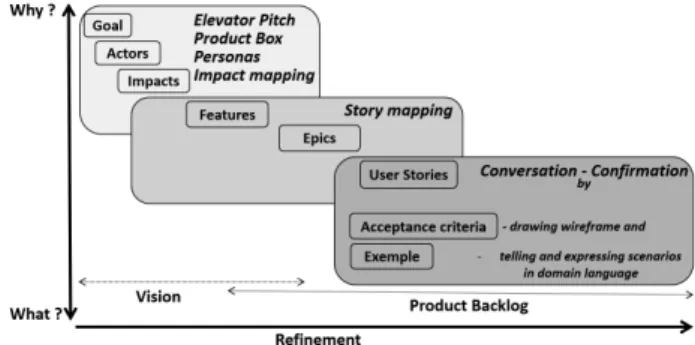
In the figure 1, we present a sequence of collaborative workshops to teach agile requirements from a product vision to relevant user stories describing the right product. First, we capture requirements in order to build a vision by discovering the problem and identifying first features of a solution which maximize customers benefits and value proposition. Second, we refine these features to epics and we begin to split into user stories. Third, we promote discussion around user stories to detail them, share common understandings and ensure domain language.
This sequence of collaborative workshops was presented and practiced during a 3-days course about agile requirements for a pro-fessional Bachelor dedicated to Development and Software Quality. The objective was not to write code, but to produce a prototype with Marvel1. Then, in the context of a supervised project in full agile development, team of 7 students proposed their own product ideas. Each team re-used these workshops to initialize their product backlog around one specific product idea during two days.
This sequence of workshops is based on our experience and inspired by Specification By Example [1] and User eXperience tech-niques. Each workshop will be briefly described according to its position in this sequence at the next section.
Figure 1: A guideline from vision to user stories
2
WORKSHOPS SEQUENCE
2.1
From goal to features
2.1.1 Elevator Pitch. An elevator pitch is a short summary used to quickly and simply define a product, service, or organization and its benefits to customers. It should be possible to deliver the summary in the time span of an elevator ride, or approximately 30 seconds to two minutes [5]. The workshop consists of exploring and sharing the product vision by collaboratively writing a summary based on the following template :
For . . . (the product’s target market)
Who/That . . . (describe what need your product solves) Our Product . . . (product name, or product category)
That Leads To . . . (main advantage, appealing reason for purchase) Unlike The . . . (principal competing alternatives)
Our Product Offers . . . (describe main differentiation)
At the end of the sequence, a new iteration of the elevator pitch can be requested. This new version generally shows that the vision of the project has been refined thanks to the next workshops that helps to better target the product goal and to better define the main features to develop.
2.1.2 Product Box. The Product Box is the next workshop used to refine and share the vision. The goal of the product box is to identifity the most exciting product features[6]. Each member of the team is asked to imagine that the product will be sold on store shelves or at a trade show, such as a product box. A blank white cardboard box is provided each team. The team must then imag-ine a name for the product, maketing slogans, pictures and some key arguments. They build boxes through materials (newspapers, stickers, color papers) or just by writing target phrases. Once the box is finished, each team presents their box to sell their product. A discussion is then initiated (who want to buy this box ? why ?) and the other teams give feedback on the product to improve its functionality and use.
2.1.3 Personas. Difficulties raised by students are in targeting the users and in indentifying the main purposes of the product. A reflect o n p ersonas c an h elp t hem t o refine th eir vi sion and then make effective design decisions. The notion of personas was intially proposed by [4]: they are defined as pretend users, not real people rather hypothetical archetypes of actual users whose behaviors, motivations and goals are close. Personas should also be discovered through an investigation phase. However, this phase is time-consuming and at first students are simply invited to imagine personas.
Such a workshop consists of creating more or less detailed cards that include name, picture, storytelling on the life of the character (behavior, skills, attitudes, environment) to make the personas a realistic character and identify the needs, objectives, expectations, and obstructions that could incite them or not to use this product.
2.1.4 Impact Mapping. Impact Mapping is a strategic plan-ning technique used to help teams align their activities with overall business objectives and make better roadmap decisions [2]. It is a graphic tool which allows clear marking of project’s measures and focusing only on necessary assumptions. The impact map is a four-level mindmap created collaboratively by answering the following questions: why, who, how and what. The why focuses on a business goal that should be SMART (Specific, Measurable, Attainable, Relevant, Time-Bases). The who depicts the actors (or personas) who contribute to achievie this goal. The how identifies the behaviors changes (impacts) on the actors to achieve the goal. The what is about deliverables to support the required impacts. It helps to outline the scope of the product through main features to develop.
Drawing an impact map is not easy, that is why this workshop is used (or not) as first iteration to make effective design decisions. As the scope is generally limited to features in the map, the story mapping will then help refine the features in user stories.
2.2
From features to user stories
Story Mapping is presented by [7] as an idea to use a simple map you can work with others to tell a product’s story and see the big picture form as you do. It is an approach to specifying, organizing and prioritizing user stories in a two-dimensional map. This artefact is product backlog which offers a product vision in releases. The high-level of horizontal axis represents a narrative flow where the activities performed by a user to illustrate the behaviour of the
system are first ordered. It is focus on users and their experience, as if you are telling the story about your user to someone else. Determining these major activities becomes quite easy if an impact mapping has been done previously. The activities are then decline into larger (epic) or smaller (user story) stories. An epic is a too large story that can’t be delivered within a single iteration. An epic can be split into smaller user stories, either during this workshop, either thereafter during backlog refinement sessions regularly conducted in the further development. The vertical axis group the stories in release to plan the development. The backlog is also prioritized such that the most valuable stories are highest.
The first horizontal row also represents a walking skeleton, a minimum set of user stories to implement to deliver a usable version of the product. Working through successive rows fleshes out the product with additional functionality.
2.3
User Stories
User stories are functional increments that add business value to the product. User stories are well-known as the 3 C’s model. As mentionned in [3], while the Card may contain the text of the story, the detail are worked out in the Conversation and recorded in the Confirmation. The Cards are written during the story mapping where they are filled with just enough text (like a title) to identify the requirement.
First, we focus on stories of the walking skeleton. To promote conversation, we first recommend to collaboratively drawn wiframes on the blackboard. This work consists in illustrating re-quirements using concrete examples to clarify meaning. It allows a shared understanding, a needs alignment, a first identification of acceptance criteria of a story and sometimes the discovery of new user stories.
To be unambiguous, a good specification should be precise and testable. To be useful, it should be self-explanatory, focused, and in domain language. Afterwards, to refine details about the con-firmation of a story, it is possible from previous wireframes to tell, in domain language, precise examples of scenarios of a story. Each example can then be written using a formalism based on the Gherkin language which helps to break down it in 3 steps and al-lows express an example as an acceptance test with a Given step (to install some initial context), a When step (to describe an occured event) and a Then step (to ensure some outcomes). This formalism leaves the opportunity to automate (or not) these acceptances tests during the development.
REFERENCES
[1] Gojko Adzic. 2011. Specification by Example: How Successful Teams Deliver the Right Software. Manning Publications Co., Greenwich, CT, USA.
[2] Gojko Adzic and Marjory Bisset. 2012. Impact Mapping: Making a Big Impact with Software Products and Projects. Provoking Thoughts.
[3] Mike Cohn. 2004. User Stories Applied: For Agile Software Development. Addison Wesley Longman Publishing Co., Inc., Redwood City, CA, USA.
[4] Alan Cooper. 1999. The Inmates Are Running the Asylum. Macmillan Publishing Co., Inc., Indianapolis, IN, USA.
[5] E. Eka. 2014. Start Me Up!: The No-Business-Plan Business Plan. Career Press. [6] Luke Hohmann. 2006. Innovation Games: Creating Breakthrough Products Through
Collaborative Play. Addison-Wesley Professional.
[7] Jeff Patton and Peter Economy. 2014. User Story Mapping: Discover the Whole Story, Build the Right Product (1st ed.). O’Reilly Media, Inc.
[8] Eva-Maria Schon, Jorg Thomaschewski, and Maria Jose Escalona. 2017. Agile Requirements Engineering: A systematic literature review. Computer Standards and Interfaces 49 (2017), 79 – 91. https://doi.org/10.1016/j.csi.2016.08.011