To link to this article : DOI : 10.1007/s11192-015-1562-1 URL : http://dx.doi.org/10.1007/s11192-015-1562-1
To cite this version : Hartley, James and Cabanac, Guillaume An academic odyssey: Writing over time. (2015) Scientometrics, vol. 103 (n° 3). pp. 1073-1082. ISSN 0138-9130
O
pen
A
rchive
T
OULOUSE
A
rchive
O
uverte (
OATAO
)
OATAO is an open access repository that collects the work of Toulouse researchers and makes it freely available over the web where possible.
This is an author-deposited version published in : http://oatao.univ-toulouse.fr/ Eprints ID : 16834
Any correspondence concerning this service should be sent to the repository administrator: [email protected]
An academic odyssey: Writing over time
James Hartley · Guillaume Cabanac
Abstract In this paper we present and discuss the results of six enquiries into the first author’s academic writing over the last 50 years. Our aim is to assess whether or not his academic writing style has changed with age, experience, and cognitive decline. The results of these studies suggest that the readability of textbook chapters written by Hartley has remained fairly stable for over 50 years, with the later chapters becoming easier to read. The format of the titles used for chapters and papers has also remained much the same, with an increase in the use of titles written in the form of questions. It also appears that the format of the chosen titles had no effect on citation rates, but that papers that obtained the highest citation rates were written with colleagues rather by Hartley alone. Finally it is observed that Hartley’s publication rate has remained much the same for over fifty years but that this has been achieved at the expense of other academic activities.
Keywords Academic writing · Productivity · Ageing · Longitudinal study · Writing style
Introduction
There have been several studies of writing in old age — both that of academics and that of other types of writers. Most academic studies are cross-sectional, that is they compare bodies of writers at different ages (e.g., see Pennebaker & Stone, 2003). Others focus on writing at a particular age (e.g., Skinner, 1983; Sommer, 2014). Others are longitudinal (e.g., Hartley, Howe, & McKeachie, 2001; Todorovsky, 1997, 2014) — but these are much rarer. Cross-sectional studies require the readers to assume that the different age-groups are similar in every respect — except age — but this of course is unlikely. Age-specific studies are biographical and provide case-histories at a particular point in time. Longitudinal studies compare the same writers at different ages, but here the readers have to assume that the only thing that changes in their samples is their age. Few longitudinal studies mention other
J. Hartley
School of Psychology, Keele University, Staffordshire, United Kingdom ST5 5BG E-mail: [email protected]
G. Cabanac
Computer Science Department, IRIT UMR 5505 CNRS, University of Toulouse, France E-mail: [email protected]
changes in, for example, life-styles, or even the tools that writers use to write over time — from pen/pencil to typewriter, word-processor and, for example, voice-activated computers (but seeHartley, Sotto, & Pennebaker,2003).
These studies differ in other respects too. Some researchers focus on using statistical packages to analyse the use of various grammatical features over time, as well as particu-lar kinds of words (e.g. emotional, cognitive, personal: e.g., seeGraesser, McNamara, & Kulikowich,2011;Markowitz & Hancock,2014;Pennebaker,2013) whereas others, using simpler methods, look at topics such as word and sentence lengths, and readability (e.g.,
Hartley et al.,2001). Other authors have used such tools in forensic studies to see if the authorship of a document is consistent, and whether or not different texts (or parts of texts) attributed to one author were actually written by someone else (see, e.g.,Boyd & Pennebaker,
in press;Labbé,2007;Savoy,2012).
In this paper we seek to assess whether a single academic author’s writing style has remained much the same or changed over a period of fifty years (see“Lifetime Achievement Award: James Hartley”,2014). Why, might we ask, should the writing styles of academics change over time? Well, improvements with practice over time may make writers more efficient, and learning from experience might lead to more effective writing. Writers might benefit from observing excellent practice elsewhere — and trying to copy it. Different formats for titles, abstracts, introductions and discussions may be tried and tested, leading to a change or bias in one way of writing or another.
In this paper we report six studies which raise questions such as these about writing over time by the first author of this paper:
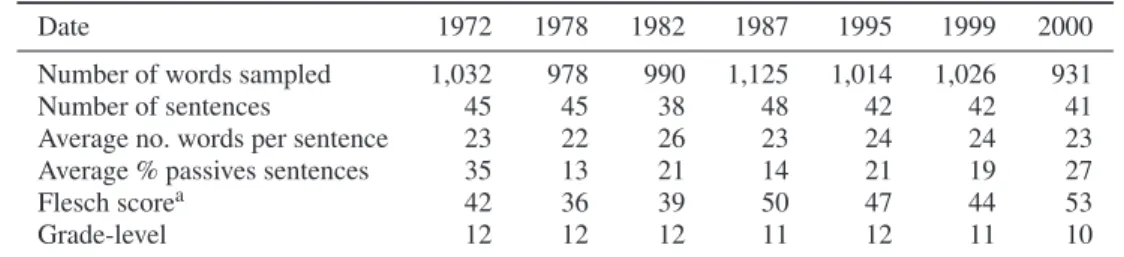
• InStudy 1 Hartley et al.(2001) were interested in the readability of texts produced by three different authors over the time-period 1972–2000. They showed that each author differed from each other, but that there were few changes in their individual writing styles over time — as measured byFlesch(1948) readability scores. Table1shows some of the data provided by Hartley et al.
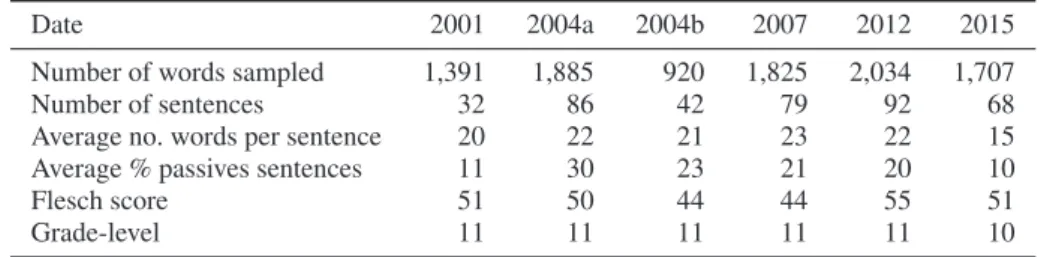
• InStudy 2we replicated these studies by examining the readability of book chapters written by the first author over the last ten years. Our aim was to see if the data reflected any progress in his desire to make his book chapters easier to read. Table2shows some success in this respect.
• InStudy 3we examined the styles of titles written by the first author and listed in his current short curriculum vitae.1Here we looked to see if there were different patterns in the use of question marks and colons for book chapter titles, and the titles of academic articles over a period of fifty years. We found an increase in the use of titles with question marks in the last 25 years. A larger use of question marks is also apparent in the author’s recent blogs.
• InStudy 4we examined whether or not the first author’s articles that contained colons and question marks in their titles were cited more or less often than were those titles that were written in grammatically simpler text. Here we found an increase in the numbers of question marks and colons in the titles of more recent papers, but that this was not reflected in citation rates.
1 This ‘short curriculum vitae’ lists Hartley’s major publications (for the sake of convenience). It includes,
for example, only 5 of his 23 publications with undergraduates (seeHartley,2014a), and short notes, letters, etc. are not included.
• InStudy 5we looked to see if articles written with colleagues were cited more than articles written by Hartley alone. Here there was a significant difference in this respect for the most highly cited 20 papers, but no significant differences between them when a larger sample was used.
• InStudy 6we examined Hartley’s output to see if it was maintained over the years or whether or not there were changes in this respect. We found that there were no changes in the rate of output over time, but this was achieved by reducing other activities.
Study 1. Writing over time
In this study Hartley, Howe, and McKeachie first illustrated how the methods they used to write had changed dramatically over a thirty-year time period (Hartley et al.,2001). In Hartley’s case, he progressed from writing drafts in longhand, to having different versions first typed by secretaries and then word-processed by them until he finally word-processed them himself. Currently he writes, edits, and revises each of numerous drafts simultaneously, using word-processing software. His colleagues, Howe and McKeachie, similarly changed their ways of writing over time, and indeed McKeachie dictated some of his speeches for a part of this period.
Table1shows an extract from the data obtained. These data showed the results obtained in term of readability scores for seven book chapters written by Hartley over a period of approximately 30 years. It can be seen that the scores vary very little, despite the considerable changes in the ways that they were written.
Table 1 Readability statistics for book chapters written by James Hartley from 1972–2000
Date 1972 1978 1982 1987 1995 1999 2000 Number of words sampled 1,032 978 990 1,125 1,014 1,026 931 Number of sentences 45 45 38 48 42 42 41 Average no. words per sentence 23 22 26 23 24 24 23 Average % passives sentences 35 13 21 14 21 19 27 Flesch scorea 42 36 39 50 47 44 53
Grade-level 12 12 12 11 12 11 10
aFlesch scores range from 0 to 100. The higher the score the more readable the text (seeFlesch,1948). Scores
below 30 are deemed ‘very difficult to read’ and are typical in academic text. Similar data are presented for two other colleagues inHartley et al.(2001).
Study 2. Revisiting Study 1
InStudy 2we wished to bring the findings of Study 1up to date. Not only had Hartley continued to write book chapters but he had become more aware from the earlier results of the need to make them easier to read.
In this study we report the results for six book chapters published between 2002 and 2015, using the same format as that used in Table1. The readability measures shown in Table2
indicate that, on the whole, these later chapters are easier to read than the earlier ones. Indeed, the median Flesch score for early chapters is 44.0 compared to 50.5 for the later chapters.
Table 2 Readability statistics for book chapters written by James Hartley from 2001–2014
Date 2001 2004a 2004b 2007 2012 2015 Number of words sampled 1,391 1,885 920 1,825 2,034 1,707 Number of sentences 32 86 42 79 92 68 Average no. words per sentence 20 22 21 23 22 15 Average % passives sentences 11 30 23 21 20 10
Flesch score 51 50 44 44 55 51
Grade-level 11 11 11 11 11 10
Study 3. Did the forms of title chosen for publications differ over time?
Titles come in many different forms (seeHartley,2008, for 13 types). The three most common are:
• a simple sentence (Titles come in many different forms) • titles with colons (Titles with colons: three different ways), and • titles with question marks (How many types of titles are there?).
In Study 3 we were interested to see if there had been any changes in the types of titles that Hartley had used over time. To answer this question we examined the titles of publications listed in Hartley’s short curriculum vitae from 1964. First of all we counted the number of colons and the number of question marks used in book chapters and articles (Table3). These data show that there were no differences in the use of titles with colons or question marks for book chapters, but that colons were used more than question marks in the titles of articles. Yet, there was no significant association between the type of publication and the form of title, χ2(1,N= 60) = 1.50,p= 0.22.
Table 3 Number of titles with colons and question marks in Hartley’s book chapters and articles
Number of titles with. . . Type colons question marks Chapters 5 5
Articles 35 15
The above results were obtained using data from the first author’s short curriculum vitae. The next question we asked was ‘Were there any differences over time?’ Here we re-analysed these data in terms of a 50:50 split — in order to compare titles written during 1965–1990 with those written during 1991–2014 (see Table4). There was a significant relation between the time periods and the use of colons and question marks in titles, χ2(1,N= 60) = 4.54,p= 0.03. The results suggest that Hartley changed over time to using more titles with question marks in his publications.
Finally, we looked at the format of the titles used by Hartley in his recent interest in writing academic blogs. Here he published 11 blogs between 2012 and 2015. Five of these had titles with question marks, 1 used two question marks, 1 used a question mark and a colon, 2 used colons, and 2 were simple sentences. So simplifying, there were 7 titles with question marks, 3 with a colon, and 2 simple sentences. It appears then that Hartley used more titles written with question marks in his blogs than he did in his more standard publications. However, titles with question marks are more common in this genre.
Table 4 Number of titles with colons and question marks in Hartley’s book chapters and articles over time
Number of titles with. . . Years colons question marks 1965–1990 17 3 1991–2014 23 17
Study 4. Did the format of a title influence an article’s citation rate?
Next, we looked to see if the format of the title of an article influenced its citation rate. Here we examined the titles of articles and their citation rates provided by Google Scholar for the first author.2Being aware of the issues raised about this inappropriate data source (Jacsó,
2010), we manually checked each record and discarded inappropriate ones. We recorded the format of the title for the top 100 cited publications. In this sample of 100 titles, the most cited title had been cited 267 times and the lowest 8. We then looked at the format of these titles in terms of question marks, colons, and simple sentences. Table5shows the results.
Table 5 The medians (and ranges) of the citation rates for three different types of title (from a sample of 100 chapters and papers)
Simple sentences Titles with colons Titles with question marks
Median 18 21 23
Range 8–211 8–267 8–59
N 45 40 15
These data show that only 15% of the titles were written in the form of questions, and that titles with colons or simple sentence titles were roughly equal in terms of their number (about 43%). Furthermore, for all three types of title, there were large ranges in terms of their citations rates, with the exception of titles with question marks. The data are so widely spread that it is safe to report that there were no statistically significant differences between the citation rates of Hartley’s papers using these three types of title. This conclusion replicates that found in earlier studies (seeHartley,2007). Other studies of colonic usage, using larger databases have, however, found more varied results. The use of colons in titles seems to be more discipline based than was thought to be the case — there being more colonic titles in the medical sciences than in engineering and technology (Hartley,2014b;Lewison & Hartley,
2005).Buter and van Raan(2011) for instance, also reported that hyphens and colons were common in some disciplines and that including them correlated positively with impact — and they advised authors to stick to their disciplinary practices.
Study 5. Are articles written with colleagues cited more than single-authored ones? There is some debate in the literature over whether or not articles written with colleagues get cited more than articles written alone (Abrizah et al.,2014;Didegah & Thelwall,2013;
Gazni & Thelwall,2014). In this study it was possible to examine this question using data
from Google Scholar again to compare the citation rates for articles written by Hartley and colleagues with those written by Hartley alone.
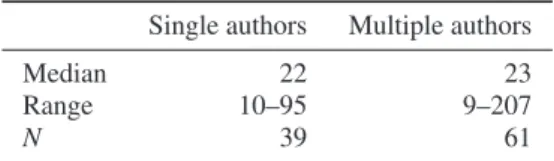
One problem with citation data, of course, is that they are influenced by the date of publication: citation rates are usually higher, the older the article. In this study we examined the citation rates for the most highly cited 100 articles in Google Scholar according to whether or not they were written by a single author (Hartley) or with other(s). Table6shows the data we obtained.
Table 6 The median citation rates for 39 single-authored and 61 multi-authored articles
Single authors Multiple authors
Median 22 23
Range 10–95 9–207
N 39 61
These results offer no support for the notion that jointly-authored papers are cited more frequently that single authored ones. However, further inspection of the raw data suggested that there was a difference between the citation rates for single and multi-authored papers when the most-highly cited papers were compared. Table7shows the results obtained for the top ten papers in each group.
Table 7 The median citation rates for the top ten single-authored and multi-authored articles
Single authors Multiple authors
Median 56 130
Range 34–95 68–207
N 10 10
These latter data do show some support for the notion that papers with multiple authors are cited more than singly-authored papers, U = 15.5,p= 0.001 (the titles of these papers and their citation rates are presented in theAppendix).
The data thus confirm the earlier findings showing that multi-author papers may be cited more than single-authored ones. But, we note in passing, that exactly what is meant by collaboration, and how it is measured, are actually complex matters (Laudel,2002). It is not clear to us, for example, just how the single-authored papers differ in content from the multiple-authored ones. It is also possible that the journals in which these papers are published may be an important factor.
Study 6. Declining over time
Finally, it is to be expected that publication rates will decline over time as writers get older. Other things have to be taken into account. Consider the following two quotations from a study on academic writing in old age (Hartley,2012):
“I’ve been lucky to have kept reasonably fit. But my energy now (as I approach 90) is fading. In the first 20 years of retirement I published 20 journal papers, 4 books and 11 book chapters. Now I am content to have just one job a year.”
“I am better able to devote large blocks of time to writing. But probably, also a little slower, physically, and possibly, mentally.”
Table 8 presents some data in this respect by examining the numbers of Hartley’s publications over five ten-year periods.
Table 8 The number of publication in 10 year periods (data from short curriculum vitae)
Publication 1965–1974 1975–1984 1985–1994 1995–2004 2005–2015
Books 2 6 5 4 0
Book chapters 2 8 5 10 4
Journal articles 8 19 18 26 23
Blogs – – – – 11
These data suggest that numbers of books and chapters produced over time are perhaps slowing down, but that the publication rates for articles have been maintained. What the studies in this table do not show is that Hartley’s productivity has been maintained whilst
other activities have been abandoned(e.g., teaching, administration, examining, presenting at and attending conferences, supervising dissertations, etc.). Thus whilst one activity (writing) has been sustained, others have been reduced or abandoned altogether. Basically these ideas support the views ofHess(2014), who argues that, relative to younger adults, older ones become more sensitive to the contexts of performance and more selective in their allocation of cognitive resources. As Hess puts it:
“For the most part, selective engagement may be viewed as an adaptive process, as older adults adjust their levels of participation to be in line with the costs of such engagement and to conserve resources to maximize performance in the most personally relevant situations.” (Hess,2014, p. 401)
Hartley has conserved his enthusiasm for academic writing whilst at the same time reducing his interest in several other academic pursuits.
Summary
In this paper we have looked to see if there have been changes in the writing style of the first author over a period of 50 years. In brief it appears that:
1. The readability of Hartley’s book chapters (as measured by the Flesch Reading Ease score) has remained remarkably similar for over fifty years, but there is a suggestion that they have got easier to read in the latter years.
2. The format of the titles used for chapters and articles initially remained much the same for the earlier period but, following his wish to make the text easier to read, the use of titles with question marks increased in the latter period.
3. The format of the titles used for books, chapters, and articles had no significant effect on their citation rates.
4. Hartley’s papers with higher citations were written with colleagues and have been cited more frequently than similar papers written by Hartley alone: for less highly cited papers there appears to be no significant difference in this respect.
5. Hartley’s publication rates — over 10 year periods — suggest that in the later years, the number of books and book chapters has declined but that the publication rates for articles has remained much the same.
6. This output has been maintained by cutting back on other competing activities in the last few years.
Acknowledgements We are grateful to two anonymous referees for helpful comments and suggestions, and particularly to the one who cast our data into graphical forms.
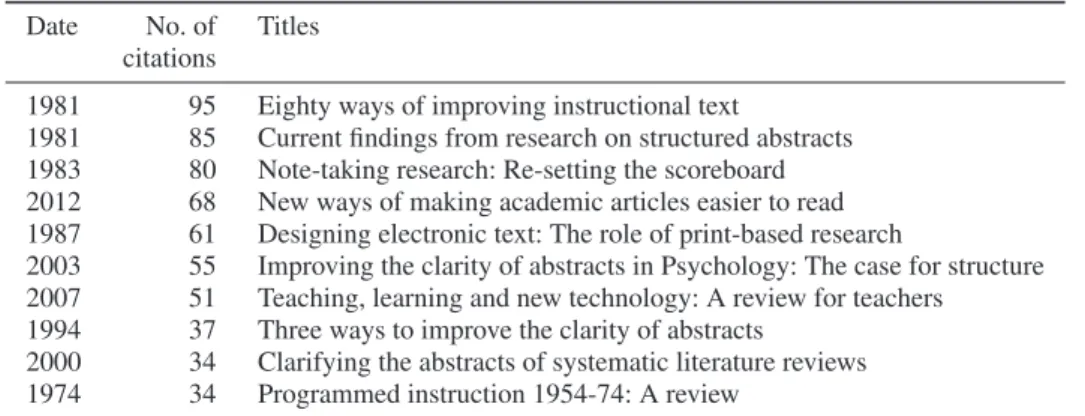
Appendix. Citation rates for single author and multiple authors Data from Table9and Table10were used inStudy 5.
Table 9 Citation rates for single-author papers (top 10)
Date No. of Titles citations
1981 95 Eighty ways of improving instructional text
1981 85 Current findings from research on structured abstracts 1983 80 Note-taking research: Re-setting the scoreboard 2012 68 New ways of making academic articles easier to read 1987 61 Designing electronic text: The role of print-based research
2003 55 Improving the clarity of abstracts in Psychology: The case for structure 2007 51 Teaching, learning and new technology: A review for teachers 1994 37 Three ways to improve the clarity of abstracts
2000 34 Clarifying the abstracts of systematic literature reviews 1974 34 Programmed instruction 1954-74: A review
Table 10 Citation rates for multi-author papers (top 10)
Date No. of No. of Position of Titles citations authors Hartley
1978 267 2 1 Note-taking: A critical review 1976 252 2 1 Pre-instructional strategies. . . 2005 211 5 4 Teachers’ beliefs and intentions. . . 2001 184 3 2 Response-format in writing. . . 1996 172 2 1 Time-management skills. . .
1967 88 2 1 . . . observations on the efficiency of lectures 1996 79 3 1 Obtaining information accurately. . . 1974 76 2 1 On notes and note-taking
1985 68 2 1 A research strategy for text designers. . . 1998 60 2 1 An evaluation of structured abstracts
References
Abrizah, A., Erfanmanesh, M., Rohani, V. A., Thelwall, M., Levitt, J. M., & Didegah, F. (2014). Sixty-four years of informetrics research: Productivity, impact and collaboration.
Scientometrics, 101(1), 569–585. doi: 10.1007/s11192-014-1390-8
Boyd, R. L., & Pennebaker, J. W. (in press). Did Shakespeare write Double Falsehood? Identifying an individual’s psychological signature with text analysis. Psychological
Science. (Paper available from the authors, University of Texas at Austin, USA) Buter, R. K., & van Raan, A. F. J. (2011). Non-alphanumeric characters in titles of scientific
publications: An analysis of their occurrence and correlation with citation impact. Journal
of Informetrics, 5(4), 608–617. doi: 10.1016/j.joi.2011.05.008
Didegah, F., & Thelwall, M. (2013). Which factors help authors produce the highest impact research? Collaboration, journal and document properties. Journal of Informetrics, 7(4), 861–873. doi: 10.1016/j.joi.2013.08.006
Flesch, R. (1948). A new readability yardstick. Journal of Applied Psychology, 32(3), 221–233. doi: 10.1037/h0057532
Gazni, A., & Thelwall, M. (2014). The long-term influence of collaboration on citation patterns. Research Evaluation, 23(3), 261–271. doi: 10.1093/reseval/rvu014
Graesser, A. C., McNamara, D. S., & Kulikowich, J. M. (2011). Coh-Metrix: Providing multilevel analyses of text characteristics. Educational Researcher, 40(5), 223–234. doi: 10.3102/0013189x11413260
Hartley, J. (2007). Planning that title: Practices and preferences for titles with colons in academic articles. Library & Information Science Research, 29(4), 553–568. doi: 10.1016/j.lisr.2007.05.002
Hartley, J. (2008). Academic writing and publishing: A practical handbook. Abingdon, UK: Routledge.
Hartley, J. (2012). To cite or not to cite: Author self-citations and the impact factor.
Scientometrics, 92(2), 313–317. doi: 10.1007/s11192-011-0568-6
Hartley, J. (2014a). Publishing with undergraduates. Psychology Teaching Review, 20(2), 158–160.
Hartley, J. (2014b). Titles are the hardest thing: How can we make them more effective. Retrieved from http://blogs.lse.ac.uk/impactofsocialsciences/ 2012/05/24/titles-are-hardest-more-effective (LSE Impact of So-cial Sciences Blog)
Hartley, J., Howe, M., & McKeachie, W. (2001). Writing through time: Longitudinal studies of the effects of new technology on writing. British Journal of Educational Technology,
32(2), 141–151. doi: 10.1111/1467-8535.00185
Hartley, J., Sotto, E., & Pennebaker, J. (2003). Speaking versus typing: A case-study of the effects of using voice-recognition software on academic correspondence. British Journal
of Educational Technology, 34(1), 5–16. doi: 10.1111/1467-8535.00300
Hess, T. M. (2014). Selective engagement of cognitive resources: Motivational influences on older adults’ cognitive functioning. Perspectives on Psychological Science, 9(4), 388–407. doi: 10.1177/1745691614527465
Jacsó, P. (2010). Metadata mega mess in Google Scholar. Online Information Review, 34(1), 175–191. doi: 10.1108/14684521011024191
Labbé, D. (2007). Experiments on authorship attribution by intertextual distance in English.
Journal of Quantitative Linguistics, 14(1), 33–80. doi: 10.1080/09296170600850601 Laudel, G. (2002). What do we measure by co-authorships? Research Evaluation, 11(1),
Lewison, G., & Hartley, J. (2005). What’s in a title? Numbers of words and the presence of colons. Scientometrics, 63(2), 341–356. doi: 10.1007/s11192-005-0216-0
Lifetime achievement award: James Hartley. (2014). The Psychologist, 27(8), 605.
Markowitz, D. M., & Hancock, J. T. (2014). Linguistic traces of a scientific fraud: The case of Diederik Stapel. PLoS ONE, 9(8), e105937. doi: 10.1371/journal.pone.0105937 Pennebaker, J. W. (2013). How authors’ forgettable words reveal their personality and social
behaviors. Information Design Journal, 20(3), 267–272. doi: 10.1075/idj.20.3.062pen Pennebaker, J. W., & Stone, L. D. (2003). Words of wisdom: Language use over the life
span. Journal of Personality and Social Psychology, 85(2), 291–301. doi: 10.1037/ 0022-3514.85.2.291
Savoy, J. (2012). Authorship attribution: A comparative study of three text corpora and three languages. Journal of Quantitative Linguistics, 19(2), 132–161. doi: 10.1080/ 09296174.2012.659003
Skinner, B. F. (1983). Intellectual self-management in old age. American Psychologist,
38(3), 239–244. doi: 10.1037/0003-066x.38.3.239
Sommer, R. (2014). My last journal article. (Unpublished manuscript available from the author, Dept. Psychology, University of California, Davis, CA 95616 8686)
Todorovsky, D. (1997). On the working time budget of the university teacher. Scientometrics,
40(1), 13–21. doi: 10.1007/BF02459259
Todorovsky, D. (2014). Follow-up study: On the working time budget of a university teacher. 45 years self-observation. Scientometrics, 101(3), 2063–2070. doi: 10.1007/ s11192-014-1284-9